Retro Television Review: Miami Vice 5.17 “Freefall”


Welcome to Retro Television Reviews, a feature where we review some of our favorite and least favorite shows of the past!  On Mondays, I will be reviewing Miami Vice, which ran on NBC from 1984 to 1989.  The entire show can be purchased on Prime!

This week, Crockett and Tubbs are burned out.

Episode 17 “Freefall”

(Dir by Russ Mayberry, originally aired on May 12th, 1989)

As this episode begins, we find Crockett and Tubbs at their most cynical.  After five years as partners, they’ve seen a lot of bad guys go down.  They’ve seen a lot of innocent people die.  Larry Zito was killed by drug dealers.  Switek has developed a gambling addiction.  Gina has shot numerous men in cold blood.  Trudy was kidnapped by aliens.  Castillo has never once smiled.  None of it seems to make any difference.

When the government approaches them and orders Crockett and Tubbs to go into a war-torn island country and smuggle out dictator General Manuel Borbon (Ian McShane), Crockett is not happy about the assignment.  Tubbs, however, believes that the government is telling the truth about Borbon having information that could take down the world’s biggest drug cartel.  The government, for their part, think that Crockett and Tubbs have the undercover experience to pull off the operation.  Has the government not noticed that Crockett and Tubbs have had their covers blown in nearly every episode?

Of course, it turns out that the government is lying.  They just wanted Borbon out of the country so he wouldn’t reveal what he knows about American intelligence’s activities in Central America.  Crockett and Tubbs manage to get Borbon to Miami but they then find themselves under constant attack from the drug gangs that want Borbon dead.  Borbon proves to be untrustworthy.  Because of his gambling addiction, Castillo suspects that Switek may have sold out his partners.  Switek responds by tracking down three hitmen and gunning them down.  Did Switek sell out Crockett and Tubbs?  The answer isn’t clear but it does seem like his time as a detective is coming to an end.

Finally, Tubbs and Crocket do what they have to do.  They go on a “suicide” mission that involves them firing their weapons at Borbon’s sea plane until it explodes.  Borbon is killed and so are several of his American associates.  When the CIA man in charge of the operation threatens to have their badges, Crockett and Tubbs toss their badges on the ground.  Castillo offers to back them up if they chose to stay on the force.  Tubbs says thanks but no thanks.  Tubbs is going back to New York.  Crockett is heading further south, presumably to live in the Florida everglades.

And so, Miami Vice ends.

Except it doesn’t!  There were four so-called “lost episodes” that aired in syndication.  We’ll take a look at them over the next four weeks.

As for Freefall, it’s not a terrible conclusion to the story of Crockett and Tubbs.  It stays true to the cynicism that ran though the entire series.  Crockett and Tubbs finally admit that the War on Drugs is a sham and they quit.  It’s a shame that Gina and Trudy didn’t get to do much in the finale.  I wasn’t happy with the idea of Switek being a traitor but it actually did work for his character.  Switek had been spiraling ever since Zito was killed.  This episode has a lot of surprisingly violent action, the show’s trademark political subtext, and Johnson and Thomas bringing their characters to life one last time.

Apparently, this episode was originally envisioned as ending with both Crockett and Tubbs dying.  That actually would have been a totally appropriate ending as both characters have often seemed as if they had a death wish.  However, the network turned down that idea because they were hoping to do a spin-off series.  Crockett and Tubbs were spared by the higher-ups.  The series ends — or it would end if not for the four extra episodes — with Crockett and Tubbs speeding through the streets of Miami and it’s had not to feel that’s the way it should be.


Film Review: Atlas Shrugged Part Three (dir by J. James Manera)


In 2014, the Atlas Shrugged trilogy came to a close with Atlas Shrugged Part III: Who Is John Galt?  As you can probably guess from the title, this is the movie that finally revealed the elusive character of John Galt.

Unfortunately, after all the time spent discussing the character over the past two movies, there’s really no way that the actual John Galt could possibly live up to all the hype.  John Galt, the man who stopped the motor of the world and who is the world’s greatest living engineer, turns out to be a sensitive lumberjack type who has founded his own scenic village in Galt’s Gulch.  He’s manly and handsome and chivalrous and he’s a bit dull.  Kristoffer Polaha, who plays the character, is a perfectly pleasant and likable actor but there’s nothing about his screen presence or his performance that suggests that he’s the man who has figured out how to save civilization from the regulatory state.  As a character, Galt works best as a literary creation, someone who the reader can imagine for themselves.  When seen on screen, he’s a bit of a letdown.

Taking over the role from Taylor Schilling and Samantha Mathis, Laura Regan plays Dagny Taggart as an overworked businesswoman who really needs a vacation.  (Of the three actresses who played the character, only Mathis was credible as the dynamic Dagny of Ayn Rand’s original novel.)  Having crashed her plane in the mountains at the end of the second film, Dagny is nursed back to health by John Galt and the inhabitants of Galt’s Gulch.  Dagny is shocked to discover that most of her old friends are now living in Galt’s Gulch.  As they explain, they’re on strike and they’re no longer going to serve a government that is looking to control and ultimately destroy them.  Unfortunately, the film presents Galt’s Gulch as being a bit of a dull place, one that is not even livened up the presence of pirate Ragnar Danneskold (Eric Allan Kramer).  It’s the type of place where Dagny can visit the local farmer’s market and recuperate in a taste-fully decorated bed and breakfast, all while falling in love with her hunky host.  If the first two Atlas Shrugged films now feel somewhat prophetic, the third one feels like a Libertarian-themed Hallmark movie.

Atlas Shrugged: Part III feels a bit rushed.  Apparently, no one from the cast and crew of either the first or the second film returned to work on Atlas Shrugged: Part III and it feels quite a bit different from the previous two films.  Whatever one may think of the way the first two films presented the effects of government regulation, they were effective because they specifically showed the consequences.  The audience actually saw two trains collide due to incompetent management.  The audience saw the government showing up and forcefully taking over Rearden Metal.  The third film relies on a narrator, one who tells us what happened instead of letting us see it with our own eyes.  We hear about a bridge collapsing but we don’t see it.  We hear about union thugs forcefully taking over a factory but we don’t see them.  We hear about out-of-control government bureaucrats but, as opposed to the first two films, we don’t really get to spend much time with them and, when we do, they’re far more cartoonish in their villainy than they were in the first two films.  John Galt does get to deliver his speech to the world but it’s in a truncated form and the film’s decision to then cut to Sean Hannity, Glenn Beck, and Ron Paul all praising the speech on television not only goes against the film’s depiction of a country where public dissent is suppressed but it also reminds the audience that the film’s outlook has more in common with Fox News than Ayn Rand.

As previously mentioned, the third film has a totally different cast from the first two films.  Greg Germann is enjoyably over-the-top as the unhinged James Taggart but, otherwise, the new cast fails to make much of an impression, with some of them only showing up for a few brief seconds before disappearing from the story.  Rob Morrow plays Hank Rearden but is only seen for less than a minute.  By sidelining one of the book’s most important characters, Atlas Shrugged: Part III also drops the whole storyline about Hank’s affair with Dagny.  While I guess that makes it easier for the film to then have Dagny and John Galt hook up, it still feels a bit unfair to the people who actually watched the entire trilogy.

Considering that both Parts I and II have improved with the passage of time, Part III is a rather disappointing ending for the trilogy.  Upon watching, John Galt would probably be disappointed but not surprised.

Playing Catch-Up With The Lesser Films of 2015: Get Hard, Paul Blart: Mall Cop 2, Pixels, The Wedding Ringer


SPOILER ALERT!

One or more of the films reviewed below will appear on my list of the 16 Worst Films of 2015!  Can you guess which one(s)?

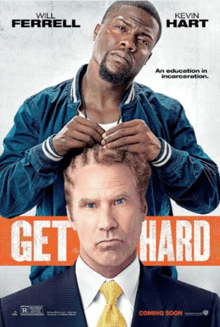
Get_Hard_film_poster

Get Hard (dir by Etan Cohen)

Will Ferrell is funny and Kevin Hart is funny and you would think that putting them together in one movie would be especially funny but … nope.  Get Hard, which I watched on HBO a few weeks ago, is incredibly not funny.  Ferrell plays a hedge fund manager who is convicted of fraud and embezzlement and it’s a sign of how haphazard this film is that I was never really sure whether he was supposed to be guilty or not.  Anyway, Ferrell is terrified of going to prison but fortunately, he runs into Kevin Hart.  Hart is playing the owner of a car wash here, a mild-mannered family man who simply wants to be able to afford to send his daughter to a good school.  However, Ferrell assumes that, since Hart is black, Hart must be an ex-con.

So, Ferrell hires Hart to teach him how to survive in prison and Hart agrees.  And, to be honest, this is not a terrible idea for an edgy satire but the film pulls it punches and never really exposes or challenges the racism that led to Ferrell hiring Hart in the first place.  Instead, it’s more interested in making homophobic jokes about prison rape (there’s a particularly long and unpleasant scene where Ferrell attempts to learn how to give a blow job that feels like it was lifted from a deservedly forgotten 90s film) and eventually, it devolves into a painfully predictable action film.

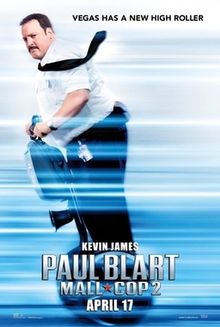
Paul_Blart_-_Mall_Cop_2_poster

Paul Blart: Mall Cop 2 (dir by Andy Fickman)

I know what someone out there is saying.

“YOU’VE NEVER EVEN SEEN THE FIRST PAUL BLART: MALL COP!!!  WHO THE HELL ARE YOU TO REVIEW THE SEQUEL!?”

Well, listen — it’s true.  I’ve never seen the first film and the only reason I watched the second one (on HBO at a friend’s house, which means that it literally cost me nothing) was because I had heard how terrible it was and I figured that I should see it before making out my list of the worst films of the year.  But, even with that in mind, I think I can still give this film a fair review.

(At the very least, I’ll try.  Dammit, I’ll try.)

Paul Blart: Mall Cop 2 is one of those films that is so forgettable that you forget about it while you’re watching.  Kevin James plays Paul Blart, a mall security guard who goes to Las Vegas for a security guard convention and ends up getting involved in thwarting a big heist.  It’s a comedy, though I can’t think of a single time I laughed.  Paul Blart: Mall Cop 2 was not quite the abomination that I had been led to expect.  It was, in no way, comparable to Birdemic, April Rain, or Man of Steel.  Instead, it was just an incredibly empty and soulless film.  It was a zombie movie that existed only to eat money.

One thing that is frustrating about a film like Paul Blart: Mall Cop 2 is that Kevin James seems like he could actually survive appearing in a good film, if he could just get a chance to make one.  He’s likable and he’s got an everyman quality about him.  But, for now, he seems to be trapped in films where he either plays Paul Blart or he’s surrounded by talking animals.

PixelsOfficialPoster

Pixels (dir by Chris Columbus)

Speaking of Kevin James, he’s also in Pixels!  He plays William Cooper.  When he was a kid, he was obsessed with playing video games.  Now that he’s an adult, he’s the President of the United States!  And he still keeps in contact with his best friend from childhood, Sam.  Sam, needless to say, will never be President.  When Sam was a kid, he was traumatized when he lost a national video game championship.  Now that he’s an adult, he installs home-theater systems and he’s played by Adam Sandler…

When Earth is invaded, it turns out that the aliens are under the impression that video games are real!  So, they recreate a bunch of classic video game characters and send them off to do havoc.  Who better to stop them than the President and Sam?  And who better to help than a nerdy conspiracy theorist (Josh Gad) and Eddie Planet (Peter Dinklage), the same guy who cheated in order to defeat Sam at the video game championship….

If you’re thinking that sounds like way too much plot for a silly comedy about video games coming to life, you’re right.  Pixels has some cute moments (though, based on the comments and occasional laughter of the middle-aged people in the theater around me, I get the feeling that a lot of the film’s video game-themed humor was a bit too “before my time” for me to fully appreciate) but oh my God, it was such an unnecessarily busy movie.  The idea behind Pixels had some potential but the film refused to take advantage of it.

I’ve said this before and I always get some strange looks but I honestly do think that — if he would actually break out of his comfort zone and stop doing movies that mostly seem to be about finding an excuse to hang out with his friends — Adam Sandler could be an acceptable dramatic actor.  Check out his work in Punch-Drunk Love, Funny People, Reign Over Me, Spanglish, and even the first half of The Cobbler.  (Tarantino even wrote the role of Donny Donowitz in Inglourious Basterds with Sandler in mind.)  The fact that Sandler could be doing good work makes his continual bad work all the more frustrating and annoying.

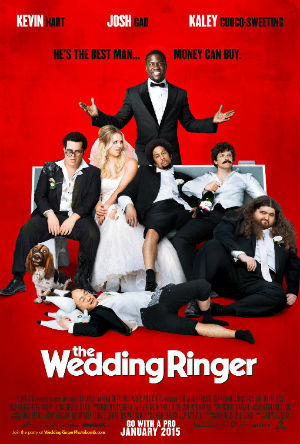
TheWeddingRingerPoster

The Wedding Ringer (dir by Jeremy Garelick)

And speaking of Josh Gad…he’s also in The Wedding Ringer!  For that matter, so is Kevin Hart.  Hart plays a guy who, for a sizable fee, will pretend to the lifelong best friend (and best man) for grooms who do not have enough real friends to fill out a wedding party.  Hart refuses to get emotionally involved with his clients but that all changes when, despite himself, he becomes friends with Josh Gad, who is on the verge of getting married to Kaley Cuoco.

The Wedding Ringer got terrible reviews but it also was very popular with audiences and I imagine a lot of that had to do with the relationship between Hart and Gad.  Both of them give very sincere performances that elevate some otherwise unpromising material.  The Wedding Ringer wasn’t good (it’s predictable, it’s portrayal of Kaley Cuoco’s character verges on misogynistic) but, at the same time, it wasn’t as bad as it was made out to be.  In the end, it was pretty much a typical January film.

I'm so excited!  I'm so excited!  I'm so ... wait a minute, am I just here because this is a post about bad movies?

I’m so excited! I’m so excited! I’m so … wait a minute, am I just here because this is a post about bad movies?

Which of these four films will make my list of the worst 16 films of 2015?  The answer shall be revealed soon!