My sister asked me to watch and review this one. I’ll have to remember to thank her for that.
A group of cheerleaders go to a cheerleading camp for the summer. In between all of the usual camp shenanigans, someone is killing the cheerleaders. Alison (Betsy Russell) seems like the likeliest suspect because she keeps having weird dreams and is really possessive of her unfaithful boyfriend, Brent (Leif Garrett). Is Alison the murderer or is she being set up? Cheerleading is a cut-throat business so anything is possible.
As a former cheerleader, there were a few scenes that I could relate to. Alison has the same nightmare that I used to have all through high school, where you show up for the game late, you have to put on your uniform in such a rush that you don’t even have time to put on a bra, and then you run out on the field and no one’s there. I had that dream a hundred times. And the movie was right about everyone making fun of the mascot. I felt bad for Cory (Lucinda Dickey).
Overall, the movie left me with some questions. The main one was whether or not these were supposed to be high school or college cheerleaders. Some of them looked really old to still be in high school. Brent had a receding hairline. I also wondered why there was a pervy fat guy on Alison’s cheerleading squad. There’s nothing wrong with male cheerleaders but I would not be comfortable with a male cheerleader who kept trying to see all of the other cheerleaders naked. Finally, I wondered how everyone at the camp could be so stupid. Why would anyone stay after the first dead body is found? I liked Alison but even I groaned when she picked up a bloody meat cleaver. Girl, that’s evidence! Don’t get your fingerprints on that! I also figured out who the murderer was after the first fifteen minutes. It was pretty obvious.
I enjoyed cheering but I’m glad I never went to that cheerleader camp. Most of the routines were awful and everyone ended up dead. It’s not worth it.
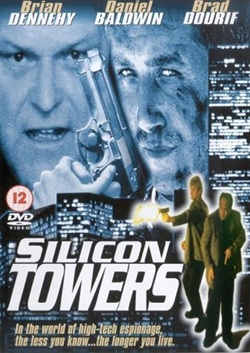
Charlie (Jonathan Quint) gets a promotion to an executive job at Silicon Towers. After his promotion, he is sent an encrypted email that reveals that the company is manufacturing computer chips that it can use to drain money from the banks and to control the world. Charlie goes on the run, jumping from roof to roof as he tries to avoid the company’s security team and reveal the truth. Brian Dennehy plays the evil CEO. Daniel Baldwin plays another executive. Brad Dourif plays a paranoid tech expert and steals the movie. Robert Guillaume is the police detective who is investigating the strange things that are happening around the company. Be sure to hum the Benson theme song while watching.
There was a lot of movies like SiliconTowers in the late 90s. The internet was still exotic and people were still convinced that technology was going to destroy us all on Y2K. SiliconTowers was not the only paranoid tech thriller to come out in 1999 but it might have been the most inept. Serge Rodnunsky made a lot of movies back in the day and never let a lack of a budget stand in his way but he also never seemed to understand the importance of being able to hear dialogue or smooth editing. There are some good actors in Silicon Towers. Good luck understanding what any of them are saying.
This film is mostly memorable for the scenes of Charlie “hacking.” Charlie writes his hacking code in HTML. That’s pretty much all you need to know.
John Carpenter has directed 18 features film, from 1974’s Dark Starto 2010’s The Ward. Some of his films have been huge box office successes. Some of his films, like The Thing, were box office flops that were later retroactive recognized as being classics. Carpenter has made mainstream films and he’s made cult favorites and, as he’s always the first to admit, he’s made a few films that just didn’t work. When it comes to evaluating his own work, Carpenter has always been one of the most honest directors around.
Amazingly, Carpenter has only directed one film that received an Oscar nomination.
That film was 1984’s Starman and the nomination was for Jeff Bridges, who was one of the five contenders for Best Actor. (The Oscar went to F. Murray Abraham for Amadeus.) Bridges played the title character, an alien who is sent to Earth to investigate the population and who takes on the form of the late husband of Jenny Hayden (Karen Allen). The Starman takes Jenny hostage, though its debatable whether or not he really understands what it means when he picks up her husband’s gun and points it at her. He and Jenny drive across the country, heading to Arizona so that he can return to his ship. Pursued by the government (represented by the sympathetic Charles Martin Smith and the far less sympathetic Richard Jaeckel), the Starman learns about emotions, eating, love, and more from Jenny. Jenny goes from being fearful of the Starman to loving him. Carpenter described the film as beingIt Happened One Night with an alien and it’s not a bad description.
After Jenny and the alien visitor make love in a boxcar, the Starman says, “I gave you a baby tonight,” and that would be an incredibly creepy line coming from a human but it’s oddly charming when uttered by an alien who looks like a youngish Jeff Bridges. Bridges definitely deserved his Oscar nomination for his role here. Speaking with an odd accent and moving like a bird who is searching for food, Bridges convincingly plays a being who is quickly learning how to be human. The Starman is constantly asking Jenny why she says, does, and feels certain things and it’s the sort of thing that would be annoying if not for the way that Bridges captures the Starman’s total innocence. He doesn’t mean to be a pest. He’s simply curious about everything.
Bridges deserved his nomination and I would say that Karen Allen deserved a nomination as well. In fact, it could be argued that Allen deserved a nomination even more than Bridges. It’s through Allen’s eyes that we see and eventually come to trust and then to love the Starman. Almost her entire performance is reactive but she makes those reactions compelling. I would say that Bridges and Allen deserved an Oscar for the “Yellow light …. go much faster” scene alone.
Carpenter agreed to make Starman because, believe it or not, The Thing had been such a critical and commercial flop that it had actually damaged his career. (If ever you need proof that its best to revisit even the films that don’t seem to work on first viewing, just consider Carpenter’s history of making films that were initially dismissed but later positively reevaluated. Today, The Thing, They Live, Prince of Darkness, and In The Mouth of Madness are all recognized as being brilliant films. When they were first released, they all got mixed reviews.) Carpenter did Starman because he wanted to show that he could do something other than grisly horror. Starman is one of Carpenter’s most heartfelt and heartwarming films. That said, it also features Carpenter’s trademark independent streak. Starman not only learns how to be human but, as a result of the government’s heavy-handed response to his arrival, one can only assume that he learns to be an anti-authoritarian as well.
Starman is one of Carpenter’s best films and also a wonderful showcase for both Karen Allen and Jeff Bridges.
The 1978 film, Killer’s Delight, opens with the usual beautiful shots of San Francisco in the 70s. It’s a lovely city, full of attractive people with their entire lives ahead of them. The camera lingers on the Golden Gate Bridge. If your movie doesn’t feature the Golden Gate Bridge, is it really set in San Francisco?
A van drives through the city and into the countryside. My first instinct was to think, “Oh, that’s definitely a rape van,” and yes, it is. (Seriously, don’t ever accept a ride from someone with a van. Actually, you shouldn’t be hitchhiking to begin with! Shame on you!) The owner of the van, Danny (John Karlen), pulls over to the side of the road and tosses a naked woman’s body over the side of a cliff.
AGCK!
Now, I have to admit that Killer’s Delight (which is known by about a dozen other titles, including The Dark Ride) is a film that I’ve tried to watch several times but I’ve always struggled to make it all the way through. That’s not because of the subject matter, though as a woman who once thought of herself as being invincible, I could certainly relate to many of the women who appeared in this film and made the fatal mistake of getting in that van. No, the reason why I’ve always struggled with Killer’s Delight is because it’s a slow movie. It’s not necessarily a bad film but it’s not one to watch if your eyelids are already starting to feel heavy.
This is an early serial killer film, made before it was decided that every killer should be portrayed as being an erudite and witty anti-hero. Instead, the film’s killer is a loser named Danny (John Karlen) who has never gotten over his childhood and who, when he’s not killing, is busy sobbing. It’s certainly a more realistic portrayal of a serial killer than anything that one might find in any of the films or books about Hannibal Lecter. Danny has two skills. He’s good at disguising himself and he’s fairly good at getting rid of bodies whenever there’s no one else around to see him. Otherwise, he’s a total loser. This realistic portrayal actually makes Danny into a very scary character. You’re never going to meet Hannibal Lecter in real life. That’s one reason why it’s so easy for some people to accept his crimes. However, there are hundreds of people just like Danny out there. There’s probably at least a few in your city right now.
The majority of the film is taken up with Sgt. Vince De Carlo (James Luisi) and his attempts to prove that Danny is the killer. Vince is married and very protective of his daughters. He’s also having an affair with a psychiatrist (Susan Sullivan) who runs the potential of becoming one of Danny’s victims. Vince becomes obsessed with Danny but, much like Charles Bronson in Ten To Midnight, he knows that the justice system does not know what to do with a monster like Danny.
As I said, it’s a slow film but it is well-acted and, if you stick with it, it does cast an ever-growing atmosphere of doom. It’s the type of film that will make you double-check the locks before you go to bed.
As for why this is a true crime film, it’s loosely based on the crimes of Edmund Kemper and Ted Bundy. At the time the film was made, Bundy was still at large. Killer’s Delight was the first film to be based on Bundy’s crimes, though Danny ultimately has more in common with Kemper than with Bundy.
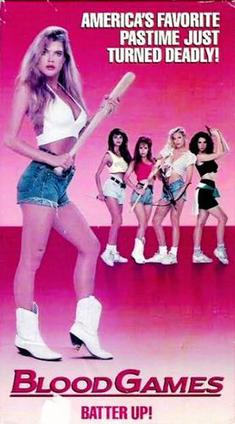
First released in 1990, Blood Games opens with a birthday celebration gone terribly wrong.
Somewhere in the rural South (at least, I assume it’s meant to be the South if just because of the big Confederate flag that appears in one scene), Roy Collins (Gregory Cummings) is celebrating his birthday. Roy’s father, Mino (Ken Carpenter), has invited Babe and the Ball Girls, a women’s softball team, to come to town to play an exhibition game against Roy and the local boys. When Babe (Laura Albert) and her team not only beat but also thoroughly humiliate the hometown team, Mino doesn’t take it well. He yells at Roy and Roy and his idiot friend, Holt (Don Dowe), decide to get revenge. After Roy is killed while trying to assault one of the girls, Mino gathers all of the rednecks together and declares, “I WANT JUSTICE!” Everyone in town grabs a shotgun, jumps in a pickup truck, and heads off in pursuit of the Babe and the Ball Girls tour bus.
It shouldn’t come as a surprise to anyone that the bus itself breaks down in the middle of the woods and the team is forced to hike to safety while being pursued by Mino, Holt, and all of the rest of the shotgun toting locals. It turns out that Mino is a deadly shot with a crossbow and Holt, at times, seems to be close to indestructible. However, it also turns out that Babe and the Ball Girls are far tougher than any of the men expected. The film reaches its bloody conclusion at a deserted farm, complete with a dramatically-scored flashback montage that reminds us of everyone whose life was lost during Roy’s birthday weekend.
Just to state the obvious, Blood Games is just as exploitive as it sounds. This is the type of film where, early on, the action stops so the camera can linger on Babe and the Ball Girls in the locker room after they win their game. (George “Buck” Flower shows up as the redneck who inevitably ends up peeking in at them.) The team’s uniforms were probably popular with the film’s target audience but short shorts and crop tops don’t really seem practical for a game that would involve sliding through the dirt and the weeds on the way to home plate and, as a Southern girl who spent many a summer in the country while growing up, I cringed a bit when I thought about all the bugs that were probably in the grass and the dirt, waiting for a chance to hop onto a bare leg. (It didn’t help that the game was apparently just being played in some random field.)
And yet, as exploitive as many viewers will undoubtedly find Blood Games to be, the film definitely works. The rednecks are so loathsome and they overreact so severely to losing one game to a team of girls that it’s impossible not to cheer when Babe and the Ball Girls turn the tables on their pursuers. “Batter up!” the film’s trailer announces and it is true that the Ball Girls use the same teamwork that won them the game to survive in the wilderness. At the same time, they also use baseball bats, ropes, guns, and anything else they can get their hands on.
The acting is a bit inconsistent, though Don Dowe and Ken Carpenter are both well-cast as the main villains. Dowe plays Holt as being someone who knows that he’s in over his head but who is too weak-willed to go against the mob. The fact that he’s weak makes him all the more dangerous because a weak man will do anything to try to convince others that he’s strong. Carpenter, meanwhile, is chillingly evil as Mino, who quickly goes from mourning his son to taking a sadistic pleasure out of hunting down human beings. The film’s real strength is to be found in Tanya Rosenberg’s direction. Along with keeping hte movie moving at a fairly steady pace, Rosenberg also captures the atmosphere of being lost in the country in the summer. Watching the film, you can literally feel the heat rising from the ground and hear the cicadas in the distance.
Incidentally, I convinced my sister to watch this film with me because I assumed it was a baseball movie. However, as Erin quickly pointed out to me, it instead turned out to be a softball movie. I have no idea what exactly the difference is between baseball and softball but Erin assures me that there is one. Well, no matter! Whether it was softball or baseball, Babe and the Ball Girls did a good job striking out the hometown boys.
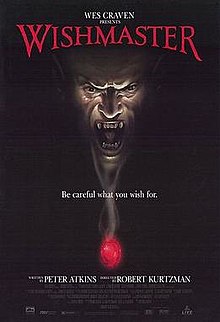
Played by Andrew Divoff, the Wishmaster was a genie (or a djinn) who made his film debut in the 1997 film of the same name. The Djinn’s schtick is to randomly approach people and say something like, “Would you like to be rich?” or “Would you like all of your enemies to suffer?” He grants wishes but he does so in ironic ways. So, if you say want to be rich, you might very well turn into someone named Rich who is on the verge of getting hit by a bus. If you say that you want to escape from your mundane life, you might end up in a straight-jacket under water, struggling to perform one of Harry Houdini’s signature escapes.
I rewatched Wishmaster a few months ago and what I immediately discovered was the the Djinn wasn’t really that good at his job. He pretended to be clever in the way that he would fool humans but, honestly, it often seemed less like he was tricking people and more like he really wasn’t playing fair. Take the security guard who made the mistake of wishing for an escape. As I just mentioned, The Djinn immediately put him underwater in a straight-jacket. But the guard’s wish was not to have to escape. The guard’s wish was to simply escape. So, putting him in a life-and-death situation and telling him to figure it out for himself wasn’t fulfilling the guard’s wish. It just seemed like the Djinn wanted to drown someone and he decided to use his wish-granting job as an excuse.
The guard, by the way, was played by Tony Todd, one of the many horror icons who appeared in small roles in Wishmaster. (Today, Tony Todd is best known for the Final Destination films but, when Wishmaster came out, he was known for playing the Candyman.) Among the other cameos:
From Phantasm, Angus Scrimm provided the narration while Reggie Bannister played an unlucky pharmacist.
From Friday the 13th, Kane Hodder played a security guard who made the mistake of saying that he wished he could see the Djinn try to walk straight through him.
Day of the Dead’s Joseph Pilato played a crane operator.
John Carpenter vet George “Buck” Flower played an angry homeless man.
Sam Raimi’s brother, Ted Raimi, showed up long enough to get crushed by a crate.
And finally, Robert Englund played the somewhat pretentious professor who was responsible for bringing the Djinn to America in the first place.
As you can probably guess by looking at all of the cameos, Wishmaster is not a film that’s meant to be taken seriously. It’s often deliberately campy. Wes Craven may have produced it and was undoubtedly responsible for recruiting many of the actors who appeared in it but the film’s direction was handled by special effects maestro, Robert Kurtzman and he puts more emphasis on the visual effects than on any sort of serious exploration of the somewhat random series of events that make up the film’s storyline. Of course, when seen today, the film’s special effects look a bit cheap but, for many viewers (like me!), that’s actually a part of the film’s grisly charm.
Wishmaster does have a plot but it’s not particularly important. The Djinn tries to make Alexandra (Tammy Lauren) make three wishes so that he can unleash the forces of Hell. Why he spends all of his time granting wishes to other people instead of just concentrating on Alex is never really explained. It may be an often dumb movie but it’s also undeniably entertaining when taken on its own terms. Andrew Divoff is enjoyably sinister as the Djinn, playing the character with a sarcastic wit to go along with his evil schemes. It’s a fun movie to watch, even if it does feel like it was basically slapped together in a handful of days.
You should always be careful what you wish for but Wishmaster is still an entertaining piece of 90s horror.
Originally released in 1988, Pumpkinhead has always struck me as being one of those films that more people remember hearing someone else talk about it than have actually sat down and watched.
I think that’s because it has such a great title. Pumpkinhead! That’s not a title that you’re going to forget and it conjures up all sorts of scary images. If you hear someone mention that title, it stays in your head. It’s an easy title to remember and it’s also an easy title to turn into a macabre joke. If, on Halloween night, you and your friends hear a sound in the house, you can always say, “It must be Pumpkinhead!” Everyone will laugh, regardless of whether they’ve seen the film or not. It’s kind of like how everyone knows what the Great Pumpkin is, even if they’ve never actually watched the old cartoon.
As for the actual film, it’s a mix of monster horror and hick revenge flick. It’s one of those movies where a bunch of dumb city kids do something stupid while driving through the country and, as a result, they end up having to deal with a curse and a monster.
Ed Harley (Lance Henriksen) is a widower who owns a grocery store that is pretty much sitting out in the middle of nowhere. Seriously, you look at his little store sitting off the side of a country road and you wonder how he makes enough money to feed his family. Of course, the store’s location isn’t the only problem. The other problem is that Ed seems to instinctively mistrust the few people who do stop off at the place. Even if I lived near there, I probably wouldn’t want to shop at that store because I know Ed would glare at me and make me feel like I was doing something wrong.
However, a group of dumbass dirt bikers do stop off at the store. And then they decide to drive their dirt bikers around the store while another member of the group takes pictures. Unfortunately, the dirt bikers run over Ed’s son, little Billy. The dirt bikers flee the scene, heading to their cabin. Ed meanwhile goes to the local witch and asks her to summon …. PUMPKINHEAD!
After a lengthy ceremony, Pumpkinhead shows up. Because Pumpkinhead was directed special effects maestro Stan Winston, he’s a very impressive creature. He looks something like this:
You may notice that Pumpkinhead doesn’t actually have a pumpkin for a head but no matter! It’s still a good name and when your monster looks like that, he can call himself whatever he wants.
Anyway, Pumpkinhead tracks down and starts to kill the people responsible for the death of Billy. Unfortunately, it turns out that Ed experiences each murder along with Pumpkinhead and he quickly has a change of heart. The witch tells him it’s too late. Pumpkinhead will not stop until everyone’s dead and if Ed tries to interfere, Ed will die as well.
It’s a clever-enough idea, a filmed version of one of those old legends that you occasionally hear about in the country. It’s a good thing that the monster is really, really scary because his victims are pretty much forgettable. Some of them feel bad about killing Ed’s son and some of them don’t but it’s hard to keep straight which is which. They’re just too bland. As a result, their deaths don’t really generate any sort of emotion, good or bad. They’re just there to be victims. The only person your really care about is Ed but that’s mostly because he’s played by Lance Henriksen and Henriksen is one of those actors who can bring almost any character to life, regardless of how thinly-drawn that character may be. Henriksen has a built-in authenticity. Since he’s clearly not a product of the Hollywood publicity machine but is instead someone who obviously lived an interesting life before he ever auditioned for his first film, you believe in Henriksen’s performance even when the script betrays him. You believe that he owns that store, even though the store seems to be in the worst location ever. When he mourns Billy, you believe it. When he tries to stop Pumpkinhead, you believe that as well. What little humanity that there is to be found in the film is almost totally the result of Henriksen’s performance.
So, give it up for Lance Henriksen and give it up for the scariness of Pumpkinhead and also give it up for director Stan Winston, who came up with enough horrific visuals that it almost made up for his apparent lack of interest in the film’s human characters. Give it up to for a little-known character actress named Florence Schauffer, who is properly creepy as the local witch. Pumpkinhead is a good film to watch with your friends on Halloween, even if the title monster doesn’t really have a pumpkin for a head.
There were four of them and they all deal with this ancient Djinn (Andrew Divoff) who, during each film, would escape from his magical prison and then wander around granting people their wishes. Of course, since the Djinn was evil, there was always a catch. He would either interpret the wish very literally or he would manipulate people into asking for the wish in the wrong way. As a result, people would always get their wish but they’d get in a way that would make them suffer.
For instance, a typical Wishmaster conversation would go something like this:
“I wish I was a better actor.”
“Am I to understand that you wish you were John Wilkes Booth?”
“Wait …. what?”
“As you wish.”
“Sic semper tyrannis!”
The first Wishmaster was released in 1997 while the fourth (and, to date, last) installment was released in 2002. They’ve never gotten as much attention as some of the other horror franchises from that period, largely because there was really only so much that you could do with a character like the Djinn. Part of the problem was that almost every scene depended on someone not understanding the importance of being clear when making a wish. There’s only so many times that you can watch the Djinn trick people into saying, “I wish I never get old,” before the whole novelty of it all wears off.
That said, the Wishmaster films did have one thing going for them and that was Andrew Divoff. A veteran character actor (and one who you might recognize from Lost, where he played a member of the Others who was both Russian and who had only one eye), Divoff was always creepy as fug in the role of the Djinn. Whenever someone made the mistake of making a wish, this little smile would appear on Divoff’s face and you knew that someone was about to learn an important lesson about being careful what you wish for. Divoff was seriously frightening of the Djinn, so much so that you regretted that the films themselves could never quite keep up with his performance.
Last night, I watched the first Wishmaster film for the first time in six years and it was actually a little bit better than I remembered. The plot itself is typical Wishmaster stuff. The Djinn is trapped inside of a gem that eventually makes it way to the United States. An idiot lab worker attempts to experiment on it, which leads to the gem exploding, the Djinn getting free, and an epidemic of mass wish granting. Nobody seems to have learned the lesson that the first thing you wish for is more wishes.
Wishmaster is stupid but fun. The first film was produced by Wes Craven and perhaps that explains why the film is full of cameos from everyone who was anyone in low-budget 90s horror. As a result, you’ve got Kane Hodder saying that he would “love it if” the djinn “tries to go right through him,” and Robert Englund playing a businessman and Tony Todd showing up as a doorman. It’s nice to see them all, though ultimately the main reason to watch the film is for Andrew Divoff’s wonderfully smirky turn as the Djinn. It’s hard not to wish that he had another horror franchise to dominate.
I have something of a tradition with John Carpenter’s The Fog. Every year, I try to watch the film on the date and time where the story starts – April 20th, at around 11:55pm. It’s not the scariest of stories, but it does have a spooky atmosphere that lends itself well to Halloween – or any late quiet night. I love this movie.
The Fog marked the first film that John Carpenter worked on after Halloween, collaborating with the late Debra Hill, who also produced the movie. She’d go on to also produce both Escape From New York and Escape from L.A for Carpenter. While it didn’t really have the impact of Halloween, it held up until Escape from New York came out the following year.
Here’s the story:
In the town of Antonio Bay, an old captain (John Houseman) explains to some children about the ill-fated Elizabeth Dane (what a beautiful name, I might add), a ship that belonged a rich of crew of lepers led by someone named Blake. The heads of the town conspired to steal the gold by setting up the ship to crash against the docks. It works out for the Conspirators, as they are “aided by a unearthy fog” that blinds the Leper ship’s navigators. and the gold they collect helps to form the great town the kids play in to this day.
What they don’t realize is that vengeance is coming in the form of that very same fog, as the ghost of the Lepers have come to claim the lives of the six conspirators…or their direct descendants.
As a kid, I had a problem with that. You mean because my great great grandparents messed up somewhere ages ago, I have to get killed for it? I remember thinking that it really wasn’t fair, but I’m kind of diverging from the topic here. The story gives you four points of view. You have Nick (Tom Atkins, sans his signature mustache) and a hitchhiker he picks up played by then scream queen Jamie Lee Curtis. You have Curtis mother, Janet Leigh, who’s character is working on the anniversary party for the town and her assistant, Sandy, played by Nancy Loomis (who appeared in the first three Halloween films). The third comes from Adrienne Barbeau’s character, Stevie Wayne, who works for the local radio station. Her character acts as the warning voice for the town and she starts to notice that something’s going on when her son gives her a piece of Driftwood that later echoes Blake’s warning. The final viewpoint comes from Father Malone (Hal Holbrook), who discovers Blake’s diary and learns the truth about what happened 100 years ago. His character helps to piece the mystery together, somewhat.
Carpenter and Hill gathered many of their friends, who went on to work on other films for this. Tommy Lee Wallace went on to direct Halloween III: Season of the Witch (and coincidentally did the voice of the Silver Shamrock ad-man in the commercial) and Vampires: Los Muertos. Wallace’s name was given to Carpenter fan favorite Buck Flower. Nick Castle’s name was given to Tom Atkins character. Makeup Wizard Rob Bottin (who also played Blake in the film) went on to do some of the effects in The Thing.
The makeup effects in this film were okay. The lighting and fog did more to obscure than to actually help one see what was doing the attacking, but it really worked for some of the shadowing in the film. If the movie has any drawbacks, it’s that there’s a really low body count to the film. In essence, there are only 6 people the ghosts are after, so these are only the ones they actually get. It would have been interesting if there were a few random deaths, or more individuals in danger, but I supposed it worked out well for the time period.
The Fog is a nice film to catch late at night. You won’t find it at the upper rankings of top horror films, but it’s one to try, at least. Don’t even bother with the Remake for this one. It’s not even work talking about.
Last night, as part of my quest/mission/curse to watch all of the movies included in Mill Creek’s 50 Classic Chillers Box Set, I watched a film from 1974 called Drive-In Massacre.
So, what’s Drive-In Massacre about? Well, there’s this drive-in and there’s someone wandering around with a sword which he uses to kill various filmgoers. Now, you might think that the fact that people keep getting hacked to pieces at the drive-in would lead to the establishment either getting closed down or perhaps, at the very least, it would lead to an increased police presence. Well, you would be wrong. Even more people start hanging out at the drive-in and the police presence amounts to two overweight detectives who go undercover to catch the killer. (By undercover, I mean that one of the detectives shows up in drag.)
Since this is a pre-1980, giallo-influenced slasher film, the film is structured as a whodunit. Instead of giving us the wisecracking killer that we usually associate with slasher films, this one presents us with a handful of weirdos and dares us to try to guess whose guilty. Is it the bald guy who manages the drive-in and who is referred to as being “a perfect asshole?” Or is it Orville The Pervert who spends all of his time trying to peep on young lovers and who happens to have some bloody clothes in the back of his car? Then again, it could be Germy, the creepy janitor who is a natural suspect because 1) he’s a former sword swallower and 2) his name is Germy. Then again, it could also be the sweaty guy who pops up out of nowhere during the film’s final 20 minutes and spends all of his time saying things like, “I’m going to cut the bad out of you.”
Of course, there’s always the possibility that the film will end with an out-of-nowhere “surprise” twist that will either piss you off or make you squeal with delight depending on how seriously you take these things. Me, I squealed with delight.
I loved this movie and I make no apologies for it. The plot makes absolutely no sense, the acting is really odd, and the whole film has this wonderful feel to it that leads you to suspect that someone just turned on a camera and yelled, “DO SOMETHING!” The first kill scene is actually rather effective and there’s a few scenes of intentional humor that actually work almost well. As well, the film did manage to capture the feel of a sleazy drive-in (perhaps because it was filmed at a sleazy drive-in). I mean, I’ve never been to a drive-in and I probably never will since I don’t think they exist anymore but, after seeing this film, I feel like I’ve had the drive-in experience.
However, my love of this film truly came down to two things:
1) I loved Germy! Seriously, I’ve seen a lot of movies featuring mentally disturbed janitors and Germy belongs in the Mentally Disturbed Janitor Hall Of Fame. Plus, his name was Germy. That just makes me laugh so much.
2) The movie itself only lasts an hour and 13 minutes. Now, on the one hand, that means that there’s not a lot of time for anything along the lines of coherence. However, on the other hand, it also means that the movie never gets a chance to drag and right when you’re starting to get annoyed with it, it’s over!
As a sidenote, Arleigh might be interested to know that this film was apparently co-written by George “Buck” Flower.



 Through the Shattered Lens