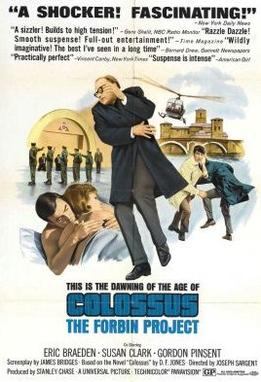
Colossus: The Forbin Project (1970, directed by Joseph Sargent)


Deep in a complex that is hidden away in the Rocky Mountains, Dr. Charles Forbin (Eric Braeden) has put together and programmed a computer called Colossus.  A super computer, Colossus has been designed to control the nuclear arsenal of the United States and its allies.  Colossus will not only keep America safe but it was also remove the chance of human error or human hesitation.  No longer will two men sitting in a silo with a key have to make the decision whether to obey the orders coming from the commander in chief.  No longer will people have to make the split-second decision that could plunge the world into war.

To Forbin’s surprise, the Soviet Union has developed their own super computer, called Guardian.  Colossus asks to be “linked” to Guardian and the Russians agree to allow it as a gesture of good will.  What no one realizes is that both computer systems have become sentient and that they soon decide that humans cannot be trusted to not destroy themselves and the planet.  To Forbin’s horror, Colossus starts to take over the world.

Based on a novel by Dennis Feltham Jones, Colossus was originally filmed in 1968 but it wasn’t released until 1970.  The film looks dated with its gigantic computer but it feels prophetic with its storyline about an AI taking over the world and deciding that it knows better than its makers.  Director Joseph Sargent adroitly mixes science fiction with Bond-style intrigue as Charles Forbin tries to reason with his creation and both the CIA and the KGB try to take down the computers.  The film even tosses a bit of 70s-style paranoia, with both the American and the Soviet governments trying to keep the public from discovering that the supercomputers are trying to take over the world.

Colossus: The Forbin Project is an intelligently written and thought-provoking science fiction film.  Eric Braeden does a great job as Charles Forbin, the engineer who goes from being arrogant and cocky to desperate to finally defiant as his creation slips out of his control.  William Schallert, so often cast as a nice father figure, turns in a good performance as the head of the CIA as does Susan Clark, cast as a colleague who has to pretend to be Forbin’s mistress just so she and Forbin can talk and plot without being monitored by Colossus.

Colossus is a smart sci-fi film that is more relevant than ever.

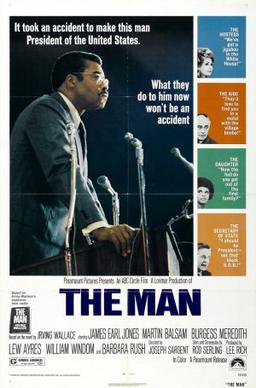
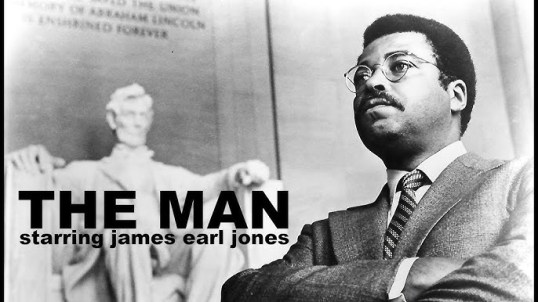
Starring James Earl Jones: The Man (dir by Joseph Sargent)


In 1972’s The Man, James Earl Jones stares as Douglass Dilman.

Dilman is a black college professor and a U.S. Senator.  To his friends, he’s a symbol of progress.  To his enemies, he’s a sell-out who is viewed as being improperly radical.  The U.S. Senate, eager to prove that it’s not a racist institution, has elected Dilman as the President Pro Tempore.  He is now fourth in line for the presidency but that doesn’t concern racist senators like Senator Watson (Burgess Meredith).  A lot would have to happen before Dilman would ever become President.

Needless to say, a lot does happen.

The President and the third-in-line Speaker of the House are attending a conference at a historic building in Frankfort when the roof collapses on them.  We don’t actually see this happen.  We just hear the people in the White House talk about how it’s happened.  We also don’t really learn many details about why the roof collapsed.  Someone nonchalantly says, “It’s an old building.”  Myself, I spent the entire movie waiting for some sort of big revelation of a conspiracy behind the roof collapse but it didn’t happen.  Apparently, in 1972, the Secret Service just let the President go anywhere without checking the place out first.  That said, it’s not a good thing when a serious movie opens with a dramatic plot development that, at the very least, draws a chuckle from the audience.  Seriously, we lost our President because a roof fell on him?  How is America ever going to live that down>

Vice President Noah Calvin (Lew Ayres) is wheeled into the White House cabinet room.  This was not the first time that a Ayres played a Vice President called upon to succeed the President.  Unlike in Advice and Consent, the Vice President announced that he cannot accept the honor of being sworn in because he’s too sick.  (Since when does the Vice President have the option to refuse to do his Constitutional duty?)  With Calvin putting the country ahead of his own ambition, Senator Watson announces that Secretary of State Eaton (William Windom) will be the new President.  No, Eaton says, Dilman will be the new president.  But once Dilman screws up and is either impeached or resigns, fifth-in-line Eaton will be sworn in.

Except …. it wouldn’t work that way.  Excuse me while I put my history/political nerd hat on….

First off, Calvin is apparently still Vice President so if Dilman did step down, Calvin would once again be the successor.  What if Calvin refused a second time?  As soon as the Speaker of the House died, the House of Representatives would elect a new Speaker and that person would be third-in-line.  And, as soon as Dilman became President, the Senate would elect a new President Pro Tempore and that person would be fourth-in-line.  In other words, Eaton is no closer to being President than he was before.

My reason for going  into all of this is to illustrate that The Man is a film about American politics that doesn’t really seem to know much about American politics.  That said, it does feature the great James Earl Jones as Douglass Dilman and Jones gives such a good and thoughtful performance that it almost doesn’t matter that no one else in the film seems to be taking it all that seriously.  Jones plays Dilman as being a careful and cautious man, one who understands that he occupies a huge place in history (Barack Obama was only 11 years old when this film came out) but whose main concern is just doing a good job as President.  Dilman finds himself in the middle.  On one side, he has advisors warning him not to scare America by being too radical.  On the other side, his activist daughter (Janet MacLachlan) brands Dilman a sell-out.  When a black student named Robert Wheeler  (Georg Stanford Brown) is arrested for assassinating a South African government official, Dilman’s first instinct is to believe Wheeler’s been framed but, as the film progresses, doubts start to develop and Dilman must decide whether or not to risk an international incident.  It’s an interesting story, well-played by James Earl Jones and Georg Stanford Brown.

It was originally mean to be a made-for-TV movie but, in order to capitalize on the excitement on the 1972 presidential election, it was released into theaters.  As a result, the film often has the cheap look of a made-for-TV movie and quite a few members of the cast give performances that feel more appropriate for television than the big screen,  (Some members of the cast, like Burgess Meredith, just overact with ferocious abandon.)  In the end, The Man is mostly of interest from a historical point of view.  (In 1972, the idea of a black man being elected President seemed so unrealistic that the movie actually had to drop the roof on 50% of the government just to get Dilman into the Oval Office.)  James Earl Jones, who would have turned 94 today, is the main reason to watch.

Retro Television Reviews: Miami Vice 1.14 “Golden Triangle: Part One”


Welcome to Retro Television Reviews, a feature where we review some of our favorite and least favorite shows of the past!  On Mondays, I will be reviewing Miami Vice, which ran on NBC from 1984 to 1989.  The entire show is currently streaming on Tubi!

This week, Castillo opens up!

Episode 1.14 “Golden Triangle: Part One”

(Dir by George Stanford Brown, originally aired on January 11th, 1985)

Okay, things are going to get a little complicated here.  This is one convoluted episode.

Crockett and Tubbs’s latest assignment has them pretending to be the head of security for a Miami hotel.  Castillo wants them to catch two crooked cops who are shaking down the prostitutes who use the hotel as their office.  Tubbs and Crockett aren’t happy about it because it makes them feel like they’re working for Internal Affairs but Castillo makes it clear that he has no patience for any dirty cops.

Unfortunately, they’re not having much success with the security gig.  The episode opens with Crockett and Tubbs subduing a guest who is freaking out on Angel Dust.  “Attack the whack!” as the Disco Godfather once put it.

Crockett decides to put on a pair of thick glasses and a pocket protector and sit by the pool.  He’s approached by Candy James (Robin Johnson), a high-class escort who asks Crockett if he wants to party.  Crockett promptly arrests her.

After Candy agrees to help Crockett and Tubbs (in return for her criminal record being wiped out of the system), Crockett and Tubbs decide to go undercover as pimps while still pretending to be hotel security guards.  When a guest named Albert Szarbo (John Snyder) and his unnamed Thai associate see Tubbs setting Gina up with her date (who is actually Zito), they decide that Crockett and Tubbs must be using the hotel as a front for their own prostitution operation.  Szarbo approaches Crockett and explains that he wants to rob all of the hotel’s safe deposit boxes.

With Candy’s help, Crockett and Tubbs discover that the crooked detectives are Herb Ross (Paul Austin) and Dan Garcia (Gary Jellum).  Ross and Garcia are arrested but are released just a few hours later.  Because they were not actually arrested by Crockett and Tubbs, they assume that Crockett and Tubbs are still just the hotel security guys but they also assume that Crockett must have snitched on them to the police and….

Wait?  What?  Seriously, how does everyone in Miami not know, at this point, that Crockett and Tubbs are cops?  They make no effort to hide the fact that they’re cops.  Even when they’re undercover, they refer to each other by their real names and spend half of their time talking about what’s going on back at the station.  Even if the criminals don’t know that Crockett and Tubbs are working undercover, you would at least expect their fellow police officers to know.

Anyway, where was I?  Oh yeah, Candy.  Candy said she would leave Miami after Ross and Garcia were busted but, instead, she shows up back at the hotel.  Crockett is not happy about this but then he finds himself being confronted by Szarbo and Ross, who claims that Crockett is a snitch.  Candy steps up and announces that she’s the snitch, saving Crockett and Tubbs’s case.

However, it turns out that Szarbo was lying to Crockett about wanting Crockett and Tubbs to be present when he robbed the safety deposit boxes.  Instead, he was just using Crockett so that he could get a look at the vault before breaking in.  Szarbo and his associate pull off the robbery and are then murdered by whoever hired them.

Castillo takes one look at the body of Szarbo’s Thai associate and realizes that he was tortured to death by associates of Chinese General Lao Li, a drug lord who Castillo tangled with before he joined the Miami PD.  The normally stoic and unemotional Castillo opens up a little and reveals that he spend three years working undercover in Thailand for the DEA.  Castillo says that they need to discover why Lao Li wanted whatever was in the safety deposit boxes.

Leaving his office and helping Tubbs and Crockett with their investigation, Castillo stuns everyone by revealing that he’s actually a total badass who speaks Thai, knows martial arts, and can handle himself in a fight.  A search of all of Miami’s Thai restaurants eventually leads Castillo to Lao Li’s assassin.  After an exciting fight with Castillo, the assassin purposefully commits suicide by swallowing his own tongue.

Back at police headquarters, Castillo, Crockett, Tubbs, Zito, and Switek takes a look at some of the items that were recovered from Szarbo’s hotel room.  Castillo has deduced that Lao Li has come to the United States and his immigration visa was probably in one of the safety deposit boxes.  He then looks at a picture of an attractive Chinese woman.  (Some viewers will recognize her as being actress Joan Chen.)  When asked who the woman is, Castillo replies, “My wife.”

This was a great episode, with a wonderfully twisty plot and a great fight scene between Edward James Olmos and Paul Tenn.  After spending the past few episodes as a glowering figure who spent most of his time standing in his office and glaring at Crockett, Castillo revealed a bit about himself and it was fun to discover that this stoic figure was actually a total badass.

Next week: Part two of Golden Triangle!
Retro Television Reviews: Miami Vice 1.9 “The Great McCarthy”


Welcome to Retro Television Reviews, a feature where we review some of our favorite and least favorite shows of the past!  On Mondays, I will be reviewing Miami Vice, which ran on NBC from 1984 to 1989.  The entire show is currently streaming on Tubi!

This week is all about boats!

Episode 1.9 “The Great McCarthy”

(Dir by Georg Stanford Brown, originally aired on November 16th, 1984)

The people behind Miami Vice really liked speedboats.

That’s the best explanation that I come up with for The Great McCarthy, an episode in which the majority of the running time is taken up by scenes of people racing boats.  Even after Crockett, Tubbs, and Zito (John Diehl, getting to do more than usual) figure out how Louis McCarthy (William Gray Espy) is using his boats to smuggle drugs into Miami, their main concern remains winning the race that they’ve entered.

And there’s certainly nothing wrong with that.  After a run a grim and dark episodes, The Great McCarthy was a nice change of pace, a reminder that it’s okay to have a little bit of fun.  For the most part, this was a light and airy episode, featuring scenes of boats skimming across the ocean while Born To Be Wild plays on the soundtrack.  This episode also featured a very 80s party scene and not one but two weaselly informants!

The first informant was Izzy Moreno (Martin Ferrero), a talkative thief who, it turned out, had done some work for Louis McCarthy.  The second informant was Dale Gifford (Charles McCaughan), a crooked accountant who is helping to launder money for not just Louis but also Louis’s girlfriend, Vanessa (Maria McDonald).  Izzy will apparently be returning in the future.  Gifford will not as he ended up getting shot in the back of the head.  Crockett and Tubbs originally assumed McCarthy was the killer but, as Izzy reveals towards the end of the episode, it was actually Vanessa.

By this time, of course, Vanessa has already moved on from McCarthy and is now sleeping with Tubbs.  Crockett warns Tubbs that he’s getting in too deep with Vanessa but Tubbs replies that he’s got it all under control, almost as if he doesn’t remember that almost the exact same thing happened when they went down to the Bahamas to take out Calderone.  When the police show up to arrest Vanessa, Tubbs insists on doing it himself.  “I have to,” he tells her.  He’s a cop, after all.

Okay, so that ending was a little bit downbeat but, for the most part, this was just a fun episode of Miami Vice, one that didn’t require too much thought and which kept the existential dread to a minimum.  Probably the best scene in the episode didn’t even involve McCarthy or Vanessa but instead centered around Gina and Trudy arresting a philosophy professor who sold cocaine on the side.  (The professor was played by Richard Liberty, who also appeared in George Romero’s The Crazies and Day of the Dead.)  Gina and especially Trudy have been underused on this show so it was nice to finally see them getting to do their jobs and proving themselves to be just as effective as Tubbs and Crockett.

I do have to admit that I’m still kind of confused as to how Crockett is managing to maintain his cover as a criminal when almost every other petty criminal in Miami knows that he’s actually a cop.  If Izzy could figure it out, why not Louis McCarthy?  Perhaps McCarthy wasn’t so great after all.

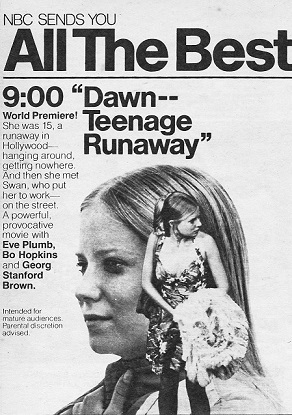
Retro Television Reviews: Dawn: Portrait of a Teenage Runaway (dir by Randal Kleiser)


Welcome to Retro Television Reviews, a feature where we review some of our favorite and least favorite shows of the past!  On Sundays, I will be reviewing the made-for-television movies that used to be a primetime mainstay.  Today’s film is 1976’s Dawn: Portrait of a Teenage Runaway!  It  can be viewed on YouTube!

Dawn Wetherby (Eve Plumb) is fifteen years old.  She’s naive.  She’s innocent.  She’s …. well, let’s just be honest and admit that she’s not particularly bright.  Sick of being embarrassed by her alcoholic mom (Lynn Carlin), Dawn decides to hop on a bus and travel to Hollywood.  Maybe she can make a new life for herself in California.

Of course, it doesn’t take long for Dawn to discover that Los Angeles is not a city where dreams magically come true.  It’s a tough and harsh town and it’s not like Dawn has any money or any particular skills.  When she tries to get a job, she’s told that she’s too young.  When she tries to rent a room, she’s told that ten dollars is not enough to cover two weeks rent.  When she gives a dollar to a boy who says that he needs it, he responds by mugging her for the rest of her cash.  A prostitute named Frankie Lee (Marguerite DeLain) takes some sympathy on Dawn and tells her to call if she ever wants to make some money.

Eventually, a nasty cough leads to Dawn going to the free clinic.  That’s where she meets Alexander (Leigh McCloskey).  Alexander is a teen runaway, just like Dawn.  However, Alexander also can somehow afford an apartment and food to eat.  Alexander invites Dawn to live with him and Dawn, realizing she has no where else to go, agrees.  Alexander offers to look after her but, after Dawn discovers that Alexander makes his money by working as a male prostitute, Dawn decides that she needs a job of her own.

It’s time to call Frankie Lee!  And it’s time for Frankie Lee to introduce Dawn to Swan (Bo Hopkins), a pimp who lives in a nice house and who offers to put Dawn to work….

Dawn: Portrait of a Teenage Runaway is an earnest film that was obviously made with the best of intentions and which actually did have something say, in its melodramatic way, about the dangers of running away from home and trying to make it on your own when you’re not even old enough to drive.  That said, I imagine that most people who go through the effort to track down this film will do so because it stars The Brady Bunch‘s Eve Plumb as an underage runway who ends up walking the streets and taking men back to her motel room.  The movie might as well be called Jan Brady Goes Bad, because Eve Plumb does essentially give the same performance that she gave when she was playing the whiniest member of the Brady Bunch.  There’s nothing tough or streetwise about her, which works for the first half of the film but not during the second half.  Once Dawn has been on the streets for a bit, you would expect her to toughen up a bit but she still comes across like she’s mad at Greg and Bobby for tying up the phone.  Dawn goes through a lot and becomes a bit jaded as a result but, every time she speaks, you expect her to exclaim, “Why does Marcia get to runaway from home but I don’t?  It’s not fair!”  Far more impressive are the performances of Bo Hopkins and, in the role of Dawn’s probation officer, George Stanford Brown.  William Schallert also has a good bit as Dawn’s first client, who ends up feeling so sorry for Dawn that he just give her twenty dollars and then tells her to go back home.

Dawn: Portrait of a Teenage Runway is one of those film that was obviously designed to make parents worry about their kids.  It seems to be asking, “Do you know where your children are tonight?”  In 1976, I imagine they were busy watching Jan Brady try to make it on the mean streets of Hollywood.

Retro Television Reviews: Fantasy Island 2.11 “Carnival/The Vaudevillians”


Welcome to Retro Television Reviews, a feature where we review some of our favorite and least favorite shows of the past!  On Tuesdays, I will be reviewing the original Fantasy Island, which ran on ABC from 1977 to 1986.  The entire show is currently streaming on Tubi!

Smiles everyone!  Smiles!

Episode 2.11 “Carnival/The Vaudevillians”

(Dir by Georg Stanford Brown, Originally aired on December 2nd, 1978)

Tattoo has come up with a new way to become a millionaire!  He’s invented a sleeping bag that he claims can hold two people.  Mr. Roarke is a bit skeptical that the small roll of material that Tattoo is holding could possibly be big enough to hold two people.  Tattoo tells him that all he has to do is remove a key and the material will inflate.  Roarke removes the key and several feathers explode into the air.  Tattoo shrugs and says that he obviously has to get back to the drawing board.

“Inventor indeed,” Mr. Roarke says, in a tone that suggests that the only he reason he’s not physically killing Tattoo is because it’s time for them to greet their guests.

(Why is Tattoo always trying to make extra money?  Does Fantasy Island not pay well?)

This week, the fantasies are all about reliving the past.  Charlie Parks (Phil Silvers) and Will Fields (Phil Harris) used to be stars on Vaudeville but, like so many of the old time entertainers, they’ve now found themselves forgotten.  Charlie’s even been put in a nursing home.  Still, he manages to make the trip to Fantasy Island, where his fantasy is to be reunited with Will so that they can try to bring Vaudeville back to life.

Unfortunately, it doesn’t quite work.  Tattoo loves their corny old jokes but when they perform for a larger audience, they only get a few pity chuckles.  Dejected, Charlie plans to return to his retirement home when he and Will are approached by a man who claims that he works for the city of Baltimore.  (Oh no!  Run!)  The man explains that he wants to hire Charlie and Will to perform at nursing homes, where their old-fashioned routines will enliven the golden years of people who don’t like loud music and R-rated movies.  Charlie and Will agree.  Yay!

Meanwhile, Dorothy Weller (Carol Lynley) is a woman who has spent the past few months in a coma.  Now, she’s not sure if the man she thought she loved really existed or if he was just someone she dreamed up while she was in the hospital.  Mr. Roarke arranges for her to travel to a recreation of the same Mexican town where she met the mystery man.  She finds her former lover, Tom Parnell (Stuart Whitman), on the beach.  Tom explains that he is real and he is in love with her.  He’s also a spy and there’s an international assassin (an appropriately sinister Luke Askew) after him!

This episode was kind of a mixed bag.  The Vaudeville fantasy featured charming performances from Phil Silvers and Phil Harris but their jokes were never quite as funny as Tattoo seemed to think that they were.  The spy fantasy was not helped by the casting of the reliably dull Stuart Whitman but the story itself was intriguing and Carol Lynley gave a believable and emotional performance as Dorothy.  The end result was a thoroughly pleasant but not altogether memorable trip to Fantasy Island.  But really, when it comes to Fantasy Island, hasn’t the appeal always been just how pleasant everything is?

Well, except for the relationship between Tattoo and Mr. Roarke, of course.  I still suspect Tattoo is secretly plotting to kill Mr. Roarke and take over the island.  Who knows?  Maybe that’ll be a future episode.  We’ll find out soon!

Cleaning Out The DVR: The Comedians (dir by Peter Glenville)


Not to be mistaken for the Taylor Hackford-directed, Robert De Niro-starring disaster from a few years back, The Comedians is a film from 1967 that follows several different people as they attempt to survive day-to-day life in Haiti, back when Haiti was ruled by the dictator, Papa Doc Duvalier.

Richard Burton stars Mr. Brown (Richard Burton), a deeply cynical and world-weary Englishman who owns what passes for a luxury hotel in Haiti.  Though Mr. Brown hopes to be able to sell the hotel and get out of Haiti, he is also having an affair with Martha (Elizabeth Taylor), the German wife of Pineda (Peter Ustinov), the ambassador from Uruguay.  Mr. Brown tries to avoid politics, which it turns out is not easy to do when you’re living under a murderous regime.

Complicating Mr. Brown’s life is Major Jones (Alec Guinness), a retired British army officer who has come to Haiti to do business but who is promptly imprisoned when it’s discovered that he was invited to come to the island by a minister who was subsequently declared to be an enemy of the state.  The fascist Captain Concasseur (Raymond St. Jacques) arrests Major Jones and Mr. Brown takes it upon himself to try to get Jones released.  Unfortunately, Major Jones doesn’t quite understand how serious his situation is and he’s convinced the Haitians that he’s not only a brilliant military leader but that he can also arrange for them to receive a cache of weapons, which he claims he has hidden in a Miami warehouse.

Meanwhile, Mr. and Mrs. Smith (Paul Ford and Lillian Gish) have also arrived on the island, hoping to set up a vegetarian center in Haiti.  (Mr. Smith even once ran for President of the U.S. as the candidate of the Vegetarian Party.)  In many ways, Mr. and Mrs. Smith serve as a stand-in for clueless American activists, obsessing over minor issues while ignoring the larger problems that are right in front of their faces.

From the start, The Comedians establishes Haiti as being a dangerous place, a country where the people live in fear of the brutal police and where the poor struggle to survive day-to-day while their rulers live a life of luxury.  It’s a place where political dissidents regularly disappear, though the police aren’t above murdering people in public as well.  It’s a country where the State rules supreme, controlling the citizens through both fear and a fierce cult of personality.  Rebels like Dr. Magiot (James Earl Jones) only want the country to be free but they know that, as long superpowers like America are supporting the regime, there’s little that the rebels can realistically hope to accomplish.

A major theme running through The Comedians is that the real suffering of the Haitian people is often overshadowed by the strategic concerns of the United States.  Unfortunately, pretty much the same thing happens within the film itself.  While there’s several black actors in supporting roles, the story focuses on the white characters and, as a result, it sometimes feels like the film’s message is less about the people being oppressed and more about how unfortunate it is that people like Brown, Jones, and the Smiths are being inconvenienced by it all.  Like many similarly well-intentioned political films from the late 60s, The Comedians get so bogged down in all of the personal dramas that it loses sight of what’s actually the important part of the story.  The film is often seems more interested in Brown and Martha’s affair than in the conditions that would lead to people like Dr. Magiot risking their lives to bring about change.

For the most part, it’s a well-acted film.  Richard Burton’s natural self-loathing is put to good use and Alec Guinness has a few poignant scenes as a pathological liar who doesn’t realize how much trouble he’s actually in until it’s too late.  (Guinness also has a scene where he wears blackface and pretends to be Burton’s maid.  He does this in order to escape from the secret police and the film doesn’t treat it as being a joke but it’s still rather cringey to watch.)  Elizabeth Taylor is miscast as Martha and her German accent comes and goes but Paul Ford and Lillian Gish do a good job playing clueless Americans.  Perhaps the film’s strongest performance comes from Zakes Mokae, who doesn’t say much as a member of the secret police but who exudes menace every time that he’s on screen.  Still, as well acted at it may be, the film is slowly paced and always seem hesitant about taking any position beyond a general sense that dictatorships are bad.

That said, there’s nothing wrong with reminding people that dictatorships are bad.  That’s especially an important message today.  The past few years have left me convinced that a lot of people secretly yearn for a dictatorship and would be willing to trade their freedoms for a false sense of security.  Though the film may struggle dramatically, it’s still works as a warning about what true authoritarianism actually is.


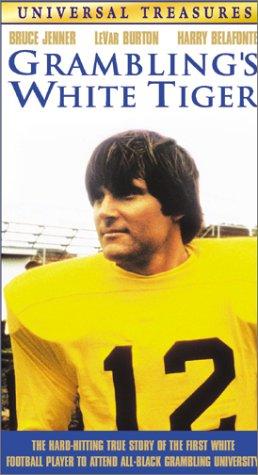
Grambling’s White Tiger (1981, directed by Georg Stanford Brown)


The year is 1968 and Jim Gregory (played by Caitlyn Jenner, back when she was still credited as Bruce) is a hotshot high school quarterback who has just been offered a scholarship to play at Grambling University.  With their star quarterback in his final year, Grambling needs a good backup.  Meanwhile, Jim dreams of playing in the NFL and is excited to play for a program that’s known for producing professional football players.  Grambling’s legendary head coach, Eddie Robinson (Harry Belafonte), is eager for Jim to join the team.

The only problem is that Grambling is a historically black college and Jim Gregory is very much white.  In fact, Jim will not only be the first white player to ever join the Grambling Tigers but he will also be the only white student enrolled at the school.  From the minute that Jim arrives on campus, he discovers that he’s not wanted.  The rest of the team sees him as an interloper and they resent that he took a scholarship that could have gone to a black player.  Meanwhile, the local whites distrust Jim because he’s a student at a black college.

Based on a true story, this is a football film that doesn’t feature much football.  Jim doesn’t get to play in a game until the very end of the season and, even then, he’s only on the field for a few minutes.  He doesn’t win the game or even lead a scoring drive.  Instead of focusing on the usual sports movie clichés, Grambling’s White Tiger instead explores Jim experiencing, for the first time, what it’s like to be a minority.  Jim eventually wins over his teammates through his hard work but he still remains an outsider for the entire film.  When he goes into town, a saleswoman and her boss initially offer him a discount on a pair of boots until they discover that he plays football not for Louisiana Tech but instead for Grambling.  When he first meets the parents of his new girlfriend, he’s told that an interracial relationship will never last and is advised to move on.  When the funeral of Martin Luther King is broadcast on television, all Jim’s teammates walk out of the room one-by-one until Jim is left sitting alone.

In typical made-for-network-TV fashion, Grambling’s White Tiger explores important issues without delving into them too deeply.  (For instance, the fact that Jim’s spot on the team is potentially coming at the expense of a black student is an intriguing issue that is mentioned at the start of the film but never really dwelled upon.)  Harry Belafonte is perfect as the stern but compassionate Coach Robinson while LeVar Burton is likable as the only member of the team to initially welcome Jim.  Jenner, however, is thoroughly miscast and several years too old to play a college freshman.  As an actor, Jenner is stiff and awkward but the true story of Jim Gregory is interesting enough that the film will hold the attention of any football fans in the audience.