Retro Television Review: Baywatch Nights 2.17 “The Servant”


Welcome to Late Night Retro Television Reviews, a feature where we review some of our favorite and least favorite shows of the past!  On Tuesdays, I will be reviewing Baywatch Nights, a detective show that ran in Syndication from 1995 to 1997.  The entire show is currently streaming on YouTube!
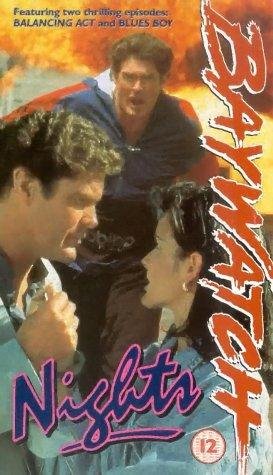
Mitch does not want to believe.

Episode 2.17 “The Servant”

(Dir by Georg Fenady, originally aired on April 12th, 1997)

There’s something strange happening at a warehouse that stores ancient artifacts.  The wealthy woman (Renee Suran) who owns the warehouse claims that someone wrapped in bandages killed both a security guard and her chauffeur.  She goes to Daimont Teague and, of course, Teague takes her to Ryan and Mitch.

“I want you to solve my murder,” the woman says, convinced that she’s destined to be killed by whatever it was that she saw in the warehouse.

The killer was wrapped in bandages and Mitch is stunned to discover that the killer apparently took four bullets without even slowing down.  In fact, one of the bullets is found on the ground and it doesn’t have a bit of blood or bodily tissue on it.  What could be going on?

Ryan and Teague suggest that the killer could be a mummy.

Mitch gets angry, saying that there’s no way a mummy has come back to life and is killing people and stealing artifacts from the warehouse.  Even when Ryan tells him about an ancient curse that may have been activated by the removal of the artifacts from a tomb, Mitch says that he doesn’t believe in mummies.  He’s a skeptic!

Okay, I’ve done this before but let’s do it begin.  Here are just a few things that have happened to Mitch since the start of season 2.

  1. Mitch has dealt with a huge number of sea monsters.
  2. Mitch has dealt with space spores that caused animals to explode.
  3. Mitch has witnessed Donna get possessed by the spirit of a serial killer.
  4. Mitch has been transported through time and has been chased by an axe-wielding maniac from the turn of the century.
  5. Mitch has battled a werewolf.
  6. Mitch has battled a vampire.
  7. Mitch has discovered that the world is secretly controlled by the Knights Templar.
  8. Mitch has witnessed two 800 year-old Vikings come back to life and immediately resume their blood feud.

And that’s just scratching the surface!  After seeing all of that, Mitch somehow cannot bring himself to believe that there is a mummy wandering around a warehouse that appears to only house cursed Egyptian artifacts.  Myself, I think just the stuff with the Vikings would have convinced me to believe just about anything.

My personal theory is that, much like the protagonist of a Lovecraft short story, Mitch does believe in the mummy but he’s insisting that he doesn’t because he know that accepting it as reality will lead to him losing his mind.

Fortunately, Ryan is not as skeptical as Mitch and she’s able to discover that the mummy and the missing artifacts are all a part of a plot to open up a mystical portal.  Fortunately, she and Mitch are able to thwart the plans of Dr. Kasan (Erick Avari).  Seriously, if everyone had listened to Mitch, Malibu would have been invaded by hundreds of mummies.

This episode was dull.  The cast was noticeably small, with regulars Griff and Donna noticeably absent from the proceedings, the warehouse and the mummy looked cheap, and the only think creating any atmosphere was an overuse of Dutch angles.  Angie Harmon was great as usual but, surprisingly considering that his signature brand is overwhelming earnestness, David Hasselhoff seemed bored with the whole thing.  This mummy should have been kept under wraps.
Late Night Retro Television Review: Baywatch Nights 1.20 “Rendezvous”


Welcome to Late Night Retro Television Reviews, a feature where we review some of our favorite and least favorite shows of the past!  On Tuesdays, I will be reviewing Baywatch Nights, a detective show that ran in Syndication from 1995 to 1997.  The entire show is currently streaming on You tube!

This week, Mitch and the Gang screw up another easy case.

Episode 1.20 “Rendezvous”

(Dir by Georg Fenady, originally aired on May 4th, 1996)

Mitch, Ryan, and Garner are hired to track down Bradley Thurman (John Sanderford), a former top executive who embezzled over twenty million dollars and then, with the help of plastic surgery, went into hiding.  Thurman has come to California to track down his wife and child, both of whom are in the witness protection program.  They are told that, if they help to capture Bradley, they will be entitled to 20% of whatever money is recovered.

“20% of 20,000,000,” Mitch says, dreamily.

“Or 20% of nothing,” Ryan adds, revealing that she at least understands that both this show and presumably Baywatch would be over if Mitch ever became independently wealthy.

Donna and and Griff help out with the case, despite the fact that neither one of them is a detective and they both already have jobs that should presumably keep them busy.  I mean, Donna owns a bar and it seems like that would require a lot of work on her part.  Instead, she’s always either training to become a life guard, pursuing a modeling career, and trying to help Mitch solve a case.  If I was Donna, I would be concerned about the fact that I’m always being told to go flirt with the bad guys.  It seems like a dangerous assignment to give to someone who isn’t actually a detective.  Griff, as a professional photographer, at least has a skill that is regularly used in actual detective work.

Even though this episode’s story felt like a return to the type of plots that Baywatch Nights featured when it first premiered, it was still a rather inconsequential episode.  Bradley Thurman was hardly a clever or even a menacing villain and the fact that he got as close to his wife and his child as he did had less to do with any skill on Thurman’s part and everything to do with Mitch just not being very good at his job.

Actually, why are Mitch, Ryan, and Garner such terrible detectives?  Mitch’s problem is that he never seems to focus on the case at hand.  Instead, he’s always trying to flirt with Ryan or looking out at the ocean to see if anyone’s drowning.  Being a detective requires concentration and that seems to be something that Mitch struggles with.  Garner, meanwhile, is a bit too cocky for someone who, despite appearing in the open credits, hardly ever actually appears on the show.  But still, Ryan seems like she should have everything that it takes to be a good detective but, every show, she makes the same mistakes as Mitch and Garner.  I think Ryan actually is a good detective.  She’s just being dragged down by Mitch’s incompetence.  I think if Ryan went off on her own, she’d have a lot more success.

Next week, Mitch helps an old friend who thinks his wife is an imposter!

Late Night Retro Television Review: Baywatch Nights 1.18 “Vengeance”


Welcome to Late Night Retro Television Reviews, a feature where we review some of our favorite and least favorite shows of the past!  On Tuesdays, I will be reviewing Baywatch Nights, a detective show that ran in Syndication from 1995 to 1997.  The entire show is currently streaming on You tube!

This week, Baywatch Nights get uncomfortably violent as a crazed killer escapes from prison and targets everyone responsible for putting him away in the first place.

Episode 1.18 “Vengeance”

(Dir by Georg Fenady, originally aired on April 20th, 1996)

A psycho murderer named Johnny Larkin (Robert Dryer) escapes from prison and kills everyone who he blames for his conviction.  He shoots a bailiff in the head.  He beats the judge to death with his own gavel.  He shoots the jury foreman and dunks his dead body into a fish tank.  His latest target?  The cops who arrested him, Lea Broussard (Dominique Jennings) and her former partner, Garner Ellerbee.  It falls to Garner, Mitch, and Ryan to stop him.

Yikes!  My main thought on this episode of Baywatch Nights was that it was unusually violent for the show.  The episode opens with Johnny beating the judge to death and then its followed by a lengthy scene of Lea staring at the blood-drenched blanket covering the judge’s body and it just keeps going from there.  The jury foreman begs for his life and says that he was just doing his civic duty and, as he died, it occurred to me that no one volunteers for jury duty.  The man’s life is ended because he was randomly selected to serve.  By the time Johnny was attempting to drown Lea, I found myself wondering about the families of all the people who had been killed and how their lives would be forever changed.  It didn’t make for very pleasant viewing and it made the scenes of Mitch and Ryan flirting feel very awkward and out-of-place.  I know that I’ve complained about Baywatch Nights leaving behind its noir inspirations to become an imitation of Baywatch but this episode goes too far in the other direction.  Baywatch Nights should be a fun detective show, not a disturbing hour of televised horror.

I will give the show some credit for making Johnny Larkin into a genuinely scary villain.  Robert Dryer played Johnny with just the right of amount of ruthless madness.  That said, how stupid was Johnny to leave a newspaper clipping about his trial with the judge’s dead body?  Basically, Johnny announced his guilt and that he was seeking to kill everyone who had anything to do with him getting convicted the first time.  Way to lose the element of surprise, Johnny.

Anyway, this episode just wasn’t any fun and, as a result, I really don’t have much to say about it.  If there’s anything that a show like Baywatch Night should never do, it’s taking itself seriously.  This is a series that was made to be parodied and it is at its best when it hints that it’s in on the joke.  Hopefully, next week’s episode will be better!

Late Night Retro Television Review: Baywatch Nights 1.16 “The Curator”


Welcome to Late Night Retro Television Reviews, a feature where we review some of our favorite and least favorite shows of the past!  On Tuesdays, I will be reviewing Baywatch Nights, a detective show that ran in Syndication from 1995 to 1997.  The entire show is currently streaming on Youtube!

Yep, it’s another late review.  Sorry, I was exhausted last night.

Episode 1.16 “The Curator”

(Dir by Georg Fenady, originally aired on March 9th, 1996)

When Garth Youngblood (Steven Culp) threatens to shoot himself in her lifeguard tower, Caroline Holdren (Yasmine Bleeth) begs him not to and tells him that he not only has a lot to live but his name isn’t half as stupid as he thinks that it is.  Deciding that Caroline is in love with him, Garth turns into a full-on psycho, the type of guy who chases Caroline across the beach, puts Lifeguard Newman (Michael Newman) in the hospital, flirts with Donna, and ultimately ends up locking Caroline in a cage made to resemble an apartment, much as what happened to Billy Pilgrim in Slaughter-House Five.

Caroline turns to Mitch and his detective agency for protection. Of course, as head lifeguard, Mitch is already Caroline’s boss so he already should be looking out for her.  Unfortunately, even after Garth is arrested, he’s released after he explains that he forgot to take his Prozac.  (That’s the actual excuse that they give!  Never mind that everyone’s favorite lifeguard, Newmie!, is in the hospital because Garth smashed his head through a window.)  Garth is given a restraining but, because Caroline works on the beach, it’s easy for Garth to watch her while standing 100 feet away.

Now, on the plus side, Steven Culp was believably creepy as Garth and this episode had no fear of embracing the storyline for all of the macabre melodrama that it could.  Yasmine Bleeth also does a good job portraying Caroline’s growing fear as Garth grows more and more unstable.  As an actress on Baywatch, I’m sure she had to deal with a lot of real-life Garths and, speaking as someone who has been stalked, I appreciated that both Bleeth and the show itself took her fears seriously.  The scene in which Caroline runs across the beach with Garth in pursuit was far more effective and scary than you would ever expect to find on an episode of Baywatch Nights.

That said, this episode highlighted one of the big problems with the second half of Baywatch Night‘s debut season.  This was essentially just an episode of Baywatch, with the extra addition of Angie Harmon flirting with Mitch and Eddie Cibrian’s Griff standing the background.  (I guess Griff is a part of the detective agency now.)  Baywatch Nights originally started as a show about Mitch spending his nights as a private investigator but this episode took place largely during the day and featured Mitch as a lifeguard.  Baywatch Nights without the nights is just Baywatch.

Fear not, though!  We’re just a few episodes away from one of the most radical reboots in television history!

Late Night Retro Television Review: CHiPs 1.15 “Surf’s Up”


Welcome to Late Night Retro Television Reviews, a feature where we review some of our favorite and least favorite shows of the past!  On Mondays, I will be reviewing CHiPs, which ran on NBC from 1977 to 1983.  The entire show is currently streaming on Freevee!

This week, Ponch and Baker hit the beach!

Episode 1.15 “Surf’s Up”

(Dir by Georg Fenady, originally aired on January 19th, 1978)

At the beginning of this week’s episode, Ponch and Baker are miserable.

Los Angeles, the city that they’ve taken an oath to protect, is no longer as friendly as it once was.  The highways are congested.  The chases are long and tedious.  The citizens don’t seem to appreciate the highway patrol’s hard work.  When Baker is forced to throw a reckless driver on someone else’s hood in order to arrest him, the owner of the car (Fran Ryan) yells at him for scratching her car and threatens to sue the department.

Ponch and Baker need a break!

At first, Getraer is dismissive of their concerns.  He points out, quite sensibly, that he can’t approve their request for a temporary transfer just because they’re having a bad day.  They work in Los Angeles and not every day is going to be a perfect day.

“Thanks a lot, pal,” Ponch snaps.

“I’m your sergeant,” Getraer starts, “if you want a pal….”

“Join the Police Athletic League, we know,” Baker says.

Fortunately, for Ponch and John, the Malibu division has a few men who have gotten the flu so Getraer, realizing that he doesn’t want to have to listen to Ponch and Jon whine for a whole week, finally agrees to giving them a temporary transfer.

The rest of the episode follows Ponch and John as they patrol Malibu.  It turns out that Malibu has the same problems as Los Angeles but it’s also closer to the beach.  (“You can hear the ocean from headquarters!” an excited Ponch says.)  Not only do Ponch and Baker stop a car theft (and save the baby who was trapped in the back seat) but they also catch a gang of van thieves.  Ponch also takes a few kids from the neighborhood to Disneyland, in order to make up for having incorrectly accused one of them of having stolen a radio and bunch of sunflowers.

Of course, we don’t actually see Ponch at Disneyland.  We just hear about afterwards.  What we do see is Ponch and Baker hanging out on the beach and trying out a jet ski.  As I watched this episode, it occurred to me that CHiPs really wasn’t a police show as much as it was an hour long commercial for California.  The theme of this episode appeared to be, “Even if Los Angeles is too crowded and smoggy for you, you can still go to Malibu, meet and date two flight attendants, and conquer the ocean on a jet ski!”  And really, this show is at its most effective when it focuses on being a travelogue.  I imagine quite a few people watched this episode in 1978 and thought to themselves, “I have to get to Malibu!”

Scenery aside, this is a bit of a dull episode.  The van thieves were not particularly impressive villains and even the show’s famous chase scenes felt a bit perfunctory.  As a drama, this episode fell flat but it worked wonderfully as a commercial.

Late Night Retro Television Reviews: Baywatch Nights 1.11 “Takeover”


Welcome to Late Night Retro Television Reviews, a feature where we review some of our favorite and least favorite shows of the past!  On Tuesdays, I will be reviewing Baywatch Nights, an detective show that ran in Syndication from 1995 to 1997.  The entire show is currently streaming on Youtube!

This week, Baywatch Nights reboots for the first time and gets a brand new opening.

Episodes 1.11 “Takeover”

(Dir by Georg Fenady, originally aired on February 3rd, 1996)

This week’s episode opens with Mitch arriving at Nights early in the morning.  Ryan and Garner are waiting for him and so are all of the club’s waitresses.  Some expositional dialogue establishes that Lou Raymond has sold Nights to “D.M. Marco.”  The waitresses are waiting to see if they still have jobs.  Ryan, Garner, and Mitch are waiting so that they can re-sign a lease for their detective agency….

Eleven episodes into the first season and Baywatch Nights has already rebooted itself!  It’s usually not a good sign when a show drastically changes its format or starts writing out old characters and replacing them with new people.  Usually, when this happens, it’s because the show’s rating have suddenly declined and the producers are desperately trying to inject some new life into things.  It’s never a good sign when something like this happens before the first season is even halfway finished.

As Mitch waits, a blonde wearing a short but not particularly flattering blue dress steps into the club.  Mitch assumes that she’s a waitress and starts hitting on her.  Ha ha!  Joke’s on you, Mitch!  She’s Donna Marco (Donna D’Errico) and she’s your new landlord and a new regular on the show!  Mitch is stunned to discover that women can be successful in business.  This kind of goes against everything that the viewer has previously learned about Mitch but whatever.  It’s a reboot!  It’s a new world!  And now Mitch is apparently one of those guys who is left with his mouth agape over the idea of a woman being the boss.

As for this week’s case, it’s also about business.  Someone is targeting the executives of a company called Rancor.  Two of those executives went to high school with Mitch so he’s not going to let anyone kill them.  That said, a lot of executives who don’t have a previous Mitch connection do end up dying.  In fact, this episode has the highest body count of Baywatch Nights so far.  At first, Mitch assumes that the murders are being orchestrated by a corporate raider who wants to take over the business and who has apparently never learned how to buy stock.  But instead, the murderer turns out to be a blonde executive named Nicki (Sandra Hess), who blames the company for death of her father.  Despite her murderous ways, there are some sparks of romance between Nicki and Mitch but that comes to an end when Nicki blows herself up while trying to take out the final Rancor executive.

This was a weird episode, as the pacing felt off and the story was far more violent than any of the ones that came before it.  At one point, Mitch gets a favor from an IRS agent by promising him a date with Donna and that just felt really icky.  There’s another extended scene where both a businessman and the show’s cameraman spends several minutes leering at Ryan’s legs and again, it just felt off.  Previously, the show had never been shy about showing off Angie Harmon’s legs and, speaking as someone who enjoys showing off her own legs, there’s nothing wrong with that but, in this particular episode, it crosses the line from being appreciative to being tacky.  One could tell that the show’s producers brainstormed and couldn’t come up with anything better than, “Let’s make Baywatch Nights more like Baywatch!”

What’s sad is that Baywatch Nights really didn’t need a reboot.  The first ten episodes were, for the most part, fun and entertaining in their vapid way.  This episode, though, feels like it’s begging for attention and that’s never a good look.  Don’t worry, though.  Not all reboots are bad, as we’ll see in another 11 episodes.  That is when we will reach season 2 of Baywatch Nights.

Late Night Retro Television Reviews: CHiPs 1.9 “Hustle”


Welcome to Late Night Retro Television Reviews, a feature where we review some of our favorite and least favorite shows of the past!  On Mondays, I will be reviewing CHiPs, which ran on NBC from 1977 to 1983.  The entire show is currently streaming on Freevee!

This week, Ponch gets bowling fever!

Episode 1.9 “Hustle”

(Dir by Georg Fenady, originally aired on November 24th, 1977)

Life is a hustle when you work for the California Highway Patrol.

Ponch and Baker deal with a lot of things over the course of this episode.  While pursuing two motorcycle riders who are suspected of holding up a grocery store, Ponch gets a cigarette tossed on him by a passing motorist.  The suspects turn out to be two women who were just out for an afternoon ride.  They seem to be pretty amused by the whole thing, despite the fact that Baker roughly frisked them as soon as they pulled over.  Luckily, the sight of the hole that was left on Ponch’s uniform by the cigarette (and the boxers underneath) gives everyone an excuse to laugh.

This is not the best time for Ponch to have a wardrobe malfunction because he’s due in court.  Ponch gave a ticket to Sidney Engelhart (Marty Ingels) but Sidney claims that the only person who is guilty of reckless driving is Ponch.  Sidney tries to prove his point by basically stalking Ponch while he does his job.

While Ponch deals with his stalker, Baker pulls over a car being driven by veteran screen actor Broderick Crawford.  Ponch is totally excited to see Crawford but Baker is fairly nonchalant about the whole thing.  When his pen runs out of ink, Baker borrows Crawford’s gold fountain pen and then forgets to return it to the actor, which leads to Baker getting called out at the next morning briefing.

Meanwhile, there’s a huge car accident that leads to Ponch and Baker saving a mother and her baby from a live electrical wire.  Baker also pulls over a man driving a car that only has three wheels and, of course, there are the grocery store robbers to deal with.

And yet, for everything going on, Ponch’s main concern remains the department’s bowling tournament.  As has been a consistent theme so far during the first season of CHiPs, Ponch’s main concern continues to be doing things that don’t have much to do with his actual job.  Whereas Baker comes across as if nothing makes him happier than writing a speeding ticket, Ponch often seems to view policework as something to do until something better comes along.  On the one hand, this does not make Ponch a particularly effective cop.  We’re only 9 episodes into the series and I’ve lost count of the number of times that he’s had to go back to the trailer park to change his uniform.  On the other hand, it is probably a realistic portrayal of how most people view their jobs.  Ponch does enough to get by.

As for the episode itself, this was another “day-in-the-life” style episode.  So far, the first season of CHiPs has been dominated by rather loose plotting.  Ponch and Baker just ride and see what type of trouble they can find on the highways.  As for the bowling subplot, Baker turns out to be a surprisingly competent bowler and Ponch plots to win a lot of money from his fellow officers.  But then Baker sprains his bowling fingers and it looks like Ponch is once again out of a small fortune.  Poor Ponch, he is fortune’s fool!

(I actually have gone bowling a few times.  I’m not any good at it but I’ve been told that the important thing is to jump up and down regardless of what happens.)

This Hustle, I would give a solid B.  The scenery was nice.  There was an exciting motorcycle chase at the start of the show.  The episode was a pleasant-enough diversion, albeit not one that leaves a huge impression afterwards.

Late Night Retro Television Reviews: CHiPs 1.7 “Taking Its Toll”


Welcome to Late Night Retro Television Reviews, a feature where we review some of our favorite and least favorite shows of the past!  On Mondays, I will be reviewing CHiPs, which ran on NBC from 1977 to 1983.  The entire show is currently streaming on Freevee!

This week, Jon Baker gives up a dream.

Episode 1.7 “Taking Its Toll”

(Dir by Georg Fenady, originally aired on November 3rd, 1977)

Inspired by his hero Joseph Wambaugh, Jon Baker is writing a book.  It’s a novel all about the crazy things that he has seen as a member of the California Highway Patrol.  Ponch is one of the main characters.  Of course, Baker is mostly focusing on all of the times that Ponch has screwed up.  On his writer’s board, Baker has cards that read, “Ponch Falls In Glue,” “Ponch Loses His Bike,” and “Ponch Rips His Pants.”  Ponch, when he discovers what Jon is doing, isn’t necessarily happy about being held up to ridicule but then Baker promises to portray Ponch as a hero, a modern-day Roman centurion who rides his bike like a horse into battle.

This episode provides Baker with plenty of material.  Two blonde surfer dudes are robbing people who are stopped at toll booths and then making their escape in stolen sports cars.  As well, a man crashes his car and, when the highway patrol investigates, they discover a bomb in the back seat!  The bomb squad is called but what about the innocent motorcyclist who is trapped underneath the car?  If the bomb blows up, not only will the motorcyclist be killed but so will Ponch, the officer who is trying to keep him calm.  (Don’t worry, the bomb doesn’t blow up.)  As well, when a truck carrying a bunch of onions has an accident, it leads to onions all over the road!  Ponch, Baker, Bear, and even Gatraer end up shedding some tears while directing traffic.

It sounds like it will make a great book but, unfortunately, Baker discovers that, as a cop, he’s not really allowed to freely write a book about his experiences.  Instead, he has to clear everything with the legal department and then ask permission before even trying to get the book published.  (As Gatraer explains it, the California Highway Patrol has to protect its image.)  To Ponch’s disappointment, Baker abandons the book and throws away his plot cards.  Fear not, though!  Ponch says he’s going to write his own book and even commandeers Baker’s typewriter to do so.

(Yes, a typewriter.  Seriously, I can’t imagine writing anything without having the ability to just highlight a paragraph and delete the entire thing without the click of a button.)

This was one of those day-in-the-life episodes that didn’t really add up to much.  Interestingly enough, the emphasis was often less on Baker and Ponch and more on the idea of the entire California police force — from the Highway Patrol to the Sheriff’s Department to the Bomb Squad — all working together to keep people safe.  The best part of the episode came early on with an exciting chase between Baker and the toll thieves.  For the most part, though, this episode just left me thinking about how an episode that featured Baker writing a book somehow still managed to largely focus on Ponch.  Watching this episode, I could understand why Larry Wilcox was reportedly not always happy with the direction of the show.  Even when its about Baker, CHiPs is still largely the Ponch Show.

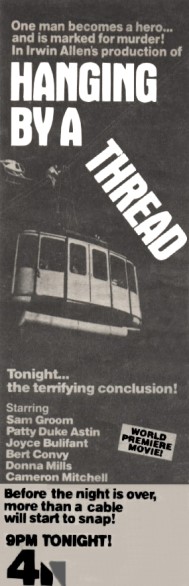
Hanging By A Thread (1979, directed by Georg Fenady)


A group of old friend who call themselves the Uptowners’ Club (yes, really) want to go on a picnic on top of a remote mountain.  The only problem is that they have to ride a cable car up to the mountain and there are reports of potentially bad weather.  It’s not safe to ride in a cable car during a thunderstorm.  Drunken ne’er-do-well Alan (Bert Convy) doesn’t care and, since his family owns both the mountain and the tramway, his demands that he and his friends be allowed to ride the cable car are met.  One lightning strike later and the members of the Uptowners’ Club are stranded in a cable car that is perilously suspended, by only a frayed wire, over treacherous mountain valley.

With no place to go, there’s not much left for the members of the Uptowners’ Club to do but bicker amongst themselves and have lengthy flashbacks that reveal every detail of their own sordid history.  Paul (Sam Groom) is angry with Alan because Alan is now engaged to his ex-wife (Donna Mills).  Sue Grainger (Patty Duke) is angry with everyone else because they don’t want to admit how their old friend Bobby Graham (Doug Llewellyn) actually died.  The other members of the Uptowners’ Club are angry because there’s not much for them to do other than watch Duke and Convy chew on the scenery.  Because of the supposedly fierce winds, someone is going to have to climb out on top of the cable car and repair it themselves.  Will it be Paul or will it be cowardly drunk Alan?  On top of everything else, Paul is set to enter the witness protection program and has got hitmen who want to kill him.

This made-for-TV disaster movie was produced by Irwin Allen.  Are you surprised?  It’s also three hours long and amazingly, Leslie Nielsen is not in it.  It’s hard to understand how anyone could have produced a cable car disaster film and not given a role to Leslie Nielsen.  Cameron Mitchell’s in the film but he’s not actually in the cable car so it’s a missed opportunity.  Any film that features Patty Duke detailing how her friends got so drunk that they ended up killing the future host of The People’s Court is going to at least have some curiosity value but, for the most part, Hanging By A Thread gets bogged down by its own excessive runtime and lack of convincing effects.  Hanging By A Thread came out at the tail end of the 70s disaster boom and it shows why the boom didn’t continue into the 80s.

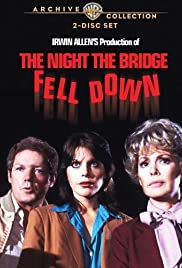
The Night the Bridge Fell Down (1983, directed by Georg Fenady)


When civil engineer Carl Miller (James MacArthur) discovers that the Madison Bridge is on the verge of collapsing, he goes to his superior (Philip Baker Hall!) and explains that the bridge has to be closed down or people could die.  Since there wouldn’t be a movie if anyone listened to Carl’s concerns, he’s ignored.

No sooner has Carl been told that he doesn’t know what he’s talking about than the bridge suddenly starts to collapse.  With both ends of the bridge collapsing into the river below, a diverse group of people find themselves stranded in the middle.  The group is made up of the usual group of disaster movie characters and, of course, one of them is played by Leslie Nielsen.  This time, Nielsen is a crooked businessman with a mistress (played by Barbara Rush) and a baby to worry about.  Eve Plumb (who was a member of the original Brady Bunch) is a nun.  Richard Gilliland is a wounded cop.  Gregory Sierra is a landscaper.  Perhaps most improbably, clean-cut Desi Arnaz Jr. is a bank robber who keeps losing his temper and pointing a gun at everyone.  Carl has to figure out how to get everyone off of the bridge before the entire things collapses.  This leads to many shots of chunks of concrete falling off what’s left of the bridge, as if we need to be reminded that it’s dangerous to be on a bridge that’s in the process of very slowly collapsing.

After finding success making movies about fires, overturned ocean liners, volcanoes, cave-ins, and killer bees, I guess it only makes sense that Irwin Allen would finally get around the producing a movie about a collapsing bridge.  The Night The Bridge Fell Down was filmed in 1980 but it wasn’t aired until 1983.  When it did air, it played opposite the series finale of M*A*S*H, which remains one of the highest rated single episodes of television ever aired.  It’s obvious that no one had much faith in a three hour film about a collapsing bridge and it only aired because NBC needed something — anything — to air at a time when they knew no one would be watching.

Because of the lengthy amount of time between the film’s production and it’s airing, The Night The Bridge Fell Down is the type of serious and plodding disaster film that was popular in the 70s but, by the time 1983 rolled around, had been rendered obsolete by the satiric bards of Airplane!  Airplane‘s Leslie Nielsen even appears here, giving the type of serious performance that he specialized in before people discovered that he was actually a very funny man.  Nielsen doesn’t give a bad performance but everything he says is thoroughly undercut by how difficult it is to take Leslie Nielsen seriously.  No matter what Nielsen says, it always seems like he’s on the verge of adding, “And don’t call me Shirley.”

The main problem with The Night The Bridge Fell Down is that it’s a three-hour movie and that’s a long time to spend with a group of thinly characterized people on a bridge.  I guess the film does feature an important message about maintaining roads and bridges.  Watch it next Infrastructure Week.