Lisa Marie Reviews An Oscar Nominee: Mississippi Burning (dir by Alan Parker)


1988’s Mississippi Burning opens on a lonely Mississippi backroad in 1964.  A car is pulled over by the police.  Inside the car are three young men, one black and two white.  Judging from their nervous expressions and the sound of the people who stopped them and the fact that they’re in Mississippi during the 60s, we can guess what is about to happen to the people in the car.

With the three men, who were civil rights activists who were involved in voter registration efforts, officially considered to be missing, the FBI sends down two agents to find out what happened.  The two agents are Alan Ward (Willem DaFoe) and Rupert Anderson (Gene Hackman).  Ward is a Northerner who does things by the book and who resents having to deal with lax Southern law enforcement.  He is serious-minded and, just in case we need a reminder of how serious he is, he wears bar-rimmed glasses that make him look like the world’s most fearsome IRS agent.  Anderson is from Mississippi.  He’s a talkative good ol’ boy who was a sheriff before he joined the FBI.  “You know what has four eyes but can’t see?” Anderson asks, “Mississippi.”  It’s a tense partnership, as Ward sometimes disapproves of Anderson’s methods and Anderson thinks that Ward doesn’t understand how things work in Mississippi.

From the first minute we meet local law enforcement, we know that they’re the killers.  Just the fact that one of them are played by Brad Dourif is evidence enough.  However, no one in town is willing to say a word against the police or their cronies.  The white citizens are either too intimidated or they agree with what happened to the three civil rights workers.  (The three men are often referred to as being “outside agitators.”)  The black townspeople live in fear of the Klan and have no reason to trust the word of white FBI agents like Ward and Anderson.

Ward and Anderson investigate the case, hoping that they can find some bit of evidence that will prove the guilt of Sheriff Stuckey (Gailard Sartain), Deputy Pell (Brad Dourif), KKK leader Clayton Townley (Stephen Tobolowsky), and maybe even the town’s mayor (R. Lee Ermey).  One advantage that the FBI has is that the murderers are incredibly stupid.  Another is that Deputy Pell’s abused wife (Frances McDormand, giving the film’s best performance) might be persuaded to testify against her husband.

Mississippi Burning is an example of both powerful filmmaking and problematic history.  Like Ridley Scott, director Alan Parker got his start making commercials and he brought the same sensibility to his movies.  He knew what audiences wanted to see and he made sure to give it to them.  Mississippi Burning looks fantastic and is full of memorable performances.  (Both McDormand and Hackman received Oscar nominations).  The action moves quickly and the villains are so hateful that watching them end up getting humiliated really does bring about a sort of emotional release.

At the same time, this is a film about the Civil Rights era that presents the FBI as being the heroes.  And while it’s true that the FBI did investigate the real-life murders that inspired this film, Mississippi Burning leaves out the fact that the FBI was just a rigorous in harassing and wire tapping Martin Luther King as they were in keeping an eye on the leaders of the Klan.  It’s a film about racism in which the heroes are as white as the villains.  Gene Hackman gives a good performance as Rupert Anderson but the film never really delves all that deeply into Anderson’s feelings about racism in the South.  We’re told that he was a sheriff in Mississippi but we never learn much about what type of sheriff Anderson was.  He’s opposed to the Klan but, historically, the same can be said of many segregationists in the 60s, many of whom felt the Klan’s activities brought unwanted federal attention to what was happening in their home states.  By not delving into Anderson’s own history as a member of Mississippi law enforcement or the FBI’s own more problematic history when it comes to the civil rights movement, the film provides viewers with the escape of viewing the bad guys as being aberrations as opposed to being the norm in 1964.  In the end, Mississippi Burning is an effective thriller with strong heroes and hateful villains.  Just don’t watch it for historical accuracy.

Mississippi Burning was nominated for Best Picture but it lost to Rain Man.

Lisa Reviews An Oscar Winner: Unforgiven (dir by Clint Eastwood)


The 1992 Best Picture winner, Unforgiven, begins as a story of frontier justice.

In Kansas, a young and cocky cowboy who calls himself the Schofield Kid (Jaimz Woolvett) rides up to an isolated hog farm.  He’s looking for Will Munny (Clint Eastwood), a notorious outlaw with a reputation for being a ruthless killer.  Instead, he just finds a broken down, elderly widower who is trying to raise two young children and who can barely even manage to climb on a horse.  Will Munny, the murderer, has become Will Munny the farmer.  He gave up his former life when he got married.

The Schofield Kid claims to be an experienced gunfighter who has killed a countless number of men.  He explains that a group of sex workers in Wyoming have put a $1,000 bounty on two men, Quick Mike (David Mucci) and his friend, Davey Bunting (Rob Campbell).  Quick Mike cut up one of the women when she laughed at how unimpressively endowed he was.  While Davey didn’t take part in the crime, he was present when it happened and he didn’t do anything to stop it.  The local sheriff, a man named Little Bill Daggett (Gene Hackman), had Davey give the woman’s employer several horses as compensation.  The Kid wants Munny to help him collect the bounty.

At first, Munny refuses to help the Kid.  But, when he realizes that he’s on the verge of losing his farm, Munny changes his mind.  He and his former partner, Ned Logan (Morgan Freeman), join with the Kid and the three of them head to Wyoming.  Along the way, they discover that the Kid is severely nearsighted and can hardly handle a pistol.

Meanwhile, in the town of Big Whiskey, Wyoming, Little Bill ruthlessly enforces the peace.  He’s a charismatic man who is building a house and bringing what many would consider to be civilization to the Old West. When we first meet Little Bill, he seems like a likable guy.  The town trusts him.  His deputies worship him.  He has a quick smile but he’s willing to stand his ground.  But it soon becomes apparent that, underneath that smile and friendly manner, Bill is a tyrant and a petty authoritarian who treats the town as his own personal kingdom.    Little Bill has a strict rule.  No one outside of law enforcement is allowed to carry a gun in his town.  When another bounty hunter, English Bob (Richard Harris), comes to town to kill the two cowboys, Little Bill humiliates him and sends him on his way but not before recruiting Bob’s traveling companion, writer W.W. Beauchamp (Saul Rubinek), to write Bill’s life story.  Bill’s not that much different from the outlaws that he claims to disdain.  Like them, Bill understands that value of publicity.

Unforgiven starts as a traditional western but it soon becomes something else all together.  As the Schofield Kid discovers, there’s a big difference between talking about killing a man and actually doing it.  Piece-by-piece, Unforgiven deconstructs the legends of the old west.  Gunfights are messy.  Gunfighters are not noble.  Davey Bunting is the only man in town to feel guilty about what happened but, because he’s included in the bounty, he still dies an agonizing death.  Quick Mike is killed not in the town square during a duel but while sitting in an outhouse.  Ned and Munny struggle with the prospect of going back to their old ways, with Munny having to return to drinking before he can once again become the fearsome killer that he was in the past.  And Little Bill, the man who says that he’s all about taming the west and bringing civilization to a lawless land, turns out to be just as ruthless a killer as the rest.  A lot of people are dead by the end of Unforgiven.  Some of them were truly bad.  Some of them were good.  Most of them were in the wrong place at the wrong time.  Everyone’s got it coming, to paraphrase Will Munny.

With its violent storyline, deliberate pacing, and its shots of the desolate yet beautiful western landscape, Clint Eastwood’s film feels like a natural continuation of the Spaghetti westerns that he made with Sergio Leone.  (Unforgiven is dedicated to both Leone and Don Seigel.)  Unforgiven was the first of Eastwood’s directorial efforts to be nominated for Best Picture and also the first to win.  It’s brutal meditation on violence and the truth behind the legends of the American frontier.  Eastwood gives one of his best and ultimately most frightening performances as Will Munny.  Gene Hackman won his second Oscar for playing Little Bill Daggett.

Unforgiven holds up well today.  Hackman’s Little Bill Dagget feels like the 19th century version of many of today’s politicians and unelected bureaucrats, authoritarians who claims that their only concern is the greater good but whose main interest is really just increasing their own power.  Unforgiven remains one Clint Eastwood’s best films and one of the best westerns ever made.  Leone would have been proud.

HOOSIERS and a son of a basketball coach!


HOOSIERS is based on the true story of a small high school winning the Indiana state basketball championship in 1954. Gene Hackman plays Coach Norman Dale, the once successful college coach who gets a second chance when he’s hired to coach high school basketball in the tiny town of Hickory, Indiana. It takes some time for Coach Dale to whip the talented, but undisciplined young men into a team, and it also takes a little time for local legend Jimmy Chitwood to decide that he will play basketball again. Chitwood had stopped playing prior to the arrival of Coach Dale, but after watching the way the coach goes about his business, he decides he’ll give it another go. After a rough start, the team starts playing good basketball and starts piling up wins as they make their way towards a potential state championship.

HOOSIERS was released when I was 13 years old, and it has been one of my favorite movies for almost 40 years. Why, you might ask? I’ll start by giving you a little Bradley Crain family history. First, basketball was my life growing up. My dad was a teacher and high school basketball coach. From the earliest days I can remember, my dad was teaching me how to play basketball. He taught me the proper techniques for shooting, and through lots of practice I became very good at it. I’m one of those people who could be referred to as a “gym rat.” The only things I wanted to do growing up were play basketball and go fishing. I have a brother who is one year and 5 days older than me, and he loved basketball too. The competition between the two of us made it difficult at times at home, but it also pushed us to get better. Second, I grew up in a small rural community in Arkansas known as Toad Suck, and I went to school in the small town of Bigelow, Arkansas. Bigelow was classified as a “Class B” school for sports purposes. This was the smallest classification that you could be in, and my class consisted of approximately 40 students. Finally, when HOOSIERS came out I was in junior high and my dream was to win a high school state basketball championship. Our teams were good, and I was still young and naïve enough to believe anything was possible. We even won the district championship my 9th grade year, which was the year after HOOSIERS was released. Alas, the chips didn’t fall our way, and even though we won a lot of basketball games over the next few years, there were no state championships. Now back to the movie!

One of my favorite things about HOOSIERS is the cast of young men hired to play the members of the team. So often in movies, the actors that are supposed to be good at basketball are clearly not. That’s not the case in HOOSIERS. These guys can act and are talented basketball players as well. And what can I say about the cast that includes a marvelous Gene Hackman as the coach, and Dennis Hopper as the friendly, but alcoholic dad of one of the players who “knows everything there is to know about the greatest game ever invented.” Hopper is phenomenal, and his work was recognized with an Oscar nomination.  Finally, as the team is making its way towards the championship, each player is given a moment to shine and do their part to help the team. I liked that. It all makes for an exciting and heartwarming true story that pretty much anyone can enjoy. I still love the movie now just thinking about it!

Scenes That I Love: Harry’s Nightmare from The Conversation


1974 was a very good year for Francis Ford Coppola.  Not only did he direct the Oscar-winning Godfather Part II but he also directed another film that was nominated for Best Picture, an intense study of paranoia called The Conversation

Today’s scene that I love comes from The Conversation.  Surveillance expert Harry Caul (Gene Hackman, giving one of his best performances) fears that his work may lead to murder.  In this scene, he has a nightmare in which he tries, in vain, to talk to one of the people who he has been surveilling.  This scene perfectly captures the horrific logic and helpless feeling of a nightmare.  Harry, who is not the most open or emotional of men, can only be his true self in his dreams.

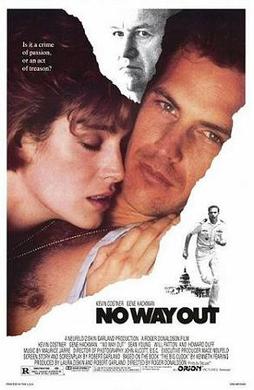
14 Days of Paranoia #7: No Way Out (dir by Roger Donaldson)


Trust no one in Washington would seem to be the message of this 1987 thriller.

Kevin Costner plays Lt. Commander Tom Farrell, a Naval Intelligence officer who is hailed as a hero after saving a shipmate who falls overboard.  In Washington, Tom is recruited by a friend from college, Scott Pritchard (Will Patton), to work for Secretary of Defense Brice (Gene Hackman).  Brice doesn’t trust the head of the CIA (played by future senator, Fred Dalton Thompson) and he wants Tom to serve as his mole within the service.  What Brice doesn’t know is that Tom is sleeping with Brice’s mistress, Susan Atwell (Sean Young).

Still, Brice does suspect that the woman with whom he is cheating is also cheating on him.  When he confronts her about it, their argument leads to him accidentally pushing Susan over an upstairs railing.  Pritchard, who is implied to be in love with Brice, takes charge of the cover-up and decides to push the story that Susan was killed by a possibly mythical Russian agent who is known only by the name “Yuri.”

Tom assists with the investigation of her death, both because he wants to know who killed Susan and also because he knows that there’s evidence in Susan’s apartment that could be manipulated to make him look guilty of the crime.  For instance, Susan took a picture of Tom shortly before her death.  The picture failed to develop but, through the use of what was undoubtedly cutting edge technology in 1987, Naval Intelligence is slowly unscrambling the picture.  For Tom, it’s a race against time to find the actual killer before the picture develops and he’s accused of both killing Susan and being Yuri.

Everyone has an agenda in No Way Out, from the ambitious Brice to the fanatical Scott Pritchard to the head of the CIA, who wants Brice to approve funding for a costly submarine.  Even the film’s nominal hero has an agenda, which has less to do with finding justice for Susan and everything to do with protecting himself and his future.  In fact, as is revealed in the film’s enjoyable if slightly implausible twist ending, some people in Washington have multiple agendas.  The film portrays Washington as being a place where, behind the stately facade, everyone is a liar and everyone is ultimately a pawn in someone else’s game.  If you have the right connections, you can even get away with murder.  Loyalty is rewarded until you’re no longer needed.

It’s an enjoyably twisty thriller, one that makes good use of the contrast between Kevin Costner’s All-American good looks and his somewhat shady screen presence.  The film introduces Costner as being a character who, at first glance, seems almost too good to be true and then spend the majority of its running time suggesting that is indeed the case.  Gene Hackman is well-cast as the weaselly cabinet secretary, as is Sean Young as the woman who links them all together.  In the end, though, the film is stolen by Will Patton, who plays Scott Pritchard as being someone who has unknowingly given his loyalty to a man who is incapable of returning it.  As played by Patton, Scott is an outsider who desperately wants to be an insider and who is willing to do just about anything to accomplish that goal.  He’s a version of Iago who never turned against Othello but instead devoted all of his devious tricks to trying to cover up the murder of Desdemona.

Even with an over-the-top final twist, No Way Out holds up well as a portrait of how the lust for power both drives and corrupts our political system.

14 Days of Paranoia:

  1. Fast Money (1996)
  2. Deep Throat II (1974)
  3. The Passover Plot (1976)
  4. The Believers (1987)
  5. Payback (1999)
  6. Lockdown 2025 (2021)

Scenes That I Love: Gene Hackman In Mississippi Burning


I was in a medically-approved Vicodin haze yesterday so I missed the fact that it was Gene Hackman’s birthday!  Well, let’s make up for it today with a scene of Hackman being a righteous badass in 1988’s Mississippi Burning.

If you need any proof that Gene Hackman is one of our best actors, just consider that it’s been nearly 20 years since he retired from acting and he’s rarely seen out in public (reportedly due to just naturally being a very private man) yet he remains a popular performer who earns new fans every day.  In this scene, Hackman plays an FBI agent who lets a bunch of racists know that just because he might share their accent, that doesn’t mean that he shares their beliefs.  No one could go from friendly to intimidating with as much style as Gene Hackman.

(And yes, that is a young Michael Rooker getting put in his place, along with Brad Dourif.)

Scenes That I Love: Ernest Borgnine Yells In The Poseidon Adventure


Ernest Borgnine, that great character actor, was born 104 years ago today.  In tribute, today’s scene that I love comes from one of my favorite Borgnine films, 1972’s The Poseidon Adventure.

Borgnine was a great yeller and, in The Poseidon Adventure, he even manages to outyell the great Gene Hackman.

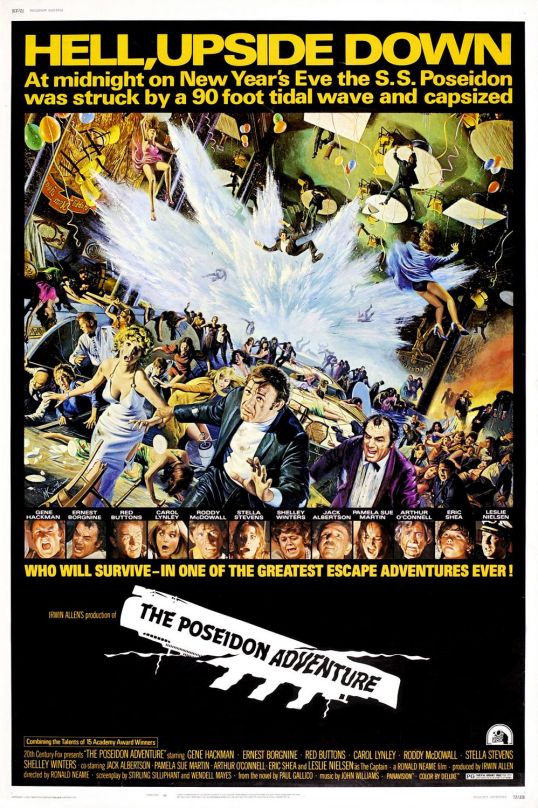
Scenes That I Love: Happy New Year From The Poseidon


Happy new year!

With 2023 coming in like a tidal wave, it only seem fitting that the first scene that I love for this year should come from 1972’s The Poseidon Adventure.  Just as how Die Hard has recently been acclaimed as one of the great Christmas films, The Poseidon Adventures is one of the best of the New Year’s Day films.  It’s also perhaps the only film in which Gene Hackman managed to overact more than even Ernest Borgnine.  I mean, don’t get me wrong.  It’s a strong competition between two great actors, neither of whom was known for being particularly subtle when it came to barking out their lines.  But, in the end, Hackman still managed to take the overacting crown for this film.

(That said, what’s New Year’s Day without Borgnine shouting, “Where’s your God now, Preach-ah!?”)

In the scene below, the passengers ring in the new year while Leslie Nielsen faces the tidal wave that will soon turn the boat upside down.  Whatever else you may want to say about this particular film, it does a great job of contrasting the celebrations in the ballroom with the dread on the bridge.  While everyone else is counting down and celebrating and mugging for the camera, Nielsen can only stare in stoic horror as the wave approaches.  He does the only thing that a captain can do.  He sounds the alarm.  He sends out an S.O.S.  Unfortunately, the alarm can barely be hard over the celebrations of the new year and the S.O.S. man is quickly swept away by the crashing of the wave.

The scene goes from celebrating the future to highlighting the type of old-fashioned, nature-fueled destruction that has been wiping out civilizations since the beginning of time.  It doesn’t matter how many plans you’ve made.  It doesn’t matter how rich  you are.  It doesn’t matter how safe you feel or how much you cling to the furniture as the world turns upside down.  Fate, whether it’s in the form of a wave or some other natural disaster, is pitiless.  That’s one reason why disaster movies, as melodramatic as they could often be, so entranced audiences.  Everyone knew that it would just as easily happen to them.  Just as no one expected the tidal wave on New Year’s, no one would be expecting to leave the theater to be confronted by an earthquake or a tornado.  But it could definitely happen.  Life, like society, is a fragile thing.  If not even Gene Hackman, Stella Stevens, Shelley Winters, and Roddy McDowall could make it to the end of the movie, what hope is there for anyone?  Of course, the thing to remember is that they may not have made it but Ernest Borgnine, Red Buttons, Carol Lynley, and a few others did.  They survived, though I imagine they spent the rest of their lives dreading January 1st.

Needless to say, neither the passage of time nor the wave can be escaped.  As much as we may have things left to do in 2022, it’s too late now. 2023 is here and the world has moved on.

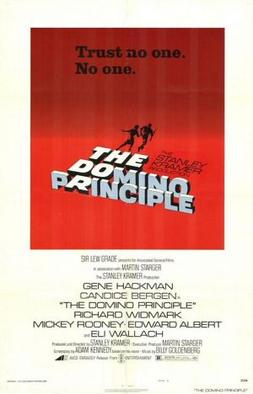
The Domino Principle (1977, directed by Stanley Kramer)


Roy Tucker (Gene Hackman) loyally served his country as a part of a “search and destroy” team in Vietnam but when he returned home, he discovered that America didn’t appreciate his sacrifice.  When he was convicted of murdering his wife’s abusive first husband, he was tossed in prison.  But now, two mysterious men (Richard Widmark and Edward Albert) have offered Tucker a chance to escape from prison and reunite with his wife (Candice Bergen) in Costa Rica.  The only catch is that they also expect Tucker to do a job for “the Organization” and assassinate an unidentified target.  As Tucker discovers, The Organization has been watching and manipulating him entire life, setting him up for this very moment.  Every small event in Tucker’s life led to another event that eventually sent him to both the war and to prison.  It’s almost like a game of dominos.  And we have a title!

The Domino Principle gets off to a good start, with a black-and-white montage of actual assassinations and then an opening credit sequence that features someone placing dominos over pictures of Roy Tucker at different ages.  (I am guessing that actual childhood photos of Gene Hackman were used because even the baby pictures feature the Hackman squint.)  However, the scene immediately following the credits features Gene Hackman and Mickey Rooney as cellmates and the film never really recovers.  Though they were both talented actors, Gene Hackman and Mickey Rooney don’t seem as if they belong on the same planet together, let alone sharing a prison cell in a grim and downbeat political thriller.  Hackman is his usual surly self, while Mickey seems like he’s going to try to get the entire prison to put on a show.  The film tries to do some unexpected things with Mickey’s character but it doesn’t change the fact that he’s Mickey Rooney and he just doesn’t belong here.

As for the rest of The Domino Principle, it’s slow and ponderous.  Best known for earnest social issue films like The Defiant Ones and Guess Whos’ Coming To Dinner, Stanley Kramer is the wrong director for a film that aspires to duplicate the conspiracy-themed atmosphere of other 70s thrillers like The Parallax View and Three Days of the Condor.  For all the time that film takes to build to its obvious conclusion, Kramer doesn’t even bother to identify who Tucker is supposed to kill or why the Organization wants him dead.  Though he seems like he should be a good choice for the lead role, Gene Hackman goes through the movie on autopilot.  Perhaps he was overwhelmed to be sharing a prison cell with Mickey Rooney or to be playing the husband of Candice Bergen, who the film unsuccessfully attempts to deglamorize.

Sadly, this would be one of Kramer’s last films.  He followed it up with The Runner Stumbles, which starred Dick Van Dyke (!) as a conflicted priest, and then went into semi-retirement.  (A few attempts to return to directing failed.)  Kramer spent his twilight years writing about movies for The Seattle Times.  Before his death in 2001, he also published a very entertaining autobiography, A Mad Mad Mad Mad World: A Life in Hollywood, which I recommend to anyone interested in the history of Hollywood.

Lisa Reviews a Palme d’Or Winner: Scarecrow (dir by Jerry Schatzberg)


With the 2021 Cannes Film Festival underway in France, I thought this would be a good opportunity to spend the next few days looking at some of the films that have won the Palme d’Or in the past.  As of this writing, 100 films have won either the Palme d’Or or an earlier version of the award like the Grand Prix du Festival International du Film.  Some of those films — like Parasite, The Tree of Life, The Piano, Pulp Fiction — went on to huge box office success and Oscar renown.  Others, like 1973’s Scarecrow, did not.

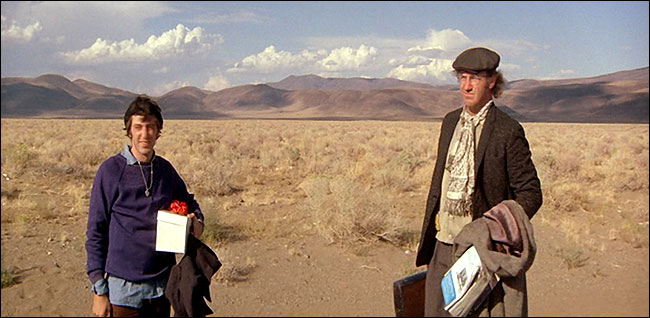
Scarecrow is an example of a type of film that was very popular in the 70s.  It’s a road film, one in which two or more people take a journey across the country and discover something about themselves and, depending upon how ambitious the film was, perhaps something about America as well.  Scarecrow centers on two drifters, who just happen to meet on a dusty road while they’re trying to hitch a ride.  Max (Gene Hackman, fresh off of winning an Oscar for The French Connection) is an ex-convict with a bad temper and a huge chip on his shoulder.  Lion (a young Al Pacino, fresh off of The Godfather) is an ex-sailor who views the world with optimism and who appears to be sweet-natured but simple-minded.  To be honest, it’s a little bit hard to believe that the perpetually resentful Max and the always hopeful Lion would ever become friends but they do.  They travel around the country, talking about their dreams of opening a car wash together.  They meet up with ex-girlfriends and ex-wives.  Eventually, they even end up in a prison farm together, where Lion, temporarily estranged from Max, is taken advantage of by a sadistic prisoner named Riley (Richard Lynch).

Scarecrow is an episodic film, one that moves at its own deliberate pace.  (If that sounds like a polite way of saying that the film is slow-moving …. well, it is.)  Director Jerry Schatzberg was a photographer-turned-director and, as a result, there’s several striking shots of Max and Lion standing against the countryside, waiting for someone to pick them up and give them a ride.  Whenever Max and Lion end up in a bar, the scene is always lit perfectly.  At the same time, Schatzberg also attempts to give the film a spontaneous, naturalistic feel by letting scenes run longer than one would normally expect.  There’s several scenes of Hackman and Pacino just talking while walking down a country road or a city street.  On the one hand, you have to appreciate Schatzberg’s attempt to convince us that Max and Lion are just two guys with big dreams, as opposed to two Oscar-nominated actors pretending to be societal drop-outs.  On the other hand, Schatzberg’s approach also leads to an interminably long scene of Gene Hackman eating a piece of chicken and if you think that Gene Hackman was the type of actor who wasn’t going to act the Hell out of gnawing on and gesturing with a chicken bone, you obviously haven’t seen many Gene Hackman films.

The main appeal of the film, for most people, will probably be to see Gene Hackman and Al Pacino, two of the top actors of the 70s, acting opposite of each other.  Reportedly, both Hackman and Pacino went full method for the film and spent their prep time on the streets of San Francisco, begging for spare change.  The end result is a mixed bag.  There are a few scenes — like when they first meet or when they’re in prison — in which Hackman and Pacino are believable in their roles and you buy them as two lost souls who were lucky enough to find each other.  There are other scenes where they both seem to be competing to see who can chew up the most scenery.   Sometimes, Pacino and Hackman are compelling acting opposite each other.  Other times, it feels like we’re just watching an Actors’ Studio improv class that someone happened to film.  Too often, Hackman and Pacino seem to be so occupied with showing off their technique that the film’s reality seems to get lost under all of the method showiness.  In the end, neither one of the film’s stars makes as much of an impression as Richard Lynch, who is genuinely frightening in his small but key role.

Scarecrow is an uneven film, one that is occasionally effective but also a bit too studied for its own good.  It wears it influences — Of Mice and Men, Midnight Cowboy, Five Easy Pieces — on its sleeve but it also fails to exceed or match any of those previous works.  That said, the film does have its fans.  (Schatzberg has been working on a sequel for a while.)  Certainly, the 1973 Cannes Jury (headed by none other than Ingrid Bergman) liked it enough to give it the Palme.

Scarecrow 2