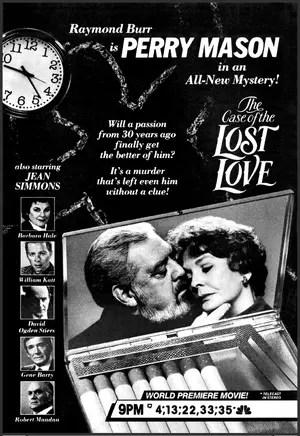
Perry Mason’s ex-girlfriend, Laura Robertson (Jean Simmons), is about to be appointed to the Senate when blackmailer Pete Dixon (Jonathan Banks) threatens to reveal that she once underwent shock treatment after having a nervous breakdown. When Dixon is murdered, Laura’s husband (Gene Barry) is arrested. Laura hires Perry (Raymond Burr) to serve as his attorney.
At first, this movie felt weird to me because it didn’t seem right for Perry to have an ex-girlfriend when we all know that he and Della (Barbara Hale) were in love. When Laura is at the office waiting to see Perry, she and Della have a conversation and it’s obvious that each is jealous of the other. When Laura asks, “What about you and Perry?,” Perry shows up before Della can answer. We all know what the answer was though. Della loves Perry and, probably because she was so upset over Perry dating Laura, she threw herself at Paul Drake, Sr. and that’s how we got Paul Drake, Jr.
As for Paul Drake, Jr. (William Katt), he flirts with two different women in this movie but he doesn’t get to do as much investigating as he did in the first few films. This movie is almost all Perry Mason interrogating people. Raymond Burr uses a cane in this movie and there’s a few scenes where it’s obvious that he was in pain but he still gives a very good performance. The movie is very talky but it also has the best courtroom confession scene yet and Raymond Burr really sells Perry’s ambivalent feelings. The identity of the killer actually took me by surprise!
It was weird to see Perry in love with someone oter than Della but this was still an excellent entry in the series.
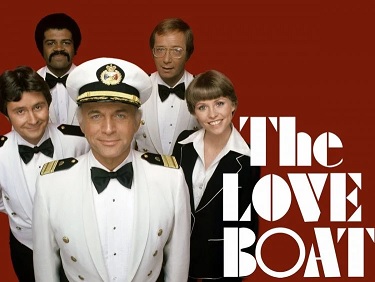
Welcome to Retro Television Reviews, a feature where we review some of our favorite and least favorite shows of the past! On Wednesdays, I will be reviewing the original Love Boat, which aired on ABC from 1977 to 1986! The series can be streamed on Paramount Plus!
This week, horror royalty boards the Love Boat!
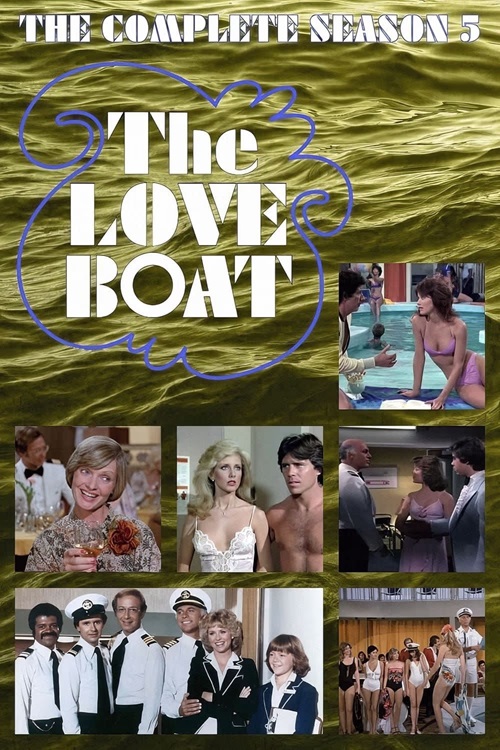
Episode 5.24 “Isaac Gets Physical/She Brought Her Mother Along/Cold Feet”
(Dir by Bob Sweeney, originally aired on March 20th, 1982)
For this week, and this week only, there’s a new member of the Love Boat crew. Charlene Glover (Shirley Hemphill) is a nurse who has been sent to give every member of the crew a physical in order to make sure that it’s safe for them to work on a cruise ship. Isaac panics because he has high blood pressure and he worries that he’s going to lose his job as a result. This would seem like a good opportunity for the show to share some tips on what to do if you suffer from high blood pressure but instead, the whole storyline is a smitten Charlene chasing Isaac and Isaac trying to change his medical records. It was a bit mean-spirited since most of the laughs came from the idea of Isaac having to get romantic with someone who was overweight in order to keep his job.
(That said, take your blood pressure seriously, everyone. My Dad had high blood pressure his entire life and it was not easy for him.)
Speaking of mean-spirited, Carter Randall (Richard Dean Anderson) is engaged to marry Muffy (Linda Blair …. yes, that Linda Blair) but he’s getting cold feet. So, he starts leaving her messages and making phone calls to her in which he speaks with a fake Southern accent. There are three Texans on the boat and Carter is pretending to be one of them, hoping that Muffy will fall in love with this imaginary person and then break off their marriage …. WHAT A JERK! And yet, somehow, this plan causes Carter to realize how much he does love Muffy and Muffy is totally forgiving when the truth comes out. Seriously, that’s not the Linda Blair that we all know from such classic films as SavageStreets and ChainedHeat! What the heck, Linda?
(I should also mention that Carter’s attempt at a Texas accent was terrible. In fact, none of the actors playing the Texans had a convincing accent. For shame, LoveBoat, for shame!)
Finally, Millicent (Betsy Palmer) boards the boat with her daughter, Debbie (Connie Needham). Debbie introduces Millicent to her boyfriend and it turns out that Debbie’s dating some guy who is at least twenty years old than her. In fact, Ted (Gene Barry) is so old that he used to date Millicent! Wow, creepy! Anyway, Millicent and Ted realize that they’re still in love so sorry, Debbie. Ted even says he fell in love with Debbie because she reminded him of Millicent. Somehow, Debbie learns all of this without jumping overboard.
As a horror fan, I enjoyed this episode. Gene Barry was in WaroftheWorlds. Linda Blair was in TheExorcist. Betsy Palmer was the original Mrs. Voorhies. They really should have aired this episode in October. The stories were terrible but I simply can’t resist an episode that featured this much horror royalty.
Welcome to Retro Television Reviews, a feature where we review some of our favorite and least favorite shows of the past! On Wednesdays, I will be reviewing the original Love Boat, which aired on ABC from 1977 to 1986! The series can be streamed on Paramount Plus!
This week, Vicki learns how to gamble.
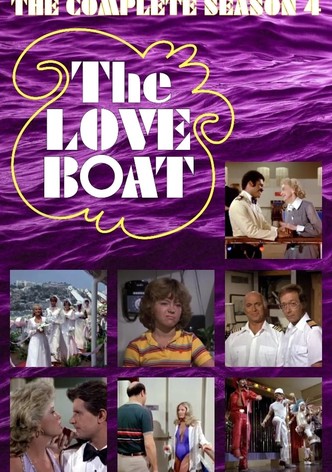
Episode 4.24 “That Old Gang of Mine/Love with a Skinny Stranger/Vicki and the Gambler”
(Dir by Richard Kinon, originally aired on April 11th, 1981)
It’s an anniversary cruise!
Captain Stubing and Vicki are celebrating the anniversary of Vicki coming to live on the boat with her father. Captain Stubing has already picked out the gift that he’s going to give Vicki, a beautiful and valuable pearl necklace. As for Vicki, there’s a watch in the boat’s gift shop that she would love to give her father but she can’t afford it. Then again, Vicki is the Captain’s daughter. Can’t she just take whatever she wants? I mean, who is going to snitch on the Captain’s daughter? Add to that, it was only two weeks ago that the manager of the gift shop was juggling three lovers on one cuise. Who is she to judge anything Vicki might do?
Admirably, Vicki is an honest person and does not want to just steal something for her father. But when her father’s old friend, Wade Hubbard (Gene Barry), boards the ship, he shows Vicki that she can easily make enough money to buy the watch by betting on a horse race! Wade, it turns out, is a compulsive gambler and Vicki soon falls under his influence. Captain Stubing is not happy about that so Wade pretends to lose all of his money (and Vicki’s necklace!) in order to trick Vicki into not only hating him but also hating gambling.
You know, Wade and Captain Stubing could have just told Vicki not to gamble anymore. Vicki seems like she’s pretty smart and level-headed so I’m sure she would have listened if Wade and the Captain had just told her that they didn’t want her placing bets as a minor. Instead, Wade created an elaborate lie and basically traumatized Vicki for life. That seems a bit extreme to me but, then again, I don’t have a gambling problem.
As for the other passengers, Patty Beller (Vicki Lawrence) is stunned when she discovers that her long-distance boyfriend, Phil Manning (Charles Siebert), has spent the last month at a fat farm and is now totally athletic and handsome. Patty always took it for granted that Phil would only have eyes for her but suddenly, every other woman on the cruise appears to be trying to get his attention. This story would have perhaps worked better if Patty hadn’t come across as being so self-centered. Phil explains that he lost the weight because he was worried about his health and tired of people making fun of him. To me, it seems like Phil should be applauded for his self-discipline and his desire to make a better life for himself. Instead, Patty gets upset that Phil is taking care of himself. Seriously, Phil — you can do better!
Finally, three old-time crooks (Jack Gilford, Jesse White, and Kaye Ballard) board the cruise and make plans to rob the safe. That shouldn’t be too hard since Gopher is the person in charge of watching the safe. However, the crooks are all elderly and out-of-touch with life in the swinging 80s. The safecracker has gone deaf and needs someone else to listen as he turns the dial. It’s all a bit silly but it was kind of a sweet story, largely due to the performances of Gilford, White, and Ballard.
The safecracker’s story aside, this episode of The Love Boat was a bit of a sour ride. Between Wade lying to Vicki and Patty wishing that her boyfriend was at risk for heart disease, this just wasn’t a very likable cruise. Hopefully, next week will be a bit more fashionable. Considering that the upcoming episode guest stars Glorida Vanderbilt, Bob Mackie, and Halston, I imagine it will be.
Welcome to Retro Television Reviews, a feature where we review some of our favorite and least favorite shows of the past! On Tuesdays, I will be reviewing the original Fantasy Island, which ran on ABC from 1977 to 1984. Unfortunately, the show has been removed from most streaming sites. Fortunately, I’ve got nearly every episode on my DVR.
Episode 5.8 “Lillian Russell/The Lagoon”
(Dir by Don Weis, originally aired on November 28th, 1981)
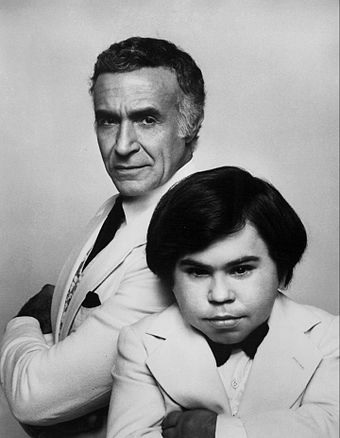
Tattoo is in this episode, which means that Julie only appears long enough to tell Mr. Roarke that she’s going to busy exploring the island with a bunch of hunky professors. (It says a lot about how poorly the Julie character has been developed that I couldn’t tell if Julie was supposed to be naive or clever when it came to going off with the men.)
At this point, it’s obvious that Julie was only added to the show to act as insurance in case Herve Villechaize walked off the set. Early on in the season, when Herve was apparently negotiating for a better contract, Julie had a few episodes where she was Roarke’s main assistant while Tattoo was described as being elsewhere on the island. But in the episodes where Tattoo is present, Julie always has to go do something else for the weekend. Ironically, Julie is such a bland and unnecessary character that it actually proves Herve Villechaize’s point about how important Tattoo was to the success of the show. By having Julie always leave whenever Tattoo is present, the show really only reminds the viewer that Roarke only needs on assistant and it’s Tattoo.
As for this week’s fantasies, they both have to do with the past.
Calvin Pearson (Claude Akin) has just spent years in prison for a crime that he didn’t commit. He’s finally been released and, understandably, he really doesn’t want to have much to do with the rest of the world. When he was a child, he spent a summer on a nearby island with his father. His father was fisherman and Calvin claims that he once caught a fish that could sing. Calvin wants to spend the weekend on the Island and he wants to catch the same serenading fish.
Sound like a pretty simple fantasy, right? Well, Calvin is not happy to discover that the he’s not alone on “my island.” There’s now a trading post, run by Jake Dutton (Broderick Crawford) and his daughter, Mira (Pamela Susan Shoop). Even worse, there are some recently escaped convicts (led by Glenn Corbett) who want to kidnap Mira! At first, Calvin refuses to get involved. He just wants to fish. But, in the end, he finally does the right thing and saves the Duttons.
What about the “serenading fish?” Calvin may not have caught a fish but he did capture the heart of Mira, who hums a tune that she says she once heard out on the lagoon. Calvin leaves the Island alone but he tells Roarke that he plans to return so that he can work at the trading post with the Duttons.
This fantasy was a bit predictable and you really do have to wonder why Roarke insists on nearly getting his guests killed every week. It seems like that would lead to a lawsuit. But the fantasy does feature a good performance from Claude Akin as a man who manages to conquer his own bitterness.
As for the other fantasy, it features Phyllis Davis as a writer named Lilly Martin who wants to write a book about the singer Lillian Russell. Roarke sends her back to 1890s New York and literally transforms Lilly into Lillian Russell, complete with singing talent and two notorious suitors, “Diamond Jim” Brady (Gene Barry) and Peter Whiting (Craig Stevens). This fantasy was enjoyable eye candy, with Lilly getting to dress up as Lillian Russell and getting to wear all sorts of jewels. Unfortunately, it’s also a fantasy that ends with a poker game. I’ve never been able to follow poker and I always groan a little whenever the plot of a show hinges on the outcome. Whenever people start talking about “bluffing” and “royal flushes,” and all that, my eyes just glaze over and that was the case here.
That said, at least Mr. Roarke got to take part in Lilly’s fantasy, popping up not once but three times to see how everything was going! In fact, Mr. Roarke and Tattoo also popped up in Calvin’s fantasy. It’s always fun when Roarke drops in.
The poker game aside, this was an enjoyable trip to the Island. Season 5 has been a bit uneven but this was one of the better episodes.
Welcome to Retro Television Reviews, a feature where we review some of our favorite and least favorite shows of the past! On Tuesdays, I will be reviewing the original Fantasy Island, which ran on ABC from 1977 to 1986. Almost the entire show is currently streaming is on Youtube, Daily Motion, and a few other sites.
Smiles, everyone, smiles!
Episode 4.9 “Sanctuary/My Late Lover”
(Dir by Leslie H. Martinson, originally aired on January 3rd, 1981)
This week brings us two fantasies, neither one of which quite works.
Thomas Henshaw (Bobby Sherman) is a man who does not initially appear to be too happy to be on Fantasy Island. That’s because someone has poisoned him and he only has a day or two to live. His fantasy is to go the Sanctuary, an exclusive resort for killers, and track down his assassin. Henshaw has got one clue, a strand of hair that he found on his clothing. All has to do is find someone who has the same hair. This would make perfect sense in a world where only one person had light brown hair. It make less sense in the real world or, for that matter, even on Fantasy Island.
Mr. Roarke gives Thomas Henshaw a serum that will prolong his life for a few days. Henshaw goes to the Sanctuary, where he immediately finds himself being menaced by Sid Haig! Sid plays the bad guy’s henchman. There’s a scene where Thomas attempts to grab a strand of Sid’s hair and instead pulls off his wig. Sid does not look particularly amused by the whole thing.
Thomas meets and falls for Tessa (Morgan Brittany), who is basically owned by one of the assassins. Thomas changes his fantasy, telling Mr. Roarke that he just wants Tessa to be free, even if that means that he loses his chance to track down the killer. Mr. Roarke agrees to the change but no worries. Thomas still manages to track down his assassin and learn the name of the poison. (He also snatches a strand of hair off of the bad guy’s head and declares, “It’s the same!” DNA testing used to be so simple!) Mr. Roarke and the Fantasy Island cops show up and arrest the killer and also provide an antidote to Thomas. Thomas lives and leaves the Island with Tessa.
The main problem with this fantasy is that Bobby Sherman was extremely miscast, giving a performance that was so mild that you never once believed he could be at the center of a murder-for-hire scheme. Michael Cole, who plays one of the assassins, perhaps would have been believable as Thomas Henshaw. For that matter, if the show’s producers and writers had really been willing to think outside the box, it would have been interesting to see Sid Haig play a sympathetic role on Fantasy Island. But Bobby Sherman is just too bland for this type of story.
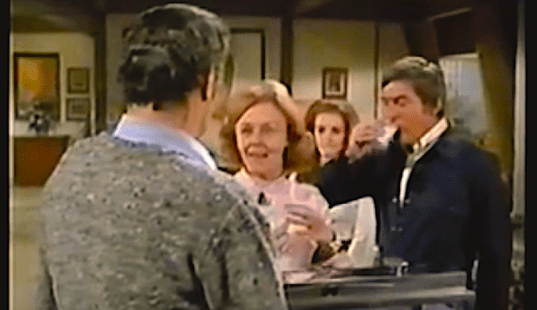
The other fantasy is also, sad to say, a bit bland. Anastasia Decker (Eva Gabor) is a wealthy widow who is trying to choose between three suitors. Complicating matters is the ghost of Anastasia’s husband, the charming Dex (Gene Barry). Dex keeps popping up and pointing out all of the flaws in the men who want to replace him. Anastasia cannot emotionally move on. Finally, Anastasia decides she wants to be with Dex so she tries to drive her car over a cliff! Luckily, Ghost Dex is able to magically stop the car in mid-air and return it to the road. Anastasia realizes that, of her suitors, nerdy-but-nice Walter (Craig Stevens) is the one who truly loves her and that’s who she leaves the Island with. Dex returns to the afterlife, happy in the knowledge that Anastasia will be able to move on.
I like it when Fantasy Island deals with the supernatural but this particular fantasy was so bland that not even a tap-dancing ghost could liven things up. Eva Gabor tried her best but this fantasy was the type of story that the show had already done several times in the past. Despite effective performances from Gabor, Barry, and Stevens, it was just a bit too familiar to be effective.
Well, this was a disappointing trip to the Island. Hopefully, the plane will bring something more interesting next week!
In the late 1970s, the Rev. Jim Jones was a very powerful man.
The leader of the California-based People’s Temple, Rev. Jones had made a name for himself as a civil right activist. As a minister, he made it a point to reach out to the poor and to communities of color. (It was said, largely by Jones, that he had been forced to leave his home state of Indiana by the Ku Klux Klan.) Local politicians eagerly sought not only Jones’s endorsement but also the donations that he could easily raise from the members of the People’s Temple. Though there were rumors that he was more of a cult leader than a traditional preacher, Jones was appointed chairman of the San Francisco Housing Authority. Everyone from Governor Jerry Brown to San Francisco Mayor George Moscone appeared with Jim Jones at campaign events. Among the national figures who regularly corresponded with Jim Jones were First Lady Rosalyn Carter and Vice President Walter Mondale.
Of course, what actually went on behind the closed doors of the People’s Temple was a bit of secret. Jones was a self-proclaimed communist who claimed to have had visions of an upcoming nuclear war between the U.S. and Russia. In his sermons, he often claimed that it would be necessary for both him and the rest of the People’s Temple to eventually leave the United States. Jones spoke of enemies that were trying to destroy him, like the reporters who investigated Jones’s claim of being a faith healer and who followed up on reports that Jones was sexually exploiting both the women and the men who followed him. Jones secretly started to make plans to leave the United States in 1973 but it would be another four years before he and a thousand of his followers arrived in Guyana. The People’s Temple Agricultural Project sat in the jungle, isolated from oversight. It was informally known as Jonestown.
Over the next year, Jonestown did not exactly thrive. Rev. Jones demanded that his people work hard and he also demanded that they spend several hours a day studying socialism and listening to him preach. Jones ran his commune like a dictator, refusing to allow anyone to leave (for their own safety, of course). Anyone who questioned him was accused of being an agent of the CIA. In the U.S, the families of Jonestown’s citizens became concerned and started to petition the government to do something about what was happening in Guyana. A few people who did manage to escape from Jonestown told stories of forced labor, suicide drills, rape, and torture. The People’s Temple claimed that those people were all lying and, because Jones still had his government connections, he was largely left alone.
Finally, in 1978, Congressman Leo Ryan, a Democrat who had a history of opposing the political establishment, flew down to Guyana so that he could see Jonestown for himself and also bring back anyone who wanted to leave. Despite the efforts of Jones to disguise the truth about life in Jonestown, several people did ask to leave the colony with Rep. Ryan. Jones sent his most loyal men to meet and open fire on Rep. Ryan’s entourage at a nearby airstrip. Rep. Ryan and four others were shot and killed, making Ryan the first Congressman to be assassinated since 1868. Nine others, including future Rep. Jackie Speier, were wounded in the attack.
Back at Jonestown, Jim Jones announced that his prophecy was coming true and that the imperialists would soon descend on Jonestown. Though 85 of Jones’s followers managed to escape into the jungle, the other 909 residents of Jonestown subsequently died. Though some showed signs of having been murdered by Jones’s followers, the majority committed suicide by drinking poisoned Flavor-Aid. Jim Jones shot himself in the head.
The world was horrified and the term “drinking the Kool-Aid” entered the discourse. And, of course, many filmmakers were inspired by the horrific events that happened in Jonestown. Ivan Rassimov, for instance, played a Jim Jones-style cult leader in Umberto Lenzi’s Eaten Alive. Meanwhile, Powers Boothe would win an Emmy for playing Jim Jones in a 1980 television miniseries called Guyana Tragedy.
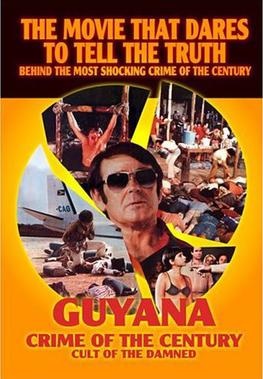
Guyana Tragedy is often described as being the definitive film about Jim Jones. However, a full year before Guyana Tragedy aired, the Mexican director, Rene Cardona Jr., was in theaters with his own version of the Jim Jones story. To anyone who is familiar with Cardona’s style of filmmaking, it’s perhaps not surprising that 1979’s Guyana: Crime of the Century did not win any awards.
Cardona’s film opens with a rather odd title card, explaining that, though the film is based on Jonestown, the names of certain characters “have been changed to protect the innocent.” But if you’re going to start the film by announcing that it’s about the biggest news story of the past year, what’s the point of changing anyone’s name? And for that matter, why is Jim Jones renamed James Johnson and his colony rechristened Johnsontown? Jones was hardly one of the innocents, not to mention that he was dead and in no position to sue when the film came was released. Why is Leo Ryan renamed Lee O’Brien, especially when the film portrays Ryan as being the type of hard-working and honest congressman that anyone would be happy to vote for?
The film opens with Rev. James “Johnson” (played by Stuart Whitman) giving a lengthy sermon about how it’s time for the congregation to move to Guyana, which he describes as being a Socialist paradise. Oddly, in the film, the People’s Temple is portrayed being largely white and upper middle class whereas, in reality, the opposite was true. Indeed, Jones specialized in exploiting communities that were largely marginalized by American society. One reason why Jones’s claim of government persecution was accepted by the members of his church is because the People’s Temple was made up of people who had very legitimate reasons for distrusting the American government.
A few scenes later, Johnson is ruling over “Johnsonville.” Since this is a Cardona film, the viewers are shown several scenes of people being tortured for displeasing Johnson. A child is covered in snakes. Another is shocked with electricity. A teenage boy and girl are forced to kneel naked in front of Johnson as he announce that their punishment for trying to run away is that they will be forced to have sex with someone of Johnson’s choosing. Once the torture and the nudity is out of the way, the film gets around to Congressman O’Brien (Gene Barry) traveling to the Johnsontown. Since the audience already knows what’s going to happen, the film becomes a rather icky game of waiting for O’Brien to announce that he’s ready to go back to the landing strip.
Because the film has been released under several different titles and with several different running times, Guyana: Crime of theCentury has gotten a reputation for being one of those films that was supposedly cut up by the censors. I’ve seen the original, uncut 108-minute version of Guyana and I can tell you that there’s nothing particularly shocking about it. Instead, it’s a painfully slow film that doesn’t really offer much insight into how Jim Jones led over 900 people to their deaths. While Gene Barry make for a convincing congressman, Stuart Whitman gives a stiff performance as the Reverend Johnson. There’s very little of the charisma that one would expect from a successful cult leader. One gets the feeling that Whitman largely made the film for the paycheck.
Of course, Whitman was hardly alone in that regard The film features a host of otherwise respectable actors, including Yvonne DeCarlo, Joseph Cotten, John Ireland, Robert DoQui, and Bradford Dillman. As well, Cardona regular Hugo Stiglitz appears as a photographer. (Stiglitz is perhaps best known for starring in Nightmare Cityand for lending his name to a character in Tarantino’s Inglourious Basterds.) Of the large cast, I appreciated the performances of Cotten and Ireland, who play Johnson’s amoral but well-connected attorneys. (The characters are based on the Temple’s real-life attornes, Charles Garry and Mark Lane. Lane also wrote the first JFK conspiracy book, Rush to Judgment.) I also liked Yvonne DeCarlo’s performance as the most devoted of Johnson’s followers. Even Bradford Dillman’s natural blandness was used to good effect as his character comes to represent the banality of evil when it comes time for him to start administering the Flavor-Aid. But those good performances still can not overcome the film’s slow pace and the fact that the film didn’t bring any new insight to the tragedy.
The film sticks fairly close to what is believed to have actually happened at Jonestown but, in the end, it barely even works as an example of shameless grindhouse filmmaking. It’s not even offensive enough to be enjoyable on a subversive level. Instead, it was just a quick attempt to make some money off of the crime of the century.
Welcome to Retro Television Reviews, a feature where we review some of our favorite and least favorite shows of the past! On Wednesdays, I will be reviewing the original Love Boat, which aired on ABC from 1977 to 1986! The series can be streamed on Paramount Plus!
Things get a bit icky this week. Ugh!
Episode 2.5 “Julie’s Aunt/Where Is It Written?/The Big Deal”
(Dir by Allen Baron, originally aired on October 14th, 1978)
How icky can one cruise get?
Well, consider this. On this week’s episode of The Love Boat, Captain Stubing’s uncle (Red Buttons) is a passenger on the boat. Uncle Cyrus decides that he likes Julie. How does he express how much he likes Julie? He invites her to his cabin and then lunges at her and starts kissing her. Julie runs out of the cabin and Uncle Cyrus chases her through the corridors of the boat. Once Julie does get away from him, she tells Doc and Gopher about what happened. Doc and Gopher both think that it’s funny.
(Uhmm, guys, this isn’t some old guy with a crush. This is someone who invited the cruise director to his cabin …. AND ATTACKED HER!)
Everyone agrees that Julie should just try to avoid Cyrus and that she should not tell the Captain about what happened. Unfortunately, because Uncle Cyrus told the Captain about how much he enjoys Julie’s company, Stubing insists that Julie spend as much time as possible with Uncle Cyrus. Every time that Julie goes down to his cabin, Cyrus grabs her and starts kissing her. Scene after scene, Julie has to push Cyrus off of her so that she can escape, screaming, into the hallway.
Finally, realizing that she can’t go on like this, Julie realizes that she has to do something, even if both Doc Bricker and Gopher refuse to take the situation seriously. Out of the three choice below, which do you think she goes with?
Call the police
Tell Captain Stubing and demand that he call the police
Have Gopher dress up like a woman and pretend to be a member of the police
If you picked number three, you could have been a writer for The Love Boat!
Ugh! I hated everything about this storyline!
I wasn’t a fan of the other two storylines as well. The first featured Hope Lange as Sandra Newberry, the wife of publisher Alfred Newberry (Gene Barry). She is upset to discover that Alfred has invited a Norman Maileresque writer named Mark Littlejohn (Richard Mulligan) to accompany them on the cruise. Alfred wants Mark to hurry up and finish the final chapter of his autobiography. Make wants to steal Sandra away. In the end, Alfred and Mark get into a fight. They’re too clumsy to actually hit each other but they do manage to knock out Captain Stubing. Again, you would think that this would be the sort of thing that would eventually involve the police but instead Stubing just accepts a payment that will come from the royalties of Mark’s book. Whatever. Go deal with your uncle, Captain.
Finally, Martin Scott (Allen Ludden) is a businessman who is selling his business to Brad Collins (Sam Groom). Martin’s daughter, Allison (Mackenzie Phillips), feels like she has to date Brad even though she’s actually in love with a musician named Jim Warren (Erik Estrada). It was hard not to feel that, intentionally or not, Martin was basically pimping out his daughter. Again, it was just icky.
This was not a fun cruise. Hopefully, next week will be better.
Welcome to Retro Television Reviews, a feature where we review some of our favorite and least favorite shows of the past! On Tuesdays, I will be reviewing the original Fantasy Island, which ran on ABC from 1977 to 1996. The entire show is currently streaming on Tubi!
Smiles, everyone! Smiles! My fantasy is to get this week’s review over with because, to be honest, this was one of the less interesting episodes of the original Fantasy Island. So, let’s get to it!
Episode 1.6 “Treasure Hunt/Beauty Contest”
(Directed by Allen Baron and George McCowan, originally aired on March 11th, 1978)
For this week’s episode of Fantasy Island, we have two so-so fantasies and a lot of scenes of Mr. Roarke and Tattoo arguing with each other. After having an almost brotherly relationship over the past few weeks, Roarke and Tattoo both seem kind of annoyed with each other during this episode. If I had to guess, I’d say that the episodes are probably being shown out of production order and this episode was written and filmed before the show’s producers were sure what the overall tone of the show should be.
Indeed, the first fantasy features Mr. Roarke allowing three people to search for a lost pirate’s treasure on an isolated part of the island. He does this despite the fact that the terrain is dangerous and that he knows that one of the three treasure hunters is planning on killing the other two. When Tattoo points out that a murder would be bad for business, Roarke kind of shrugs Tattoo off. Indeed, in this storyline, Roarke comes across as being rather aloof, as if he has little concern for the troubles of humanity.
As for the three treasure hunters, they are Stu Chambers (Michael Callan), his wife Andrea (Jo Ann Harris), and their friend James (Peter Haskell). Stu is under the impression that James and Andrea are carrying on an affair and, as Mr. Roarke mentioned, he is planning on killing the two of them. Fortunately, he changes his mind during the fantasy and, instead of murdering his wife and his best friend, he instead helps them survive when they get trapped in a cave. In the end, they don’t get the treasure but they do win back their ability to trust each other. One has to wonder what the consequences would have been if Stu had gone through with his original plans. Is there a Fantasy Island police force? Would Tattoo be forced to arrest Stu? Who knows?
Meanwhile, in the other fantasy, Maureen McCormick plays Sally Quinn. Sally is the daughter of a legendary beauty pageant winner. She wants to follow in her mother’s footsteps and win a pageant herself. However, Roarke — who seems far more invested in Sally’s fantasy than the treasure hunt fantasy — figures out that Sally’s real fantasy is to win the love of her father, Neville (Gene Barry). In the end, Sally doesn’t win the pageant but she does learn that there’s more to happiness than being beautiful.
To be honest, both of the fantasies in this episode are pretty dull and predictable. But we do learn a little bit about what Tattoo actually does on the island. He’s the accountant. He starts the show complaining that Mr. Roarke doesn’t charge enough for the fantasies. Tattoo then says he has a fantasy. Mr. Roarke laughs him off, saying that candy shop employees never develop a taste for candy. WHAT!?
We also learn that Roarke and Tattoo enjoy playing Monopoly but Tattoo apparently cheats by using loaded dice. And, to be honest, the thought of Roarke and Tattoo arguing over Boardwalk is such an appealing one that it saves the entire episode.
As for next week’s episode …. hopefully, it’ll involve even more Monopoly!
L.A. 2017 is the Steven Spielberg film about which you’ve probably never heard.
To a certain extent, that’s understandable. Spielberg was only 24 when, in 1971, he directed L.A. 2017. It was a film that he directed for television. In fact, it was only his third directorial assignment. As opposed to the huge budgets that we tend to associate with a typical Spielberg production, L.A. 2017 was made for about $300,000. The entire film was shot in about 12 days. In fact, with a running time of only a scant 69 minutes, L.A. 2017 hardly qualifies as a feature-length film. L.A. 2017 has never been released on DVD or Blu-ray, making it a true oddity in Spielberg’s filmography. Despite the fact that Spielberg has credited L.A. 2017 with opening a lot of doors for him, it’s an almost totally forgotten film.
Of course, some of that is because L.A. 2017 really isn’t a film at all. Instead, it was an episode of a television show called The Name of the Game. The show was about Glenn Howard (Gene Barry), a magazine publisher, and the reporters who worked for him. L.A. 2017 was unique in that it was the show’s only excursion into science fiction. In fact, from everything that I’ve read about the show, it appears that L.A. 2017 was nothing like any of the other episodes of The Name of the Game. This episode was also unique because Spielberg directed it as if he was making a feature, as opposed to just another installment in a weekly series. If not for the opening credits (which announce, among other things, that we’re watching a Robert Stack Production), one could easily imagine watching L.A. 2017 in a movie theater, perhaps as a double feature with Beneath The Planet Of The Apes.
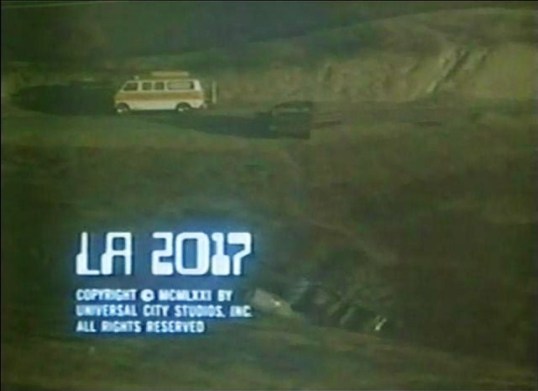
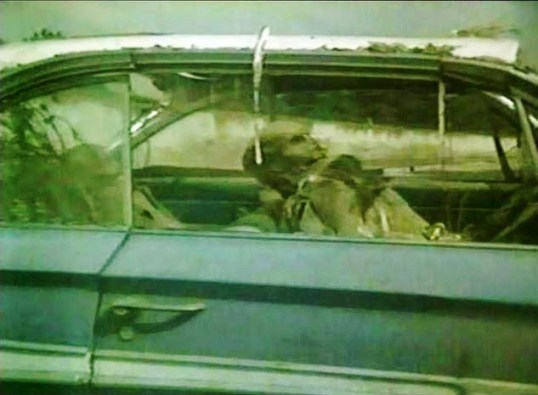
L.A. 2017 opens with Glenn driving down a mountain road in California. He’s heading to a pollution summit and, as he drives along, he awkwardly dictates an editorial into a tape recorder. Glenn worries that society may have already ruined the environment to such an extent that the Earth cannot be saved. As if to prove his point, Glenn starts to cough as he’s overcome by all of the smog in the air. His car swerves into a ditch and Glenn is knocked unconscious.
Welcome to the future
When he wakes up, he finds himself being rescued by men wearing wearing protective suits and masks. The sky is a sickly orange and an ominous wind howls in the background. Glenn’s rescuers take him to an underground city where he discovers that, somehow, he has traveled through time. The year is now 2017, which in this film looks a lot like the 70s except that everyone’s now underground and the landline phones are extra bulky. (Needless to say, watching 1971’s version of 2017 in 2019 is an interesting experience.) It turns out that the pollution got so bad that the surface of the planet became uninhabitable. The U.S. is now run by a corporation that is headquartered in Detroit. (Presumably, the Corporation is a former car company.) The U.S. is also at war with England, for some reason. No mention is made about what’s happened to Canada but, if Detroit’s still around, I assume at least some of Canada managed to survive as well.
The …. uh, Future.
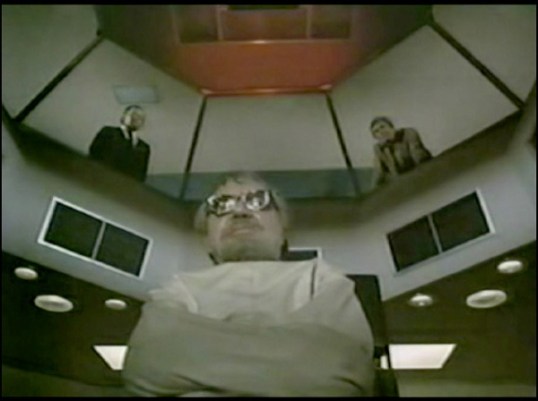
Everyone in the future drinks a lot of milk and, when they’re not listening to cheerful announcements, they’re listening to the soothing music that the Corporation provides for them. Everyone in the future is also very friendly. We know this because everyone keeps assuring Glenn that he’s surrounded by friends. In fact, everyone in the future refers to one another by their first name because “it’s friendlier.” It’s also the law. It turns out that there’s a lot of laws in the future. In fact, the underground cities are pretty fascist in the way that they handle things. There are constant announcements encouraging people to pursue a career in law enforcement and anyone who disagrees with the Corporation ends up in a straight jacket. Glenn feels that maybe he’s been brought to the future so he can start a new magazine and challenge the status quo. The Corporation disagrees….
This is what happens when you don’t go underground in the future.
Okay, so there’s nothing subtle about L.A. 2017. From the villainous corporation to the heavy-handed environmental message, there’s nothing here that you haven’t seen in dozens of other sci-fi films. But the lack of subtlety doesn’t matter, largely because Spielberg directs with so much energy and with such an eye to detail that it’s impossible not to get sucked into the story. As opposed to the somewhat complacent Spielberg who has recently given us rather bland and safe blockbusters like Lincoln, The BFG, and The Post, the Spielberg who directed L.A. 2017 was young and obviously eager to show off what he could do with even a low budget and that enthusiasm is present in every frame, from the wide-angle shots of Glenn driving his car to the scenes of Glenn looking up at the shadowy executives and scientists who are staring down at him when he’s first brought to the underground city. As opposed to the sterile vision of so many other future-set films, Spielberg’s future feels as if it’s actually been lived in. When Glenn finds himself in a new world, it comes across as being a real world as opposed to just a narrative contrivance.
Of course, because L.A. 2017 was just one episode in a weekly series, Glenn couldn’t remain in the future and L.A. 2017 returns Glenn to the present in the most contrived and predictable way possible. Still, L.A. 2017 remains an entertaining example of what a young and talented director can do when he’s determined to be recognized. Watching the film, it’s easy to draw a straight line from Spielberg doing L.A. 2017 to doing Duel and then subsequently being hired for Jaws.
Incidentally, Joan Crawford is somewhere in this film. Crawford worked with Spielberg when he directed her in the pilot for Night Gallery and she was one of his first major supporters in Hollywood. Apparently, in L.A. 2017, she plays one of the people staring down at Glenn when he’s first brought into the underground city. I haven’t found her yet but she’s apparently there somewhere.
Unfortunately, L.A. 2017 has never been released on DVD or Blu-ray but it is currently available on YouTube.
Robert Mitchum puts the pedal to the metal as a moonshine runner at odds with both the Feds and gangsters in THUNDER ROAD. This is Mitchum’s most personal picture, not only starring but producing, writing the story (and two songs!), and, rumor has it, doing much of the directing. His notorious independent streak comes through in his character Luke Doolin, a Korean War vet who believes in the right of individual ownership, whether on his land or in his car, and free market enterprise, without interference from outsiders or the government. That’s right, Luke Doolin is a true Libertarian hero!
He’s also the best damn driver in River Valley, Kentucky, as we see in the opening scene, speeding down the backroads, eluding police with the greatest of ease. The Doolins have been making moonshine for generations, with daddy Vernon running the still, baby brother Robin the family mechanic, and mama Sarah praying for…



 Through the Shattered Lens