Late Night Retro Television Review: CHiPs 3.6 “Counterfeit”


Welcome to Late Night Retro Television Reviews, a feature where we review some of our favorite and least favorite shows of the past!  On Mondays, I will be reviewing CHiPs, which ran on NBC from 1977 to 1983.  The entire show is currently streaming on Prime!
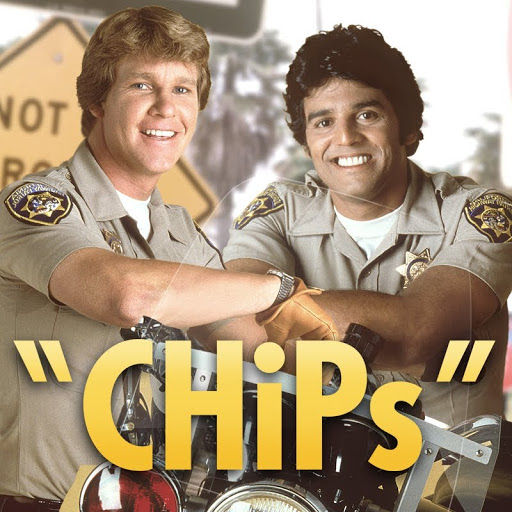
Tonight’s episode is weird.

Episode 3.6 “Counterfeit”

(Dir by John Florea, originally aired on October 20th, 1979)

Ponch is shocked to discover that he’s carrying several counterfeit twenties.  He turns the money into the Treasure Department, hoping that it will mean receiving an monetary award.  Instead, he’s told that his reward is helping the government crack down  on the bad guys.  Ha!  Take that, Ponch!

That said, you better believe that Ponch is there to help arrest the counterfeiters, who turn out to be a bunch of phony preachers working out of a church.  I know that sounds like the sort of thing that could be interesting.  But, for the most part, these guys are still just generic CHiPs bad guys, even if one of them is played by veteran screen tough guy Ralph Meeker.

Meanwhile, Ponch goes on a date with a woman and is upset when it appears that she’s shallow and doesn’t want to talk about anything that is the least bit intellectual.  That’s our, Ponch!  He’s never shallow!  Fortunately, it turns out that his date isn’t shallow either.  She was just pretending to be shallow to test whether or not Ponch was shallow.  And now, it’s time to dance!  Wait, what?  That doesn’t make any sense.  Ponch — when are you going to settle down?  Disco isn’t going to last forever.

While that’s going on, architect James O’Hara (played by veteran dwarf actor Billy Barty) becomes frustrated with people assuming that he can’t drive because of his size.  He gets tired of all the dumb jokes and the condescending remarks.  As a result, he keeps getting into minor accident whenever he drives on the highway.  This was a strange storyline, largely because O’Hara’s scenes made up over half the episode despite the fact that he had never appeared on the show before and he barely interacted with the members of the Highway Patrol.  A part of me wonders if maybe this episode was meant to be a backdoor pilot for a series about James O’Hara.  The other weird thing about this episode is that O’Hara’s frustration over people making fun of his height was often played for laughs.  The whole thing just felt well-intentioned but oddly tone deaf.

If you’re keeping track, this episode had two Ponch storylines and a storyline about a guy we had never seen before.  Sorry, Baker!  If we had any doubts about who was the favored partner as far as this show goes, this episode erased them.

This whole episode just felt weird.  On the plus side, there was a lot of nice California scenery and there were quite a few accidents, which is the main reason why most people would have been watching the show in the first place.  But this episode really is an example of how a show can get bogged down with a character that we’ve never seen before and that we’ll probably never see again.  The episode just never comes together.
Horror on TV: One Step Beyond 2.5 “Night of the Kill” (dir by John Newland)


When young Davey Morris tells his parents that he’s been hanging out with a friendly Bigfoot-type creature, all of the adults in town react in the worst way possible.

This episode, from the second season of One Step Beyond, was one of the first to deal with the legend of Bigfoot.  Needless to say, it’s the adults who turn out to be the true monsters in this scenario.

This episode originally aired on October 20th, 1959.

Retro Television Review: In Broad Daylight (dir by Robert Day)


Welcome to Retro Television Reviews, a feature where we review some of our favorite and least favorite shows of the past!  On Sundays, I will be reviewing the made-for-television movies that used to be a primetime mainstay.  Today’s film is 1971’s In Broad Daylight!  It  can be viewed on YouTube.

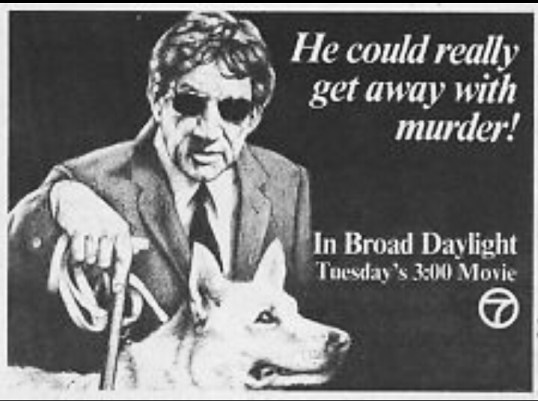
Tony Chappel (Richard Boone) is an actor who has just recently lost his sight as a result of an accident.  Released from the hospital, Tony struggles to adjust to living in a world without his vision.  When one cab driver says to him, “Didn’t you used to be Tony Chappel?,” he flinches as he realizes that his career as a famous actor is now considered to be over.  One day, he comes home early and overhears his wife (Stella Stevens) fooling around with his lawyer and “best friend” (Fred Beir).  Tony promptly decides to murder his wife and frame his friend for the crime.

Tony decides to use his acting skills to his advantage.  He memorizes the the area around him so that he can make his way through it by memory.  He puts on a fake beard, speaks with Greek accent, and makes a point of carrying a camera with him.  He starts taking public transportation and going out of his way to be talkative and social  Everyone that he meets, he tells them about how he’s been taking pictures of the city and how he can’t wait to see how they come out.  When his wife is eventually murdered, the police receive a reports of a mysterious Greek man, one who was definitely not blind, in the area.  However, Lt. Bergman (John Marley) has his doubts and comes to suspect that Tony is the killer.

In Broad Daylight was made from an early script written by Larry Cohen, who would later go on to direct films like God Told Me To.  It’s a clever script, one that sets up an intriguing premise and which ends on a properly twisty and satisfactory note.  The film works because it is as much of a character study as a thriller.  Tony’s wife not only cheats on him but also betrays him at the moment when he needs her and his friends the most.  Tony has gone from being a movie star to being a man who can barely walk from one room to another.  He’s already angry.  Discovering that his wife is laughing at him behind his back is the last straw.

Larry Cohen reportedly felt that Richard Boone was miscast as Tony.  I felt that Boone did a pretty good job, even if he did overact a bit while Tony was trying to convince everyone that he was a Greek tourist.  Stella Stevens is perfectly cast as his wife and Suzanne Pleshette is sympathetic as his nurse.  Godfather fans will be happy to see John Marley not having to deal with a horse’s head but instead playing the clever detective who attempts to solve the murder.

In Broad Daylight is a clever and entertaining thriller and character study.

Late Night Retro Television Reviews: CHiPs 1.14 “Rustling”


Welcome to Late Night Retro Television Reviews, a feature where we review some of our favorite and least favorite shows of the past!  On Mondays, I will be reviewing CHiPs, which ran on NBC from 1977 to 1983.  The entire show is currently streaming on Freevee!

This week, CHiPs makes me cry!

Episode 1.14 “Rustling”

(Dir by Phil Bondelli, originally aired on January 12th, 1978)

This week’s episode of CHiPs featured a scene that brought tears to my mismatched eyes.

A drunk driver (played by G.W. Bailey) swerves across the highway and causes another car to flip over.  While Ponch chases after the driver, Baker goes to investigate the crash.  He discovers that the car’s driver is a 17 year-old girl named Susie (Pamelyn Ferdin) and she has been pinned under the wreckage.  He manages to free her and carry her away from the car before it explodes.  YAY!  Another life saved by Jon Baker, right?

That’s when Susie says that she can’t feel her legs.

That scene got to me.  It was far more well-acted than anything that I think one would normally expect to find on a episode of CHiPs, with both Ferdin and Larry Wilcox bringing a lot of emotional sincerity to their roles.  Susie realizes that she may never walk again.  Baker realizes that, just because he saved her from the car, he can’t save Susie from the other consequences of the accident.  I wanted to cry.  Actually, I did cry.

Now, I should admit that I’m recovering from a sprained ankle and I was doing my ankle exercises while watching this scene.  So, not only did I already have tears in my eyes (seriously, some of those exercises hurt!) but I was also feeling pretty emotional.  But still, even if I was just watching this scene while sitting on a couch, I think it would have had the same effect on me.

Of course, for the record, Ponch does capture the drunk driver (and the driver starts to sob when he realizes what he has done).  And, by the end of the episode, Baker is informed that Susie is going to be okay.  I was happy about that.

Excuse me, I’m starting to cry again….

Okay, believe it or not, that was only a small part of the episode.  The main storyline featured the great L.Q. Jones as a cattle rustler who, when he’s not driving his truck full of stolen cattle, rides a motorcycle.  Fortunately, after a lengthy chase, Baker and Ponch are able to capture him and his accomplice (Paul Tuerpe).  It was a pretty simple story but, at the same time, L.Q. Jones was one of those brilliant character actors who make even the most mundane of characters interesting.

Also, over the course of the episode, Ponch and Baker deal with an irate driver (Mill Watson) who claims that he was only speeding because his gear shift failed.  In court, Ponch is able to prove that the gear shift didn’t break by pointing out that the brake lights would have come on in that case.  (“Your honor,” the defense attorney says, “my client would like to change his plea to guilty.”)  Ponch and Baker also stop a magician and his assistant and are so fascinated by the magician’s tricks that they nearly forget to write his assistant a ticket.

Finally, Ponch arranges for everyone to meet at Baker’s apartment to throw him a surprise birthday party.  Whoops!  Baker’s birthday isn’t for another three months.  Ponch looked at Baker’s personnel file and misread his employment number as being his birthdate.  Oh, Ponch!  Still, the party is a success.  Getraer shows up with zucchini.  The magician shows up and performs a trick that involves tossing milk on Ponch and Baker.  What?  Well, whatever.

What’s important is that one scene that brought tears my eyes.  The rest of the episode may have been generic but that one scene was beautifully done and I’ll never forget it.

Retro Television Reviews: Suddenly Single (dir by Jud Taylor)


Welcome to Retro Television Reviews, a feature where we review some of our favorite and least favorite shows of the past!  On Sundays, I will be reviewing the made-for-television movies that used to be a primetime mainstay.  Today’s film is 1971’s Suddenly Single!  It  can be viewed on YouTube.

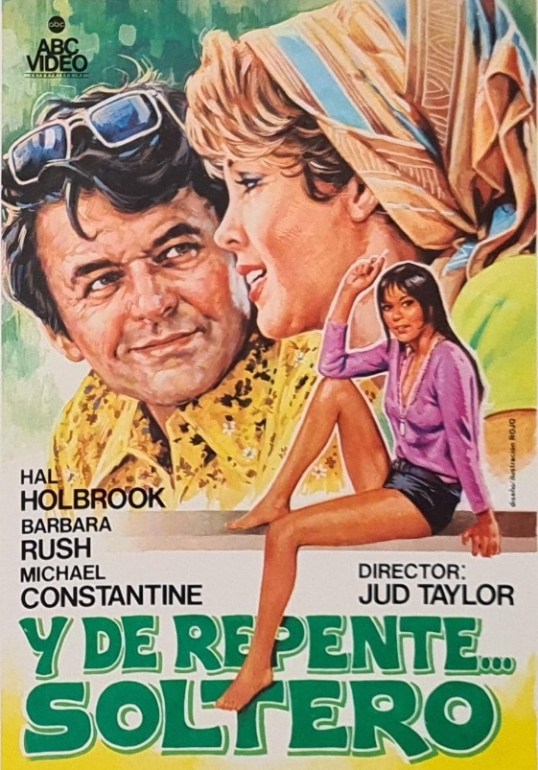
Suddenly Single opens with middle-aged Larry Hackett (Hal Holbrook) loading his suitcases into the back of his car.  His neighbors (David Huddleston and Pamela Rodgers) come over to say goodbye.  Larry has just gotten divorced and, as a result, he’s lost his perfect house in the suburbs.  Now, he’s going to have to move into the city and start a new life but he assures his neighbors that he’ll be okay and that there aren’t any hard feelings between him and his ex, Joanne (Cloris Leachman).  Sometimes, marriages just don’t work out….

Then Joanne shows up….

With her new husband, Ted (Fred Bier)!

While Larry can only watch, Ted insists on picking up Joanne and carrying her over the threshold of what used to be Larry’s house.  As it dawns on him that Joanne was having an affair during the final days of their marriage, Larry is understandably miffed.

Larry just isn’t ready to find himself in the world of the early 70s.  He’s an extremely conservative pharmacist who will now have to deal with hippies and the single scene.  His co-worker (Harvey Korman) encourages Larry to hit the bars.  Marlene (Agnes Moorehead) encourages him to figure out what he wants to do with his life.  His new and much younger neighbor, Jackie (Margot Kidder), tells him that he needs to get a gym membership and be more open-minded.  At first, Larry pursues a relationship with the classy Evelyn Baxter (Barbara Rush) but then he’s drawn to Jackie.  And Jackie, oddly enough, is drawn to him….

Quicker than you can say Breezy, Larry is dating the much younger Jackie and he’s starting to wear hip clothes and hang out with cool, long-haired people.  When he runs into his old neighbors on the street, he discovers that he no longer has much in common with them.  However, Larry still finds himself becoming jealous and possessive of Jackie, who is not the type of to give up her freedom for a relationship.  In the end, Larry is forced to admit that, while he has become more open-minded following his divorce, he still can’t magically change who he is.

Suddenly Single has a great cast and it’s not surprising that it’s a well-acted film.  At the same time, Larry can be a bit of a jerk.  Evelyn is the nicest person in the entire movie and Larry basically breaks her heart so that he can pursue an obviously doomed relationship with the younger Jackie.  It’s a bit sad to watch because everyone but Larry can see what he’s doing.  Larry may be wiser by the end of the film but that’s small solace to Evelyn.  Suddenly Single is about flawed characters and, as such, it can be easy to get annoyed with Larry and Jackie while also appreciating the fact that, like all of us, they’re just trying to figure out life as they go along.

Suddenly Single acts as a bit of time capsule and watching it is as probably as close as one can get to 1971 without a time machine.  It’s a trip to the past with some of the best actors of the era.

18 Days of Paranoia #14: The Organization (dir by Don Medford)


Sidney Poitier played Detective Virgil Tibbs for the third and final time in the 1970 film, The Organization.

This time, Virgil is investigating a murder at an office building in San Francisco.  It’s a very odd murder, in that an executive was shot, a security guard was bludgeoned, and even though it looks like there was a robbery taking place, nothing appears to have actually been stolen.  Since neither the company nor the executive were believed to be involved in anything shady, Virgil finds himself perplexed as to why any of this has happened at all.

Fortunately, the local urban revolutionaries are here to help!  They contact Virgil and Virgil reluctantly agrees to meet with the group, which is made up of the usual collection of angry 1970s activists — i.e., a dissident preacher, a reformed drug dealer, a guy who won’t stop yelling, and a woman who is obviously going to be killed before the movie is over.  The revolutionaries explain that they were the ones who broke into the office but they also say that they didn’t kill anyone.  Instead, they broke into the office because they wanted the police to investigate the break-in and discover that the company was a front for a bunch of drug dealers.  “The Organization” is flooding poor and minority neighborhoods with heroin and the revolutionaries want to stop them.  In fact, the revolutionaries have stolen four million dollars worth of heroin.  Now, they want Virgil to help them.

Even though Virgil is sympathetic to the revolutionaries, he’s still a cop and he can’t get directly involved with illegal activities.  Instead, he agrees to not arrest the revolutionaries and to continue his investigation, in the hope of bringing down the Organization.  It’s not going to be easy, of course.  There’s evidence that the Organization may even have agents inside the San Francisco police department.

As far as the Virgil Tibbs movies are concerned, The Organization is slightly better than They Call Me Mister Tibbs! but it’s nowhere near as good as the one that started it all, In The Heat of the Night.  Probably the biggest flaw with The Organization is that Virgil has to share the spotlight with the revolutionaries.  With the exception of Raul Julia (who plays a former drug dealer named Juan), none of the revolutionaries are particularly memorable characters and their plan for taking down The Organization is so unnecessarily convoluted that it’s hard to believe that Virgil would go along with it.

On the plus side, The Organization works fairly well as a conspiracy thriller.  It does manage to create a consistent atmosphere of unease and mistrust.  This is one of those films where people are constantly getting shot by unseen gunmen mere minutes after getting arrested and the fact that even cool and in-control Virgil Tibbs can’t save them does a lot towards creating a nice sense of paranoia.  The films end on perhaps the most downbeat note of all of the Virgil Tibbs movies, suggesting that, in the end, everything we’ve just watched was for nothing.


Other Entries In The 18 Days Of Paranoia:

  1. The Flight That Disappeared
  2. The Humanity Bureau
  3. The Private Files of J. Edgar Hoover
  4. The Falcon and the Snowman
  5. New World Order
  6. Scandal Sheet
  7. Cuban Rebel Girls
  8. The French Connection II
  9. Blunt: The Fourth Man 
  10. The Quiller Memorandum
  11. Betrayed
  12. Best Seller
  13. They Call Me Mister Tibbs


Horror on TV: One Step Beyond 2.5 “Night of the Kill” (dir by John Newland)


When young Davey Morris tells his parents that he’s been hanging out with a friendly Bigfoot-type creature, all of the adults in town react in the worst way possible.

This episode, from the second season of One Step Beyond, was one of the first to deal with the legend of Bigfoot.  Needless to say, it’s the adults who turn out to be the true monsters in this scenario.

This episode originally aired on October 20th, 1959.


Horror On TV: Kolchak: The Night Stalker 1.6 “Firefall” (dir by Don Weis)


It appears that YouTube is finally back up (for the sake of future historians, YouTube was down for several hours on the night of Tuesday, October 16th, 2018, leading to great panic on twitter) so I can share tonight’s episode of Kolchak: The Night Stalker!

In this episode, our favorite neurotic journalist investigates several cases of spontaneous human combustion.  It all appears to have something to do with the spirit of a dead gangster, one who is wandering around in the form of a famous (and still living) conductor.

I swear, Chicago was a crazy place to live in the 70s.

This episode originally aired on November 8th, 1974.

Enjoy!

http://www.youtube.com/watch?v=XshaJapPXqw