
Artist Unknown
Artist Unknown
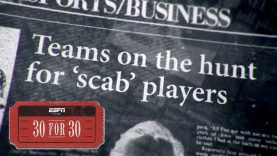 In 1987, two weeks into the season, the National Football League Player’s Association went on strike. In the past, player strikes had led to cancelled games and shortened seasons. But in 1987, the owners fought back. Instead of cancelling games, they brought in replacements. Some of the replacements were former college players. Some were players that were recruited from the Canadian leagues or the recently folded USFL. Some of them were just locals who could throw a ball or kick a field goal. They were called scabs and, at first, they were hated by the fans. But for three weeks, they were the NFL.
Year of the Scab, the latest entry in ESPN’s 30 for 30 documentary series, is about the players who (briefly) played for the 1987 Washington Redskins, the only team to be 100% made up of replacements. To the shock of everyone, while the team’s stars were walking the picket line, the replacement players won all three of their games, including one against the Dallas Cowboys. For three weeks, the scabs were stars but, when the strike ended, the replacements were cut and ultimately forgotten. When the Redskins won the super bowl, the replacements got to join the team at the White House but they did not receive rings. As one of the replacement players puts it, “Even the girl who answered the telephones in the front office got a ring.”
The most interesting part about Year of the Scab are the interviews with the former replacements today. Some are still involved in football, coaching high school teams. One works in a warehouse. Tony Robinson was paroled from prison so that he could play for the Redskins and then returned to prison as soon as the season was over. All of them are still emotional about their time in the NFL and, to varying degrees, all of them are aware that, because of their status as scabs, they will never receive the recognition that their gameplay deserved. Some of them still struggle with their decision to cross the picket line while others just wish they had gotten a ring. (One player even had a duplicate super bowl ring made but he laments that it’s still not the same as having the real thing.) Year of the Scab is an interesting and thought-provoking documentary about opportunities received and lost.
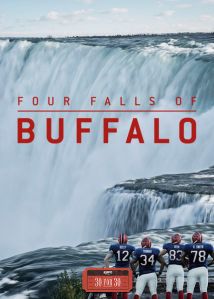 In America, they love winners and that’s especially true when it comes to the Super Bowl. Every year, one team wins the Super Bowl and goes home to a parade and sometimes a riot. Another teams loses the Super Bowl, often becomes a laughing-stock, and spends the next season searching for “redemption,” never mind that even the team that loses the Super Bowl still did something that 30 other NFL teams failed to do.
Just ask the Buffalo Bills. In the early 1990s, the Bills accomplished something that no other football team had ever accomplished. They went to four consecutive super bowls. And yet, because they lost all four times, the 90s Bills are remembered for what they lost instead of what they accomplished. If the Bills had won all four of those Super Bowls, they would be remembered as the greatest team of all time. But because they lost, they are forever remembered as being joke.
Four Falls of Buffalo is a documentary about those four Super Bowls, all told from the point of view of the players that lost and the city that loved them. Four Falls of Buffalo is very much a fan’s film but it’s still interesting to watch. Along with detailing what went wrong (and sometimes right) at all four of the Super Bowls that the Bills lost, it also features interviews with the Bills players. Particularly notewothy is an interview with Scott Norwood, the kicker who missed a field goal that, had he made it, would have won Super Bowl XXV for the Bills. Even though the city of Buffalo embraced him after the loss, it is obvious that missed kick still haunts him.
Watch Four Falls of Buffalo in honor of all the teams that made it to the Super Bowl but did not get that win.
Since we are only a few hours away from the big game, I better get my Super Bowl predictions in.
I predict that the final score will be:
New England Patriots — 32
Atlanta Falcons — 17
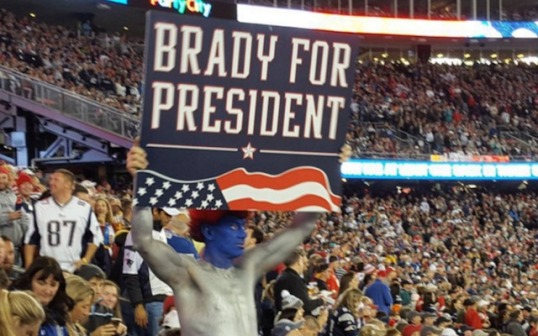
After winning his fifth Super Bowl, Tom Brady will announce his retirement, run against Elizabeth Warren in 2018, and will be elected President in 2028.
Congratulations, Mr. President!
 Remember the XFL?
Though it may be regarded as a joke today, the XFL was a big deal for a few months in 2001. The brainchild of the WWF’s Vince McMahon, the XFL was a football league that, like the USFL before it, would play during the NFL’s off-season. McMahon promised that, if the NFL was now the “No Fun League,” the XFL would be the “Extra Fun League.” McMahon’s longtime friend and the President of NBC sports, Dick Ebersol, purchased the rights to broadcast the XFL’s first two seasons.
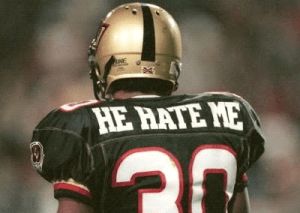
Ebersol and McMahon put together the XFL (8 teams and 2 divisions) in just a year’s time. They recruited players who hadn’t been able to find a place in NFL. Using many of the same techniques that he perfected in the world of professional wrestling, McMahon encouraged the players to be big personalities and allowed them to pick their own nicknames. Rod Smart would briefly become a star as He Hate Me while another player requested to be known as Teabagger. McMahon tweaked the rules, encouraging faster and more aggressive play. Instead of a coin flip, each game would start with two opposing players scrambling for the ball. The XFL was not only more violent than the NFL but it also had sexier cheerleaders.
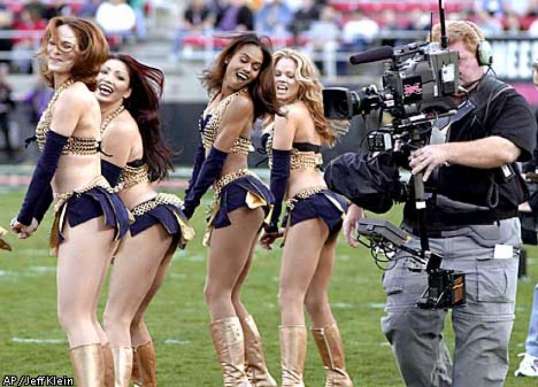
In 2001, I was really excited for the XFL. It was everything that an 18 year-old male football fan could hope for. I was one of the 14 million people who watched the very first broadcast. I watched half of the second broadcast and that was it. I lost interest and I was not alone. The XFL started with higher ratings than expected but the final games of that inaugural season set records for being the lowest-rated prime time sports telecasts in history.
What went wrong? That’s what ESPN’s latest 30 for 30 documentary, This Was The XFL, explains. Directed by Dick Ebersol’s son, Charlie, This Was The XFL features interviews with McMahon, the senior Ebersol, players like Rod Smart and Tommy Maddox, and sports journalists like Bob Costas. The XFL’s rise and demise is presented as being a comedy of errors. Already viewed with skepticism because of McMahon’s unsavory reputation, the XFL was doomed by a combination of terrible luck and bad gameplay that confirmed why many XFL players couldn’t find a place in the NFL. During the first week, several players were injured during the opening scramble. In the 2nd week, a power outage interrupted the broadcast of a game in Los Angeles. With ratings in freefall, McMahon resorted to playing up the cheerleaders and sending Gov. Jesse “The Body” Ventura onto the field so that he could harass the coaches during the game. Trying to do damage control, McMahon appeared on The Bob Costas Show and their hostile interview is one of the highlights of the documentary. Even if the league ultimately failed, it is impossible not to admire McMahon’s determination to shake things up.
The XFL’s first season was also its last but, as This Was The XFL makes clear, its legacy is still evident today. Miked-up players, the skycam, sideline interviews, all of these are the legacy of the XFL. Even Jerry Jones, when interviewed, says that the XFL changed the way that NFL football is broadcast.
With this being Super Bowl weekend, take a moment to raise a toast to the memory of the XFL.

A part of ESPN’s 30 for 30 documentary series, Small Potatoes: Who Killed the USFL? tells the story of the United States Football League. The USFL was not the first American football league to try to take on the NFL but, arguably, it was one of the most successful. Playing a spring/summer schedule, the USFL lasted for three seasons, from 1983 to 1985. During that time, the USFL introduced many rules that would later be adopted by the NFL, including the two-point conversion and the coach’s challenge. Several future NFL superstars, like Herschel Walker and Steve Young, got their start in the USFL.
So, why is the USFL nearly forgotten today? This documentary largely lays the blame at the feet of none other than Donald Trump. Long before he was President or even a reality TV star, Trump wanted to own a football team. When it became obvious that he wasn’t going to be able to buy an NFL team, Trump purchased the USFL’s New Jersey Generals. Trump not only decided that the USFL needed to switch to a fall schedule and compete directly with the NFL but, under his direction, the USFL also filed an antitrust lawsuit against the NFL. Ironically, the USFL won that lawsuit but were only awarded $3.75 in damages. With the league’s financial resources depleted by the lawsuit, the USFL suspended the 1986 season and never came back.
For all the legitimate criticism that can be directed towards ESPN, the 30 for 30 documentaries have been consistently excellent. While Small Potatoes features plenty of exciting game footage and interviews with former USFL players, it’s not surprising that the most interesting thing about it is listening to Trump revealingly discuss his time as a USFL team owner with the same mix of self-aggrandizement and defensive posturing that he uses to discuss the size of the crowd at his inauguration. Unlike the majority of the players and former owners interviewed in Small Potatoes (including Burt Reynolds, who was one of the owners of the Tampa Bay Bandits), Trump still appears to take it personally that he was never taken seriously as the owner of a football team.
I did not know anything about the USFL before I watched Small Potatoes. My only complaint is that I wish it had been longer. The story of the USFL was too interesting to be confined to just one hour.

For the longest time, I thought that Two-Minute Warning was a movie about a gang of art thieves who attempt to pull off a heist by hiring a sniper to shoot at empty seats at the Super Bowl. As planned by a master criminal known as The Professor (Rossano Brazzi), the sniper will cause a riot and the police will be too busy trying to restore order to notice the robbery being committed at an art gallery that happens to be right next to the stadium.
I believed that because that was the version of Two-Minute Warning that would sometimes show up on television. Whenever I saw the movie, I always through it was a strange plan, one that had too many obvious flaws for any halfway competent criminal mastermind to ignore them. What if the sniper was captured before he got a chance to start shooting? What if a riot didn’t break out? The sniper spent the movie aiming at empty seats but, considering how many people were in the stadium, it was likely that he would accidentally shoot someone. Were the paintings really worth the risk of a murder charge?
Even stranger was that Two-Minute Warning was not only a heist film but it was also a 1970s disaster film. Spread out throughout the stadium were familiar character actors like Jack Klugman, John Cassevetes, David Janssen, Martin Balsam, Gena Rowlands, Walter Pidgeon, and Beau Bridges. It seemed strange that, once the shots were fired and Brazzi’s men broke into the gallery, all of those familiar faces vanished. When it comes to disaster movies, it is an ironclad rule that at least one B-list celebrity has to die. It seemed strange that Two-Minute Warning, with all those characters, would feature a sniper shooting at only empty seats. For that matter, why would there be empty seats at the Super Bowl?
That wasn’t the strangest thing about Two-Minute Warning, though. The strangest thing was that Charlton Heston was in the film, playing a police captain. In most of his scenes, he had dark hair. But, in the scenes in which he talked about the art gallery, Heston’s hair was suddenly light brown.
Recently, I watched Two-Minute Warning on DVD and I was shocked to discover that the movie on the DVD had very little in common with the movie that I had seen on TV. For instance, the television version started with the crooks discussing their plan to rob the gallery. The DVD version opened with the sniper shooting at a couple in the park. In the DVD version, there was no art heist. The sniper had no motive and no personality. He was just a random nut who opened fire on the Super Bowl. And, in the DVD version, he did not shoot at empty seats. Several of the characters who survived in the version that I saw on TV did not survive in the version that I saw on DVD.
What happened?
The theatrical version of Two-Minute Warning was exactly what I saw on the DVD. A nameless sniper opens fire and kills several people at the Super Bowl. In 1978, when NBC purchased the television broadcast rights for Two-Minute Warning, they worried that it was too violent and too disturbing. There was concern that, if the film was broadcast as it originally was, people would actually think there was a risk of some nut with a gun opening fire at a crowded event. (In 1978, that was apparently considered to be implausible.) So, 40 minutes of new footage was shot. Charlton Heston even returned to film three new scenes, which explains his changing hair color. The new version of Two-Minute Warning not only gave the sniper a motive (albeit one that did not make much sense) but it also took out all of the violent death scenes.
Having seen both versions of Two-Minute Warning, neither one is very good, though the theatrical version is at least more suspenseful than the television version. (It turns out that it was better to give the sniper no motive than to saddle him with a completely implausible one.) But, even in the theatrical version, the potential victims are too one-dimensional to really care about. Ultimately, the most interesting thing about Two-Minute Warning is that, at one time, an art heist was considered more plausible than a mass shooting.

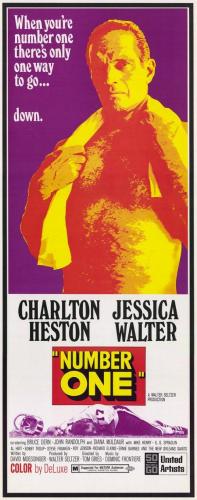 Quarterback Cat Catlan (Charlton Heston) used to be one of the greats. For fifteen years, he has been a professional football player. He probably should have retired after he led the New Orleans Saints to their first championship but, instead, the stubborn Cat kept playing. Now, he is 40 years old and struggling to keep up with the younger players. His coach (John Randolph) says that Cat has another two or three years left in him but the team doctor (G.D. Spradlin who, ten years later, played a coach in North Dallas Forty) says that one more strong hit could not only end Cat’s career but possibly his life as well. Two of former Cat’s former teammates (Bruce Dern and Bobby Troup) offer to help Cat find a job off the field but Cat tells them the same thing that he tells his long-suffering wife (Jessica Walter). He just has to win one more championship.
Number One is unique for being one of the first movies to ever take a look at the dark side of professional football. At 40, Cat is facing an uncertain future. His years of being a star have left him unprepared to deal with life in the real world. He has no real friends and a wife who no longer needs him. This would seem like a perfect role for Heston, who always excelled at playing misanthropes. Heston is convincing when he’s arguing with his wife or refusing to sign an autograph but, surprisingly, he is thoroughly unconvincing whenever he’s on the field. For all of his grunting and all the lines delivered through gritted teeth, Heston is simply not believable as a professional athlete, even one who is past his prime. (When he played the 40 year-old Cat, Heston was 46 and looked like he was 56.) Whenever Cat throws a football, he’s played by Heston in close-ups and very obviously replaced by real-life Saints quarterback Billy Kilmer for the long shots. A football film is only as good and convincing as the football action and, on that front, Number One leaves much to be desired.
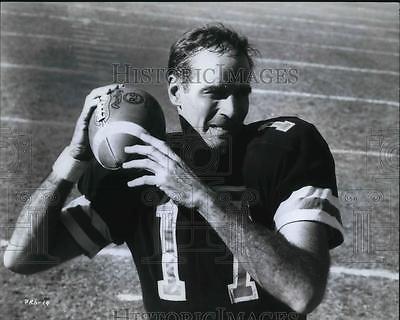
This 1969 press photo displays Heston’s throwing technique.
Two final notes: For the scene in which Cat is tackled by three Dallas Cowboys (all played by actual players), Heston requested that the players actually tackle him. Heston ended up with three broken ribs.
Finally, Number One was made the cooperation of the New Orleans Saints and features several players in the cast. When Number One was filmed, the Saints were still a relatively new expansion team. Cat is described as having already led the Saints to a championship but it would actually be another 40 years before the Saints would finally make their first trip to the Super Bowl.
Since we are only three hours away from the game, I better get my prediction in:
Carolina 24
Denver 21
And the game-winning field goal will be kicked by Gus the mule.
Enjoy the game (if you’re watching!)
…and there hasn’t even been a commercial yet. Ok, I admit this might seem petty on the surface, but I’m pretty goddamn pissed off. Over the years, I’ve experienced Super Bowl advertisements degenerate from clever, creative entertainment to raunchy, sensationalist garbage, and I’ve accepted it. I’ve seen right-wing nut jobs fork over millions to air their political garbage–anyone recall Focus on the Family’s anti-abortion ad a few years ago?–and I’ve kept my mouth shut. But what I saw in the pre-game show today took tasteless to a new level. For those of you who missed it, Fox got the rights to the game this year, and they exploited their control of the content to interrupt pre-game coverage for a half hour of Fox News and Bill O’Reilly lambasting the president.
Think about that, and forget your opinion of Barrack Obama while you do it. We’re talking about the most televised event in the world, and its exclusive broadcaster this year has set aside tens of millions of dollars worth of content time to advertise for the extreme right wing of the Republican party. “Oh, Bill O’Reilly is relatively moderate, and they just plastered a Fox News logo over it; they didn’t bring up many sensitive issues.” Fuck that. If the KKK sponsored a Super Bowl ad for white hoodies you’d all be shitting bricks. And this isn’t a conventional ad–a business transaction–a hunk of advertisement paid for in full. This is coming directly from the network that ought to be responsible for monitoring advertisement content throughout the game. This isn’t a matter of turning a blind eye for a pay check; Fox shamelessly wants you to know that this program has been brought to you by good, god-fearing straight white people (and their wives).
I suppose they’re not going to lose any viewers over it. I’m still watching–albeit on mute now until the ball’s on the ground–and the money’s already on the books anyway. It was just more dope for the already brainwashed really, and a little salt in the wound for anyone who believes in social justice. But if the NFL accepts without further comment that an endorsement of Fox Sports means an endorsement of Fox News and everything that subsidiary stands for, it’s time we all called it a fun half-century and took up soccer or cricket or something.
 Through the Shattered Lens