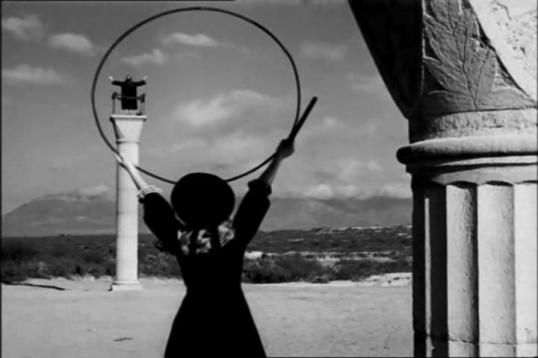
Adapted from the classic short story by Washington Irving, 1922’s The Headless Horseman tells the story of Ichabod Crane (Will Rogers), a stern schoolmaster and a student of the occult. He comes to the town of Sleepy Hollow to serve as the new school teacher and he immediately gets on everyone’s bad side by being a bit tougher on the students than they were expecting. When it appears that Ichabod is interested in Katrina Von Tassel (Lois Meredith), Katrina’s other suitor, Abraham Von Brunt (Ben Hendricks, Jr.) conspires to make it appear as if Ichabod is working with a coven of witches.
Of course, even if Ichabod survives the witchcraft accusations, there’s still the threat of the Headless Horseman who is said to haunt the isolated roads around Sleepy Hollow….
This was not the first film adaptation of The Legend of Sleepy Hollow. There were two other silent versions that came out before The Headless Horseman but they are both lost films. The Headless Horseman is the earliest surviving film version of Irving’s tale. Historically, it’s interesting as an example of an early horror film. To be honest, the scene in which Crane imagines what will happen to him if he is found guilty of witchcraft is more effective than the Horseman scenes. But Will Rogers does do a good job with the role of Ichabod Crane, even if Rogers is hardly the tall and thin Crane who was described in Irving’s story. Rogers was, of course, best-known for being a humorist and it was claimed that he “never met a man he didn’t like.” Unfortunately, the same cannot be said of Ichabod Crane.
First released in 1970, The Cross and the Switchblade stars Pat Boone as David Wilkerson.
David is a small-town preacher who heads to Brooklyn in the late 50s. Having read an article about the prevalence of violent gangs in New York City, David is determined to make a difference and bring some peace to the city. Why exactly he feels that he can do that, as opposed to someone who is actually from New York and who has some actual experience dealing with gangs, is never really explained. David starts going to drug dens and back alleys and rooftops in the poorest parts of the city. At first, no one takes him seriously but, because he refuses to give up, he does slowly start to win the neighborhood’s respect. He’s even given a place to live so that he’ll no longer have to spend his time sleeping in his car.
(Sleeping in his car? David really didn’t think this out before heading up to New York, did he?)
David becomes obsessed with trying to reach Nicky Cruz (a young Erik Estrada), who is one of the most fearsome member of the Mau Maus gang. The problem is that Nicky really doesn’t want to be reached. He’s been betrayed too many times by the system to trust anyone who claims that they want to help. Nicky is a lot like the character that Michael Wright played in The Principal, basically threatening to cut off any helping hand this offered to him. When one of Nicky’s girlfriends begs for a fix of heroin, Nicky instead sends her to the local church with orders to “take care of” David. When she instead accepts David’s offer of help and gets sober, Nicky becomes even angrier….
The Cross and the Switchblade is an early example of the type of “mainstream” religious film that, as of late, has become popular in America. It may be about religion but it also has a lengthy fight scene and some mild cursing, as if the film wanted to make sure that everyone watching knew that it was a “real movie” as opposed to just being a religious tract. The film was shot on location in Brooklyn, which does bring an authentically gritty feel to certain parts of the film.
Unfortunately, the film itself is done in by a slow pace and a few odd casting choices. One would think that a young Pat Boone would be a good choice for a fresh-faced preacher from Middle America but, instead, Boone gives a rather stiff performance as David Wilkerson and certainly shows none of the charisma that would be necessary to get the film’s gangs to even momentarily put down their weapons and listen to a sermon. If Boone doesn’t show enough emotion, Estrada shows a bit too much. The film was Estrada’s acting debut but, even at the age of 21, Estrada had already developed the Shatneresque acting style that makes him so entertaining in films like Gunsand Chupacabra Vs. The Alamobut less credible in films where he actually has to play characters who go through a change or learn a lesson.
In the end, perhaps the most interesting thing about this film is that it was directed by Don Murray, the actor who was nominated for an Oscar for Bus Stop and who played the doomed senator in Advice and Consent. Three years after Cross and the Switchblade, Murray would make quite an impression as the evil Governor Breck in Conquest of the Planet of the Apes. More recently, he played Dougie’s surprisingly sympathetic boss in Twin Peaks: The Return. Murray is a great, albeit underrated actor. But, as a director (or at least as the director of this particular film), he struggled to keep the action moving and far too often, he used gimmicks like slow motion and weird camera angles in an attempt to liven up the story.
The Cross and the Switchblade asks the viewer to choose one or the other. Ultimately, it doesn’t make a compelling case for either.
Though the Academy of Motion Picture Arts and Sciences claim that the Oscars honor the best of the year, we all know that there are always worthy films and performances that end up getting overlooked. Sometimes, it’s because the competition too fierce. Sometimes, it’s because the film itself was too controversial. Often, it’s just a case of a film’s quality not being fully recognized until years after its initial released. This series of reviews takes a look at the films and performances that should have been nominated but were, for whatever reason, overlooked. These are the Unnominated.
In 1971, Clint Eastwood made his directorial debut with Play Misty For Me.
Eastwood plays Dave Garver, a DJ at a Carmel-By-The-Sea jazz station who has ambitions to some day go national. Every night, a woman named Evelyn (Jessica Walter) calls Dave and asks him to “Play Misty for me.” Eventually, Dave meets Evelyn in a bar and he takes her home with him. After sleeping with her, Dave tells Evelyn that he’s only interested in having a casual relationship. Evelyn, however, reveals that she has a far different interpretation of casual. Soon, Evelyn is dropping by Dave’s house unannounced and acting rather clingy, even appearing to attempt suicide when Dave tries to tell her that he’s not interested in having a serious relationship with her.
At first, it’s hard not to feel bad for Evelyn. Yes, she’s obviously unstable. Yes, she’s clingy. Yes, the scene in which she intentionally ruins Dave’s interview for a national job is difficult to watch. But there’s something so sincere and desperate about her need to have someone in her life that, again, it’s hard not to have sympathy for her. When she claims that Dave took advantage of her when they first met, she’s got a point. Dave obviously felt that Evelyn was a one-night stand that he would never have to see again. Evelyn feels differently.
Things chance when Dave eventually runs into his former girlfriend, Tobie Williams (Donna Mills). Dave and Tobie tentatively restart their relationship. When Evelyn finds out, she goes from being clingy to be homicidal. She goes from trashing Dave’s place to attacking Dave’s housekeeper to attacking Dave and Tobie themselves.
An assured directorial debut, Play Misty For Me shows that Eastwood had a strong directorial sensibility from the start. (It also shows, during an extended sequence in which Dave and Tobie attend a jazz festival, that Eastwood was always capable of being rather self-indulgent.) Eastwood uses the film to deconstruct his own confident persona, with Dave going from being a somewhat callous womanizer to ultimately being terrified for his life. The film is dominated by Jessica Walter’s performance as Evelyn. Walter is sad and terrifying, often in the same scene. Though the film doesn’t dig into what happened in Evelyn’s past to drive her to such extremes, Jessica Walter’s performance leaves no doubt that she’s someone who has been hurt by the world and is now so desperate for love and protection that she’ll strike out at anyone who she feels is denying it to her.
As a horror movie that was directed by an actor who, at the time, was still not a favorite of the critics, it’s perhaps not surprising that the Academy ignored Play Misty For Me. Still, it’s a shame. If nothing else, Jessica Walter’s performance was far more memorable that Janet Suzman’s nominated turn in the painfully dull Nicholas and Alexandra. It’s a brave performance and one that more than deserved to be honored.
The 1945 Best Picture nominee, Spellbound, tells the story of Dr. Constance Petersen (Ingrid Bergman), a psychoanalyst at a mental hospital in my least favorite state, Vermont.
Constance has fallen in love with a man (Gregory Peck) who she believes to be Dr. Anthony Edwardes, the newly appointed director of the hospital. Dr. Edwardes is youngish and handsome and idealistic and authoritative …. well, he’s Gregory Peck. However, he also has an intense phobia about seeing any set of parallel lines. Curious to discover the reason for Edwardes’s phobia, Constance does a little digging on her own and discovers that Dr. Anthony Edwardes is not a doctor at all! Instead, he’s a guilt-stricken amnesiac who is convinced that he murdered Dr. Edwardes and took his place!
Constance, however, doesn’t believe that the Amnesiac is a murderer. She thinks that he is suffering from some sort of deep-rooted guilt that had led him to believe that killed the doctor. She wants a chance to psychoanalyze him and discover the truth about his background. Unfortunately, the police do think that the Amnesiac is a murderer and their determined to arrest him.
Constance and the Amnesiac go on the run, heading to the home of Constance’s mentor, Dr. Alexander Brulov (Michael Chekhov, the nephew of Anton Chekhov). With Brulov’s help, Constance analyzes a dream that the Amensiac had, one involving curtains decorated with eyes, the faceless proprietor of a casino, and a man falling off a mountain. Can Constance and Brulov solve the mystery of the Amnesiac’s identity before the police take him away to prison?
Spellbound was the last of the four Hitchcock best picture nominees and it was also the last film that Hitchcock made for producer David O. Selznick. Selznick was quite a fan of psychoanalysis and he insisted that Hitchcock not only make a movie about it but that he also use Selznick’s own therapist as a technical advisor on the project. Hitchcock, for his part, was able to bring in the surrealist Salvador Dali to help design the Amnesiac’s dream sequence but Selznick felt that the 20-minute sequence was too long and too weird and, as a result, it was cut down to two minutes for the final film. All this considered, it’s not a surprise that, despite the fact that Spellbound was a hit with critics and audiences, Hitchcock himself didn’t care much for it and considered it to be more of a Selznick film than a Hitchcock film. And it is true that the film’s total faith is psychoanalysis feels more like something one would expect to hear from a trendy producer than from a director like Hitchcock, who was known for both his dark wit and his rather cynical attitude towards anyone in authority.
For a film like Spellbound to truly work, there has to be some doubt about who the Amnesiac is. For the suspense to work, the audience has to feel that there’s at least a chance, even if it’s only a slight one, that the Amnesiac actually could be a murderer, despite the attempts of Constance and Brulov to prove that he’s not. And Spellbound is full of scenes that are meant to leave the audience wondering about whether or not the Amnesiac should be trusted. However, because the Amnesiac is played by Gregory Peck, there’s really no doubt that he’s innocent. Hitchcock was not particularly happy with Gregory Peck as his leading man. Peck projected a solid, middle-American integrity. It made him ideal for heroic and crusading roles but made him totally wrong for any role that required ambiguity. It’s difficult to believe that the Amnesiac is suffering from a guilt complex because it’s difficult to believe that Gregory Peck has ever done anything for which he should feel guilty. Cary Grant could have played the Amnesiac. Post-war Jimmy Stewart could have done an excellent job with the role. But Peck is just too upstanding and stolid for the role. In a role that calls from neurosis, Peck is kind of boring.
That said, the rest of the cast is fine, with Ingrid Bergman giving one of her best performance as Constance and Michael Chekhov bringing some needed nuance to a role that could have turned into a cliché. Leo G. Carroll has a small but pivotal role and he does a good job keeping the audience guessing as to his motivation. Even at a truncated two minutes, the Dali dream sequence is memorably bizarre and the famous shot of a gun pointed straight at the camera still carries a kick. This is a lesser Hitchcock film but, that said, it’s still a Hitchcock film and therefore worth viewing.
As I mentioned previously, this was the last of Hitchcock’s films to be nominated for Best Picture. Ironically, his best films — Rear Window, Vertigo, and Psycho among them — were yet to come. Spellbound was nominated for six Oscars but only won for Miklos Rozsa’s score. (Ingrid Bergman was nominated for Best Actress that year, not for her role in Spellbound but instead for The Bells of St. Mary’s.) The big Oscar winner that year was Billy Wilder’s The Lost Weekend.
The 1983 slasher film, The Prey, opens with a wildfire raging through the Rocky Mountains, destroying a community of people who lived in a cave. 32 years later, the only survivor of the fire (played by Carel Struycken, who would later be memorably cast on Twin Peaks as the “It is happening again” giant), wanders through the forest. When he spots a middle-aged couple camping and tending to a campfire, the survivor snaps and kills them both.
The next morning, a van drives through the national park. Inside the van are three young couples, Nancy (Debbie Thureson) and Joel (Steve Bond), Bobbie (Lori Lethin) and Skip (Robert Wald), and Gail (Gayle Gannes) and Greg (Philip Wenckus). They are looking forward to a nice weekend of camping, sex, and mountain climbing. The girls are especially happy when they meet the handsome local parker ranger, Mark O’Brien (Jackson Bostwick). The couples head into wilderness, little realizing that they are being followed and watched by the murderous survivor.
Watching The Prey, I was reminded of why I don’t go camping. I mean, I like looking at nature. I like handsome park rangers. There’s a sweet scene where Mark tells an extremely corny joke to a baby deer and it made me go, “Awwwwww!” But seriously, I would never want to spend my night sitting around a campfire or sleeping on the ground. Not only is the wilderness full of bugs but there’s always the danger of getting trapped in a sudden storm or some other natural disaster. And I have to admit that I’m just not a fan of the way that people act while camping. My fear is that, if I ever did go camping, I would end up with people shouting, “Go! Go! Go!’ at me. If my camping companions insist on going mountain climbing, am I obligated to accompany them? If one of them falls off the side of the mountain, that’s really going to ruin my weekend.
As for The Prey as a film, the plot is standard slasher stuff. Attractive young people end up stranded out in the middle of nowhere and they are picked off, one at a time, by a monster who seems to take issue with anyone trying to have any fun. That said, The Prey has enough strange moments to make it memorable. With an 80-minute running time, The Prey is an oddly paced film. (And yes, oddly paced does often translate to boring.) The majority of the film is just made up with footage of the three couples walking through the forest and having conversations that were reportedly improvised by the cast. (Gayle laughs as she talks about a time that she nearly drowned.) The film is full of skewed camera angles that give the entire proceedings an off-balance feel and occasionally the action cuts away from the main characters to Mark playing a banjo or another park ranger (played by former Charlie Chaplin co-star Jackie Coogan) having a tense conversation with a policeman who calls to ask about the missing middle-aged couple. The survivor doesn’t really go after the main couples until the film’s final 15 minutes and the pace suddenly quickens as if to mirror the relentless violence of the film’s killer. The strange pacing and the weird details gives The Prey a dream-like feel and the ending, in which the survivor reveals that he has interests outside of killing, is fascinating in just how unexpectedly bizarre it is.
The Prey was undoubtedly made to take advantage of the popularity of other wilderness slasher films but it’s just weird enough to establish an identity of its own.
1973’s Blackenstein tells the story of Eddie Turner (Joe De Sue), a black man who served in Vietnam. Unfortunately, while serving his country, Eddie stepped on a landmine and lost his arms and his legs. Now back in Los Angeles, Eddie spends his days laying in a bed in a VA hospital, where he’s taunted by an orderly who, it turns out, is actually just upset because he wanted to join the army but he failed his physical. Because this film was made on the cheap, Eddie’s limbless state is represented by continually having the covers of his bed drawn up to his neck.
Eddie’s girlfriend, Dr. Winifred Walker (Ivory Stone), is upset because Eddie is having a hard time adjusting to life in the States and, having lost the lower half of his body, Eddie has been rendered impotent. She gets a job working with Dr. Stein (John Hart), a doctor who has down amazing things with DNA and RNA. He lives in a castle-like mansion and he has a laboratory that is full of lasers and beakers that are labeled “DNA.” Apparently, Dr. Stein can inject people with DNA …. don’t look at me like that, I didn’t write this movie …. and not only reverse the aging process but also help people regrow limbs.
Eddie is brought to the mansion to be Dr. Stein’s latest patient. Unfortunately, Dr. Stein’s assistant, Malcomb (Roosevelt Jackson), has fallen in love with Winifred and is stung when she tells him that her heart belongs to Eddie. Malcomb sabotages Eddie’s DNA injections so that Eddie, along with growing back his arms and his legs, also transforms into a turtleneck-wearing monster with a flattop. Eddie spends his days in a coma and his nights stalking Los Angeles.
Blackenstein was released at the height of the blaxploitation boom, when filmmakers were reinterpreting classic genres with black actors. Some of these films, like Shaft and Superfly, hold up very well and remain a part of the pop cultural landscape. And others, like Blackenstein, would be largely forgotten if not for the strangeness of their title. Blackenstein was clearly inspired by the success of Blacula, though it comes nowhere close to being as compelling as that film.
Blackenstein has more than a few problems. The pacing is abysmal. The plot requires a lot of smart people to do a lot of dumb things. As opposed to other films based on Mary Shelley’s novel, the Monster is neither scary nor sympathetic. Eddie Turner was played by a non-actor named Joe de Sue, who was hired because he was a client of the Frank Salteri, the criminal lawyer-turned-filmmaker who produced the film. Joe de Sue rarely speaks and when he does, he turns his face away from the camera and it is fairly obvious that his dialogue was dubbed in after the scene was shot. Ivory Stone and Roosevelt Jackson awkwardly deliver their lines about DNA and RNA in a tone that suggests that neither they nor the filmmakers were exactly sure what either one of those were. John Hart is perhaps the most mild mad scientist in the history of horror cinema.
One could argue that there’s an interesting subtext to this film, with its scenes of a white scientist conducting a dangerous medical experiment on a black man who is not in a position to refuse. But let’s not fool ourselves. This film is not Blacula, with its title character being transformed into a vampire as punishment for standing up to Dracula’s racism. Blackenstein had very little on its mind, beyond cashing in on the then-blaxploitation boom. The title promises a certain over-the-top silliness but, ultimately, this film is way too boring for something called Blackenstein.
2021’s Deadly Nightshade is not an easy film to describe.
An analog voice asks us to return to a time in the recent past, when people watched movies on VHS tapes and the television was the world’s main source of escape. In Brixton, Victoria (Suzie Houlihan) goes to her flat, excited to spend the weekend in Brighton with her boyfriend, Marcus (Matthew Laird). She finds a mysterious man named Adam (Christopher Blackburn) in the flat. Adam says that he’s a friend of Marcus’s and he’s going to be staying in the flat for the weekend. Adam wants Victoria to listen to a tape recording of what he claims is an exorcism. Victoria is not comfortable with him.
Marcus finally shows up, covered in blood that is not his. Marcus says that he witnessed an accident on the way home and he stopped to rescue one of the women involved. Suddenly, that woman shows up. Her name is Mia (Lottie Johnson) and it appears that she’s planning on staying in the apartment as well.
The analog voice invites us to watch a documentary about the real events that inspired Deadly Nightshade but an appearance by Eric Roberts as occult expert Father Walsh clues us in that the documentary is just as fictional as the film that we’re watching.
Strange things continue to happen at the flat. Victoria’s mother mysteriously appears at one point. Adam has visions of a woman lying in bed and telling him that he’s too obsessed with television. Victoria falls asleep and when she wakes up, Mia is claiming that Marcus is her boyfriend and that Adam is Victoria’s boyfriend and no one really seems to know why Victoria is even at the flat. For all the talk of spending the weekend in Brighton, no one seems like they’re in a particular hurry to leave the flat….
It’s an odd film and I would suggest not trying too hard to follow the plot. It’s a film that plays out like a filmed nightmare, working on its own bizarre strain of logic. Just as in a dream, personalities change randomly and the lay-out of the flat seems to alter from scene to scene. Plot points, like Adam’s exorcism tape, are brought up and then abandoned just to mysteriously be brought up again. It’s not a movie that makes much sense but, if you relax and just go with it, it definitely leaves an impression.
As for Eric Roberts, he’s not in much of the film. It’s pretty obvious that he filmed his scenes in an hour or two, probably at his own home. It wouldn’t surprise me if he provided his own clerical collar. That said, if you’re going to have a mysterious man talking about the supernatural in your low-budget film, I would say that Eric Roberts is who you would want to go with.
Previous Eric Roberts Films That We Have Reviewed:
Welcome to Retro Television Reviews, a feature where we review some of our favorite and least favorite shows of the past! On Sundays, I will be reviewing the made-for-television movies that used to be a primetime mainstay. Today’s film is 1969’s Dragnet 1966! It can be viewed on YouTube!
“This is the city….”
So begins Dragnet, a television movie version of the classic cop show that was the Law & Order of it’s day. Dragnet began as a radio program in 1949 before making it’s way over to television in 1951. Each episode starred (and the majority were directed by) Jack Webb, who played a no-nonsense cop named Joe Friday. Friday narrated every episode, dropping trivia about the history of Los Angeles while also showing viewers how the cops went about catching criminals. Despite what is commonly believed, Joe Friday never said, “Just the facts, ma’m,” but he did investigate each case with the cool determination of a professional who kept his emotions under control. The majority of Dragnet’s episodes were based on actual cases that were worked by the LAPD, hence the opening declaration of, “The story you are about to see is true.”
On television, Dragnet originally ran from 1951 to 1959, during which time Dragnet also became the first television series to be adapted into a feature film. Jack Webb decided to relaunch Dragnet in 1966 and he produced a made-for-television movie that followed Friday and his latest partner, the far more talkative Bill Gannon (Harry Morgan), as they worked multiple cases over the course of one long weekend. The pilot movie did lead to a new show, one that lasted from 1967 to 1970 and which is today fondly remembered for scenes of Friday and Gannon debating the merits of the legal system with hippies. However, for whatever reason, the 1966 pilot movie was not actually aired until 1969.
The made-for-TV movie features Friday and Gannon searching not for LSD dealers and draft dodgers but instead for a crazed photographer (Vic Perrin) who hires women to pose for him and then ties them up and takes their picture right before her murders them. The photographer is based on real-life serial killer Harvey Glatman and Perrin is perfectly creepy in the role. Though Friday never loses his composure, his disgust at the photographer and his crimes is palpable and it adds an extra charge to the scene where, in the middle of a drenching rain storm, Friday tries to sneak up on the trailer where he believes the photographer is holding his latest victim. It’s actually a pretty exciting scene and definitely one that will take by surprise anyone who thinks of the 60s Dragnet as just being a campy exercise in establishment resentment.
Of course, catching a serial killer is not all that Friday and Gannon deal with. It’s a long weekend so Friday and Gannon end up investigating the murder of a French tourist and Friday helps a younger, black detective deal with a racist criminal. (The scene where Friday stands up to the racist was obviously meant to answer those who claimed the LAPD was a racist organization.) At the start of the film, Joe almost gets collared into working security for a visiting Russian diplomat and the Russian’s paranoid security team is contrasted to the level-headed and capable men of the LAPD. Some of these scenes are better than others. The French tourist subplot features some truly risible acting and the scene with the racist is well-intentioned but still feels a bit condescending in its portrayal of the black detective needing Friday to help him deal with the suspect. That said, I did enjoy listening to Bill Gannon talking about his plans for retirement and how working for the LAPD was destroying his teeth. Harry Morgan’s folksy humor was always the perfect counterpart to Jack Webb’s perpetually rational Friday.
Finally, I appreciated that the movie featured a scene with Friday and Gannon went undercover at a lonely hearts club. If you’ve watched the 1960s version of Dragnet, you know that, for all the times that Friday and Gannon went undercover, they never really put much effort into it. I mean, they didn’t ever bother to take off their jackets!
Though I was disappointed by the lack of hippies, Dragnet 1966 was still not only a good police procedural but also a fun time capsule of its era.
Today’s horror scene that I love features an actor appreciated by horror fans everywhere, the great Tom Atkins.
The son of a Pennsylvania steel mill worker who originally planned to follow in his father’s footsteps, Tom Atkins served in the U.S. Navy and noticed that officers seemed to have all the fun. He also noticed that the officers all had college degrees so, upon getting out of the service, he enrolled in Pittsburgh’s Duquesne College. It was while at Duquesne that Atkins met a girl who was involved with a local theater group and he discovered that he actually enjoyed acting. Atkins made his film debut in 1968’s The Detective and he’s been working steadily ever since. A favorite of both John Carpenter and George Romero, Atkins has been a reliable horror fixture since the early 80s.
In this scene, from 1982’s Halloween III, Tom Atkins plays a doctor who desperately tries to stop the cruelest Halloween prank of all. One reason why this scene is so effective is because, if Tom Atkins can’t stop the broadcast, then that means nobody can.
The 1970 film, The Honeymoon Killers, takes place in the late 40s. Martha Beck (Shirley Stoler) is an overweight nurse who lives in Alabama with her senile mother (Dortha Duckworth) and her best friend, Bunny (Doris Roberts). Knowing that Martha is lonely, Bunny signs Martha up for a “lonely hearts club,” which was basically the Tinder and Craig’s List of the pre-Internet age. Though Martha is initially reluctant, she soon starts to receive letters from a conman named Ray Fernandez (Tony Lo Bianco). Ray specializes in swindling the women who respond to his letters. After Ray travels to Alabama and tricks Martha into giving him a “loan,” Ray sends her a letter telling him that he can no longer correspond with her. Martha responds by getting Bunny to call Ray and tell him that she attempted suicide.
Recognizing Martha as a fellow con artist, Ray invites Martha to his home in New York. He shows her the pictures that he’s received from other women and reveals how he makes his money. Martha soon becomes Ray’s partner in crime, traveling across the country with Ray and meeting the women, most of whom are elderly, that Ray has corresponded with. Ray claims that his name is Charles Martin and that Martha is his sister. He also swears to Martha that he won’t sleep with any of the women while he’s swindling them. Even though Martha knows that Ray is a pathological liar, she chooses to believe him whenever he swears that he’s actually in love with her.
The first murder occurs when Martha realizes that one of Ray’s victims is determined to sleep with him. Martha gives her an overdose of sleeping pills and then Martha and Ray dump her on a bus, where she subsequently dies. More murders occur, usually due Martha and Ray making sloppy mistakes that reveal their actual plans to their victims. At first, Ray claims that he’s disgusted with killing and he says that Martha is the one who has to do it because she’s a nurse. But eventually, Ray shows his true colors.
When talking about The Honeymoon Killers, one has to start by mentioning that this film was nearly Martin Scorsese’s second feature film. (Fresh out of film school, Scorsese had previously turned a student film, Who’s That Knocking At My Door?, into his feature debut.) Scorsese was fired from the film because the film’s producers felt that he was taking too long to set up the shots and, according to Scorsese himself, he was only shooting master shots. That said, there are a few Scorsese-directed scenes to be found in The Honeymoon Killers and they’re pretty easy to spot. The film opens with a tracking shot of Shirley Stoler walking through her hospital and reprimanding two interns. I was not surprised to learn that was one of the Scorsese scenes. After Scorsese left the project, he was replaced by Leonard Kastle, who wrote the script. The Honeymoon Killers was both Kastle’s directorial debut and his swan song.
The film’s harsh and grainy black-and-white cinematography gives the film a documentary-style feel and while there are moments of dark humor, The Honeymoon Killers is overall a grim movie. It plays out like a creeping nightmare, one where the viewer knows that there’s something terrible waiting right around the corner. The bickering between Martha and Ray may occasionally inspire a chuckle, but there’s nothing funny about the murders and the film, to its credit, it totally on the side of Martha and Ray’s victims. Martha and Ray may look down upon them but the film itself portrays them as being lonely people who are struggling to adjust to a changing world. (In the role of the couple’s second victim, Mary Jane Highby is just heartbreaking.) Ray is a bit of ludicrous figure, with his swagger and his exagerated accent but he’s been able to get away with his crimes because people want him to be the charming gentleman that he claim to be. Even after Martha discovers who he really is, she still finds herself under the spell of Ray’s con.
Shirley Stoler and Tony Lo Bianco both give excellent performances as Martha and Ray, with Stoler especially doing a good job in the role of Martha. At first, it’s easy to feel sorry for Martha. At the start of the movie, she’s just as lonely as any of Ray’s victims. At the film progresses, Martha’s true self is revealed and yet, as soulless as she can be, her love for Ray is strangely sincere. As Ray, Tony Lo Bianco is all swagger and charm until he loses control of the situation and he reveals just how spineless he actually is.
The film presents Martha Beck and Ray Fernandez as a couple who became murderers after they found each other. In reality, it’s suspected that Ray Fernandez murdered at least one woman before he met Martha and it’s also been suggested that Martha killed a few patients while she was working as a nurse. Ray and Martha were both executed on the same day, going to electric chair on March 8th, 1951.