October Positivity: Trust (dir by Angus Benfield)


The 2018 Australian film, Trust, tells the story of Daniel Rainwater (Keith Austring).

Daniel is an illustrator whose seemingly perfect life falls apart in just one day.  He loses his job and doesn’t even receive a severance package.  He discover that his wife (Lisa Carey) has been unfaithful and wants a divorce.  With no money coming in, he loses his home.  His children move in with his wife.  At one point, he develops a terrible rash on his face.  When he does get a new place to live, it’s a tiny apartment that is so cluttered and dusty that it looks like it should be on an episode of Hoarders.  When he gets a new car, he is involved in a terrible car crash and ends up breaking his leg in five different places.  When he finally gets the cast off, the first thing he does is fall flat on his face.  When he does get another job, he finds himself working in a warehouse….

Well, you get the idea.

At one point, one of Daniel’s friends informs him, “I think you’re going through a Job-like test.”

“Awesome,” Daniel replies.

Yes, Trust is yet another film based on the Book of Job but, as opposed to so many similar films, Trust actually has a sense of humor about itself.  Instead of resorting to melodrama, as so many other Job-inspired films do, Trust often finds the humor in Daniel’s various situations.  I mean, the guy just cannot catch a break.  Indeed, Daniel’s problems can often just as easily be ascribed to him having terrible luck as they could to an wager between God and Lucifer.  Daniel is the type whose laptop dies right before he needs to use it.  He’s the type who always locks his keys in his car.  He’s the type who gets drenched by a sudden rainstorm.  Daniel has a lot to deal with and he frequently gets discouraged but he never gives up and, as played by Keith Austring, it’s hard not to like him.

Yes, it’s based on the Book of Job and Job is a Rorschach test for how one feels about the idea of being tested.  Many see the book as a celebration of faith in the face of adversity.  Others see it and wonder why poor Job and his family (the majority of whom ended up dying) had to be put through so much for just a wager.  Trust avoids a lot of the issues inherent in the Job narrative by making Daniel’s problem more down-to-earth.  Daniel may have to move out of the house and he may not get to see his children as much as he likes but at least they aren’t killed by a plague.  Though Daniel eventually finds peace with all of his problems and realizes that they’ve helped to make him a stronger man and a better father, the film itself never feel preachy.  Trust is a well-directed and well-acted film, one that understands the importance of humor and humanity.

Horror Scenes I Love: Peter Lorre in Tales of Terror


Born in what is now Slovakia, Peter Lorre began his acting career in Europe, appearing on the stage and making quite an impression when he starred in Fritz Lang’s M.  When the Nazis came to power, Lorre was one of the many film artists who left Germany.  At first, he moved to France but, in 1934, he set sail for the United States and continued his career in Hollywood.  A popular character actor, Lorre appeared in such classic films as The Man Who Knew Too Much, The Maltese Falcon, Mad Love, Arsenic and Old Lace and Casablanca.  Though his role in Casablanca was small, he still played a key role when he gave Rick the letters of transit.

He also appeared in several horror films, often opposite his good friend Vincent Price and Boris Karloff.  In this scene from 1962’s Tales of Terror, Lorre and Price challenge each other to a wine-drinking contest.


October True Crime: The Manson Family (dir by Jim Van Bebber)


Jim Van Bebber’s The Manson Family (a.k.a. Charlie’s Family) opens with chaos.  The viewer is assaulted with a series of quick cuts and disturbing images.  The American flag flies.  The American flag is covered in blood.  Insane faces flash by.  We catch glimpses of blood squirting and we hear people screaming while two performers go through with some sort of S&M bondage ritual with a red, white, and blue dildo.  I have to admit the opening few minutes of the montage actually made me nuaseus.  That’s not necessarily criticism, though.  If anything, I imagine that was Van Bebber’s intention.  The opening announces that the viewer is not just about to see another film about the Manson murders.  Instead, The Manson Family is a plunge into the heart of darkness that beat at Spahn Ranch.  It’s not a film for those who cannot handle being shocked.

The disjointed nature of the film’s montage is carried over into the film’s narrative.  The Manson Family deals with two different time periods.  In 1996, a journalist named Jack Wilson (Carl Day) sits in the studio of his show, Crime Time, and watches grainy footage of the former members of Manson’s Family being interviewed.  Some of them still proudly have X’s carved into their foreheads and continue to parrot Manson’s hippie psychobable.  Others are interviewed from prison and try to play down their own roles in the crimes.  Tex Watson (Marc Pitman) and Sadie Atkins (Maureen Alisse) both appear to be in a prison chapel.  Tex, who was one of the most brutal of the murderers in Manson’s Family, comes across as mild-mannered.  Sadie — who was nicknamed Sexy Sadie when she was a member of the Family — now has gray hair, glasses, and the speaking style of a high school guidance counselor.  At first, only Bobby Beausoliel (played by director Van Bebber) seems to be willing to fully admit to what happened but even he eventually changes his story to seemingly protect Manson.  While Wilson watches the footage, a group of young Manson fans ominously wait outside of his studio.

During the interviews, the film frequently flashes back to 1969 and we watch as Charles Manson (Marcello Games) unsuccessfully pursues rock stardom and gathers the members of his so-called Family at the Spahn Movie Ranch.  While Manson’s followers talk about how charismatic and wise he was, the flashbacks reveal that Manson was actually a cowardly racist who ordered others to kill for him and who went into hiding after he shot a drug dealer because he was convinced that the Black Panthers were going to come after him.  The film suggests that Manson’s murders had less to do with Helter Skelter or any of his other hippie psychobabble and more to do with Manson’s anger over not being famous.  At Spahn Ranch, Manson lives like almost a parody of a rock star, complete with all the drugs, groupies, and sex that he could want.  But, ultimately, it doesn’t matter because, unlike his friend and follower Bobby Beausoliel, Manson can’t even get a record contract.  The murders are depicted and this is a very bloody movie but, to its credit, the film never attempts to make Manson or the majority of his followers into sympathetic characters.  Instead, by featuring the character of Jack Wilson putting together yet another exploitive TV show about Manson, the film examines how the media can even turn as scummy a loser as Charles Manson into an icon of sorts.

It’s a chaotic film, one that features its share of shockingly explicit footage.  When the incarcerated members of the Family say that the early days at Spahn Ranch were a nonstop orgy, Van Bebber doesn’t hesitate to show us what they’re talking about.  At the same time, there’s a constant threat of violence to be found in every scene.  Every shot feels just a little bit off-center, preventing the viewer from ever feeling like they can relax.  Even the moments that shouldn’t work, like Tex briefly turning into the devil, do work when viewed as being a part of the film’s portrayal of a world that’s spiraling out of control.  Throughout the film, we hear snippets of not Charles Manson but instead Jim Jones, exhorting his followers to commit mass suicide at Jonestown.  It’s a reminder that Manson was not the only cult leader who convinced his followers to do terrible things.  The Manson Family is a messy, raw, but effectively disturbing film of a death-obsessed culture.

The production of The Manson Family was, itself, a rather chaotic one.  Van Bebber spent ten years filming the movie and, indeed, one reason why the character of Charles Manson disappears from a lot of the film is because the actor himself stopped showing up on set.  (Interestingly enough, that works to the film’s advantage as it makes Manson into a character who always feels like he’s present even when he isn’t.)  A rough cut of the film made the festival circuit in 1997.  The film, itself, didn’t get an official release until 2003.  One gets the feeling that the disjointed nature of the film’s production was reflected in the film’s equally disjointed narrative but again, that works to the film’s advantage.  Though not always easy to watch, The Manson Family is one of the better Manson family films to have been made.  If nothing else, watching the film makes it much easier to understand why so many people cheered when Leo DiCaprio set Sadie Atkins on fire at the end of Once Upon A Time In Hollywood.

6 Shots From 6 Horror Films: The Special Lucio Fulci Edition!


6 Shots From 6 Films is just what it says it is, 6 shots from 6 of our favorite films. As opposed to the reviews and recaps that we usually post, 6 Shots From 6 Films is all about letting the visuals do the talking.

This October, I am going to be using our 6 Shots From 6 Films feature to pay tribute to some of my favorite horror directors, in alphabetical order!  That’s right, we’re going from Argento to Zombie in one month!

Today’s director?  The master of Italian horror himself, Lucio Fulci!

6 Shots From 6 Lucio Fulci Films

Zombi 2 (1979, dir by Lucio Fulci, DP: Sergio Salvati)

City of the Living Dead (1980, dir by Lucio Fulci, DP: Sergio Salvati)

The Beyond (1981, dir by Lucio Fulci, DP: Sergio Salvati)

The House By The Cemetery (1981, dir by Lucio Fulci, DP: Sergio Salvati)

The Black Cat (1981, dir by Lucio Fulci, DP: Sergio Salvati)

Manhattan Baby (1982, dir by Lucio Fulci, DP: Guglielmo Mancori)

Horror On The Lens: Carnival of Souls (dir by Herk Harvey)


Well, we’re more than halfway done with October and, traditionally, this is when all of us in the Shattered Lens Bunker gather in front of the television in Arleigh’s penthouse suite, eat popcorn, drink diet coke, and gossip about whoever has the day off.

Of course, after we do that, I duck back into my office and I watch the classic 1962 film, Carnival of Souls!

Reportedly, David Lynch is a huge fan of Carnival of Souls and, when you watch the film, it’s easy to see why.  The film follows a somewhat odd woman (played, in her one and only starring role, by Candace Hilligoss) who, after a car accident, is haunted by visions of ghostly figures.  This dream-like film was independently produced and distributed.  At the time, it didn’t get much attention but it has since been recognized as a classic and very influential horror film.

This was director Herk Harvey’s only feature film.  Before and after making this film, he specialized in making educational and industrial shorts (some of which we’ve watched on this very site), the type of films that encouraged students not to cheat on tests and employees not to take their jobs for granted.  Harvey also appears in this film, playing “The Man” who haunts Hilligoss as she travels across the country.

Enjoy Carnival of Souls!

And remember, don’t stop for any hitchhikers!

October Positivity: Held For Ransom (dir by Bruce Lood)


This 1976 movie opens with a title card that assures us that we are about to see a true story.

The film deals with a kidnapping.  Two kidnappers — one of whom is cocky and arrogant and the other of whom is naïve and speaks with a slight stutter — abduct a middle-aged woman in Minnesota.  They toss her into their car and then drive her to an abandoned house.  They tie her up.  They put a blindfold over her eyes.  Otherwise, they’re actually fairly polite about the whole thing.  They’re not there to hurt anyone.  They just want to get some money.

The woman’s husband is a wealthy banker.  The younger, more naïve of the two kidnappers calls the man at his office and informs him that he needs to get all the money that he can gather and leave it at a phone booth at the corner of “66th and Lindale.”  Obviously, this isn’t a particularly well thought-out crime.  Not only do the kidnappers fail to give a definite ransom demand (“all the money you can get” could be interpreted in many different ways) but they also come up with a drop point that would be ludicrously easy for the cops to track down.  Still, the husband agrees to pay the ransom.  He also calls the police, which gets the FBI involved.  The husband goes home and prays.

Meanwhile, at the abandoned house, the woman prays as well.  In fact, she has such a cheerful attitude that the kidnappers even let her remove her blindfold a few times.  The younger kidnapper asks the woman to explain why she’s able to handle so things.  The woman talks to him about her religious faith….

You can probably guess where this low-budget film is leading.  Eventually, the police do catch the kidnappers and the woman is reunited with her husband.  At the end of the movie, the actual people involved appear, standing in front of their house.  The man says that he did pray as much as he was shown praying in the film.  His wife says that one of her kidnappers has written her from prison, asking her to forgive him and thanking her for leading him to God.  It’s an interesting moment because the real people are notably awkward in front of the camera and one gets the feeling that neither one was quite as recovered from the experience as the film suggests.

I assume that Held for Ransom is one of those films that was specifically made to be viewed in church basements.  It’s a low-budget film with what appears to be a semi-amateur cast.  That said, it’s also a well-meaning and earnest film and not one that allows itself to become preachy.  The film has its slow spots but watching it feels like the equivalent of stepping into a time machine and going back to 1976.  Regardless of whether you agree with the film’s message or not, you are glad that things worked out in the end.

Burt Young, R.I.P.


Burt Young has died.  The actor was 83 years old.

Burt Young will, of course, always be remembered for playing the lovable drunk Paulie in the Rocky films.  The later films in the franchise portrayed Paulie as being kind of a mooch and a loser and it’s easy to forget that, in the first film, Paulie was the one who supplied Rocky with a place to train and was really the first person to support Rocky in his mission to go the distance with the champ.  Long before Mickey agreed to train him and Adrian agreed to live with him, Paulie believed in Rocky.

Young also appeared in several other classic films, including Chinatown and Once Upon A Time In America.  Though it may not be considered a classic, he was absolutely terrifying as the abusive father in Amityville II: The Possession.  Off-screen, Burt was a painter, a novelist, a playwright, and, by most accounts, a total gentleman.

Burt Young will be missed.  Rest in Peace.

October Hacks: Alice, Sweet Alice (dir by Alfred Sole)


Eh.  The 1976 film, Alice, Sweet Alice, is one of the few slasher films to have found critical acclaim and to have been seriously studied in the years after its release but I have to admit that it’s never done much for me.

It’s a film that takes place in 1961, in a Catholic neighborhood of Patterson, New Jersey.  It’s perhaps the ugliest setting of a film outside of Combat Shock The houses that we see are run-down.  The apartment building in which much of the action takes place is dirty and rat-infested.  Even the local church looks like it could use a bit of spring cleaning.  Of course, if you think the neighborhood looks ugly, you should see some of the people who live in it.  There’s really not anyone in this film who could be considered to be at all appealing.  Everyone’s either angry or disturbed or grotesquely obese or pervy.  It’s one of those films where everything is so dirty and sleazy that it’s hard not kind of laugh at it all.  John Waters could have worked wonders with this neighborhood but Alfred Sole, Alice’s director, seems to take his story just a little too seriously to give it the camp approach that it deserves.

(In fact, probably the only appealing sight in Alice, Sweet Alice is a picture of John F. Kennedy that is seen hanging in a few offices.  There’s a lot of not positive things that can be said about JFK but at least he was handsome.)

Anyway, the plot deals with Alice Spages (Paul Sheppard), an annoying twelve year-old sociopath who lives in the desolate apartment building and who enjoys tormenting people by putting on a Halloween mask and scaring them.  Alice is basically a bully but I think we’re supposed to sympathize with her because she’s rebelling against the suffocating hypocrisy all around her.  Again, whatever.  I was a brat when I was 12 years old too.

Alice’s younger sister, Karen (Brooke Shields, making her film debut), is as perfect as Alice is troublesome.  Everyone loves Karen, except for Alice who is obviously jealous.  On the day of her first communion, Karen is strangled to death by someone wearing a Halloween mask and a yellow raincoat, one that looks a lot like the one that Alice owns.  The killer steals Karen’s crucifix and tries to set the body on fire.  Father Tom (Rudolph Willrich) is annoyed that the ceremony has been interrupted.  Actually, it’s hard to think of a moment in this film in which Father Tom isn’t annoyed by something.

Did Alice murder her sister?  A lot of people think so, especially after other people who get on Alice’s nerves end up getting attacked.  Alice ends up getting sent to a mental hospital but, of course, Alice isn’t the murderer.  Who is the murderer?  No need for me to say.  If you watch the film, you’ll figure it out easily on your own.

Alice, Sweet Alice is often described as being an early slasher film.  If anything, it’s more of an American giallo, with the emphasis being on figuring out who is the killer behind the mask.  Many critics have praised Alice, Sweet Alice for its atmosphere and its anti-religious subtext but, to be honest, I’ve always found it to be kind of boring.  Part of the problem is that every character is so repulsive (physically, mentally, and morally) that it’s difficult to really care about whether or not they die or if they’re the guilty party.  Even Alice comes across like someone who is destined to start fires once she grows up.  None of the actors gives a good enough performance to hold your attention.  The film attempts to criticize the Church, as many giallo films did.  But one need only compare Alice Sweet Alice to other anti-clerical giallo films, like Lucio Fulci’s Don’t Torture A Duckling or Aldo Lado’s Who Saw Her Die? , to see how simplistic and superficial Alice, Sweet Alice‘s approach really is.

Anyway, a lot of people will disagree with this review and that’s fine.  Some films work for some people while failing to work for others and, in this case, Alice Sweet Alice is just a film that does not work for me.  Que sera sera.

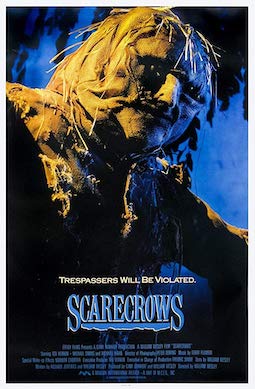
The TSL Horror Grindhouse: Scarecrows (dir by William Wesley)


The 1988 film Scarecrows is one that has a very simple but also very effective premise.

Scarecrows are scary as Hell.

And you know what?  There’s a lot to be said for the premise.  Seriously, I have no problem with clowns but scarecrows definitely make me nervous.  It’s the way that they’re just left out there in the middle of a field, tied to a post and seemingly staring at the world through black eyes.  I know that some people try to make scarecrows less creepy by giving them smiles but, to me, a smiling scarecrow is even creepier than a scarecrow with no expression at all.  At night, whenever you see the shadow of a scarecrow in the distance, it’s always easy to imagine it climbing off of its post and walking towards your house, its dark eyes focusing on your bedroom window the whole way.  If you’re not scared of scarecrows, you’re not paying attention.

(Of course, perhaps the scariest thing about scarecrows is that crows don’t seem to be particularly scared of them.  I mean, if the crows have figured out that they’re not human, what’s the point of having them unless you’re going to use them to summon evil spirits?)

Scarecrows opens with a daring heist.  Five paramilitary mercenaries, people who are paid to fight and kill for a living, steal three million dollars from Camp Pendleton and then force pilot Al (David James Campbell) and his teenager daughter, Kellie (Victoria Christian), to fly them to Mexico.  However, in the middle of the flight, one of the merceneries grabs the money and a parachute and jumps from the plane.  Two other mercenaries jump after him while the remaining two force Al to land the airplane.  The plane ends up landing outside of a small farm, one that appears to be deserted except for all the scarecrows….

Now, seriously, think about this.  The majority of the characters in this film are mercenaries.  They’ve been trained in every form of combat.  They’ve got weapons and they know how to use them.  They are used to fighting and, in fact, they even look forward to it.  Not only are they mercenaries but they’ve also just successfully robbed a MARINE base.  You don’t mess with the Marines unless you’re very stupid or very confident or maybe both.  Adam Driver was a Marine.  Do you want Adam Driver mad at you?  My point is that these characters are not your run-of-the-mill horror movie victims.

And yet, one-by-one, they’re taken out by the scarecrows.  We get a bit of backstory about the scarecrows when the mercenaries stumble across a farmhouse and discover that it was owned by three Satanists who transferred their souls into the scarecrows.  But really, that’s not important.  What is important is that the scarecrows will emerge from the darkness and kill anyone who lets their guard down.  The scarecrows even talk to each other!  TALKING SCARECROWS!  AGCK!

Anyway, Scarecrows is an effective, quickly-paced, and atmospheric horror film, one that I really enjoyed when I watched it last October.  The scarecrows make for efficient and frightening monsters.  This is the film that proves that scarecrows are scarier than clowns.

Seriously, don’t mess with the scarecrow.

A Blast From The Past: The Drug Knot (dir by Anson Williams)


In 1986’s The Drug Knot, Dermot Mulroney plays a high school student.

At the time this show aired, Dermot Mulroney was 25 years-old and he looked like he was 30 but, looks aside, he actually gives a pretty convincing performance as Doug Dawson.  Doug is a smart and musically-gifted high school senior.  He’s talented enough to make beautiful music with a saxophone and rebellious enough to skip class so that he can play the sax in the school locker room.  His girlfriend, Kim (Meryl Streep look-alike Kim Myers), is totally in love with Doug but she also worries that he’s getting too heavily into dugs.  He’s gone from smoking weed to snorting cocaine.  He hides his drugs in his bedroom.  His mother (Mary Ellen Trainor) has no idea that Doug is a drug addict while Doug’s little brother (David Faustino) wants to be just like him.

Can you see where this is heading?

In order to combat the school’s growing drug problem, the school has invited a speaker named David Toma to give a speech at a school assembly.  Toma is a former cop who struggled with addiction himself.  He inspired not one but two television shows, one called Toma and the other called Baretta.  He goes from school to school and he gives speeches about all of the teenagers that he knows who have died as a result of doing drugs.  As we see throughout the episode, Toma is a confrontational speaker, one who is not afraid to yell at his audience.  Doug shows up for the assembly but his bad attitude leads to Toma kicking him out.

Personally, I’ve always had mixed feelings about the idea of trying to change people’s behavior by yelling at them.  I know that it’s a popular technique and there’s been a lot of television shows (Intervention and Beyond Scared Straight come to mind) that are all about getting in people’s faces and screaming at them.  My feeling, though, has always been that this approach is more about making other people feel good than actually changing behavior.  Everyone wants to see the people who have caused them stress get yelled at.  On talk shows, audiences would applaud whenever a disrespectful teen got sent to boot camp but it’s rare that you ever heard about whether or not the approach actually worked.  I mean, I assume the approach works for some people but I know that if someone yells at me not to do something, my usual reaction is to go ahead do it just because I resent authority.  David Toma’s approach would not have worked with me.

(One interesting thing about The Drug Knot is that David Toma is a real person and he plays himself.  Apparently, he’s still out there and still at it, even though he’s in his 90s now.  I should note that, on YouTube, there’s a lot of comments from people who say that getting yelled at by David Toma saved their lives so maybe the yelling approach does work for more people than I assumed.)

Anyway, as always when it comes to these made-for-TV anti-drug programs, the drugs lead to tragedy and The Drug Knot ends on a particular dark note.  For once, there is no redemption.

Here is The Drug Knot, complete with an anti-drug message from Michael Jordan: