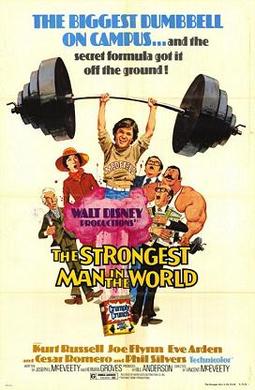
Dexter Riley (Kurt Russell) is back, again! He still hasn’t graduated from Medfield College and Medfield is still on the verge of going broke. Dean Higgins (Joe Flynn) discovers that the reason Medfield can never get out of the red is because the science class and students like Dexter are spending so much money on their experiments. The Dean fires the science professor and threatens to expel Dexter! But when Dexter’s latest experiment develops a type of milk that gives the drinker super strength, the Dean might have to change his mind.
A cereal company wants to buy the supermilk, which would get Medfield out of the hole. But a rival cereal company just wants to steal the formula for the milk so they hire disgraced businessman and gangster A.J. Arno (Cesar Romero) to once again try to thwart the best laid plans of Medfield College. Meanwhile, Dexter competes in a contest to prove that the supermilk has truly made him into the strongest man in the world.
The plot of the last Dexter Riley movie somehow manages to be even dumber than the first two and it was high time for Dexter to graduate and get on with his life but The Strongest Man In The World did make me laugh a few times. Because this entry in the series involved super strength instead of invisibility or merging with a computer, it allowed for more physical comedy and it felt less dates than the other two movies. The action is pretty much nonstop, as Dexter gets into one scrape after another and the cast is likable even if they all were getting a little old to still be playing college students. Like the other Dexter Riley films, The Strongest Man In The World is too innocent and good-natured not to enjoy on some level.
I guess Dexter finally graduated after this movie. Both he and Kurt Russell went on to better things.
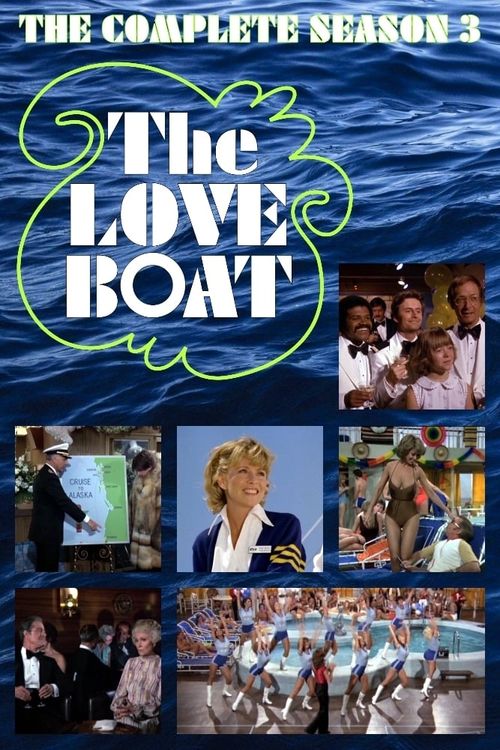
Welcome to Retro Television Reviews, a feature where we review some of our favorite and least favorite shows of the past! On Wednesdays, I will be reviewing the original Love Boat, which aired on ABC from 1977 to 1986! The series can be streamed on Paramount Plus!
This week, it’s a family affair on The Love Boat!
Episodes 3.18 & 3.19 “Kinfolk/Sis & the Slicker/Moonlight & Moonshine/Too Close for Comfort/The Affair: Part 2”
(Dir by Roger Duchowny, originally aired on January 19th, 1980)
Well, heck, it’s another double-sized, two-hour episode of The Love Boat.
This is actually the third two-hour episode of the third season, following the season premiere and the episode with the Dallas Cowboy Cheerleaders. I have to admit that I don’t really look forward to these two hour episodes because they’re usually a bit uneven. The Love Boat was the perfect hour show, one that featured stories that were specifically designed to be neatly wrapped up in 40 minutes. The two-hour episodes always seem to lose their narrative momentum after that first hour and that’s certainly the case here.
At the center of the episode is Danny Fields (Donny Osmond), a singer who has been booked to perform on the cruise. Julie is convinced that Danny is going to be a big star and she’s even convinced a talent scout named Steve Sorrell (Rich Little) to board the ship so that he can see Danny perform. However, Steve is more interested in Kitty Scofield (Loni Anderson), an innocent West Virginia girl who is eager to see the rest of the world but who is also engaged to marry the unambitious Elmer Fargas (Randall Carver). Kitty is also Danny’s sister and, in fact, Danny’s entire family (played by Richard Paul, Marion Ross, and Slim Pickens) are on the cruise. Danny is worried that his hillbilly family will stand in the way of his rock ‘n’ roll career and he goes out of his way to avoid them. While the rest of the Scofields are willing to accept that Danny doesn’t want to associate with them, Grandpa Luke Scofield (Slim Pickens) lets Danny know that he’s not to happy with Danny and his rock ‘n’ roll ways. Of course, Luke himself is being courted by Brenda Watts (Eve Arden), a writer who wants to write about the Scofield family and who gets close to them by pretending to be from West Virginia herself.
Fortunately, Danny comes to realize the error of his ways, especially after he sees how Steve has been manipulating his sister. At his next performance, Danny introduces his family and sings Country Roads especially for them. Meanwhile, Kitty realizes that she needs to be independent for a while so she dumps both Steve and Elmer, though it’s suggested that she’ll eventually give Elmer a second chance. Brenda comes clean to Luke about not being a hillbilly and Luke eventually forgives her because he’s in love with her and Brenda’s in love with him. Even old Steve turns out to be not such a bad guy, though he does tell Danny that his record label just isn’t looking for any new country acts. Hmmm …. maybe Danny should have stuck with the rock ‘n’ roll. Oh well!
Got all that? I hope so because I’m not typing all that out again.
Meanwhile, Frank (Robert Guillaume) and Maura Bellocque (Denise Nicholas) are taking the cruise with their best friends, Dave (Richard Roundtree) and Cynthia Wilbur (Pam Grier). Frank and Cynthia are having an affair and they aren’t particularly discreet about it. I was expecting Maura to decide that maybe she and Dave should have an affair of their own but instead, she just spent the entire cruise glaring at Frank. This was actually a surprisingly dramatic story, one that did not end with the expected positive outcome. (Is this the first cruise of the Love Boat to end in divorce?) This is a story that demands at least one big, explosive moment but instead, it was all surprisingly low-key.
Finally, the sprinkler system malfunctioned while the boat was in dock and the cabins of Doc, Gopher, and Isaac were flooded. So, they move in with the Captain! The Captain is not amused by Doc’s snoring, Gopher’s New Age chanting, or Isaac’s disco dancing. And when Doc, Gopher, and Isaac all try to bring different women back to the cabin with them, no one is amused by that. I’m not really sure I understand why they all had move in together. Why couldn’t Doc just sleep in his doctor’s office and maybe Isaac and Gopher could have shared an empty passenger’s cabin during the cruise? (Julie did mention that there were some “small” cabins available.) Anyway, the important thing is that they all manage to survive the cruise without killing each other.
This was an uneven episode. The Captain annoyed with everyone as funny because Gavin MacLeod was always amusing whenever he acted annoyed. The storyline with the cheating couple was well-acted, if dramatically a bit unsatisfying. But then you get to all the stuff about Danny and his country family. I know that The Love Boat is not meant to be a realistic or particularly nuanced show but still, Danny’s family was portrayed as being such a bunch of hicks that I was half-expecting them to ask the Captain whether he ever worried about the boat sailing over the edge of the world. Loni Anderson and Slim Pickens gave likable performances but Donny Osmond was incredibly bland as Danny and the scenes where he “performed” featured some truly abysmal lip-synching. It was also a bit difficult to buy Rich Little as a swinger. He came across like he just couldn’t wait to get back home and hang out at the Elks Lodge.
This episode probably would have been fun if it had played out over a compact 60 minutes but, at two hours, things were just stretched a bit too thin.
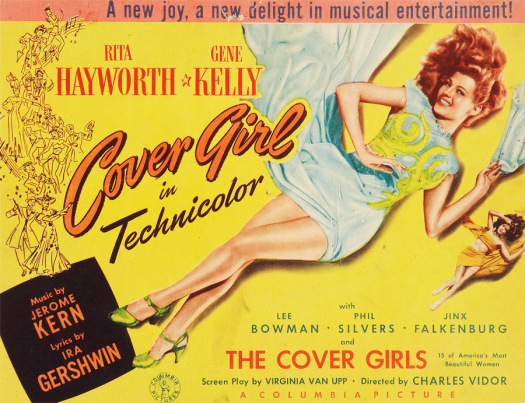
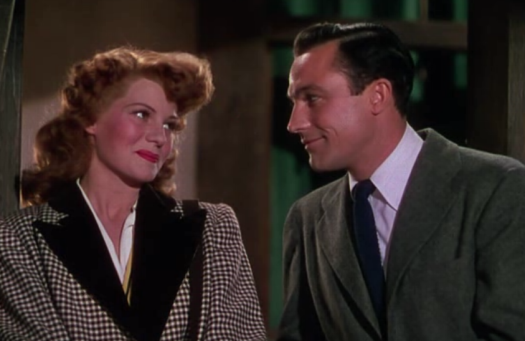
Bright, bold, and bouncy, COVER GIRL was a breakthrough film for both Rita Hayworth and Gene Kelly. Sultry, redheaded Rita had been kicking around Hollywood for ten years before Columbia Pictures gave her this star-making vehicle, while Kelly, on loan from MGM, was given free rein to create the memorable dance sequences. Throw in the comedic talents of Phil Silvers and Eve Arden , plus a bevy of beauties and songs by Jerome Kern and Ira Gershwin, and you have what very well may be the quintessential 40’s musical.
Rusty Parker (Rita) is a hoofer at Danny McGuire’s (Kelly) joint in Brooklyn (where else?). She enters a contest sponsored by Vanity Magazine to find a new cover girl for their 50th anniversary issue. Editor John Coudair ( Otto Kruger ) spots her and is reminded of the girl he once loved and lost (who turns out to have been…
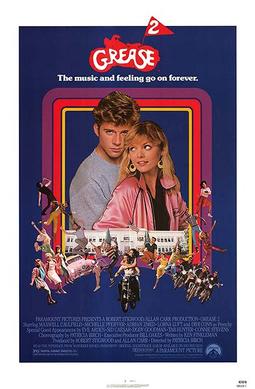
So, the whole reason that I watched Grease last week was so I would be prepared to watch the 1982 sequel Grease 2 over the weekend. As I’ve mentioned many times on this site, I absolutely hate Grease and I know what you’re probably asking yourself:
“But Lisa, if you hate Grease so much, why did you want to see Grease 2?”
Well, there’s a very good answer to that question but I’m not going to reveal it. I’m going to encourage you to learn to love the mystery. For whatever reason, I wanted to watch Grease 2. Perhaps it was because I’ve heard that Grease 2 is the worst sequel ever made. I really didn’t see how that was possible. How, I wondered, could a film be any worse than the original Grease?
And, so, I watched Grease 2 on Netflix and yes, it was really, really bad. But you know what? It was so bad that it became almost compulsively watchable. Unlike the first Grease, which is full of slow spots, Grease 2 is oddly exciting in its mediocrity. I watched much of it in open-mouthed horror, wondering if things could possibly get any worse. And, with each scene, it did get worse. It was so overwhelmingly and shamelessly bad and so thoroughly misguided that, strangely enough, I really want to rewatch it.
Grease 2 takes place in 1961. There’s a whole new gang of students at Rydell High! Well, actually, Frenchy (Didi Conn) has returned. You may remember that, in the previous film, Frenchy dropped out of high school and went to beauty school. (She was also visited by Satan, who came to her disguised as the Teen Angel.) But now Frenchy is back, trying to pass a chemistry class so she can … well, I’m not really sure what the whole deal with Frenchy was. I imagine that Didi Conn was probably free for a weekend.
The T-bird and the Pink Ladies are still around but they have a whole new membership. The head of the Pink Ladies is Stephanie Zinone (played, in her film debut, by Michelle Pfeiffer). Her boyfriend, Johnny Nogorelli (Adrian Zmed), is the chain-smoking leader of the T-birds. Actually, Johnny is now her ex-boyfriend. He cheated on her over the summer.
And there’s a new boy at Rydell! He’s originally from England and he’s Sandy’s cousin! His name is Michael Carrington (superhandsome Maxwell Caulfield, who is perhaps fated to always be best known for playing Rex Manning in Empire Records) and, when we first meet him, he’s getting off a school bus and he’s wearing a suit! Michael really likes Stephanie but you have to be a T-bird if you’re going to date a Pink Lady and…
AGCK!
Sorry, that was a primal scream. Trying to describe the plot of Grease 2 inspires a lot of primal screams.
Anyway, this is a film is also a musical but apparently, none of the original Grease composers were involved with the sequels. All the songs kinda sound like something you would hear in a parody of Grease, as opposed to a sequel. Also adding to bizarre feel of this sequel is that everyone delivers their lines as if they’re appearing in a stage production, projecting to the back of the theater and overenunciating every single syllable. This may have made sense for Grease, which was adapted from an actual stage show and, despite efforts to open up the action, was still deliberately stagey. Grease 2, meanwhile, is an adaptation of a stage show that never actually existed.
The film starts with a 7 minute production number called Back To School Again. As the Pink Ladies and the T-birds and all the other students show up outside of Rydell, they sing, “Woe is me! The Board of Education took away my parole.” And the scene just keeps going and going, until you start to wonder if Rydell High is a cult compound.
This is followed by a song about bowling (!) that’s called “Score Tonight.”
And it just keeps getting worse from there. The film becomes sickly fascinating as you find yourself trying to predict how much more worse it can possibly get. You may be tempted to give up but you’ll definitely want to stick around for the scene in which Michael discovers that Stephanie wants a “cool rider.” How does he know that? She sings a song about it!
Naturally, Michael gets a motorcycle, a helmet, and pair of goggles and he starts to romance Stephanie. Stephanie doesn’t know who that Michael is the mysterious motorcyclist, despite the fact that Michael is just wearing a helmet and a pair of goggles. Though you have to admire Pfieffer’s commitment to her role (and she gives a fairly good performance, considering the material she was working with), you can’t help but feel that Stephanie might not be the smart. Especially after she sings, “Who’s that guy?”
Uhmmm … it’s Michael. It’s not like he’s dressed up like a bat or wearing the Iron Man armor. He’s just got a helmet and goggles on. Add to that, while Maxwell Caulfield doesn’t give a bad performance (he seems to be doing the best he can with what he’s been given to work with), he also doesn’t attempt to act any differently when he’s the mysterious motorcyclist than when he’s Michael.
There are other things going on as well. The film is full of vignettes about life in 1961, all featuring the students and teachers at Rydell High. For instance, former teen idol Tab Hunter shows up as a substitute teacher and sings a song about reproduction.
And again, it’s so bad that you can’t look away and you watch knowing that you’ll never get the images and the songs out of your head. So compulsively watchable is this bad movie that I may have to watch it again after I finish this review. (Then again, I’ll probably just rewatch the fifth season of Degrassi…)
(That said, I would actually argue that Grease 2 is a better directed film than the first Grease. Grease 2 was directed by Grease‘s choreographer and, as opposed to the first film, the dance numbers are actually framed with modicum of care.)
(By the way, I’ve always wanted to use the phrase “modicum of care” in a review.)
Anyway, Grease 2 apparently bombed at the box office and, as a result, there have been no further Grease films. It’s a shame because you so know that Grease 3 would have taken place in 1967 and featured hippies.
When it comes to reviewing Grease on this site, the film and I have a long and twisted history. There have been several times when I was tempted to review Grease but one thing has always stopped me:
I absolutely hate this film.
Grease is one of my least favorite films and, to be honest, just thinking about it causes me pain. Just about everyone that I know loves Grease. They love the songs. They love the music. They love the performances. They want to see it on stage. They want to see it on the big screen. They watch every time it pops up on AMC.
Growing up as a theater nerd means being surrounded by people who love Grease. I cannot begin to count the number of times that I forced to watch this movie in school. So many theater teachers seemed to feel that showing Grease in class was some sort of reward but, for me, it was pure torture. And the fact that I was usually the only one who disliked the film made the experience all the more unbearable.
Back in 2014, when I was doing the first set of Back To School reviews, I was planning on reviewing Grease. But I just could not bring myself to voluntarily relive the film. Instead of putting myself through that misery, I decided to watch and review Rock ‘n’ Roll High School instead. It was the right decision and I stand by it.
Jump forward two years and here I am doing Back to School again. And again, for some reason, I had put Grease down as a film to review. It’s just a movie, right? And yet, after I finished writing my excellent review of Animal House, I again found myself dreading the idea of having to even think about Grease.
So, I said, “Fuck this,” and I promptly erased Grease from the list and I replaced it with Skatetown USA. Then I watched Skatetown and I’m glad that I did because that was an experience that I can’t wait to write about! And yet, I still had this nagging voice in the back of my mind.
“You’re going to have to review Grease at some point,” it said, “If not now, when?”
The voice had a point. However, I was soon reminded that there was an even more important reason to review Grease. A little further down on my list of Back to School films to review was a little film called Grease 2. How could I possibly review Grease 2 if I hadn’t already reviewed Grease? My OCD would not allow it!
And so, here I am, reviewing Grease.
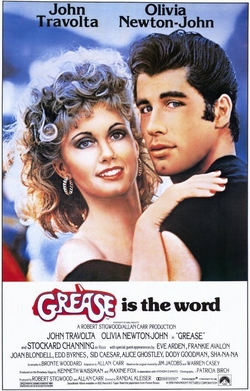
Grease, of course, is a musical about teenagers in 1958. Danny (John Travolta) is in love with Sandy (Olivia Newton-John) and Sandy is in love with Danny. But Danny’s a greaser and Sandy’s Australian! Will they be able to work it out, despite coming from different worlds? Of course they will! Danny’s willing to dress up like a jock in order to impress Sandy while Sandy’s willing to wear black leather to impress Danny! Yay! They go together! And they’ve got a flying car, too! YAY!
And then Satan arrived…
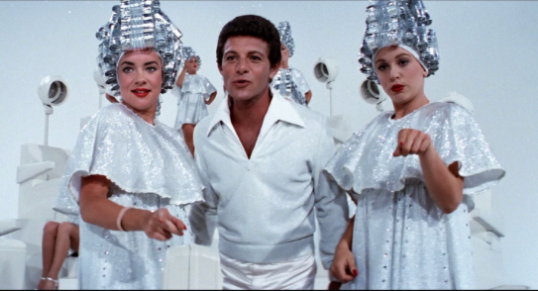
Of course, there’s other subplots as well. For instance, Frenchy (Didi Conn) nearly drops out of school but she’s visited by Satan (Frankie Avalon) and he manages to change her mind. And Rizzo (Stockard Channing) might be pregnant because Kenickie (Jeff Conaway) hasn’t bought any new condoms since the 8th grade. Comparing the sensitive way that teen pregnancy was handled on a show like Degrassi: The Next Generation with the way it’s handled in Grease is enough to make you want to sing “O Canada” every day for the rest of your life.
Here’s what I do like about Grease: Stockard Channing is great as Rizzo, though it’s hard not to feel that she deserves better than a doofus boyfriend like Kenickie and a boring bestie like Sandy. I also like You’re The One That I Want. That’s a fun song.
But as for the rest of the movie … BLEH! I mean, it is so BORING! It takes them forever to get to You’re The One That I Want. Olivia Newton-John is so wholesome that she literally makes you want to tear your hair out while John Travolta pretty much acts on auto pilot. As for the supporting cast, most of them appeared in the stage production of Grease and they still seem to be giving stage performances as opposed to film performances. They’re still projecting their lines to the back of the house. Worst of all, it’s obvious that director Randal Kleiser had no idea how to film a musical because the dance numbers are so ineptly staged and framed that, half the time, you can’t even see what anyone’s doing with their feet. If you can’t see the feet, it defeats the whole purpose of having an elaborate dance number in the first place!
The 35th film in Mill Creek’s Fabulous Forties box set was — wait a minute? I’m on my 35th Fabulous Forties review? Let’s see — there’s 50 films in the box set so that means that I only have 15 more of these to write and I’ll be done! And then I can move onto the Nifty Fifties, the Sensation Sixties, the Swinging Seventies, and the Excellent Eighties! YAY!
Anyway, where was I?
Oh yeah, the 35th film.
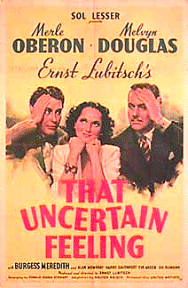
First released in 1941, That Uncertain Feeling is a movie about sophisticated people doing silly things. Socialite Jill Baker (Merle Oberon) gets the hiccups whenever she gets nervous or irritated. Her trendy friends suggest that she try the new big thing: seeing a psychoanalyst! At first, Jill is reluctant but eventually, she gives in to the pressures of high society and she goes to visit Dr. Vengard (Alan Mowbray). Dr. Vengard tells her that her hiccups are a result of her marriage to Larry (Melvyn Douglas) and suggests that the best way to cure them would be to get a divorce.
At first, Jill is horrified at the suggestion. Whatever will people think if she gets a divorce!? However, Larry is kind of a condescending jerk. (Or, at least, he comes across as being a jerk when viewed by 2016 standards. By 1941 standards, I imagine he’s supposed to be quite reasonable.) And Jill happens to meet another one of Vengard’s patients, an outspoken pianist named Alexander Sebastian (Burgess Meredith).
Soon, Jill is not only contemplating getting a divorce from Larry but perhaps marrying the eccentric Sebastian as well! When Larry realizes that Jill is dissatisfied with their marriage and that she is attracted to Sebastian, he gives her a divorce. He even pretends to be an abusive husband so that she can file for divorce on grounds of cruelty. (It’s funnier than it sounds.) Jill and Sebastian get engaged but, once Larry starts to date again, Jill realizes that she’s not quite over her ex…
I was really excited when I saw that The Uncertain Feeling was an Ernst Lubitsch film. Lubitsch directed some of my favorite Golden Age comedies, films like Ninotchka and Heaven Can Wait. But That Uncertain Feeling is not quite up to the standard of the other Lubitsch films that I’ve seen. As played by Burgess Meredith, Sebastian never comes across as being a realistic rival to Larry. The character is so cartoonishly eccentric that it becomes impossible to see what Jill sees in him. At the same time, Larry comes across as being such a chauvinist that it’s far easier to understand why Jill would divorce him than why she would ever want to take him back. The end result is a rare Lubitsch misfire.
However, as long as we’re talking about Lubitsch, make sure to see The Smiling Lieutenant if you get the chance. Now, that’s a good Lubitsch film…
(For those following at home, Lisa is attempting to clean out her DVR by watching and reviewing 38 films by the end of today!!!!! Will she make it? Keep following the site to find out!)
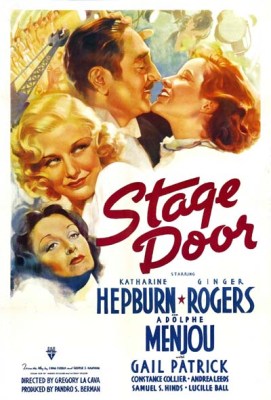
The 1937 film Stage Door is a great example of a unique genre of American film, the Katharine Hepburn Gets Humbled genre.
In the 1930s, Katharine Hepburn went through a period of time where she was considered to be “box office poison.” She was undeniably talented but it was obvious that the studios weren’t sure how to showcase that talent. They put her in high-brow films that often did not have much appeal to audiences. As well, the press hated her. Katharine Hepburn was outspoken, she was confident, she was a nonconformist, and, too many, her refusal to do interviews and sign autographs marked her as a snob. Very few people wanted to see a movie starring Katharine Hepburn and therefore, very few people were willing to make a movie starring Katharine Hepburn.
(Interestingly enough, as I sit here typing this, another KH — Katharine Heigl — is pretty much in the exact same situation, with the main difference being that Hepburn was a far more interesting actress.)
Fortunately, Katharine Hepburn was smart enough to recognize the problem and she started to appear in films like Stage Door. In Stage Door, she essentially played a character who mirrored the public’s perception of her. Terry Randall is a snobbish and pretentious aspiring actress who comes to New York to pursue her career and moves into a theatrical rooming house. At first, her attitude makes her unpopular with the other actresses living in the house. But, as the film progresses, Terry slowly starts to let down her defenses and reveals that she’s just as insecure, neurotic, and vulnerable as everyone else. She also proves herself to be willing to stand up to manipulative producers and condescending directors. When she’s cast in her first Broadway show, it turns out that the show is being financed by her father and his hope is that she’ll do such a bad job and be so humiliated that she’ll give up acting. And, at first, it appears that Terry will be terrible. During rehearsals, she is stiff and mannered. (Hepburn was actually quite brave to portray Terry as being such a believably bad actress.)
Of course, Terry isn’t the only actress at the rooming house who has issues to deal with. For instance, Judy Canfield (Lucille Ball) has to choose between pursuing her career or getting married and starting a family. Kay (Andrea Leeds) is a once successful actress who is now struggling to find roles, can’t pay her bills, and has become suicidal as a result. And then there’s Jean (Ginger Rogers), Terry’s cynical roommate and frequent enemy and occasional friend. Jean is falling in love with Anthony Powell (Adolphe Menjou), the lecherous producer of Terry’s play.
Stage Door is a wonderfully entertaining mix of melodrama and comedy. You’ll laugh, you’ll cry, and you’ll really find yourself hoping that all of the actresses at the rooming house will have their dreams come true. While the film is dominated by Hepburn and Rogers, it truly is an ensemble piece. Not only does the cast include Eve Arden, Lucille Ball and Andrea Leeds (giving the film’s best and most poignant performance) but the great dancer Ann Miller appears as Jean’s equally cynical best friend. Stage Door may be 79 years old but it’s aged wonderfully.
At the box office, Stage Door was a modest success and it directly led to Hepburn being cast in the classic screwball comedy, Bringing Up Baby. Stage Door was nominated for best picture but it lost to The Life of Emile Zola.
First off, a confession of my own. When I’m not reviewing movies or chattering away on twitter, I work in a law office. Before anyone panics, I’m not a lawyer, I just hang out with a couple of them. For the most part, I answer the phone, I schedule appointments, and I keep all the files in alphabetical order. On a few very rare occasions, I’ve accompanied my boss to court and the thing that has always struck me about real-life courtroom drama is how boring it all really is. There are no surprise witnesses, no impassioned closing statements, and those all trail rarely, if ever, jump to their feet and start yelling that they’re innocent. For the most part, real life lawyers are usually just as poorly groomed and bored with their work as the rest of us. Don’t even get me started on the judges, the majority of whom seem to have judgeships because they weren’t really making the grade as an attorney.
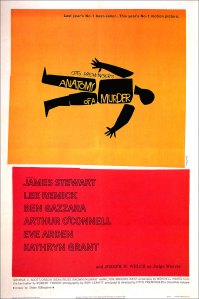
As a result, it’s rare that I get much out of seeing lawyer-centric movies or tv shows any more. After seeing the reality of it, I find fictionalized courtroom theatrics to be ludicrous and, for the most part, evidence of a lazy writer. However, I’m happy to say that last night, I discovered that — no matter how jaded I may now be about the legal process — Anatomy of a Murder is still one of my favorite movies.
Based on a best-selling novel and directed by the notorious Otto Preminger, Anatomy of a Murder tells the story of Paul Beigler (James Stewart), a former district attorney who is now in private practice after having been voted out of office. Having apparently fallen into a state of ennui, Beigler spends his time drinking with another alcoholic attorney (Arthur O’Connell) and trying to avoid his secretary’s (Eve Arden) attempts to get paid.
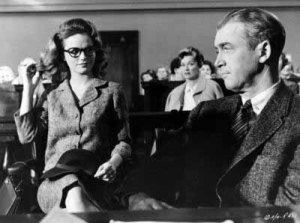
However, things change for Beigler when he is hired to defend an army officer named Frederick Manion (Ben Gazzara). Manion has been arrested for murdering a bar own named Barney Quill. Manion says that he was justified in committing the murder because Quill raped his wife, Laura (Lee Remick). Others claim that Manion is himself just a notoriously violent bully and that the openly flirtatious Laura was having an affair with Quill. Despite strongly disliking Manion and disturbed by Laura’s own obvious instability, Beigler takes on the case.
Beigler decides to argue that Manion was temporarily insane when he shot Quill and that he was acting on “irresistible impulse.” As shaky as that line of defense might seem, it’s not helped by the fact that Manion himself is a bit of a brute. Meanwhile, Beigler finds himself facing not the innefectual D.A. in court but instead a young, ambitious prosecutor from the State Attorney General’s Office, Claude Dancer (played by a young and obviously ambitious George C. Scott). As the trial begins, small hints start to appear that seem to indicate that there’s a lot more to the murder of Barney Quill than anyone realizes…
Director Otto Preminger is an odd figure in film history. Up until the early 60s, he was a consistently interesting director who made intelligent, well-acted films that often challenged then-contemporary moral attitudes. However, once the 60s hit, he became something of a parody of the egotistical, old school, autocratic filmmaker and his films seemed to suffer as a result. Like many of the film industry’s top directors, he found himself adrift once the 60s and 70s hit. His decline was so dramatic that, as a result, there’s a tendency to forget that he made some truly great and important films, like Laura, Carmen Jones, The Man With The Golden Arm, and, of course, Anatomy of a Murder.
Anatomy of a Murder represents Preminger at his best. His own natural tendency towards embracing melodrama and shock are perfectly balanced with an intelligent script and memorable performances. Whereas later Preminger films would often come across as little more than big screen soap operas, here he makes the sordid believable and compelling. Preminger has never gotten much attention as a visual filmmaker but here, he uses black-and-white to perfectly capture the grayness of the both the film’s location and the moral issues that the film raises. He keeps the camera moving without ever calling attention to it. As a result, the movie has an almost documentary feel to it.
As previously stated, Preminger gets a lot of help from a truly amazing cast. At first, it’s somewhat strange to imagine a Golden Age icon like Jimmy Stewart appearing in the same film as a dedicated method actor like Ben Gazzara. These are two men who represent not only different philosophies of acting but seemingly from two different worlds as well. However, Preminger uses their differing acting styles to electrifying effect. One of the joys of the movie is watching and contrasting the old style, “move star” turns of James Stewart, Arthur O’Connell, and Eve Arden with the more “naturalistic” approaches taken by their younger co-stars, Gazzara, Lee Remick, and especially George C. Scott. The contrast in style becomes a perfect reflection of the film’s contrast between what is legal and what is correct. All the actors, as both individuals and as an ensemble, give memorable performances. When you look at the cast, you realize that any one of their characters could have been the center of the story without the film becoming any less compelling.
Lee Remick (a notoriously fragile actress who, for years, I knew solely as the poor woman who kept getting attacked by her adopted son in the original Omen) brings out the best in everyone she shares a scene with. Whether she’s making Stewart blush or breaking down on the witness stand, she dominates every scene as an insecure young woman who forces herself to be happy because otherwise, she’d have to confront the fact that she’s miserable. (I should admit that I related more than a bit to Remick’s character. To me, the movie was about her and therefore, about me.)
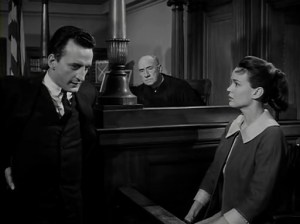
She is perhaps at her best towards the end of the film when she is on the witness stand and is cross-examined by George C. Scott. Starting out as flirtatious and seemingly confident, Remick slowly and believably falls apart as Scott methodically strips away every layer of defense that, until now, she’s spent the entire movie hiding behind. By the end of the scene, Remick has shown as every layer of pain that has built up in Laura Manion over the years. For his part, Scott is simply amazing in this scene. Determined and focused, Scott doesn’t so much cross-examine Remick but seduces her and the audience along with her. As a result, when he suddenly turns off the charm and lunges in for his final attack, it’s devastating for everyone watching. (And, as was correctly pointed out to me by a friend while I was watching the film last night, George C. Scott was quite the sexy beast when he was young.)
Lastly, the film’s judge is played by an actual lawyer by the name of Joseph Welch. Welch wasn’t a great actor but he did make for a great judge.
Of course, it wouldn’t be a Preminger film is a few contemporary morals weren’t challenged and, at the time it was released, Anatomy of a Murder was considered to be very daring because of its frank discussion of topics like rape and spousal abuse. It doesn’t seem quite so daring now but it does seem to be remarkably mature in a way that even most modern movies can’t match. That being said, the film does occasionally embrace the “she must have been asking for it” male viewpoint but still, it’s a remarkably advanced movie for the 1950s.
One of the wonderful things about watching a 51 year-old film is that it provides a chance to see what was considered to be shocking in the years before you or I was born. From watching this movie, I’ve discovered that, in the year 1959, “panties” was apparently a taboo phrase. A good deal of the film’s plot revolves around the panties Lee Remick’s character was wearing the night she was raped and their subsequent disappearance. At one point, there’s even a scene where Welch, Stewart, and Scott struggle to come up with a less offensive term to use when referring to them in the court. (Scott suggests employing a term he heard in France.) Seen 51 years later (in a time when we can not only say “thong” in polite conversation but specifically go out of our way to show off the fact that we’re wearing one), this scene, and the actors’ obvious discomfort whenever they have to say the word “panties”, never fails to amuse me.
Preminger’s other grand challenge to the 50s mainstream was in getting Duke Ellington to compose the film’s jazz soundtrack. At the risk of being called a heretic by some of my closest friends, I’ve never been a big fan of jazz but it works perfectly here. Ellington, himself, makes a cameo appearance and wow, is he ever stoned.
In conclusion, allow me to thank the readers of the site for “ordering” me to watch, once again, a truly classic film. Now, seeing as how close the vote was and that I know, for a fact, that some people voted more than once, I think it would be only fair for me to also rewatch and review the other 9 movies (Lost in Translation, Primer, Hatchet For the Honeymoon, Emanuelle in America, Starcrash, Darling, Sole Survivor, The Sweet House of Horrors, and The Sidewalks of Bangkok) in my poll over the next couple of weeks. I’m looking forward to each and every one of them (well, almost all of them) and, again, thank you for allowing me to start things off with a great film like Anatomy of a Murder.


 Through the Shattered Lens