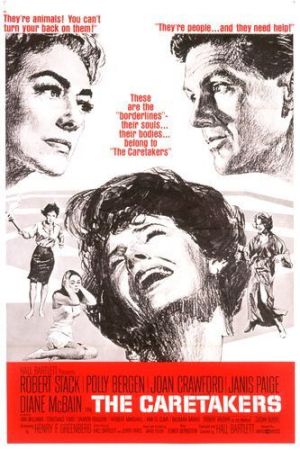
Embracing the Melodrama Part II #27: The Caretakers (dir by Hall Bartlett)


The_Caretakers_(1963_movie_poster)Whenever I go to Half-Price Books, I always seem to end up spending most of my time browsing the “nostalgia” section.  This is where they keep all of the old paperbacks that were published long before I was born.  This is where you can find old romance novels, “for adults only” novels, detective novels, and occasionally you’ll even find mainstream novels that were apparently considered to be quite daring when they were originally released.  These novels usually carry cover blurbs that brag about how controversial they are and how they deal with the “real issues of today.”

Usually, these novels are pretty silly and over-the-top which is why I always seem to end up buying a lot of them.  About a year ago, I bought a novel from 1959.  It was by Dariel Telfer and it was called The Caretakers.  The cover features a naked woman standing in front of several nurses and doctors.  The cover blurb announces that The Caretakers is “A shattering novel about nurses, doctors, and patients in a state hospital where emotions readily explode!”  The back cover features a pull quote from Time: “Will shock as well as arouse compassion.”

Now, I have to admit that I have yet to get around to actually reading The Caretakers.  However, thanks to TCM, I recently saw the 1963 film version and it’s a film that definitely embraces the melodrama.

How melodramatic is The Caretakers?  It’s melodramatic enough that it opens with Lorna Medford (Polly Bergen) stumbling into a movie theater and having a nervous breakdown.  Since this film was made in 1963, her mental breakdown is represented by spinning the camera around and getting hyperactive with the zoom lens, all while Bergen shrieks and tears at her hair.

Lorna is sent to a mental hospital, where she meets several other patients and is treated by Dr. MacLeod (Robert Stack), who is a rebel.  We know that he’s a rebel because everyone else at the hospital keeps telling him that he’s a rebel and complaining about his use of radical use of group therapy.  Under Dr. MacLeod’s guidance, Lorna reveals that she hasn’t gotten over the tragic death of her child.

As the film progresses, Lorna gets to know the rest of the patients.  They’re a mixed bunch, all played by actresses who clearly saw this as their chance to pick up an Oscar for Best Supporting Actress and were determined to make as big an impression as possible.  For instance, Barbara Barrie plays Edna, who never speaks but who does enjoy setting fires and who, whenever she’s feeling persecuted, poses as if she’s hanging from a cross.  And then there’s grandmotherly Irene (Ellen Corby), who is supposed to be the nice one but always looks like she’s on the verge of very sweetly shoving a pair of knitting needles into someone’s eyes.

However, my favorite patient was the cynical Marion (Janis Paige), precisely because she was so cynical and, as a result, she got all the best lines.  Marion is a former prostitute who now hates all men and Paige has a lot of fun playing the role.  Whenever Paige is giving one of her long, angry monologues, she practically grabs the film and refuses to let it go.

And then, of course, there’s Joan Crawford.  Crawford doesn’t play a patient.  Instead, she’s the head nurse and she doesn’t approve of Dr. MacLeod’s methods.  Crawford announces early on that she’s been attacked by a patient in the past and her main concern is protecting her staff.  She teaches a self-defense class.  If you’ve ever wanted to see a middle-aged Joan Crawford flip someone over, The Caretakers is a film to watch.

And that’s The Caretakers for you.  It’s one of those films that takes itself so seriously that it becomes humorous despite itself.  As a result, the film is a lot of unintentional fun.

And who knows?

Maybe someday, I’ll get around to reading the book!


Embracing the Melodrama Part II #26: Cleopatra (dir by Joseph L. Mankiewicz)


Cleopatra_posterWhile watching the 1963 best picture nominee, Cleopatra, I had many thoughts.  The film lasts over 4 hours so I had a lot of time to think.

For instance, I often found myself impressed by the sheer size of the production.  I marveled at the recreation of ancient Greece and Rome.  I loved looking at the ornate costumes.  I loved feeling as if I was taking a look back at what Rome may have actually looked like at the height of the Roman Empire.  Making it all the more impressive was that this film was made in the days before CGI.  When the film’s Romans walked through the streets of Rome, they weren’t just actors standing in front of a green screen.  They were walking down real streets and surrounded by real buildings.  It reminded me of the awe and wonder that I felt when I was in Italy and I was visiting the ruins of ancient Rome.

(I don’t know if any of the cast accidentally flashed everyone like I did when I visited during Pompeii on a windy day but considering how short some of the skirts on the men were, it wouldn’t surprise me if they did!)

And, as I marveled at the recreation of Rome, I also thought to myself, “How long is this freaking movie?”  Because, seriously, Cleopatra is an amazingly long movie.  It’s not just the film is over four hours long.  It’s that the film feels even longer.  Gone With The Wind, The Godfathers Part One and Part Two, Once Upon A Time In America; these are all long films but, because they’re so great, you never find yourself checking the time while watching.  Cleopatra is the opposite of that.  Cleopatra is a film that, at its slowest, will make you very much aware of how many seconds are in a minute.

I found myself marveling at the lack of chemistry between Elizabeth Taylor and Richard Burton.  If anything, this is the most shocking thing about Cleopatra.  If Cleopatra is famous for anything, it’s famous for being the film where Elizabeth Taylor (cast in the role of Cleopatra) first met Richard Burton (who was playing Mark Antony).  Their affair dominated the gossip headlines.  (If TMZ and YouTube had been around back then, there would be daily videos of Richard Burton punching out paparazzi.)  Cleopatra was the first of many big-budgeted, overproduced films that Taylor and Burton co-starred in.

(Then again, they also starred in Who’s Afraid of Virginia Woolf, a film that is almost the exact opposite of Cleopatra.)

In the role of Mark Antony, Burton spends most of the film looking absolutely miserable.  Elizabeth Taylor, meanwhile, seems to be having a lot more fun.  It’s almost as if she understood what Cleopatra was going to become so she went out of her way to give the type of over-the-top performance that the film deserved.  The same can also be said about Rex Harrison, who plays Julius Caesar and who, perhaps because he appears to have shared her attitude, actually does have some chemistry with Taylor.

Actually, if anyone gives a truly great performance in Cleopatra, it’s Roddy McDowall.  McDowall plays the future Emperor Augustus with a mesmerizing intensity.  Again, McDowall’s performance is not exactly subtle but Cleopatra is not a film that demands subtlety.

As the film finally neared its end, I found myself wondering how Joseph L. Mankiewicz went from directing two close to perfect films, A Letter To Three Wives and All About Eve, to directing this.  Even more amazing, Mankiewicz had previously directed one of the best Roman Empire films ever, 1953’s Julius Caesar.  (When compared to Cleopatra, the low-key and thoughtful Julius Caesar appears to have been filmed on an entirely different planet.)  Well, in Mankiewicz’s defense, he was not the original director.  He was brought in to replace Rouben Mamoulian, who had previously attempted to make the film with Joan Collins, Ben-Hur‘s Stephen Boyd, and Peter Finch.  When Mankiewicz was brought in, the cast was replaced with Taylor, Burton, and Harrison.  Between the expensive stars, the troubled production, and all of the offscreen romantic melodrama, Mankiewicz probably did the best that he could.

Today, Cleopatra is mostly interesting as an example of a film from the “Only Gigantic Productions Will Save Us From Television!” era of Hollywood filmmaking.  Cleopatra started out as a $2,000,000 production and ended up costing $31,000,000.  It was the number one film at the 1963 box office and it still nearly bankrupted 20th Century Fox.  While the film does have some kitsch appeal, the critics hated it and it’s easy to see why.

And yes, it was nominated for best picture of the year, a tribute to the size of the production and the determination of 20th Century Fox to get something — anything — in return for their money.

Cleopatra is a bit of a chore to sit through but it can be fun if you’re in a snarky mood.  It’ll do until the inevitable Angelina Jolie remake comes along.

Embracing the Melodrama Part II #25: West Side Story (dir by Robert Wise and Jerome Robbins)


West_Side_Story_poster

Nearly two weeks ago, I started on something that I call Embracing the Melodrama, Part II.  For the next month or so, I will be reviewing, in chronological order, 126 examples of cinematic melodrama.  I started things off by reviewing the 1927 classic Sunrise and now, 24 reviews later, we’re ready to start in on one of my favorite decades, the 1960s!

And what better way to start the 60s than be taking a look at the 1961 best picture winner, West Side Story?

Being a lifelong dancer, I have to admit that I’ve lost track of how many times I’ve seen West Side Story.  If you love to dance, this is one of those films that you simply have to see.  Of the various musicals that have won best picture, West Side Story is arguably the best.  Based on a hit Broadway show (which was itself rather famously based on William Shakespeare’s Romeo and Juliet), West Side Story was co-directed by the great choreographer Jerome Robbins and it features some of the greatest dance numbers ever filmed.  If you don’t get excited while watching the Sharks and the Shark Girls arguing about America, then there’s really no hope for you.  Tonight Quintet, Somewhere, A Boy Like That, Maria … even Gee, Officer Krupke, has there ever been another musical score that just leaves you wanting to sing as much as West Side Story does?

(I mean, I’ll be the first admit that I absolutely love the theme song from Santa Claus Conquers The Martians but it can’t even compare to West Side Story!)

What’s funny is that, in between viewings of the film, I always seem to forget just how good West Side Story actually is.  (Fortunately, this also means that I’m pleasantly surprised every time I watch the movie.)  In theory, this is an easy film to joke about.  It tells the story of street gangs who are apparently just as good at dancing as they are at fighting.  The all-white Jets snap their fingers and tell us that when you’re a jet, you’re the best.  The Puerto Rican Sharks are moving in on the Jets’s territory.  The two leaders of the gangs — Riff (Russ Tamblyn) and Bernardo (George Chakiris) — want to settle thing with a “rumble.”  And it’s easy for contemporary audiences to laugh because “rumble” is such an old-fashioned way of saying things that it’s now one of those terms that’s only used when one is trying to be ironic or snarky.

(For instance, I was with some friends at the movies and the people sitting behind us kept talking.  One of my friends told them to shut up.  One of the loud people replied that we were the ones who need to shut up.  As the insults escalated, I finally said, “Y’all — do we really have to have a rumble right now?”  Unfortunately, everyone was too busy arguing to appreciate my pitch perfect delivery.)

Riff’s best friend is Tony (Richard Beymer).  Tony was a co-founder of the Jets but now, he wants to move on from the gang.  He meets a girl named Maria (Natalie Wood) and the two of them fall in love.  However, Maria is Bernardo’s younger sister.  Her best friend, Anita (Rita Moreno), is Bernardo’s girlfriend.  Loving Tony, in other words, is prohibido.

And, since West Side Story is based on Romeo and Juliet, you can probably guess to what type of tragedy all of this leads.

Now, before I heap too much praise of West Side Story, I do need to admit that, in the role of Tony, Richard Beymer does not exactly radiate charisma.  He’s handsome enough but you never quite buy that he was former member of the Jets.  Since Tony’s singing voice was dubbed by Jimmy Bryant, you do believe everything that he sings.  But otherwise, Richard Beymer comes across as being stiff and rather awkward.

And it doesn’t help, of course, that he’s acting opposite Russ Tamblyn who, in the role of Riff, is a whirlwind of unstoppable energy.  Tamblyn is the one who you remember at the end of the film, followed by George Chakiris.  Compared to those two, Richard Beymer’s performance is just dull.

Fortunately, there’s Maria (played by Natalie Wood with Marni Nixon doing the singing).  Natalie Wood is one of my favorite of the classic Hollywood actresses.  She’s certainly one of the actresses with whom I most idenitfy.  With Richard Beymer sleepwalking through the role of Tony, it falls on Natalie to provide some true emotion to the film’s love story and that’s exactly what she does.  Every time I see West Side Story, I want to be Natalie Wood and I want to have a best friend like Rita Moreno and I want to meet someone like Riff…

Sorry, Tony.

West Side Story is one of the best musicals ever made.  If you’re not dancing and then crying and then dancing while crying as you watch West Side Story, then you’re doing it wrong.

Embracing the Melodrama Part II #24: The Diary of a High School Bride (dir by Burt Topper)


teen01

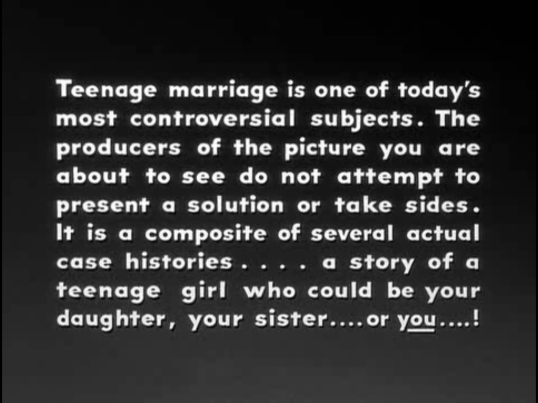
I always enjoy it when a film opens with a message statement that announces that it was made to shine the light on one of “today’s most controversial subjects.”  Even better is when that message statement states that the film could be my story or that it could serve as a warning to people like me about what might happen.

Of course, it’s too late for me to be warned.  I’m not in high school anymore.  I’ve already made my decisions and had to deal with the consequences of my mistakes and all the other melodrama that makes life interesting.  But I can watch a film like 1959’s The Diary Of A High School Bride and I can read the message statement at the beginning and I can think to myself, “If only I had seen this movie before I decided to sneak out that night and drink alcohol or smoke weed or let my boyfriend take pictures of me naked or have sex with a married man or rob a convenience store or read that forbidden book or become a bride of Cthulhu or agree to spy for the communists or whatever the Hell it was that I did that night!”  If only…

Actually, it probably wouldn’t have made much of a difference.  Life doesn’t come with a message statement and whenever I see one at the beginning of a film, it usually makes me less likely to take that film seriously.  In fact, I tend to seek out films the open with message statements because they’re usually a lot of fun.

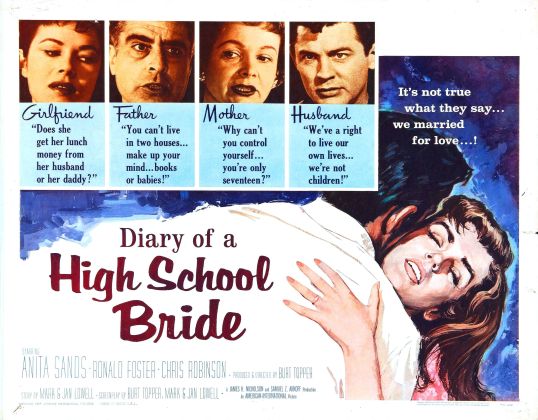
Take The Diary of a High School Bride, which is silly in a way that only an American International Pictures youth film could be.  The film opens with 25 year-old law student Steve (Ron Foster) driving home from Las Vegas with his new wife, 17 year-old Judy (Anita Sands).  When Steve gets pulled over by a police officer, Judy starts to tremble in terror.  When the cops asks Judy how old she is, she lies that she’s 21 and then starts to cry.  When the police officer asks if she’s really married to Steve, she wails, “Yes, and this record proves it!”  At this point, she holds up a vinyl record.

However, a vinyl record is not the only thing that Judy has.  She also has a teddy bear and oh my God, she literally carries that teddy bear with her everywhere!  When she and Steve tell her parents, she has the teddy bear.  When she wails at them, “AND NO — I’M NOT PREGNANT!,” she has the teddy bear.  When she and Steve go out to a coffeehouse and listen to some pretty good flamenco music, Judy has that teddy bear.  When they get back to Steve’s apartment and Judy finally see Steve with his shirt unbuttoned, Judy drops the teddy bear on the floor.

Why are Steve and Judy married?  That’s never really made clear.  They have absolutely nothing in common and Judy is so naive and so innocent that she spends most of the movie struggling to speak in coherent sentences.  (And, of course, she also won’t let go of her teddy bear.)  Steve, meanwhile — well, listen, when you’re 17, any man in his 20s is automatically attractive.  But still, there’s something undeniably (and, judging from the film’s script, unintentionally) creepy about Steve’s marriage to Judy.

Anyway, when Judy goes back to school, she has to deal with people singing Here Comes The Bride at her.  She also has to deal with her ex-boyfriend, Chuck (Chris Robinson).  Chuck wants her back and soon, he’s harassing the newly married couple and making such a menace out of himself that the whole “She’s only 17!” thing gets forgotten about…

So, that’s Diary of a High School Bride.  It’s a film that, if I had seen it when I was an out-of-control teenager, would have made absolutely no difference whatsoever.  But, if you’re a fan of 1950s B-movies (and who isn’t!) and if you have a group of friends who like to be snarky while watching old movies (and who doesn’t!), you’ll probably enjoy The Diary of a High School Bride.  At the very least, it features a fun little theme song from someone named Tony Casanova.

The Diary of a High School Bride was directed by Burt Topper and written by the poet Robert Lowell.  (Okay, it was probably a different Robert Lowell…)  It’s currently available on Netflix and it’s a lot of fun if you’re in the right snarky mood.

Diary

Embracing the Melodrama Part II #23: The Defiant Ones (dir by Stanley Kramer)


Defiant_Ones_poster

Stanley Kramer is one of those old school filmmakers who directed several films that were acclaimed when they were originally released but who tends to be dismissed by contemporary film critics.  Kramer specialized in making films about social issues and he deserves to be applauded for attempting to look at issues that Hollywood, at that time, would have preferred to ignore.  However, as Mark Harris points out in his excellent book Pictures At A Revolution, Kramer started out as a producer and, even after he started directing, he never lost his producer sensibility.  As a result, a Kramer film would typically address issues that were guaranteed to generate a lot of free publicity but, at the same time, Kramer would never run the risk of truly alienating his audience by digging too deeply into those issues.  As a result, Kramer’s films have come to represent a very safe and middlebrow version of 50s and early 60s style liberalism.

Now, I have previously reviewed 4 Stanley Kramer films on this site and I have to admit that I was somewhat dismissive of most of them.  I felt that Ship of Fools was shallow.  I thought that Guess Who’s Coming To Dinner collapsed under the combined weight of a self-satisfied script and Kramer’s refusal to let Sidney Poitier’s character be anything other than idealized perfection.  R.P.M. is a guilty pleasure, specifically because Kramer was so out-of-touch with the film’s subject matter.  I did give Judgment at Nuremberg a good review, describing it as one of Kramer’s rare films that still holds up today.

And now, I’m going to give another Kramer film a good review.

Kramer’s 1958 film The Defiant Ones features a classic Kramer situation.  White Joker (Tony Curtis) and black Noah (Sidney Poitier) are both prisoners in the deep south.  Joker is an unrepentant and violent racist while Noah … well, Noah is Sidney Poitier.  He’s determined, he’s not afraid to speak his mind, and most of all, he’s dignified.  That’s not meant to be a complaint about Poitier’s performance in The Defiant Ones.  In the role of Noah, Poitier has a great screen presence and it’s impossible not to root for him.  Whereas Curtis tends to chew up every piece of scenery that he gets nears (and, again, that’s not really a complaint because Curtis’s overacting is totally appropriate for his character), Poitier keeps the film grounded.

When the prison bus that is transporting them crashes, Joker and Noah are able to escape.  Fleeing on foot, they make their way through the wilderness and attempt to hide from the police.  As quickly becomes obvious, Joker and Noah hate each other but, because the sheriff had a sense of humor, they have also been chained together.  In other words, they’re stuck with each other and, in order to survive, they’re going to have to learn to coexist.

No, it’s not exactly subtle but it works.

As a filmmaker, Kramer was never known for being visually inventive and, as a result, his films often had to resort to heavy-handed monologues to make their point.  But, in The Defiant Ones, the chains act as a great visual symbol for race relations in America.  Joker and Noah literally can’t escape from each other and they have to work together if they’re going to survive.  The chains make that obvious and, as a result, this is the rare Kramer film where nobody has to give a big speech to get across Kramer’s message.  As a result, The Defiant Ones preaches without ever getting preachy.

Though the film is dominated by Poitier and Curtis, it also features some excellent supporting work.  Lon Chaney, Jr, for instance, has a great cameo as world-weary man who helps the two convicts in their flight.  Cara Williams is surprisingly poignant as a lonely, unnamed woman who tries to both protect Joker and get rid of Noah.  And finally, there’s Theodore Bikel, playing the role of Sheriff Max Muller.  Max is the most surprising character in the film, the head of a posse that’s set out to recapture Noah and Joker.  As opposed to most of his men, Max is a humane and caring man who struggles to control the more bloodthirsty men who are serving under him.

Message films tend to get dated rather quickly but The Defiant Ones holds up surprisingly well.

Embracing the Melodrama Part II #22: The Cry Baby Killer (dir by Joe Addis)


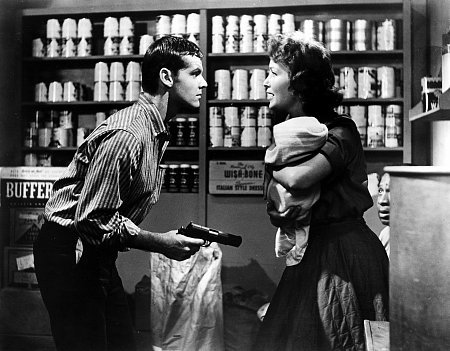
That's Jack Nicholson with the gun.

That’s Jack Nicholson with the gun.

Two years ago, there was a rumor that Jack Nicholson had announced his retirement from acting because he was starting to suffer from memory loss.  Even though Nicholson’s people later claimed that this was false and that Jack was actively reading scripts, that rumor still left me feeling very depressed.  Jack Nicholson is such an iconic actor that it’s difficult to think that there will be a time when he’ll no longer be arching his eyebrows and delivering sarcastic dialogue in that signature voice of his.  When you look at a list of his films, you find yourself looking at some of the best and most memorable films ever made.  Chinatown, The Shining, The Departed, The Shooting, Easy Rider, One Flew Over the Cuckoo’s Nest; Nicholson has appeared in some truly great films.

But every actor, no matter how iconic he may be, had to start somewhere.  For Jack Nicholson, that somewhere was the 1958 Roger Corman-produced film, The Cry Baby Killer.  The good news is that the 21 year-old Nicholson starred in his very first film.  The bad news is that there’s absolutely nothing about Jack’s performance that would give you any reason to believe that he would eventually become one of the best known and most-honored actors of all time.  It’s not that Jack gives a bad performance.  In fact, it’s somewhat disappointing that Jack doesn’t do a terrible job in the role.  When you’re seeing the obscure film debut of a cinematic icon, you always hope that the first performance will either be amazingly good, shockingly bad, or just embarrassingly inappropriate.  But, in Jack’s case, he’s neither good nor bad and he doesn’t really embarrass himself.  Instead, he’s just bland.

Yes, you read that right.

Jack “HEEEEEEEEEERE’S JOHNNNNNNNY!” Nicholson was bland in his debut film.

As for the film itself, Jack plays Jimmy.  We’re told that Jimmy is 17 years-old and he’s still in high school.  (Since Jack Nicholson’s hairline was already receding at 21, we automatically have a difficult believing him in the role of Jimmy.)  Jimmy’s a good kid but he’s kind of stupid.  Also, his ex-girlfriend Carole (Carolyn Mitchell) is now dating an 18 year-old gangster named Manny Cole (played by Brett Halsey, who would later have a prolific career in Italian exploitation films as well as appearing in The Godfather, Part III).  Jimmy confronts Manny.  Manny has two of his thugs beat up Jimmy.  Jimmy grabs a gun off a thug and shoots someone.  Scared of going to jail, Jimmy runs into a store and takes three hostages — a stocker and a young mother with a baby.

The rest of the 70-minute film consists of an understanding policeman (Harry Lauter) trying to convince Jimmy to surrender while the crowd of reporters and observes outside the store hope for a violent confrontation.  The film does make a still-relevant point about how the media exploits the potential for tragedy but, for the most part, it’s pretty forgettable.

As I stated above, Jack is adequate but forgettable.  If I had seen this movie when it first came out in 1958, I would have expected handsome and charismatic Brett Halsey to become a huge star while I would have predicted that Nicholson would spend the rest of his career in television.

However, we all know that didn’t happen.  Jack Nicholson became an icon.  Sadly, Jack hasn’t appeared in a film since 2010.  Hopefully, he’ll give us at least one more great performance.  Who knows?  Maybe some aspiring screenwriter will write as script for Cry Baby Killer 2: Jimmy’s Revenge.

It could happen.

Cry_Baby_Killer

Embracing the Melodrama Part II #21: Emergency Hospital (dir by Lee Sholem)


Emergency Hospital

Right now, on Netflix, you can find Emergency Hospital, a low-budget film from 1956.  Emergency Hospital, which probably was made to be the second feature on a double bill, covers the course of one night at a hospital.  Patients come in.  Crimes are investigated.  Two doctors — one a man and one a woman and since this film was made in the 50s, that leads to all sorts of confusion — deal with all of the patients.  The film manages to stuff a lot of incidents into just 61 minutes of running time.

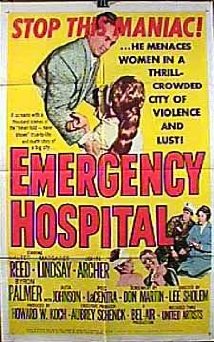
If you look at the poster above, you’ll see that it implores us to “STOP THE MANIAC!  He menaces women in a thrill-crowded city of violent and lust!”  I’m not really sure which of the film’s many subplots that is meant to refer to.  At one point, the son of a police detective is brought in after crashing his car.  He briefly attempts to hold a nurse hostage with a scalpel but, in the end, he doesn’t turn out to be much of a maniac.

In fact, if there’s anything that really distinguishes Emergency Hospital is just how low-key it is.  For the most part, the film emphasizes the fact that everyone at the hospital is focused on doing her or his job.  The patients all come in with their own individual melodramas but, for the most part, the doctors and the police all react calmly and rationally.  It’s interesting to compare Emergency Hospital to something like Magnificent Obsession.  Whereas Magnificent Obsession truly embraces the melodrama, Emergency Hospital invites the melodrama to pull up a chair and then tells it to calm down.

Perhaps because it was such a low-budget and obscure film, Emergency Hospital gets away with taking a look at and talking about issues that you normally wouldn’t expect to be so openly explored by a film made in the 50s.  And, interestingly enough for a film made in a culturally reserved time, the doctors and nurses at Emergency Hospital take a rather open-minded and nonjudgmental approach to their patients.  An anxious mother comes in with her bruised baby and is confronted about being an abusive parent.  A teenage girl comes in after being raped and the doctors try to convince her father (who thinks his daughter’s reputation will be ruined) to call the police.

Now, make no mistake about it: Emergency Hospital is not a secret masterpiece.  It’s an extremely low-budget movie that looks like an extremely low-budget movie.  But, taking all that into consideration, it’s still a lot better than your typical 61 minute second feature.

Emergency Hospital can currently be watched on Netflix.

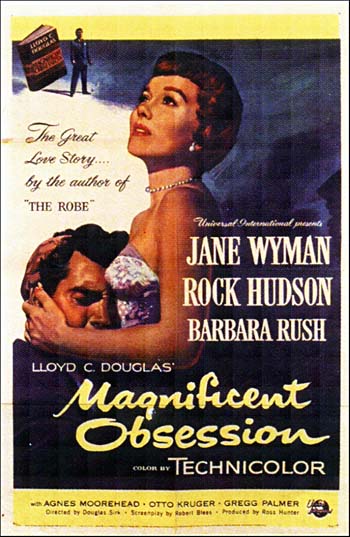
Embracing the Melodrama Part II #20: Magnificent Obsession (dir by Douglas Sirk)


Magnificent_obsessionThere’s a scene early on in the 1954 melodrama Magnificent Obsession in which formerly carefree millionaire Bob Merrick (Rock Hudson) meets with an artist named Edward Randolph (Otto Kruger).  We know that Randolph’s brilliant because he speaks in a deep voice, tends to be unnecessarily verbose, and often stares off in the distance after speaking.  Bob wants to know about a dead doctor who was a friend of Randolph’s.  Randolph explains the late doctor’s philosophy of doing anonymous good works.  Bob’s mind is blown.  (Hudson, who was never the most expressive of actors, conveys having his mind blown by grinning.)

“This is dangerous stuff,” Randolph warns him, “One of the first men who used it went to the cross at the age of 33…”

And a heavenly chorus is heard in the background…

And that one line pretty much tells you exactly what type of film Magnificent Obsession is.  It’s a film that not only embraces the melodrama but which also holds on tight to make sure that the melodrama can never escape.  There’s not a single minute in this film that is not hilarious overwritten.  It’s not just Randolph who tends to be portentous in his pronouncements.  No — everyone in the film speaks that way!

The dead doctor is dead specifically because of Bob.  Apparently, the doctor had a heart attack but the local hospital’s only resuscitator was being used to save the life of Bob who, while the doctor was dying, was busy recklessly driving a boat.

Helen (Jane Wyman), the doctor’s widow is, at first, bitter towards Bob and when Bob offers to donate $250,000 to the hospital, Helen refuses to accept his check.  This leads to Bob doing a lot of soul-searching and eventually having his life-changing conversation with Randolph.  Excited at the prospect of doing anonymous good works for the rest of his life, Bob tracks down Helen and tries to tell her that he’s a changed man.  Helen, however, wants nothing to do with Bob and ends up getting hit by a car while running away from him.  Helen survives but now, she’s blind!

Now, at this point, you might think that Bob has done enough to ruin Helen’s life.  At least, that’s the way that Helen’s family views it and when Bob attempts to visit her in the hospital, they order him to go away.

Eventually, Helen comes home from the hospital and starts to adjust to a life without eyesight.  One day, she meets a man on the beach and they start up a tentative romance.  What she doesn’t realize, at first, is that the man is Bob!  By the time she does realize who the man is, Helen has fallen in love with him.  However, she feels that it wouldn’t be fair to Bob to pursue a relationship with him and she leaves him.

So, of course, Bob’s response is to go to medical school and become a neurosurgeon.  Many years later, Helen has a brain tumor and needs an operation to survive.

Can you guess who her surgeon turns out to be?

Magnificent Obsession is almost a prototypical 1950s melodrama.  It’s big, it’s glossy, it’s self-important, and undeniably (and occasionally unintentionally) funny.  Even the total lack of chemistry between Hudson and Wyman somehow adds to the film’s strange charm.  It’s hard not to admire a film that starts out over-the-top and just grows more excessive from there.

Watching Magnificent Obsession is a bit like taking a trip into a parallel, technicolor dimension.  It’s strange, fascinating, and far more watchable than it should be.


Embracing the Melodrama Part II #19: Sunset Boulevard (dir by Billy Wilder)


Sunset Boulevard

“All right, Mr. De Mille, I’m ready for my close-up!”

— Norma Desmond (Gloria Swanson) in Sunset Boulevard (1950)

First released in 1950 and nominated for Best Picture, Billy Wilder’s Sunset Boulevard is one of the greatest and most influential films of all time.  It’s also something of a difficult film to review because, in order for one to truly understand its greatness, it needs to be seen.  A description simply will not do.  You have to experience, first hand, the performances of Gloria Swanson, William Holden, and Eric Von Stroheim.  You have to see, with your own eyes, the way that Billy Wilder perfectly balances drama, satire, and horror.  I can tell you about how cinematographer John F. Seitz perfectly contrasts the empty glossiness of Hollywood with the dark shadows that fill the ruined mansion of Norma Desmond but, again, it’s something that you owe it to yourself to see.  You need to hear the perfectly quotable dialogue with your own ears.  You need to experience Sunset Boulevard for yourself.

And, while you’re watching it, think about how easily one bad decision could have screwed up the entire film.  Sunset Boulevard is famous for being narrated by a dead man, a screenwriter named Joe (William Holden).  When we first see Joe, he’s floating in a pool.  Originally, however, the film was to open with the dead Joe sitting up in the morgue and telling us his story.  Reportedly, preview audiences laughed at the scene and it was cut out of the film.  And Wilder made the right decision to remove that scene.  Sunset Boulevard may be famous for being a strange film but, when you actually watch it, you realize just how controlled and disciplined Wilder’s direction actually is.  Sunset Boulevard may be weird but it’s never less than plausible.

Joe Gillis is a former newspaper reporter-turned-screenwriter.  He may have started out as an idealist but, as the film begins, he’s now just another Hollywood opportunist.  While trying to hide from a man looking to repossess his car, Joe stumbles upon a dilapidated old mansion.  The owner of the mansion is none other than Norma Desmond (Gloria Swanson), a silent film star who has sent been forgotten but who still dreams of making a comeback.  (When Joe tells her that she used to be big, Norma famously responds that she’s still big and it’s the pictures that have gotten small.)  Norma has written a script and the opportunistic Joe convinces her to hire him as a script doctor.

Joe moves into the mansion and discovers a world that has never moved past the 1920s.  Norma’s butler and former director, Max (played by Gloria Swanson’s former director Erich Von Stroheim) writes letters that he claims were sent by Norma’s fans.  Norma spends her time watching her old movies.  Occasionally, other forgotten silent screen stars (including Buster Keaton) drop by to play cards.

Encouraged by Joe’s vapid flattery and a mysterious phone call from a Paramount exec, Norma has Max drive her down to the studio.  Greeted by the older employees and ignored by the younger, Norma visits with director Cecil B. DeMille (who plays himself).  In a rather sweet scene, she and DeMille remember their shared past.  DeMille obviously understands that she’s unstable but he treats her with real respect, in contrast to the manipulative Joe.

As for Joe, he’s fallen for a script reader named Betty (Nancy Olson) and wants to escape from being dependent on Norma.  However, Norma has invested too much in her “comeback” to just allow Joe to leave…

Sunset Boulevard is a wonderful mix of film noir and Hollywood satire.  And, though the film may be narrated by Joe and told from his point of view, it’s firmly on Norma’s side.  As easy as it is to be dismissive of Norma’s delusions, she’s right in the end.  It is the pictures that have gotten small and, as she proves towards the end of the film, she is still as capable of making a grand entrance as she ever was.

Joe may have been too stupid to realize it but Norma Desmond never stopped being a star.

Embracing the Melodrama Part II #18: A Letter To Three Wives (dir by Joseph L. Mankiewicz)


220px-A_letter_to_three_wives_movie_poster

Last week, I started a little series that I call Embracing The Melodrama, Part II.  Over the next three weeks, I will be reviewing, in chronological order, 128 cinematic melodramas.  I started this series with the 1927 silent film Sunrise and now, we have reached our 18th film, the 1949 best picture nominee, A Letter To Three Wives!

Now, I’m going to start this review by pointing out something that will probably scare off some of our readers.  So, before you read the next paragraph, understand that A Letter To Three Wives is a great film that’s full of great performances and witty dialogue and you really should watch it the next time that it’s on TCM.  Got all that?  Okay.  Good.  Moving on…

A Letter To Three Wives feels a lot like a 1949 version of Desperate Housewives.  Now, before you freak out, I’m talking about early Desperate Housewives as opposed to later Desperate Housewives.  The similarities are actually pretty striking.  Both A Letter To Three Wives and Desperate Housewives take place in an upper class suburb.  Both of them deal with women who appear to have happy marriages but who are all actually dissatisfied with how their lives have turned out.  Both of them are satires disguised as mystery stories.  (The mystery in Desperate Housewives involved murder.  The one in A Letter To Three Wives involves adultery.)  Perhaps most significantly, both Desperate Housewives and A Letter To Three Wives are narrated by a snarky woman who exists largely off screen.

The narrator in A Letter To Three Wives is named Addie Ross and voiced by Celeste Holm.  We never actually see Addie but we hear a lot from her and a lot about her.  Apparently, every man in town has, at some point, been in love with Addie.  Every woman is jealous of her.  And Addie, amazingly enough, seems to have the power to know exactly what’s happening in everyone else’s marriage.  At the start of A Letter To Three Wives, Addie has sent … well, a letter to three wives.  In the letter, Addie explains that she’s run off with one of their husbands but she declines to reveal which husband.  Each one of the wives thinks back on her marriage and wonders if her husband is the one.

Deborah (Jeanne Crain), for instance, is a country girl who met and married Bradford “Brad” Bishop (Jeffrey Lynn) during World War II.  Deborah is insecure about the fact that Brad comes from an upper class background and that he was apparently engaged to marry Addie before he met Deborah.

(Here’s an interesting piece of trivia for those of you who, like me, are into true crime stories.  Along with the movie character, there’s also a real-life murderer named Bradford “Brad” Bishop.  Like the character in the movie, he came from an upper class background.  Unlike the film character, the real Brad Bishop ended up murdering his wife, his children, and his mother and then fled to Europe.  He’s been a fugitive for close to 40 years and is believed to still be alive.  He’s currently on the FBI’s most wanted list.)

And then there’s Rita (Ann Sothern), who is an old friend of Brad’s.  Rita is married to George.  George is a quiet and intellectual English professor who is insecure over the fact that Rita, working as a soap opera writer, makes more money than he does.  George is played by Kirk Douglas and, admittedly, it does take a while to get used to the idea of Kirk Douglas playing an introverted intellectual.  But, once you get over the initial shock, Kirk Douglas gives a pretty good performance.  Kirk may be miscast but that actually works to the film’s advantage.  In a world where surface appearances hide the unexpected truth, it only makes sense that a mild college professor would look like Kirk Douglas.

My favorite wife was Lorna Mae (Linda Darnell), who grew up next to the train tracks and who pursues and eventually married a wealthy, older man (Paul Douglas).  It was impossible for me not to relate to and even admire Lorna Mae.  Much like me, Lorna Mae was determined to get what she wanted.  Perhaps my favorite scene with Lorna Mae was when she blatantly did everything possible to get stuffy old Paul Douglas to look at her legs, largely because I’ve done the exact same thing on occasion.

A Letter To Three Wives is an entertaining and witty film that still holds up today.  Director Joseph L. Mankiewicz deservedly won the Best Director Oscar for his work here.  The film itself was nominated for best picture but lost to All The King’s Men.  I actually happen to like All The King’s Men but, if I had been an Academy voter in 1949, my vote would have totally gone to A Letter To Three Wives.