Retro Television Review: The Love Boat 4.25 & 26: “This Year’s Model/The Model Marriage/Vogue Rogue/Too Clothes for Comfort/Original Sin”


Welcome to Retro Television Reviews, a feature where we review some of our favorite and least favorite shows of the past!  On Wednesdays, I will be reviewing the original Love Boat, which aired on ABC from 1977 to 1986!  The series can be streamed on Paramount Plus!
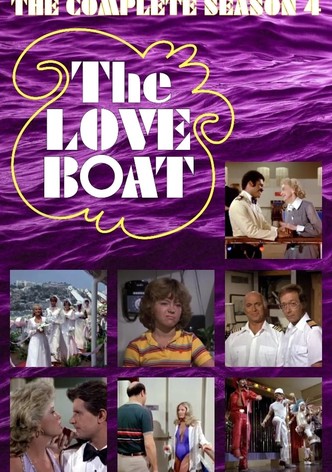
This week, it’s time for the fashion festival!

Episode 4.25 and 4.26 “This Year’s Model/The Model Marriage/Vogue Rogue/Too Clothes for Comfort/Original Sin”

(Dir by Roger Duchowny, originally aired on May 2nd, 1981)

This week, the Love Boat sails to Acapulco for the International Fashion Festival!  Vicki, who hopes to grow up to be a fashion designer, is excited about meeting her idols.  Doc, Gopher, and Isaac are excited about the models.  Captain Stubing starts the cruise by reminding everyone to do their job for once.  It’s about time Stubing told them that.  Does Doc even keep office hours anymore?

This one of those two-hour episodes of The Love Boat that gets chopped into two episodes for syndication.  As such, it’s double-sized, with twice as many guest stars and the boat actually sailing to Acapulco during filming.  That doesn’t mean that the storyline are any more complicated than usual on this episode.  Despite being longer then usual, the episode follows the usual Love Boat pattern.  The extra time is largely taken up with a travelogue of Mexico (watch as a limo very slowly drives to a luxury hotel!) and the fashion show.

Fashion designers Gloria Vanderbilt, Bob Mackie, Halston, and Geoffrey Beene all appear as themselves.  They’re listed as guest stars but they don’t actually do anything other than board the ship and then show off their designs.  They don’t find love on the boat, nor do they search for it.  (Well, Halston probably did….)  Interestingly enough, none of them — not even the famous Halston — has much of a screen presence and in the scene where they introduce themselves to the crew, they’re all so stiff that it is somewhat difficult to watch.  It’s obvious that none of them were actors but it’s also interesting to consider that there was a time when someone could be internationally famous without being a natural on camera.

There are also a few fictional designers on the cruise.  They’re the one who actually have storylines.  Harvey Blanchard (Dick Shawn) is not aware that his daughter, Mandy (Debra Clinger), has married his nerdy assistant, Alvin Beale (Richard Gilliand).  Mandy wants Alvin to tell her father that they re married during the cruise but first, Alvin is going to have to figure out what to do after he accidentally dumps some designer clothes down a laundry chute and they end up shrinking in the dryer.  (“Have you ever considered designing children’s clothing?” Alvin asks his boss.)

Benita James (Elke Sommer) is an “up-and-coming” fashion designer who falls in love with Sidney Sloan (Mike Connors), despite the fact that he’s an industrial spy who has been hired to steal her designs.  Sid falls in love with Benita as well and decides that he can’t betray her.  But when Sid’s partner (Steve Franken) ransacks Benita’s cabin, will Sid be able to convince her that he wasn’t involved?

Charles Paris (Robert Vaughn, looking somewhat embarrassed) is a cosmetics tycoon who boards the boat looking for the new Ms. Paris, the model who will be the face of his company.  Will he pick Liz(Morgan Brittany) the model with whom he is falling in love, or will he pick Joanne Atkins (Carmilla Sparv), the model who has been told that, since she’s now over 35, her career is over?

Speaking of Joanne, she falls in love with Captain Stubing and Stubing falls in love with her.  Meanwhile, the married heads of her modeling agency (Anne Baxter and McClean Stevenson, who looks almost as embarrassed as Robert Vaughn) argue over whether or not Joanne is too old to continue on as a model.

Julie is excited because her former sorority sister, Melissa (Cristina Ferrare), is a model on the cruise.  Julie can’t wait to spend the whole cruise with her but Melissa meets and falls in love with Larry (Chris Marlowe).  When Melissa and Larry run off to get married, Julie takes her friend’s place in the fashion show.

And really, the fashion show is what this episode is all about.  The stories aren’t particularly important.  We’re here for the clothes!

Bob Mackie starts things off with a really cute collection of lingerie and pajamas, which happen to be my favorite things to wear.  I loved his collection.

Gloria Vanderbilt follows with sporty summer fashion, and watching her collection, I found myself wanting to go play tennis with my neighbors.

Geoffrey Beene follows with a collection of plaid suits that will be familiar to anyone who has ever binged a 70s sitcom.

“Up and comer” Benita James presents a collection of truly hideous cocktail dresses.

And Halston closes things out with evening wear.  “Red is my favorite color,” Halston says, “It’s so fun.”  This redhead appreciates the sentiment, even if it was kind of obvious that Halston didn’t bring his top designs on the cruise with him.

As the highlight of the episode, the fashion show was definitely entertaining though. it was impossible not to smile at just how ugly Benita James’s designs actually were.  Seriously, someone went to the trouble to hire two industrial spies to steal those designs?

As for everything else, it all works out.  This is The Love Boat.  Everything always works out.  Charles Paris announces that the new Ms. Paris will be Joanne but then he asks Liz to be “Mrs. Paris.”  Sid and Benita decide to get married as well.  Captain Stubing gets to have sex for once.  I think that may be the first time that’s happened since this show started.  Julie enjoys modeling.  Everyone either finds love or decides not to get divorced.  That’s a successful cruise!

This cruise was fun in its silly way.  Bob Mackie definitely won the fashion show.  Though the designers may not have been comfortable on camera and McClean Stevenson looked like he was on the verge of jumping overboard from embarrassment, this was The Love Boat at its most entertaining.

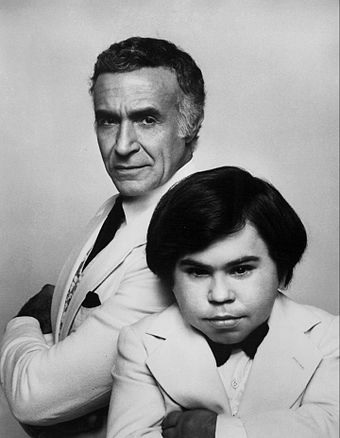


Retro Television Review: Fantasy Island 5.6 “Druids/A Night In A Harem”


Welcome to Retro Television Reviews, a feature where we review some of our favorite and least favorite shows of the past!  On Tuesdays, I will be reviewing the original Fantasy Island, which ran on ABC from 1977 to 1984.  Almost the entire show is currently streaming on Daily Motion, YouTube, Plex, and a host of other sites.

Let’s see what’s happening on Fantasy Island this week!

Episode 5.6 “Druids/A Night In A Harem”

(Dir by Don Weis, originally aired on November 14th, 1981)

Hey, Tattoo is back!

Now, interestingly enough, Tattoo is in this episode but Julie only appears for a few seconds, just long enough to tell Roarke that she will be too busy babysitting to help out with any of the fantasies this week.  Considering that she’s screwed up almost everything she’s been entrusted with, I’m sure Roarke was relieved to hear this.  Still, you have to wonder if there was some rule that Julie and Tattoo couldn’t be equally featured in the same episode.

Tattoo is enthused about one of the fantasies this week.  Shy and nerdy Herbie Snyder (Paul Williams) wants to have a harem for the weekend so that he can build up his confidence.  Tattoo offers to accompany Herbie on his fantasy but Roarke says that won’t be necessary.  It turns out Herbie screwed up when he requested his fantasy and asked to be a part of a harem.

Soon, Herbie finds himself surrounded by a bunch of oily body builders as he becomes a member of an all-male harem that belongs to the Contessa (Jayne Meadows)!  Herbie is not comfortable being a sex toy but he is happy to meet and fall in love with Lisa (Pat Klous), the daughter of the Contessa.  Fortunately, it turns out that the Contessa has a fantasy of her own and that’s for Lisa (hey, great name!) to meet and fall in love with a good man.  Herbie and Lisa even get married on Fantasy Island!

This whole fantasy was silly, with Jayne Meadows devouring the scenery as only a veteran guest star can.  That said, Paul Williams and Pat Klous were a cute couple.

As for the other fantasy, Lauren Fandell (Joan Prather) wants to be the center of attention.  Roarke informs her that she’s a descendant of Druid queen.  It turns out that there’s some druids living on a nearby island!  Lauren heads over to Druid Island and is promptly proclaimed Queen of the Druids.  “Are you married? she is asked.  When she says she’s not, she is proclaimed the Virgin Queen.  Uhmmm, okay.  Maybe that’s a druid thing but that just seems like a huge assumption to me….

Unfortunately, being the Virgin Queen means that she’s due to be sacrificed to their God, the evil Pan.  Roarke shows up briefly and gives her a magic acorn necklace, which she does eventually use to distract Pan and escape with her new boyfriend, Paul (Dennis Cole).

(And yes, it does turn out that Paul was another guest whose fantasy was to study the druids.)

This was a good episode.  The fantasies were entertainingly silly and Tattoo was back.  We even got a little of the old Roarke/Tattoo banter, which used to be a highlight of the show.  This episode, with all of its silliness and melodrama, felt like what Fantasy Island was meant to be.

Horror Film Review: The Astral Factor (dir by John Florea)


Filmed in 1978 but not released until 1984, The Astral Factor tells the story of Roger Sands (Frank Ashmore).

Known as the Celebrity Killer, Roger is a serial killer who murdered women who reminded him of his famous mother.  It may seem like Roger is destined to spend the rest of his life in prison but what the legal system didn’t consider is that Roger has the ability to not only move things with his mind but to also turn himself invisible.  How did Roger get those powers?  Who knows?  At one point, Roger’s psychiatrist mentions that Roger was a student of the paranormal.  Later, it’s revealed that he had several books about the supernatural in his bedroom.  Apparently, Roger figured out how to do it himself.

Anyway, Roger is now invisible and soon, he has escaped from prison.  He is determined to kill the five women who testified against him at his trial, both because they remind him of his mother and also because he blames them for sending him to prison.  Roger strangles his victims, which in this case means that the actresses playing them have to pretend like they’re struggling with someone who can’t be seen.  In fact, Roger spends almost the entire film in a state of invisibility.

How do you catch a killer who can’t be seen?  It’s a fair question but police Lt. Charles Barnett (Robert Foxworth) might have the answer.  Barnett’s solution involves grabbing a gun and keep firing it until you hit something.  That’s a straight-forward solution but The Astral Factor is a pretty straight forward film.  The film begins with Roger turning invisible and, to its credit, it doesn’t spend too much time trying to justify or explain Roger’s magical powers.  The film understands that all the audience really needs to know is that Roger can’t be seen and that it’s up to Lt. Burnett to find a way to stop his killing spree.

The Astral Factor is a low-budget film, one that is full of formerly prominent performers who obviously showed up to get a quick paycheck.  Sue Lyon, Marianne Hill, Leslie Parrish, and Elke Sommer all play potential victims and all of them look like they would rather be doing anything other than appearing in The Astral Factor.  Robert Foxworth, to his credit, does his best to give a convincing performance as a level-headed cop who is forced to accept the reality of the paranormal.  Not only is he having to investigate a series of murders but he’s having to do it on his birthday.  Stefanie Powers plays his girlfriend, Candy.  Candy often refers to herself in the third person whenever she’s having a conversation with her boyfriend.  I tend to do the same thing so at least there was a character in this movie to whom I could relate.  Knowing the rules of the genre, I spent the entire movie expecting Candy to be put in danger and I was actually impressed when my expectations were subverted and that didn’t happen.

With the exception of a few atmospheric scenes and an entertainingly garish and tacky dance number, the film itself has the rather flat look of a made-for-TV movie, though the occasional hint of nudity indicates that it was meant to be a theatrical release.  As I mentioned at the start of this review, The Astral Factor was originally filmed in 1978 but it sat on the shelf until 1984.  That’s when a slightly shortened version was released under the title The Invisible Strangler.  Today, the film is available in countless Mill Creek Box Sets, under its original title and with its original run time restored.

International Horror Film Review: Baron Blood (dir by Mario Bava)


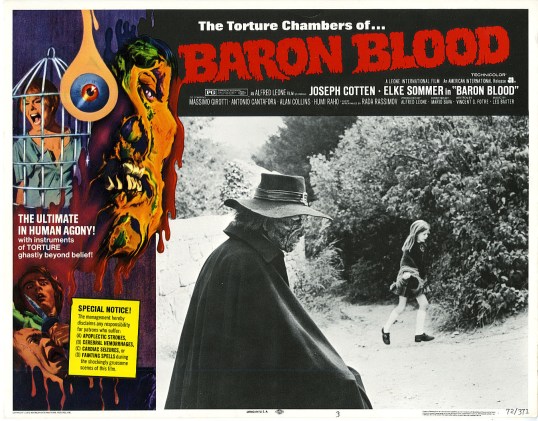
Directed by the great Mario Bava, the 1972 Italian film, Baron Blood, tells a story of gothic horror.

During the 19th century, there was no one as feared in Austria as Baron Otto Von Kleist.  Much like the infamous Gilles de Rais, the Baron was a sadist who used his noble background as a cover for his macabre activities.  In his castle, he murdered hundreds of villagers and, for that, he was nicknamed Baron Blood.  He also had an accused witch burned at the stake.  As she died, she cursed the Baron, saying that he would continually rise from the dead just so he could be killed again and again.  When you think about it, that’s actually a pretty badass curse.

One hundred years later, the Baron’s American descendant, Peter Kleist (Antonio Cantafora), arrives in Austria to check out the family castle.  The castle is being converted into a tacky hotel where tourists can stay in the same rooms where the Baron used to kill his victims.  However, Peter is not particularly concerned with what’s about to happen to the castle.  Instead, he’s in Austria because he’s discovered a parchment that contains an incantation that will bring the Baron back to life.  He wants to give it a try, more for his own amusement than anything else.  Neither her nor Eva (Elke Sommer), a college student who is studying the hotel’s architecture, really think that they are going to bring the Baron back to life by reading the incantation at midnight.  Of course, they’re wrong.

It’s easy to make fun of Peter and Eva for being so naïve as to think that it wouldn’t be a big deal to cast a magic spell but it’s not like they realize that they’re characters in an Italian horror film.  They don’t know that their lives are being directed by Mario Bava.  To be honest, if I was there, I probably would have joined them in reading the spell.  Sometimes, it can be fun to tempt fate.

That said, in the case, fate should not have been tempted.  People are soon dying.  When the man behind the hotel project is murdered, a wheelchair-bound millionaire named Alfred Becker (Joseph Cotten) shows up and purchases the castle for himself and announces plans to restore it.  Will restoring the castle bring peace to the village or is the witch’s curse too powerful to defeat?

Baron Blood is often described as being one of Bava’s lesser films and is it true that it feels a bit conventional, particularly when compared to the subversive and satiric Bay of Blood and the surreal Lisa and the Devil.  Baron Blood was a film that Bava himself was reportedly not enthused about making, one that he took on only because his last few films had struggled at the box office and he didn’t feel he would get any better offers.  Perhaps that’s why a definite strain of melancholy and disillusionment runs through Baron Blood, a film in which a beautiful castle is destined to be turned into a tacky tourist trap by a businessman who could hardly care less about either history or aesthetics.

Though the story is a bit predictable (and you’ll have little trouble guessing which character is the Baron in disguise), I actually like Baron Blood.  Not surprisingly, considering that it was a Bava film, Baron Blood is heavy on gothic atmosphere, so much so that it feels almost like an extra-bloody Hammer film.  Both the castle and the village are full of shadows, from which anyone or anything could emerge at any moments and the cold grandeur of the castle is nicely contrasted with the garishness of 70s Europe.  A visually striking scene where Eva flees from an attacker is especially well-directed and the film ends on a properly macabre note, one that once again feels as if it’s putting a distinctly Italian spin on a situation one would usually expect to find in a Hammer production.

Antonio Cantafora is a bit of a stiff but Elke Sommer gives an energetic and committed performance as someone who is torn between preserving the past and embracing the modern world.  She doesn’t get to do as much in this film as she did in Lisa and the Devil but she’s still a sympathetic lead and someone to whom most viewers will be able to relate.  We care about her character and, as a result, we care about discover just what exactly the Baron has in store for her.

Baron Blood may not have been a critical or a box office success when it was originally released but it has achieved a certain immortality.  In a development that could have been lifted from one of Bava’s films, the sounds of the Baron’s victims screaming were later lifted from this film, remixed, and sold as being a recording that had apparently been made of sinners screaming from behind the gates of Hell.  To this day, there are sites that insist that this recording is genuine.  One hopes that Bava would have appreciated the admittedly dark humor of it all.

International Horror Film Review: Lisa and the Devil (dir by Mario Bava)


Originally filmed in 1972 and tragically not seen the way it was intended to be seen until years after Mario Bava’s death, Lisa and the Devil tells the story of Lisa (Elke Sommer), a tourist who is visiting the city of Toledo, Spain with a friend.  From the first minute we see Lisa walking through the streets of the city, something seems to be off.  The city seems strangely deserted.  The streets themselves seem menacing, in much the same way that streets of Vienna did in The Third Man.

Lisa leaves her tour group and goes in a store.  A menacing, bald man (Telly Savalas) gives Lisa a strange look as he buys a dummy.  The man resembles a portrait of the devil that Lisa saw earlier.  Running from the shop, Lisa runs into another man (Espartaco Santoni) who appears to be following her.  The man appears to fall to hi death but, despite that, the man will return later.  People have a way of returning in Lisa and the Devil.

Lisa’s tour group appears to have vanished.  She eventually runs into a seemingly friendly couple (Sylvia Koscina and Eduardo Fajardo) who, along with their driver (Gabriee Tinti), agree to take Lisa back to her hotel.  But instead, they somehow end up outside of a dilapidated, mannequin-filled mansion.  When the car breaks down, the group is invited to spend the night by the Countess (Alida Valli, who also appeared in The Third Man), who lives in the mansion with her strange but handsome son, Maximilian (Alessio Oriano).  Maximilian is still mourning his ex-girlfriend, Elena.  Elena, we’re told, bore a striking resemblance to Lisa.

However, it turns out that the Countess and Maximilian are not alone in the mansion.  Also living in the house is the Countess’s second husband, Carlos, who just happens to be the same man that was following Lisa in the city!  And finally, there’s the butler, Leandro, who is the same man who Lisa earlier saw in the shop!

Lisa and the Devil is one of my favorite Italian horror films.  Yes, some of that is because I shared the same name as the movie’s main character and I love it when people say my name a lot.  But I would love this film even if Elke Sommer was playing someone named Annalise or Tiffany.  Mario Bava said that this film, or at least his version of the film, was one of his most personal works and the entire movie does feel like a puzzle that only one person could possibly solve.  In the movie, only Leandro seems to full understand what’s happening in both the city and the house.  In real life, it’s likely that only Mario Bava understood everything that happened in the film.  The film mixes a giallo mystery (because people do soon start to die the mansion) with a surreal exploration of memory, regret, sin, and guilt.  The movie plays out like a waking dream, leaving us to wonder just who exactly Lisa truly is and who the Devil of the title might be.  It’s easy to spot the Devil.  It’s less easy to spot which parts of the film are meant to be reality and which parts might simply be happening in Lisa’s mind.

Unfortunately, the film’s producer had no idea what to do with Bava’s surreal masterpiece.  The few people who saw the film were baffled.  The Italian censors demanded massive cut for both sex and violence and, as a result, Lisa and the Devil was one of the few Bava films not to get a theatrical release in his native country.  It apparently did play in South Korea and Spain, though the Spanish version did not feature Bava’s original, mind-twister of an ending.

Even worse, for the film’s American release, the film’s producer requested that Bava add some exorcism scenes so that the film could take advantage of the popularity of The Exorcist.  By now realizing that his preferred version of the film would probably never be seen, Bava agreed.  With the help of his son, Lamberto, Mario Bava shot several scenes featuring Elke Sommer acting possessed while a priest played by Robert Alda tried to exorcise the demon.  The original Lisa and the Devil footage was presented as being scenes from the dimension Lisa’s soul had been sent to while the demon controlled her body.  The film was retitled House of Exorcism in Amercia.  And here’s the thing — House of Exorcism is hardly a bad movie.  Bava is Bava, afterall.  Sommer does a convincing job acting possessed and the mix of new and old footage is edited together fairly well.  But it’s still not the film that Bava set out to make.

Sadly, Bava’s original version of Lisa and the Devil would not get a proper video release until decades after his death.  It’s not always an easy film to follow.  I’ve seen it several times and there are still things about it that I still don’t fully understand.  It’s a surreal masterpiece, one that is perhaps not meant to be fully understood and the type of dream-film that shows why Bava is one of the few directors that David Lynch has regularly cited as being an influence on his own work.  Lisa and the Devil is a trip through a world dominated by dark and disturbing things and it’s one of the best Italian horror films to come out of the 70s.  Thankfully, it can now be seen the way that Bava intended.


The Swiss Conspiracy (1976, directed by Jack Arnold)


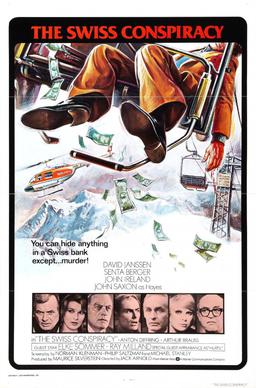
In The Swiss Conspiracy, David Janssen growls his way through another international crime thriller.

Janssen plays David Christopher, a former Treasury agent who is now living in Geneva.  When a Swiss bank is contacted by blackmailers who threaten to reveal the secret account numbers of some of its most prominent and unsavory clients, the bank’s president, Johann Hurtill (Ray Milland), hires Christopher to find out who is behind the plot.  Unfortunately, one of the account holders is a U.S. gangster named Robert Hayes (John Saxon, naturally) and he’s not happy about having to work with a former fed.

With The Swiss Conspiracy, you know what you’re getting into the minute that the film opens with a narrator giving a lengthy explanation about how Swiss bank accounts work.  This is one of those 70s thriller where the budget is low, the plot is often nonsense, and the entire cast seems to be more interested in hitting the slopes than actually making a convincing movie.  The cast is full of familiar actors who, at the time of filming, had seen better days.  Along with Ray Milland, John Ireland, Anton Diffring, and Elke Sommer all have small roles while “German screen sensation” Senta Berger is cast as the woman who might be in love with David Christopher.  Martin Landau is not in this movie but it certainly feels like he should have been.

David Janssen made a lot of movies like this in the 70s.  Janssen was a good actor and he was especially skilled at playing grizzled tough guys but in The Swiss Conspiracy, he seems to be more interested in checking out the sights than in anything else.  You can’t really blame him because the film was shot on location in Zurich and the local scenery is always more interesting than anything else that’s happening on screen.

The Swiss Conspiracy was directed by Jack Arnold, a veteran B-movie director who was also did The Creature From The Black Lagoon and The Incredible Shrinking Man.  His direction in The Swiss Conspiracy is workmanlike and undistinguished but he does make great use of the locations.  The Swiss Conspiracy may not be a great movie but I’ll damned if I don’t want to hop on the next plane and head to Switzerland for the week.

Spies Like Us: THE VENETIAN AFFAIR (MGM 1967)


gary loggins's avatarcracked rear viewer

vene1

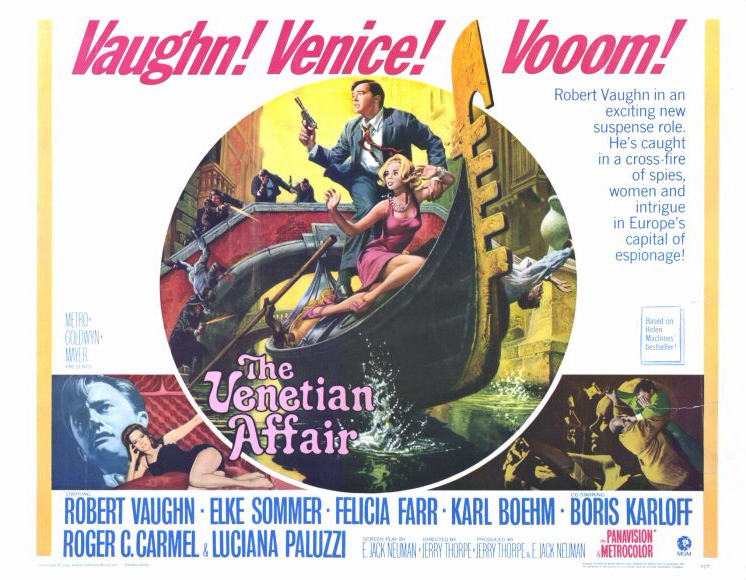
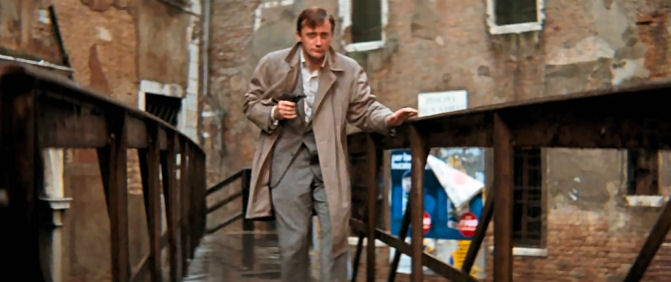
Robert Vaughn played superspy Napoleon Solo on TV’s THE MAN FROM U.N.C.L.E. from 1964 to 1968. The series was inspired by the James Bond craze, filled with outlandish gadgets and evil supervillains. Vaughn’s popularity led to a starring role in THE VENETIAN AFFAIR, a Cold War spy thriller with a much more adult theme. Here, he plays Bill Fenner, ex-CIA agent, now a hard-drinking reporter who gets caught up in international intrigue.

vene2

Fenner is sent to Venice after a U.S. diplomat supposedly sets off a bomb at an international nuclear disarmament conference. He soon learns the assignment was arranged by his former CIA boss, “Rosey” Rosenfeld (Edward Asner). Rosey wants to use Fenner to smoke out old flame Sandra Fane (Elke Sommer), a Communist agent with a mysterious link to the bombing. Fenner’s odyssey takes him through double-and-triple crosses in the world of international espionage he once left behind.

vene3

Boris Karloff is on hand in…

View original post 265 more words

Lisa Marie Reviews The Oscar Nominees: The Oscar (dir by Russel Rouse)


the-oscar-stephen-boyd-db54

I stayed up way too late last night but it was totally worth it because I was watching a film from 1966, The Oscar.

Among those of us who love bad and campy movies from the 50s and 60s, The Oscar is a legendary film.  It has a reputation for being one of best so bad-its-good-films ever made.  The Oscar is a film that I’ve read about in several books but, until last night, I had never gotten a chance to actually see it.  When I saw that the film was going to be on last night, I said “Sleep be damned!” and I stayed up and watched.  What other choice did I have?

The Oscar takes place in a world where women are “dames” and men are “fellas” and everyone acts as if they’re a character in a Rat Pack-themed fanfic.  One look at Frankie Fane (played by Stephen Boyd) and you know he’s the type of guy who snaps his fingers when he walks and probably uses pig Latin when he flirts.  He’s one cool cat and as the film begins, he’s been nominated for an Academy Award for Best Actor.

The film begins at the Oscars.  Frankie sits out in the audience, surrounded by Hollywood royalty and nervously waiting for the envelope to be opened.  The camera pans over to Frankie’s personal manager, Hymie Kelley.  Hymie stares bitterly at his former friend and suddenly, we hear his thoughts and do they ever let us know what type of movie we’re about to see.

As Hymie himself puts it:

“You finally made it, Frankie! Oscar night! And here you sit, on top of a glass mountain called “success.” You’re one of the chosen five, and the whole town’s holding its breath to see who won it. It’s been quite a climb, hasn’t it, Frankie? Down at the bottom, scuffling for dimes in those smokers, all the way to the top. Magic Hollywood! Ever think about it? I do, friend Frankie, I do…”

Hymie, incidentally, is played by the singer Tony Bennett.  This was Bennett’s first dramatic film role and it was also his last.  Whatever talent or magnetism Bennett may have had as a singer, it didn’t translate into screen presence.  Bennett goes through the entire film looking embarrassed but who can blame him when the script calls for him to constantly tell Frankie that, “You lie down with pigs, you stand up smelling like garbage…”

As we discover through the use of flashback, Frankie has had to lay down with a lot of pigs to get his chance at winning an Oscar.  After starting out his career working at sleazy clubs, Frankie, Hymie, and Frankie’s stripper girlfriend (Jill St. John) find themselves in New York.  Frankie dumps his girlfriend (unaware that she’s pregnant with his child) after he meets artist Elke Sommer at a “swinging party.”

“Are you a tourist or a native?” Frankie asks her.

“Take one from column A and one from column B.  You get an egg roll either way,” Sommer replies.

No wonder Frankie tells her, “You make my head hurt with all that poetry.”

Eventually, Frankie is discovered by a talent agent who takes him to see studio mogul Joseph Cotten (who went from Citizen Kane, The Magnificent Ambersons, and Third Man to this).  Cotten is so impressed with Frankie that he says, “Once in a while, you bring me meat like this.  It all has different names: prime rib of Gloria, shoulder cut of Johnny.  MEAT!”

With the help of savvy talent agent Milton Berle, Frankie becomes a film star but he’s still a total heel who cheats on Sommer and takes advantage of Hymie’s loyalty.  When Frankie gets nominated for an Oscar, he hires a sleazy private investigator (Ernest Borgnine, of course) to leak a story about Frankie’s criminal past.  Frankie assumes that one of his fellow nominees will be blamed for the leak and that he’ll be able to ride a wave of sympathy to victory.

And who are Frankie’s fellow nominees?  We only learn the identity of three of them – Frank Sinatra, Richard Burton, and Burt Lancaster.  We never find out what movie Sinatra was nominated for but we’re told that Burton was nominated for The Grapes of Winter (which, I’m going to assume, was a film version of a Shakespeare play about Tom Joad) while Lancaster was nominated for his amazing performance in The Spanish Armada.  Doesn’t that sound like an amazing film?

Oh, how to describe the delirious experience of watching The Oscar?  In many ways, it is a truly terrible movie but it’s fun in the way that only a “racy” film from the mid-60s can be.  Nobody plays his or her role with anything resembling subtleness.  Instead, everyone spends the entire film yelling, screaming, and gritting their teeth while flaring their nostrils.  Everyone, that is, except for Tony Bennett who gives a performance that has a definite community theater feel to it.  Even better is the dialogue.  People in this film don’t just say their lines – they exclaim them.  If you’ve ever wanted to spend two hours in a world where every sentence ends with an exclamation point, watch The Oscar.

For a film that was apparently meant to be something of a love letter to the Academy, The Oscar was only nominated for two Oscars.  It received nominations for Best Art Design and Best Costume Design.  While I had a hard time seeing what was so impressive about the film’s art design (in the world of The Oscar, Hollywood has a definite Ikea feel to it), the costumes were fairly impressive in a tacky, 1966 type of way.

Finally, I think it’s time that somebody remake The Oscar.  David Fincher can direct it, Aaron Sorkin can write the script, Jessie Eisenberg can play Frankie Fane, and Justin Timberlake would make for an adorable Hymie Kelley.  For the supporting roles, I think Billy Crystal would be a natural for Milton Berle’s role and perhaps Philip Baker Hall could step into the shoes of Joseph Cotten.  Perhaps veteran film blogger and self-described very important person Sasha Stone could make her film debut in Ernest Borgnine’s role.

Seriously, I think it would be a winner.