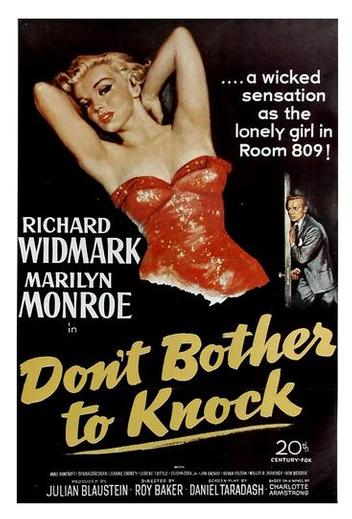
Lisa Cleans Out Her DVR: Don’t Bother To Knock (dir by Roy Ward Baker)


(I am currently attempting to clean out my DVR.  I recorded the 1952 film Don’t Bother To Knock off of FXM on April 3rd.)
Welcome to the McKinley Hotel in New York City!  The McKinley is a nice place, though it’s no Grand Budapest Hotel.  Presumably, the McKinley was named after the late President William McKinley.  While I’m sure that McKinley would have appreciated the gesture, I don’t know how he would feel about all the melodrama that’s occurring behind closed doors.

For instance, there’s Lyn Lesley (Anne Bancroft, making her screen debut).  Lyn sings in the hotel bar and, though she might seem to be cynical and tough, she actually has a big heart.  In fact, she cares so much about humanity that she broke up with her longtime boyfriend, Jed Towers (Richard Widmark), because he doesn’t seem to have a heart at all.  Of course, she broke up with Jed by sending him a letter.  When Jed checks into the hotel and tracks her down in the bar, he has questions about their breakup and he wants answers that won’t require any reading.  She tells him that he’s not capable of caring about anyone so why should she waste her time on him?  Then she sings a love song because that’s her job.

As for Jed, he’s kind of a jerk in the way that most men tend to be in movies from the 1950s.  He’s an airline pilot who served overseas during World War II and spent a year living in England.  He’s tough and he’s cynical and now, he’s single.  He’s also got a room in a hotel for the night.

And then there’s Peter and Ruth Jones (Jim Backus and Lurene Tuttle), who have a function to attend in the hotel ballroom but who don’t have anyone to look after their ten year-old daughter, Bunny (Donna Corcoran).  Fortunately, the hotel’s elevator operator, Eddie (Elisha Cook, Jr.), has a niece named Nell (Marilyn Monroe).  Nell is quiet and shy and needs the money.  She’ll be more than willing to babysit!

Of course, the only problem with Nell is that she’s a little unstable.  This becomes obvious when she’s left alone with Bunny and promptly says that, if Bunny isn’t careful, something bad might happen to one of her toys.  Inside the apartment, Nell is impressed by all the pretty things owned by Ruth.  She tries on her jewelry.  She sprays her perfume in the air.  She puts on Nell’s negligee and looks at herself in the mirror.  Eddie is not amused when he discovers what Nell’s been doing.  If she wants all of this stuff, he tells her, she needs to marry someone rich.  That’s not bad advice but the only problem is that Nell is currently single.  She’s been single ever since her boyfriend died in a plane crash.  In fact, Nell was so upset by his death that she even tried to commit suicide afterward.

From his room, Jed has a direct view of Nell trying on Ruth’s clothes.  When he and Nell spot each other, Nell invites him over.  She tells Jed that she’s a guest at the hotel and that Bunny is her daughter.  Jed can immediately tell that there’s something strange about Nell.  Nell, meanwhile, thinks that Jed is her dead boyfriend.  Meanwhile, Bunny is helpless in her room…

Clocking in at a brisk 72 minutes, Don’t Bother To Knock feels less like a movie and more like a one-act play or maybe even an adaptation of an old television production.  (After watching the movie, I was shocked to discover that it was based on neither.)  Seen today, it’s mostly memorable for featuring Marilyn Monroe’s first true starring role.  After appearing in small roles in several films (including All About Eve), Don’t Bother To Knock was not only Marilyn’s shot at stardom but also her first dramatic performance.  Reportedly basing her performance on her troubled mother, Marilyn is sympathetic and almost painfully vulnerable.  Her scenes with Elisha Cook, Jr. are especially charged, full of a subtext that will probably be easier for modern audiences to spot than it was for audiences in 1952.  Marilyn gave an incredibly poignant performance and she is the main reason to watch Don’t Bother To Knock.

A Movie A Day #126: Baby Face Nelson (1957, directed by Don Siegel)


The place is Chicago.  The time is the era of Prohibition.  The head of the Chicago Outfit, Rocca (Ted de Corsia), has arranged for a career criminal named Lester Gillis (Mickey Rooney) to be released from prison.  A crack shot and all-around tough customer, Gillis has only two insecurities: his diminutive height and his youthful appearance.  Rocca wants to use Gillis as a hit man but Gillis prefers to rob banks.  When Rocca attempts to frame Gillis for a murder, Gillis first guns down his former benefactor and then goes on the run with his girlfriend, Sue Nelson (Carolyn Jones).  Because they are both patients of the same underworld doctor (played by Sir Cedric Hardwicke), Gillis eventually meets public enemy number one, John Dillinger (Leo Gordon).  Joining Dillinger’s gang, Gillis becomes a famous bank robber and is saddled with a nickname that he hates: Baby Face Nelson.

While it is true that Lester “Baby Face Nelson” Gillis was an associate of John Dillinger’s and supposedly hated his nickname, the rest of this biopic is highly fictionalized.  The real Baby Face Nelson was a family man who, when he went on the run, took his wife and two children with him.  While he did get his start running with a Chicago street gang, there is also no evidence that Nelson was ever affiliated with the Chicago Outfit.  (The film’s Rocca is an obvious stand-in for Al Capone.)  In real life, it was Dillinger, having just recently escaped from jail, who hooked up with Nelson’s gang.  The film Nelson is jealous of Dillinger and wants to take over the gang but, in reality, the gang had no leader.  Because Nelson killed three FBI agents (more than any other criminal), he has developed a reputation for being one of the most dangerous of the Depression-era outlaws but, actually, he was no more violent than the typical 1930s bank robber.  Among the era’s outlaws, Dillinger was more unique for only having committed one murder over the course of his career.  In this film (and practically every other film that has featured Baby Face Nelson as a character), Nelson is a full on psychopath, one who even aims his gun at children.

Baby Face Nelson may be terrible history but it is still an excellent B-movie.  Don Siegel directs in his usual no-nonsense style and Mickey Rooney does a great job, playing Baby Face Nelson as a ruthless but insecure criminal with a perpetual chip on his shoulder.  As his fictional girlfriend, Carolyn Jones is both tough and sexy, a moll that any gangster would be lucky to have waiting for him back at the safe house.  B-movie veterans like Thayer David, Jack Elam, Elisha Cook Jr., and John Hoyt all have colorful supporting roles but the most unexpected name in the cast is that of Cedric Hardwicke, playing an alcoholic surgeon with broken down dignity.

Don’t watch Baby Face Nelson for a history lesson.  Watch it for an entertaining B-masterpiece.


Number One With A Bullet: Lawrence Tierney in DILLINGER (Monogram 1945)


gary loggins's avatarcracked rear viewer

dillinger1

Poverty Row Monogram Studios found themselves with a huge hit on their hands when they released DILLINGER, making a star out of an obscure actor named Lawrence Tierney in the process. This King Brothers production brought the gangster movie back in big way, with Tierney’s ferocious performance turning him into a film noir icon. DILLINGER burst the Kings out of the B-movie bracket, and gave the little studio its first major Oscar nomination for Best Screenplay.

dillinger2

The saga of bank robber John Dillinger should be familiar to most of you through its myriad film portrayals, so let’s skip the story and go straight to Tierney. Though the film bills him as “Introducing Lawrence Tierney”, the RKO contract player had been in films a couple years playing bit parts in movies like GHOST SHIP and BACK TO BATAAN when his home studio loaned him out to the Kings. The New York-born actor took…

View original post 657 more words

Outside the (Hat) Box: PHANTOM LADY (Universal 1944)


gary loggins's avatarcracked rear viewer

pl1

Interested in a Hitchcockian 40’s thriller full of suspense and noir style? Then PHANTOM LADY is the film for you, a small gem based on a Cornell Woolrich novel and  directed by the talented Robert Siodmak. I wouldn’t go so far as to call this film noir like many do, but it certainly contains many of the stylistic elements of the genre in its gripping murder mystery story. Pretty damn close, though!

The Hitchcock influence clearly comes from Joan Harrison , former secretary and screenwriter for The Master of Suspense, who became one of only three female producers working during Hollywood’s Golden Age. There’s Hitchcock’s famed McGuffin to be found in the form of a “crazy hat” worn by the mysterious woman of the title that’s crucial to the film’s plot. Add the tension ratcheted up by screenwriter Bernard Schoenfeld and you’ve got a Hitchcock movie without Hitchcock.

pl2

The noir elements…

View original post 525 more words

Horror On The Lens: House On Haunted Hill (dir by William Castle)


I was actually planning on waiting until closer to Halloween before I posted this film but … well, why save the best for last?  Seriously, it’s always a good time watch the original House on Haunted Hill.  Be sure to check out Gary’s review by clicking here!

Now, I will admit that I previously shared this film two Halloweens ago.  However, the YouTube video that I embedded in that post no longer exists.  So, I figured, why not post it again?

Below is what I wrote the previous time that I shared this movie:

“Released in 1959, House On Haunted Hill tells the story of how an eccentric millionaire (played by Vincent Price, of course) rented out a “haunted” mansion for a party. invited over five guests, and offered each of them $10,000 on the condition that they manage to spend the entire night in the house.  Along for the ride is Price’s unhappy wife (Carol Ohmart) and the house’s wonderfully neurotic caretaker (played by Elisha Cook, Jr, who played a lot of neurotic caretakers over the course of his long career).

House on Haunted Hill remains one of the classic B-movies.  This is largely because of Price’s wonderfully over-the-top lead performance and William Castle’s equally over-the-top direction.

Back in 1959, theaters were equipped so that a plastic skeleton would appear to fly over the heads of the audience during some of the film’s more shocking moments.  So, grab yourself a skeleton, take a seat, and enjoy House on Haunted Hill!”


Cleaning Out The DVR #25: The Maltese Falcon (dir by John Huston)


(For those following at home, Lisa is attempting to clean out her DVR by watching and reviewing 38 films by this Friday.  Will she make it?  Keep following the site to find out!)

220px-Falconm

I would love to see a remake of The Maltese Falcon with Bill Murray in the role of Sam Spade.  Well, maybe not the Bill Murray of today because he’s getting a little bit too old to play a hard-boiled private detective who is as good with his fists as his brain.  Instead, I’m thinking more of Lost In Translation era Bill Murray, when he was no longer young but could still probably beat up any sniveling punk who came at him with a gun.

Now, that may sound crazy to some but think about it.  Bill Murray is one of the great deadpan snarkers and so is Sam Spade.  Last night, when I watched the famous 1941 version of The Maltese Falcon (the story was filmed twice before, once with Bette Davis as the femme fatale), I was struck by how much of the film really was a comedy.  It may have been a murder mystery that featured death and betrayal and a lot of people getting beaten up but, ultimately, The Maltese Falcon is really about Sam Spade reacting to all of the crazy and strange people around him.  No matter how weird things get, Spade always responds with a smirk and a quip.  It’s a role that, at times, seems to be tailor-made for an actor like Bill Murray.

Bill Murray wasn’t around in 1941 but fortunately, Humphrey Bogart was.  Humphrey Bogart may have grown up wealthy and attended private schools but, on screen, nobody was tougher than Humphrey Bogart and nobody was better at delivering sarcastic, snark-filled dialogue.  After spending years as a villainous supporting actor, Humphrey Bogart got his first starring role when he played Sam Spade in The Maltese Falcon.  His performance, of course, would set the standard by which all future cinematic private eyes would be judged.

And, of course, Spade was tough and he was cynical and he has that wonderful moment at the end of the film where he explains that nobody’s going to make a “sap” out of him.  But for me, Bogart’s best moments come when Spade is alone and thinking.  It’s at those times that Spade suddenly becomes a human being.  A slight smirk comes to his lips, almost as if he’s sharing a private joke with the audience.  You can tell that he’s thinking to himself, “Can you believe how weird my life is?”

And it is indeed a weird life.  The film opens with Spade’s partner, Miles Archer (Jerome Cowan), being murdered.  The police believe that Archer was murdered by a man named Thursby and that Thursby was subsequently murdered by Spade.  Spade, however, suspects that both Archer and Thursby were killed by his latest client, a woman who introduced herself as Ruth Wonderly (Mary Astor).  Except, of course, that’s not her real name.  Her real name is Brigid O’Shaughnessy and, as she admits to Spade, Thursby was her partner.  She claims that Thursby must have murdered Archer but that she doesn’t know who could have possibly killed Thursby.

What’s particularly interesting about all this is that no one really seems to be that upset about Archer’s death.  Spade’s main motivation for investigating the murder is to clear his name and there are several lines of dialogue that reveal how little regard he had for Miles.  In fact, when Archer’s widow (Gladys George) suggests that Spade might be Archer’s killer, you can understand why she might think that.  But then again, that’s the world of The Maltese Falcon.  Only the tough survive.  Getting sentimental or allowing yourself to care is the biggest mistake you can make.

The murders are connected to the hunt for a valuable statue of a bird.  (This is the famous Maltese Falcon of the title.)  As Spade tries to clear his name in the two murders, he also finds himself getting caught up with a strange group of treasure hunters.  There’s the obsequious Joel Cairo (Peter Lorre).  There’s the ruthless “fat man,” Kasper Gutman (Sidney Greenstreet).  And then there’s Wilmer (Elisha Cook, Jr.), Gutman’s young henchman who spends the entire film trying to convince everyone that he’s tougher than he appears.  Wilmer is a born patsy.  Whenever Spade gets annoyed, he beats up Wilmer.  And he usually smiles afterward.

Along with being the directorial debut of John Huston, The Maltese Falcon was also one of the first great film noirs.  It’s one of the most influential films ever made and, even seen today, it’s a lot of fun.  You really can’t go wrong with Bogart, Astor, Greenstreet, Lorre, and Cook all in the same movie.  Bill Murray may never get a chance to play Sam Spade but that’s okay.  Humphrey Bogart’s the only Sam Spade we really need.

The Maltese Falcon was nominated for best picture.  However, it lost to How Green Was My Valley, a film that literally seems to take place in an entirely different universe from The Maltese Falcon.

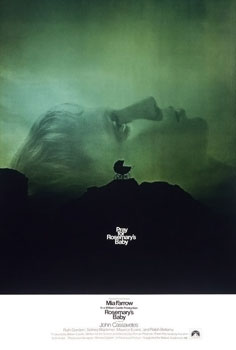
Horror Film Review: Rosemary’s Baby (dir by Roman Polanski)


Rosemarys_baby_poster

“This is no dream!  This is really happening!”

— Rosemary Woodhouse (Mia Farrow) in Rosemary’s Baby (1968)

Yes, Rosemary, it is.

The classic 1968 horror movie Rosemary’s Baby is probably best remembered for a lengthy and wonderfully surreal “dream” sequence in which naive newlywed Rosemary Woodhouse (Mia Farrow) is raped by the Devil while a bunch of naked old people stand around her and chant.  At one point, she sees her husband, Guy (John Cassavetes), saying that she’s awake and that she knows what’s going on.  Their neighbor, Minnie Castevet (Ruth Gordon), tells him that Rosemary can’t hear anything and that it’s like she’s dead and then snaps at him, “Now, sing!”  It’s a great sequence, one of the greatest of Roman Polanski’s career, a perfect blending of horror and dark comedy.

For me, the most interesting part of that dream sequence comes at the start.  Rosemary envisions herself naked on a boat and, as she tries to cover herself, who is sitting next to her?  None other than John F. Kennedy!  Suddenly, Rosemary is wearing a bikini and she’s relaxing out on the deck with a glamorous group of people who I assume were meant to be Kennedy relatives.  As the boat leaves the dock, Rosemary sees that her friend and protector, Hutch (Maurice Evans), is standing on the dock.

“Isn’t Hutch coming with us?” Rosemary asks.

“Catholics only,” John F. Kennedy hisses in that famous accent, “I’m afraid we are bound by these prejudices.”

“I understand,” a dazed Rosemary replies.

And it’s a wonderful little moment, though I have to wonder if I’d react as strong if my own background wasn’t Irish Catholic.  But still, there’s something so wonderfully subversive about a bunch of elderly Satanists pretending to be the Kennedys.

And really, Rosemary’s Baby is a wonderfully subversive film.  I imagine it was even more subversive when it was first released back in 1968.  It’s been ripped off and imitated so many times that it has undoubtedly lost some of its impact.  (That’s one reason why I wish I had a time machine, so I could go back in the past and see it was truly like to see a classic film for the first time.)  But still, 47 years after it was initially released, Rosemary’s Baby is still a surprisingly effective horror film.

The film opens with newlyweds Rosemary and Guy moving into the Bramford, an exclusive New York apartment building.  Guy is an actor who, despite having appeared in two off-Broadway shows (one of which was entitled Nobody Likes An Albatross and really, that is so true) and a few motorcycle commercials, is still waiting for his big break.  There are hints that, before she married Guy, Rosemary had a very active and interesting life (when we briefly meet her old friends, they all seem to be a lot more exciting than boring old Guy) but, when we meet her, Rosemary appears to have happily settled into a life of domesticity.

Life at the Bramford is strange.  For one thing, Guy and Rosemary appear to be the only young people living in the entire building.  (There is a young woman named Terry but she ends up jumping out of a window.)  The Woodhouses befriend elderly Minnie Castevet and her husband, Roman (Sidney Blackmer.)  Roman claims to have traveled all over the world and embarrasses the Catholic Rosemary by criticizing the Pope.  Minnie, meanwhile, is the noisiest person in the world.  Guy makes fun of both of them and, yet, he still decides to spend his free time with Roman.

One day, Guy gets a role that he had previously lost.  Why?  Because another actor is struck by a sudden case of blindness.  Shortly afterward, Rosemary has her “dream.”  She wakes up and discovers that her body is covered with red scratches.  Guy claims that he had sex with her while she was asleep and promises to cut his fingernails.

Soon, Rosemary is pregnant but the Castevets insist that she use their doctor, the firm and sinister Dr. Saperstein (Ralph Bellamy, who just 8 year earlier had played FDR in Sunrise at Campobello).  Rosemary knows that something is wrong with the baby but she can’t get anyone to listen to her.  It all leads to one of the best and most iconic endings in the history of horror cinema.

Rosemary’s Baby is a classic of fear and paranoia and it holds up surprisingly well.  See it this October, whether you’re Catholic or not.

(However, do not see the needless 2014 remake.  Seriously, what the Hell was up with that?)

(By the way, is anyone else amazed that I made it through this entire review without making a single joke about either Ronan Farrow or Mia’s lame Sharknado live tweet?  I am shocked.)


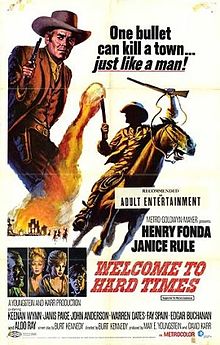
Film Review: Welcome to Hard Times (1967, directed by Burt Kennedy)


220px-WelcomehardtimesWelcome to Hard Times is a western that used to frequently turn up on TV when I was a kid.  I remembered that I had always enjoyed it but otherwise, I had largely forgotten about it when I saw that it was airing on TCM earlier today.  I rewatched it to see if I would still enjoy it.  Welcome To Hard Times has its flaws but it is still an above average addition to the genre.

Based on a novel by E.L. Doctorow, Welcome to Hard Times takes place in the small western settlement of Hard Times, Nevada.  When the mysterious Man From Bodie (Aldo Ray) shows up, he terrorizes everyone in the town.  When the town founder, Mr. Fee (Paul Birch), attempts to stand up to him, the Man from Bodie shoots him dead.  When the local undertaker, Mr. Hansen (Elisha Cook, Jr.) tries to stop the Man from stealing one of his horses, the Man silently guns him down.  As the town’s mayor, Will Blue (Henry Fonda), stands by and helplessly watches, The Man rapes and murders Fee’s girlfriend and also kills the local saloonkeeper, Avery (Lon Chaney, Jr.).  The Man burns down the town and finally leaves.

Thought most of the surviving townspeople abandon Hard Times, Will Blue stays behind and tries to rebuild.  He adopts Fee’s son, Jimmy (Michael Shea).  Also staying behind is Jimmy’s mother, Molly Riordan (Janice Rule), a former saloon girl who was also raped by the Man and who constantly taunts Will for not being able to stand up to him.  New settlers arrive and the town starts to rebuild.  Zar (Kennan Wynn) and his four girls reopen the saloon and serve the workers at a nearby mine.  Isaac Maple (John Anderson) reopens the general store.  Under Will’s leadership, Hard Times starts to thrive.

A drifter named Leo Jenks (the great Warren Oates) also moves in.  When Molly discovers that Leo is a crack shot, she gets him to teach Jimmy how to handle a shotgun.  Both she and Will know that the Man is going to return in the spring.  Molly is obsessed with vengeance and Will fears that Jimmy is going to be consumed by her hatred.

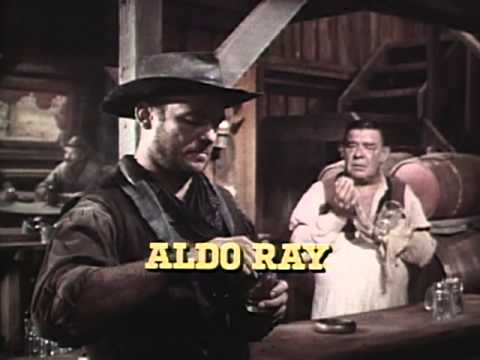
Aldo Ray  Welcome to Hard Times (1967)Of course, the Man does eventually return.

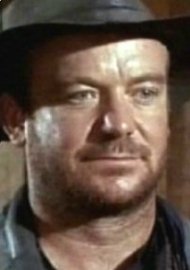
Welcome to Hard Times works best at the beginning and the end, when Aldo Ray is on-screen.  As the sadistic Man from Bodie, Ray gives a classic western bad guy performance.  He’s intimidating, he’s violent, and he guns down the citizens of Hard Times with even more casual arrogance than Lee Marvin, Jack Palance, and Lee Van Cleef combined!  The middle section of the film drags and it is hard to ignore Jane Rule’s shaky Irish accent.  It is obvious that Welcome to Hard Times is trying to say something about Will Blue’s humanistic approach but it does not seem to know what.

Director Burt Kennedy was best known for directing comedic westerns.  Welcome to Hard Times was a rare dramatic film for him.  It’s not a great western but, thanks to Aldo Ray’s performance and the excellent work of cinematography Harry Stradling, Jr., it’s still a worthy addition to the genre.


Aldo Ray

Shattered Politics #2: They Won’t Forget (dir by Mervyn LeRoy)


they_won_t_forget-582401011-large

The title of the 1937 film They Won’t Forget works on many levels.

It describes the reaction of a small Southern town, following the brutal murder of teenager Mary Clay (played, in her film debut, by Lana Turner).  The town won’t forget Mary and they won’t forget the terror caused by her murder.  They also won’t forget that local teacher Robert Hale (Edward Norris) was accused of the crime.

The district attorney, Andrew Griffin (Claude Rains), hopes that the people of his state won’t forget his efforts to see Griffin convicted of that crime.  Griffin wants to be elected to the U.S. Senate and he knows that the high profile case could be just what his career needs.

The Governor (Paul Everton) knows that, if he steps into the case and acts on his suspicion that Hale is innocent, the voters of his state will never forget.  And they certainly won’t be willing to forgive.

And, on a larger level, the title lets us know that the South and the North will never forget the Civil War and the conflict between the two regions.  The film opens with three elderly veterans of the Confederate Army, preparing to march in the town’s annual Confederate Memorial Day parade and admitting to each other that, after all these years, it’s difficult to remember much about the war other than the fact that they’re proud that they fought in it.

It’s while the rest of the town is busy watching Griffin and the governor ride in the parade that Mary Clay is murdered.  It’s easy to assume that Hale was the murderer because Hale was one of the few townspeople not to go to the parade.  You see, Hale is originally from New York City.  When he’s accused of murder, it’s equally easy for Griffin and tabloid reporter William A. Brock (Allyn Joslyn) to convince the town people to blame this Northern intruder for both the murder of Mary Clay and, symbolically, for all of the post-Civil War struggles of the South itself.

Meanwhile, up North, Hale is seen as a victim of the South’s intolerance.  A high-profile lawyer (Otto Kruger) is sent down to defend Hale but, as quickly becomes clear, everyone involved in the case is more interested in refighting the Civil War than determining the guilt or innocence of Andrew Hale.

They Won’t Forget is a hard-hitting and fascinating look at politics, justice, and paranoia.  It’s all the more interesting because it’s based on a true story.  In 1913, a 13 year-old girl named Mary Phagan was murdered in Atlanta.  Leo Frank was accused and convicted of the murder.  (In Frank’s case, he was born in Texas but was also Jewish and had previously lived in New York before moving to Atlanta, all of which made him suspicious in the eyes of many.)  On the word of a night watchmen, who many believe was the actual murderer of Mary Phagan, Leo Frank was convicted and sentence to death.  After spending days reviewing all of the evidence and growing convinced that Frank had been wrongly convicted, Georgia’s governor committed an act of political suicide by commuting Frank’s sentence to life imprisonment.  Leo Frank was subsequently lynched and the man who had prosecuted the case against him was subsequently elected governor.

Well-acted and intelligently directed, They Won’t Forget is probably one of the best films of which few people have heard.  Fortunately, it shows up fairly regularly on TCM and, the next time that it does, be sure to watch.  It’s a great film that you won’t easily forget.


Horror On The Lens: House on Haunted Hill (dir by William Castle)


House on Haunted Hill

With only two days left to go until we reach Halloween, now seems like the perfect time to watch a classic Vincent Price haunted house film.  I’m talking, of course, about the original House On Haunted Hill.

Released in 1959, House On Haunted Hill tells the story of how an eccentric millionaire (played by Vincent Price, of course) rented out a “haunted” mansion for a party. invited over five guests, and offered each of them $10,000 on the condition that they manage to spend the entire night in the house.  Along for the ride is Price’s unhappy wife (Carol Ohmart) and the house’s wonderfully neurotic caretaker (played by Elisha Cook, Jr, who played a lot of neurotic caretakers over the course of his long career).

House on Haunted Hill remains one of the classic B-movies.  This is largely because of Price’s wonderfully over-the-top lead performance and William Castle’s equally over-the-top direction.

Back in 1959, theaters were equipped so that a plastic skeleton would appear to fly over the heads of the audience during some of the film’s more shocking moments.  So, grab yourself a skeleton, take a seat, and enjoy House on Haunted Hill!