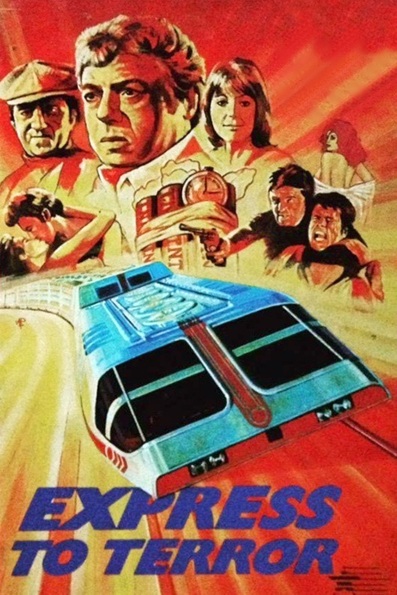
Icarus File No. 24: Express to Terror (dir by Dan Curtis)


The year was 1979 and Fred Silverman, the president of NBC, had an idea.

How about a television series in which each week’s episode would depict a different group of passengers going on a trip?  The passengers would all be dealing with their own stories, some of which would be dramatic and some of which would be humorous.  With any luck, some of them might even fall in love over the course of their journey!

To keep the audience interested, the show would also feature a cast of regular characters, the crew.  Edward Andrews would play the captain, a sensible and by-the-book type.  Robert Alda played Doc, the doctor who was also a bon vivant.  Patrick Collins was the goofy purser.  Nita Talbot played Rose, the perky director of entertainment.  Michael DeLano was the bartender who always had the best advice for the passengers….

Does this sound familiar?

If you think that it sounds like Fred Silverman just ripped off The Love Boat …. well, you’re wrong.  The Love Boat took place on a boat.  Supertrain took place on a train.

At the time that Supertrain went into production, it was the most expensive television production of all time.  Before the pilot film was even shot, NBC had spent ten million dollars on the Supertrain sets.  Not only was a fake train built but two models were also constructed for the shots of the train moving through the countryside.  At the time, the assumption was that the costs would be easily covered by the money that NBC stood to make from broadcasting the 1980 Summer Olympics.  Unfortunately, Jimmy Carter decided that the U.S. would be boycotting the Olympics as a way to protest Russia’s invasion of Afghanistan.  The only thing that kept NBC from going bankrupt was that the BBC was apparently run by someone even more incompetent than Fred Silverman.  The BBC paid $25,oo per episode for the rights to air Supertrain in the UK.  Supertrain proved to be such a disaster that the BBC never actually aired the episodes that they had purchased.

1979’s Express to Terror was the pilot to Supertrain.  (It was later released in some territories as a stand-alone film.)  Directed by horror impresario Dan Curtis (who was also brought in to produce the series), Express to Terror opens with an apparently drunk Keenan Wynn playing the role of railway baron Winfield Root.   Winfield loudly announces to a group of nervous investors that he has created ” an atom-powered steam turbine machine capable of crossing this country in 36 hours!”  A few months later, Supertrain sets off from New York to Los Angeles.

The main thing that one notices about the train is that it’s incredibly tacky.  For all the money that Winfield Root (not to mention NBC) poured into the thing, it looks awful.  The cabins are bland and also seem to be constantly shaking as the train rumbles over its tracks.  Whereas The Love Boat featured glorious shots of passengers enjoying themselves on an open-air deck, Express to Terror features a lot of shots of passengers trying to squeeze their way through narrow and crowded hallways.  There’s a disco car, which sounds like fun but actually looks like a prom being held in a locker room.  There’s a swimming pool but you can’t really lay out by it because it’s on a train.  Winfield is among the passengers and he continually refers to the train as being “Supertrain” in conversation, which just sounds dumb.  “The next person who stops Supertrain,” he announces “will be walking to L.A!”

The main drama features Steve Lawrence as Mike Post, a Hollywood agent with a gambling problem who thinks that someone on the train is trying to kill him.  Actually, the assassin is after a different Mike Post (Don Stroud) but that Mike Post is a criminal who, after entering the witness protection program, changed his name to Jack Fisk.  The criminal Post is hoping that the agent Post will be killed by mistake.  The criminal Mike Post has a girlfriend named Cindy (Char Fontane) who falls in love with the agent Mike Post.  Fred Williamson appears as a football player-turned-assassin.  George Hamilton plays a Hollywood executive.  Don Meredith is the alcoholic best friend of the agent Mike Post.  Stella Stevens is on the train as a diva.  So is Vicki Lawrence, playing a naive innocent.

Express to Terror tries to mix comedy and drama but it doesn’t really work because the “Good” Mike Post doesn’t really seem to be worth all the trouble.  Steve Lawrence gives a mind-numbingly bad performance in the role and, as a result, “Good” Mike Post really isn’t any more sympathetic than “Bad” Mike Post.  The main problem is that “Good” Mike Post comes across as being a coward and there’s only so much time that you can watch a coward act cowardly before you lose sympathy for him.  Being scared is one thing.  Being so dumb that accidentally gets your fingerprints on a knife that’s just been used to kill a man is another thing.

As for the members of the crew — the captain, the doctor, the bartender, and such, they take a back seat to the drama of the two Mike Posts.  It’s a bit odd because no one on the train — not even Winfield Root — seems to be that upset by the fact that one of their passengers is murdered while the train is going through a tunnel.  You would think that everyone would be worried about the future of Supertrain at that point.  A murder is not good for publicity but Winfield Root is oddly unconcerned about it.  I swear, light rail people are almost as heartless as bicyclists!

Of course, the worst thing about Express to Terror is that it promises terror but it doesn’t deliver.  When I see a the word “terror” in a film directed by Dan Curtis, I expect a little terror!  Other than Steve Lawrence’s overacting, there really wasn’t anything particularly terrifying about Express to Terror.

As for Supertrain, it ran for nine episodes and was promptly canceled.  Fred Silverman left NBC and spent the rest of his career as an independent producer.  Supertrain’s tracks got too close to the sun and they nearly took down a network.

Previous Icarus Files:

  1. Cloud Atlas
  2. Maximum Overdrive
  3. Glass
  4. Captive State
  5. Mother!
  6. The Man Who Killed Don Quixote
  7. Last Days
  8. Plan 9 From Outer Space
  9. The Last Movie
  10. 88
  11. The Bonfire of the Vanities
  12. Birdemic
  13. Birdemic 2: The Resurrection 
  14. Last Exit To Brooklyn
  15. Glen or Glenda
  16. The Assassination of Trotsky
  17. Che!
  18. Brewster McCloud
  19. American Traitor: The Trial of Axis Sally
  20. Tough Guys Don’t Dance
  21. Reach Me
  22. Revolution
  23. The Last Tycoon

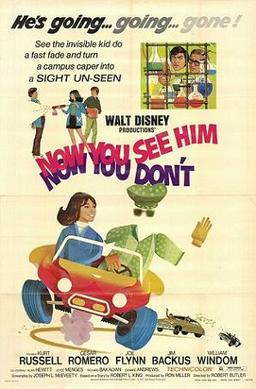
I Watched Now You See Him, Now You Don’t (1972, Dir. by Robert Butler)


Dexter Riley (Kurt Russell) is back and just in time because Medfield College is on the verge of getting closed down again.

In The Computer Wore Tennis Shoes, buying a computer was supposed to be the solution to all of Medfield’s financial problems.  I guess it didn’t work because Medfield is broke again and corrupt businessman A.J. Arnoe (Cesar Romero) is planning on canceling the school’s mortgage so that he can turn it into a casino.

There is some hope.  Dexter has accidentally created an invisibility spray.  Not only does it tun anything that it touches invisible but it also washes away with water so there’s no risk of disappearing forever.  Dexter and his friend Schuyler (Michael McGreevey) know that they can win the science fair with their invention but the science fair doesn’t want to allow small schools like Medfield to compete unless they really have something big to offer.  Dexter tells the Dean (Joe Flynn) that he has a sure winner but Dexter also refuses to reveal what it is because he doesn’t want word to leak before for the science fair.  The Dean decides to raise the money to pay off the mortgage by becoming a golfer, as one does.  Schulyer works as the Dean’s caddy while Dexter uses the invisibility spray to help the Dean cheat.  That’s a good message for a young audience, Disney!  But when Arno finds out about the spray, he wants to steal it so he can rob a bank.

This was even dumber than The Computer Wore Tennis Shoes but it was also hard to dislike it.  The comedy was too gentle, Kurt Russell and the rest of the cast were too likable, and the special effects were too amusingly cheap in that retro Disney way for it to matter that the movie didn’t make any sense.  When a bunch of college kids learn the secret of invisibility and use it to cheat at golf, you know you’re watching a Disney film.

Retro Television Reviews: Fantasy Island 1.7 “The Funny Girl/Butch and Sundance”


Welcome to Retro Television Reviews, a feature where we review some of our favorite and least favorite shows of the past!  On Tuesdays, I will be reviewing the original Fantasy Island, which ran on ABC from 1977 to 1996.  The entire show is currently streaming on Tubi!

“Smiles, everyone, smiles!”

Sorry, Mr. Roarke, there’s not much to smile about when it comes to this episode.

Episode 1.7 “The Funny Girl/Butch and Sundance”

(Dir by Cliff Bole, originally aired on March 18th, 1978)

At the start of this episode, Tattoo is all excited because his birthday is coming up and he remembers that, last year, he partied all night and a bunch of beautiful women celebrated with him.  Mr. Roarke promises Tattoo that things will be different this year.  This year, Mr. Roarke says, there will be no presents.  Tattoo will play a game of chess and drink a glass of sherry and maybe there will be a cello recital.  Tattoo, needless to say, is disappointed.

Ignoring Tattoo’s anger, Mr. Roarke introduces him to the latest guests at Fantasy Island and it turns out that their fantasies are almost as disappointing and boring as Mr. Roarke’s plans for Tattoo’s birthday.  Kay Penny (Marcia Strassman) is apparently the world’s most successful comedienne even though she never comes across as being particularly funny.  Her fantasy is to move to small town where no one knows her.  That sounds like a pretty lousy fantasy but whatever.

Bill (Christopher Connelly) and Alex (James MacArthur) are two friends who want to be Butch Cassidy and The Sundance Kid for a weekend.  They’re huge fans of the film, though it appears neither one of them ever stuck around for the end.  Mr. Roarke takes Bill and Alex to an old west town (perhaps the same one that we saw a few weeks ago) and Bill and Alex get to live out their fantasy while trading quips and robbing banks.  The problem, for those of us who are watching then, is that neither Christopher Connelly nor James MacArthur can compare to Robert Redford and Paul Newman.  Eventually, though, the great character actor William Smith shows up as a visitor whose fantasy is to be Wyatt Earp.  He attempts to arrest Butch and Sundance.  They outsmart him and then Bill and Alex go home, satisfied.  Good for them but what about the guy who wanted to be Wyatt Earp?  Does he get his money back?  Seriously, I don’t think being humiliated was a part of his fantasy.

Meanwhile, Kay finds herself living in a small town.  Using the name Katherine Patrino, she gets a job as the receptionist for a veterinarian (played by Dennis Cole) and she also helps the vet’s silent son get over the recent loss of his mother.  She also tells a lot of jokes, none of which are particularly funny.  The best thing about this fantasy is that Mr. Roarke disguised himslef as a clown and showed up at the small town’s Founders Day Festival.

And then Tattoo did the same thing.

Anyway, during the festival, a dog was hit by a truck but Kay helped to bring it back to life and that brought a tear to my mismatched eyes.  Otherwise, this was a very forgettable trip to Fantasy Island.

On a positive note, though, it turned out that Mr. Roarke was just joking and Tattoo got to have a wild party after all.  Good for him, he earned it!

Retro Television Reviews: The Love Boat 1.3 “Ex Plus Y / Golden Agers / Graham and Kelly”


Welcome to Retro Television Reviews, a feature where we review some of our favorite and least favorite shows of the past!  On Wednesdays, I will be reviewing the original Love Boat, which aired on ABC from 1977 to 1986!  The series can be streamed on Paramount Plus!

Love!  Was it exciting and new this week?

Episode 1.3 “Ex Plus Y / Golden Agers / Graham and Kelly”

(Directed by  Adam Rafkin and Stuart Margolin, originally aired on October 8th, 1977)

The third episode of The Love Boat is all about age differences, growing together, and growing apart.

For instance, it’s love at first sight when Julie spots Jim Wright (Charles Frank).  I mean, hey, his name is even “Mr. Wright!”  And it turns out that, even though he looks like he’s 40, Mr. Wright is actually only 30!  And he likes Julie too!  The problem, however, is that Jim has been hired to serve as a tour guide for a group of elderly tourists.  And those tourists (led by Edward Andrews) simply will not leave Mr. Wright alone!  Every time Mr. Wright tries to spend some time alone with Julie, the old people show up.  Obviously, the show means for us to sympathize with Julie and Jim but I think I’m actually on the side of the old people as far as this is concerned.  I mean, they didn’t pay money so that Jim could have a vacation.  They paid Jim to be their tour guide and, unless he’s going to refund their money, that’s what he needs to concentrate on.  He and Julie can fall in love once Jim is off the clock.

While Julie pursues Jim, 12 year-olds Kelly (Kristy McNichol) and Graham (a very young Scott Baio) pursue their own romance.  Or actually, it’s Kelly who pursues the romance.  Graham likes Kelly but he’s also immature and not sure how to talk to girls so he always ends up doing or saying something silly or stupid whenever he and Kelly are on the verge of having a “real” moment.  On the one hand, this was actually a fairly realistic storyline, at least by Love Boat standards.  On the other hand, Baio and McNichol looked so much alike that any scene featuring the two of them was like that picture of the two Spider-Men pointing at each other.  Graham also ended up with a very convoluted backstory to explain why he was traveling with a British grandmother (played by Hermoine Baddeley) despite being a kid from Brooklyn.  It was one of those overly complicated and distracting things that could have been solved by simply not casting a British stage actress as Baio’s grandmother or not casting a very American actor as Baddeley’s grandson.

Finally, Robert Reed and Loretta Swit played a divorced couple who found themselves on the same cruise.  At first, they dreaded seeing each other but then, eventually, they agreed that they still had feelings for each other.  Surprisingly enough, the story did not end with Reed and Swit getting back together.  Instead, they just grew as people and were now ready to let go of the bitterness that was holding them back in their new relationships.  That was actually a pretty good story and I appreciated the realistic resolution.  However, before making peace with his ex-wife, Robert Reed came across as being so angry and so bitter that it was actually kind of scary to watch.  It turns out that the Love Boat has skeet shooting.  If you don’t think the sight of Robert “Mr. Brady” Reed with a rifle wouldn’t be terrifying, this episode is here to prove you wrong!

I have to give this episode a mixed review.  Two of the stories worked better than I was expecting but this episode suffered from the miscasting of some of the passengers.  Still, the ship and the ocean looked as lovely as ever and really, that’s the important thing.

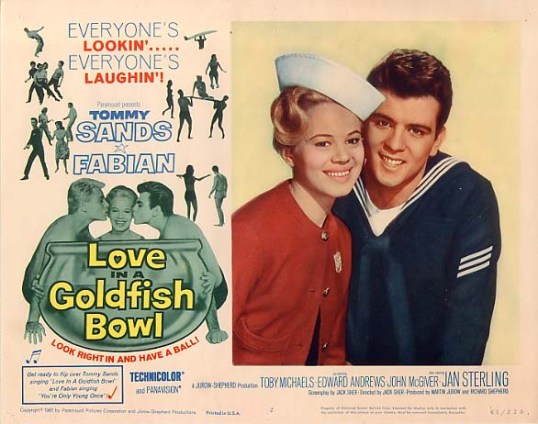
Spring Breakdown: Love In A Goldfish Bowl (dir by Jack Sher)


The 1961 film, Love in a Goldfish Bowl, tells the story of two college students.

Gordon Slide (Tommy Sands) and Blythe Holloway (Toby Michaels) are best friends.  Their relationship is strictly platonic, though everyone at the college assumes that they’re more than just friends.  Gordon and Blythe both share the common bond of coming from broken but wealthy families and they both want to do something more with their lives than just following the rules.  Blythe is a good student, the daughter of a senator.  Gordon is styles himself as being a cynic, or at least what was considered to be a cynic by the standards of 1961.  (James Dean would have probably called him a phony.)  The school’s headmaster (John McGiver) suspects that 1) Gordon and Blythe are more than just friends and 2) that Gordon is a bad influence on Blythe.  He even orders them to stop seeing each other, which I guess is something that headmasters could get away with in 1961.

Still, it’s going to take more than some stuffy authority figure to keep Gordon and Blythe for enjoying their Spring Break!  Especially when Gordon’s mother happens to own a beach house, which would be the perfect place for the two of them to hang out.  Despite knowing that each of their parent probably wouldn’t approve of them spending the break together, Gordon and Blythe decide to do just that.  Blythe even gets permission for her father, albeit by duplicitous means.  (Gordon imitates the headmaster on the phone.  Wow, that wild and crazy Gordon.)

At first, the beach house seems like the perfect place for Gordon and Blythe to unwind.  But when they meet Giuseppe La Barba (Fabian Forte), things start to change.  A member of the Coast Guard, Giuseppe plots to steal Blythe away from Gordon, with his schemes causing Gordon and Blythe to reconsider their feelings for each other.

Considering that this film is 60 years old, it’s perhaps not surprising that Love In A Goldfish Bowl often feels like it’s a rusty time capsule that someone buried in the sand on a California beach.  Everything from the intrusive headmaster to the scandal of divorce to the domestic routine that both Gordon and Blythe naturally slip into as soon as they arrive at the beach house makes this film feel almost as if it comes from another planet.  While the film is critical of adults who don’t understand what it’s like to be young and idealistic, it also ultimately ends with the suggestion that the adults might not be so clueless themselves.  It’s a bit of a wishy-washy approach to what little conflict the film has to offer up.

My point here is that Love In A Goldfish Bowl is an amazingly innocent little film, the type of Spring Break movie that would cause even your grandma to say, “Those kids really need to loosen up and live a little.”  Usually, I kind of like time capsule films like this, just because I’m a history nerd and I’m always interested in seeing how people used to live and communicate.  Unfortunately, Love In A Goldfish Bowl is a remarkably slow 88 minutes and neither Tommy Sands nor Toby Michaels have enough chemistry to be interesting as friends, let alone as a chaste couple waiting for their wedding night.  Fabian has a little bit more screen presence than Tommy Sands but overall, this is a pretty bland affair.

Ultimately, this film is mostly interesting as an example of what beach movies were like before AIP reinvented the genre with the Frankie and Annette beach party films.  Thank goodness people finally learned how to celebrate being young and on the beach.

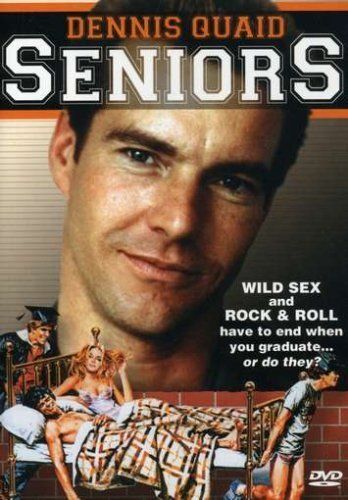
The Seniors (1978, directed by Rod Amateau)


Four college seniors (including one played by Dennis Quaid) are upset at the prospect of graduating, having to get real job, and losing Sylvia (Priscilla Barnes), the mute nymphomaniac who lives in their house with them and does all the cleaning and cooking.  They decide that the best way to avoid getting a real job is by setting up a fake company called Phantom Research.  They apply for and get a grant to study female sexuality, which essentially means that they pay the girls on campus to have sex with them.  Before you can say Risky Business (which was actually released years after this film), they expand their operations, get involved with some crooked businessmen, and nearly lose their lives.  It’s a comedy.

The Seniors is one of those films that used to come on television frequently when I was a kid.  I remember watching it when I was 12 and enjoying it, mostly because I was a stupid kid and I was at that age where any film about sex seemed clever and hilarious.  I recently rewatched it and discovered that there was only one funny bit and that was about a nerdy research assistant named Arnold (Rocky Flintermann) who helps out the seniors in return for them setting him up with Sylvia.  Throughout the film, the formerly virginal Arnold gets laid so often that he loses the ability to walk and then he dies.  Ha ha.  The rest of the film is just dumb.  The problem is that the film wants to be a raunchy, Animal House-style comedy but it was written by Stanley Shapiro (who previously wrote Doris Day comedies) and directed by Rod Amateau, who had previously directed several episodes of Gilligan’s Island.  Their style is all wrong for the material.

The film’s opening credits announce that it stars, among others, Ryan O’Neal, Clint Eastwood, and Charles Bronson.  A cartoon professor then walks out and announces that, “All of these big stars!  None of them are in this film!”  That’s too bad.  I would have liked to have seen some of those stars in this movie.  I think Eastwood would have told the seniors to get jobs and stop exploiting Sylvia.  Bronson would have blown away the entire operation but Ryan O’Neal probably would have been cool with it all.

O’Neal, Eastwood, and Bronson are not in the film.  Dennis Quaid is, though he probably doesn’t brag about.  Edward Andrews and Ian Wolfe both have minor roles as corrupt businessmen who help fund Phantom Research.  Alan Reed, the voice of Fred Flinstone, plays a professor.  This was his last performance before his death.

Horror on TV: Thriller 1.31 “A Good Imagination” (dir by John Brahm)


In tonight’s episode of the Boris Karloff-hosted anthology series, Thriller, Edward Andrews plays a bookseller who discovers that his wife has numerous lovers.  Fortunately, he has a collection of books that is just full of good ways to take care of the competition!

This episode was written by Robert Bloch and was based on his short story.

Enjoy the little tribute to the power of literature!

http://www.youtube.com/watch?v=wgj9NDt0cJ0


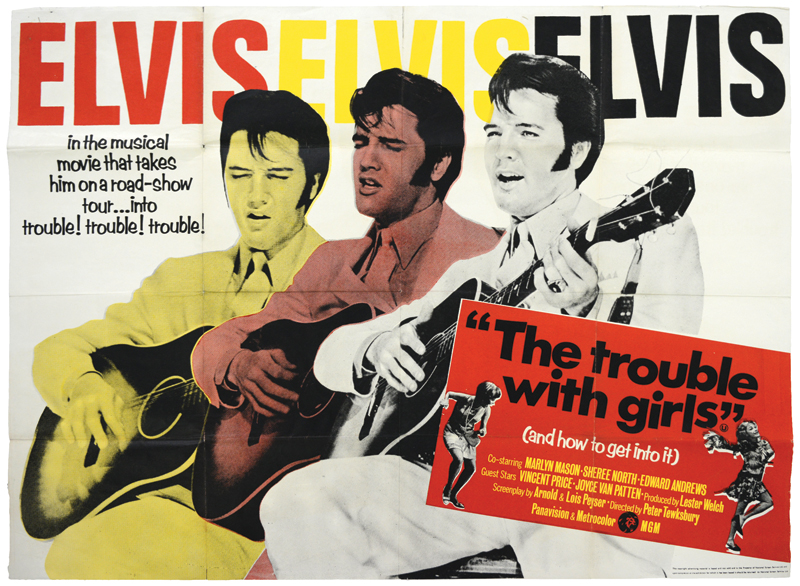
Happy Birthday Elvis!: THE TROUBLE WITH GIRLS (MGM 1969)


gary loggins's avatarcracked rear viewer

twg1

Elvis Aron Presley was born on this date in 1935. The King of Rock’N’Roll got the older generation “All Shook Up” when he burst on the national scene in 1956 with hits like “Heartbreak Hotel” and “Hound Dog”. He also made his first film that year, the Western LOVE ME TENDER, and was an immediate box office sensation. His following three films, LOVING YOU, JAILHOUSE ROCK , and KING CREOLE, were well done, but after his stint in the Army, and the success of 1961’s BLUE HAWAII, Presley’s 60’s movies followed a strict formula, thanks to manager Col. Tom Parker, with interchangeable titles like KISSIN’ COUSINS, HARUM SCARUM, and DOUBLE TROUBLE.

By the late 60’s, things had changed. The Beatles  were top of the pops, the psychedelic revolution was in full effect, and Elvis hadn’t had a hit record in a few years. The movies were still profitable, but lacked energy. Presley’s 1968…

View original post 697 more words

Cleaning Out the DVR Pt 9: Film Noir Festival Redux


gary loggins's avatarcracked rear viewer

prev

Welcome back to the decadently dark world of film noir, where crime, corruption, lust, and murder await. Let’s step out of the light and deep into the shadows with these five fateful tales:

redux1

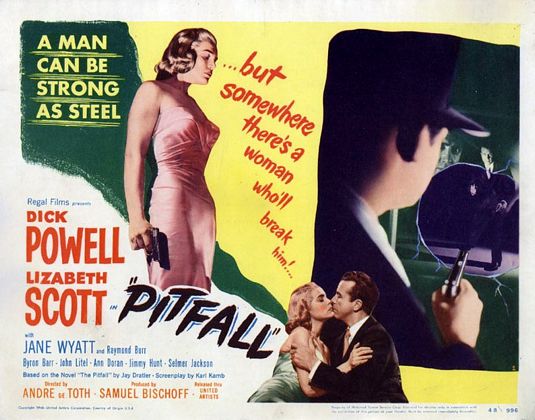
PITFALL (United Artists 1948, D: Andre DeToth) Dick Powell is an insurance man who feels he’s stuck in a rut, living in safe suburbia with his wife and kid (Jane Wyatt, Jimmy Hunt). Then he meets hot model Lizabeth Scott on a case and falls into a web of lies, deceit, and ultimately murder. Raymond Burr  costars as a creepy PI who has designs on Scott himself. A good cast in a good (not great) drama with a disappointing ending. Fun Fact: The part of Scott’s embezzler boyfriend is played by one Byron Barr, who is not the Byron Barr that later changed his name to Gig Young.  

redux2

THE BRIBE (MGM 1949, D:Robert Z. Leonard) Despite an…

View original post 759 more words

Horror on TV: Twilight Zone 5.14 “You Drive”


TheTwilightZoneLogo

In this episode of The Twilight Zone, Ollie Pope (Edward Andrews) kills a boy in a hit-and-run accident. Ollie tries to cover up the crime and frame an innocent man. His car, however, has a different idea.

This episode originally aired on January 3rd, 1964.