A Movie A Day #153: Blue Collar (1978, directed by Paul Schrader)


Three Detroit auto workers (played by Harvey Keitel, Yaphet Kotto, and Richard Pryor) are fed up.

It’s not just that management is constantly overworking them and trying to cheat them out of their money.  That’s what management does, after all.  What really upsets them is that their union is not doing anything to help.  While the head of the union is getting rich off of their dues and spending time at the White House, Keitel is struggling to pay for his daughter’s braces, Kotto is in debt to a loan shark, and Pryor is lying to the IRS about the number of children that he has.  (When a social worker shows up unexpectedly, Pryor’s wife recruits neighborhood children to pretend to be their’s.)  Kotto, Pryor, and Keitel plot to rob the union but instead, they just discover evidence of the union’s ties to the mob.  The union bosses will do anything to keep that information from being revealed, from trying to turn the friends against one another to committing murder.

Blue Collar was the directorial debut of screenwriter Paul Schrader.  Schrader has said that the three main cast members did not get along during the filming, with Richard Pryor apparently bringing a gun to the set and announcing that there was no way he was going to do more than three takes of any scene.  The tension between the lead actors is visible in the film, with all three of them giving edgy and angry performances.  That anger is appropriate because Blue Collar is one of the few films to try to honestly tackle what it’s like to be a member of the “working class” in America.  While management is presented as being a bunch of clowns, Blue Collar reserves its greatest fury for the corrupt union bosses who claim to represent the workers but who, instead, are just exploiting them.  The characters in Blue Collar are pissed off because they know that nobody’s got their back.  To both management and the union, the workers are worth less than the cars that they spend all day putting together and the money that can be subtracted from all their already meager pay checks.

Since it’s a Paul Schrader film from 1978, the action in Blue Collar does come to a halt, 40 minutes in, for a cocaine-fueled orgy that feels out of place.  While Keitel and especially Kotto give believable performances, Pryor sometimes seems to be struggling to keep up.  Still, flaws and all, Blue Collar has a raw and authentic feel to it, something that few other movies about the working class have been able to capture.  Perhaps because it never sentimentalizes its characters or their situation, Blue Collar was not a box office success but it has stood the test of time better than many of the other films that were released that same year.  Sadly overlooked, Blue Collar is a classic American movie.


Lisa Reviews An Oscar Nominee: The Accidental Tourist (dir by Lawrence Kasdan)


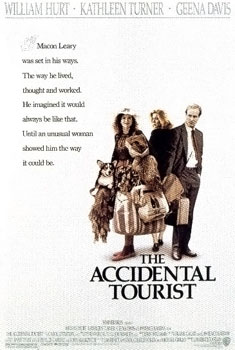
the_accidental_tourist

I have to admit that I was tempted to be a little bit snarky in my review of the 1988 Best Picture nominee, The Accidental Tourist.  I was going to say that The Accidental Tourist was a perfect example of a genre of film that has always been oddly popular with the Academy, the emotionally stunted man in New England learns to love again genre.

But, then I realized that I was wrong.  The Accidental Tourist does not take place in New England.  It takes place in Baltimore which may be located up north but which is technically considered to be part of the mid-Atlantic.  But, even with that in mind, it was impossible for me to watch The Accidental Tourist without thinking of other New England-set Oscar nominees, such as Mystic River and Manchester By The Sea.

As for the film itself, it’s about a man whose depressing life would be unbearable to watch if not for the fact that everyone around him is so extremely eccentric.  Macon Leary (William Hurt) is a travel writer.  He’s writes books giving people advice on how best to behave while seeing the world.  Throughout the film, we hear snippets of his prose.  Macon warns people about overpacking.  He warns them about arriving late at the airport.  He warns them about not properly planning out their trip.  He suggests that travelers bring a book to read but not too many books.  And don’t bring magazines because they get wrinkled too easily.  Now, to be honest, I liked most of Macon’s advice but then again, I’m OCD and I spend most of my time trying to make sure that everything I own is properly organized and can be equally divided.

A year ago, during a fast food robbery, Macon’s son was shot and killed.  Withdrawing from the world, Macon barely reacts when his wife, Sarah (Kathleen Turner), leaves him.  After breaking his leg while trying to convince his dog to climb down the stairs into the laundry room, Macon ends up moving in with his three siblings: autocratic Porter (David Ogden Stiers), slightly less autocratic Charles (Ed Begley, Jr.) and sweet but neurotic Rose (Amy Wright).

And so it goes.  Even when his agent, Julian (Bill Pullman), starts to date Rose, Macon can’t bring himself to open up emotionally.  Fortunately, Macon meets Muriel (Geena Davis), a quirky dog trainer.  Though it takes a while, Muriel starts to pull Macon out of his shell.  Soon, Macon is spending his nights over at her apartment and bonding with her sickly son.

(Why does every single mother in these type of movies have a sickly son?  Just for once, couldn’t a single mother be portrayed as having a child who is well-adjusted, popular, and healthy?)

But, just when everything seems to be perfect, Macon’s phone rings.  It’s Sarah and she wants to give their marriage another chance…

Just judging from the tone of this review, you’re probably thinking that I disliked The Accidental Tourist.  Actually, nothing could be further from the truth.  While the film’s mix of grim reality and relentlessly quirky supporting character can be a bit overwhelming at first, the film works if you stick with it.  That’s the thing — you have to stick with it.  When William Hurt first stares at the camera with his dead eyes and starts to drone about the importance of not spending too much money while in Paris, it’s tempting to just give up.  But, as the film progresses, it improves and so does Hurt’s performance.  By the time he finally worked up the strength to hold Muriel’s son’s hand while walking the boy home from school, I had tears in my mismatched eyes.

The Accidental Tourist is low-key but rather sweet film.  While the film centers around the performances of Hurt and Geena Davis (who won an Oscar for her work here), my favorite performances came from Bill Pullman and Amy Wright.  I honestly would happily watch a film that was just about their characters.

The Accidental Tourist was nominated for Best Picture but lost to Rain Man.

Film Review: Ghostbusters (dir by Paul Feig)


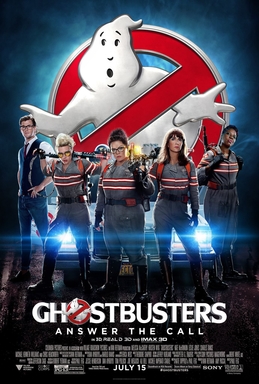
Ghostbusters

If you need any further proof that 2016 is a screwed-up year, just consider the fact that Ghostbusters, an entertaining but ultimately rather mild-mannered and innocuous summer action/comedy, has become the center of one of the biggest controversies of the year.

It all started, of course, when the reboot was first announced.  Fanboys reacted with outrage, offended that Hollywood would even consider remaking a film that was apparently one of the defining moments of their childhood.  Then, it was announced that Ghostbusters would feature an all-female cast and it would be directed by Paul Feig, the director of Bridesmaids.  The howls of outrage grew even louder.  Then that infamous trailer was released and even I felt that trailer sucked.  I wasn not alone because the trailer quickly became one of the most disliked videos in the history of YouTube.  Reading the comments underneath that trailer was literally like finding yourself trapped in a production of Marat/Sade.

Suddenly, in the eyes of very vocal group of internet trolls, the reboot of Ghostbusters went from being simply another dubious idea to being a crime against humanity.  And the trolls were so obnoxious that they managed to turn this big-budget, studio-backed production into an underdog.  Here was a movie directed by one of Hollywood’s biggest directors and starring some of Hollywood’s hottest stars and suddenly, it had become David in a biblical showdown with the Goliaths of internet.
ghostbusters1-800x430

And then it happened.  Earlier last week, Ghostbusters was finally screened for critics.  The first reviews started to come in and they were surprisingly positive.  In fact, they were so positive that I found myself distrusting them.  I found myself wondering if critics were reacting to the film or if they were simply trying to prove that they were better than the trolls who leave obscene comments on YouTube.

Which was true, I wondered.  Was Ghostbusters the worst film ever made or was it the greatest?  Or was it perhaps just possible that Ghostbusters would turn out to be a typical summer film?

With all the controversy, it’s tempting to overpraise a film like Ghostbusters.  Battle lines have been drawn and sometimes, I feel as if I’m being told that failing to declare Ghostbusters to be the greatest and most important comedy of all time is the equivalent of letting the trolls win.

Well, that’s not true.  Ghostbusters is not the greatest or the most important comedy of all time but you know what?  Ghostbusters is good.  Ghostbusters is entertaining.  Especially during the first half, it’s full of laugh out loud moments.  At times, Ghostbusters is everything that you could hope for.

No, it’s not a perfect film.  Paul Feig is a great comedy director but, in this film at least, his direction of the big action sequences often feels uninspired (especially when compared to his previous work on Spy).  The final fourth of the film gets bogged down in CGI and the film goes from being a clever comedy to being just another summer spectacle.  Even the one-liners, which flowed so naturally at the start of the film, feel forced during the final half of the film.  Ghostbusters is good but it never quite becomes great.

ghostbusters-2016-cast-proton-packs-images

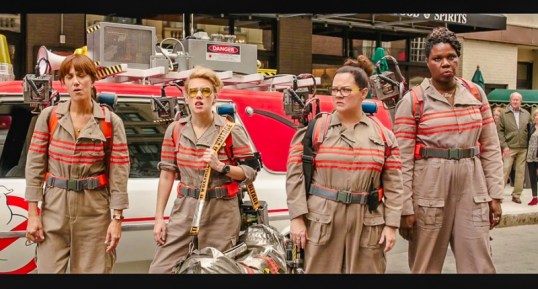
Here’s what did work: the cast.  As he previously proved with Bridesmaids, Paul Feig is a director who is uniquely skilled at creating and showcasing a strong comedic ensemble.  Kristen Wiig plays Erin Gilbert, who is denied tenure at Columbia when it is discovered that a book she wrote on the paranormal has been republished and is being sold, on Amazon, by her former best friend, Dr. Abby Yates (Melissa McCarthy).  When Erin goes to confront Abby, she not only meets Abby’s newest colleague, Dr. Jillian Holtzmann (Kate McKinnon) but she also gets dragged into investigating an actual case of paranormal activity..  Soon, Erin, Abby, and Holtzmann are investigating hauntings and capturing ghosts, all with the secret approval of the Mayor of New York (Andy Garcia).  Of course, for PR reasons, the mayor’s office has to continually disavow the Ghostbusters and occasionally have them arrested.  Working alongside the three scientists are Patty (Leslie Jones), who apparently knows the history of every building in New York, and Kevin (Chris Hemsworth), their adorably stupid receptionist.

As written, both Patty and Kevin are fairly thin characters.  Kevin’s the handsome dumb guy.  Patty is streetwise and sassy.  But both Hemsworth and Jones give such enthusiastic and sincere performances that they transcend the stereotypical nature of their roles.  At times, Kevin runs the risk of becoming too cartoonish for even a Ghostbusters film.  But if you can’t laugh at Chris Hemsworth explaining that he took the lenses out of his glasses because they were always getting dirty, what can you laugh at?

Erin is an interesting character and Kristen Wiig deserves a lot of credit for her performance.  Erin is actually given a fairly affecting backstory, centering around how she was haunted by the ghost of the old woman who used to live next door to her.  Erin is a former believer, someone who, in order to succeed in the “real” world, gave up her beliefs and conformed to the expectations of society.  When she actually meets a ghost, it’s more than just a confirmation of the supernatural.  It’s a chance for Erin to finally embrace who she truly is and what she truly cares about.  When she and the other ghostbusters chase after evil spirits, Erin is not just doing a job.  Instead, she’s finally found somewhere where she belongs.  She no longer has to pretend to be someone that she isn’t.  Wiig plays the role with just the right touch of neurotic wonder.  She grounds the entire film.

Wiig McKinnon

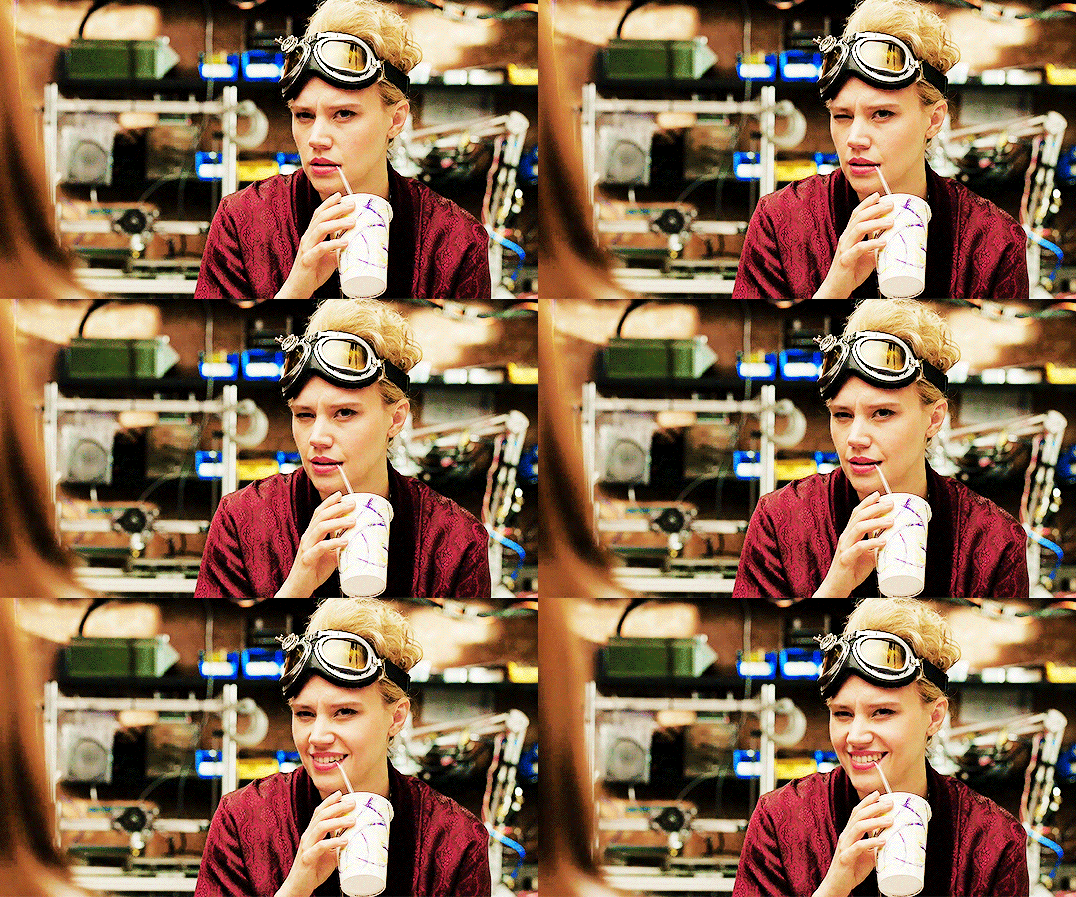
But the true star of the film is Kate McKinnon.  Whether she’s cheerfully smiling as a ghost vomits all over her colleagues or cheerfully explaining how easily their equipment could kill them all, Holtzmann is the greatest character in the film and McKinnon gives the best performance.  If Wiig grounds the film, McKinnon provides it with a truly demented soul.

The first half of the movie, which focuses on the relationships between the characters and features snappy and endlessly quotable dialogue, is wonderful and I was thrilled while watching it, convinced that the entire movie would be as good as the first hour.  However, the second half of the film gets bogged down in a rather predictable plot and the final action sequences could have just as easily been lifted from Pixels or one of The Avengers movies.  The surviving cast of the original Ghostbusters all show up in cameos that are, at best, inoffensive and, at worst, groan-worthy.  The end result is rather uneven.  If the film had maintained the momentum of that first hour, it would be a classic.  But that second half transforms it into just another entertaining but not quite memorable summer action film.

That said, Paul Feig is an excellent comedy director and let’s hope that he never gets so self-important that he ends up turning into Jay Roach.  Hopefully, if there is a sequel, Feig will return to direct it and Kate McKinnon will have an even bigger role.

tumblr_o3h37546Pl1v6mqeeo2_540


Horror Film Review: Cat People (dir by Paul Schrader)


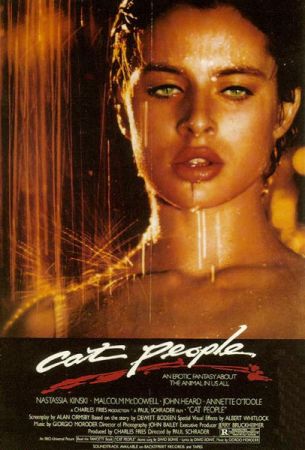
Cat_People_1982_movie

Before I get around to actually reviewing Paul Schrader’s 1982 reimagining of Cat People, I’m going to suggest that you take a few minutes to watch the film’s opening credits.  Say what you will about Schrader’s Cat People, it has a great opening, one that perfectly sets up the rest of the film.

In this version of Cat People, Irena (Natassja Kinski) is a naive young woman (and virgin) who, after the death of her parents, has spent most of her previous life in foster care.  Irena travels to New Orleans, where she reconnects with her older brother, Paul (Malcolm McDowell).  From the minute that Irena meets her brother and his housekeeper (Ruby Dee), it’s obvious that something is off.  When Paul looks at her, he does so with an unsettling intensity.  At night, while Irena sleeps, Paul wanders the dark streets of New Orleans.

One morning, Irena wakes up to discover that Paul is missing.  Having nothing else to do, Irena wanders around New Orleans.  When she visits the zoo, she feels an immediate connection to a caged panther who stares at her with a familiar intensity.  It turns out that the panther was captured the previous night, after he mysteriously appeared in a sleazy motel and mauled a prostitute.

It’s at the zoo that Irena meets zookeeper Oliver Yates (John Heard).  Oliver gets Irena a job working at the zoo gift shop. where Irena is befriended by Oliver’s co-worker, Alice (Annette O’Toole).  One day, Irena witnesses the panther kill another zookeeper before it then escapes from its cage.

That night, Paul suddenly shows up in Irena’s bedroom.  He explains to her that they are a cursed species.  Having sex causes them to turn into panthers and the only way to avoid the curse is through incest.  A terrified Irena flees her brother and soon finds herself living with and falling in love with the increasingly obsessive Oliver, all the while knowing that giving herself to him physically will lead to her transformation.

From the very first second of the film. Schrader’s Cat People is an exercise in pure style.  If the original Cat People was largely distinguished by its restraint, Schrader’s version is all about excess.  Everything that was merely suggested in the original is made explicit in this version.  As tempting as it may be to try, it’s somewhat pointless to try to compare these two versions.  Though they may both be about a woman who turns into a panther when she has sex, they are two very different films.

Schrader’s Cat People walks a very fine line between moodiness and absurdity, which is perhaps why I enjoyed it.  Making great use of both the sultry New Orleans setting and Giorgio Moroder’s atmospheric score, Cat People is compulsively dream-like and enjoyably over-the-top.  Cat People is often described as being an example of a movie that could have only been made in the coked up 80s  and truly, this is one of those films that’s so excessive that it’s becomes fascinating to watch.

(I think that often we are too quick to assume that excess is necessarily a bad thing.  If you can’t be excessive when you’ve got Malcolm McDowell playing an incest-minded cat person in New Orleans, when can you be excessive?)

Schrader’s Cat People may not have much in common with the original version but the film’s best scene is the only one that is a direct recreation of a scene from the original.  In fact, in recreating the scene where Alice is menaced while swimming in a public pool, Schrader actually improves on the original.  Brilliantly performed by both Annette O’Toole and Natassja Kinski (whose cat-like features made her perfect for the role of Irena), it’s the only scene in the film that can truly be called scary.  Starting with a tracking shock that follows Alice as she jogs, the stalking scene is practically a master class in effective horror cinema.  If nothing else, you should see Cat People for that one scene.

And you should also see it for the wonderful soundtrack!  Let’s end this review with David Bowie’s theme song, which you may also remember from Quentin Tarantino’s Inglourious Basterds.