Retro Television Reviews: Fantasy Island 3.11 “The Mermaid/The Victim”


Welcome to Retro Television Reviews, a feature where we review some of our favorite and least favorite shows of the past!  On Tuesdays, I will be reviewing the original Fantasy Island, which ran on ABC from 1977 to 1986.  Almost entire show is currently streaming is on Youtube!

Smiles!

Episode 3.11 “The Mermaid/The Victim”

(Dir by Earl Bellamy, originally aired on December 1st, 1979)

This week, Fantasy Island suddenly becomes the most dangerous place on Earth.

Julie Bett (Joan Prather) comes to the island with a simple fantasy.  She wants a date — just one date — with a man that she met briefly four years ago.  Mr. Roarke asks Julie if perhaps she has overidealized her memories of Michael Duvall (James Darren).  Julie says no and that Michael is the ideal man.  Roarke reveals that Duvall lives on a nearby island where Roarke has no legal authority.  Julie says that fine, since the date will be on Fantasy Island.  Roarke reveals that Duvall is usually not allowed to step foot on Fantasy Island because of his shady reputation.  Julie replies that there’s nothing shady about Michael Duvall.  Roarke finally allows Duvall to come to Fantasy Island for the date.

Of course, within minutes of arriving, Duvall has drugged Julie’s drink and then whisked her back to his own island.  It turns out that Michael Duvall is a Jeffrey Epstein-style human trafficker and his estate doubles as a prison for the women that he had abducted.  His evil assistant, Madame Jeannot (Yvonne DeCarlo), announces that there is no way that Julie can escape and, to prove her point, she introduces Julie to Annie (Cathryn O’Neil), who tried to escape and was severely beaten as a result.

Julie tries to rally the other prisoners (including Dorothy Stratten, who would be murdered 8 months after this episode aired) to fight back against Duvall, Jeannot, and their servant.  If her rebellion fails, Julie knows that she’ll never be seen again….

Meanwhile, oceanographer Harold DeHaven (John Saxon) has come to Fantasy Island with his wife, Amanda (Mary Ann Mobley).  Harold and Amanda have a troubled marriage, largely because Harold is too obsessed with his work and his desire to make a major discovery of some sort.  No sooner has Harold started walking along the beach then he comes across a mermaid!  Princess Nyah (Michelle Phillips) is apparently a well-known figure on Fantasy Island and, at one point, Roarke even confronts Nyah about her history of trying to lure the guests to their deaths.  Can Amanda prevent her husband from drowning in his attempt to be with Princess Nyah?

(This episodes leaves us to wonder just what exactly Fantasy Island’s legal liability would be if someone died as a result of their fantasy.  Seriously, it seems like Mr. Roarke has really left himself vulnerable to a lawsuit.)

Anyway, Julie and the other kidnapped women manage to escape from Duvall’s estate, just to find Mr. Roarke and a bunch of policemen waiting for them.  Roarke explains that he knew what Duvall was doing but he needed proof before he could contact that authorities.  Julie provided the proof.  Essentially, Roarke is saying that he put Julie’s life at risk to take down Duvall but Julie and the other women seem to be amused by the whole thing.  Everyone smiles as Mr. Roarke says that he’ll take them back to Fantasy Island.  I guess PTSD doesn’t exist on the islands.

Meanwhile, Amanda’s efforts to keep Harold from swimming off with Nyah nearly leads to Amanda drowning.  Seeing his wife risk her life for him, Harold realizes that he really does love Amanda and both he and Amanda return to dry land.  Disappointed, Nyah swims off.

Yay!  Everyone lived!  As they all left the Island, no one seemed to be the least bit traumatized by nearly dying.  At the plane flies away, Roarke suggest that Nyah’s new target might be Tattoo.  “Be serious, boss,” Tattoo, “I can’t even swim.”  The thought of his assistant dying a terrible death from drowning cause Roarke to laugh out loud as the end credits roll.

There was a weird episode and compulsively watchable as a result.  Seriously, how do you not love John Saxon following Michelle Phillips into water?  That said, Fantasy Island seems like a very dangerous place.

The Unnominated: Star 80 (dir by Bob Fosse)


Though the Academy of Motion Picture Arts and Sciences claim that the Oscars honor the best of the year, we all know that there are always worthy films and performances that end up getting overlooked.  Sometimes, it’s because the competition too fierce.  Sometimes, it’s because the film itself was too controversial.  Often, it’s just a case of a film’s quality not being fully recognized until years after its initial released.  This series of reviews takes a look at the films and performances that should have been nominated but were,for whatever reason, overlooked.  These are the Unnominated.

First released in 1983, Star 80 is an examination of fame, obsession, misogyny, and finally madness.  All four of those qualities are exemplified in the character of Paul Snider (Eric Roberts), a man with a charming smile, a ludicrous wardrobe, and the personality of a pimp.  When we first see Paul Snider, he’s naked and he’s covered in blood and he’s ranting about how the world is trying to destroy him.  Even if he wasn’t holding a rifle, he would be terrifying.  Suddenly, we flash back to a few years earlier.  Snider is being dangled out a window by two men.  Snider pathetically begs to be pulled back into the room.  The men laugh at him before pulling him up.  Snider, looking fairly ridiculous in a cheap suit that he probably thinks makes him look like a celebrity, fights off tears as he says he deserves to be treated with dignity.

Star 80 is based on a true story.  Mariel Hemingway plays Dorothy Stratten, the actress and Playboy playmate who was murdered by Paul Snider.  Snider, who often claimed credit for having “made” Dorothy, was married to her at the time, though Dorothy had filed for divorce and was dating director Peter Bogdanovich.  Unwilling to let her go and return to being a small-time hustler, Snider shot Dorothy and then himself.  Director Bob Fosse, who was best known for directing musicals like Cabaret and All That Jazz, was attracted to the story because he understood that type of world that produces sleazes like Paul Snider.  According to Eric Robets, Fosse even said that he probably would have ended up like Paul Snider if not for his talent.

Snider, the film quickly establishes, really doesn’t have any talent beyond the ability to manipulate people who are too naïve to see through his bullshit.  Snider wants to be a star.  He wants to be rich.  He wants people to kiss his ass.  When he meets Dorothy, he sees her as his ticket.  Dorothy’s mother (a poignant performance from Carroll Baker) sees straight through him from the start.  Tragically, Dorothy doesn’t realize the truth abut who he is until they’re already in Hollywood.  As Dorothy tries to break away from him, Paul desperately tries to find some sort of success, all the while complaining that the world is conspiring to keep him from being a man. 

Eric Roberts dominates the film and it’s one of the scariest performances that I’ve ever seen.  Roberts is convincing when he’s ranting and raving against the world that he feels is against him but what’s even more disturbing is that he’s convincing when he’s turning on the charm.  Paul Snider may not be smart.  Paul Snider may not be talented.  But he know how to gaslight.  He knows how to destroy someone’s fragile confidence, largely because his own confidence has been shattered so many times that he’s become an expert in exploiting insecurity.  Snider is a tacky dresser and nowhere near as smooth as he thinks but, intentionally or not, he uses that to his advantage.  He tries so hard to impress that it’s easy to see how someone could feel sorry for him and want to help him.  However, because Fosse lets us know from the start what Snider is really going on inside of Sinder’s head, we never make the mistake of trusting him.  We know who Paul Snider is because we’ve all known a Paul Snider.

Eric Roberts’s performance is so intense that it’s unfortunate but not surprising that it was overlooked at the 1983 Oscars.  He was playing a truly repellent character and he did it so convincingly that I imagine many viewers had a hard time realizing that Eric Roberts was not Paul Snider but was instead an actor playing a terrible character.  Some probably said, “Why should we honor such a loathsome character?” and again, the answer is because there are many Paul Sniders out there.  Roberts captured much more than just one man’s breakdown.  He captured a sickness at the heart of a fame-driven culture.

Of course, Paul Snider was not the only symptom of that sickness to be depicted in Star 80.  Every man that Dorothy either uses her in some way or just views her as being a commodity.  Hugh Hefner (Cliff Robertson) presents himself as being a fatherly mentor but Robertson plays him as being just as manipulative and ultimately narcissistic as Paul Snider.  Director Aram Nicholas (Roger Rees, playing a character based on Peter Bogdanovich) seems to love Dorothy but their relationship still feels out-of-balance.  Aram, afterall, is the director while Dorothy is the actress.  The private detective (Josh Mosel) that Paul hires to spy on Dorothy seems to have no lingering guilty over the role he played.  Even Snider’s roommate (David Clennon) is more interested in talking about his dog and his car then about the murder/suicide of two people with whom he lived.

It’s a dark film and not one to be watched when depressed.  At the same time, it’s a portrait of obsessiveness, misogyny, and an overwhelming need to be “someone” that still feels relevant today.  Along with Sweet Charity, it was the only Bob Fosse film not to be nominated for Best Picture.  (This was back when there were only five best picture nominees.  Three of the nominated films — Terms of Endearment, Tender Mercies, and The Right Stuff — hold up well.  Two of the nominees — The Dresser and The Big Chill — are a bit more iffy.)  Eric Roberts was not nominated for the best performance of his career.  Again, it’s a shame but not a surprise.  This was a dark and disturbing film, a true Hollywood horror story.  One imagines that most members of the Academy wanted to escape it far more than they wanted to honor and be reminded of it.

Previous entries in The Unnominated:

  1. Auto Focus 

Flat Broke In The ’70s: Americathon (1979, directed by Neal Israel)


The year is 1998 and America is flat broke.  Paper currency is now worthless and, to the joy of Ron Paul supporters everywhere, all transactions are done in gold.  After the country ran out of oil, people started using skateboards and bicycles for transportation and many turned their cars into homes.  While the citizenry spends their time consuming a steady diet of sitcoms and reality television, the government tries to figure out how to pay back the loan that it took from Sam Birdwater (Chief Dan George), a Native American who made billions after buying Nike.  Birdwater wants his money back and he is prepared to foreclose on the entire country.
Newly elected President Chet Roosevelt (John Ritter) is not helping.  A combination of Jack Tripper and Jerry Brown (who was gearing up to challenge Jimmy Carter in the Democratic primaries when Americathon was first released), Chet Roosevelt is a spaced-out former governor of California who speaks in 70s self-help slogans and who is more interested in getting laid than leading the country.  Roosevelt governs out of The Western White House, a condo in California.  When an ad exec named Eric McMerkin (Peter Reigert) suggests a month-long telethon to raise the money to pay off the loan, Roosevelt leaps at the chance.

Hosted by Harvey Korman, the telethon (which is called, naturally, the Americathon) features a wide variety of acts.  There’s a ventriloquist.  Jay Leno boxes his grandmother.  Meat Loaf destroys a car.  Even Elvis Costello and Eddie Money make brief appearances.  While Chet falls in love with one of the performers, his chief-of-staff (Fred Willard) plots, with the leaders of a new Middle Eastern superstate, to sabotage the telethon.

Based on a play by the Firesign Theater, Americathon has a big, talented cast that is let down by Neal Israel’s uncertain direction and a script that is only rarely funny.  The idea of America hosting a tacky telethon to pay its debts sounds like a good SNL skit (especially if Bill Murray played the host) but the premise is too thin for a feature film.  Like Airplane! or The Naked Gun films, Americathon is a movie that tosses every joke it can against the wall to see what will stick.  If the jokes are good, like in Airplane!, that formula can lead to a comedy classic.  If the jokes are bad, not even John Ritter, Harvey Korman, and Fred Willard can make them funny.

Today, if Americathon is remembered, it’s because it supposedly predicted several future events.  Americathon does take place in a future where China is an economic superpower, Nike is a huge conglomerate, and reality game shows are very popular.  But, even with those correct predictions, Americathon is a such a film of its time that it was probably dated from the minute that it was released.  Just the sight of John Ritter in a condo permanently marks Americathon as a film of and about the ’70s.

George Carlin does score a few laughs as the narrator and Elvis Costello performs both Crawlin’ To The USA and (I Don’t Want To Go To) Chelsea.  Eagle-eyed viewers might want to keep an eye out for the tragic Playboy playmate, Dorothy Stratten, who has a brief non-speaking role.  Otherwise, Americathon is as hopeless as the country it’s trying to save.

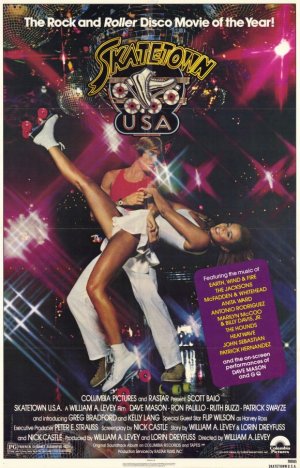
Back to School Part II #11: Skatetown U.S.A. (dir by William A. Levey)


Poster_of_the_movie_Skatetown,_USA

Now that I’ve fully recovered from the trauma of writing about Grease, let me tell you about a little movie from 1979.  It’s a movie about teenagers, love, and competition.  It’s also a movie about disco and some actors who had some extra time on their hands.  It has a great soundtrack and the whole movie is pure 70s.  It even features the debut performance of a future movie star!

What film am I talking about?

SKATETOWN, USA, of course!

But before I talk about the movie, check out the trailer.  This is one of my favorite trailers of all time.  It pretty much tells you everything that you need to know about the movie.  There’s not a deceptive moment to be found in this preview:

Skatetown, U.S.A. is one of those movies that you watch and think, “This could only have been made in the 70s.”  Remember how watching Hollywood High caused me to doubt whether or not the 70s were actually all they were cracked up to be?  Well, Skatetown USA has renewed my faith!  Skatetown is such a 70s film that I personally think someone should send me an honorary coke spoon to reward me for watching it.

(Maureen McCormick, who is best known for playing Marcia Brady and who had a small role in Skatetown, wrote in her autobiography that the main thing she remembers about Skatetown is all the cocaine on the set.)

Skatetown USA doesn’t really have a traditional plot.  Instead, it’s a collection of “comedic” skits mixed in with roller skating performances and a nonstop soundtrack.  There is not a second that music is not playing in the background and, for what appears to be a low-budget film, the soundtrack is truly impressive.  Basically, almost every great disco song from the 1970s is heard at some point during Skatetown USA.  (Even that “Boogie Nights” song that Paul Thomas Anderson was apparently not allowed to actually use in Boogie Nights!  Imagine being the copyright holders who said yes to Skatetown but no to Paul Thomas Anderson…)

The film’s main character appears to be an unnamed DJ (Denny Johnston).  The DJ wears a big white afro wig and is always dancing in his booth.  Occasionally, he shoots a lightning bolt from his middle finger and suddenly, professional roller dancers appear and do a routine.  At the end of the movie, he looks at the camera, says that it’s all a fantasy, and winks.

Skatetown is the most popular disco roller rink in town.  Clean-cut teenager and all around nice guy Stan Nelson (Greg Bradford) wants to win Skatetown’s roller dancing contest.  (The prize is $1,000 and a moped!)  His best friend, Richie (Scott Baio), accompanies him and hopes to win a lot of money by betting on the outcome of the contest.  Stan angrily reprimands him, “This isn’t the streets!  This is Skatetown, U.S.A!”

That’s right — don’t mess with the good name of Skatetown!

Anyway, Stan’s actually a pretty good performer and he does this trick where he rides a skateboard while wearing roller skaters so you would think he would be a sure bet to win.

BUT NO!

The reigning Skatetown champion is Ace Johnson (Patrick Swayze, making his film debut) and we know that Ace is a bad guy because he wears all black and he occasionally snaps a whip while he’s rolling around!  Ace isn’t above cheating to win but really he doesn’t have to cheat!  Ace may be the bad guy but, seriously, he totally kicks ass while wearing roller skates.  As soon as he rolls out there, you understand why he’s the reigning champion.

See, here’s the thing with Skatetown: We’re supposed to be rooting for Stan but Ace really is a hundred times better than him.  There’s a reason why Patrick Swayze went on to have a career after Skatetown while Greg Bradford only has 8 credits on the imdb.  Swayze, even in this silly role, had movie star charisma whereas Bradford — well, he’s comes across as a nice guy but there’s nothing special about him.  Swayze, meanwhile, is dangerous and smoldering.

For instance, when Stan does his routine, his background music is The Village People singing “Macho Man” and you can’t help but snicker a little.  Whereas, when Ace performs, his background music is a slightly menacing cover of Under My Thumb.  Stan is the Village People.  Ace is the Rolling Stones.

Anyway, the film might not be good in the traditional sense but I absolutely loved Skatetown, U.S.A.  Why?  Because it’s a total time capsule! Watching it is such a totally 70s experience that I was even tempted to get a frizzy perm, start wearing bell bottoms, and stop wearing a bra.  Fortunately, the temptation passed but still, I enjoyed getting to use my cinematic time machine.

Add to that, the film itself is just so over-the-top and silly that … well, you can really believe that everyone involved in the movie was snorting mountains of cocaine in between takes.  There’s not a subtle moment to be found in Skatetown, U.S.A.  Instead, it’s all bright neon, loud music, flamboyant characters, silly melodrama, and corny humor.

(My personal theory is that Skatetown, U.S.A. was taking place in the same cinematic universe of A Clockwork Orange and it was showing what normal teenagers were doing while Alex and his droogs were seeking out the ultraviolence.  The over-the-top design of Skatetown reminded me of the similar flamboyance of the Korova Milk Bar and the droogs’s bowlers and oversized codpieces weren’t that different from some of the costumes worn by the cast of Skatetown.)

Anyway, Skatetown is one of those films that everyone should see once.  Unfortunately, because of all the music in the film, it’s never been released on DVD or Blu-ray and it probably never will be because life sucks.  It is on YouTube, though it was recorded off an old VHS tape so the transfer is not the best.

Here’s Skatetown, USA:

One final note: Skatetown, USA was directed by the same William Levey who also directed Blackenstein, Hellgate, and The Happy Hooker Goes to Washington.  It was written Nick Castle, who played Michael Myers in the original Halloween and directed a film that is well-liked by several of the writers here at the Shattered Lens, The Last Starfighter.