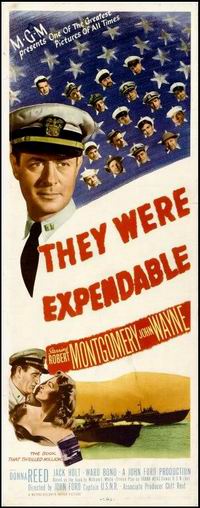
They Were Expendable (1945, directed by John Ford)


In December of 1941, Lt. John Brickley (Robert Montgomery) commands a squadron of Navy PT boats, based in the Philippines.  Brickley is convinced that the small and agile PT Boats could be used in combat but his superior officers disagree, even after viewing a demonstration of what they can do.  Brickley’s second-in-command, Rusty (John Wayne), is frustrated and feels that he will never see combat.  That changes when the Japanese attack Pearl Harbor and then turn their attention to the Philippines.  Brickley gets his chance to show what the PT boats can do but both he and his men must also deal with the terrible risks that come with combat.  Brickley and his men have been set up to fight a losing battle, only hoping to slow down the inevitable Japanese onslaught, because both they and their boats are considered to be expendable.  The hot-headed Rusty learns humility when he’s sidelined by blood poisoning and he also falls in love with a nurse, Sandy (Donna Reed).  However, the war doesn’t care about love or any other plans that its participants may have.  With the invasion of the Philippines inevitable, it just becomes a question of who will be sent with MacArthur to Australia and who will remain behind.

One of John Ford’s best films, They Were Expendable is a tribute to the U.S. Navy and also a realistic look at the realities of combat.  The movie features Ford’s trademark sentimentality and moments of humors but it also doesn’t deny that most of the characters who are left behind at the end of the movie will not survive the Japanese invasion.  Even “Dad’ Knowland (Russell Simpson), the fatherly owner of a local shipyard who does repair work on the PT boats, knows that he’s expendable.  He resolves to meet his fate with a rifle in hand and a jug of whiskey at his feet.  Rusty, who starts out thirty for combat, comes to learn the truth about war.  Ford was one of the many Hollywood directors who was recruited to film documentaries during World War II and he brings a documentarian’s touch to the scenes of combat.

Robert Montgomery had previously volunteered in France and the United Kingdom, fighting the Axis Powers before America officially entered the war.  After the war began, he entered the Navy and he was a lieutenant commander when he appeared in They Were Expendable.  Montgomery brought a hardened authenticity to the role of Brickley.  (Montgomery also reportedly directed a few scenes when Ford was sidelined with a broken leg.)  John Wayne is equally good in the role of the hot-headed Rusty, who learns the truth about combat and what it means to be expendable.  The cast is full of familiar faces, many of whom were members of the John Ford stock company.  Keep an eye out for Ward Bond, Cameron Mitchell, Leon Ames, Jack Holt, and Donald Curtis.

They Were Expendable is one of the best of the World War II movies.  It’s a worthy film for Memorial Day and any other day.
Lisa Marie Reviews An Oscar Winner: From Here To Eternity (dir by Fred Zinnemann)


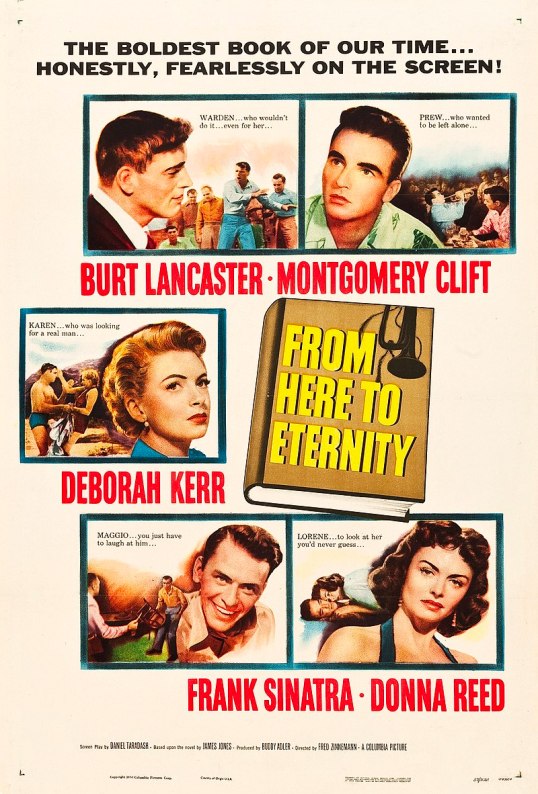
“The boldest book of our time,” shouts the poster art for 1953’s From Here To Eternity, “honestly, fearlessly brought to the screen!”

And indeed, James Jones’s novel was brought to the screen about as boldly as a studio film could be brought in 1953.  The book told the story of several soldiers in the days immediately before the attack on Pearl Harbor.  The Production Code was still in effect and, as a result, a few changes were made to the film’s plot.  Donna Reed played Lorene, a character who is described as being a “hostess” at social club but who, in the book, worked at a brothel that was popular with the soldiers from a nearby army base.  In the book, an unfaithful husband gives his wife a venereal disease that leads to her getting a hysterectomy.  In the movie, Karen’s (Deborah Kerr) hysterectomy was the result of a miscarriage that occurred after she discovered her husband was being unfaithful.  The book was critical of the Army and featured officers who faced no consequences for their actions.  The movie definitely presents the enlisted men as being at the mercy of officers but the worst of the officers is ultimately disciplined.  The movie was made with the cooperation of the U.S. Army and, as a result, the film’s villains — like Captain Holmes (Philip Ober) and the monstrous Fatso Judson (Ernest Borgnine) — were portrayed as being aberrations who did not represent the Army as a whole.  That said, the film version of From Here To Eternity is still a powerful, moving, and daring film.  What couldn’t be shown on screen is still suggested.  One might not see the specifics of what Fatso Judson does to Maggio (Frank Sinatra) in the stockade but it’s not difficult to figure out.

The film follows one company of soldiers as they laugh, fight, and fall in love while stationed in Hawaii.  They spend time training for a war that most of them think will never come.  Captain Holmes is more concerned with his regimental boxing team than the prospect of going to war and is confused when Private Prewitt (Montgomery Clift) refuses to stop back into the ring.  Prewitt, who takes pride in his ability as a bugler, quit boxing after he blinded an opponent in the ring but Holmes doesn’t care.  Holmes wants another trophy for his office.  He orders Sgt. Warden (Burt Lancaster) to make life Hell for Prewitt until Prewitt agrees to box.  Warden, who has seen a lot of officers come and go and who has been tempted to become an non-commissioned officer himself, is having an affair with Holmes’s wife, Karen.  Meanwhile, Prewitt and his friend Maggio spend their time looking forward to the weekends they’re allowed to spend off the base.  Prewitt has fallen in love with Lenore but, as with all the men in From Here To Eternity, Prewitt’s true love is for the army.  Even with Holmes pressuring him to box, Prewitt’s loyalty is to the men with whom he serves.  There’s a lot of drama, a lot of death, and a lot of romance.  This is the film in which Burt Lancaster and Deborah Kerr make out on the beach while the tide rolls in.  But, when Pearl Harbor is attacked, all of the drama and all of the romance is forgotten as America goes to war.

From Here To Eternity is one of the best films of the 1950s and certainly one of the more worthy winners for Best Picture.  Intelligently directed, wonderfully acted, deliriously romantic, and finally rather sad, it’s a film that embraces the melodrama without ever hitting a false note.  Burt Lancaster’s rugged weariness, Montgomery Clift’s method sensitivity, Frank Sinatra’s naturalism, Ernest Borgnine’s crudeness, Deborah Kerr’s classiness, and Donna Reed’s earnestness all come together to create a film in which the characters feel real and alive.  Warden, Prewitt, Lenore, Karen, and Maggio are all interesting, multi-faceted people, trying to find some sort of happiness in the shadow of an inevitable war.  The viewer may sometimes have mixed feelings about their actions (and Borgnine’s Judson is one of the most loathsome roles that the normally likable Borgnine ever played) but you never cease to care about them and their stories.  With all of the characters and the affairs and the secrets, From Here To Eternity can feel like a soap opera but it’s also a portrait of a world that is on the verge of changing forever.

A few years ago, I attended a screening of From Here To Eternity at the Dallas Angelika.  This is a film that definitely deserves to be seen on the big screen.  From the famous scene on the beach to the attack on Pearl Harbor to the tragic final moments, this is a big movie that deals with big emotions and big moments.  It’s one of the best.

Scenes That I Love: The Phone Call From Sam Wainwright From It’s A Wonderful Life


Tonight, NBC will be airing It’s A Wonderful Life.

Watching It’s A Wonderful Life on Christmas Eve is a tradition for many people.  It definitely is for me and my family.  I’ve watched It’s A Wonderful Life so many times that I’ve practically got the entire movie memorized.  It’s not only my favorite Christmas movie but also one of my favorite movies of all time.

Everyone knows, of course, that It’s A Wonderful Life is a film about a man named George (played by Jimmy Stewart) who gets a chance to see what the world would be like without him.  What I think is often overlooked is that it’s also a powerful and poignant love story and that the scenes between George and Mary (Donna Reed) are some of the most intensely romantic ever filmed.

In the scene below, George and Mary get a phone call from Mary’s ex, Sam Wainwright.  Sam has a business opportunity but George has more on his mind than staying in Bedford Falls and making money.  This scene, which begins with Mary upset and George feeling lost, ends with one of the most powerful kisses of the 1940s.

This is a scene that I love from a movie that I love and I look forward to watching it tonight!

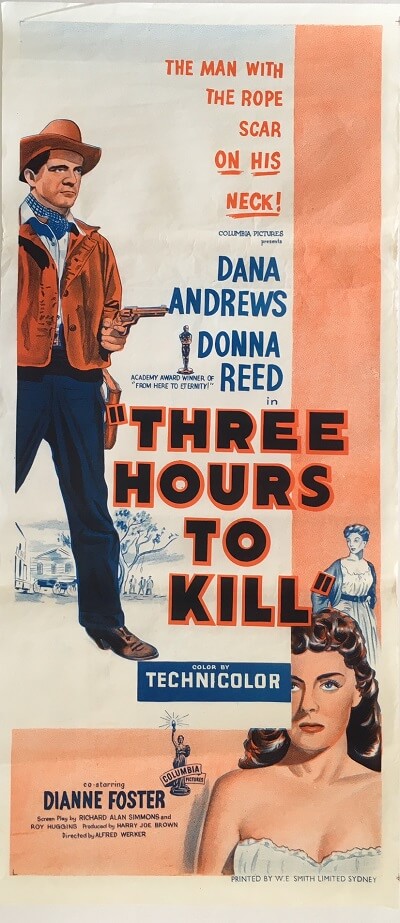
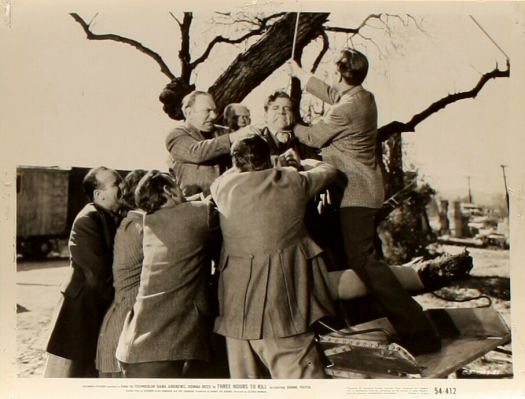
Time Well Spent: THREE HOURS TO KILL (Columbia 1954)


gary loggins's avatarcracked rear viewer

I don’t think you’ll find THREE HOURS TO KILL among anyone’s Top Ten Films list, or Top Ten Westerns, or even Top Ten Dana Andrews Movies. What you will find, if you give this movie a chance, is a solid, adult themed Technicolor Western with just a hint of film noir, made by Hollywood pros in front and behind the cameras. And you can’t ask for much more than that.

Jim Guthrie returns after a three year absence to the town that once tried to hang him. Jim relates the tale via flashback to old friend and current sheriff Ben East: a big night in town had everybody drinking and partying it up. Sexy hotel owner Chris Palmer comes on to Jim, but he only has eyes for pretty Laurie Mastin, bringing out the jealous side of banker Niles Hendricks. Laurie’s brother Carter disapproves of Jim, and a fight…

View original post 672 more words

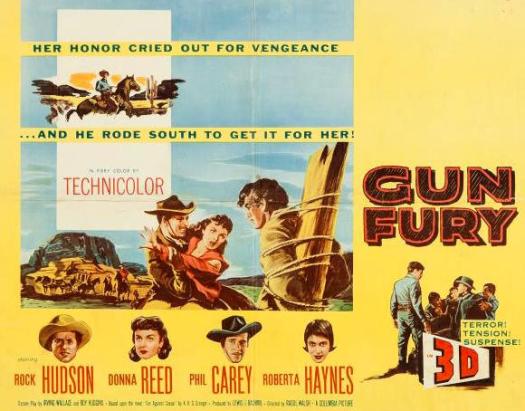
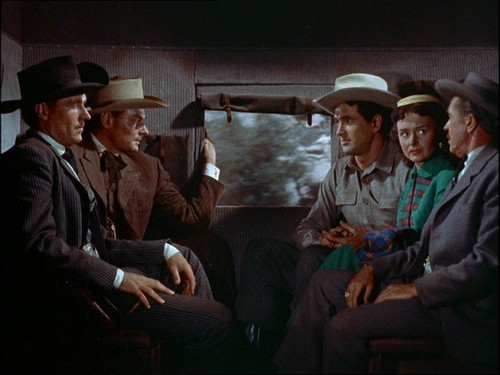
No Surprises Here: GUN FURY (Columbia 1953)


gary loggins's avatarcracked rear viewer

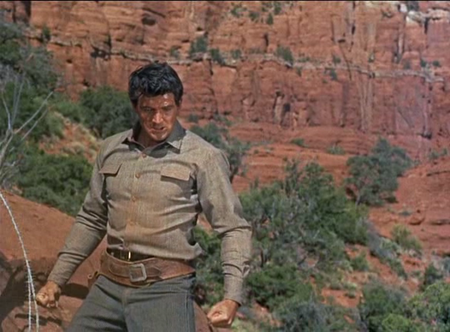
I watched GUN FURY expecting a surprise. What I got instead was a routine Western, not bad for its type, bolstered by a better-than-average cast, solid direction from veteran Raoul Walsh , and some lavish Technicolor location footage from Sedona, AZ. But I kept waiting and waiting for that “surprise” that never came. What am I talking about? Read on and find out, buckeroos!

Ben Warren, a peaceful Civil War vet, meets his intended bride Jennifer Ballard at the stagecoach station. The two lovebirds intend to travel to the next stop and get hitched. Also onboard the stage is mean desperado Frank Slayton, an “unreconstructed Southerner” feared across the territory, and his partner-in-crime Jess Burgess. Frank’s gang, disguised as Cavalry soldiers, lie in wait and rob the stage of it’s shipment of gold, stealing the loot killing everyone except Jennifer, who Frank has designs on and kidnaps.

But wait! Ben’s…

View original post 432 more words

Dear Old Alma Mater: John Wayne in TROUBLE ALONG THE WAY (Warner Brothers 1953)


gary loggins's avatarcracked rear viewer

Tomorrow’s the big night, as my New England Patriots go up against the tough defense of the Philadelphia Eagles in Super Bowl LII. Tom Brady and company will be going for Ring #6, and everyone here in Southern New England is super excited, looking forward to another victory celebration! I’ll be attending a huge party with plenty of food, big screen TV’s, raffles, squares, and like-minded fans, but before the festivities begin, let’s take a look at TROUBLE ALONG THE WAY, a football-themed film starring none other than Big John Wayne !

St. Anthony’s College is a struggling Catholic university run by sweet old Father Burke, who’s getting to be as decrepit as the school itself. The powers-that-be want to close his beloved St. Anthony’s, seeing how the school’s $170,000 in debt, but old Father Burke comes up with an idea. Citing Deuteronomy 32:15 (“The beloved grew fat and kicked”)…

View original post 486 more words

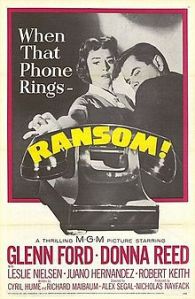
A Movie A Day #128: Ransom! (1956, directed by Alex Segal)


What would you do if your child was kidnapped?

That’s the question asked in this unjustly obscure film from 1956.  Dave Stannard (Glenn Ford) is a wealthy businessman, with a beautiful wife (Donna Reed), a big suburban home, and a butler named Chapman (the great Puerto Rican actor Juano Hernandez).  One day, his son Andy (Bobby Clark) does not come home from school.  The school says that a nurse showed up to pick Andy up for a doctor’s appointment but neither Dave nor his wife know about any appointment and their family doctor says that he would never send a nurse to pick up a patient.

Andy has been kidnapped.  When the kidnappers call, they tell Dave that they want half a million dollars in ransom.  Dave gets the money together but is then told, by reporter Charlie Telfer (Leslie Nielsen), that, once the kidnappers have the money, they will have no incentive to return Andy.  Since Andy is the only person who could identity them to the police, they may very well kill Andy after getting the money.  By paying the ransom, Dave will also be encouraging other kidnappers.

The next morning, Dave goes on television and announces that he will not be paying the ransom.  Instead, he announces that if the kidnappers do not immediately return his son, the money will be given as a reward to anyone who helps to track them down.

If this sounds familiar, it’s because Ransom! was later remade by Ron Howard, with Mel Gibson as the father and Gary Sinise as the kidnapper.  (Ransom! itself was a remake of a live television drama that aired in 1954.)  As opposed to the Howard film, the original Ransom! is a low-key character piece, one that takes place almost entirely in the Stannard home and in which the kidnappers remain largely unseen.  Almost the entire movie focuses on Dave, his decision, and his struggle to come to terms with that decision.  Was Dave right or was he wrong?  Ransom! is stagey but thought-provoking with excellent performances from the entire cast.  Even Leslie Nielsen, making his film debut, does well in the type of dramatic role that defined his career until he reinvented himself as a masterful comedic actor.

They don’t make them like this anyone and that is too bad.


Scenes I Love: George Meets Mary Again in It’s A Wonderful Life


It may seem strange, on Valentine’s Day, to share a scene that I love from a Christmas movie.  Well, we’re all about being strange here at the Shattered Lens!

Add to that, George and Mary share one of the greatest romances ever put on the big screen.  It may be a Christmas movie but it’s also a love story.

So, for your viewing pleasure, here’s how it all started…

Did you miss It’s A Wonderful Life? Don’t worry, we got you covered!


Last night, NBC broadcast the classic 1946 film It’s A Wonderful Life and…

What?

You missed it?

Well, don’t worry — we’ve got you covered!

Presented for your listening enjoyment, here is the 1947 radio version of It’s A Wonderful Life!  This was an episode of the Lux Radio Theater and it featured Jimmy Stewart and Donna Reed recreating their film roles!

Holiday Scenes That I Love: The Ending of It’s A Wonderful Life


At this very moment, NBC is broadcasting the classic 1946 film, It’s A Wonderful Life!  They show it every Christmas Eve and every year, I watch.

Why?

Because I love this movie so much that I could watch it a million times and then a million times more!  There is no movie that makes me happier than It’s A Wonderful Life.  There is no movie that brings tears to my mismatched eyes as quickly as It’s A Wonderful Life.  I love this film so much that I even watch it outside of December.  If I’m depressed, this is the movie that I’m going to watch.

And who can blame me?  The scene below is one that I love but, to be honest, there’s not a single scene in It’s A Wonderful Life that I don’t love.  I even love those scenes with old Sam Wainwright going, “Hee haw!”  Sam may have been a jackass but he was a good guy underneath it all.

(Plus, he made a fortune in plastics!  Money can excuse all sorts of obnoxious behavior!)

As for the scene below, it’s the final ten minutes of It’s A Wonderful Life.  To me, nothing exemplifies the joy of the holidays better than Jimmy Stewart running down the snow-filled streets of Bedford Falls and shouting “Merry Christmas” to everyone, even mean old Mr. Potter.  (“And a happy new year to you — IN JAIL!”)  This is a great scene and wonderfully acted by James Stewart, Donna Reed, Lionel Barrymore, Ward Bond, and everyone else in the film!

And here it is!

(For an alternative take on whether or not Bedford Falls would have been better off if George Bailey had never been born, check out this interview with Mr. Potter himself!)