They Were Expendable (1945, directed by John Ford)


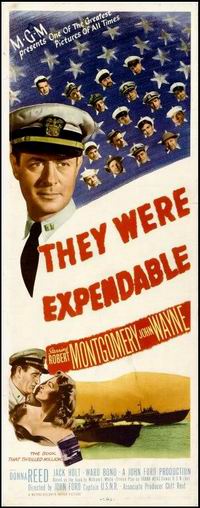
In December of 1941, Lt. John Brickley (Robert Montgomery) commands a squadron of Navy PT boats, based in the Philippines.  Brickley is convinced that the small and agile PT Boats could be used in combat but his superior officers disagree, even after viewing a demonstration of what they can do.  Brickley’s second-in-command, Rusty (John Wayne), is frustrated and feels that he will never see combat.  That changes when the Japanese attack Pearl Harbor and then turn their attention to the Philippines.  Brickley gets his chance to show what the PT boats can do but both he and his men must also deal with the terrible risks that come with combat.  Brickley and his men have been set up to fight a losing battle, only hoping to slow down the inevitable Japanese onslaught, because both they and their boats are considered to be expendable.  The hot-headed Rusty learns humility when he’s sidelined by blood poisoning and he also falls in love with a nurse, Sandy (Donna Reed).  However, the war doesn’t care about love or any other plans that its participants may have.  With the invasion of the Philippines inevitable, it just becomes a question of who will be sent with MacArthur to Australia and who will remain behind.

One of John Ford’s best films, They Were Expendable is a tribute to the U.S. Navy and also a realistic look at the realities of combat.  The movie features Ford’s trademark sentimentality and moments of humors but it also doesn’t deny that most of the characters who are left behind at the end of the movie will not survive the Japanese invasion.  Even “Dad’ Knowland (Russell Simpson), the fatherly owner of a local shipyard who does repair work on the PT boats, knows that he’s expendable.  He resolves to meet his fate with a rifle in hand and a jug of whiskey at his feet.  Rusty, who starts out thirty for combat, comes to learn the truth about war.  Ford was one of the many Hollywood directors who was recruited to film documentaries during World War II and he brings a documentarian’s touch to the scenes of combat.

Robert Montgomery had previously volunteered in France and the United Kingdom, fighting the Axis Powers before America officially entered the war.  After the war began, he entered the Navy and he was a lieutenant commander when he appeared in They Were Expendable.  Montgomery brought a hardened authenticity to the role of Brickley.  (Montgomery also reportedly directed a few scenes when Ford was sidelined with a broken leg.)  John Wayne is equally good in the role of the hot-headed Rusty, who learns the truth about combat and what it means to be expendable.  The cast is full of familiar faces, many of whom were members of the John Ford stock company.  Keep an eye out for Ward Bond, Cameron Mitchell, Leon Ames, Jack Holt, and Donald Curtis.

They Were Expendable is one of the best of the World War II movies.  It’s a worthy film for Memorial Day and any other day.

Lisa Reviews An Oscar Nominee: Spellbound (dir by Alfred Hitchcock)


The 1945 Best Picture nominee, Spellbound, tells the story of Dr. Constance Petersen (Ingrid Bergman), a psychoanalyst at a mental hospital in my least favorite state, Vermont.

Constance has fallen in love with a man (Gregory Peck) who she believes to be Dr. Anthony Edwardes, the newly appointed director of the hospital.  Dr. Edwardes is youngish and handsome and idealistic and authoritative …. well, he’s Gregory Peck.  However, he also has an intense phobia about seeing any set of parallel lines.  Curious to discover the reason for Edwardes’s phobia, Constance does a little digging on her own and discovers that Dr. Anthony Edwardes is not a doctor at all!  Instead, he’s a guilt-stricken amnesiac who is convinced that he murdered Dr. Edwardes and took his place!

Constance, however, doesn’t believe that the Amnesiac is a murderer.  She thinks that he is suffering from some sort of deep-rooted guilt that had led him to believe that killed the doctor.  She wants a chance to psychoanalyze him and discover the truth about his background.  Unfortunately, the police do think that the Amnesiac is a murderer and their determined to arrest him.

Constance and the Amnesiac go on the run, heading to the home of Constance’s mentor, Dr. Alexander Brulov (Michael Chekhov, the nephew of Anton Chekhov).  With Brulov’s help, Constance analyzes a dream that the Amensiac had, one involving curtains decorated with eyes, the faceless proprietor of a casino, and a man falling off a mountain.  Can Constance and Brulov solve the mystery of the Amnesiac’s identity before the police take him away to prison?

Spellbound was the last of the four Hitchcock best picture nominees and it was also the last film that Hitchcock made for producer David O. Selznick.  Selznick was quite a fan of psychoanalysis and he insisted that Hitchcock not only make a movie about it but that he also use Selznick’s own therapist as a technical advisor on the project.  Hitchcock, for his part, was able to bring in the surrealist Salvador Dali to help design the Amnesiac’s dream sequence but Selznick felt that the 20-minute sequence was too long and too weird and, as a result, it was cut down to two minutes for the final film.  All this considered, it’s not a surprise that, despite the fact that Spellbound was a hit with critics and audiences, Hitchcock himself didn’t care much for it and considered it to be more of a Selznick film than a Hitchcock film.  And it is true that the film’s total faith is psychoanalysis feels more like something one would expect to hear from a trendy producer than from a director like Hitchcock, who was known for both his dark wit and his rather cynical attitude towards anyone in authority.

For a film like Spellbound to truly work, there has to be some doubt about who the Amnesiac is.  For the suspense to work, the audience has to feel that there’s at least a chance, even if it’s only a slight one, that the Amnesiac actually could be a murderer, despite the attempts of Constance and Brulov to prove that he’s not.  And Spellbound is full of scenes that are meant to leave the audience wondering about whether or not the Amnesiac should be trusted.  However, because the Amnesiac is played by Gregory Peck, there’s really no doubt that he’s innocent.  Hitchcock was not particularly happy with Gregory Peck as his leading man.  Peck projected a solid, middle-American integrity.  It made him ideal for heroic and crusading roles but made him totally wrong for any role that required ambiguity.  It’s difficult to believe that the Amnesiac is suffering from a guilt complex because it’s difficult to believe that Gregory Peck has ever done anything for which he should feel guilty.  Cary Grant could have played the Amnesiac.  Post-war Jimmy Stewart could have done an excellent job with the role.  But Peck is just too upstanding and stolid for the role.  In a role that calls from neurosis, Peck is kind of boring.

That said, the rest of the cast is fine, with Ingrid Bergman giving one of her best performance as Constance and Michael Chekhov bringing some needed nuance to a role that could have turned into a cliché.  Leo G. Carroll has a small but pivotal role and he does a good job keeping the audience guessing as to his motivation.  Even at a truncated two minutes, the Dali dream sequence is memorably bizarre and the famous shot of a gun pointed straight at the camera still carries a kick.  This is a lesser Hitchcock film but, that said, it’s still a Hitchcock film and therefore worth viewing.

As I mentioned previously, this was the last of Hitchcock’s films to be nominated for Best Picture.  Ironically, his best films — Rear Window, Vertigo, and Psycho among them — were yet to come. Spellbound was nominated for six Oscars but only won for Miklos Rozsa’s score.  (Ingrid Bergman was nominated for Best Actress that year, not for her role in Spellbound but instead for The Bells of St. Mary’s.)  The big Oscar winner that year was Billy Wilder’s The Lost Weekend.

Horror On The Lens: Earth vs. The Flying Saucers (dir by Fred F. Sears)


For today’s horror on the lens, we’ve got a sci-fi shocked from 1956.

In Earth vs. The Flying Saucers …. well, the plot is right there in the title.  In a semi-documentary style, this film tells the story of what happens when a bunch of flying saucers come to Earth.  Unfortunately, the inhabitants of those flying saucers aren’t looking to open up a new trading route.  Instead, they want to enslave humanity and, as always, it falls to America to save the world.

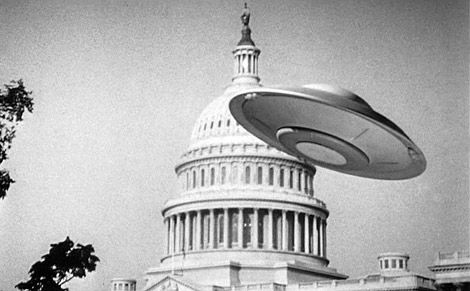
This film is probably best known for the scenes of the flying saucers crashing into monuments and buildings in Washington, D.C.  The special effects were done by Ray Harryhausen.

The film was originally black-and-white.  The version below is colorized.  I’m not a huge fan of colorization in general but I do have to say that they did a pretty good job with Earth vs. The Flying Saucers.  While the film may not be as deeply philosophical as Plan 9 From Outer Space, it’s still pretty enjoyable.

Keep watching the skies!

https://www.youtube.com/watch?v=J-JcWNK-0AE

Film Review: The Ten Commandments (dir by Cecil B. DeMille)


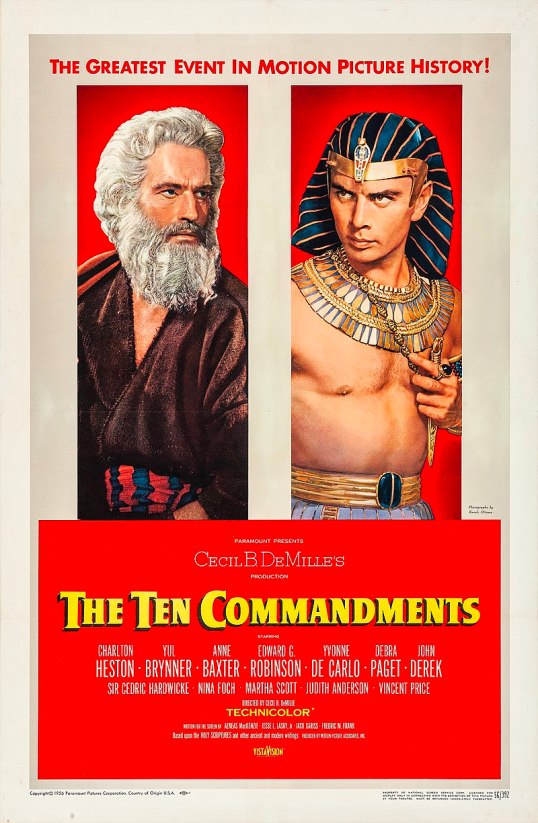
Though you may not know it if you’ve only seen the film during one of its annual showings on television, the 1956 religious epic, The Ten Commandments, originally opened with director Cecil B. DeMille standing on a stage.  Speaking directly to the audience, DeMille explains that, though the film they’re about to see me take some dramatic license with the story of Moses, it still based on not just the Bible but also the accounts of Philo, Josephus and Eusebius.  He also tells us that The Ten Commandments is more than just an adaptation of the Book of Exodus.  Instead, it’s a film about every man’s desire to be free.

Demille concludes with: “The story will take 3 hours and 29 minutes to unfold.  There will be an intermission. Thank you for your attention.”

To be honest, it’s kind of a sweet moment.  Cecil B. DeMille is a name that is so associated with (occasionally overblown) epic filmmaking that it’s easy to forget that DeMille was one of the most important names in the artistic development of American cinema.  He was there from the beginning and, unlike a lot of other filmmakers, he was equally successful in both the silent and the sound era.  Say what you will about his films, DeMille was a showman and he handles the introduction like a pro.  At the same time, there’s a real sincerity to DeMille’s tone.  After you listen to him, you’d almost feel guilty if you didn’t sit through all 3 hours and 29 minutes of his film.

That sincerity extends throughout the entire film.  Yes, The Ten Commandments is a big, long epic and some members of its all-star cast are more convincing in their roles than others.  And yes, the film can seem a bit campy to modern viewers.  (In fact, it wouldn’t surprise me if it seemed a bit campy to viewers in 1956 as well.)  Yes, The Ten Commandments does feature Anne Baxter saying, “Oh Moses!  You sweet adorable fool!”  But it doesn’t matter.  Even the most ludicrous of dialogue just seem right.  The film is just so sincere that it’s difficult not to enjoy it.

In the Book of Exodus, Moses is described as having a speech impediment and even tries to use it as an excuse to get out of going to Egypt.  That’s actually one of the reasons why Moses brought Aaron with him to Egypt, so that Aaron could speak for him.  In the movie, Moses is played by Charlton Heston, who comes across as if he’s never felt a moment of insecurity over the course of his entire life.  But no matter.  Heston may not by the Moses of Exodus but he’s the perfect Moses for the DeMille version.  When Heston says that Egypt will be visited by plagues until his adopted brother Ramses (Yul Brynner) agrees to allow the Jews to leave Egypt, you believe every word.  (Aaron, incidentally, is played by the legendary John Carradine.  He doesn’t get too much other than respectfully stand a few feet behind Charlton Heston but still: John Carradine!)

And really, anyone who dismisses The Ten Commandments out-of-hand should go back and, at the very least, watch the scene where the Angel of Death descends upon Egypt.  The scene where Moses and his family shelter in place while the screams of distraught mothers echo throughout the city is chilling.  Ramses may spend most of the film as a petulant villain but you almost feel sorry for him when you see him mourning over his dead son.  When he sets off after Moses, it’s not just because he’s doing what villains do.  He’s seeking vengeance for the loss of his first born.  For that brief moment, Ramses goes form being a melodramatic bad guy to being someone with whom the viewer can empathize.  Brynner, with his burning intensity, gives a great performance as Ramses.

As I said before, this film has what, in 1956, would have been considered an all-star cast.  Watching the names as they show up during the opening credits — Cedrick Hardwicke!  Yvonne DeCarlo!  Woody Strode!  Debra Paget! — is like stepping into a TCM fever dream.  Some of the performers give better performance than others.  And yet, even the worst performer feels as if they just naturally belong in the world that DeMille has created.  John Derek may seem rather smarmy as Joshua but his callowness provides a good contrast to the upright sincerity of Heston’s performance as Moses.  Edward G. Robinson’s cries of, “Where is your God now!?” may have provided endless fodder for impersonators but just try to imagine the film without him.  Even Vincent Price is in this thing!  He doesn’t have his famous mustache but, as soon as you hear his voice and see that famous glare, you know that it’s him.

Of course, when you’re growing up and The Ten Commandments is on TV every year, you mostly just want to see the scene where Moses parts the Red Sea.  The Ten Commandments was nominated for seven Oscars but it only won one, for its special effects.  (The prize for Best Picture went to another epic, Around The World In 80 Days.)  Today, the film’s special effects may no longer amaze viewers but there’s still something rather charming about the Red Sea parting and then crashing in on the Egyptian army.  The scene where the Earth opens up and swallows those who worshiped the Golden Calf remains impressive, if just because all of the extras really look terrified that they might die.  And while the Pillar of Fire may look a bit cartoonish to modern eyes, that’s a huge part of the film’s appeal.

The Ten Commandments is a big, long, sometimes silly, sometimes effective, and always entertaining epic.  It’s a grand spectacle and one that I usually watch every year when it shows up on television.  I missed this year’s showing but, fortunately, I own it on DVD.  It’s a sincere epic and a difficult one not to like.


Horror Film Review: The Amazing Mr. X (dir by Bernard Vorhaus)


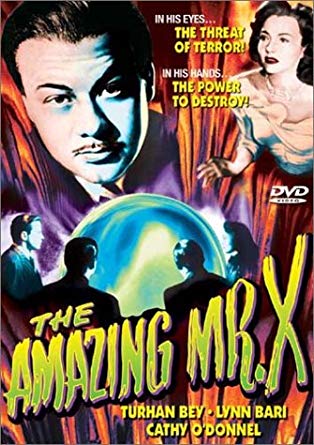
A woman named Christine (Lyn Bari) walks along the beach when she thinks that she hears the voice of her husband calling out her name.  The only problem is that her husband has been dead for two years.  Christine’s sister, Janet (Cathy O’Donnell), says that Christine is just hearing things and that she needs to move on from mourning.  After all, her boyfriend, Martin (Richard Carlson), is on the verge of asking Christine to marry him….

And yet, Christine can’t escape the feeling that her husband is trying to contact her from beyond the grave.  During another walk along the beach, she runs into a handsome man who introduces himself as being Alexis (Turhan Bey).  Alexis says that he’s a medium and that he has the power to speak to the dead.  Furthermore, he tells Christine that he can speak to her dead husband for her.

Despite the fact that Alexis owns a really impressive crystal ball, Martin is skeptical of his claims.  Martin even goes so far as to hire a private investigator (Harry Mendoza) to investigate Alexis’s past.  Meanwhile, though she has her suspicions, Janet finds herself falling in love with the charming Alexis….

Released in 1948, The Amazing Mr. X is an unjustly obscure little mystery film.  Though I guess it’s open to debate whether it should be considered a horror film or just a noirish thriller, The Amazing Mr. X is full of creepy atmosphere and eerie moments.  Employing expressionistic camera angles and dark lighting, director Bernard Vorhaus turns The Amazing Mr. X into a dream of dark and forbidden things.  Some of the black-and-white shots are simply stunning and the seance sequence is brilliantly done.

The film is also well-acted by a cast of actors who deserve to be better remembered.  Lynn Bari is perfectly fragile and sympathetic as the haunted Christine while Cathy O’Donnell turns the potentially boring Janet into a compelling character.  The film even makes good use of Richard Carlson’s reliable dullness by casting him as the one character who is meant to be a force of stability in Christine’s otherwise neurotic life.

That said, the entire film is stolen by Turhan Bey.  Born in Austria and of Turkish descent, Turhan Bey was nicknamed the “Turkish Delight” during his film career and, watching The Amazing Mr. X, you can see why.  Bey is so charming and so handsome that you can understand why even those who should know better would want to believe that Alexis could talk to the dead.  The Amazing Mr. X was one of the last films that Bey filmed in the United States.  He retired a few years later and returned to his native Austria, where he ran a cafe.  (40 years later, the now elderly Bey did come out of retirement and made a few appearance of television before passing away, at the age of 90, in 2012.)

Like all good mysteries, The Amazing Mr. X has a third act twist that you probably won’t see coming and it ends with the proper combination of tragedy and redemption.  The Amazing Mr. X is currently in the public domain and can be viewed on YouTube so check it out!  You won’t be sorry!