If you love classic movies, you’re going to love this trailer for the new Netflix documentary, Five Came Back!
Based on Mark Harris’s brilliant non-fiction book, Five Came Back takes a look at the work that five great directors — Frank Capra, William Wyler, John Huston, George Stevens, and John Ford — did during World War II. It’s a fascinating story and it was a fascinating book. I just hope this documentary does it justice.
We’ll find out on March 31st!
(Incidentally, Five Came Back is narrated by Meryl Streep so expect to see her nominated for Best Actress next year…)
I’m really late with this news but better late than never!
Last week, the Academy’s Documentary Branch announced the 15 semi-finalists for the Best Documentary Feature Oscar! Five of the films below will be nominated. This has been a brilliant year for documentaries, as you can tell from looking at the titles below!
I’m especially happy to see that The Witness — which can currently be seen on Netflix — made the shortlist.
Not making the list? Leonardo DiCaprio’s Before The Flood. If nothing else, this means that we no longer have to worry about sitting through another rambling, if well-intentioned, Leo lecture.
(Or maybe not. Leo is also involved with The Ivory Game, which is on the shortlist.)
Anyway, here are the 15 semi-finalists!
“Cameraperson,” Big Mouth Productions
“Command and Control,” American Experience Films/PBS
“The Eagle Huntress,” Stacey Reiss Productions, Kissiki Films and 19340 Productions
“Fire at Sea,” Stemal Entertainment
“Gleason,” Dear Rivers Productions, Exhibit A and IMG Films
“Hooligan Sparrow,” Little Horse Crossing the River
“I Am Not Your Negro,” Velvet Film
“The Ivory Game,” Terra Mater Film Studios and Vulcan Productions
“Life, Animated,” Motto Pictures and A&E IndieFilms
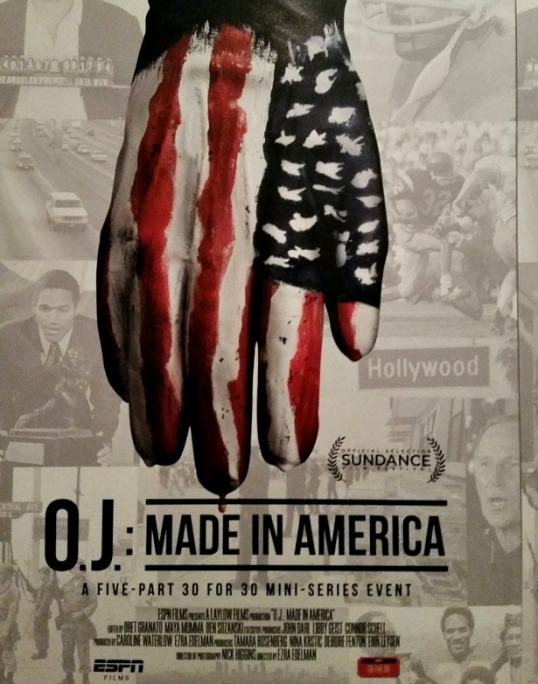
“O.J.: Made in America,” Laylow Films and ESPN Films
“13th,” Forward Movement
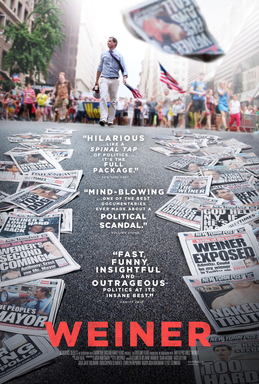
“Tower,” Go-Valley “Weiner,” Edgeline Films
“The Witness,” The Witnesses Film
“Zero Days,” Jigsaw Productions
Here’s what won at the International Documentary Association Awards! This has been a really good year for documentaries, as is evident from the list below!
Best Feature Award
“O.J.: Made in America”
Director: Ezra Edelman
Producers: Deirdre Fenton, Libby Geist, Nina Krstic, Erin Leyden, Tamara Rosenberg, Connor Schell and Caroline Waterlow
Best Short Award
“The White Helmets”
Director: Orlando von Einsiedel
Producer: Joanna Natasegara
Best Curated Series Award
“DR2 Dokumania”
Executive Producer: Mette Hoffmann Meyer
Best Limited Series Award
“Making a Murderer”
Executive Producers: Moira Demos and Laura Ricciardi
Best Episodic Series Award
“Last Chance U”
Executive Producers: Joe LaBracio, Dawn Ostroff, Lucas Smith, James Stern and Greg Whiteley
Best Short Form Series Award
“Field of Vision”
Executive Producers: Charlotte Cook, Laura Poitras and AJ Schnack
David L. Wolper Student Documentary Award
“4.1 Miles”
Director: Daphne Matziaraki (UC Berkeley Graduate School of Journalism)
ABC News VideoSource Award
“13TH”
Director: Ava DuVernay
Pare Lorentz Award
“Starless Dreams”
Director: Mehrdad Oskouei
Best Cinematography
“Fire at Sea”
Cinematography by: Gianfranco Rosi
Best Editing
“Cameraperson”
Edited by: Nels Bangerter
Best Writing
“I Am Not Your Negro”
James Baldwin material compiled and edited by Raoul Peck
Best Music
“The Bad Kids”
Original Score by: Jacaszek
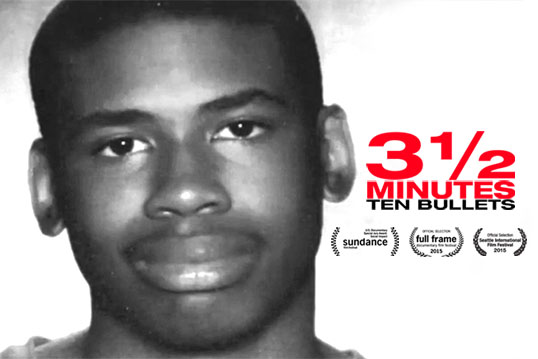
On November 23rd, 2012, an SUV pulled up to a gas station in Jacksonville, Florida. Inside the SUV were four teenage boys, all of whom were black. A car pulled up next to the SUV. Inside the car was a man and his girlfriend. They were both white.
The man was named Michael Dunn and reportedly, he was annoyed by the loud rap music that was being played in the SUV. He told his girlfriend that he hated “thug music.” He got out of his car and asked them to turn down the music. What happened next depends on who you ask. The driver of the SUV says that he turned down the music but then his friend, Jordan Davis, turned it back up. Michael Dunn claims that Jordan Davis opened a door and pointed something at him that looked like a shotgun.
What everyone agree on is that Dunn grabbed his own gun and proceeded to fire it into the SUV, killing Jordan Davis. Everyone also agrees that no shotgun was ever found in the SUV.
Michael Dunn was tried for the murder of Jordan Davis and the attempted murder of the other three teenagers. Dunn claimed he was acting in self-defense. He was “standing his ground.” Dunn’s first murder trial ended in a mistrial. His second trial ended with his conviction.
3 1/2 Minutes Ten Bullets was filmed during the two trials and it is infuriating. Though Michael Dunn was not interviewed for the film, we do hear recordings of some of the calls he made to his girlfriend while he was in prison and it is chilling to listen to him as he continues to insist that he did nothing wrong. Even when confronted by the fact that no shotgun was found in the SUV, Dunn continues to insist that the four teenagers had to have been armed. After all, he says, they were listening to “thug music!” If you had any doubt about the type of person Michael Dunn was before watching this documentary and hearing his voice, that doubt will be gone after watching 3 1/2 Minutes.
Even more importantly, 3 1/2 Minutes features extensive interviews with Jordan’s friends and family, all of whom express their sadness and anger with such articulation that it’s impossible not to get infuriated when Dunn and others casually dismisses them as being “thugs.”
3 1/2 Minutes is a powerful and moving documentary that should be seen by anyone who is interested in taking a serious look at race in America.
The Wolfpack (dir by Crystal Moselle)
I had mixed feelings about The Wolfpack.
On the one hand, The Wolfpack is a fascinating story about seven siblings who — after spending 14 years locked away in a New York apartment — finally start to enter the real world. Everything that the siblings know about the world, they learned through the movies. Inside the apartment, they obsessively recreate their favorite movies, with an elaborate production of Pulp Fiction being a definite highlight. When they go out into the real world, they do so dressed like the characters from Reservoir Dogs.
(Except, of course, for the one time that one of them goes out while dressed like Michael Myers from Halloween. That leads to some trouble with the authorities…)
Watching these brothers (and one sister) as they talked about their unconventional childhood and as they discovered what the world was like outside of their apartment, it was impossible for me not to be moved. I was touched by their love for each other and I related to their obsession with the movies. I hoped that they would survive in the outside world. I was happy for them but, at the same time, I was scared for them. I knew that their new opportunities would come with a certain loss of innocence.
At the same time, it frustrated me that less time was spent on the circumstances that led to them never leaving that apartment for 14 years. Or, perhaps, I should say that it angered me that they didn’t seem to be as angry as I was. The father was obviously mentally ill and, while it would be easy to just dismiss him as a monster, I couldn’t help but feel that the truth was perhaps a bit more complex.
The Wolfpack is a fascinating documentary and it’s currently available on Netflix!
Here are reviews of 6 documentaries that I saw in 2015:
Packed In A Trunk: The Lost Art of Edith Lake Wilkinson (dir by Michelle Boyaner)
In 1924, painter Edith Lake Wilkinson was committed to an insane asylum and lived the rest of her life in sad obscurity. As a result of Edith’s commitment, her artwork never received the recognition it deserved. That’s the idea behind this documentary, which follows Edith’s great-great niece as she researches Edith’s life and tries to get the art world to acknowledge Edith’s talent. As an art history major, I really wanted to like this documentary but, unfortunately, it focused more on the self-important niece than on the artwork. Matters were not helped by a lengthy visit with a psychic who claimed to have “contacted” Edith’s spirit. For the most part, this was a missed opportunity.
Requiem for the Dead: American Spring 2014
This film takes a look at the hundreds of people who were murdered by someone using a gun during the Spring of 2014. Some of the cases are examined in detail while other victims only appear for a second or two, quickly replaced by another tragedy. The cases are recreated through 911 calls, news reports, and occasionally interviews. It makes for sobering and sad viewing though, at the same time, it works better an indictment of our sick culture than as a call for greater gun control.
Southern Rites (dir by Gillian Laub)
Photographer Gillian Laub comes down to Montgomery County, Georgia, in order to take pictures of the town’s first integrated prom. She sticks around to film the trial of an old white man who shot and killed a young black man. The film has good intentions and it’s obvious that Laub is convinced that she has something important to say that hasn’t been said before but, especially when compared to the superior and thematically similar 3 1/2 Minutes, it quickly becomes obvious that neither she nor the film can offer up any new insight as far as racism in America is concerned.
A Symphony of Summits: The Alps From Above (dir by Peter Bardehle and Sebastian Lindemann)
A Symphony of Summits, which is currently available on Netflix, is basically 94 minutes of aerial footage of the Alps. A Symphony of Summits was originally made for German television and the English-language narration track has a blandly cheerful, touristy feel to it that often doesn’t go along with the imposing images and the occasionally bloody events being discussed. (The history of the Alps is not necessarily a peaceful one.) My advise would be to turn down the sound, put on your favorite music, and just enjoy the beauty of the images.
Thought Crimes: The Case of the Cannibal Cop (dir by Erin Lee Carr)
Thought Crimes tells the story of Gilberto Valle, a New York Cop who, in 2013, was convicted, on the basis of comments that he made online about plotting to kidnap and eat a woman. Valle claimed that he was just sharing a fantasy and that he had no intention of following through. Eventually, a judge agreed with him and his conviction was overturned. This disturbing and creepy documentary features extensive interviews with Vallee (who literally made my skin crawl) and examines some of the darkest corners of the internet. Many times in the documentary, Vallee claimed that he would never actually hurt anyone and I didn’t believe him for a second. (As a cop, Vallee accessed the police database to look up info on a woman he was fantasizing about abducting and cannibalizing.) That said, Thought Crimes still raised some interesting issues about the internet as an outlet for fantasy and how seriously we should take it as an indicator for real world actions. There are no easy answers.
The Thread (dir by Greg Barker)
The Thread is a 61 minute documentary about the Boston Marathon Bombing and how a group of wannabe detectives used Reddit and twitter to wrongly accuse a missing graduate student of being one of the bombers. It’s interesting and occasionally cringe-inducing viewing experience, even if it really doesn’t offer up much original insight. (Documentarians are always quicker to bemoan the rise of new media than to seriously investigate why old media collapsed in the first place.) Among those interviewed about the rush to find a suspect is Sasha Stone, the founder and editor of AwardsDaily and yes, she is just as annoying and smugly self-important as you would expect. (Thankfully, they did not interview Ryan Adams.)
I’m a little late in sharing this (well, about three days) but things have been a little bit busy around these parts. The nominees for the International Documentary Association’s awards were announced a few days ago. You can view the full list here.
For the purposes of those of us who are obsessed with trying to predict all the Oscar nominees, our main concern is with the 6 movies that were nominated for the Best Feature Award. Best Documentary Feature is, traditionally, one of the most difficult categories to predict. Every little bit of info helps. All 6 of the movies listed below have also been included on the list of the 124 documentaries that have been deemed to be Oscar-eligible this year.
Best Feature Award Amy, The Black Panthers: Vanguard of the Revolution, Listen to Me Marlon, The Look of Silence, The Russian Woodpecker, What Happened, Miss Simone?
Despite making an effort to see more documentaries this year, Amy is the only one of the above nominees that I’ve actually watched. It definitely deserves to be nominated.
One final question: though Going Clear was not nominated by the IDA, it is Oscar-eligible. If Going Clear did somehow get an Oscar nomination, would Tom Cruise and John Travolta still show up for the ceremony?
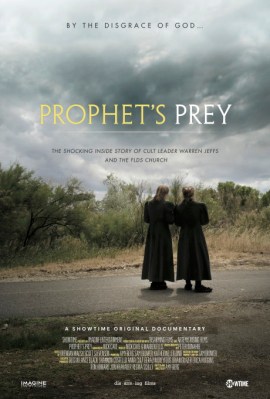
I just finished watching the documentary Prophet’s Prey and I have to say that it’s one of the creepiest things that I’ve ever seen in my life. As our regular readers know, I love horror movies but, in many ways, Prophet’s Prey is scarier than even the most effective horror film. Prophet’s Prey is frightening because it’s true.
Prophet’s Prey is about the secretive Fundamentalist Church of Jesus Christ of Latter Day Saints (FLDS), a group that is best known for its practice of polygamy. The Presidents of the FLDS, Warren Jeffs, has been convicted of two counts of child sexual assault and is currently serving a life sentence. This documentary suggests that Warren Jeffs (who is estimated to have close to 70 wives) is still controlling the FLDS from behind bars.
Warren Jeffs’s voice is heard throughout the film. He recorded his sermons, the majority of which appeared to be about the importance of obeying his authority, and we hear excerpts of them throughout the film. What’s especially striking is that Warren Jeffs does not sound the way that we would expect him to. After hearing about how powerful he is and how the members of the FLDS continue to defend and follow him, we expect to hear a voice full of charisma and insidious power. Instead, the sermons are delivered in a flat monotone and the utter banality of his voice makes them all the more creepy. It’s the same monotone that we hear when a tape is played of Jeffs praying and then having sex with a 12 year-old that he’s just married.
We also hear a few excerpts of Warren Jeffs at his arraignment. His response to nearly every question is to softly reply, “Fifth amendment.” Even when asked if he has any remorse about his crimes, he replies, “Fifth amendment.”
We also see footage of Warren Jeffs in jail. We watches as he wanders around his tiny cell and occasionally tries to get some sleep. And again, the thing that strikes us is how ordinary and boring he looks. If you ever needed proof of the banality of evil, Warren Jeffs would appear to be that proof.
How, we wonder, did this seemingly dull and uncharismatic man become one of the biggest (and, some would say, most dangerous) cult leaders in America?
The film searches for an answer and suggests that Warren Jeffs’s power over his followers has less to do with Warren and more to do with the culture in which they were raised. The film’s best moments come when the filmmakers drive through the twin towns of Colorado City, Arizona and Hilldale, Utah. These towns served as the headquarters of the FLDS. Cameras line the roads, keeping track of strangers driving past the modest and identical houses. The people who live in town watch the cars pass with unsmiling expressions. Soon, the camera crew realize that they are being followed by another car. At one point, a member of Jeffs’s security force pulls them over and asks what they’re done before taking their pictures. With mountains rising high in the background and the blue sky seeming to go on forever, Colorado City and Hilldale seem like the most isolated places in the world.
Because it covers so much material and comes to so many disturbing conclusions, Prophet’s Prey can be an exhausting film. Along with detailing the life and crimes of Warren Jeffs, the film also details the larger history and culture of the FLDS. It makes for fascinating and disturbing history and it all ends with the ominous reminder that Warren Jeffs is still leading his group from prison.
Pair Prophet’s Prey with Going Clear for an anti-cult double feature.
I think Lisa Marie and I could spend hundreds of hours just talking about history. While I love history in general, I do admit that military history has been a particular fascination of mine. Some would say that I’m just being bloodthirsty. That I’m reveling in the worst aspects of humanity. I would strongly disagree with that opinion.
Military history is not just about rehashing the cold facts and figures of battles, wars and conflict. It’s a type of history that gives people a window to the past. A past we could learn from so as not to repeat the same mistakes in the future. It’s not even the death and destruction shown through historical writing by aficionados and academia.
With PBS re-airing Ken Burns’ The Civil War this week we get to witness one of the great triumphs in filmmaking 25 years after it first aired in 1990. It’s a documentary that gives us an everyman’s look at the cause, effect and consequence of the bloodiest war in American history. A war that would shape the American consciousness for generations to come. It was also a war that pit brother against brother, fathers against sons and lifelong friends against each other as battlefields across the states and territories of the United States flowed with the blood of Americans.
One of the great things about this documentary series is how it doesn’t just rely on the facts and figures of this historical event in American history, but the personal voices of individuals who participated in the war and it’s periphery. These voices (as narrated by stars such as Morgan Freeman, Sam Waterston, Jason Robards, Julie Harris, Arthur Miller and George Plimpton to name a few) adds an poignant and personal touch to what could’ve been a very dry and academic exercise.
One of the best scenes in the series arrives at the end of the first day of five for the series. It’s a letter from one Union officer Sullivan Ballou to his wife a week before he participates in the war’s first major engagement, the First Battle of Bull Run.
Sullivan Ballou’s Letter
July the 14th, 1861
Washington D.C.
My very dear Sarah:
The indications are very strong that we shall move in a few days—perhaps tomorrow. Lest I should not be able to write you again, I feel impelled to write lines that may fall under your eye when I shall be no more.
Our movement may be one of a few days duration and full of pleasure—and it may be one of severe conflict and death to me. Not my will, but thine O God, be done. If it is necessary that I should fall on the battlefield for my country, I am ready. I have no misgivings about, or lack of confidence in, the cause in which I am engaged, and my courage does not halt or falter. I know how strongly American Civilization now leans upon the triumph of the Government, and how great a debt we owe to those who went before us through the blood and suffering of the Revolution. And I am willing—perfectly willing—to lay down all my joys in this life, to help maintain this Government, and to pay that debt.
But, my dear wife, when I know that with my own joys I lay down nearly all of yours, and replace them in this life with cares and sorrows—when, after having eaten for long years the bitter fruit of orphanage myself, I must offer it as their only sustenance to my dear little children—is it weak or dishonorable, while the banner of my purpose floats calmly and proudly in the breeze, that my unbounded love for you, my darling wife and children, should struggle in fierce, though useless, contest with my love of country?
I cannot describe to you my feelings on this calm summer night, when two thousand men are sleeping around me, many of them enjoying the last, perhaps, before that of death—and I, suspicious that Death is creeping behind me with his fatal dart, am communing with God, my country, and thee.
I have sought most closely and diligently, and often in my breast, for a wrong motive in thus hazarding the happiness of those I loved and I could not find one. A pure love of my country and of the principles have often advocated before the people and “the name of honor that I love more than I fear death” have called upon me, and I have obeyed.
Sarah, my love for you is deathless, it seems to bind me to you with mighty cables that nothing but Omnipotence could break; and yet my love of Country comes over me like a strong wind and bears me irresistibly on with all these chains to the battlefield.
The memories of the blissful moments I have spent with you come creeping over me, and I feel most gratified to God and to you that I have enjoyed them so long. And hard it is for me to give them up and burn to ashes the hopes of future years, when God willing, we might still have lived and loved together and seen our sons grow up to honorable manhood around us. I have, I know, but few and small claims upon Divine Providence, but something whispers to me—perhaps it is the wafted prayer of my little Edgar—that I shall return to my loved ones unharmed. If I do not, my dear Sarah, never forget how much I love you, and when my last breath escapes me on the battlefield, it will whisper your name.
Forgive my many faults, and the many pains I have caused you. How thoughtless and foolish I have often been! How gladly would I wash out with my tears every little spot upon your happiness, and struggle with all the misfortune of this world, to shield you and my children from harm. But I cannot. I must watch you from the spirit land and hover near you, while you buffet the storms with your precious little freight, and wait with sad patience till we meet to part no more.
But, O Sarah! If the dead can come back to this earth and flit unseen around those they loved, I shall always be near you; in the garish day and in the darkest night—amidst your happiest scenes and gloomiest hours—always, always; and if there be a soft breeze upon your cheek, it shall be my breath; or the cool air fans your throbbing temple, it shall be my spirit passing by.
Sarah, do not mourn me dead; think I am gone and wait for thee, for we shall meet again.
As for my little boys, they will grow as I have done, and never know a father’s love and care. Little Willie is too young to remember me long, and my blue-eyed Edgar will keep my frolics with him among the dimmest memories of his childhood. Sarah, I have unlimited confidence in your maternal care and your development of their characters. Tell my two mothers his and hers I call God’s blessing upon them. O Sarah, I wait for you there! Come to me, and lead thither my children.
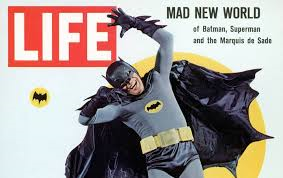
Holy high camp! STARRING ADAM WEST is a fun documentary about the quest to get a star on the Hollywood Walk of Fame for 60s TV star Adam BATMAN West. The film also serves as a biography of the cult actor, from his humble beginnings as a child in Walla Walla, Washington to his rise as TV’s biggest star of the mid-60s, and his fall after being typecast as the Caped Crusader reduced to performing in crappy car shows and carnivals. West later resurrected his career as an ironic icon in the 90s and still does voice work today, notably on the animated FAMILY GUY. Through all the ups and downs, the star has retained both his sense of humor and love of family. An entertaining look at a down to earth guy in the what-have-you-done-for-me-lately world of show biz, STARRING ADAM WEST is playing all this month on Showtime.
Austin to Boston is a documentary about a group of mostly British folk musicians who, in 2012, toured the United States. The group included a few familiar names (Ben Lovett of Mumford and Sons, for example) and several up-and-comers (Ben Howard, The Staves). Traveling across America in five VW campers, the bands went from Austin to Boston in two weeks. Along the way, they stopped and played at everywhere from Nashville to Woodstock. The documentary, which is narrated in a memorably grizzled fashion by driver Gill Landry, follows them as they discover America, deal with shows that are both good and bad, and, most of all, make music. Make no mistake, this is a musical documentary. While the musicians do occasionally talk about their lives, for the most part, we get to know them through their music.
I have to admit that I was a little bit surprised by how much I enjoyed Austin to Boston. My taste in music tends to run the gamut from EDM to more EDM so, to be perfectly honest, spending 70 minutes watching a bunch of folk acts should have been pure misery for me. (Someday, I’m going to write an article about the Tyranny of Acoustic Harmonizing.) But, even if it wasn’t my type of music, I could still appreciate that the musicians traveling from Austin to Boston were damn talented and had beautiful voices. Could I have done without that gospel song that seemed to go on forever? I certainly could have. But, if that’s your type music, you’ll probably really enjoy hearing it because it’s being performed by some seriously talented people.
And even if it isn’t your type of music, Austin to Boston is such an intensely likable documentary that it really doesn’t matter. There’s something really sweet and special about watching these British musicians discover and, to a certain extent, fall in love with America. And, speaking as an American, Austin to Boston made me better appreciate my frustrating home country as well. Over the course of this short but achingly sincere film, we get to see a lot of American scenery and it reminds us of just how beautiful it all can be. When you live here, you tend to take it for granted and sometimes, I think it’s good to take another look through non-native eyes.
Did Austin to Boston awaken any sort of dormant love that I may have for folk music? No, it did not. To a certain extent, I wish it had because it really is such a heartfelt documentary. But, in the end, The Staves all have beautiful voices but it’s just not my type of music. But it did make me better appreciate both my home country and the way that music — regardless of style or genre — can bring us all together.
And you know what? If this is your type of music, you’ll freaking love this documentary. You’ll watch Austin to Boston and you’ll say, “What the Hell was that EDM-loving redhead talking about? THIS IS GREAT!”
Austin to Boston can currently be viewed on Netflix.