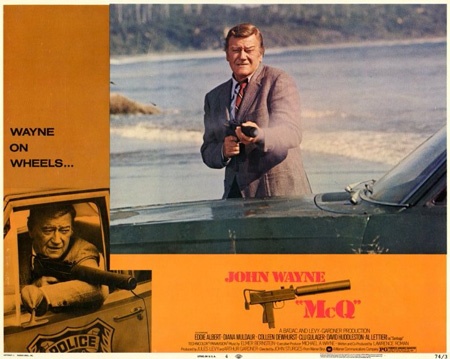
John Wayne didn’t get off his horse very often in the latter part of his career. The Duke hadn’t done a non-Western since 1969’s HELLFIGHTERS, but cop pictures were in style in the early 70s due to the success of movies like THE FRENCH CONNECTION and DIRTY HARRY. Wayne was actually offered the part of Dirty Harry Callahan and turned it down. But in 1974, Big John traded in his horse for a Pontiac Firebird in the action packed MCQ, directed by veteran John Sturges (GUNFIGHT AT THE OK CORRAL, THE MAGNIFICENT SEVEN, THE GREAT ESCAPE).
Wayne plays tough cop Lon McQ, who quits the force to investigate the murder of his former partner. He gets tangled up with drug dealers and corrupt officials, car chases and shootouts. Sound formulaic? It is, but the action scenes make up for a lame script. Duke basically plays the same character he did in most all his films, tough but tender, fair but firm. It’s kind of jarring to see Wayne in his (pretty bad) hairpiece instead of the usual cowboy hat, and tooling around the streets of Seattle in a muscle car rather than the dusty trail on his horse. He’s surrounded by a supporting cast full of familiar faces (Eddie Albert, Diana Muldaur, Colleen Dewhurst, Al Lettieri, David Huttleston, Clu Gulager), all of whom do their best with the clichéd script. MCQ plays like a TV movie of the week, which isn’t necessarily a bad thing, and fans of 70s action flicks will dig it.
John Wayne only made three more films after MCQ, including another cop movie, BRANNIGAN, and his swan song, 1976’s THE SHOOTIST, before succumbing to cancer in 1979. The Duke made much better movies then MCQ, but for a look at the star without his spurs and six-gun, it’s definitely worth watching.
(This post originally appeared, in slightly altered form, on the 2015 TCM Summer of the Stars Blogathon, hosted by Journeys in Classic Film)
Quite the extreme reversal from #4 to #5 but then my taste in music between junior high and high school was pretty much all over the place. I could be listening to the latest teeny bopper, LAtin-freestyle dance track one month then I’m picking up that hard rock or metal song that I knew my parents would never approve of (especially my mom).
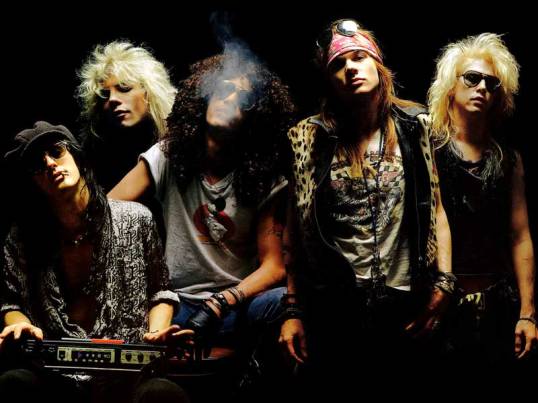
Guns N’ Roses’ “Welcome to the Jungle” was one such song though I was surprised that my Dad actually liked it as much as I did. My first memory of ever hearing “Welcome to the Jungle” was watching the latest and last Dirty Harry film with my dad. It was The Dead Pool and this song was used as a sort of soundtrack in the fake horror film in the film. I’m not sure if my dad liked the song because it was in a Dirty Harry flick or he just liked it because he grew up in the 60’s and 70’s listening to hard rock.
I don’t think my dad was too keen on the Guns N’ Roses look though. Even then he knew the hair metal, glam look was no bueno.
So, “Welcome to the Jungle” was my initial introduction to Guns N’ Roses and pretty much opened up my ears to a whole new spectrum of music. I never abandoned the R&B, dance pop and freestyle songs from junior high and even years later, but hard rock and metal soon joined the LP (and later CD) rotation.
Hi there! Today, I will be concluding my look at the Dirty Harry series with the final film in the franchise, 1988’s The Dead Pool.
Harry’s back and he’s still carrying a gun. He’s also older, wrinklier, grouchier, and suddenly famous because he’s just given testimony in a mob boss’s trial. You would think that Harry would already be famous seeing as how he not only killed the Scorpio Killer but he also rescured the Mayor from all those communists. But, I guess that’s what Harry gets for living in the same city that’s been sending Nancy Pelosi to Congress for the last 100 years.
Harry and his new partner (Evan C. Kim) are assigned to investigate the death of rock star Johnny Squares (Jim Carrey). Harry immediately suspects that the murderer was pretentious film director Peter Swan (Liam Neeson). This is largely because Swan makes the type of horror films that inspire Harry to snarl with disdain. It also turns out that Swan has been playing a “dead pool” game and that the various celebrities on his list have been getting killed. And guess what? Harry’s name is also on that list…
The Dead Pool was the final Dirty Harry film and, in many ways, it also feels like the most generic. Whereas Dirty Harry actually had quite a lot on its mind and the first three sequels at least pretended to be concerned about something more than just mayhem, The Dead Pool is often content to be a rather cartoonish action film. With the exception of a rather witty car chase involving a remote-controlled toy car that’s been strapped with an explosive, the action scenes are predictable and Eastwood’s character could just as easily have been named Spinner Mason or Eli Goldworthy. There’s simply no huge reason for this film to be a Dirty Harry film, beyond the fact that it wouldn’t show up on AMC every few weeks if it wasn’t.
And yet, it’s impossible for me not to like The Dead Pool. Though the film might feel generic overall, there’s still the occasional moments that hint that the movie is actually a bit smarter than it might first appear to be. Considering that the film largely takes place on a movie set and features a film critic among its victims, it’s tempting to see The Dead Pool as being almost a spoof on both the Dirty Harry films themselves and the controversy that’s been generated by their violent content. It makes sense that Harry Callahan’s name would appear on Swan’s dead pool list because, after spending four films battling serial killers, fascists, communists, gangsters, white trash, and a countless amount of bank robbers, the only opponent left for Harry to face is his own reputation.
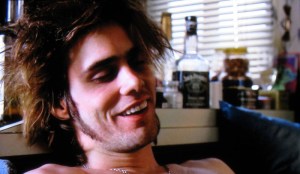
The Dead Pool has one of the more interesting casts of the Dirty Harry films. After dominating the previous films in the series,Clint Eastwood steps to the side and instead, allows his supporting cast to run off with the movie. It’s a little bit bizarre to see Jim Carrey playing a rock star (and even more bizarre to see him lip-synching to Welcome to Jungle) but that odd touch seems strangely appropriate for a film that doesn’t seem to be too concerned with much more than being entertaining. Evan C. Kim is one of Harry’s more likable partners and Liam Neeson, complete with pony tail and superior attitude, is a lot of fun to watch as he spoofs every single pretentious filmmaker that you’ve ever been unfortunate enough to have taken a film class with.
For a lot of reasons, The Dead Pool was the last of the Dirty Harry films. It was a box office disappointment and, even way back in 1988, Eastwood looked a just little bit old for an action hero. Eastwood has said that he has no interest in playing the character again and that’s probably for the best because, after five films, you have to wonder just what exactly was left for Harry to deal with. (That said, I’ve always thought of Gran Torino as being the unofficial sixth Dirty Harry film.)
Well, that concludes my look at the Dirty Harry film series and, not coincidentally, it also concludes the month of September as well! Starting tomorrow, along with all the other usual great stuff that you expect from us at the Shattered Lens, we’re going to be starting horror month!
Today, we continue our look at the Dirty Harry film series by considering the fourth installment in the franchise, 1983’s Sudden Impact.
“Go ahead. Make my day…”
Yes, this is the film where Police Inspector “Dirty” Harry Callahan (played, as always, by Clint Eastwood) delivers that classic one liner. In this case, he says it to a man holding a gun to a waitress’ head. The implication, I guess, is that the gunman would make Harry’s day by killing the innocent woman that he’s holding hostage and therefore, giving Harry an excuse to shoot him in the head. That line really does get to the heart of one of the main themes that runs through all of the Dirty Harry movies in general and Sudden Impact in specific. Harry’s life would be a lot of easier if people would simply stop getting in the way and just let him shoot anyone that he wants to.
At the start of Sudden Impact ,we discover that Harry Callahan is still on the San Francisco police force and Captain McKay (Bradford Dillman) is still his antagonistic boss. Eight years have passed since the end of the Enforcer and Harry is a bit grayer and definitely grumpier. Whereas the previous three films in the franchise made a (minimal) effort to humanize him, the Harry of Sudden Impact is a snarling, forehead vein-throbbing killing machine. After years of dealing with sleazy criminals and weak-willed liberals, Harry now appears to wake up each morning and ask himself, “How many people can I find an excuse to kill today?”
Not surprisingly, all those years of shooting people have apparently made Harry the most targeted man in San Francisco. Within the first 20 minutes of the film, three separate and unconnected groups of criminals attempt to kill Harry. His superiors demand that Harry take a vacation before the entire city of San Francisco is destroyed. Harry snarls in response so his bosses do the next best thing and order him to go to the coastal town of San Paulo to help with an unsolved murder.
San Paulo has a problem. Local lowlifes are turning up dead, shot once in the head and once in the genitals. Along with the gruesome way that they die, all of them seem to be acquainted with a frightening woman named Rae (played by Audrey J. Neenan). The chief of police (Pat Hingle) doesn’t seem to be trying too hard to solve the crimes and he openly resents Harry’s attempts to help. (He’s even less happy about the fact that the mobsters who were trying to kill Harry in San Francisco have followed him out to San Paulo.) Harry, however, is determined to solve the crime even while dealing with the unwanted gift of a rather ugly bulldog (given to him by his latest partner, who is played by series regular Albert Poppwell) and romancing an artist (a rather unconvincing Sondra Locke) who has some very strong thoughts of her own on both the sorry state of the criminal justice system and what should be done to improve it.
Sudden Impact was the only one of the Dirty Harry films to officially be directed by Clint Eastwood. Even if his name wasn’t listed in the opening credits, you would probably be able to guess that Eastwood directed this. From the film’s opening nighttime scene, during which time the screen is almost totally black except for the occasional flash of a gun being aimed, the film features Eastwood’s signature noir-influenced visual style but it doesn’t contain any of the thematic ambiguity that typifies Eastwood’s better films.
Sudden Impact is an entertaining and well-made action film but it’s also my least favorite of the Dirty Harry series. Whereas the first three installments at least tried to play around with figuring out what made Harry tick (and, occasionally, even allowing Harry’s methods to be questioned by sympathetic characters like Chico in Dirty Harry or Kate Moore in The Enforcer), Sudden Impact is content to just to let Harry kill some of the most cardboard villains in the franchise’s history. The end results are crudely effective but ultimately rather forgettable, with none of the eccentric touches that occasionally distinguished the next film in the series, The Dead Pool. There’s a reason why Sudden Impact is best remembered for a one-liner that’s uttered during the film’s first 10 minutes and which doesn’t really have anything to do with anything else that happens in the movie.
Speaking of The Dead Pool, that’s the film we will be looking at tomorrow as we conclude this series on the Dirty Harry franchise.
Today, we continue our look at the Dirty Harry film series by reviewing the third film in the series, 1976’s The Enforcer.
There’s a moment, towards the end of this film, where Harry (played as always by Clint Eastwood) is preparing to blow away one of the bad guys. Before firing, Harry mutters something under his breath. The first time I watched the film, I couldn’t make out what Harry was saying so I turned on the captioning and watched the scene again to discover just what exactly Harry had said before dispensing justice.
The line: “You fucking fruit.”
Yes, The Enforcer finds Harry at his most reactionary and it’s a good thing too. Whereas Magnum Force found Harry fighting his fellow cops, The Enforcer could have just as easily been called Harry Vs. Occupy San Francisco. This time around, the bad guys are members of something called The People’s Revolutionary Strike Force. They’re led by a psychotic ex-pimp named Bobby Maxwell (played by an actor with the wonderful name of Deveren Bookwalter) and they’re fond of saying things like, “For the people!” before striking. To be honest, The Enforcer’s villains are some of the most forgettable in the history of the franchise but that’s appropriate. As opposed to the original Dirty Harry and Magnum Force, The Enforcer is less concerned with being a struggle between equals and more about Harry killing people.
The Enforcer opens with Harry preventing yet another armed robbery. This time, he manages to destroy the entire store while doing so and ends up costing the city of San Francisco several million dollars. Harry’s new superior, Capt. McKay (played by Bradford Dillman) isn’t amused and, as a punishment, temporarily transfers Harry over to the Personnel Department. I have to say that McKay is a very brave man since Harry blew up the last superior who attempted to reprimand him.
Working Personnel, Harry has to sit in on interviews for promotions. While doing so, he is informed that the Mayor has ordered them to find three women to promote to inspector. “Women!?” Harry growls in shocked response.
While Harry is busy attempting to impede the march of progress, his old partner DiGiorgio (John Mitchum) stumbles upon Bobby and the revolutionaries stealing weapons. As often happens with Harry’s partners, DiGiorgio is killed by the bad guys and Harry is transferred back to Homicide so he can investigate the death. Helping Harry out is his new partner — Kate Moore (Tyne Daly), one of the three women who have recently been promoted to inspector.
While Harry and his new partner are busy tracking down Bobby, Capt. McKay tries to pin the crime on yet another revolutionary force, a group of black militants led by Big Ed Mustapha.
Big Ed is played by Albert Poppwell, who previously appeared in Dirty Harry as the “I’s got to know” robber. When Harry first meets him, Harry says, “Haven’t I met you before?” Though the film never explicitly says so, I like to think that the two characters are one in the same.
As for Bobby and the People’s Revolutionary Strike Force, they’re busy kidnapping the mayor and demanding $5,000,000 for his release. Of course, it’s up to Harry and Moore to rescue the mayor and put all the “fucking fruits” back in their place….
Looking over other reviews of the Dirty Harry franchise, The Enforcer often seems to be dismissed as almost an afterthought. Daly’s performance is usually praised (and quite rightfully so because she does give the film’s best performance) but the rest of the film is usually dismissed. To a certain extent, that’s understandable. As I mentioned before, Bobby Maxwell is not that interesting of a villain and Harry is at his most one dimensional here.
That said, I think The Enforcer is actually underrated. There might not be much nuance to Eastwood’s performance here but he gets by on charisma alone and he has a likable chemistry with Daly. As opposed to what we’ve been conditioned to expect from most other films, Harry and Moore’s relationship never turns romantic. Instead, by the end of the film, they truly are equals.
The Enforcer was followed, nearly a decade later, by Sudden Impact. We’ll take a look at that film tomorrow.
Today, we continue our look at the Dirty Harry film franchise by taking a look at the second film in the series, 1973’s Magnum Force.
Despite the fact that Dirty Harry famously ended with Harry Callahan throwing away his badge in disgust, Magnum Force reveals that Callahan (played again by Clint Eastwood) is still a member of the San Francisco Police Department. He’s got a new partner (Felton Perry, a likable actor in a thankless role) but he’s still butting heads with his superiors at the department. He’s also still got a way with the one-liners. When Lt. Briggs (Hal Holbrook) brags that he never once had to draw his gun while he was in uniform, Callahan replies, “A man’s got to know his limitations.”
While Callahan is busying himself with doing things like gunning down robbers and preventing an attempt to hijack a plane, a group of motorcycle cops are gunning down the town’s criminals. They begin by killing a mobster who has just beaten a murder charge on a technicality but soon, they’re gunning down anyone who has ever so much as been suspected of committing a crime. Alone among the detectives investigating the murders, Callahan believes that the killers are cops and, even worse, he suspects that his old friend Charlie McCoy (played by Mitchell Ryan) might be a member of the group…
Though it suffers when compared to Dirty Harry, Magnum Force is still an exciting and effective action film that is clearly a product of the same period of time that gave us such classics of paranoid cinema as The Parallax View and Three Days of the Condor. Whereas Dirty Harry took an almost documentary approach to capturing life and death in San Francisco, Magnum Force is a film that is full of dark shadows and expressionistic angles.
In Dirty Harry, the Scorpio Killer was both an obvious outsider and an obvious force of destruction. The film’s dramatic tension came from the fact that he was so clearly guilty and yet nothing could be done to stop him. The villains in Magnum Force are the exact opposite of Scorpio. As chillingly played by David Soul, Robert Urich, Tim Matheson, and Kip Niven, the killer cops are distinguished not by their otherness but by their total lack of individuality.
In the film’s best scene, they confront Harry in a parking garage and basically tell him that he’s either with them or against him. Sitting on their motorcycles, wearing their leather jackets, and with their grim faces hidden behind their aviator sunglasses, these cops are the ultimate representation of faceless fascism. After listening to their excuses, Harry asks if they consider themselves to be heroes.
“All of our heroes are dead,” one of them replies, delivering the film’s best line.
Obviously, Magnum Force was made to be an answer to those critics who claimed that Dirty Harry was a fascist film and it is a bit jarring, at first, to see Harry “defending” the system. (“I hate the goddamn system but until something better comes along…”) When Harry tells the killer cops, “I’m afraid you’ve misjudged me,” it’s not hard to see that this is the same message that Eastwood meant to give his critics.
However, what makes the killer cops in Magnum Force such interesting villains is that they are, ultimately, tools of the system that they’re attempting to destroy. By killing off criminals as opposed to arresting them and putting them on trial, the killer cops are minimizing the risk of the flaws inherent in the system being exposed. Hence, by defending the system, Harry is helping to expose and destroy it.
When I told Jeff that I was planning on watching and reviewing all of the Dirty Harry films, he suggested that I watch them in reverse-order. His logic was that, since the films tended to get worse as the series progressed, watching them backwards would allow me to end my project on a happy note as opposed to a note of bitter disappointment. I took his advice and I’m glad I did. While I disagree with him about whether or not The Dead Pool is a better film than Sudden Impact, I do have to agree that the first two Dirty Harry films are dramatically better (and quite different in tone) from the ones that subsequently followed.
Tomorrow, we’ll look at the third film in the series, 1976’s The Enforcer.
“Dirty Harry is obviously just a genre film but this action genre has always had fascist potential and it has finally surfaced…Dirty Harry is a deeply immoral movie.” — Pauline Kael
“It’s not about a man who stands for violence. It’s about a man who can’t understand society tolerating violence.” — Clint Eastwood
I decided that I wanted to review the Dirty Harry film franchise about two seconds after Clint Eastwood finished giving his speech at the Republican National Convention last month.
It had nothing to do with the politics of Eastwood’s speech because, quite frankly, I think a good film is a work of art and art is always more important than politics. Instead, as I watched Eastwood give his speech, I was reminded that Clint Eastwood is about as close to a living icon as we have in America. There aren’t many actors who could get away with giving a speech to an empty chair and, despite the predictable outraged tweets from Roger Ebert, Eastwood is one of them. And, if Eastwood is an icon, Harry Callahan is perhaps the most iconic role of his career.
Now, I have to admit that, as I started this project, I knew more about Harry Callahan as a character than I did about the films he had actually appeared in. I had seen both Dirty Harry and The Dead Pool because, for whatever reason, they both seem to turn up on AMC every other week. I knew that Harry Callahan was a police inspector who was based in San Francisco. I knew that he was willing to go to extremes when it came to fighting criminals. I knew that, in his first film appearance, Harry had a really impressive head of hair that had pretty much vanished by the time that he reached his final appearance in The Dead Pool. And, finally, I knew that, at some point in the film series, Harry growled the line, “Go ahead, make my day.”
So, for me, reviewing every film in the Dirty Harry franchise gave me a chance to discover why Harry has become such an iconic character and why people still ask Eastwood to repeat that “make my day” line. When I started watching the films, Jeff warned me that the Dirty Harry films got worse as you went along and I discovered that, in many ways, he was right. But I still enjoyed the experience and I hope that you enjoy reading my reviews over the next few days.
But, first things first. Let’s take a look at the film that started the entire series, 1971’s Dirty Harry.
I have to admit that it’s a bit intimidating to try to review Dirty Harry because, quite frankly, what’s left to be said about this film? It’s one of the most influential movies of all time. Any time you see a cop in a TV show or a movie getting yelled at by his superiors for not going “by the book,” it means that you’re watching a movie or an episode that is directly descended from Dirty Harry. And yet, despite all the imitations, it’s a movie that remains as exciting and visceral today as when it was first released.
Dirty Harry tells the story of two outsiders, two men who seem to exist solely to reveal the dark impulses of conventional society. Both of these men are killers and both of these men are motivated by a rage against what they perceive society as being.
One of these men calls himself Scorpio. As played by Andy Robinson (who gives one of the definitive cinematic psycho performances here), Scorpio is a jittery mass of nerves, an unkempt man who wears a peace sign as a belt buckle but who also writes letters to the Mayor of San Francisco (played by John Vernon) in which he threatens to kill one innocent person a day unless he’s paid off. When he first appears, he’s on a rooftop, aiming a rifle at an unaware woman in a swimming pool. At one point, the phallic barrel of rifle seems to be pointed directly at the camera (and by extension, at us in the audience). When he fires the rifle, we see the mortally wounded woman silently sink under the water. It’s a scene that still disturbs me every time I see it, one that establishes early on that we’re all potentially vulnerable to the Scorpios of the world.
In the next scene, we see San Francisco Police Inspector Harry Callahan (Clint Eastwood, of course) investigating the crime scene. The difference between Harry and Scorpio is striking. Whereas Scorpio is only calm while killing, Callahan inspects the crime scene (and goes through almost the entire film) without showing a hint of emotion. While Scorpio looks like a madman, Callahan looks like a professional. And yet, when Callahan foils a bank robbery (and delivers his famous “Do you feel lucky?” monologue to wounded bank robber played by Albert Popwell), it becomes obvious that he does have something in common with Scorpio. They’re both willing to shoot to kill. The only difference is that, as a police officer, Callahan is ostracized for his willingness to kill while Scorpio, as an American citizen, is protected by the U.S. Constitution.
It would be foolish to pretend that Dirty Harry isn’t a political film. One need only watch the scene where a law professor explains to Harry why his pursuit and arrest of Scorpio violated Scorpio’s constitutional rights. (The way that Eastwood snarls during this scene is priceless.) As one can tell from the quote from Pauline Kael at the beginning of this review, Dirty Harry was a film that upset a lot of liberals when it was first released (much as Clint Eastwood’s empty chair speech managed to upset Roger Ebert). However, as the years have passed, Dirty Harry has come to be acknowledged as a classic by critics on both sides of the political divide.
The success of Dirty Harry goes beyond politics. I think any film students who aspires to direct an action film should be required to watch Dirty Harry a few dozen times before he graduates. What makes the film work is not just what director Don Siegel does but what he doesn’t do. As opposed to some of the later films in the franchise, Dirty Harry is a fast-paced film that tells its story with a minimum amount of padding. It’s hard to think of a single scene that isn’t necessary to tell the story that the film wants to tell. Even the oft-criticized scene where Harry, on a stake out, spies on some naked lesbians, works as a parallel to Scorpio’s own voyeurism at the start of the film.
Much as in a classic western, Harry and Scorpio are presented as two sides of the same coin. Both of them are outsiders who refuse to follow the rules of society and the film’s violent and mournful climax is powerful precisely because, by this point, the audience understands that the Scorpios of the world can not exist without the Harrys and vice versa.
Along with generated a lot of controversy, Dirty Harry was a huge box office success. Not surprisingly, a sequel would follow.
(This is not a political post but if it was, it would solely reflect my opinion and not necessarily the opinion of anyone else who writes for this site.)
The big news tonight seems to be that former President Bill Clinton is giving a speech at the Democratic National Convention. After being told by several people on twitter that Clinton is “one of the greatest speakers of all time,” I listened to a few minutes of “America’s greatest politician” and you know what?
I still prefer Clint Eastwood.
That’s not meant to be an endorsement of any political position that has or has not been advocated by Clint Eastwood over the past few weeks. This is not a political statement as much as it’s just an acknowledgement of the fact that Presidents give speeches but Clint Eastwood gets results.
And that leads me to tonight’s scene that I love. From the classic 1971 crime film Dirty Harry, here’s the famous scene that explains why so many people love Clint Eastwood in the first place.

 Through the Shattered Lens