Long before he became Hollywood’s favorite quirky character actor, Dennis Hopper was a young performer who was known for his devotion to the method and for being more than a little difficult. In fact, directors like Henry Hathaway had gotten so frustrated with Hopper and his refusal to “compromise his art,” that, by the time the 1960s rolled around, Hopper had gone from being a promising young star to being virtually blacklisted. He had gone from scene-stealing turns in Rebel Without a Cause and Giant to struggling to get anyone at the major studios to even admit to knowing who he was.
Unable to get a job on a mainstream film, Hopper teamed up with another unconventional talent, director Curtis Harrington. A film critic-turned-experimental filmmaker, Harrington was talented but, like Hopper, he had a reputation for being an eccentric. An openly gay artist who was living and working a time when that was still a crime in some states, Harrington gravitated to other outsiders so it was perhaps inevitable that he and Dennis Hopper would become early collaborators and make a film together.
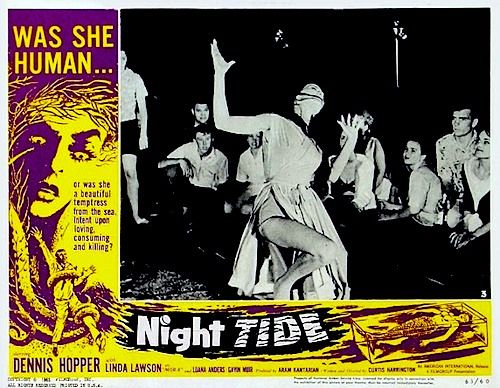
That film was 1961’s Night Tide. Harrington directed while Hopper played Johnny, a naïve young sailor who, while in on leave in Santa Monica, meets a mysterious woman named Mora (Linda Lawson). Mora works as a mermaid at a sideshow. Her boss is the overly possessive and somewhat brutish Captain Samuel Murdock (Gavin Muir). Captain Murdock makes it clear that he doesn’t want Johnny to have anything to do with Mora. Is it because he’s worried about losing Mora or is there another, more supernatural reason?
Johnny hears rumors that the men who fall in love with Mora tend to disappear. Mora, herself, explains that she’s a Siren. Her destiny is to lead sailors to their doom. Johnny tells her that’s ridiculous but what if she’s right?
It’s a strange film, one that moves at its own slow and rather deliberate pace. As Mora, Linda Lawson delivers her lines hesitantly, as one might expect from someone who is having to pretend to be a human being. Meanwhile, Dennis Hopper gives a compelling but nervous performance as Johnny. As written, Johnny is a pretty bland character but Hopper plays up Johnny’s sense of isolation. He’s far from home, he doesn’t know many people in town, and the woman he loves just explained that she’s a sea monster. One can understand why Johnny is a bit jumpy. There’s a few scenes where Hopper’s devotion to the method works against him. He’s convincing when he’s at the center of the scene but a bit too fidgety in the scenes where he just has to listen to other people speak. But, ultimately, Hopper’s performance works. He plays Johnny with a mix of fresh-faced innocence and hints of instability.
As I said, it’s not a conventional film. It moves at its own dream-like pace. The film was shot in black-and-white and that’s the version to see. Avoid the colorized version, in which the colors are so garish that they ruin the film’s surreal atmosphere. Night Tide is an experiment that won’t be for everyone but, when taken on its terms, it’s definitely intriguing.
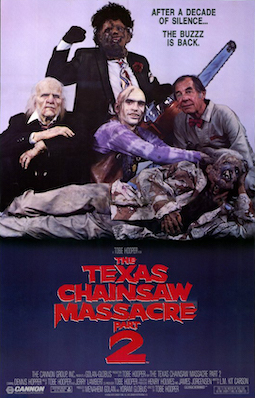
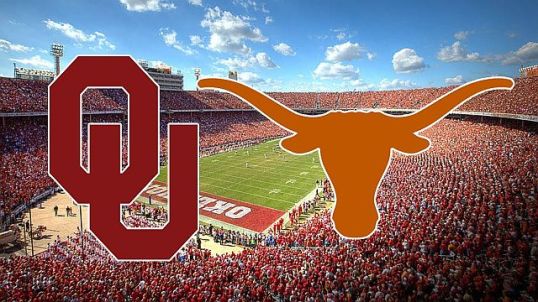
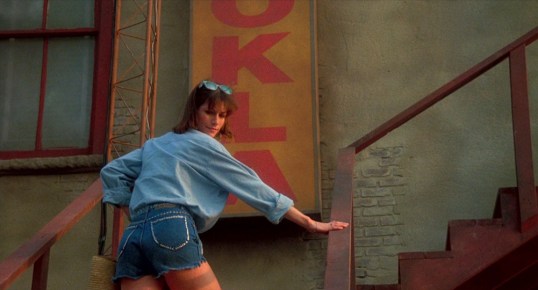
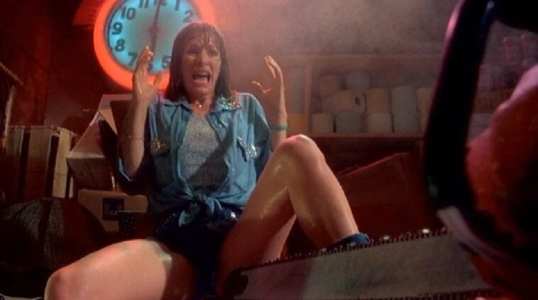
First released in 1986, The Texas Chainsaw Massacre Part 2 opens with two idiots driving down an isolated highway in Texas. They’re heading down to Dallas for the Red River Showdown, the annual football game between Oklahoma U. and the University of Texas at Austin. They’re drunk, of course. And, being rich kids in the mid-80s, they’ve got a car phone. They place a call to a local radio DJ named Stretch (Caroline Williams, giving a great performance) and they force her to listen as they harass the driver of a passing truck. Of course, when a chainsaw-wielding Leatherface (Bill Johnson) emerges from the truck and kills both of them, Stretch hears that as well.
Yes, Leatherface and the entire family are back. When last seen at the end of 1974’s The Texas Chainsaw Massacre, Leatherface was dancing with his chainsaw while the morning sun shined down on the Texas countryside. Now, he and the family have moved to North Texas and the eldest brother, Drayton Sawyer (Jim Siedow), has become a bit of a local celebrity due to his chili. (Everyone loves Drayton’s chili but that’s mostly because they don’t know who the main ingredient is.) Though one of the brothers was killed at the end of the original film, he’s been replaced by the manic Chop-Top (Bill Moseley), who has a metal plate in his head. Of course, Grandpa (Ken Evert) is still alive. He’s well over a hundred years old but he still enjoys trying to wield a hammer.
The family is being pursued by Lefty Enright (Dennis Hopper), a crazed Texas ranger who is also the uncle of Sally and Franklin Hardesty, who were both victimized in the first film. (Sally, we’re told, is in a mental institution. As for Franklin, a skeleton in a wheelchair does make an appearance at one point.) Lefty approaches Stretch to get a copy of the tape of the two drunk idiots being killed by Leatherface. Unfortunately, the family also discovers that Stretch has the tape and they soon come after her as well….
The Texas Chainsaw Massacre Part 2 is not as universally beloved as the first film but I like it. It helps, of course, to know something about Texas-OU weekend. Imagine Mardi Gras without the nudity or the beads but with a lot more beer and a lot more frat boys and you have a pretty good idea of what Texas-OU weekend is like in Dallas. The entire city goes crazy as it’s invaded by football fans from Oklahoma and Austin. Why are they playing football in Dallas as opposed to their own cities? Dallas is considered to be neutral ground and the fact that they need neutral ground to play a football game should tell you just how invested people get in that one game. Texas-OU weekend is all about excess and the same could be said about The Texas Chainsaw Massacre Part 2.
With the original film, Tobe Hooper fooled audiences into thinking that they were seeing more gore than they actually were. The first Texas Chainsaw Massacre is nearly bloodless. Hooper takes the opposite approach to the sequel, filling the screen with blood and viscera. For that reason, Part 2 is still controversial among fans of the original Texas Chainsaw Massacre films but I think Hooper made the right decision. Attempting to duplicate the original’s atmosphere would have been impossible. Instead of just remaking the original film, Hooper did something different. As well, as opposed to the more subtle social satire of the first Texas Chainsaw Massacre, the humor in Texas Chainsaw Massacre Part 2 is far broader and a bit more hit-and-miss. But again, it all links back to Texas-OU weekend. There may not be much that’s subtle about The Texas Chainsaw Massacre Part 2 but the same can be said of the Red River showdown and Texas-OU Weekend. For that matter, the same can be said for much of Texas in general and Dallas in specific. Like me, Tobe Hopper was a Texan. True Texans know what makes our state great but we also know what makes our state totally batshit insane. Tobe Hooper got Texas in a way that all the filmmakers from up North never will.
That’s not to say that The Texas Chainsaw Massacre Part 2 is a perfect film, of course. The film’s second half, which takes place almost entirely in the underground caverns in which the Sawyers have made their home, is considerably less compelling than the first. The scene where the Sawyers attempt to get Grandpa to bludgeon Stretch with a hammer goes on forever and it’s far less effective than when they tried to get Grandpa to do the same thing to Sally in the first film. As well, it’s hard not to be disappointed with Drayton’s transformation from being ambiguously friendly in the first film to being a flat-out villain in the second. The first film showed that Jim Siedow was a far better actor than one might guess from the sequel.
But here’s what does work. Bill Moseley’s performance as Chop Top is completely manic and over-the-top and, at times, a little bit annoying. But he’s also so completely unhinged and Moseley is so uninhibited in the role that it’s impossible to look away whenever he’s onscreen. Dennis Hopper, who was just starting to make his Hollywood comeback when he appeared in this film, plays Lefty as being so obsessive that sometimes, he seems like he might be just as dangerous as the people that he’s pursuing. Hopper makes the character sympathetic, though. There’s a gleam of madness in his eyes but the viewer never doubts his love for his family. It takes a special actor to pull off the scene where Lefty discovers Franklin’s remains and Hopper was exactly that actor. And finally, there’s Caroline Williams, giving a strong and inspiring performance as Stretch and never allowing the character to become a helpless victim. Stretch may scream (because who wouldn’t in that situation) but she never stop fighting. The scene where she “charms” Leatherface is the epitome of The Texas Chainsaw Massacre Part 2. It’s over the top, excessive, borderline offensive, sickly funny, and yet somehow very effective. If nothing else, The Texas Chainsaw Massacre Part 2 is one of the few of the 80 slasher films to acknowledge what’s really going on with those boys and their chainsaws, machetes, and knives.
Though it may not be as good as the original, The Texas Chainsaw Massacre Part 2 holds up well on its own. It’s an effective mix of satire and horror, featuring a strong heroine and a great performance from Caroline Williams. Hell, I think I’m going to be Stretch for Halloween this year!
As some of our regular readers undoubtedly know, I am involved in a few weekly live tweets on twitter. I host #FridayNightFlix every Friday, I co-host #ScarySocial on Saturday, and I am one of the five hosts of #MondayActionMovie! Every week, we get together. We watch a movie. We tweet our way through it.
Tonight, for #ScarySocial, I will be hosting 1986’s The Texas Chainsaw Massacre Part 2!
That’s right! It’s Tobe Hooper’s classic sequel to his classic horror film! It’s Dennis Hopper vs. Leatherface! It’s Caroline Williams vs Chop Top! It’ll make you laugh. It’ll make you scream. And the ending …. well, the ending always make me cry.
If you want to join us on Saturday night, just hop onto twitter, start the film at 9 pm et, and use the #ScarySocial hashtag! The film is available on Prime and a few other streaming sites. I’ll be there co-hosting and I imagine some other members of the TSL Crew will be there as well. It’s a friendly group and welcoming of newcomers so don’t be shy.
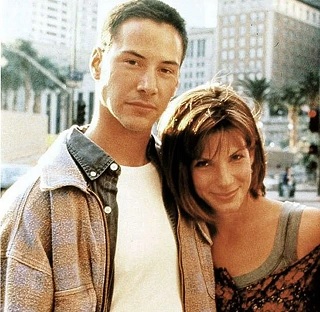
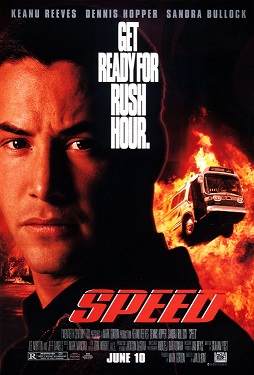
That was my main thought when I recently rewatched the 1994 film, Speed. There’s a lot of reasons why Speed remains popular 28 years after it was initially released but I think a huge (if underrated) factor is that it’s just a good love story. At this point, everyone knows that the film is about a bus that has been wired to explode if it goes under 50 miles per hour. Most people know that Dennis Hopper plays Howard, the mad bomber, Keanu Reeves plays Jack, the cop who jumps on the bus and tries to figure out how to defuse the bomb, and Sandra Bullock plays Annie, the passenger who takes over driving the bus after the driver is incapacitated. (If you’re fan of the work of John Hughes, you might also know that Speed was the film where Ferris Bueller‘s Alan Ruck broke free of his Cameron typecasting and established himself as a dependable character actor.) Most people remember what the cops do in an attempt to trick Dennis Hopper and, for that matter, they also remember the one mistake that led to Hopper figuring out their ruse.
And yet, even though most viewers will know exactly what is going to happen, the film remains a fun watch because of the chemistry between Keanu Reeves and Sandra Bullock. This was one of Sandra’s first major roles. This was also one of Keanu’s earliest attempts to helm a big budget, major studio action picture. (Director Jan de Bont insisted on casting him after seeing him in the film Point Break. The studio preferred Tom Cruise.) In Speed, both Keanu and Sandra are young, likable, attractive, enthusiastic, and they have smiles that light up the screen. As soon as Sandra takes over driving and Keanu tells her that she cannot allow the bus to slow down under any circumstances, the two of them just seem to belong together. The film’s enduring popularity is about more than just watching a bus try not to go under a certain speed. The popularity of Speed is also about watching the characters played by Keanu and Sandra fall in love.
Who would have guessed it? Well, certainly not whoever put together the film’s original theatrical trailer. Check this out:
As you can see, the original trailer doesn’t feature much of Sandra Bullock. For that matter, it’s not quite as Keanu-centric as you might expect it to be. Instead, the trailer is dominated by things exploding and Dennis Hopper’s over-the-top performance as the bomber. And make no doubt about it, Dennis Hopper is definitely an entertaining part of the film. There’s not a subtle moment to be found in his performance and that makes him the perfect for the role of a man whose response to a cheap retirement present is to go on a bombing spree. That said, the film belongs to Keanu and Sandra.
That said, it would be a mistake to ignore the other people on the bus. One of the things that I like about Speed is that the other passengers on the bus come together to survive their ordeal. They may start out as weary commuters but, by the end of the film, they’ve become a family. They may get annoyed with each other but, when it comes time to climb from one bus to another, they hold on to each other and they hug one another on the other side. The bomber, like all terrorists, thought that he could turn people against each other through his threats and his violence. Instead, the people came together provided one another with comfort and protection. There’s an important lesson there, one that’s even more important in 2022 than it probably was in 1994.
(On a personal note, I’m not usually a public transportation person. However, in high school, I would occasionally catch the DART bus — that’s Dallas Area Rapid Transportation — if it was raining. The buses were often not in particularly good shape. One that I boarded actually had a hole in the floor and, since it was raining, the passengers would have to hold up their feet whenever the bus splashed through a puddle. Personally, I was kind of amused by the weirdness of it all but I think I was the only one. Would the passengers of that bus bonded together to defeat a mad bomber? One can only hope.)
Speed may be a film about a bomb on a bus but, ultimately, it’s also a film about humanity at its best. And that’s why, after all this time, it remains a classic.
Sometimes, I have to remind myself that Dennis Hopper is no longer with us.
Seriously, he’s one of those iconic screen figures who remains as much of a pop cultural presence in death as he was in life. For an actor who spent a good deal of his career under an unofficial blacklist, Hopper appeared in a number of classic films. Rebel Without A Cause, Giant, Night Tide, Easy Rider, Apocalypse Now, Blue Velvet, Speed, True Romance, The Trip, The Other Side of the Wind, Queen of Blood, Land of the Dead, Hoosiers, Out of The Blue …. one of the things that they all share in common is the eccentric presence of Dennis Hopper. Even Hopper’s bad films, like Waterworld, are more popular than the bad films of other actors. And while Hopper will probably always be best-known as an actor, he’s received some posthumous recognition for his work as a director. It’s been 12 years since Dennis Hopper passed but he’s still very much a part of the American cultural landscape.
How did this happen? How did Dennis Hopper go from being a kid from Kansas to being a disciple of James Dean? How did Hopper go from appearing in big budget films like Giant to working as a member of Roger Corman’s stock company? How did Hopper come to revolutionize American film with Easy Rider, just to lose the next few years of his life to his legendary addictions? Remarkably, Dennis Hopper not only inspired the “New Hollywood” with Easy Rider but he nearly destroyed it with The Last Movie. In the 70s and the first half of the 80s, he was still capable of giving a good performance but the key was to find him when he wasn’t dealing with a fit of drug-induced paranoia. And yet, even with his addictions and demons, he still directed one of the most important films of the 80s, Out of the Blue.
Remarkably, Hopper did eventually conquer his addictions. Starting with David Lynch’s Blue Velvet, Hopper remade himself as one of Hollywood’s busiest character actors and, to many, he became an almost lovable relic of the 60s. The former self-described communist became a Republican. And, even if he never could quite restart his directing career, Hopper stayed busy for the rest of his life. It was a remarkable transformation. The rebel who once ran a cult-like commune in New Mexico became a beloved member of the establishment that he once swore he would destroy.
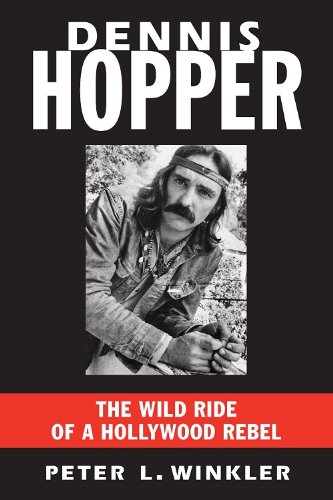
Peter L. Winkler’s 2011 biography, Dennis Hopper: The Wild Ride of a Hollywood Rebel, takes a look at how this happened. The Dennis Hopper that emerges from this detailed biography is a natural born rebel who was also canny enough to keep one foot in the system that he was trying to destroy. As such, Hopper could shares James Dean’s dismissive attitude towards Hollywood while also remaining a favorite of John Wayne’s. Hopper could make the ultimate hippie film without actually becoming a hippie himself. Hopper had the talent necessary to keep getting roles even when he had a reputation for not being quite sane. Indeed, the book argues that Hopper’s best performances were given when he had something to prove and that Hopper’s work and his films became significantly less interesting once he was fully welcome back into the establishment.
And while I do think that Winkler is a bit too dismissive of some of Hopper’s later work, he does have a point. Dennis Hopper thrived on being a rebel, which is one reason why he came to define the late 60s and the early 70s. One reason why Hopper’s performance as Frank Booth in Blue Velvet remains so powerful is because he’s rage is so palpable. Booth is trying to destroy the world, just as surely as Hopper once tried to destroy Hollywood. But, eventually, Hopper’s style of rebellion fell out of fashion and then resurfaced as the subject of nostalgia. The rebels always eventually become the establishment.
Winkler’s biography not only takes a look at some of Hopper’s best films but it also puts him and his work in a proper historical and cultural context. The book is as much about what Hopper represented to a generation as how Hopper lived his life. And while Hopper himself is not always a sympathetic figure (like many actors, he could be more than a little self-absorbed), he does come across as being a fascinating talent. Hopper often referred to himself as being the epitome of the “American Dreamer” and this biography leaves no doubt that he was correct.
Today is not only the 1st of March. It’s not only Texas Independence Day. It’s not only Zack Snyder’s birthday. It’s not only the day of Texas primaries. It’s not only the day when the State of the Union address is scheduled to be given (yawn!). It’s also Mardi Gras!
What a busy day!
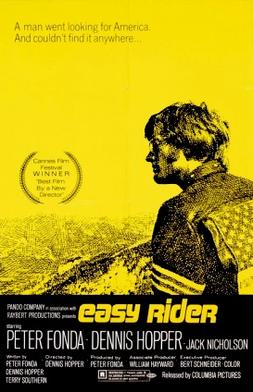
For today’s scene that I love, here is the Mardi Gras/Cemetery sequence from 1969’s Easy Rider. Featuring Peter Fonda, Dennis Hopper, Karen Black, and Toni Basil walking through the streets of New Orleans, this scene was actually filmed during Mardi Gras. Those are real Mardi Gras floats and real Mardi Gras participants staring at the camera. That’s an actual citizen of New Orleans with whom Dennis Hopper appears to have nearly gotten into a fight. And, in the cemetery scene, that was real acid that Peter Fonda took.
Here is today’s scene. The scene is age-restricted so you’ll actually have to click on “watch on YouTube” to see it.
If you don’t want to click on “watch on YouTube,” here is a shorter version that just features the parade without the admittedly disturbing cemetery stuff.
I like how Toni Basil can’t help but dance, no matter what.
4 (or more) Shots From 4 (or more) Films is just what it says it is, 4 (or more) shots from 4 (or more) of our favorite films. As opposed to the reviews and recaps that we usually post, 4 (or more) Shots From 4 (or more) Films lets the visuals do the talking.
85 years ago, Dennis Hopper was born in Dodge City, Kansas.
It seems rather appropriate that one of America’s greatest cinematic outlaws was born in a town that will be forever associated with the old west. Dennis Hopper was a rebel, back when there were actual consequences for being one. He started out acting in the 50s, appearing in films like Rebel Without A Cause and Giant and developing a reputation for being a disciple of James Dean. He also developed a reputation for eccentricity and for being difficult on set and he probably would have gotten completely kicked out of Hollywood if not for a somewhat improbable friendship with John Wayne. (Wayne thought Hopper was a communist but he liked him anyways. Interestingly enough, Hopper later became a Republican.) Somehow, Hopper managed to survive both a raging drug addiction and an obsession with guns and, after a mid-80s trip to rehab, he eventually became an almost universally beloved and busy character actor.
Hopper, however, always wanted to direct. He made his directorial debut with 1969’s Easy Rider, a film that became a huge success despite being an infamously chaotic shoot. The success of Easy Rider led to the Hollywood studios briefly trying to produce counter-culture films of their own. Hopper was given several million dollars and sent to Peru to make one of them, the somewhat dangerously titled The Last Movie. Unfortunately, The Last Movie, was such a bomb that it not only temporarily derailed Hopper’s career but it also turned Hollywood off of financing counter culture films. Hopper spent a decade in the Hollywood wilderness, giving acclaimed performances in independent films like Tracks and The American Friend, even while continuing to increase his reputation for drug-fueled instability. Hopper would eventually return to directing with his masterpiece, 1980’s Out of the Blue. (Out of the Blue was so controversial that, when it played at Cannes, Canada refused to acknowledge that it was a Canadian production. It played as a film without a country. Out of the Blue, however, is a film that has stood the test of time.) Unfortunately, even after a newly cleaned-up Hopper was re-embraced by the mainstream, his directorial career never really took off. He directed 7 films, of which only Easy Rider and Colors were financially successful. Contemporary critics often didn’t seem to know what to make of Dennis Hopper as a director. In recent years, however, Hopper’s directorial efforts have been reevaluated. Even The Last Movie has won over some new fans.
Today, on his birthday, we honor Dennis Hopper’s directorial career with….
7 Shots From 7 Dennis Hopper Films
Easy Rider (1969, dir by Dennis Hopper, DP: Laszlo Kovacs)The Last Movie (1971,dir by Dennis Hopper, DP: Laszlo Kovacs)Out of the Blue (1980, dir by Dennis Hopper, DP: Marc Champion)Colors (1988, dir by Dennis Hopper, DP: Haskell Wexler)The Hot Spot (1990, dir by Dennis Hopper, DP: Ueli Steiger)Backtrack (1990, dir by Dennis Hopper, DP: Edward Lachman)Chasers (1994, dir by Dennis Hopper, DP: Ueli Steiger)
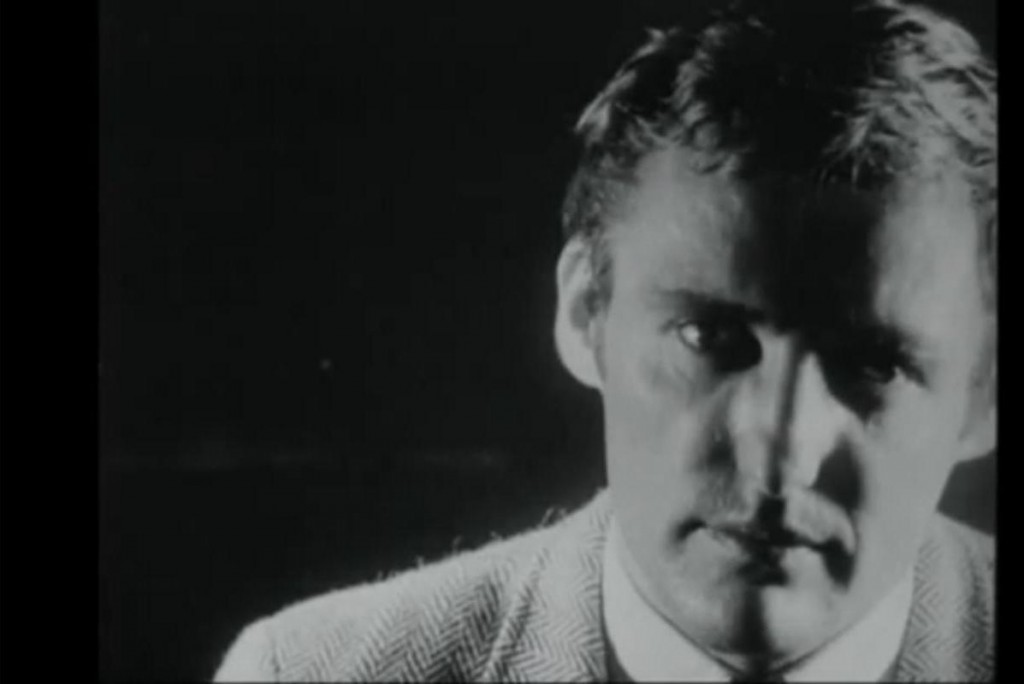
First released in 1961 and directed by Curtis Harrington, Night Tide stars a young Dennis Hopper as Johnny, an awkward sailor. Johnny meets Mora (Linda Lawson), who works as a “mermaid” on the pier. For Johnny, it’s love at first sight. However, the more that Johnny pursues her, the more he learns about both her mysterious past and the dark fate of her previous boyfriends.
Night Tide is low-key and atmospheric gem of a movie, one that serve as an inspiration for low-budget filmmakers every where. Lawson is perfectly cast as the enigmatic Mora but the film really belongs to Dennis Hopper. Hopper’s naturally off-key presence made him perfect for the role of Johnny.
Night Tide is one of those low-budget movies that, because it’s in the public domain, has been released on DVD (often in inferior form) by dozens of different companies. Often times, films like this turn out to be fairly forgettable. Night Tide, however, is an exception.
Since today would have been Dennis Hopper’s 84th birthday, I decided to watch the 1971 documentary, The American Dreamer.
Filmed in 1970, between the success of Easy Rider and the release of Hopper’s infamous follow-up to that film, The Last Movie, The American Dreamer is a cinematic portrait of a very specific time in both Dennis Hopper’s life and American film history. Dennis Hopper was 34 years old at the time The American Dreamer was shot and he was at the top of his career. As a result of the success of Easy Rider, he was regularly touted as being the future of American film. He was a self-styled revolutionary who specialized in spacey yet compelling monologues about how American movies were about to enter into a new age. Eager to try to capture the same audience that had made Easy Rider a success, Universal Pictures gave Dennis Hopper a million dollars and allowed him to take the money to South America, where he used it to film The Last Movie, a film that was designed to show who Hopper truly was as a filmmaker. The American Dreamer was filmed while The Last Movie was in post-production and we do see a few scenes of Hopper editing the film.
That said, Hopper doesn’t really seem to be too interested in talking about the specifics of The Last Movie. He does talk a lot about how he’s leading a revolution that’s going to forever alter the American cultural scene but again, Hopper doesn’t really go into too many specifics when it comes to his artistic vision. He’s more into slogans than details. Fortunately, Hopper was a compelling speaker so he holds your attention regardless of how incoherent his frequent monologues are. The American Dreamer may not convince you that Dennis Hopper was a great director but it does prove that he was a good actor. In this film, he’s acting the role of being an outlaw and a visionary.
As vague as he is about his artistic vision, Hopper gets a bit more specific whenever he’s talking about his love of weed, sex, and guns. In between leading encounter groups with all of the women who are living with him in New Mexico, Hopper brags about being such a considerate love that he’s a “male lesbian.” In another scene, Hopper talks to three giggling girl in a bathtub. He explains that free love is a part of the revolution and that he’s helping people get over their hang-ups. It’s impossible not to cringe as Hopper comes across less like a lovable eccentric and more like one of those cult leaders who ends up living in a compound in Nevada and getting into a stand-off with the government.
Hopper’s a bit more likable when he’s filmed rolling a joint. Watching the film, you can tell that he was a man who truly loved getting stoned and he actually lets down his guard a bit and grins once he’s ready to light up. However, Hopper is probably at his most natural and likable when he’s shooting a gun in the desert. Hopper spends a good deal of the film talking about his love for guns. On the one hand, it’s a bit alarming as Hopper doesn’t exactly come across as being the most stable person on the planet. On the other hand, Hopper appears to be having such a good time that it’s hard not to be happy for him. Hopper explains that, when you’re an outlaw and you’ve living in New Mexico, you have to have guns for your own protection and he makes a pretty good argument. One of the frequent misconceptions about Hopper is that he was a hippie. (This despite the fact that Easy Rider more or less ridiculed the hippies.) The American Dreamer, with its emphasis on individual freedom and the right to protect yourself, shows that, even during the height of the Hollywood counterculture, Hopper’s outlook was essentially libertarian. Watching The American Dreamer, it’s easier to understand how Hopper went from directing Easy Rider to becoming one of the few Republicans in Hollywood. Indeed, whenever the bearded and often unwashed Hopper is seen walking through the desert or firing a gun at a cross, he comes across less like the revolutionary visionary that he’s trying to be and more like an old soul in a new world.
With its frequent use of freeze frames and its intentionally ragged editing, The American Dreamer is very much a film of its era. That’s actually the main appeal of The American Dreamer. It captures a very unique and very specific point of time. It captures an artist during the brief period between his biggest success and his greatest failure and while the film may be frustrating on a narrative level, it’s fascinating as a time capsule. The film is probably more poignant when viewed today than it would have been back in 1971 because, today, we know that The Last Movie bombed and that Hopper’s revolution ended as quickly as it began. It was not Dennis Hopper who determined the future of American film but instead Steven Spielberg and George Lucas. Hopper struggled, both professionally and personally, through the rest of the 70s and the early 80s before finally kicking drugs and emerging as not just as an in-demand character actor but also something of a pop cultural icon. Watching The American Dreamer, it’s fascinating to compare the older Hopper — the one who gave witty interviews and who joked about his past excesses — with the pretentious and self-serious Hopper of the early 70s.
Still, The American Dreamer shows that Dennis Hopper was always a compelling figure. It’s impossible not to roll your eyes while watching and listening to the youngish Dennis Hopper but, nonetheless, you do continue to watch and listen.
The 1977 German film, The American Friend, tells the story of two men.
Tom Ripley (played by Dennis Hopper) is an American. He’s also a very wealthy criminal. He wears a cowboy hat almost everywhere he goes and always tends to be a little bit too forceful when he talks to people. Because he’s wealthy, he is tolerated by high society but everyone seems to view him with a bit of suspicion. And perhaps they should because Ripley actually has a pretty good scheme going. Working with an artist named Derwatt (director Nicholas Ray), Ripley sells forged paintings. He goes to auctions and bids on these paintings, artificially driving up the price. When Ripley isn’t selling forged paintings, he’s traveling around the world and speaking into his tape recorder. He’s an existential cowboy, one who doesn’t appear to have any morals but who is still capable of exclaiming, “I’m confused!” with real anguish in his voice.
Jonathan Zimmerman (Bruno Ganz) is a German art restorer and picture framer who has a beautiful wife, two children, and a lovely shop. He also has leukemia and is obsessed not only with his impending death but also his fear that he’s going to end his life without really doing anything memorable. When Jonathan meets Ripley at an art auction, he refuses to shake Ripley’s hand because he knows about Ripley’s shady reputation. Ripley is offended but slightly forgiving when he learns, from a mutual acquaintance, that Jonathan has been sick.
Back at his mansion, Ripley receives a message from a French gangster named Minot (Gerard Blain). Minot wants Ripley to murder a rival gangster for him. Ripley, however, tells Minot that he should contact Jonathan and offer him the contract. Ripley then spreads a rumor that Jonathan’s illness has gotten worse and that both his doctor and his family are keeping the truth from him. Now believing that he’s on the verge of dying and desperate to make some money so that his family won’t be helpless after he’s gone, Jonathan is far more open to accepting Minot’s unexpected offer to become a hired gun.
To his shock, Jonathan is able to carry out the murder. However, Minot is not content to just have Jonathan kill one man. Minot is concerned about the activities of an American gangster (played by director Sam Fuller) and he expects Jonathan to keep killing for him. Meanwhile, Ripley, feeling a bit conflicted over his part in Jonathan’s new career, take it upon himself to help Jonathan out in his latest assignment. And so, on odd friendship is born….
The American Friend is based on Patricia Highsmith’s novel Ripley’s Game (which, itself, is a sequel to oft-filmed The Talented Mr. Ripley). In Highsmith’s novels, Ripley was always portrayed as being suave, well-spoken, and never suffering from self-doubt. Dennis Hopper plays Ripley as a cowboy who appears to be in the throes of an existential crisis. It’s quite the opposite of the literary Ripley but it works perfectly in the world created by The American Friend. At times, there’s something almost child-like about Hopper’s Ripley. As played by Hopper, Ripley is an unintentional force of destruction, one who targets Jonathan on an impulse and then, just as impulsively, decides to help him out. It’s one of Hopper’s best and most multi-layered performances.
Dennis Hopper is equally matched by the great Bruno Ganz, who plays Jonathan as being a gentle soul who is as shocked as anyone to discover that he’s capable of murder. Though he is morally offended by Ripley’s reputation, he still can’t help but try to help Ripley out when Ripley unexpectedly shows up at his shop. Even towards the end of the film, Jonathan seems to be so happy to finally be doing something unexpected with his life that his joy is almost infectious. You’re happy for him, even though you know things probably won’t turn out well for him.
As directed by Wim Wenders, The American Friend is a perfect mix of existential angst and film noir homage. While there’s undoubtedly a political subtext to the film — one gets the feeling that Ripley’s destructive friendship with Jonathan is meant to represent the way that America views Europe — The American Friend works best as an homage to the glorious B-movies of the 40s and 50s. (It’s probably not a coincidence that both Nicholas Ray and Samuel Fuller have prominent supporting roles.) There’s a sequence on a train that’s the equal to Hitchcock at his best and the story’s conclusion will stick with you long after the film ends.
Sadly, most of the principle members of the cast are no longer with us. All of them are at their best in The American Friend and Wim Wenders gives them all a terrific showcase in which to display their talent. The American Friend is definitely a film worth tracking down.