In 1969’s Winning, Paul Newman plays a race car driver.
That’s certainly not a surprise. Newman was very much a fan of racing and owned a few race cars himself. In Winning, he looks totally comfortable and believable behind the wheel. There’s not a moment that you look at Paul Newman and think to yourself that he couldn’t be exactly who he’s playing, a very successful and very ambitious race car driver. At its best, the film is a visual love letter to the sport of racing and the thrill of driving fast. When Newman is on that track, Winning is an exciting film.
Unfortunately, Winning doesn’t spend nearly enough time on the track. Instead, we spend way too much time examining the bad marriage of Frank (Paul Newman) and Elora Capua (Joanne Woodward). Frank meets Eulora at a car rental place, where she’s working behind the counter. After a whirlwind romance, they get married and Frank becomes a stepfather to Elora’s annoyingly sensitive son, Charley (Richard Thomas). (The film doesn’t necessarily mean for Charley to be annoying but he most definitely is.) Still, Frank remains obsessed with winning. He remains so obsessed with winning that Elora has an affair with Lou Erding (Robert Wagner), another race car driver. With his marriage in shambles, Frank throws himself into preparing for the Indianapolis 500.
Winning is very much a film of the late 60s. There’s really not much of a story so the film tries to get by on frequent jump cuts, intentionally skewed camera angles, and frequent montages. It’s one of those American films that desperately wants to be mistaken for the type of movies that were coming out of Europe at the time. I tried to count all of the jump cuts during the first few minutes of the film and I quickly gave up. While there’s nothing wrong with a good jump cut, the frequent cuts in Winning feel more like an affectation than anything else. Basically, someone in production said, “The kids like jump cuts so toss them in whether they’re necessary or not.” The film’s attempt to be arty only further serve to remind us that there’s very little actually going on.
Paul Newman had charisma to burn and, in Winning, he looks like he’s enjoying himself whenever he’s behind the wheel. The marriage of Newman and Woodward was one of Hollywood’s great love stories but that doesn’t come across in the marriage for Frank and Elora. A lot of that is because there’s really not much that can be said about who Elora. She’s a blank. Paul Newman had the screen presence and the cool confidence to get away with playing an underwritten character. Woodward, however, can’t overcome the shallow script. (Though Robert Wagner was nowhere near as good an actor as either Newman or Woodward, he has the right look for the role and his stiff line delivery actually works well for the character. For whatever reason, Wagner often seemed to do his best work in Paul Newman films.)
Really, I shouldn’t be surprised that Winning turned out to be stylish but empty. The film was directed by James Goldstone, who also directed the painfully portentous Sidney Poitier-as-Jesus film, Brother John. Eventually, Goldstone straightened up and gave us enjoyably bad films like Rollercoaster and When Time Ran Out. Newman is in When Time Ran Out as well. Just as with Winning, he’s the best thing in the movie. That’s one of the benefits of being one of the great actors. Even when they’re appearing in a less-than-impressive film, you just can’t stop watching them.
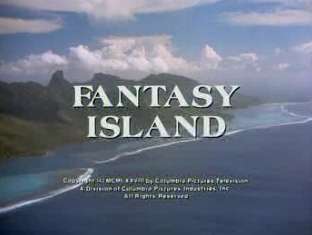
Welcome to Retro Television Reviews, a feature where we review some of our favorite and least favorite shows of the past! On Tuesdays, I will be reviewing the original Fantasy Island, which ran on ABC from 1977 to 1984. The show is once again on Tubi!
It’s time for one last trip to Fantasy Island.
Episode 7.22 “Surrogate Mother/The Ideal Woman”
(Dir by Don Weis, originally aired on May 19th, 1984)
All things must come to an end. For the original Fantasy Island, the final episode of the seventh season was also the final episode of the series.
The show didn’t get a grand finale. Instead, it was a typical episode with two fantasies. In one fantasy, Charo — yes, Charo — played a woman who had been hired to be a surrogate mother for a childless couple (John Saxon and Juliet Mills). In the other one, Ben Saunders (Shea Farrell) tried to win back his ex-fiancee (Mary Kate McGeehan) while judging a Fantasy Island beauty pageant. (How many pageants did Fantasy Island host?) Two men (Don Galloway and David Sheiner) demanded that Ben pick their girlfriends as the Ideal Woman. (Both of the girlfriends materialized on the Island, one from a painting and one from a block of stone. It was a weird fantasy.) Ben picked his ex, declaring her to be the “ideal woman.” Neither fantasy was great, though I will say that Charo gave a surprisingly sincere performance and it was nice that frequent Fantasy Island guests stars John Saxon and Juliet Mills appeared on the last episode. It was an okay trip to the Island, particularly when compared to some of the other season 7 episodes. Still, the whole thing felt a bit tired.
I have to admit that it’s hard for me to believe that I just reviewed the final episode of the original Fantasy Island.I started reviewing Fantasy Island on September 6th, 2022. It was one of the original shows that I picked for Retro Television Reviews. Now that I’m finishing the show up in 2026, The Love Boat is the only one of my original picks that I still have episodes left to review. I’ll be reviewing The Love Boat for a while.
(To be honest, I’m stunned that I’ve stuck with these reviews. I don’t think anyone was expecting me to get all the way to end of Hang Time, let alone Fantasy Island.)
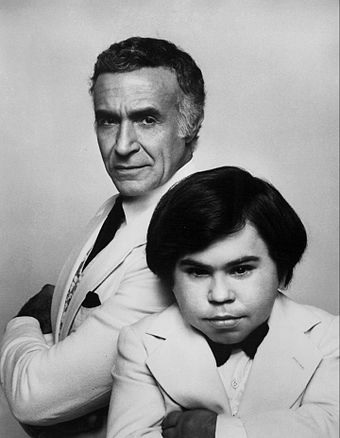
My thoughts on Fantasy Island? I loved the first four seasons. The fifth season, with its introduction of Julie and it’s frequent side-lining of Tattoo, was when the show started to go downhill. The biggest mistake that the show made was, needless to say, not agreeing to pay whatever was necessary to get Herve Villechaize to come back for season 7. Season 7, the season without Tattoo, felt odd from the start. Christopher Hewett and Ricardo Montalban never had the right chemistry and the stories themselves were largely recycled from earlier episodes. The perfect ending for Fantasy Island would have been the season 6 clip show.
What’s next? On television, Fantasy Island was revived twice. In the 90s, Malcolm McDowell played a version of Mr. Rourke. And then, more recently, there was an attempt to revive it on Fox but, after an enjoyable first season, that show became a self-parody. I may review both of them in the future. For now, though, I’m still considering several shows to start reviewing next week. I’ll reveal my pick next Tuesday!
For now, let us say goodbye to Fantasy Island. Thanks for the laughs, the tears, and the fantasies!
THE STONE KILLER opens in Spanish Harlem with detective Lou Torrey (Charles Bronson) following a young man, who had just shot a cop, into an abandoned building. When the young man refuses to turn himself in, and even tries to shoot Torrey, he gets blown away. In trouble with his superiors on the force, and being dragged in the press for the shooting, Torrey decides to change locations and continue his law enforcement career under his friend Les Daniels (Norman Fell) in Los Angeles. Soon after he arrives in Los Angeles, Torrey and his partner Mathews (Ralph Waite) are working a case against a drug dealer, when they arrest “Bootlace” Armitage (Eddie Firestone), a drug addict, but also a well-known hitman from New York. Torrey is delivering the “mechanic” back to New York for outstanding warrants when Armitage says that he is willing to give up some big information on “Wexton” in exchange for a reduced sentence. When Armitage is gunned down in what is obviously a professional hit, it’s clear that there is something going on that involves the name Wexton. We soon learn more as we meet mafia leader Al Vescari (Martin Balsam). As Vescari walks through a cemetery, he tells the leader of his operation, Lawrence (Stuart Margolin), of his plans to get revenge for a string of mafia killings that occurred 42 years earlier by using “stone killers,” in this case, former military men with no connection to the mob. As the film moves forward, Detective Lou Torrey and his fellow cops will eventually put the pieces together and find themselves taking on these “stone killers” and the mob!
I’ll just go ahead and say up front that I’m a big fan of THE STONE KILLER these days, but that’s because the movie has grown on me over the years with repeat viewings. When I first watched the film as a teenager in the 1980’s, I enjoyed it as a tough cop film, but it wasn’t one of my favorites. I think that part of the reason I didn’t appreciate it as much back then is the more convoluted plot of the film. Most Bronson films have simple and easy to follow plot lines, but THE STONE KILLER includes a somewhat complicated mafia assassination plan, and it also sends the cops on wild goose chases that have nothing to do with the actual story. Watching the film as an adult, I appreciate Director Michael Winner taking us with him on some of those 1970’s flavored tangents that include getting to hang out with some hippies at an ashram, as well as some unjustly accused black militants.
Even though the plot is more complicated than the average Charles Bronson film, director Michael Winner gives us some of the best action sequences of Charles Bronson’s career. There are two sequences in particular that stand out to me. After the impressive opening scenes where Torrey blows away the gun wielding young man in Spanish Harlem, it takes a while to get to the next extended action sequence, but it’s definitely worth the wait. The scene involves Detective Torrey in a car chase where he’s after one of the stone killers, Albert Langley (Paul Koslo), who’s on a motorcycle. In an era of great car chases, this is a doozy that features many amazing and dangerous stunts. The late 60’s and early 70’s are an embarrassment of riches for cinematic car chases and this one stands the test of time. The next great action sequence occurs later in the film when Detective Torrey and the cops bust the home and facility where the killers have trained for the planned massacre. Bronson is still in his physical prime in 1973, and his athletic prowess is clearly on display as he slides across floors, jumps on tables, and does anything else that is required to take down the bad guys. The film is not wall to wall action, but what’s here is as badass as it gets.
Detective Lou Torrey is a really good role for Charles Bronson. In his best roles, Bronson is tough, but you can also tell that he cares about other people. That’s definitely the case here as he consistently shows empathy for some of the people he’s after. For example, at the beginning of the film, he has to shoot the young man in Spanish Harlem in self-defense, but he later explains to his sister that he didn’t want to do it, even expressing some understanding of how the young man may have found himself in that situation. A little later while arresting a drug dealer with his partner Mathews, Torrey is clearly disgusted when his partner uses racial slurs during the arrest. Torrey then talks to the man with respect and gets the needed information to arrest the man buying the drugs. There are further examples later in the film as he deals with other drug addicts and militants. I say none of this to insinuate that Bronson’s character is weak in any way. Rather, he seems to want to do his job and arrest criminals in a professional manner. He’s also a complex character in some ways as he will bend the rules to get what he needs if he has to. He does end up punching the car thief, Jumper (Jack Colvin), a couple of times during an interview. While this is definitely not legal, in the context of this film, it’s required in order to get to the facts of the case. Bronson is actually quite great in the film.
Besides international superstar Charles Bronson, Michael Winner put together an amazing cast for THE STONE KILLER. Martin Balsam had won an Oscar a few years earlier, and he’s good here as the mafia boss with four decades worth of patience for revenge. Ralph Waite is also excellent as Bronson’s incompetent, racist partner Mathews. It’s hard to believe the guy would go on to play Papa Walton based on the ignorance he shows in both this film and in the Bronson/Winner collaboration CHATO’S LAND from the prior year. It’s fun watching both Norman Fell and John Ritter work together in this film, especially knowing that they would be making television history a few years later on the classic TV sitcom “Three’s Company.” The last two actors I want to mention are Stuart Margolin as the leader of the stone killers, Lawrence, and Paul Koslo as the bi-sexual badass musician Albert Langley. Both actors, especially Koslo, are good here and would have important roles with Bronson the next year as well. Margolin was an important character in DEATH WISH, and Koslo may have even outdone his work here the next year as a particularly slimy weasel in MR. MAJESTYK. Oh yeah, be sure to look for a short, uncredited cameo from B-movie queen Roberta Collins! I also want to shout out the musical score from Roy Budd, who also did the score for GET CARTER (1971). Thanks to Budd’s work, the opening credits are very cool and memorable.
THE STONE KILLER was marketed as Charles Bronson’s “Dirty Harry” and meant to be his breakout hit in America. Unfortunately, while the film was an international hit, the actual grosses in the United States were respectable but not as much as the filmmakers had hoped for. As such, we didn’t get any more entries in the case log of Detective Lou Torrey and Bronson would have to wait another year for his American box office breakout with DEATH WISH. But that’s okay because THE STONE KILLER has stood the test of time as an excellent 1970’s cop film, emerging in my personal rankings as a major feather in the cap of Charles Bronson’s career.
In this comedic western, gambler Benjamin Calhoun (Dale Robertson) wins big in a poker game. Not only does he walk away with several thousand dollars but he also now owns his own railroad, the BP;S&D. Calhoun celebrates the biggest win of his career by tossing ten dollar bills at the townspeople, recruiting a worshipful young assistant (Bob Random), and commandeering a private railcar that belongs to wealthy Burton Standish (John Anderson). In the car, he finds Marta Grenier (Diana Hyland), a “working woman,” who has been hired to provide company for Standish.
Calhoun and Marta ride off to check out Calhoun’s new railroad. What he discovers is that the railroad that he won is not only not completed but the workers are striking because they haven’t been paid in two weeks. The quick-thinking Calhoun offers to make all of the workers part-owners of the railroad. With construction once again starting, Calhoun tries to figure out how to keep his new business open. He also meets a strong-headed storekeeper named Joanna Royce (Sandra Smith).
When Standish finally shows up, it turns out that he was originally planning on buying the BP;S&D. Will Calhoun hold onto the railroad and honor the promise he made to the workers or will he sell out to Standish?
For all the talk about completing the railroad, Scalplock ends with most of the work undone. That’s because Scalplock was a pilot for The Iron Horse, a television series that lasted for two seasons in the 60s. Scalplock (and The Iron Horse) is mostly a showcase for Dale Robertson, a low-key but always convincing actor who specialized in westerns. Usually, Robertson was cast as an upstanding citizen and law enforcement agent. In Scalplock, he’s playing the type of genial rogue that James Garner played on Maverick and later in The Rockford Files. Robertson is likable in Scalplock and even convinces us that Calhoun would choose his workers over a quick payday. Fan of the genre will enjoy Scalplock, as long as they don’t get too invested in witnessing that last track of rail laid into the ground.
Dale Robertson, who started his career in the 40s, continued to act through the 90s, though usually as a guest star instead of a series lead. Robertson eventually retired to Oklahoma where he owned a ranch that was home to over 200 horses. He passed away in 2013 at the age of 89.
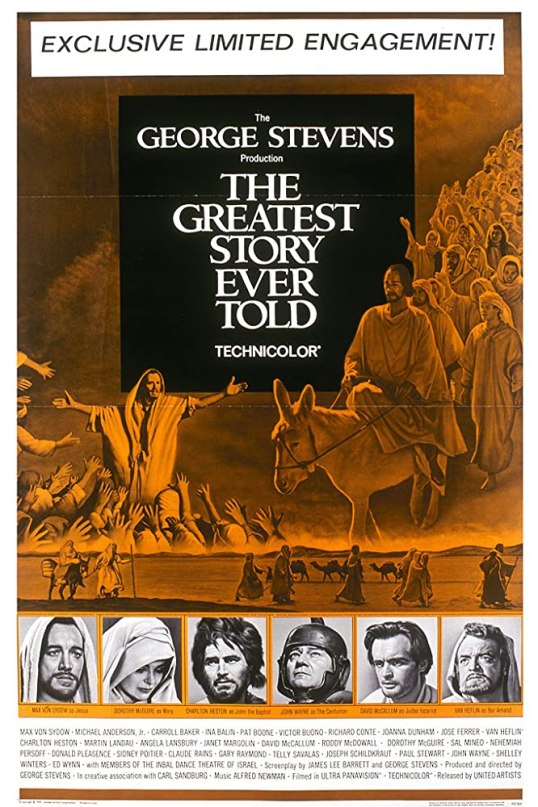
The 1965 biblical epic, The Greatest Story Ever Told, tells the story of the life of Jesus, from the Nativity to the Ascension. It’s probably the most complete telling of the story that you’ll ever find. It’s hard to think of a single details that’s left out and, as a result, the film has a four hour running time. Whether you’re a believer or not, that’s a really long time to watch a reverent film that doesn’t even feature the campy excesses of something like The Ten Commandments.
(There’s actually several different version of The Greatest Story Ever Told floating around. There’s a version that’s a little over two hours. There’s a version that’s close to four hours. Reportedly, the uncut version of the film ran for four hour and 20 minutes.)
Max von Sydow plays Jesus. On the one hand, that seems like that should work because Max von Sydow was a great actor who gave off an otherworldly air. On the other hand, it totally doesn’t work because von Sydow gives an oddly detached performance. The Greatest Story Ever Told was von Sydow’s first American film and, at no point, does he seem particularly happy about being involved with it. von Sydow is a very cerebral and rather reserved Jesus, one who makes his points without a hint of passion or charisma. When he’s being friendly, he offers up a half-smile. When he has to rebuke his disciples for their doubt, he sounds more annoyed than anything else. He’s Jesus if Jesus was a community college philosophy professor.
The rest of the huge cast is populated with familiar faces. The Greatest Story Ever Told takes the all-star approach to heart and, as a result, even the minor roles are played by actors who will be familiar to anyone who has spent more than a few hours watching TCM. Many of them are on screen for only a few seconds, which makes their presence all the more distracting. Sidney Poitier shows up as Simon of Cyrene. Pat Boone is an angel. Roddy McDowall is Matthew and Sal Mineo is Uriah and John Wayne shows up as a centurion and delivers his one line in his trademark drawl.
A few of the actors do manage to stand out and make a good impression. Telly Savalas is a credible Pilate, playing him as being neither smug nor overly sympathetic but instead as a bureaucrat who can’t understand why he’s being forced to deal with all of this. Charlton Heston has just the right intensity for the role of John the Baptist while Jose Ferrer is properly sleazy as Herod. In the role Judas, David McCallum looks at the world through suspicious eyes and does little to disguise his irritation with the rest of the world. The Greatest Story Ever Told does not sentimentalize Judas or his role in Jesus’s arrest. For the most part, he’s just a jerk. Finally, it’s not exactly surprising when Donald Pleasence shows up as Satan but Pleasence still gives a properly evil performance, giving all of his lines a mocking and often sarcastic bite.
The Greatest Story Ever Told was directed by George Stevens, a legitimately great director who struggles to maintain any sort of narrative momentum in this film. Watching The Greatest Story Ever Told, it occurred to me that the best biblical films are the ones like Ben-Hur and The Robe, which both largely keep Jesus off-screen and instead focus on how his life and teachings and the reports of his resurrection effected other people. Stevens approaches the film’s subject with such reverence that the film becomes boring and that’s something that should never happen when you’re making a film set in Judea during the Roman era.
I do have to admit that, despite all of my criticism of the film, I do actually kind of like The Greatest Story Ever Told. It’s just such a big production that it’s hard not to be a little awed by it all. That huge cast may be distracting but it’s still a little bit fun to sit there and go, “There’s Shelley Winters! There’s John Wayne! There’s Robert Blake and Martin Landau!” That said, as far as biblical films are concerned, you’re still better off sticking with Jesus Christ Superstar.
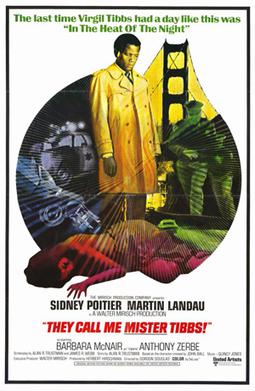
The 1970 police procedural, They Call Me Mister Tibbs!, opens with a murder in San Francisco.
A prostitute has been found dead in a sleazy apartment building and, according to witnesses, she was visited, shortly before her death, by the Reverend Logan Sharpe (Martin Landau). Rev. Sharpe is a prominent civic leader, an outspoken liberal who is a friend of the civil rights movement. Sharpe is currently at the forefront of a campaign to pass a city referendum that will add a “mini city hall” to every neighborhood and will help to fight against the gentrification of San Francisco. If Sharpe’s guilty, it will mean the death of the referendum.
Despite the fact that there’s a ton of evidence piling up against him and he kind of comes across as being a little bit creepy (he is, after all, played by Martin Landau), Rev. Sharpe insists that he’s innocent. Yes, he’s been visiting prostitutes but he’s not a client. No, of course not! Instead, Sharpe explains that he’s simply counseling them and praying for their souls. In fact, as far as Sharpe is concerned, this whole thing is just an attempt by the establishment to discredit his efforts to help the poor and underprivileged.
Heading up the investigation is a friend and supporter of Sharpe’s, Detective Virgil Tibbs (Sidney Poitier). That may seem like a good thing for Sharpe, except for the fact that Tibbs is an honest cop and he’s not the type to let friendship stand in the way of doing a thorough investigation. Tibbs admits that he supports Sharpe’s campaign and he wants the reverend to be innocent. But Tibbs is all about justice. Whether it’s teaching his son an important lesson about smoking or tracking down a potential serial killer, Virgil Tibbs is always going to do the right thing.
There are other suspects, all of whom are played by suitably sinister character actors. Anthony Zerbe plays a criminal who lived near the prostitute. Ed Asner plays her landlord, who may have also been her pimp. Is Sharpe being set up by the powers that be or is Tibbs going to have to arrest a man whom he admires?
They Call Me Mister Tibbs! was the second film in which Sidney Poitier played Virgil Tibbs. The first time he played the role was in 1967, when he co-starred with Rod Steiger in the Oscar-winning In The Heat of the Night. In that film, Poitier was a Philadelphia cop in the deep south who had to work with a redneck sheriff. In They Call Me Mister Tibbs!, Virgil is now working in San Francisco and he has to work the case on his own.
They Call Me Mister Tibbs! is a far more conventional film than In The Heat of the Night. Whereas In The Heat of the Night had a wonderful sense of place and atmosphere, They Call Me Mister Tibbs! could just as easily have taken place in Los Angeles, Phoenix, or even Philadelphia. With the exception of some slight profanity, They Call Me Mister Tibbs! feels more like a pilot for a TV show than an actual feature film. Perhaps the biggest problem with the film is that there’s no real surprises to be found within the film. You’ll guess who the murderer is within the first 10 minutes of the film and you’ll probably even guess how the movie will eventually end.
On the plus side, just as he did in In The Heat of the Night, Sidney Poitier brings a lot of natural authority to the role of Virgil Tibbs. He’s actually allowed to show a sense of humor in this film, which is something that the character (understandably) couldn’t do while he was surrounded by bigots and rednecks during his previous adventure. Virgil gets a few family scenes, where we watch him interact with his wife and his children. The scenes feel out of place but, at the same time, Poitier plays them well.
With Sharpe attempting to get his referendum passed and the possibility that riots could break out if Sharpe is indeed guilty of murder, there’s a slight political subtext to They Call Me Mister Tibbs! Sharpe’s argument that he was being set up by the establishment undoubtedly carried a lot of weight in 1970. Still, this is ultimately a shallow (if adequately entertaining) film that, for the most part, is only made memorable by Poitier’s commanding performance.
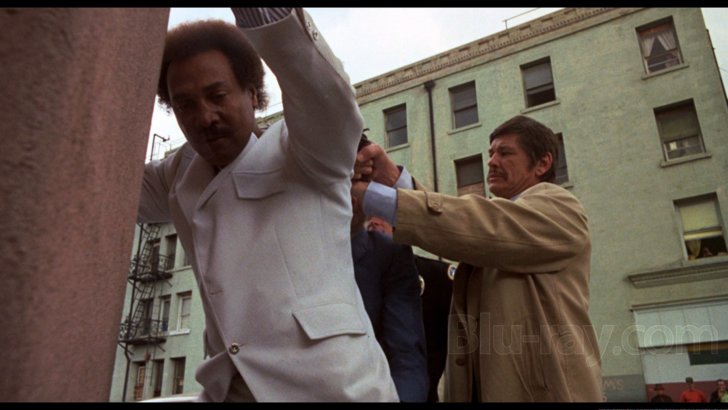
After tough New York detective Lou Torrey (Charles Bronson) lands in hot water for shooting and killing a teenage cop killer, he moves to Los Angeles and gets a job with the LAPD. Working under an unsympathetic supervisor (Norman Fell), saddled with an incompetent partner (Ralph Waite), and surrounded by paper pushing bureaucrats, Torrey still tries to uphold the law and dispense justice whenever he can. When a heroin dealer is murdered while in Torrey’s custody, Torrey suspects that it might be a part of a larger conspiracy, involving mobster Al Vescari (Martin Balsam).
Vescari is plotting something big. It has been nearly 40 since the “Sicilian Vespers,” the day when Lucky Luciano, Frank Costello, and Busy Siegel killed all of the original mafia dons at the same time. Viscari has invited mafia leaders from across the country to attend a special anniversary dinner. During the dinner, all of Vescari’s rivals will be assassinated. To keep things a secret, Vescari will not be using any of his usual hitmen. Instead, he has contracted a group of mentally unstable Vietnam vets, led by Lawrence (Stuart Margolin).
Charles Bronson has always been an underrated film star. His legacy has been tarnished by the cheap films he made for Cannon and, unlike Clint Eastwood, he never got a chance to really take control of his career and reinvent his image. But during the 1970s, not even Clint Eastwood was a more convincing action star than Charles Bronson. Bronson may have never been a great actor but he was an authentic tough guy with a physical presence that dominated the screen.
It was during this period that Bronson made his first four movies with director Michael Winner. Though Death Wish and The Mechanic are the best known, The Stone Killer may be the best. Tough, gritty, and action-packed with a great car chase, The Stone Killer was filmed on location in Los Angeles and some of the best parts are just the scenes of Bronson awkwardly interacting with the local, California culture. If you have ever wanted to see Charles Bronson deal with a bunch of hippies, this is the film to see. The Stone Killer also has more of social conscience than the usual 70s cop film, with Bronson’s character not only condemning excessive police brutality but also his racist partner.
(Ironically, Bronson and Winner would follow The Stone Killer with Death Wish, a film that many critics condemned as being racist and which suggested that the police were not being brutal enough.)
The other thing that sets The Stone Killer apart is that it has a great cast, featuring several actors who would go on to find success on television. Balsam, Fell, and especially Waite and Margolin are all great. Keep an eye out for a very young John Ritter, playing one of the only cops in the film who is not portrayed as being either corrupt or incompetent.
Though it may not be as well-known as some of his other action films, The Stone Killer is one of Bronson’s best.
For my final Netflix Noir, I watched The Mugger, a film from 1958.
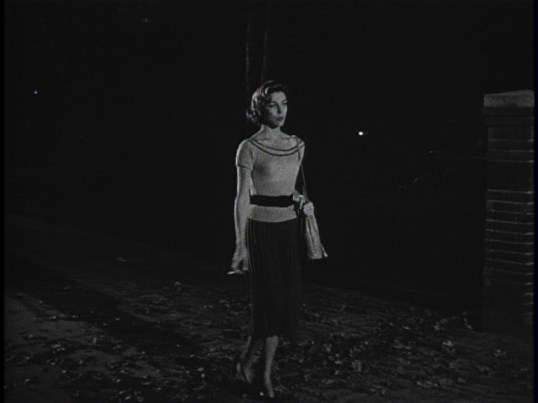
The Mugger is a police procedural. Taking place in an unnamed city, it stars Kent Smith as Dr. Pete Graham. Pete’s both a psychiatrist and a cop and, needless to say, he has a lot to deal with.
For one thing, his girlfriend, Claire (Nan Martin) is also a cop. In fact, she’s apparently the only female cop on the entire force! (“Woman cops?” another detective is heard to say, “Do we really need them?”) Claire spends most her time working undercover on the dance hall circuit. Pete wants to get married. Claire wants to solve a few more cases before making that commitment. Pete says that’s okay, as long as her plans “include me, a home, and children.”
Pete has also been forcefully recruited to counsel a Jeannie (Sandra Church), the sister-in-law of a local taxi driver. As the driver explains it, Jeannie is “about 18 and is she built!” Pete replies, “You shouldn’t get excited about a kid who wants to have a good time,” which seems like an unusually progressive attitude for a cop in the 1950s. Still, Pete agrees to try to encourage Jeannie to be a little bit less rebellious. Jeannie, by the way, is my favorite character in the film because she is never in a good mood and she gets to dismiss her older sister’s concerns by saying, “Maybe she’s getting a little old, a little jealous.”
It also turns out that Jeannie’s neighbor, Nick Greco (George Maharis), has a crush on her and apparently, just hangs out in her house all day. While this seemed rather creepy to me, the film seemed to suggest that this was just normal 50s behavior. Apparently, since nobody bothered to lock their doors back then, it was also totally appropriate to just hide in someone’s house and listen in on private conversations.
Peter’s other big problem is that there’s a mugger who is robbing women and cutting their cheek with a knife. I have to give the film some credit here because it doesn’t shy away from discussing the sexual subtext to these attacks, which I imagine was quite daring for a film in the 50s. Pete comes up with a detailed profile of the attacker, the sort of thing that would make the cast of Criminal Minds jealous. Claire goes undercover to catch the mugger and there’s a great scene where a drunk sailor tries to harass her and she threatens to shoot him in the knee caps. Again, this is not the sort of thing that we typically associate with a 50s film…
Which is not to say that The Mugger is not clearly a product of its time. For one thing, just check out the police force in this city, which is all white, all middle-aged, and — with the exception of Claire — all male. As well, this is one of those old movies where any woman who walks down a street will be leered at by every guy she passes, including the film’s heroes. One of the reasons why it was so great to see Claire threaten to cripple that soldier was because it came after 50 minutes of watching Pete and every other man in the film do a double take whenever she entered a room.
Clocking in at a little over 70 minutes and obviously low-budget, The Mugger is an undeniably obscure film. Checking with the imdb, I discovered only two reviews that had been previously written for this film and one of them was in Turkish! When I went onto YouTube to look for a trailer, I found nothing. The Mugger is forgotten and hardly a lost classic but I still enjoyed watching it. What can I say? I love my history and, if nothing else, The Mugger is definitely a time capsule.


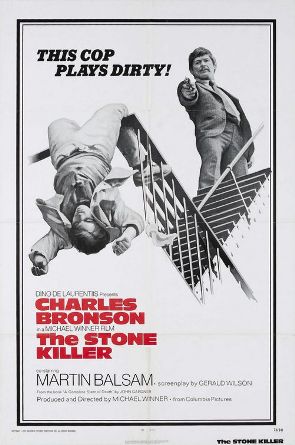 After tough New York detective Lou Torrey (Charles Bronson) lands in hot water for shooting and killing a teenage cop killer, he moves to Los Angeles and gets a job with the LAPD. Working under an unsympathetic supervisor (Norman Fell), saddled with an incompetent partner (Ralph Waite), and surrounded by paper pushing bureaucrats, Torrey still tries to uphold the law and dispense justice whenever he can. When a heroin dealer is murdered while in Torrey’s custody, Torrey suspects that it might be a part of a larger conspiracy, involving mobster Al Vescari (Martin Balsam).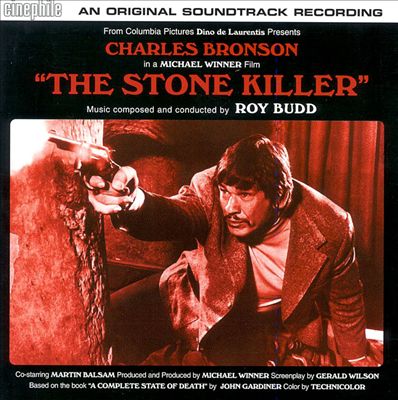
 Through the Shattered Lens