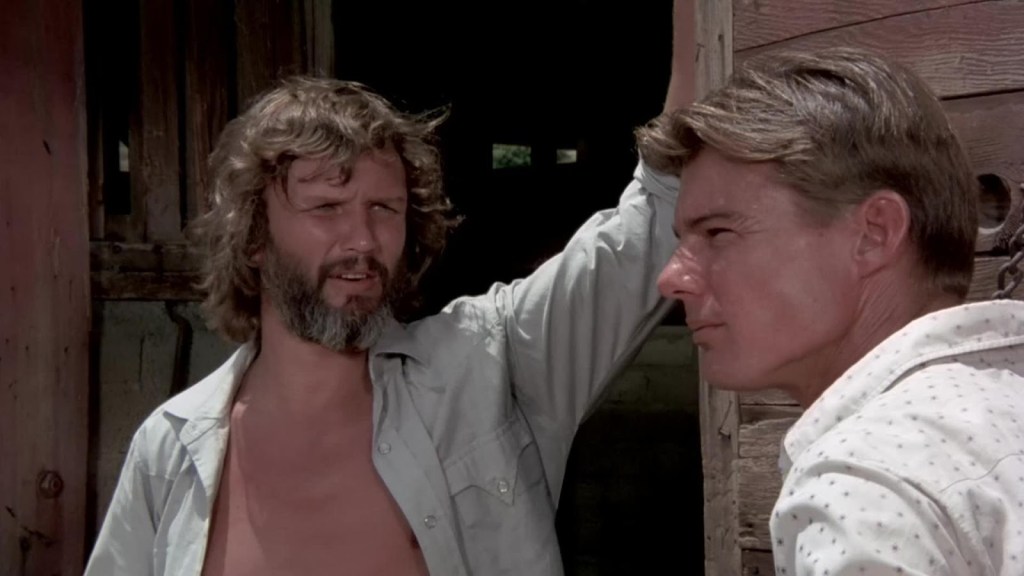
Brad reviews VIGILANTE FORCE (1976), starring Kris Kristofferson and Jan-Michael Vincent! 


I’ve been a fan of actor Jan-Michael Vincent for about as long as I can remember. I was a grade schooler in the mid-80’s when AIRWOLF was playing on network TV. I loved the show and Vincent’s character, Stringfellow Hawke. It was also around that time that I began my obsession with Charles Bronson, and Vincent co-starred in the iconic 1972 Bronson film THE MECHANIC (1972). Fox 16 out of Little Rock played the movie often, further cementing my appreciation for his work. And I specifically remember renting his 1980 movie DEFIANCE where his character takes on a ruthless gang in New York. It was my kind of movie, and I still watch it every few years. There’s just something I’ve always liked about Jan-Michael Vincent. July 15th, 2025 would have been his 80th birthday so I decided to watch one of his movies that I’ve never seen, VIGILANTE FORCE from 1976. It was playing on Amazon Prime, so I fired it up for my initial viewing. 

In VIGILANTE FORCE, Jan-Michael Vincent plays Ben Arnold, a guy from the small town of Elk Hills, California. It seems that the discovery of oil in the area has brought about a financial boom, but it’s also brought in a lot of rowdy out-of-towners and a surge in violent crime. Ben convinces the local community leaders to allow him to bring in his brother Aaron (Kris Kristofferson), a Vietnam war hero, to help restore order in town. Aaron assembles a group of ex-military types, friends of his, to help the local police restore order in town. Successful in cleaning out the riffraff at first, Aaron and his team of vigilantes eventually become the riffraff and use their law enforcement powers for their own corrupt, get-rich-quick schemes. Realizing that he made a horrible mistake in bringing in his brother, Ben is forced to confront Aaron and his team of murderous mercenaries in order to reclaim Elk Hills for its citizens.

I had not read anything beyond the title VIGILANTE FORCE and the basic cast list when I sat down to watch this film. I guess that’s a good thing, because I wasn’t expecting this movie to pit the brothers played by Vincent and Kristofferson against each other. I thought the two guys would be working together to get rid of a bunch of rednecks, and we do get that for the first half of the film, but when Kris goes bad, he really goes bad! And nobody is safe. This is one of those movies where he just kills whoever gets in his way, no matter how important or attractive they are. Writer-Director George Armitage, who would direct the excellent MIAMI BLUES (1990) fourteen years later, has said that he was trying to make a point about America’s involvement in the Viet Nam war with the Kristofferson character. Armitage apparently enjoys his references, as the film was made during the USA’s bicentennial year, but his two main characters are named after Benedict Arnold and Aaron Burr. While these ideas may have amused the director, his heavy-handed approach is not good for Kristofferson’s character in this film. His Viet Nam vet basically turns into an evil cartoon about halfway through the film and is no longer interesting, which is a shame because he gives a good performance.

Allegories aside, at its heart VIGILANTE FORCE is B-movie, drive-in fodder, and it’s pretty good at being that. It’s got that unpolished look and raw, energetic feel that I like in my low budget 70’s action movies. As you would expect in a film at this time, Jan-Michael Vincent is impressive and believable as the tough, good guy of the flick. Highly motivated due to the actions of our evil, out of control villain, Vincent handles the action scenes well in the film’s explosive finale. And I mean that literally, it seems that everything blows up big time at the end! Besides Kristofferson and Vincent, the film has a very recognizable supporting cast, which is one of the things I love about 70’s movies. Producer Gene Corman put together a cast that also includes Brad Dexter, Andrew Stevens, Victoria Principal, Bernadette Peters, Paul Gleason, Charles Cyphers, Loni Anderson and a host of other familiar voices and faces who add their unique talents to the proceedings. Principal, still a couple of years away from her career defining role as Pamela Ewing in the DALLAS TV series, is especially beautiful as Vincent’s girlfriend. 

Overall, while VIGILANTE FORCE is not required viewing, I can definitely recommend it to anyone who likes 70’s redneck action cinema, or to fans of the main stars. I enjoyed it! 

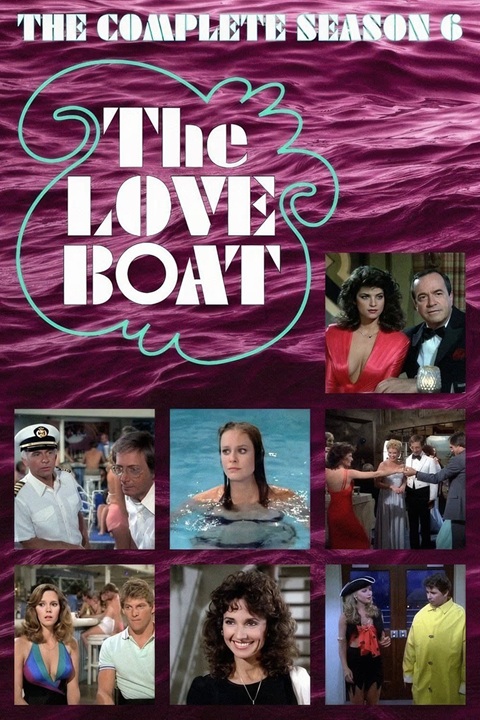
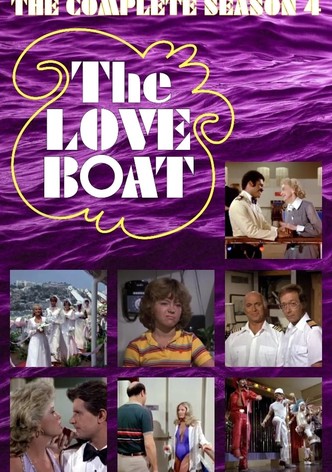
Retro Television Review: The Love Boat 6.4 “The Same Wavelength/Winning Isn’t Everything/A Honeymoon for Horace”


Welcome to Retro Television Reviews, a feature where we review some of our favorite and least favorite shows of the past!  On Wednesdays, I will be reviewing the original Love Boat, which aired on ABC from 1977 to 1986!  The series can be streamed on Paramount Plus!
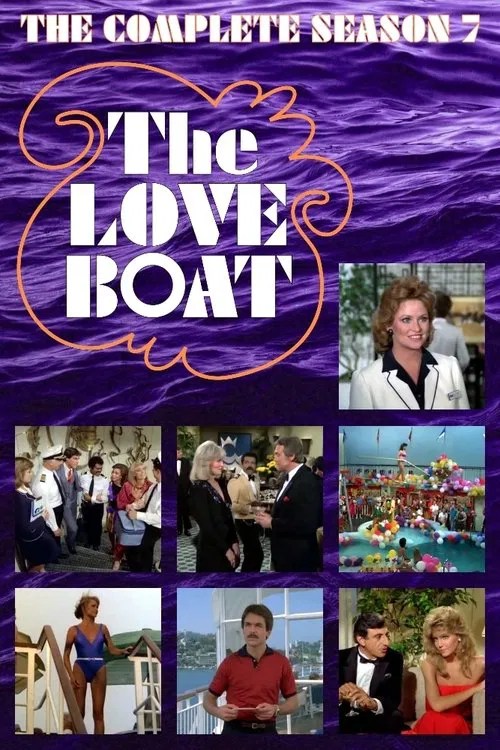
Come aboard, we’re expecting you….

Episode 6.4 “The Same Wavelength/Winning Isn’t Everything/A Honeymoon for Horace”

(Dir by Robert Scheerer, originally aired on October 23rd, 1982)

Yeesh!  This episode!  Because I’m on vacation, I’m going to lay out the facts quickly and simply.

  • Julie’s hair still looks awful.  Seriously, she looks like she should be playing the demanding gymnastics coach in a Peter Engel-produced high school sitcom.
  • Horace (Jack Gilford) and Twinkie (Nancy Walker) board the boat.  They’re in their 80s and they’re newlyweds!  Awwwww!  Horace is nervous about his honeymoon because it’s been forever since he’s kissed a woman so he asks Julie if he can practice on her.  Julie, her eyes oddly glazed over, agrees.
  • Twinkie, who loves to party, tells Julie that she’s actually been married to Horace for 30 years and he just said that he was a newlywed to trick Julie into kissing him.
  • Later, when confronted by Doc and Julie, Horace and Twinkie confess that they’re not actually married.  However, they are brother and sister.  WHAT!?
  • Turns out that Twinkie “likes to party” and Horace “likes to kiss pretty girls” so they lied so that they could do both.
  • Horace, you’re going to jail!  Oh wait, no, he’s not.  The Love Boat crew has a good laugh over it and Julie, to be honest, seemed to be pretty coked up in this episode so perhaps she had a good reason for wanting to avoid dealing with the cops.  Okay, Julie, do what you have to do, I guess.
  • Meanwhile, psychic Tess Macgill (Connie Stevens) falls in love with passenger Mike Gordon (Charles Seibert).  Unfortunately, Mike is still in love with his wife, despite the fact that they’re now separated.  It’s a good thing that there’s a psychic on board to let Mike know that his marriage is over.
  • Finally, Jack Bronson (David Doyle) boards the boat with his teenage son, Chip (Matthew Labyorteaux).  Jack is an old friend of Captain Stubing’s and he’s convinced that winning is everything!  As for Stubing, he’s just happy that Vicki will finally have someone her own age to spend some time with.  I’m happy too.  Seriously, Vicki hardly ever gets to talk to anyone under the age of 50.
  • Jack is convinced that Chip is a world-class athlete but that’s just because Chip has been lying to his father.
  • Vicki is great a table tennis.  Jack pressures Chip to play her.  Chip fakes a wrist injury to get out of it.
  • Eventually, Chip tells his father the truth and Jack realizes that he’s been pushing his son way too much.  That’s not a bad lesson but David Doyle is miscast as a competition-obsessed father.  He comes across as being too nice.  Jack is a role for Bo Svenson.

This episode …. bleh.  The psychic story was bland and the story with the elderly siblings was creepy.  The Jack and Chip story was, at least, tolerable.  Julie’s terrible new haircut continues to annoy me.  This was not the best cruise in the history of The Love Boat.

Brad’s “Scene of the Day” – The Pool Hall fight in COOGAN’S BLUFF!


One of the best action scenes in the Don Siegel / Clint Eastwood collaboration COOGAN’S BLUFF (1968)… I really enjoy this scene because Coogan tried to use Libby Raven, but she surprised him by being smarter than he thought she was. Enjoy this classic scene from COOGAN’S BLUFF!

I review COOGAN’S BLUFF (1968) – starring Clint Eastwood!


Here at The Shattered Lens, we’re looking forward to celebrating the birthday of Clint Eastwood on May 31st. In anticipation, I decided to revisit COOGAN’S BLUFF (1968). 

Clint Eastwood is Coogan, a tough as nails deputy sheriff from Arizona, who’s ordered by his boss, Sheriff McCrea (Tom Tully) to go to New York City and bring back the escaped killer James Ringerman (Don Stroud). When he gets to New York, he’s informed by Lieutenant McElroy (Lee J. Cobb) that Ringerman has overdosed on LSD while in the state’s custody, he’s now in the Bellevue Hospital, and he will not be released to Coogan until the state Supreme Court says so. Stuck in the Big Apple with nothing to do but flirt with probation officer Julie Roth (Susan Clark), Coogan decides to take matters into his own hands and get Ringerman out of the hospital early. He bluffs the attendants at the hospital into turning Ringerman over to him so he can catch the first plane back to Arizona. It seems like a good plan until he’s ambushed by Ringerman’s girlfriend Linny (Tisha Sterling) and his friend Pushie (David Doyle), he gets conked on the head, and he loses both his gun and his prisoner. Now, in trouble with Lieutenant McElroy and Sheriff McCrea, Coogan is ordered back home to Arizona. Determined to get Ringerman at any cost, Coogan stays in the city and leaves a trail of broken hearts and bruised bodies on his way to capturing his man! 

Made in 1968 after Eastwood’s string of excellent spaghetti westerns with Sergio Leone, COOGAN’S BLUFF may be set in contemporary times, but Coogan still seems to be a product of the old west. A big part of the fun is watching him interact with the people of New York City, where everyone is trying to take advantage of him, whether it be the cab driver, the hotel clerk, or the hooker down the hall. When he finally gets to the police station, he sees a building that’s completely overrun with criminals and crazies. He soon finds that Lieutenant McElroy follows the law down to the letter, while he treats the law as more of a set of suggestions on his way to getting the bad guys. This leads to endless frustration and almost gets Coogan arrested multiple times throughout the film as he doesn’t want to deal with all the red tape. One thing that doesn’t change whether Coogan is in Arizona or New York is his success with the ladies. They all swoon and he more than willingly obliges. The only problem for his prospect of true love is the fact that getting his guy always comes first, and he’ll use that sex appeal to get whatever information he needs. One of the main action scenes in this film, the bar fight, is set up ironically when the woman he’s “using” turns the tables and instead sets him up to be pummeled. 

COOGAN’S BLUFF is Eastwood’s first film with director Don Siegel, with whom he’d make DIRTY HARRY a few years later. You can definitely see the genesis of Harry Callahan in Walt Coogan, a man who does whatever it takes to stop criminals, is quick with a whip, and usually pisses off his superiors along the way. In some ways, you could say that Walt Coogan set the mold for the hero of cop films for the next couple of decades! It also has that sense of humor that would be a mark of Eastwood’s cop films. This one includes a funny thread that runs throughout where every person he meets assumes he’s from Texas because he wears a cowboy hat, and he always corrects them that he’s from Arizona. I get this as I always make sure people know that I’m from Arkansas! 

Overall, I really enjoy COOGAN’S BLUFF due mainly to Clint Eastwood’s excellent performance in the lead role. It was a great start to his “post Leone” career and would influence action movie heroes from that point forward. 

Retro Television Review: Fantasy Island 6.9 “Naughty Marietta/The Winning Ticket”


Welcome to Retro Television Reviews, a feature where we review some of our favorite and least favorite shows of the past!  On Tuesdays, I will be reviewing the original Fantasy Island, which ran on ABC from 1977 to 1984.  Unfortunately, the show has been removed from most streaming sites.  Fortunately, I’ve got nearly every episode on my DVR.

This week, Tattoo’s rich!

Episode 6.9 “Naughty Marietta/The Winning Ticket”

(Dir by Don Weis, originally aired January 8th, 1983)

Let’s get the boring storyline out of the way first.

Overbearing Beatrice Solomon (Jayne Meadows) wants her daughter, Alison (Dorothy Hamill) to become an actress.  Beatrice’s husband (David Doyle) wishes that Beatrice would just back off.  Mr. Roarke sends Alison into the past, where Alison finds herself transformed into Marietta, the subject of the operetta Naughty Marietta.  Lorenzo Lamas plays Captain Richard Warrington, who is trying to track down a notorious pirate on behalf of the Governor of Louisiana (James Doohan).  There’s a lot of singing and the costumes are nice but it’s also kind of boring because ice skater Dorothy Hamill was a terrible actress and she has next to no chemistry with Lorenzo Lamas.  The fantasy ends with everyone brought back to the present, including Lamas who, it turns out, was actually just a guest having a fantasy of his own.  It’s nothing we haven’t seen before and I don’t want to talk to much about it because the other story is …. A TATTOO STORY!

After years of being the sidekick and Mr. Roarke’s enigmatic frenemy, Tattoo finally gets a story of his own.  When Margaret Stanton (Hope Lange) comes to the Island to award a check to an employee who won the Irish Sweepstakes, Roarke is saddened to inform her that the man, a groundskeeper named Ambrose, passed away shortly after winning.  Roarke assigns Tattoo to find out who Ambrose’s closest friend was on the Island.  Tattoo takes his job seriously.  Afterall, Tattoo was one of the few people who regularly checked on the curmudgeonly old man, always stopping by to talk and to make sure that he was feeling okay.  As a matter of fact, you could even say that Tattoo was a true friend to the old man.  In the end, he was truly the old man’s best friend….

OH MY GOD, TATTOO’S RICH!

After reading the deceased man’s diary, Roarke and Tattoo realize that Ambrose would have wanted Tattoo to have the money.  Tattoo now has a million dollars and Roarke decides that this means that Tattoo is now a guest at Fantasy Island.  Tattoo moves into the most spectacular guest bungalow.  Tattoo orders a fancy meal and leaves a huge tip.  Tattoo is having a wonderful time until Mr. Roarke informs him that guests are not allowed to live on the Island….

WAIT, WHAT!?

Okay, first off, it wasn’t Tattoo’s idea to be a guest.  It was Roarke’s idea.  Roarke also mentions that Tattoo is the one who came up with the idea of not allowing guests to live on the Island but, over the past few seasons, we’ve seen many guests decide to never leave the Island and Roarke has never had a problem with it!  Seriously, I thought Tattoo and Mr. Roarke were finally getting along.  Suddenly, it seems like Mr. Roarke has decided to kick him out.  “I will miss you,” Mr. Roarke says.  Well, then don’t make him leave!  Can’t Mr. Roarke do whatever he feels like doing?

Tattoo, for his part, says that he will miss being on the Island.  He’ll miss Mr. Roarke.  He’ll miss the rest of the staff.  He’ll miss everything.  Tattoo decides that rather than leave the Island, he’ll donate the money to build a retirement home in England.  And that’s nice and all but I still don’t understand why Tattoo would have had to leave in the first place.  Maybe Mr. Roarke just wanted to teach Tattoo about generosity but Tattoo is already extremely generous.

As the show ends, Mr. Roarke mentions that Tattoo still needs to pay for his stay in the bungalow and for all the food he ordered.  DON’T START, MR. ROARKE!

This was a weird episode but it was still nice to see Tattoo get his moment in the spotlight.  I still think he should have allowed to keep the money and stay on the Island.  I mean, seriously, this Island is full of eccentric rich people living in haunted mansions.  Why should Tattoo miss out on all the fun?

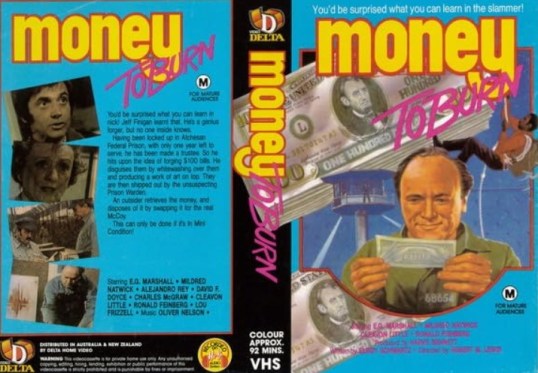
Retro Television Review: Money to Burn (dir by Robert Michael Lewis)


Welcome to Retro Television Reviews, a feature where we review some of our favorite and least favorite shows of the past!  On Sundays, I will be reviewing the made-for-television movies that used to be a primetime mainstay.  Today’s film is 1973’s Money To Burn!  It  can be viewed on YouTube.

For someone who has spent the past few years in prison, Jed Finnegan (E.G. Marshall) sure is a nice old man!  He runs the prison print shop and all of the other prisoners love him.  The guards trust him.  The warden (David Doyle) is really impressed with Jed’s watercolors and is interested in helping Jed launch a career as an artist after he gets out of prison.  Every weekend, Jed’s wife, Emily (Mildred Natwick), comes up to the prison with a picnic basket and she has lunch with her husband.  Jed admits that his wife is not a particularly good cook but it’s obvious that he really looks forward to her visits.

Emily’s sweet nature keeps a lot of people from noticing that she is just as cunning and clever a criminal as Jed ever was.  She knows that Jed had printed up one million dollars in counterfeit bills and she is looking forward to helping him exchange the fake money for real money.  Jed’s plan is to steal the payroll of the local army base and just leave the fake money in place of the real money.  However, Jed’s been in prison for so long that he doesn’t know that the military no longer pays anyone in cash.  Everyone’s paying everyone by check!

(This film is very much from the 70s.  While Jed and Emily were shocked to discover that people were no longer being paid in cash, I was shocked to discover that they were being paid by check.)

Working with two recently released ex-cons (played by Cleavon Little and Alejandro Rey), Emily tries to find a new way to switch out the money.  She discovers that there’s an incinerator nearby where the government burns the currency that it no longer needs.  But it won’t be easy to break in and make sure that the right money get burned….

And that’s not even mentioning the trouble of getting the fake money out of the prison in the first place!

Money to Burn is likable mix of comedy and (very mild) action.  It’s a film about criminals but they’re very likable criminals who go out of their way not to hurt people.  Emily is even happy about the idea of not only stealing a million dollars but also helping the government out by taking the old currency off their hands.  Marshall, Natwick, Little, and Rey all give such warm and cheerful performances that you can’t help but hope that they get away with their scheme.  The film, which deftly balances comedy and drama, clocks in at a brisk 73 minutes and it has an absolutely wonderful twist ending.  This is definitely a heist film that deserves to be better known.

Paper Lion (1968, directed by Alex March)


Writer George Plimpton (Alan Alda) is a Park Avenue sophisticate who practices “participatory” journalism.  He has already written about pitching in an exhibition all-star game and getting knocked out by Sugar Ray Robinson.  He is having trouble coming up with his next stunt until he goes to Central Park and plays a touch football game with his girlfriend Kate (Lauren Hutton) and his editor, Oscar (David Doyle).  Oscar sees George throwing the ball and decides that George should write about going to a professional football team’s training camp as a player.

George, who fantasizes about throwing the game-winning touchdown, is enthusiastic.  Most of the teams that George approaches are less enthusiastic but finally, the Detroit Lions agree to sign him as a quarterback.  Once the other players realize that George is a writer and not a professional athlete, there’s a lot of resentment.  As Guard John Gordy (playing himself) puts it, he could easily get injured while protecting an inexperienced quarterback like George.  George can always go back to Park Avenue but, for the rest of the players, the game is their life and they don’t like the idea of some outsider coming in and treating it all like a joke.  At first, only the fearsome defender Alex Karras (also playing himself) is willing to support George but eventually, George’s refusal to give up wins over the rest of the team.  They even let him score a touchdown during practice.

When the preseason begins, George waits for his opportunity to take the field.  How many yards can he lose in three plays?

Paper Lion is based on a true story.  In 1963, George Plimpton did attending training camp and play a scrimmage for the Lions and he later wrote a book about the experience.  The movie changes the time period from ’63 to ’67 so that all of the then-members of the Lions could play themselves.  (Though Karras was a friend of Plimpton’s, he was actually suspended during the 1963 season and, unlike in the movie, never joined Plimpton on the practice field.)  The film plays Plimpton’s football career largely for laughs, celebrating every guy’s fantasy of being a sports star while also showing why it’s probably best to leave the actual game to the professionals.  Alan Alda doesn’t imitate Plimpton’s famous Mid-Atlantic accent but he does capture the excitement of a man getting to live out his fantasy.

Paper Lion was made with the full cooperation of the NFL and a good deal of the film’s final third is made up footage that was shot for an actual game.  Seen today, it’s interesting to see how positively Paper Lion portrays both the game and its players and to contrast it with how the game is usually portrayed today.  There’s no talk of steroids or fears of multiple concussions.  All of the players are clean-cut, friendly, witty, and helpful.  Even the training camp hazing is all done is good fun.  Paper Lion introduces us to the nicest people in the world and they’re all football players!

Retro Television Review: The Love Boat 4.7 “The Horse Lover/Secretary to the Stars/Julie’s Decision/Gopher and Isaac Buy a Horse/Village People Ride Again”


Welcome to Retro Television Reviews, a feature where we review some of our favorite and least favorite shows of the past!  On Wednesdays, I will be reviewing the original Love Boat, which aired on ABC from 1977 to 1986!  The series can be streamed on Paramount Plus!

Come aboard, they’re expecting you!

Episode 4.7 “The Horse Lover/Secretary to the Stars/Julie’s Decision/Gopher and Isaac Buy a Horse/Village People Ride Again”

(Dir by Roger Duchowny, originally aired on November 22nd, 1980)

Well, let’s see who is sailing on the Love Boat this week….

Uh-oh.

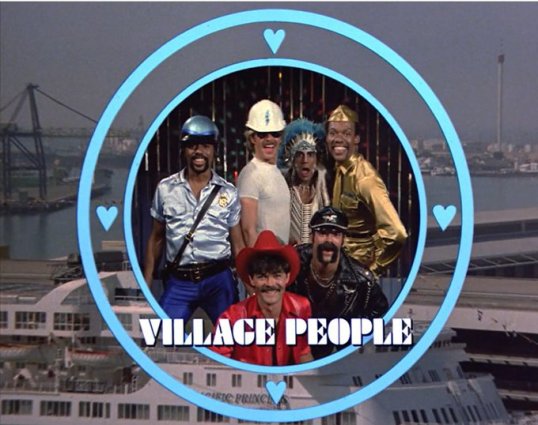
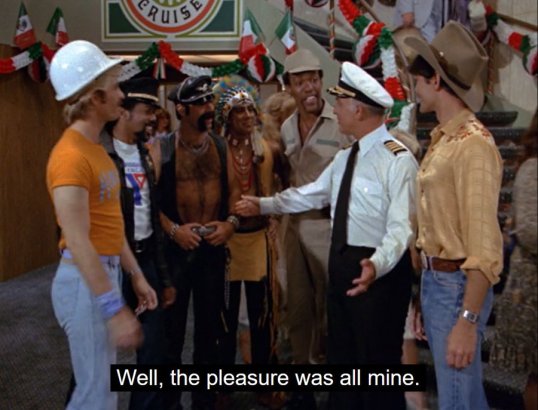
That’s right!  This week, The Village People are taking a cruise!  The disco group boards the boat while singing — you guessed it — In The Navy.  Captain Stubing is a huge fan of the Village People and he’s excited to learn that they will not only be sailing on the boat but they will also be performing their new song, Magic Night.  Stubing mentions that he wishes he could be a village person.  He’s already got a hat!  And he’s served in the Navy!  Stubing never gets around to whether or not he spent the night at YMCA and that’s probably a good thing.

This week, the boat is sailing to Acapulco for the Acapulco Steeplechase.  The Village People have entered a horse in the race, one that will be ridden by the Indian.  Gopher and Isaac have also bought a horse and entered it into the race.  They name the horse “Captain Stubing” and they go through a lot of trouble to keep the real Captain Stubing from finding out that they have snuck the horse on board.  The thing is, though — there are a lot of horses on board!  Nearly every passenger has brought a horse with them and the boat actually has a stable to hold them all during the cruise.  I’m not really sure why it’s a problem for Gopher and Isaac to have a horse, other than the fact that they both spend a lot of time checking in on the horse.  “Where is my crew!?” Stubing demands, while looking around the ship.

Paul Willis (Alan Ludden) is traveling with both his horse and his wife, Louise (Betty White).  Louise is upset that Paul seems to care more about the horse than her.  Louise even considers having a fling with Cliff (David Doyle), a man who wants to buy Paul’s horse.

Meanwhile, wealthy playboy Bret Garrett (Robert Stack) boards the ship and immediately falls in love with Julie.  Despite a 30-year age difference, Bret asks Julie to marry him.  This is the fourth or fifth times that a passenger has proposed to Julie during the course of a cruise.  Julie is happy but the crew worries that Bret might be too worldly and chronically unfaithful for Julie.

Finally, movie star Kim Holland (Loni Anderson) puts on glasses and a brunette wig and pretends to be an Englishwoman named Doris, all in order to keep people from bothering her on the cruise.  Tom Benson (Charles Frank) is obsessed, to an almost creepy extent, with Kim.  But then he falls in love with Doris, who he believes to be Kim’s secretary.  Tom fails to notice that 1) Doris looks just like Kim, just with glasses and brown hair and 2) Doris’s British accent doesn’t sound British at all.  Instead, it sounds like an American trying really hard to sound British.

The Steeplechase is won, rather easily, by Paul.  Both Gopher and the Indian end up getting thrown off their horses and they engage in a footrace to the finish line, for reasons that are not exactly clear.  After the race, Paul finally realizes how much he’s been neglecting Louise and he sells the horse to Cliff.  Meanwhile, Captain Stubing says that, next year, he’ll buy a horse with Gopher and Isaac and they’ll enter the horse into the race together.  As for Bret, he realizes that he’s not right with Julie and he pretends to cheat on her so that she’ll dump him.

And what about Kim?  Well, she tells Tom the truth and also reveals that her real name is June.  “Kim, Doris, June,” Tom says, “I can’t wait to get to know all three of you.”  Uhmm …. okay, not creepy at all.  Anyway, Tom and Kim leave the boat together but, right this episode ended, Kim appeared on an episode of Fantasy Island, in which she was again single and looking to escape her fame.  So, I guess she dumped Tom after a week.  Good for her!  Tom was super creepy.

Finally, all that is left to do is to say goodbye to the Village People.

This episode was an odd one.  Robert Stack was charming as Bret, even if he didn’t have much chemistry with Lauren Tewes.  Loni Anderson was fairly terrible as Kim, just as she would be on Fantasy Island.  And the Village People …. I mean, where do I even begin?  For a group associated with both disco and gay liberation, they came across as being an oddly dull collection of characters.  Of course, it’s doubtful that the target audience of The Love Boat knew what In The Navy was about or even understood why the members of the group were costumed the way that they were.  At one point, the Construction Worker even gives Julie an appreciate glance, as if the show’s producers were saying, “See, those rumors are just rumors!”

That said, I tend to like the odd episodes of The Love Boat and this episode functioned as a time capsule, if nothing else.  All it needed was Charo and it could have been put in a museum!

Retro Television Reviews: Fantasy Island 4.4 “Don Quixote/The Sex Goddess”


Welcome to Retro Television Reviews, a feature where we review some of our favorite and least favorite shows of the past!  On Tuesdays, I will be reviewing the original Fantasy Island, which ran on ABC from 1977 to 1986.  Almost the entire show is currently streaming is on Youtube, Daily Motion, and a few other sites.

This week’s journey to Fantasy Island is oddly unpleasant.

Episode 4.4 “Don Quixote/The Sex Goddess”

(Dir by Michael Vejar, originally aired on November 15th, 1980)

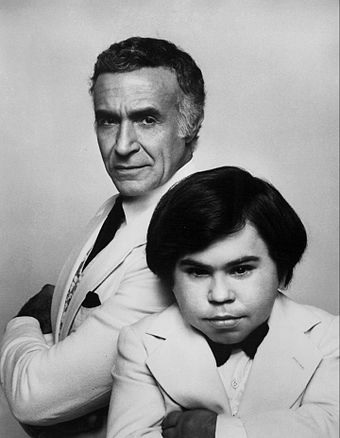
As always, this episode opens with “the plane, the plane” landing at Fantasy Island and Mr. Roarke and Tattoo heading out to meet their guests.  Unfortunately, as has been the case since the since the third season, Mr. Roarke and Tattoo no longer share any sort of playful banter before meeting the guests.  In fact, Roarke often seems to refuse to even look at Tattoo while speaking to him.  It’s awkward to watch because the dislike between Ricardo Montalban and Heve Villechaize is obvious whenever they share a scene.  It’s something that is easy to joke about while talking about the show but it’s far more unpleasant to actually witness.

Of course, this entire episode is rather unpleasant, which is a shame because Fantasy Island‘s greatest strength as a show was that watching it was usually a pleasant and undemanding way to spend an hour.

Take, for instance, the fantasy of Helen Hendrix (Phyllis Davis).  Helen’s fantasy is to become a “sex goddess.”  Tattoo expresses disbelief that the pretty but far from glamorous Helen could ever be a sex goddess but Roarke reminds Tattoo that, on Fantasy Island, all things are possible.  Roarke then says that Helen doesn’t realize that her fantasy could be a “a very dangerous fantasy.”

Well, Mr. Roarke, if it’s so dangerous, why did you agree to allow her to come to the Island?  In the past, Mr. Roarke has mentioned turning down many requests for fantasies.  He is apparently the final judge on whether or not someone will get their fantasy.  (Even when Tattoo granted a fantasy to someone who Roarke previously turned down, it was suggested that it was all a part of Roarke’s master plan.)  If the fantasy is so dangerous, why give it to Helen?  What is Mr. Roarke’s legal liability if someone gets killed while experiencing their fantasy?

Anyway, Mr. Roarke gives Helen a blue potion and when she drinks it, she becomes a blonde, starts wearing makeup, and gets a dress that’s far more flattering and low-cut than the borderline Amish outfit she was wearing when she first arrived at the Island.  She is now an internationally famous sex goddess, which unfortunately leads to her being kidnapped by three men (Michael Callan, Edd Byrnes, and Don Stroud) and held hostage on a neighboring island.  Eventually, Helen realizes that she’s going to have flirt her way out of captivity, which leads to a smitten Don Stroud helping her to escape.  Or, at least, he does until the potion wears off and Helen goes back being a brunette.  Stroud is shocked but, before he can strangle her, Roarke shows up and whisks Helen back to the Island.

Seriously, what a thoroughly unpleasant fantasy.  Helen comes to the island because she wants to know what it’s like to be famous and sexy and Roarke essentially allows her to be kidnapped by three men who apparently are planning on trafficking her.  Indeed, Roarke seems to suggest that this is Helen’s fault for wanting to be attractive in the first place.  Personally, I think Helen should sue Fantasy Island for all its worth.

As for the other fantasy, Paul Williams plays an eccentric Texas banker named Donald Quick.  His fantasy is to be Don Quixote.  (That’s a weird fantasy but whatever.)  Soon, Donald and his lawyer (David Doyle) are riding their donkeys across Fantasy Island while dressed up like conquistadors.  Donald saves a woman from a motorcycle gang and you have to wonder just what exactly a motorcycle gang is doing on Fantasy Island.  He saves another woman (Mary Louis Weller) from her louse of a boyfriend (Robert F. Lyons) and then he jousts with a Cadillac.  It’s silly but at least Donald finds love and David Doyle gets a few funny lines over how much he wants to sue Fantasy Island.

Honestly, this episode could have been saved if the two fantasies had intersected.  If Donald and his lawyer had turned up to battle the kidnappers and save Helen, this actually would have been an okay episode and the lawyer could have helped Helen file a lawsuit against Roarke.  But instead, the fantasies stay separate and the whole thing just feels icky.  Seriously, Mr. Roarke was not on top of his game of this week.  It might be time to give Tattoo more responsibility.

Retro Television Reviews: Blood Sport (dir by Jerrold Freedman)


Welcome to Retro Television Reviews, a feature where we review some of our favorite and least favorite shows of the past!  On Sundays, I will be reviewing the made-for-television movies that used to be a primetime mainstay.  Today’s film is 1973’s Blood Sport!  It  can be viewed on YouTube.

David Birdsong (played by Gary Busey, who was 29 at the time) is a high school senior with a potentially bright future ahead of him.  He’s the quarterback of his high school’s football team and it looks like he’s on the verge of leading his team to an undefeated season.  He’s getting recruited by all the big schools.  Scouts are coming to his games to watch him play.  He also has one of the highest GPAs at his school, though it’s suggested that might have more to do with his importance to the football team than his actual study skills.

“Don’t you have anything else you want to do with your life?” his high school principal (David Doyle) asks him and David’s reaction indicates that he’s never really given it much thought.  From the time he was born, David’s father, Dwayne (Ben Johnson), has been shaping his son to become a star athlete.  Dwayne is happiest when he’s watching David play, whether on the field or in the highlight reels that he keeps down in the basement.  When Dwayne sees that his son isn’t on the field, he’s the type of father who will get out of the stands and argue with the coach on the sidelines.  Dwayne continually tells David not to stay out too late.  The one time that David does, Dwayne slaps him hard enough to send his son to the floor.

Coach Marshall (Larry Hagman) is determined to get his undefeated season, no matter how hard he has to push his players.  The coach is the type who is convinced that his players respect him for his stern ways and his long-winded speeches but little does he realize that they all secretly despise him.  When one of his players drop dead of a heart attack during practice, Coach Marshall demands that the player stop being lazy and get up.  When he realizes that the player is never going to get up, Coach Marshall angrily asks, “Why did this have to happen now!?”  Later, at a pep rally, Coach Marshall announces that his team had a private meeting and agreed that they would win the final game in the player’s memory.  The team is disgusted but the rest of the town loves their coach.

David is never happier than when he’s on the field, playing football and being cheered by both the crowd and his team.  But, through it all, he sees reminders that the future in uncertain.  On the sidelines, David spots an injured player, watching the game with the knowledge that his dreams of getting a scholarship have ended.  When David visits a college, he’s reminded that being the best high school player doesn’t mean much in college and when he says that he’s a quarterback, he is told that his coach will ultimately decide who he is and David will accept the coach’s decision because David isn’t being offered a scholarship to think for himself.

When the film originally aired in 1973, it was called Birdsong but the title was changed to Blood Sport for both subsequent showings and for a European theatrical release.  Blood Sport is the more appropriate title because, even though the main character is named David Birdsong, the film is ultimately about all of the athletes who are expected to put their health at risk for the people on the sidelines.  It’s not just football that’s a blood sport, the film suggests.  It’s the entire culture that has sprung up around it, the one that cheers when players are at their best but which also looks away at the times when the players need the most help.

At 29 years of age, Gary Busey is a bit too old to be totally convincing as a high school senior but he still does a good job of capturing David’s gradual realization that he’s never really had any control over his own life.  Ben Johnson and especially Larry Hagman also give good performances as the two men who are living vicariously through David’s accomplishments.  Hagman is so believably obnoxious as the coach that you’ll want to cheer when someone finally finds the guts to stand up to him and tell him to just shut up for a minute.

The film ends on an ambiguous note, leaving many questions open about David’s future.  One hopes that he’s started to find the strength necessary to live his own life but it’s ultimately hard to say.  In the end, nothing is guaranteed, no matter how far you can throw a football.