Days of Paranoia: Dark Blue (dir by Ron Shelton)


2002’s Dark Blue opens in 1992, with a decorated Los Angeles cop named Eldon Perry (Kurt Russell) holed in a hotel room with a shotgun and a pistol.  Perry, who were learn comes from a long line of cops, should be happy. He’s about to finally get promoted.  While Los Angeles is in the grip of the riots that followed the Rodney King verdict, Perry’s lifelong dream is about to come true.  But, instead of celebrating, he’s a nervous wreck.  Dark Blue shows us why.

Perry is the protegee of Commander Jack Van Meter (Brendan Gleeson), a corrupt cop who regularly encourages his men to harass, arrest, and even kill anyone who is suspected of having committed a crime.  Van Meter and Perry claim that they’re doing what they need to do in order to keep the city safe.  They look at a reformer like Assistant Chief Arthur Holland (Ving Rhames) and they see someone who has no idea what it’s actually like on the streets and who is more concerned with his own ambitions than anything else.  However, Van Meter has a side operation going.  Two of his informants (played by Korupt and Dash Mihok) regularly commit robberies that he sets up and helps them get away with.  When their latest robbery leaves four people dead and one wounded, Van Meter assigns Perry and Perry’s young partner, Bobby Keough (Scott Speedman), to the case.  Bobby is young and maybe not as cynical as Perry.  But he’s also Van Meter’s nephew so the assumption is that he’ll play ball.

And, at first, Bobby does go along with whatever Van Meter and Perry say.  When Perry unknowingly gets too close to the truth about what happened at the robbery, Van Meter orders Perry and Bobby to go after someone else.  When Perry orders Bobby to execute an innocent man, Bobby does so and Perry takes the blame.  (In one of the film’s best scenes, Bobby gives his statement about the shooting to Internal Affairs, just for the detectives to shut off the tape recorder and give Bobby a chance to make a better statement.)  But when Bobby has a crisis of conscience and Van Meter reveals that depths that he’ll go to protect himself, Eldon Perry is forced to reconsider the life that he’s built for himself as a cop.  With Los Angeles descending into chaos, Perry has to finally decide whether or not to play the game or to do the right thing.

There’s a lot going on in Dark Blue. Actually, there’s too much going on.  The film is based on a story by James Ellroy and it has Ellroy’s traditionally dense plotting, full of duplicitous characters and macho dialogue.  Not only is Perry dealing with the investigation, he’s also dealing with his frayed marriage to Sally (Lolita Davidovich).  Not only is Bobby struggling with his ethics but he’s also struggling with his love for Sgt. Beth Williamson (Michael Michele), who is also Holland’s assistant and who also once had a one-night stand with Holland, pictures of which have gotten into Van Meter’s hands and which Van Meter plans to use to blackmail Holland into taking a job in Cleveland.  It’s a lot to keep track of and, visually, director Ron Shelton struggles to capture Ellroy’s trademark prose.  As a writer, Ellroy’s jittery style can get readers to accept almost anything, no matter how complex or potentially disturbing.  Ellroy has no fear of alienating the reader.  Shelton, on the other hand, has a much more gentle style and it’s not a good match for Ellroy’s vision of a world gone mad.  The film mixes Ellroy’s moral ambiguity with Shelton’s rather predictable liberal piety and the end result never really comes together.  Shelton doesn’t seem to be sure what he wants to say with Dark Blue.

That said, this film does feature an excellent performance from Kurt Russell.  Russell plays a character who is both good and bad.  Perry cares about his partner.  He cares about his family.  He’s loyal to the police department.  His methods may be extreme but he’s also taking criminals off the street.  But Perry is also thoroughly mired in Van Meter’s corruption.  Perry trusts Van Meter because Perry considers the police force to be his family.  His shock at being betrayed is one of the more poignant things about the film and Russell captures the moment perfectly.

Dark Blue has a lot that it wants to say, about morality, policing, and race relations.  It doesn’t really work because Ron Shelton was the wrong director to bring James Ellroy’s pulp sensibility to life.  But it does provide Kurt Russell a chance to show us that he’s one of our most underrated actors.

Lisa Marie Reviews An Oscar Nominee: The Thin Red Line (dir by Terrence Malick)


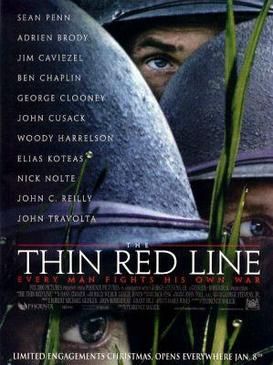
Based on a novel by James Jones (and technically, a sequel of sorts to From Here To Eternity), 1998’s The Thin Red Line is one of those Best Picture nominees that people seem to either love or hate.

Those who love it point out that the film is visually stunning and that director Terrence Malick takes a unique approach to portraying both the Battle of Guadalcanal and war in general.  Whereas Steven Spielberg’s Saving Private Ryan told a rather traditional story about the tragedy of war (albeit with much more blood than previous World War II films), The Thin Red Line used the war as a way to consider the innocence of nature and the corrupting influence of mankind.  “It’s all about property,” one shell-shocked soldier shouts in the middle of a battle and later, as soldiers die in the tall green grass of the film’s island setting, a baby bird hatches out of an egg.  Malick’s film may have been an adaptation of James Jones’s novel but its concerns were all pure Malick, right down to the philosophical voice-overs that were heard throughout the film.

Those who dislike the film point out that it moves at a very deliberate pace and that we don’t really learn much about the characters that the film follows.  In fact, with everyone wearing helmets and running through the overgrown grass, it’s often difficult to tell who is who.  (One gets the feeling that deliberate on Malick’s point.)  They complain that the story is difficult to follow.  They point out that the parade of star cameos can be distracting.  And they also complain that infantrymen who are constantly having to look out for enemy snipers would not necessarily be having an inner debate about the spirituality of nature.

I will agree that the cameos can be distracting.  John Cusack, for example, pops up out of nowhere, plays a major role for a few minutes, and then vanishes from the film.  The sight of John Travolta playing an admiral is also a bit distracting, if just because Travolta’s mustache makes him look a bit goofy.  George Clooney appears towards the end of the film and delivers a somewhat patronizing lecture to the men under his command.  Though his role was apparently meant to be much larger, Adrien Brody ends up two lines of dialogue and eleven minutes of screentime in the film’s final cut.

That said, The Thin Red Line works for me.  The film is not meant to be a traditional war film and it’s not necessarily meant to be a realistic recreation of the Battle of Guadalcanal.  Instead, it’s a film that plays out like a dream and, when viewed a dream, the philosophical voice overs and the scenes of eerie beauty all make sense.  Like the majority of Malick’s films, The Thin Red Line is ultimately a visual poem.  The plot is far less important than how the film is put together.  It’s a film that immerses you in its world.  Even the seeming randomness of the film’s battles and deaths fits together in a definite patten.  It’s a Malick film.  It’s not for everyone but those who are attuned to Malick’s wavelength will appreciate it even if they don’t understand it.

And while Malick does definitely put an emphasis on the visuals, he still gets some good performances out of his cast.  Nick Nolte is chilling as the frustrated officer who has no hesitation about ordering his men to go on a suicide mission.  Elias Koteas is genuinely moving as the captain whose military career is ultimately sabotaged by his kind nature.  Sean Penn is surprisingly convincing as a cynical sergeant while Jim Caviezel (playing the closest thing the film has to a main character) gets a head start on humanizing messianic characters by playing the most philosophical of the soldiers.  Ben Chaplin spends most of his time worrying about his wife back home and his fantasies give us a glimpse of what’s going on in America while its soldiers fight and die overseas.

The Thin Red Line was the first of Terrence Malick’s films to be nominated for Best Picture and it was one of three World War II films to be nominated that year.  However, it lost to Shakespeare In Love.

Quickie Review: Punisher: War Zone (dir. by Lexi Alexander)


If there was ever a Marvel Comics character who was perfectly suited to star in a grindhouse film it would be Frank Castle aka The Punisher. He’s a character who takes the term anti-hero past its limits and who makes other film vigilantes seem like sissy, choir boys. In December 2008 Lionsgate released a sort of reboot of The Punisher by Jonathan Hensleigh and starring Thomas Jane in the titular role. This time around the role of Frank Castle goes to Ray Stevenson (The Other Guys, Thor, Kill the Irishman) with German-filmmaker Lexi Alexander taking on the director’s reins.

Punisher: War Zone takes much of the characters in the film from story-arcs found in the Marvel Knight’s Punisher MAX series which took the character and his stories into a darker realm of violence. This latest film definitely owes much of it’s darker and more violent tone from that comic book line while at the same time creating a look which brings to mind the garish and over-the-top grindhouse action films of the early 80’s. The film quickly establishes who the Punisher is and what motivates him to take on and kill (heavy emphasis on kill) the criminal underworld of the city. In an opening sequence that probably out-violences every other film released in 2008, the Punisher wipes out a gathering of mobsters in every bloody way as possible. Blood and gore flows and splatters a-plenty in the first 10-15 minutes of this film.

There’s a semblance of a story which involves Castle mistakenly killing an undercover FBI agent which causes him a momentary crisis of conscience, but it really doesn’t last too long as there are more criminals to kill, main and blow up. If there’s one thing the Punisher knows how to do best it’s those three things. Ray Stevenson in the title role doesn’t get to emote much, but does a great job in showing the characters ice-cold ruthlessness paired with a sort of dead-man walking persona which rings true to how the Punisher has been written up of late. His Frank Castle is dead inside and only when he’s the Punisher does he even show any sort of life (even if it’s the barest hint). His foil this time around brings one of the Punisher’s earliest arch-enemies in the disfigured mobster (caused by the Punisher) Jigsaw (played with over-the-top campy relish by Dominic West). Where Castle is deadly serious to the point of morbidity his opposite was all garish with a liberal dose of crazy.

Punisher: War Zone really dispenses with any complexities to it’s plot and just finds reasons and excuses for the Punisher to go on another killing spree against criminals that for some it might not be enough. As a lover of grindhouse and exploitation films what this film offers was enough and really goes a long way in entertaining in such an 80’s fashion. It’s a film that revels in its violent absurdities and campy storytelling. Even the acting by all in the film passes the line of campy and into a sort of Looney Tunes level which makes the extreme violence and gore of the killings more cartoonish than realistic. This was a film that celebrated it’s grindhouse roots from the actors, the filmmakers all the way down to it’s cinematographer and art directors. It’s disposable entertainment and it knows it so doesn’t bother to try and hide that fact and just tries to entertain in every manner possible and then some.