Icarus File No. 21: Reach Me (dir by John Herzfeld)


The 2011 film, Reach Me, opens with a rapper named E-Ruption (Nelly) appearing on a morning show and talking about how, while he was serving a prison sentence, he read a self-help book called Reach Me.  It asked him to consider whether or not his childhood self would be happy with his adult self.  The book was written by a mysterious man named Teddy Raymond.  No one knows who this Teddy Raymond is.  He’s never appeared in public.  People film themselves reading the book online and then upload to YouTube as a way of sharing Teddy’s wisdom.  I honestly can think of nothing more annoying and boring than watching someone else read a self-help book but whatever.  I live in Texas.  The movie takes place in California.

Tabloid editor Gerald (Sylvester Stallone) takes a break from action painting to order one of his reporters, Roger King (Kevin Connolly), to track down Teddy Raymond.  Roger wants to write the great American novel.  He doesn’t care about self-help.  He meets Teddy’s associates, Wilson (Terry Crews) and Kate (Lauren Cohan) and Wilson talks about how Teddy magically cured Kate’s stutter.  Roger then wanders around the beach, asking random people, “Teddy Raymond?  Are you Teddy Raymond?”  Oh look!  There’s a guy named Teddy (Tom Berenger) who reluctantly cures Roger of his smoking addiction by ordering Roger to yell at the ocean …. over and over and over again.

Collette (Kyra Segdwick) has just been released from prison.  Reading Teddy’s book has inspired her to try to become a fashion designer.  Collette’s daughter, Eve (Elizabeth Henstridge), is an aspiring actress who was earlier groped by a sleazy star named Keating (Cary Elwes).  Collette and Eve literally crash their car into a car being driven by Wolfie (Thomas Jane), a sociopathic undercover cop who enjoys killing people and who goes to confession after every shooting.  (At the start of the movie, he guns down Danny Trejo.)  The alcoholic priest, Father Paul (Danny Aiello), refuses to hear any more of his confessions.

Meanwhile, wannabe mob boss Frank (Tom Sizemore) is upset because another mob boss, Aldo (Kelsey Grammer), doesn’t treat him with any respect.  Frank sends two of his hitmen, Thumper (David O’Hara) and Dominic (Omari Hardwick), to kill a man who owes him money and to also shoot the man’s dog.  Thumper has been reading Teddy Raymond’s book and doesn’t want to shoot the dog.  Dominic realizes that his heart isn’t into the mob life so, taking the book’s message to heart, he calls Frank and says, “My heart’s not in it.”

(Don’t try that with any real mobsters.)

Eventually, all of the characters do come together.  They don’t exactly come together in a plausible manner but they do all end up at the same location so let’s give the film credit for that.  Let’s also give this film credit for leaving me seriously confused.  I have no idea whether this film was meant to a parody or a celebration of the self-help industry.  At first, I suspected that it meant to be a parody because all of Teddy Raymond’s advice was painfully shallow and the type of basic crap that anyone could come up with.  I actually found myself losing respect for the people who claimed that Teddy had changed their lives.  But at the movie progressed, I realized that I was supposed to take Teddy and his advice seriously.  This was a film that I guess was meant to have something to say but who knows what exactly that was.

That said — hey, everyone’s in this movie!  Director John Herzfeld was a former college roommate of Sylvester Stallone’s and, once Stallone agreed to appear, that apparently convinced a lot of other “name” actors to take the risk as well.  There’s a lot of talent in this film but little of it is used correctly.  Kelsey Grammer as an Italian mobster instead of the editor?  Sylvester Stallone as the editor instead of the Italian mobster?  Thomas Jane as a sociopath who has a girlfriend by the end of the movie, one who smiles and tells him, “Try not to shoot anyone?”  Kyra Sedgwick as an ex-con?  These are all good actors but just about everyone, with the exception of the much-missed Danny Aiello, is miscast.

It’s a true Icarus File.  It was a just a little more self-aware, this would have been a Guilty Pleasure.  But, in the end, self-help cannot help itself.

Previous Icarus Files:

  1. Cloud Atlas
  2. Maximum Overdrive
  3. Glass
  4. Captive State
  5. Mother!
  6. The Man Who Killed Don Quixote
  7. Last Days
  8. Plan 9 From Outer Space
  9. The Last Movie
  10. 88
  11. The Bonfire of the Vanities
  12. Birdemic
  13. Birdemic 2: The Resurrection 
  14. Last Exit To Brooklyn
  15. Glen or Glenda
  16. The Assassination of Trotsky
  17. Che!
  18. Brewster McCloud
  19. American Traitor: The Trial of Axis Sally
  20. Tough Guys Don’t Dance

Lisa Reviews An Oscar Nominee: Moonstruck (dir by Norman Jewison)


Nominated for Best Picture of 1987, Moonstruck is a film about love, romance, New York City, and being Italian.

Loretta Castorini (Cher) is a widow and a bookkeeper who lives with her parents, Cosmo (Vincent Gardenia) and Rose (Olympia Dukakis) in Brooklyn.  When her boyfriend, Johnny (Danny Aiello), asks Loretta to marry him, Loretta says yes even though she knows that, while she likes him, she’s not really in love with him.  After he proposes, Johnny reveals that he has to go to Sicily to see his “dying” mother.  He asks Loretta to pay a visit to his estranged brother, Ronny (Nicolas Cage), and invite him to the wedding.  Loretta, a strong believer in family and the importance of following tradition, agrees.

Loretta finds Ronny working in the bakery that he owns.  Ronny is not thrilled to learn that his brother has gotten engaged.  Ronny reveals that he has a wooden hand.  He lost his real hand when he accidentally placed it in a bread slicer while having a conversation with Johnny.  After he lost his hand, Ronny’s then-fiancée left him.  Ronny has never forgiven Johnny for the loss of his hand.  “I lost my hand!  I lost my bride!”  Ronny yells to the heavens.  Loretta, however, immediately understands that Johnny actually hurt his hand to get his fiancée to break up with him.  A conversation at Ronny’s apartment leads to the two of them impulsively sleeping with each other.  The next day, Ronny promises to never bother Loretta again if she agrees to go the opera with him.

What the guilt-stricken Loretta doesn’t know is that her father is having an affair himself and it turns out that Cosmo and Mona (Rose Gilette) enjoy the opera as well.  Meanwhile, Rose finds herself tempted by a lecherous college professor named Perry (John Mahoney).

There’s a lot of stereotypes to be found in Moonstruck.  Of course, passionate Ronny loves the opera.  Of course, the simple but well-intentioned Johnny abandons his fiancée so that he can rush to Sicily to be with his “dying” mother who, it turns out, isn’t dying at all.  Of course, Loretta slaps Ronny and tells him to snap out of it.  (I should note that I’m a fourth Italian myself so I could definitely relate to some of this film.  I’ve never liked opera, though.)  Fortunately, the film’s cast is so perfectly chosen and John Patrick Shanley’s script so adroitly maintains the balance between the broad comedy and the small dramatic moments that it doesn’t matter that all of the characters are a bit stereotypical.  The film comes to a wonderful life.  It’s impossible not love these characters, flaws and all.  Cher and Olympia Dukakis deserved the Oscars that they both won for this film.  Vincent Gardenia deserved the nomination that he received.  Nicolas Cage, Danny Aiello, and John Mahoney were not nominated but they should have been.  In particular, John Mahoney is heart-breaking in his small role, playing the type of lecherous character that most films would have just portrayed as being a cardboard buffoon.  As for Nicolas Cage, Moonstruck is a film that features both his trademark eccentricity and his ability to show the real and vulnerable human being underneath all of the bluster.  Moonstruck is a film about the search for love and the glory of finding it.  It’s a wonderfully romantic film, even if almost all of that love seems to involve infidelity.  As directed by Norman Jewison, Moonstruck not only celebrates falling in love but also celebrates being lucky enough to do so in New York City.  It’s a love letter not just to its characters but to the city as well.

Moonstruck was nominated for Best Picture but it lost to a far more epic production, The Last Emperor.


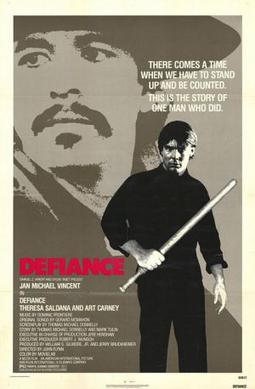
Defiance (1980, directed by John Flynn)


Serving out a six-month suspension, Merchant Seaman Tommy Campbell (Jan-Michael Vincent) rents an apartment on New York’s Lower East Side and passes the time painting and trying to learn Spanish in hope of getting assigned to a ship that is heading to Panama.

Tommy just wants to be left alone but he finds himself being drawn into the close-knit neighborhood.  He becomes friends with Carmine (Danny Aiello) and more than friends with his upstairs neighbor (Theresa Saldana).  He becomes a mentor to a street kid (Fernando Lopez) who lives with a punch-drunk boxer named called Whacko (Lenny Montana).  Abe (Art Carney), who owns the local bodega, agrees to let Tommy use his phone.

Tommy also finds himself drawing the attention of Angel Cruz (Rudy Ramos), head of the local street gang.  Tommy doesn’t want to get involved in any trouble.  He just wants to serve his suspension and sail to Panama.  But with Angel and his gang terrorizing the neighborhood and even robbing a church bingo game, Tommy and his friends finally stand up to the gang.

Defiance is more intelligent and realistic than many of the other urban vigilante movies that came out in the 70s and 80s.  Tommy never becomes a cold-blooded killer, like Charles Bronson did in the Death Wish films.  Instead, he spends most of the film trying to stay out of trouble and, when he does stand up for himself and the neighborhood, he does so realistically.  He fights the gang members but he doesn’t set out to the kill them.  About as deliberately destructive as he and Carmine get is that they destroy Angel’s car.  Rather than being a typical vigilante movie, Defiance is a portrait of a neighborhood where everyone takes care of everyone else.  Angel and his gang mistake the neighborhood’s kindness for weakness.  The neighborhood proves them wrong.

Defiance stars two actors who never quite got their due.  Theresa Saldana’s promising career was derailed when she was attacked and nearly killed by a deranged stalker in 1982.  Though she recovered and went on to do a lot of television, she never became the star that she should have.  Jan-Michael Vincent did become a star in the 70s and 80s but he later became better-known for his struggles with drugs and alcohol.  Both of them are very good in Defiance and leave you thinking about the careers that they could have had if things had just gone differently.

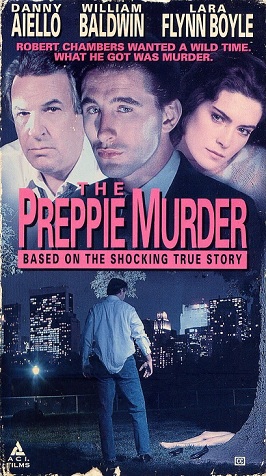
October True Crime: The Preppie Murder (dir by John Herzfield)


The 1989 film, The Preppie Murder, tells the story of the murder of Jennifer Levin (played by Lara Flynn Boyle), an 18 year-old teenager from an affluent family, who was found dead in Central Park on August 26,1986.

The man who was accused of murdering her was Robert Chambers (played by William Baldwin).  Tall, handsome, and popular, Robert Chambers was a former prep school student who had spent one semester at Boston University before being asked to leave because of a series of petty crimes.  Though Chambers and Levin were both a part of the same social circle, Chambers did not come from a wealthy family.  Instead, his background was working class.  (That said, his mother did once serve as a private nurse to John F. Kennedy, Jr. and Robert Chambers even met the presidential scion once.)  Chambers supported himself through stealing his girlfriend’s jewelry and selling drugs.  At the time that he started dating Jennifer Levin, he had just gotten out of rehab.  As shown in the early part of the film, Jennifer’s friends warned her that Chambers had a bad reputation but Jennifer felt that he was just someone who had made mistakes and who was trying to take advantage of his second chance.  To be honest, it’s a sentiment to which I could relate.  I think every woman has had at least one Robert Chambers in their life, the bad boy who could melt hearts with calculated moments of vulnerability but who, in the end, turned out to be an empty shell of a human being.

In the film, the murder occurs off-screen.  We watch as Robert and Jennifer leave a bar together and then we cut to the next morning, with Robert watching from a distance as a homicide detective (Danny Aiello, bringing his trademark, no-nonsense New York style to the role) investigates the scene of Jennifer’s murder.  When the police learn that Robert was the last person to see Jennifer alive, Robert is brought in for questioning.  The cocky Robert attempts to explain away the scratches on his face and body by saying that his cat scratched him.  (“Do you own a tiger?” Aiello’s detective asks him.)  When Robert finally confesses to having killed Jennifer, he claims that he Jennifer was assaulting him and that he only struck her in self-defense.  It’s a ridiculous and offensive story but it’s one that the press loves.  Robert may be the one charged with a crime but it soon becomes clear that, despite not being able to defend herself, Jennifer is the one being put on trial.

It’s an infuriating film, all the more so because it was based on a true story and stuck close to the facts of both the case and the trial.  William Baldwin is well-cast as Robert Chambers, playing him as a handsome and superficially charming man who secretly knows that he’s empty on the inside.  William Devane plays Chambers’s high-priced attorney, who puts Jennifer on trial and only briefly allows himself any feelings of guilt about his actions.  Lara Flynn Boyle wins the viewer’s sympathy in her limited screen time and Danny Aiello is, of course, the perfect New York cop.

What was particularly disturbing about the film was its portrayal of Jennifer and Robert’s friends, many of whom chose to support Robert even though they knew he had murdered Jennifer.  The film ends with clips of Robert at a party that was thrown by his friends after he got out on bail.  While Robert pretends to twist off a doll’s heads, his friends laugh in the background, either unaware or unconcerned that Robert is recreating his murder of Jennifer while they watch.

The real-life Robert Chambers eventually pled guilty to manslaughter and spent 15 years in prison.  He was released in 2003 and promptly returned to his old life of petty crime and drug dealing.  He was sent back in prison, convicted of selling $2800 worth of heroin to an undercover cop.  He was released in July of this year.

Music Video of the Day: Besame Mucho by Danny Aiello, feat. Hasan (2007, dir by Frankie Nasso)


“Michael Corleone says hello!”

Seriously, it’s amazing what you can come across on the YouTube when you’re searching for a music video of the day.  This single appeared on an album called I Just Want To Hear The Words.  Apparently, this was one of several albums that the actor Danny Aiello released during his lifetime.  As a singer, Danny Aiello sounds …. well, he sounds exactly how you would expect an old school New York crooner to sound.  Considering that most of his roles involved him doing a lot of bellowing, Aiello had a rather pleasant singing voice.

With the Oscars coming up, I should mention that Danny Aiello was nominated for Best Supporting Actor for his role in Spike Lee’s Do The Right Thing.  He also appeared as one of the Rosato Brothers in The Godfather Part II.  Reportedly, Aiello improvised the line, “Michael Corleone says hello!”

Enjoy!

Miniseries Review: The Last Don II (dir by Graeme Clifford)


The Clericuzio saga continues and it’s sillier than ever!

The Clericuzios were the Mob family who were first introduced in a Mario Puzo novel called The Last Don.  In 1997, CBS turned The Last Don in a three-part miniseries.  The ratings were good enough that, in 1999, the network gave the world a two-episode sequel, The Last Don II.  The Last Don II was created without the input of Mario Puzo (who died shortly before the miniseries aired) but director Graeme Clifford returned, as did a few members of the cast.

For example, Danny Aiello briefly returns as the honorable but aging Don Domenico Clericuzio, talking about life in the old country and demanding to know why some of his children have yet to marry.  Under his leadership, the Clericuzios are almost totally legit and they’ve even become powerful in Hollywood.  Claudia De Lena (Michelle Burke) is in charge of the family’s film studio and has recently become engaged to a film star named Dirk Von Schelburg (Andrew Jackson, trying to do an Arnie impersonation but coming across more like Jean-Claude Van Damme).  Still, despite the fact that the Clericuzios are (slowly) abandoning organized crime, they haven’t completely cut their ties.  They still have enemies.  And when Don Clericuzio dies after dancing at his final birthday party, those enemies are set to strike.

Who can run the Clericuzio family?  Only one of the Don’s son was actively involved in the underworld aspect of the organization and he’s promptly (and, to be honest, hilariously) crushed when someone drops a shipping crate on him.  Another Clericuzio son is gunned down at his legitimate business, proving that someone is trying to take out the entire family, regardless of whether they’re a part of the family business or not.  Georgio Clericuzio (David Marciano) goes to Paris and tires to convince Claudia’s brother, Cross (Jason Gedrick), to return from exile to take things over.  Cross refuses because he’s happily married to the most famous actress in the world, the improbably named Athena Aquataine (Mo Kelso, replacing Daryl Hannah in the role).  However, Athena is subsequently blown up by a bomb that was meant for Cross and that’s all it takes to bring Cross back to America.

Now that Cross is in charge, he sets about to discover who, among the other Families, is targeting the Clericuzios.  Helping him out with this is Billy D’Angelo (James Wilder), who we are told is the the most important of the Clericuzios capos, despite the fact that he was neither seen nor mentioned in the previous Last Don.  It seems pretty obvious from the start that Billy is not to be trusted.  Everyone who has ever seen The Godfather will automatically look at Billy and say, “There’s your rat.”  But Cross is a remarkably naïve crime lord.  He’s apparently the only guy in the Mafia who has never seen a Mafia movie.

Of course, there’s more going on than just Cross trying to figure out who is targeting the Clericuzio family.  His unstable aunt, Rose Marie (Kirstie Alley), wants revenge for the murder of her son Dante but, fortunately, she’s distracted by an affair with the family’s priest (Jason Isaacs, of all people).  Disgraced former studio exec Bobby Bantz (Robert Wuhl) is plotting against Claudia.  And finally, Cross is falling in love with his stepdaughter’s nanny (Patsy Kensit) despite the fact that it’s kind of obvious that the nanny is actually an undercover FBI agent.  Remember what I said about Cross being impossibly naïve?

The Last Don was a fairly silly miniseries.  The Last Don 2 is even sillier but, for that every reason, it’s also a bit more entertaining.  If the first Last Don was held together by the rivalry between Cross and Dante, the sequel is held together by a nonstop flow of melodrama, overheated dialogue, and thoroughly unsubtle acting.  It’s as if the director looked at every over-the-top scene and said, “It’s okay but can we turn things up just a little bit more?”  As such, tt’s not enough for Danny Aiello to merely make a cameo before his character dies.  Instead, he has to deliver cryptic words of wisdom about family and and honor and he has to do one final, Zorbaesque dance of joy before his heart gives out.  Meanwhile, Kirstie Alley really throws herself into playing the insane Rose Marie and whether she’s seducing a priest or hoarsely yelling that she doesn’t know how to ice skate, her performance is always more than strange enough to be watchable.  Jason Isaacs, meanwhile, furrows his brow desperately as he tries to resist temptation.  Patsy Kensit is the world’s worst FBI agent while Kim Coates shows up as one of her colleagues.  Conrad Dunn returns as Lia, the Sicilian assassin with the world’s silliest mustache.  Even the presence of Robert Wuhl is less of a problem in the sequel.  With everyone chewing up every piece of scenery that they can get their hands on, it somehow makes sense that Robert Wuhl would show up and start yelling, “DON’T LAUGH AT ME!”  Somehow, it even seems appropriate that Joe Mantegna receives a “special appearance” credit, even though his character pretty much only appears in the archival footage used during the opening credits.  The Last Don II is just that type of miniseries.

Jason Gedrick and James Wilder are both good actors and they both do what they can with the roles of Cross and Billy.  Unfortunately, both of them were seriously miscast in The Last Don 2.  Neither one of them is the least bit Italian and Wilder was a bit too young to be convincing as the most feared capo in the family.  Compared to the classic gangster films that inspired them, both The Last Don and its sequel feels more like gangster cosplay than an actual portrait of life as a member of the Cosa Nostra.  Like the first Last Don, The Last Don II suffers from a lack of authenticity but it’s just ludicrous enough to be fun.

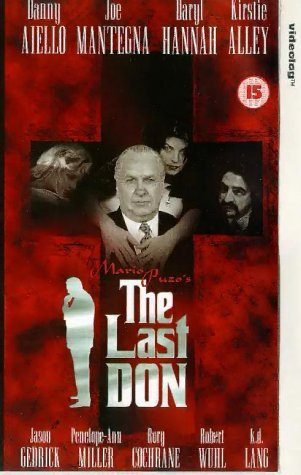
Miniseries Review: Mario Puzo’s The Last Don (dir by Graeme Clifford)


First broadcast over three nights in 1997, The Last Don tells the story of a powerful and respected Mafia family. They control politicians across the country and they own casinos in Vegas and their power even extends all the way to Hollywood. Despite having many enemies, the family has thrived due to the leadership of a wise but ruthless Don.  This Don remembers the old ways and imparts lessons about honor to the members of his own family.  Never let anyone know what you’re thinking.  Never side against the family.  If someone like you were to make enemies, they would become the Don’s enemies and then they would fear you …. you know, stuff like that.

However, times are changing and America is changing with it.  The underworld is no longer run by men of honor.  On top that, the Don is aging and in ill-health. Who will succeed him? One possible successor is respected by all but he’s stayed out of the dirtier aspects of the family’s business and, in fact, he seems to have no desire to be a feared man.  Another possible successor is ruthless and has a terrible temper.  He sometimes speaks out of turn, because the Don has a sentimental weakness for his children.  This possible successor’s anger is feared but perhaps fear is the future of the organized crime in America.  The old ways are changing but one thing remains the same.  The Don believes in America and he believes in family and….

Wait.

Okay, is it just me or does this all sound just a little bit familiar?

If it does, that’s probably because The Last Don is based on a novel by The Godfather‘s Mario Puzo.  Though the family may be called The Clerichuzios and the action may have been moved fro the 40s and the 50s to the 60s, 70s, and 80, the story is still the same basic one that was told in The Godfather.  Don Clerichuzio (Danny Aiello) is an honorable man whose time is coming to an end.  His grandnephew, Cross (Jason Gedrick), is the possible successor who isn’t crazy.  His grandson, Dante (Rory Cochrane), is the possible successor who is violent and doesn’t know how to negotiate.  Don Clerichuzio’s dream is for the family to become completely legitimate but good luck with that when the film business and the political world are just as corrupt as the Mafia.  I supposed one could argue that The Last Don is narrated by Don Clerichuzio while The Godfather has no narration at all but, seriously, once you have to add a voice-over to explain what’s going on, you have pretty much already last the war.

And yes, I did mention the film business.  When Francis Ford Coppola first read The Godfather, he famously hated the Hollywood sections of the book and, with the exception of Tom Hagen’s visit to Jack Woltz (and Woltz’s subsequent discovery of a horse’s head in his bed the next morning), Coppola refused to include them in the movie.  The second half of The Last Don, however, goes full Hollywood and, more or less, proves Coppola’s point.  Cross’s sister, Claudia (Michelle Burke, who also co-starred with Cochrane in Dazed and Confused), gets a job as an agent and one of her clients is the world’s most famous actress, the ludicrously named Athena Aquataine (Daryl Hannah).  When Athena has trouble with her crazy ex-husband (Chris Meloni, bringing a spark of genuine danger to the production), Cross helps her out, falls in love, and gets involved in the production of her next film.  This brings him into conflict with a studio exec named Bobby Bantz (Robert Wuhl).  Unfortunately, all of the Hollywood stuff is pretty dull.  One gets the feeling that Puzo was perhaps settling some old scores with the character of Bobby but Robert Wuhl is one of those goofy actors who belongs nowhere near a Mafia drama.  And don’t even get me started on country singer k.d. lang, who is bizarrely cast as a film director.

(Add to that, how can anyone take a character named Athena Aquataine seriously?  I never miss an Athena Aquataine movie!))

The Hollywood stuff distracts from the Mafia stuff, which is unfortunate because the Mafia stuff is at least occasionally interesting and it’s certainly better-acted than the Hollywood scenes.  Joe Mantegna plays Pippi, who is Cross’s father and who, years earlier, killed Dante’s father.  (Mantegna’s always good but it’s a struggle to take any character named Pippi seriously.)  Kirstie Alley plays Rose Marie, who is Dante’s mentally unstable mother and the Don’s only daughter.  Aiello, Mantegna, and Alley all give good performances, as do Burt Young and Seymour Cassel in the roles of family associates.  As for the “younger generation” of Clerichuzios, Gedrick is a bit dull but then again, Cross isn’t a very interesting character.  The slightly-built Cochrane is miscast as Dante but ultimately, that miscasting kind of works in that it reminds us that, due to his father being the scion of a rival family, Dante is destined to always be viewed as being an outsider.

As I said earlier, The Last Don was originally broadcast over three nights.  I watched the whole thing — all five hours of it — in one sitting and, yes, it was a bit of an endurance test.  It’s not just that it’s long but also that it keeps getting bogged down in all of the Hollywood stuff.  You don’t watch a film like this because you want to spend five hours watching Robert Wuhl mug for the camera.  You watch a film like this for the Mafia action and, for a film called The Last Don, there really wasn’t enough Mafia action.  It has its moments but it never feels as authentic as The Godfather, Casino, Goodfellas, The Irishman, The Sopranos or any of the other classic films and shows about the Mafia..  The Last Don needed to be extremely Italian but instead, it was only slightly Italian.  Robert Evans famously said that Coppola was selected to direct The Godfather because Coppola would make audiences “smell the pasta.”  There’s very little pasta in The Last Don.

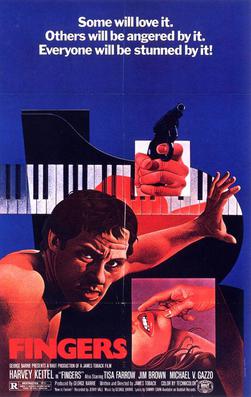
Film Review: Fingers (dir by James Toback)


Welcome to method actor Hell!

The 1978 film, Fingers, tell the story of Jimmy “Fingers” Angelilli (Harvey Keitel).  Jimmy is a creep who works as a debt collector for his father, a small-time loan shark named Ben (Michael V. Gazzo).  Jimmy is violent and brutal and often wanders around with a disturbingly blank-look on his face but we’re supposed to like him because he’s a talented pianist and he’s got a recital interview coming up at Carnegie Hall.  Jimmy carries a radio with him wherever he goes and he’s obsessed with the song Summertime.  He’s the type who will sit in a crowded restaurant and play the song and then get upset when someone tells him to turn off his radio.  By the end of the movie, I was really hoping that someone would take Jimmy’s radio and smash into a hundred pieces.

Jimmy is in love with Carol (Tisa Farrow, who was a far better actress than her sister Mia and who would later appear in Lucio Fulci’s classic, Zombi 2), who doesn’t really seem to all that into him.  Despite being in love with Carol, Jimmy still hits on every woman that he meets and, because this is a 70s films, he’s constantly getting laid despite being kind of a charmless putz.

Jimmy meets a former boxer named Dreems (Jim Brown).  Carol is apparently one of Dreems’s mistresses.  Jimmy silently watched while Dreems knocks two women’s heads together.  Jimmy stands there with his little radio and a blank expression on his face.  Is anything going on inside of Jimmy’s head?  It’s hard to say.

Eventually, Jimmy finds out that a gangster (Tony Sirico) owes his father money but is refusing to pay.  It all leads to violence.

As a film, Fingers is pretty much full of shit but that shouldn’t come as a surprise because it was the directorial debut of James Toback and there’s no American filmmaker who has been as consistently full of shit as James Toback.  Fingers has all of Toback’s trademarks — gambling, crime, guilt, classical music, and a juvenile view of sexuality that suggests that James Toback’s personal development came to a halt when he was 16 years old.  It’s a pretentious film that really doesn’t add up too much.  Again, you know what you’re getting into when James Toback directs a film.  Don’t forget, this is the same director who made a documentary where he was apparently shocked to discover that no one wanted to finance a politically-charged remake of Last Tango in Paris starring Alec Baldwin and Neve Campbell.

Fingers is a bit of an annoying film and yet it’s not a total loss.  For one thing, if you’re a history nerd like I am, there’s no way that you can’t appreciate the fact that the film was shot on location in some of New York’s grimiest neighborhoods in the 70s.  While I imagine it was more of a happy accident than anything intentional on Toback’s part (because, trust me, I’ve seen Harvard Man), Fingers does do a good job of creating an off-center, dream-like atmosphere where the world constantly seems to be closing in on its lead character.  Jimmy is trying to balance his life as violent mobster with being a sensitive artist and the world around him is saying, “No, don’t count on it, you schmuck.”

As well, Harvey Keitel gives a …. well, I don’t know if I would necessarily say that it’s a good performance.  In fact, it’s a fairly annoying performance and that’s a problem when a film is trying to make you feel sympathy for a character who is pretty unsympathetic.  That said, there’s never a moment in the film where Keitel is boring.  In Fingers, Keitel takes the method to its logical end point and, as a result, you actually get anxious just watching him simply look out of a window or sit in a corner.  Even though Jimmy eyes rarely shows a hint of emotion, his fingers are always moving and, just watching the way that he’s constantly twitching and fidgeting, you get the feeling that Jimmy’s always on the verge of giving out a howl of pain and fury.  It doesn’t really make Jimmy someone who you would want to hang out with.  In fact, I spent the entire movie hoping someone would just totally kick his ass and put him in the hospital for a few weeks.  But it’s still a performance that you simply cannot look away from.  Watching Keitel’s performance, you come to realize that Fingers is essentially a personal invitation to visit a Hell that is exclusively populated by method actors who have gone too far.

Anyway, my feelings about Fingers were mixed.  Can you tell?  It’s an interesting movie.  I’ll probably never watch it again.

Horror Film Review: Jacob’s Ladder (dir by Adrian Lyne)


The 1990 film Jacob’s Ladder asks the question, “Who is Jacob Singer?”

Is Jacob (played by Tim Robbins), a soldier serving in Vietnam who has just been severely wounded in an enemy attack and who is now barely clinging to life in a helicopter?

Is Jacob a withdrawn postal worker who lives in 1970s New York with his girlfriend, Jezzie (Elizabeth Pena), and who is haunted by horrifying visions of faceless, vibrating figures and viscous demons?  This Jacob is haunted by ill-defined past incidents.  Whenever he gets depressed, Jezzie is quick to demand that he snap out of it and that he stop thinking about anything other than the present day.  This Jacob can only watch as all of his old friends either sink into paranoia or die.  He hears rumors that they all may have been part of some sort of experiment involving LSD.  He’s sure that he served in the army but when he attempts to hire an attorney, he’s informed that the army has no record of him ever having served in combat and that they say he was discharged for psychological reasons.

Or is Jacob the husband of Sarah (Patricia Kalember) and the father of Gabe (Macaulay Culkin — yes, that Culkin)?  This is the Jacob who occasionally wakes up in bed with his wife and tells her that he’s been having the weirdest dream, one where he was living with “that crazy woman” from the post office, Jezebel?

Which one of these three realities is the truth for Jacob?  At times, Jacob himself doesn’t even seem to be sure.  Perhaps the one thing that you can be sure about in this movie is that whenever Jacob closes his eyes, he’s going to reopen them and discover that he’s in a different time and place.  Jacob spends almost the entire film trying to work out what’s happening in the present, what’s happening in the past, and what’s just happening in his head.

And, to be honest, it all gets a bit pretentious at times.  The film’s script has a lot on its mind.  In fact, it might have a little bit too much going on.  No sooner have you soaked in what the film has to say about denial and acceptance than you’re suddenly getting a crash course in MK-ULTRA and other mind-control conspiracy theories.  Whenever Jacob isn’t seeing demons and faceless apparitions, he’s being kidnapped by government agents.  There’s so much going on that this film can get a bit exhausting.

Fortunately, the film itself is such a triumph of style that it doesn’t matter that the script is a bit of a mess.  Director Adrian Lyne does a great job bringing Jacob’s nightmarish world to life.  Jacob seems to live in a world where the skies are permanently overcast and the streets are always wet after a recent storm.  When Jacob makes the mistake of walking down a subway tunnel, Lyne frames it as if Jacob is literally following a tunnel into Hell.  When a subway train rushes by Jacob, we catch disturbing glimpses of featureless faces facing the windows.  When Jacob sees a demon at a party, Lynne films the moment so that, just like Jacob, it takes us a few minutes to realize what we’re seeing.  And when Jacob is kidnapped and taken to a Hellish hospital, the scene is nightmarish in its intensity.

Tim Robbins gives a great performance as the emotionally withdrawn and haunted Jacob.  (In fact, he’s so good that it makes it all the more sad that he really hasn’t had a decent role since he won an Oscar for 2003’s Mystic River.)  He’s matched by Elizabeth Pena, who constantly keeps you wondering if Jezzie truly cares about Jacob or if she’s just another part of the conspiracy that seems to have taken over his life.

Jacob’s Ladder is an intensely effective, if somewhat messy, horror film.  Apparently, like almost every other horror film released in the 20th century, it’s currently being remade, with the remake due to released on February 9th.  Just in time for Valentine’s Day!

Weekly Trailer Round-Up: Mary Queen of Scots, Colette, The Miseducation of Cameron Post, The Favourite, Goosebumps 2, A Simple Favor, The Extinction, The Package, Life Itself, Along Came The Devil, Little Italy, Unfriended: Dark Web, Wonder Park, Castle Rock


It’s time for the weekly trailer round-up!  We’ve got fourteen today so let’s get down to business:

First off, we have the trailer for one of the most anticipated films of the year: Mary, Queen of Scots.  This movie brings together two of last year’s nominees for best actress, with Saoirse Ronan playing the title character and Margot Robbie playing Queen Elizabeth I.  It is set to be released in December for Oscar consideration.

Also getting early Oscar buzz is Keira Knightley for her performance in Colette.  Colette premiered at the Sundance Film Festival this year and will be released on September 21st.

Another film that generated buzz at Sundance was The Miseducation of Cameron Post, which stars Chloe Grace Moretz as a teenage girl forced into gay conversation therapy.  The Miseducation of Cameron Post will be released into theaters on August 3rd.

Following the arthouse success of The Lobster, Yorgos Lanthimos returns with The Favourite.  Rachel Weisz and Emma Stone play cousins who compete to be the favorite of Queen Anne.  The Favourite will be released on November 23rd.

The books and the monsters are back but Jack Black is nowhere to be seen in the trailer for Goosebumps 2: Haunted Halloween.  This film will be released on October 12th.

When Blake Lively disappears, her new best friend, Anna Kendrick, teams up with Lively’s husband to find her.  Directed by Paul Feig of Ghostbusters and Bridesmaids fame, A Simple Favor will be released on September 14th.

Everyone’s favorite sidekick, Michael Pena, finally gets the leading role in The Extinction, a sci-fi thriller that will be premiering on Netflix on July 27th.

Also coming to Netflix is The Package, a teen comedy from the creators of Workaholics.  The Package will be delivered on August 10th.

The second film to be directed by This Is Us creator Dan Fogelman, Life Itself will be released on September 21st.

According to this trailer, Along Came The Devil is “an exorcism film for a new generation.”  This film will be released on August 10th.

Have you ever wondered what happened to Danny Aiello?  He’s in Little Italy, with Emma Roberts and Hayden Christensen.  Little Italy will be released in August.

The internet is still the most dangerous place on Earth in the second trailer for Unfriended: Dark Web.  See for yourself on July 20th.

After a long and troubled production that saw original director Dylan Brown fired for “inappropriate conduct,” the animated film Wonder Park will finally be released on March 15th, 2019.

Finally, here is the long-awaited official trailer for Castle Rock, the new Hulu series from J.J. Abrams and Stephen King.  Castle Rock premieres on July 25th.