Looking for a new hit, television producer Aaron Spelling (Dan Castellanata) comes up with the story of “three little girls who went to the police academy and who were assigned very hazardous duties” but who were taken away from all that by the mysterious Charlie. The show is conceived as a star vehicle for Kate Jackson (Lauren Stamile), with fashion model Jaclyn Smith (Christina Chambers) and actress Farrah Fawcett-Majors (Tricia Helfer) playing her partners in investigating and solving crimes. Kate wants to make a feminist statement. Jaclyn wants to be a good role model to the little girls who sneak out of their room to watch the show. Farrah wants to be a star without losing her possessive husband, Lee Majors (Ben Browder). The critics hate the show. Studio president Fred Silverman (Dan Lauria) and showrunner Barney Rozenweig (Michael Tomlinson) are embarrassed by it. But Spelling has a hit and the actresses become stars. But when Farrah decides she wants to leave after one season, the show’s future is put in doubt.
This was one of NBC’s Behind The Camera films and the only one to take us behind the scenes of a “drama” program. (The other films looked at Diff’Rent Strokes, Mork and Mindy, and Three’s Company.) This is probably the best of them, though “good” and “best” are both relative terms when it comes to these movies. As with all of the films, there’s too many inside jokes about the network execs, with Dan Lauria stepping into the shoes of Brian Dennehy and Saul Rubinek as Fred Silverman. But Dan Castellanata did a surprisingly good job as Aaron Spelling and the three actresses playing the Angels were all convincing, especially Christina Chambers. The film’s main villain is Lee Majors, who is blamed for forcing Farrah to leave the show and who is portrayed as yelling, “Her name is Farrah Fawcett-Majors!” It’s low-budget and doesn’t offer much that isn’t already known but at the cast keeps the story interesting.
In Reagan, Dennis Quaid stars at the 40th President of the United States.
Framed as a story being told by a former KGB agent (Jon Voight) who is attempting to make a younger politician understand why Russia lost the Cold War, Reagan starts with Reagan’s childhood, includes his time as an actor and as the anti-communist head of the SAG, and then gets into his political career. Along the way, several familiar faces pop up. Robert Davi plays a thuggish Russian leader. Mena Suvari plays Reagan’s first wife while Penelope Ann Miller plays his second. Xander Berekely plays George Schultz (who was just previously played by Sam Waterston in The Dropout miniseries.) C. Thomas Howell, Kevin Dillon, Dan Lauria, and Lesley-Anne Down all have small but important roles. And the usual suspects when it comes to conservative filmmaking — Nick Searcy, Kevin Sorbo, and Pat Boone — are there to compliment Voight and Davi. I was a little surprised to see that Dean Cain was not present.
As usually happens to films that feature sympathetic Republicans, Reagan was slammed by critic but better-appreciated by the audience for which the film was made. I wasn’t particularly surprised. Movie critics tend to be liberal and Reagan is very much not that. For a professional film critic, a film like Reagan must be met with snark and derision because otherwise, one would risk cancellation. Don’t get me wrong. I’m not saying that there aren’t things to criticize about Reagan the film. I’m just saying that one should always keep in mind that critics have their own individual biases. One reason why the Rotten Tomatoes score is such an unfortunate development is because it ignores the fact that most films have things that work and things that don’t work and that quality is often in the eye of the beholder. Instead, it just tells us that a film is either a 90% or a 10%.
As for Reagan, it’s definitely a bit on the heavy-handed side but, then again, I think the same can be said for just about every political film that’s come out over the last few decades. For those who claim Reagan is somehow more heavy-handed than most, I invite them to sit through Rob Reiner’s LBJ. Indeed, the only director who has really shown a willingness to admit that a President can be both good and bad was Oliver Stone and when was the last time anyone watched Nixon? Reagan is at its weakness when it tries to recreate Reagan’s time as an actor. Dennis Quaid gives a good and charming performance throughout the film but he’s also 70 years old and, in the scenes where he plays the youngish Ronald Reagan, all of the soft-lighting and Vaseline on the lens ends up making him look like a wax figure. Once Reagan gets older, Quaid is allowed to act his age and both he and the film become much more convincing. I enjoyed the film once Reagan became President, though you should understand that I have biases of my own. I’m a fan of low taxes and individual freedom, which is why I’m also not a fan of communism or, for that matter, any extreme ideology that attempts to tell people how to live or think. “Tear down this wall!” Regan says while standing in front of the Berlin Wall and it’s a rousing moment, both in reality and on film.
In the end, Reagan is a film that will be best appreciated by people who already like Ronald Reagan. Yes, the film is heavy-handed and the framing device is a bit awkward. But Dennis Quaid’s heartfelt (and, towards the end, heartbreaking) performance carries the film. The film is not at all subtle but you know what? I’ve seen a countless number of mediocre films that have portrayed Reagan negatively, often with as little nuance and just as heavy-handed an approach as Reagan uses in its positive portrayal of the man. I sat through The Butler, for God’s sake. There’s nothing wrong with having a film that looks at the man from the other side. Those who like Ronald Reagan will feel vindicated. Those who don’t will say, “What was up with that Pat Boone scene?”
What were those years in your life where movies really became something special to you? I’d say mine began in around 1984 and extended all the way through about 1991, when I headed off to college and the realities of the world started kicking in. Our family got our first VCR around 1984, and this is when I first truly began to fall in love with the cinema. These are the years when I would spend every moment I could in our local video stores inspecting every film in their stock. So many of my favorite movies came out during this time and hold a sense of nostalgic value in my life even now. One of those movies is STAKEOUT, an action comedy from 1987 starring Richard Dreyfuss and Emilo Estevez.
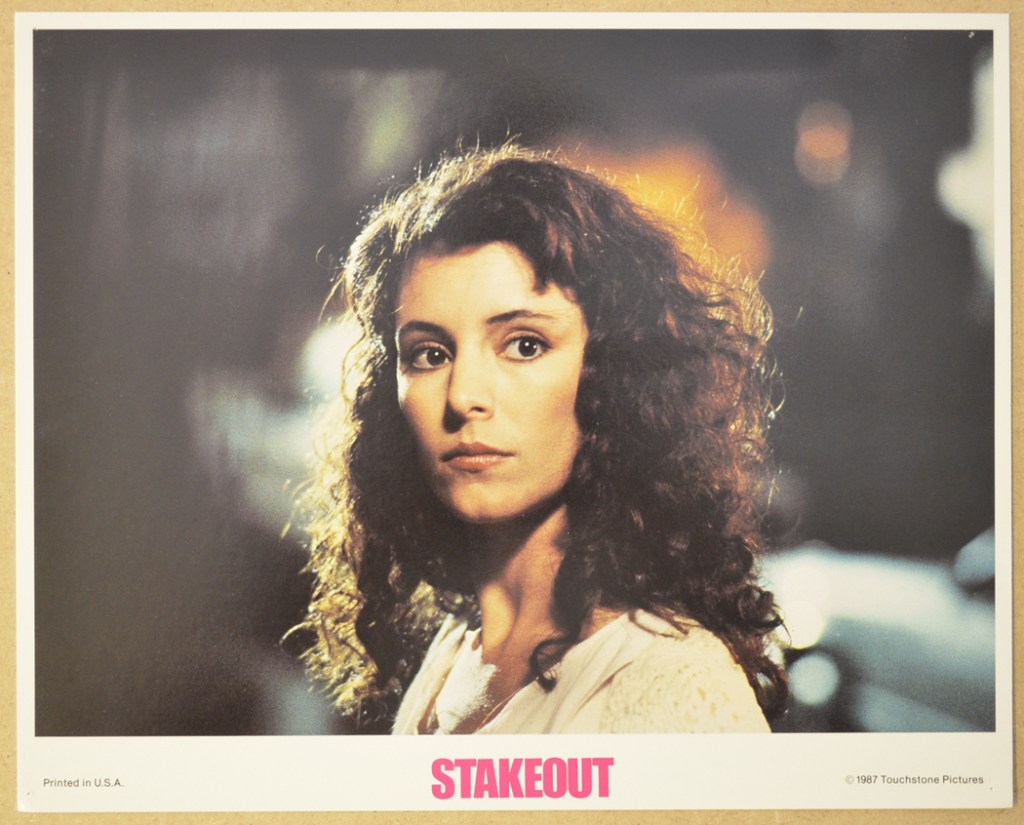
STAKEOUT begins with Richard “Stick” Montgomery (Aidan Quinn) escaping from prison, where he has been sent for killing an FBI agent a year earlier. Enter Seattle police detectives Chris Lecce (Richard Dreyfuss) and Bill Reimers (Emilio Estevez). They are assigned to stakeout the home of Montgomery’s beautiful ex-girlfriend Maria (Madeleine Stowe). In order to listen to her phone conversations, Chris impersonates a telephone repairman and meets her when he goes into her home to install the “bugs.” As fate would have it, he runs into Maria again at the local grocery store when he’s gone out to buy some supplies and donuts. She asks him to give her a ride home when she discovers she has a flat tire on her bike. He reluctantly gives her a ride home, but once he’s there, he puts up her groceries, she makes him a spicy dinner, and then he not so reluctantly makes love to her… all while his partner Bill is across the street waiting for his donuts. As you might imagine, this complicates the entire situation. And meanwhile, “Stick” Montgomery keeps making his way Seattle and Maria’s house where he stashed his cash before going away to prison.
STAKEOUT is one of those movies that our family rented in the late ‘80’s, and I immediately fell in love with. It’s my favorite kind of movie, the buddy cop film. Richard Dreyfuss and Emilio Estevez have a really nice chemistry together, and they come across as old friends. Even though there’s quite a bit of violence, the movie has a playful streak that I enjoy. There’s a series of running gags where Chris and Bill play practical jokes back and forth with the cops who relieve them on the stakeout each day, played by Dan Lauria and Forest Whitaker. The movie even throws in a little self-referential humor. In order to relieve the boredom of the stakeout, Estevez’ character is asking Dreyfuss movie trivia questions. He asks him to identify the movie where the line “this is no boating accident!” is from! Dreyfuss’ character has no idea. These are fun moments for me.
Another thing I love about STAKEOUT is the presence of the gorgeous Madeleine Stowe, who was making her first major film appearance. Seeing the film for the first time as a teenager of 14 years old made me a fan of hers for life. I’m not saying the movie was made specifically for 14-year-old boys, but it certainly wasn’t trying to push us away with its ad campaign that prominently featured the lovely Ms. Stowe. I’ll also point out that Aidan Quinn is effective and intimidating as the escaped murderer Richard “Stick” Montgomery. The fact that his character really does seem dangerous helps to make the film even more exciting when everything finally comes to a head. Veteran Director John Badham has made some really good movies in his career, including SATURDAY NIGHT FEVER (1977), BLUE THUNDER (1983), THE HARD WAY (1991), and NICK OF TIME (1995), to name a few. He knows what he’s doing, and I really started following his work based on how much I enjoyed STAKEOUT.
As much as I enjoy STAKEOUT, it’s one of those movies I don’t hear that much about these days even though it was a substantial box office hit. There was a misguided sequel made in 1993, ANOTHER STAKEOUT, that brought back Dreyfus, Estevez, and director Badham. I remember watching the sequel in the 90’s, but I honestly don’t remember anything about it. One of the reasons I enjoy writing about movies is because it gives me an opportunity to share a part of who I am, the things I enjoy, and maybe even serve as a reminder to others of films like STAKEOUT. I don’t think of these movies often myself, but when I was looking at my DVD collection earlier today, I smiled when I saw it and happily pulled it off the shelf to watch it again for the first time in several years!
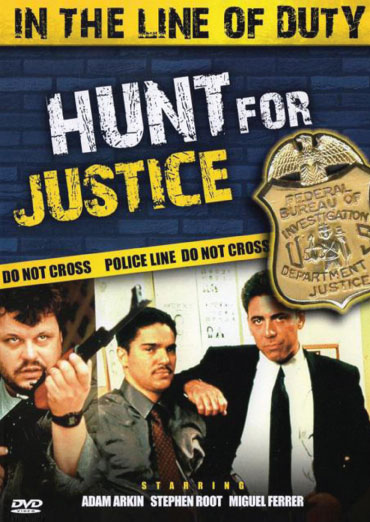
When New Jersey State Trooper Philip Lomonaco (Dan Lauria) pulls over a car for having mud on its license plate, he doesn’t know that the car is being driven by two members of the United Freedom Front, a group of left-wing revolutionaries. While Lomonaco talks to Tom Manning (Miguel Ferrer), Dickie Williams (Dell Yount) opens fire. Lomanaco is killed and Tom and Dickie flee to their safehouse in New England. While the United Freedom Front plots their next series of bombings and bank robberies, Lomonaco’s ex-partner (Nicholas Turturro) teams up with an FBI agent (Adam Arkin) to track down the terrorists and get justice for his fallen friend.
Hunt For Justice was the ninth of NBC’s In The Line of Duty films. The previous films featured religious cults, anti-tax protestors, drug lords, and mobsters. In this one, the antagonists are all former 60s radicals who are still trying to overthrow the system. The FBI views the United Freedom Front as being a threat to national security while Lomonaco’s partner just wants to make sure that Lomonaco’s death won’t go unpunished. Dan Lauria was actually a mainstay of the In The Line of Duty films, appearing previously in A Cop for the Killing and and Ambush in Waco. (Nicholas Turturro was previously featured, on the other side of the law, in Mob Justice.) Since most people who watch this film will probably remember Lauria as being Kevin Arnold’s father in The Wonder Years, everyone will want his killers to be brought to justice.
As with the previous In The Line of Duty movies, the action is evenly divided between law enforcement and the criminals that they’re pursuing. At first, Miguel Ferrer seems like odd-casting as a leftist who admires Che Guevara but he gives a good performance as someone who regrets some of the decisions that he made in the past but who knows that he can’t change them now. Melissa Leo is also very good as his wife. Stephen Root and Dean Norris, two other actors who you would not necessarily expect to see playing left-wing revolutionaries, are cast as the other members of the United Freedom Front and Hunt For Justice does a good job of contrasting their middle class lifestyles with their revolutionary rhetoric. One of the ironies of the film is that the revolutionaries are leading much more comfortable and financially-stable lives than the men who are trying to hunt them down. In fact, the main problem with the movie is that the revolutionaries are so interesting that it’s always a letdown when the action shifts over to Turturro and Arkin, whose characters are far less interesting. Arkin and Turturro go through the expected paces. The FBI doesn’t like it when local cops try to interfere with their investigations. Who knew?
Hunt for Justice is a pretty standard In The Line of Duty movie but no movie featuring Miguel Ferrer, Melissa Leo, and Stephen Root is ever going to be a total loss. The cast is the best thing that Hunt ForJustice has going for it.
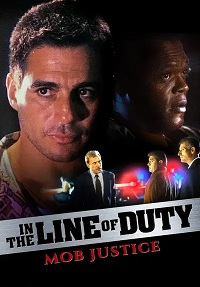
The fourth of NBC’s In The Line of Duty movies, Mob Justice opens with the murder of an undercover DEA agent by a low-level gangster who has just been released from prison. While the gangster goes into hiding, the DEA mobilizes and starts to make life so difficult for all of the other mobsters in New York that soon, the Mafia is as determined to get justice as law enforcement.
This was the first In The Line Of Duty film not be directed by Dick Lowry. Lowry’s fast-paced style is missed as Mob Justice takes forever to get going and regularly gets bogged down with scenes lifted from other mafia movies. The old mobsters talk about the importance of family, play cards in the backroom, and eat big dinners. Opera blares on the soundtrack when the DEA starts to harass them. For a movie that is supposed to honor the work and the sacrifice of federal law enforcement, the DEA actually comes across as being thoroughly incompetent in Mob Justice. A dumb mistake leads to the first murder. A series of other misjudgments lead to the Mafia dispensing the own type of violent justice before the DEA can arrest their man.
The most interesting thing about Mob Justice is the cast.
The trigger-happy gangster is played by Tony Danza, who I guess was trying to prove himself as a dramatic actor after spending years on Taxi and Who’s The Boss but who still comes across like Tony Micelli having a bad day. His best friend is played Nicholas Turturro, who later played a straight arrow detective on NYPD Blue. Frank Vincent and Leonardo Cimino plays the mob bosses who knows that murdering a federal agent is bad for business.
The head of the investigation is played by Ted Levine, who has had a long career but will always be remembered as the killer from The Silence of the Lambs. Working under him is Dan Lauria, who a generation will instantly recognize as being the long-suffering and frequently angry father from The Wonder Years. You know that this is a big case is Buffalo Bill and Jack Arnold are working together. (Dan Lauria actually appeared in several In The Line of Duty films, always playing different characters.)
And finally, the murdered DEA agent is played by none other than Samuel L. Jackson. It’s never a good thing when the best actor in a movie is killed off after the first fifteen minutes.
The cast is great but Mob Justice is forgettable. The main problem is that, after Jackson is taken out of the picture, the rest of the movie is just Danza hiding in different apartments while Levine and Lauria annoy Frank Vincent. Danza’s murderer is never smart nor interesting enough to be a compelling antagonist and there’s never any doubt that, one way or another, he will pay for his stupidity. There is one memorable scene where Danza freaks out while wearing a blonde wig but otherwise, Mob Justice doesn’t leave much of an impression.
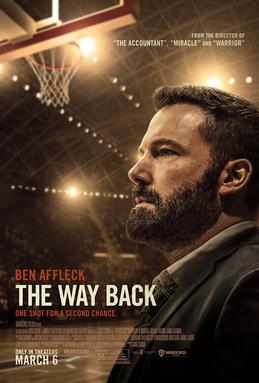
Jack Cunningham (Ben Affleck) used to be a star. When he was in high school, he was a brilliant basketball player. He led his high school, Bishop Hayes, to multiple championships. Everyone expected Jack to have a bright figure but …. well, times change.
Decades later, Jack is a construction worker. He spends every night at the neighborhood bar. He wakes up every morning with a hangover. He starts his day by drinking and he ends it by passing out. He’s separated from his wife, Angela (Janina Gavankar), and he can’t even enjoy a nice Thanksgiving dinner without everyone getting on his back about his drinking.
When he gets a phone call from his old high school, he’s shocked to learn that he’s being offered a job. The school’s basketball coach has had a heart attack. Father Devine (John Aylward) wants to know if Jack would be interested in filling in for the rest of the school year. Though at first reluctant and perhaps not wanting to be reminded of the future he once had, Jack eventually agrees.
The team, it turns out, is not particularly impressive. The school hasn’t gone to the playoffs since Jack graduated and basketball is such a low priority that the team only has 6 players. When Jack takes over, the team that has only won a single game. The team is undisciplined and so used to being losers that they can’t even imagine what it’s like to be a winner. You know what type of team I’m talking about because, even if you weren’t an athlete in school, you’ve probably seen a movie or two about underestimated high school teams that, under the leadership of a new coach, ended up shocking everyone by making it to the playoffs.
Working with assistant coach Dan (Al Madrigal), Jack struggles to turn the team into winners. He’s a strict coach and, at first, the students resent him and his methods. When he kicks one of the best players off the team for showing up late to practice, everyone thinks that Jack’s gone too far. However, when the team actually starts to show signs of improvement, the team and the school rallies around their new head coach….
Of course, Jack still has his problems. He’s too quick to lose his temper. He curses a bit too often. Despite caring about the team, he’s still weary about getting too close to them. He’s emotionally damaged as the result of an abusive childhood and the death of his son. A winning season isn’t going to magically change that. However, Jack’s main problem is that he’s still an alcoholic. To the film’s credit, it doesn’t try to sugarcoat Jack’s addictions. Jack doesn’t magically become sober just because he’s found a purpose in life. Even when he briefly cuts back on his drinking, the temptation is still there. And when Jack finally does end up returning to his neighborhood bar and has too much to drink, the film is honest about the consequences of his actions.
The Way Back took me by surprise. It started out as a well-made but rather predictable underdog sports story but it takes a turn during the third act and reveals that it’s actually a character study of a well-meaning but immature man who cannot escape his demons. The film is honest about Jack’s problems and, to its credit, it doesn’t pretend like there are any easy solutions. It’s going to take more than just coaching his team to the playoffs for Jack to make peace with himself and his past. The film ends on a note that’s hopeful yet ambiguous. Jack has a long way to go and you’re not totally convinced that he’s ever going to truly complete his journey. But, at the same time, you’re happy that he finally got a chance to do something good with his life.
Ben Affleck was the perfect choice to play Jack and he gives the best performance that I’ve ever seen him give. Affleck has been open about his own struggles with alcoholism but beyond that, it’s easy to see Jack’s struggles as a metaphor for Affleck’s own up-and-down career. Like Jack, Affleck won a championship when Argowon the Oscar for Best Picture but it sometimes seems as if he’s struggled since then. His directorial follow-up, Live By Night, was a critical and commercial failure. His turn as Batman was appreciated by some but ridiculed by others. When he stepped down from directing The Batman, he was the subject of the same type of uncharitable gossip that follows Jack as he coaches his team. In the role of Jack, Ben Affleck gives a poignant, vulnerable, and honest performance. He’s willing to be unsympathetic. He doesn’t shy away from showing us that Jack, even at his best, can be a massive fuckup. And yet, he holds onto our sympathy even while Jack does some very stupid things. It’s Affleck’s performance that elevates The Way Back from being just another sports film to being something far more touching.
The Way Back may not be quite strong enough to be called a great film (though it’s certainly a good one) but Ben Affleck gives a great performance.
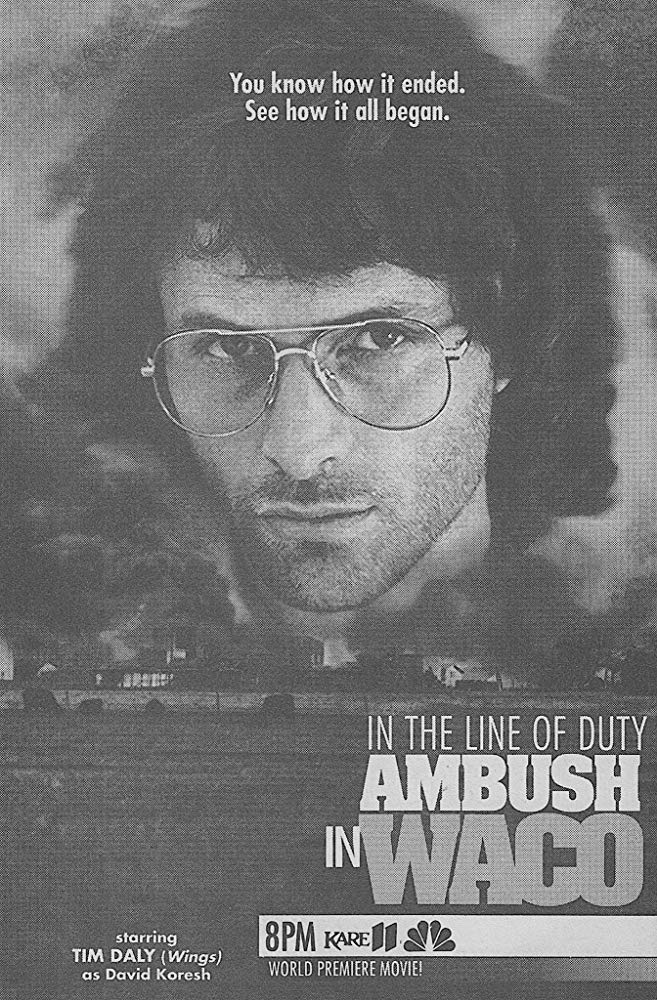
In Waco, Texas, a scruffy and frustrated musician named David Koresh (Tim Daly) has announced that he is the messiah and is gathering followers to live with him in a compound. The Branch Davidians, as they are known, spend hours listening as the increasingly unhinged Koresh gives lengthy sermons. There are rumors that Koresh is abusing the many children who live in the compound and that he is stockpiling weapons for a confrontation with the government.
The ATF makes plans to raid the compound and take Koresh into custody. Under the supervision of Bob Blanchard (Dan Lauria), the agents run several practice raids. However, when the day of the actual raid comes, they discover that the David Koresh and the Branch Davidians aren’t going to give up so easily…
Ambush in Waco is a dramatization of the infamous raid that led to a 51-day stand-off between the government and the Branch Davidians, a stand-off that ended with the compound in flames and the deaths of several innocent children. Over the years, the siege in Waco has often been cited as an example of both government incompetence and law enforcement overreaction. Instead of arresting Koresh during one of his many trips into town, the ATF decided to do a dramatic raid for the benefit of the news cameras and they were unprepared for what was waiting for them inside of the compound. After 51 days of negotiations, the FBI tried to force Koresh out and, in the eyes of many, were responsible for the death of every man, woman, and child inside of the compound. For many, the events in Waco represent the government at its worse.
You wouldn’t know that just from watching Ambush In Waco. This made-for-TV movie was put into production while the siege was still ongoing. As a result, the film shows the events leading up to the initial raid but nothing that followed. Since it would be years before the full extent of the government’s incompetence at Waco would be uncovered, Ambush in Waco today feels like propaganda, a whitewash of a shameful moment of American law enforcement history. The ATF is portrayed as being thoroughly professional while Koresh is a dangerous madman who is on the verge of trying to lead a violent revolution. Today, we know that wasn’t the case. Koresh may have been a loser with delusions of grandeur but he probably would have been content to spend the rest of his life hidden away in his compound. Meanwhile, newly appointed Attorney General Janet Reno was so eager to prove her toughness that the situation was allowed to get out of control. That’s not something you’ll learn from watching Ambush in Waco.
Of course, that doesn’t mean that David Koresh wasn’t a bad dude. Tim Daly is this film’s saving grace, giving an outstanding performance as an unstable, wannabe dictator. Ambush in Waco shows how someone like Koresh could end up attracting so many followers and it also shows how even the most well-intentioned of people can be brainwashed. Though the film may not convince us that the ATF was justified in their actions, it does show us why we should be weary of anyone who claims to have all the answers.
(Hi there! So, as you may know because I’ve been talking about it on this site all year, I have got way too much stuff on my DVR. Seriously, I currently have 193 things recorded! I’ve decided that, on January 15th, I am going to erase everything on the DVR, regardless of whether I’ve watched it or not. So, that means that I’ve now have only have a month to clean out the DVR! Will I make it? Keep checking this site to find out! I recorded Wrapped Up In Christmas off of Lifetime on November 25th!)
It’s not easy being a single mother during the Christmas season, especially when you’re a young and ambitious professional who works as the general manager of a struggling mall. You want everyone to have a good Christmas but your boss is demanding that you evict all of the locally owned stores. You want to find a good man and a good stepfather for your daughter but every man you meet has nothing in common with you. You’re sophisticated. You have dreams. You have ambition. You have an education. You don’t want just any slacker.
And then one day, you meet a man who seems like he’s perfect. He’s a lawyer, even though he’s currently helping his mom run her toy store (a store that just happens to be on the list of businesses that you’re supposed to evict). He seems to be interested in everything that you’re interested in! It seems like he’s perfect but what you don’t know is that he’s putting on an act. See, he not only works in his mom’s toy store. He’s also been voluntarily serving as the mall’s Santa Claus and when your daughter told him that she wanted you to find a man for Christmas, she also told him everything that you’re looking for.
Meanwhile, all the lovable people who work in the mall are giving your new man advice on how to impress you and your boss is still demanding that you evict everyone the week before Christmas and suddenly, you realize that everything that could happen in a Lifetime holiday movie has happened…
Seriously, if there’s anything that distinguishes Wrapped Up In Christmas from other holiday Lifetime films, it’s just how complete it is. There’s literally nothing that doesn’t happen. It’s all here. A workaholic protagonist who needs to learn the true meaning of Christmas. A nearly saintly man who happens to have one secret that could possibly derail his otherwise perfect relationship. A cute child. Santa-involved intervention. A family of matchmakers. (Actually, this one has two families of matchmakers.) It’s all here!
Anyway, I liked Wrapped Up In Christmas. There was nothing really special about it but it had a sweet soul and Tatyana Ali and Brendan Fehr was likable in the leads. It’s an enjoyable little holiday movie.
For my latest guilty pleasure, I want to take a look at Terror In The Family, a well-intentioned, out-of-control youth film from 1996.
Certain moments of Terror in the Family felt painfully familiar because, much like the film’s main character, Deena Marten (played by — yes, it’s true — Hilary Swank), I went through a period, when I was teenage, where I was seriously out-of-control. Much like Deena, I would sneak out of the house, I would hook up with guys who were obvious trouble, I had absolutely no impulse control, and I said and did a lot of hurtful and self-destructive things that I still would do anything to take back. I was 16 while, in the movie, Deena is portrayed as being 15. The main difference between me and Deena is that I was out-of-control because I was having an undiagnosed manic episode. Deena, however, is out-of-control because she comes from one of the most dysfunctional family in the history of dysfunctional families.
And that’s why, despite the fact that I can relate to the painful subject matter, Terror In The Family amuses me more than it disturbs me. Seriously, anything that can be wrong with a family is wrong with this family.
Consider this:
Father Todd Marten (Dan Lauria) spends all of his time down in the basement, making wooden bowls and then taking pictures of them. Usually, he avoids his family but when he’s finally forced to confront Deena, she ends up smashing his fingers with her bedroom door. “HOW CAN I WORK NOW!?” he bellows while holding up his bandaged hand.
Mother Cynthia Marten (Joanna Kerns) is an alcoholic who spends her spare time standing in front of a mirror and rehearsing being a disciplinarian. When Deena flees the house, Cynthia attempts to win her back by bringing her a huge, home-made pizza. “I made your favorite!” Cynthia drunkenly cries before accidentally dropping the pizza on the floor.
Grandmother Ivy (Nan Martin) is, without a doubt, one of the most evil and unpleasant characters that I have ever seen in a movie. When Cynthia tries to tell her about the difficulties of raising Deena, Ivy responds by literally punching her in the face.
Deena’s younger brother, Adam (Adam Hendershott), is a talented pianist who deals with his family by playing video games and literally sleeping with a bottle of vodka in his bed.
Finally, there’s Aunt Judith (Kathleen Wilhoite). Judith seems to be the only stable person in Deena’s family. That’s mostly because Judith left home when she was young and was apparently some sort of groupie for several years.
With this family, is it any wonder that Deena is spending all of her time with Garrett (Andy Kavovit), her 17 year-old boyfriend who, along with introducing her to drugs and sex, also speaks wistfully of killing his mother and her boyfriend? Garrett, not surprisingly, has a band and Deena soon finds herself staying out past curfew so she can perform with him at various seedy clubs. The film blames a lot of Deena’s bad behavior on Garrett but you know what? Back when I was 15, I would have been totally in love with Garrett too.
Seriously, Deena, you go girl!
Anyway, with all of this going on, can we really be shocked that Deena eventually ends up swinging a landline phone at her parents and demanding that they stay away?
Terror In The Family shows up on Lifetime occasionally and recently, for reasons that I don’t quite understand, it even turned up on Showtime, playing in between showings of Dexter and The Seduction of Misty Mundae. It’s worth watching because it really is the perfect marriage of good intentions, over-the-top melodrama, and intense cluelessness. For the most part, future Oscar winner Hilary Swank gives a good performance as Deena but the best parts of the films are the parts where she joins the rest of the cast in going totally and completely overboard.
The mix of melodrama and hindsight combine to make Terror In The Family into a true guilty pleasure.
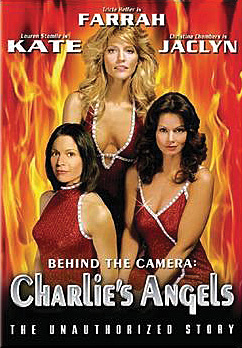 Looking for a new hit, television producer Aaron Spelling (Dan Castellanata) comes up with the story of “three little girls who went to the police academy and who were assigned very hazardous duties” but who were taken away from all that by the mysterious Charlie. The show is conceived as a star vehicle for Kate Jackson (Lauren Stamile), with fashion model Jaclyn Smith (Christina Chambers) and actress Farrah Fawcett-Majors (Tricia Helfer) playing her partners in investigating and solving crimes. Kate wants to make a feminist statement. Jaclyn wants to be a good role model to the little girls who sneak out of their room to watch the show. Farrah wants to be a star without losing her possessive husband, Lee Majors (Ben Browder). The critics hate the show. Studio president Fred Silverman (Dan Lauria) and showrunner Barney Rozenweig (Michael Tomlinson) are embarrassed by it. But Spelling has a hit and the actresses become stars. But when Farrah decides she wants to leave after one season, the show’s future is put in doubt.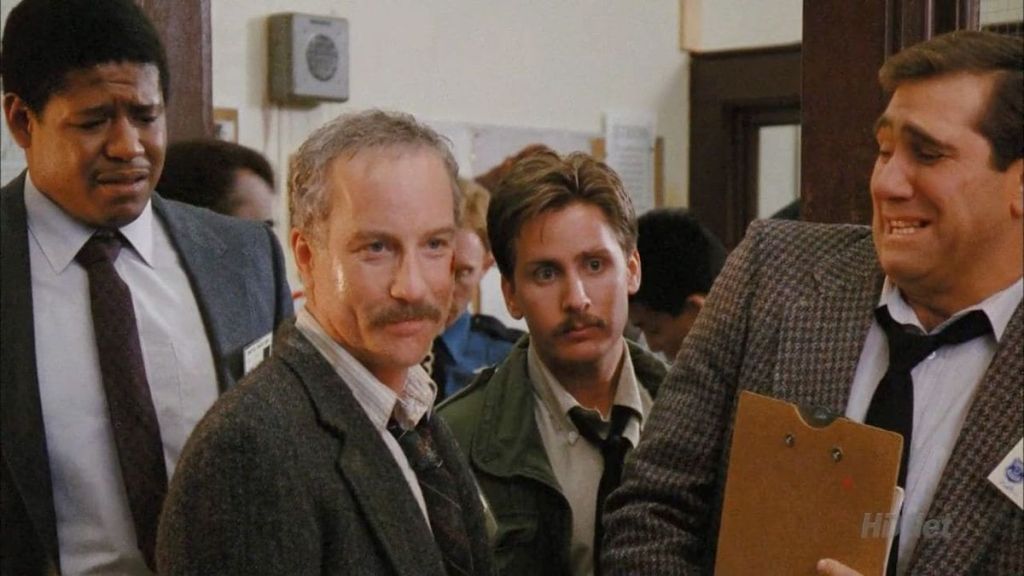



 Through the Shattered Lens