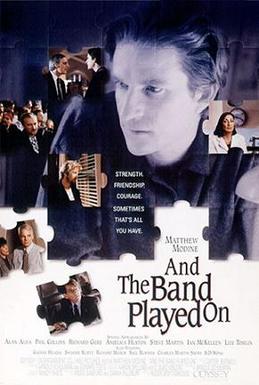
Film Review: And The Band Played On (dir by Roger Spottiswoode)


I live in a very cynical time.

That was one of my main thoughts as I watched 1993’s And The Band Played On.

Directed by Roger Spottiswoode and featuring an all-star cast, And The Band Played On deals with the early days of the AIDS epidemic.  It’s a film that features many different characters and storylines but holding it all together is the character of Dr. Don Francis (Matthew Modine), an epidemiologist who is haunted by what he witnessed during the Ebola epidemic in Africa and who fears that the same thing is going to happen in America unless the government gets serious about the mysterious ailment that is initially called “gay cancer” before then being known as “GRID” before finally being named AIDS.  Dr. Francis is outspoken and passionate about fighting disease.  He’s the type who has no fear of yelling if he feels that people aren’t taking his words seriously enough.  In his office, he keeps a track of the number of HIV infections on a whiteboard.  “Butchers’ Bill” is written across the top of the board.

Throughout the film, quite a few people are dismissive of Dr. Francis and his warnings.  But we, the audience, know that he’s right.  We know this because we know about AIDS and but the film also expects us to trust Dr. Francis because it’s specifically stated that he worked for the World Health Organization before joining the Center For Disease Control in Atlanta, Georgia.  As far as the film is concerned, that’s enough to establish his credentials.  Of course, today, after living through the excesses of the COVID pandemic and the attempts to censor anyone who suggested that it may have begun due to a lab leak as opposed to some random guy eating a bat, many people tend to view both the WHO and the CDC with a lot more distrust than they did when this film was made.  As I said, we live in a cynical time and people are now a lot less inclined to “trust” the experts.  To a large extent, the experts have only themselves to blame for that.  I consider myself to be a fairly pragmatic person but even I now find myself rolling my eyes whenever a new health advisory is issued.

This new sense of automatic distrust is, in many ways, unfortunate.  Because, as And The Band Played On demonstrates, the experts occasionally know what they’re talking about.  Throughout the film, people refuse to listen to the warnings coming from the experts and, as a result, many lives are lost.  The government refuses to take action while the search for a possible cure is hindered by a rivalry between international researchers.  Alan Alda gives one of the best performances in the film, playing a biomedical researcher who throws a fit when he discovers that Dr. Francis has been sharing information with French scientists.

It’s a big, sprawling film.  While Dr. Francis and his fellow researchers (played by Saul Rubinek, Glenne Headly, Richard Masur, Charles Martin Smith, Lily Tomlin, and Christian Clemenson) try to determine how exactly the disease is spread, gay activists like Bobbi Campbell (Donal Logue) and Bill Kraus (Ian McKellen) struggle to get the government and the media to take AIDS seriously.  Famous faces pop up in small rolls, occasionally to the film’s detriment.  Richard Gere, Steve Martin, Anjelica Huston, and even Phil Collins all give good performances but their fame also distracts the viewer from the film’s story.  There’s a sense of noblesse oblige to the celebrity cameos that detracts from their effectiveness.  All of them are out-acted by actor Lawrence Monoson, who may not have been a huge star (his two best-known films are The Last American Virgin and Friday the 13 — The Final Chapter) but who is still heart-breakingly effective as a young man who is dying of AIDS.

Based on a 600-page, non-fiction book by Randy Shilts, And The Band Played On is a flawed film but still undeniably effective and a valuable piece of history.  Director Roger Spottiswoode does a good job of bringing and holding the many different elements of the narrative together and Carter Burwell’s haunting score is appropriately mournful.  The film ends on a somber but touching note.  At its best, it’s a moving portrait of the end of one era and the beginning of another.

White Mile (1994, Directed by Robert Butler)


In this HBO movie, Alan Alda plays the biggest asshole in the world.

Alda is cast as Dan Cutler, an ad exec who books a corporate retreat to Canada’s White Mile.  He tells the nine men who accompany him, some of whom are clients and some of whom work for him, that it’s going to be a weekend of fishing and male bonding.  What he doesn’t reveal is that the trip is also going to require whitewater rafting.  Despite the fact that the majority of the men are out-of-shape and hardly any of them have any rafting experience, Dan insists that they all take part.  When their guide says that they’re going to need to take two boats, Dan refuses.  He wants everyone in one boat, the better so they can all work together to prove their manhood by conquering the river.

The trip starts out well but, when the raft hits a rock and turns over, five of the men end up dead.  Despite injuring his leg, Dan survives and, when he returns to work, he’s hailed as a hero.  However, one of the widows of the men who didn’t survive is now suing the company.  While Dan tries to cover his own ass, one of the survivors — Jack Robbins (Peter Gallagher) — is faced with a dilemma of his own.  As one of the few people who knows that Dan demanded that the guide only use one boat, will Jack testify to the truth at the trial or will he follow Dan’s orders and keep quiet about what really happened?

Based on a true story, White Mile features some brief but exciting (and harrowing) rafting scenes but the film is less about what happened in the wilderness and instead about what’s happening behind the closed doors of corporate America.  White Mile does a good job of taking Alda’s sensitive male persona and pushing it through the looking glass.  As played by Alda, Dan is the type of tyrannical boss who we’ve all had to deal with.  His friendly smile barely disguises a bullying streak.  Even after the accident leaves five of his colleagues dead, Dan is still convinced that the trip was a good idea and that everyone was having the best day of their lives until they hit that rock.  When the river guide initially finds Dan stranded on a rock, Dan makes a show of telling the guide to come back for him later and to find the others.  When Dan later comes across one of the dead men, he says, “He must have had a bad heart,” as he grasps at any way to avoid taking responsibility.  Though White Mile is dominated by Alda’s villainy, it also features good performances from Gallagher, Robert Loggia, Bruce Altman, and Jack Gilipin.  When Gilpin demands to know if anyone at the ad agency has shown any true remorse for what happened, he is speaking for the entire audience.

White Mile was an early HBO film and, because it was released before HBO became known for its original programming, it’s often unfairly overlooked.  When it was released on DVD, it was advertised as being an action-adventure film, which it definitely is not.  Instead, it’s a look at the type of head games that far too often act as a substitute for responsible and ethical management in corporate America.  It’s a good movie and you’ll never look at Alan Alda the same way again.

A Movie A Day #70: Wired (1989, directed by Larry Peerce)


Sometimes, you watch a movie and all you cay say, at the end, is “What the Hell were they thinking?”
Wired is one such movie.  Based on a widely discredited biography by Bob Woodward, Wired tells two stories.  In the first story, John Belushi (Michael Chiklis, making an unfortunate film debut) wakes up in a morgue and is told by his guardian angel that he has died of a drug overdose.  Did I mention that his guardian angel is Puerto Rican cabbie named Angel Vasquez (Ray Sharkey) and Angel drives Belushi through a series of flashbacks?  Belushi meets Dan Aykroyd (Gary Groomes, who looks nothing like Dan Aykroyd).  Belushi gets cast on Saturday Night Live.  Belushi marries Judy (Lucinda Jenney).  Belushi uses drugs, costars in The Blues Brothers, dies of a drug overdose in a sleazy motel, and plays a pinball game to determine whether he’ll go to Heaven or Hell.  While this is going on, Bob Woodward (J.T. Walsh) is interviewing everyone who knew Belushi while he was alive.

There are so many things wrong with Wired that it is hard to know where to even begin.  I haven’t even mentioned the scene where Bob Woodward travels back in time and has a conversation with Belushi while he’s dying on the motel room floor.  Wired tries to be a cautionary tale about getting seduced by fame and drugs but how seriously can anyone take the message of any movie that features Ray Sharkey as a guardian angel?  The scenes with Woodward are strange, mostly because the hero of Watergate is being played by an actor best known for playing sinister villains.  (Seven years after playing Bob Woodward, J.T. Walsh was actually cast as Watergate figure John Ehrlichman in Nixon.)  Considering that this was his first movie, Michael Chiklis is not bad when it comes to playing a drug addict named John but he’s never convincing as John Belushi.  He never captures the mix of charisma and danger that made John Belushi a superstar.  Wired wants to tell the story of Belushi’s downfall but never understands what made him special to begin with.

Wired tries to be edgy but it only succeeds for one split second.  During the filming of The Blues Brothers, a director who is clearly meant to be John Landis walks over to Belushi’s trailer.  Listen carefully, and a helicopter can be heard in the background.

As for the rest of Wired, what the Hell were they thinking?

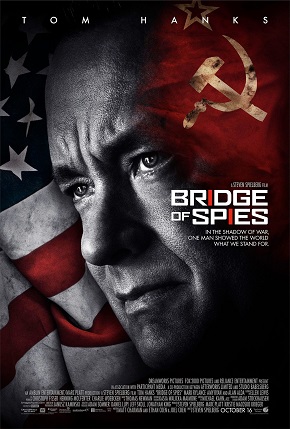
Film Review: Bridge of Spies (dir by Steven Spielberg)


Bridge_of_Spies_poster

I saw Bridge of Spies last weekend and I’m a little bit surprised that I haven’t gotten around to writing a review until now.  After all, this is not only the latest film from Steven Spielberg but it also stars the universally beloved Tom Hanks and it’s currently being touted as a possible best picture nominee.  (Mark Rylance, who plays an imprisoned spy in this film, is also emerging as a front runner for best supporting actor.)  The screenplay was written by the Coen Brothers.  (Oddly enough, films scripted by the Coens — like Unbroken, for instance — tend to be far more conventional and far less snarky than films actually directed by the Coens.)  Even beyond its impressive pedigree, Bridge of Spies is a historical drama and by now, everyone should know how much I love historical dramas.

And the thing is, I enjoyed Bridge of Spies.  I thought it was a well-made film.  I thought that Tom Hanks was well-cast as an idealistic lawyer who stands up for truth, justice, and the Constitution.  I agreed with the pundits who thought Mark Rylance was award-worthy.  It’s become a bit of a cliché for Amy Ryan to show up as an understanding wife but it’s a role she plays well and she made the most of her scenes with Tom Hanks.  Steven Spielberg knows how to put a good film together.  This really should have been a film about which I rushed home to rave.

And yet, at the same time, I just could not work up that much enthusiasm for Bridge of Spies.  It’s a good film but there’s nothing unexpected about it.  There’s nothing surprising about the film.  Steven Spielberg is one of the most commercially successful directors in history and the American film establishment pretty much orbits around him.  He’s good at what he does and he deserves his success.  Unfortunately, he doesn’t have a subversive bone in his body.  Bridge of Spies is a lot like his previous Oscar contender, Lincoln.  It’s very well-made.  It’s the epitome of competence.  But there’s not a truly surprising or unexpected moment to be found in the film.

And I have to admit that, even as I enjoyed Bridge of Spies, I still found myself frustrated by just how risk-adverse a film it truly was.  After all, we’re living in the age of Ex Machina, Upstream Color, and Sicario.  Bridge of Spies is a good movie and, in many ways, it provides a very valuable history lesson.  (The film’s best moments were the one that contrasted the U.S. with the cold desolation of communist-controlled East Germany.)  But, overall, it just didn’t make a huge impression on me.  It was just a a little bit too safe in its approach.