
by Ray Lampert, one of the first medics to reach the beach on D-Day
by Ray Lampert, one of the first medics to reach the beach on D-Day
Today is the 74th anniversary of D-Day, a day in which thousands sacrificed themselves so that the world could live free of Hitler’s tyranny.
Now, back in 1944, they didn’t have the nightly news. They didn’t have CNN or MSNBC or Fox News. There was no 24-hour news channels. And certainly, there was no internet. No one live tweeted the invasion of Normandy. No one blogged about it. No one marked themselves safe on Facebook. Instead, for many of the citizens back home, their first knowledge of D-Day came from the newsreels that often ran before movies.
The newsreel below is from June 9th, 1944, three days after the invasion. Take a look:
Also, be sure to check out some of our previous D-Day posts:
Jim Radford is a British folksinger and peace activist. At the age of 15, he was also the youngest participant of the Allied Invasion of Normandy, which occurred 74 years ago today.
This video, from 2014, features Radford singing about his D-Day experiences at the Royal Albert Hall.
As my sister has already pointed out, today is the 73rd anniversary of D-Day. With that in mind, and as a part of my ongoing mission to see and review every single film ever nominated for best picture, I decided to watch the 1962 film, The Longest Day!
The Longest Day is a pain-staking and meticulous recreation of invasion of Normandy, much of it filmed on location. It was reportedly something of a dream project for the head of the 20th Century Fox, Darryl F. Zanuck. Zanuck set out to make both the ultimate tribute to the Allied forces and the greatest war movie ever. Based on a best seller, The Longest Day has five credited screenwriters and three credited directors. (Ken Annakin was credited with “British and French exteriors,” Andrew Marton did “American exteriors,” and the German scenes were credited to Bernhard Wicki. Oddly, Gerd Oswald was not credited for his work on the parachuting scenes, even though those were some of the strongest scenes in the film.) Even though he was not credited as either a screenwriter or a director, it is generally agreed that the film ultimately reflected the vision of Darryl F. Zanuck. Zanuck not only rewrote the script but he also directed a few scenes as well. The film had a budget of 7.75 million dollars, which was a huge amount in 1962. (Until Steven Spielberg’s Schindler’s List, The Longest Day was the most expensive black-and-white film ever made.) Not only did the film tell an epic story, but it also had an epic length. Clocking in at 3 hours, The Longest Day was also one of the longest movies to ever be nominated for best picture.
The Longest Day also had an epic cast. Zanuck assembled an all-star cast for his recreation of D-Day. If you’re like me and you love watching old movies on TCM, you’ll see a lot of familiar faces go rushing by during the course of The Longest Day. American generals were played by actors like Robert Mitchum, Robert Ryan, Henry Fonda, and John Wayne. Peter Lawford, then the brother-in-law of the President of the United States, had a memorable role as the Scottish Lord Lovat, who marched through D-Day to the sounds of bagpipes. When the Allied troops storm the beach, everyone from Roddy McDowall to Sal Mineo to Robert Wagner to singer Paul Anka can be seen dodging bullets. Sean Connery pops up, speaking in his Scottish accent and providing comic relief. When a group of paratroopers parachute into an occupied village, comedian Red Buttons ends up hanging from the steeple of a church. When Richard Beymer (who is currently playing Ben Horne on Twin Peaks) gets separated from his squad, he stumbles across Richard Burton. Among those representing the French are Arletty and Christian Marquand. (Ironically, after World War II, Arletty was convicted of collaborating with the Germans and spent 18 months under house arrest. Her crime was having a romantic relationship with a German soldier. It is said that, in response to the charges, Arletty said, “My heart is French but my ass is international.”) Meanwhile, among the Germans, one can find three future Bond villains: Gert Frobe, Curt Jurgens, and Walter Gotell.
It’s a big film and, to be honest, it’s too big. It’s hard to keep track of everyone and, even though the battle scenes are probably about an intense as one could get away with in 1962 (though it’s nowhere near as effective as the famous opening of Saving Private Ryan, I still felt bad when Jeffrey Hunter and Eddie Albert were gunned down), their effectiveness is compromised by the film’s all-star approach. Often times, the action threatens to come to a halt so that everyone can get their close-up. Unfortunately, most of those famous faces don’t really get much of a chance to make an impression. Even as the battle rages, you keep getting distracted by questions like, “Was that guy famous or was he just an extra?”
Among the big stars, most of them play to their personas. John Wayne, for instance, may have been cast as General Benjamin Vandervoort but there’s never any doubt that he’s playing John Wayne. When he tells his troops to “send them to Hell,” it’s not Vandervoort giving orders. It’s John Wayne representing America. Henry Fonda may be identified as being General Theodore Roosevelt II but, ultimately, you react to him because he’s Henry Fonda, a symbol of middle-American decency. Neither Wayne nor Fonda gives a bad performance but you never forget that you’re watching Fonda and Wayne.
Throughout this huge film, there are bits and pieces that work so well that you wish the film had just concentrated on them as opposed to trying to tell every single story that occurred during D-Day. I liked Robert Mitchum as a tough but caring general who, in the midst of battle, gives a speech that inspires his troops to keep fighting. The scenes of Peter Lawford marching with a bagpiper at his side were nicely surreal. Finally, there’s Richard Beymer, wandering around the French countryside and going through the entire day without firing his gun once. Beymer gets the best line of the film when he says, “I wonder if we won.” It’s such a modest line but it’s probably the most powerful line in the film. I wish The Longest Day had more scenes like that.
The Longest Day was nominated for best picture of 1962 but it lost to an even longer film, Lawrence of Arabia.

Seventy-three years ago today, when the first wave of American troops stormed Omaha Beach during the Allied invasion of Normandy, photo journalist Robert Capa was with them. Capa took 106 pictures on D-Day but, because of an accident at a London photo lab, all but eleven of them were destroyed.
The eleven that survived, nicknamed the Magnificent Eleven, are a portrait of bravery and a tribute to the men who, on that morning, risked (and, in many cases, sacrificed) their lives to help defeat Hitler’s war machine. By the end of D-Day, 4,014 Allied troops were confirmed to have been killed in action.


Robert Capa survived D-Day. Though he initially swore that he would never cover another war, Capa accepted an assignment in 1954 to travel to Southeast Asia and cover the First Indochina War. It was there that Capa was killed when he stepped on a land mine. He was 40 years old.

Today marks the 71st Anniversary of the Normandy Landings on D-Day. As the day winds down I thought it best to share one of my favorite scenes from a film that tried to capture the chaos and death of the fateful day on June 6, 1944. The film in question is Steven Spielberg’s Saving Private Ryan. This is the film which won him his second Best Director Oscar (I still think the film should’ve won Best Picture over Shakespeare In Love) and the film which helped redefine not just how war films were shot from 1998 on, but also de-glorify World War II on film.
This scene showed the opening moments of the D-Day Landings on Omaha Beach in Normandy, France. It’s a scene that’s over 22-minutes in length and shows the utter chaos and destruction heaped on American troops as they attempted to land on the beach to take their objectives. While there have been war film before Saving Private Ryan that depicted war as the hell it truly is they were mostly about the Vietnam War. Rarely did we ever get a World War II-based war film which showed war in realistic fashion. Spielberg broke that taboo by making the battle scenes in his film — especially this extended opening sequence — done as realistic as possible without actually having people killed for real on-screen.
When this film first came out in the summer of 1998 no one knew what to make of it. This opening sequence became the talk of everyone who went to see the film. To say that they were shocked by what they saw was an understatement. Even now with over a decade since the film was released and people having seen this scene over and over again it still retain it’s impact. It’s not even the grand scale of the production required to film this action sequence which made this scene so memorable. It were the little things. Like a mortally wounded American GI crying out to his mother while trying to keep his blown out insides from spilling out. Then there’s the scene of another young soldier praying furiously with his rosary beads as men around him die by the score.
This scene also showed what most World War II films of the past failed to do. It showed both sides behaving barbarically. In the past, only the Germans were shown in a bad light. In Saving Private Ryan, we see that American soldiers were also prone at shooting surrendering troops and/or not mercy-killing enemy soldiers being burned alive (actions that have been well-documented by historians). This scene also showed just how courageous the young men of this generation which Tom Brokaw has called “The Greatest Generation”. Men who went off to war not for material gains, but for an idea that they had to stop evil (Nazi and Hitler) from taking all of Europe and, maybe, the world itself.
There’s a reason why Saving Private Ryan is in my list for greatest films of all-time and why this scene remains one of my all-time favorites.
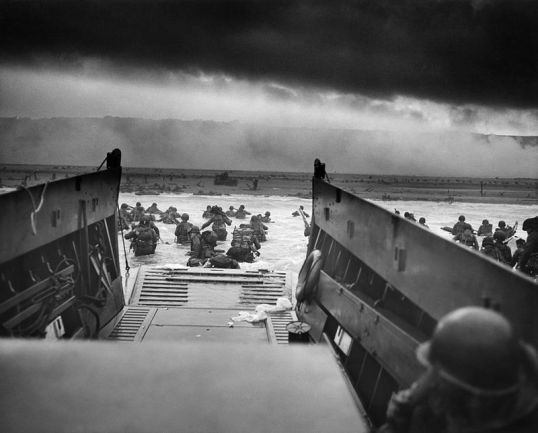
Photograph by Robert F. Sargent
“The eyes of the world are upon you. The hopes and prayers of liberty-loving people everywhere march with you.” — General Dwight D Eisenhower

Painting by Olin Downs
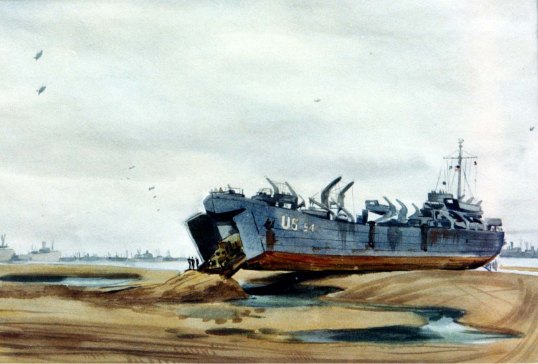
Painting by Harrison Standley
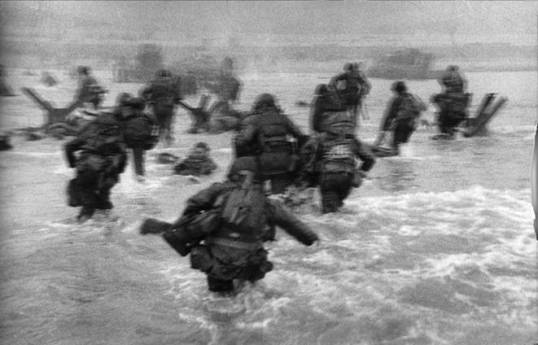
Photograph by Robert Capa

Photograph by Robert Capa

Painting by Simon Smith
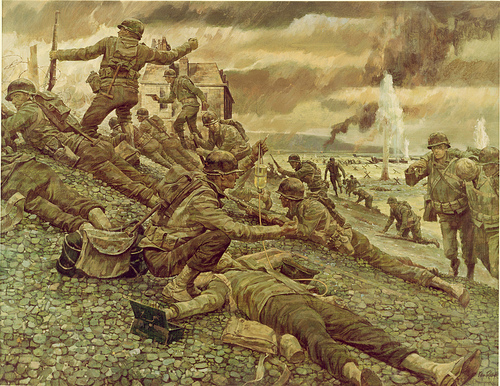
Painting by Ken Riley

Painting by Joseph Gary Sheahan
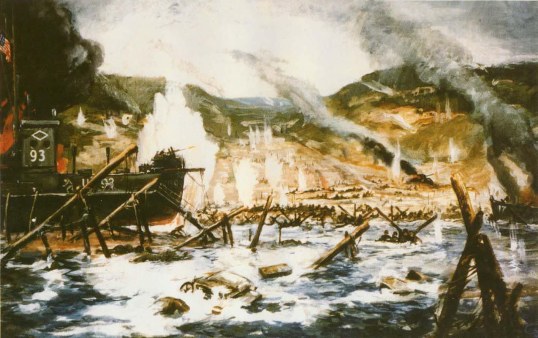
Painting by Joseph Gary Sheahan
“There is one great thing that you men will all be able to say after this war is over and you are home once again. You may be thankful that twenty years from now when you are sitting by the fireplace with your grandson on your knee and he asks you what you did in the great World War II, you won’t have to cough, shift him to the other knee and say, Well, your Granddaddy shoveled shit in Louisiana.” — General George S Patton Jr.
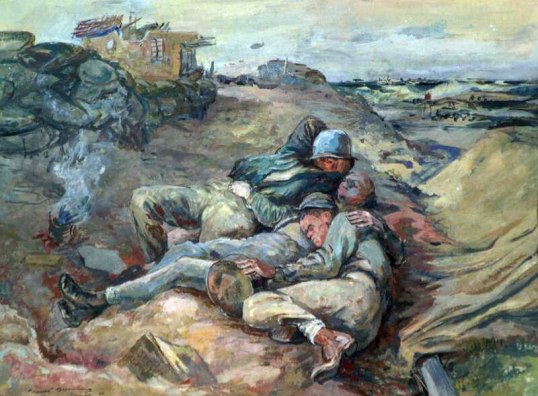
Painting by Manuel Bromberg
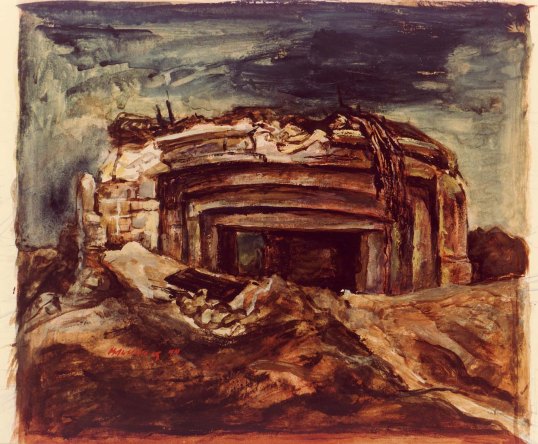
Painting by Manuel Bromberg
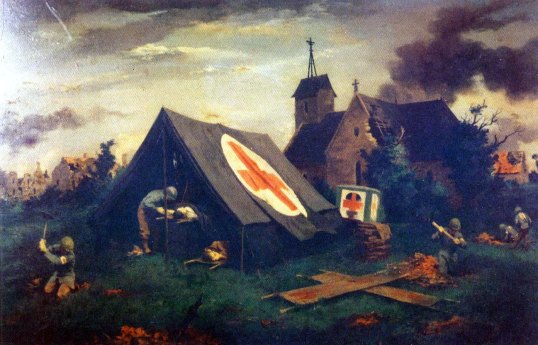
Painting by Laurence Beall Smith
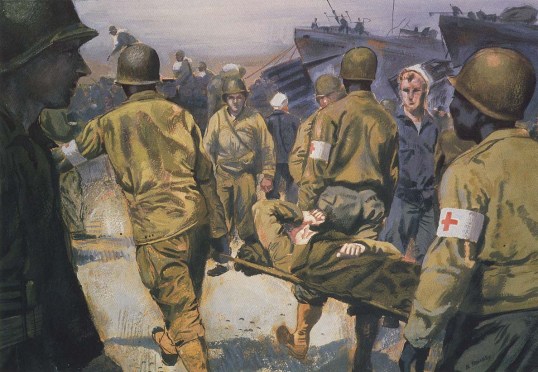
Painting by Harrison Standley
“There’s a graveyard in northern France where all the dead boys from D-Day are buried. The white crosses reach from one horizon to the other. I remember looking it over and thinking it was a forest of graves. But the rows were like this, dizzying, diagonal, perfectly straight, so after all it wasn’t a forest but an orchard of graves. Nothing to do with nature, unless you count human nature.” — Barbara Kingsolver
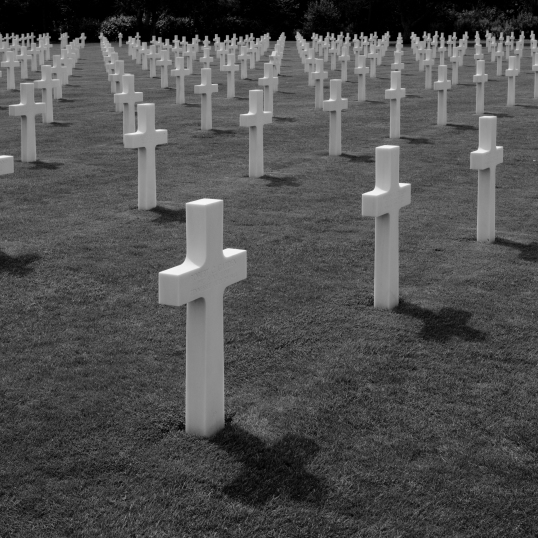
Photograph by Michael Osmenda
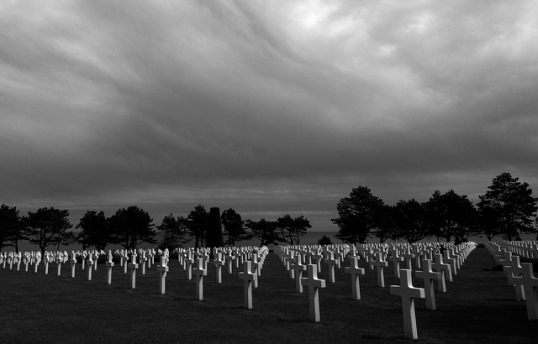
Photograph by Christine Cantera
“They fight not for the lust of conquest. They fight to end conquest. They fight to liberate.” — President Franklin D. Roosevelt
(Special thanks to my sister, Lisa Marie Bowman, who provided me with invaluable help in putting this post together.)
June 6th, 2011 is the 67th anniversary of D-Day but, if you’ve watched the nightly news, you might not know that. According to them, the only important thing about June 6th is that it’s the day a congressman admitted that he’s been using twitter and Facebook to send out pictures of his junk.
However, 67 years before Rep. Anthony Weiner admitted what everyone already knew, brave men from across the world bravely sacrificed their lives to defeat the greatest evil the world had ever known. June 6th is about honoring their memory and sorry Rep. Weiner but we’re taking the day back.
With the help of the movies, of course.
 Through the Shattered Lens