Today, we wish a happy birthday to actor, director, and producer Warren Beatty.
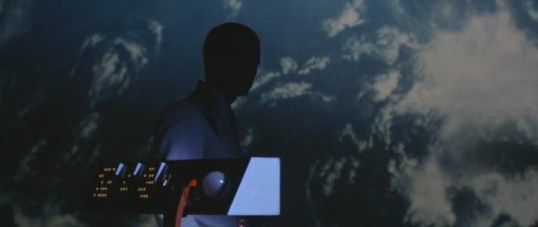
In Alan J. Pakula’s 1974 film The Parallax View, Beatty plays a seedy journalist who goes undercover to investigate the links between the mysterious Parallax Corporation and a series of recent political assassinations. In the film’s most famous sequence, Beatty — pretending to be a job applicant (read: potential assassin) for the Parallax Corporation — is shown an orientation film that has been designed to test whether or not he’s a suitable applicant. The montage is shown in its entirety, without once cutting away to show us Beatty’s reaction. The implication, of course, is that what’s important isn’t how Beatty reacts to the montage but how the viewers sitting out in the audience react.
So, at the risk of furthering the conspiracy, here’s that montage.
“We will not sterilize every Jew and wait for them to die. We will not sterilize every Jew and then exterminate the race. That’s farcical.” — Reinhardt Heydrich
HBO’s Conspiracy (2001) masterfully dramatizes the infamous Wannsee Conference, held on January 20, 1942, where high-ranking Nazi officials orchestrated the Final Solution. The film’s running time mirrors the historical meeting itself, distilling one of the darkest moments in history into a single, chilling sitting that balances historical fidelity, psychological insight, and dramatic restraint. The premise is stark and deceptively simple: a group of men, most of whom had never previously met, gather in a sun-drenched villa outside Berlin to discuss systematic mass murder while enjoying fine food and polite conversation. This contrasting setting, rendered with careful attention to period detail, powerfully underscores what Hannah Arendt called the “banality of evil.” In Conspiracy, evil is not the property of villainous caricatures, but of functionaries and technocrats—chillingly rational and disturbingly mundane.
Much of the film unfolds in real time, utilizing dialogue taken from the sole surviving minutes of the Wannsee Conference. Screenwriter Loring Mandel and director Frank Pierson avoid unnecessary embellishments, allowing the facts and the conversations themselves to carry the full, horrifying weight. Kenneth Branagh gives an Emmy-winning performance as Reinhard Heydrich, the orchestrator and presiding presence at the conference. Branagh’s portrayal is both urbane and authoritative, presenting Heydrich as a figure whose affable composure thinly veils his unwavering commitment to genocide. There is no soaring rhetoric or overt menace; Heydrich’s evil is presented with administrative casualness, making it all the more chilling.
Stanley Tucci is equally compelling as Adolf Eichmann, Heydrich’s logistical right hand and the architect of the machinery of death. Tucci infuses Eichmann with a quiet efficiency and bureaucratic pride—a portrait of a man more attached to process than morality, disturbingly bland in his demeanor. The supporting cast is no less impressive. Colin Firth, as Dr. Wilhelm Stuckart, portrays a legal architect of Nazi race law who appears increasingly unsettled as the agenda shifts from disenfranchisement to extermination. Each attendee is rendered with psychological nuance. Some are disturbingly enthusiastic about their roles, while others are quietly apprehensive, yet ultimately complicit. These subtle gradations of doubt, ambition, and opportunism animate the film’s psychological landscape.
The dialogue, rooted in the actual transcript and skillful dramatic writing, eschews melodrama. The horror emerges not through spectacle, but in analytic exchanges about logistics, quotas, and definitions—the cold calculus of genocide. The men’s debates around how to classify mixed-race Jews, whether sterilization is preferable to extermination, and who should be spared create a bureaucratic puzzle as vile as its intent. Their discussions are delivered in a neutral, even mundane tone, which heightens the chilling reality of what they are planning. Pierson’s direction is restrained; the film never leaves its confined setting, emphasizing the claustrophobic mood of collective complicity. The camera lingers on faces rather than violence, building tension through small gestures—a glance, a pause, the clinking of glassware. The impact of what is said is matched only by the weight of what goes unsaid, until Heydrich, in a quietly devastating moment, makes the true purpose explicit.
More than a simple history lesson, Conspiracy meditates on themes of collective guilt, moral responsibility, and the terrifying ease with which ordinary people become accessories to atrocity. The film is haunted by bureaucracy; if everyone is “just following orders” or “simply doing their job,” the boundaries of blame blur and diffuse. The characters’ debates skillfully skirt the language of murder, favoring euphemisms such as “evacuation” or “resettlement.” This allows viewers to witness, in real time, the kind of moral erosion that enables atrocity on a massive scale. The dry, matter-of-fact tone of the film deepens its emotional impact, forcing the audience to comprehend that such horrors were conjured not in a frenzy, but in calm administrative exchanges over lunch.
For both historians and general audiences, Conspiracy earns praise for its meticulous adherence to historical detail. The screenplay closely follows the Wannsee minutes, and the film’s design choices—muted score, period-accurate costumes, and careful pacing—all serve to render bureaucratic evil as mundane and unremarkable. This unwavering restraint, however, does impose certain limits. The film’s dramatic arc is inherently subdued; the absence of conventional action or narrative tension makes it unfold like an extended negotiation rather than a traditional drama. Some viewers may find this lack of overt conflict stifling or static, resulting in a work that feels more “important” than “entertaining,” but this is clearly by design.
Conspiracy received widespread acclaim for both its historical gravity and psychological depth. Branagh and Tucci, in particular, were celebrated for their nuanced performances. The film is often cited as a model example of how the “banality of evil” operates—not through monsters, but through functionaries in tailored uniforms, sipping wine and rationalizing extermination. For those unfamiliar with the events, the manner in which these men discuss matters of life and death with casual detachment is shocking. As one critic noted, “Most people believe they know what evil looks like… But in Conspiracy, men of true evil met in pristine, gorgeous surroundings… and go about their business leisurely… with a smile and barely a hint of remorse.”
Within the canon of Holocaust cinema, Conspiracy stands apart from films like Schindler’s List or The Pianist, which focus on the suffering and survival of victims. Instead, it occupies a space similar to Downfall and the earlier Die Wannseekonferenz, dramatizing not the machinery of genocide but the mindsets of its architects. By confining itself to dialogue and implication, the film compels viewers to reflect on how civilization’s facades both enable and obscure horror.
The film’s lingering effect is not found in dramatic catharsis or tears, but in an enduring sense of discomfort. Conspiracy dramatizes not just a choice among evil options, but the ease with which those choices become rote procedure and social negotiation. The silence in the final act, as the men calmly disperse after codifying genocide, lands with a cold, almost procedural finality. The closing captions, briefly summarizing the fates of those present, deliver a sobering message: accountability was sporadic, often delayed, and never guaranteed.
Conspiracy is not casual entertainment, nor is it meant to be. Instead, it is essential viewing for anyone interested in the psychology of atrocity, the peril of bureaucratic amorality, and the enduring question of how ordinary people become complicit in extraordinary evil. With a screenplay of surgical precision, outstanding ensemble cast (especially Branagh and Tucci), and a director committed to understatement, HBO’s film demonstrates how history’s darkest decisions are forged not in chaos, but in chilling consensus. To those seeking to understand not only what happened at Wannsee, but how, Conspiracy offers an unblinking and quietly devastating answer.
In Alan J. Pakula’s 1974 film The Parallax View, Warren Beatty plays a seedy journalist who goes undercover to investigate the links between the mysterious Parallax Corporation and a series of recent political assassinations. In the film’s most famous sequence, Beatty — pretending to be a job applicant (read: potential assassin) for the Parallax Corporation — is shown an orientation film that has been designed to test whether or not he’s a suitable applicant. The montage is shown in its entirety, without once cutting away to show us Beatty’s reaction. The implication, of course, is that what’s important isn’t how Beatty reacts to the montage but how the viewers sitting out in the audience react.
So, at the risk of furthering the conspiracy, here’s that montage.
A group of American soldiers are searching for militants. Amongst them is the grim-faced William “Spooky” MacPherson (Val Kilmer). When an adorable little girl with a teddy bear approaches the soldiers, MacPherson barely notices. His mind is on adult threats. But when the girl reveals that she has a bomb in her backpack, the majority of the soldiers are blown up with her. MacPherson survives, though he loses a leg and ends up with such severe PTSD that he can no longer carry a gun or even make a fist. Helping him recover from his wounds is his best friend and fellow soldier, Miguel (Greg Serano).
A year or so later, MacPherson is back home. He lives in a run-down apartment in New York and spends most of his time with a naked woman who speaks Russian. (Whether she was meant to be his girlfriend or just someone he hired is unclear.) Miguel continually calls him up and asks him to come down to New Mexico and work on his ranch. MacPherson refuses at first. He wants to remain isolated from the world. But when his flashbacks of the explosion become too intense, MacPherson finally decides to accept Miguel’s offer. MacPherson pawns a gun so that he’ll have enough money to get a bus ticket. And then, he heads for New Mexico.
The only problem is that, once MacPherson arrives in New Mexico, Miguel is nowhere to be seen. Walking through a town that appears to have recently been constructed, MacPherson meets a lot of people who insist that they’ve never heard of Miguel and that there is no ranch at the address that Miguel gave MacPherson. The police carefully watch MacPherson as he makes his way from business to business, searching for his friend. No one in town is friendly. No one seems to want MacPherson around. Eventually, MacPherson is approached by Rhodes (Gary Cole), the businessman who is building the town and who apparently controls everything that happens within the town limits. Rhodes is friendly. Rhodes says that MacPherson, with his white skin and blonde hair, is exactly the type of person that he likes to see in his town. Can you tell where this is going?
You probably already guessed that Rhodes is an evil businessman who is involved in human trafficking and who smuggles Mexicans across the border to work for his company before then sending back to their home country with next to no money. You’ve also probably figured out that Miguel was killed by the corrupt police force. If you haven’t figured that out, you’ve never seen a movie before. MacPherson teams up with the only kind person in town, Joanna (Jennifer Esposito), and they try to stop Rhodes’s operation. The entire movie seems to be building up to a scene where MacPherson and Joanna take on the whole town but instead, somewhat anticlimactically, everyone just stands around and watches Rhodes battle MacPherson. Conspiracy promises a lot but it doesn’t really deliver.
This was one of Val Kilmer’s first straight-to-video roles and he gives a rather detached performance, which is a shame because an actor of Kilmer’s talent could have really done something with this role if he had been in the mood to do so. But I don’t blame Kilmer for not seeming to be that invested in Conspiracy. It’s not a very interesting film. Even the usually dependable Gary Cole just seems to be going through the motions. The film’s attempt to comment on the pressing political issues of 2008 — illegal immigration, the war in Iraq, the burst of the housing bubble, the recession — only serve to reinforce how shallow and heavy-handed the film actually is. Watching Conspiracy in 2025, the most interesting about it is that the issues it deals with are the issues that, 17 years later, Americans are still dealing with.
With its portrayal of an isolated town and a scarred war veteran looking for a missing friend, Conspiracy has a lot in common with the classic 1955 film, Bad Day At Black Rock. Now, that’s a film that is definitely worth seeing!
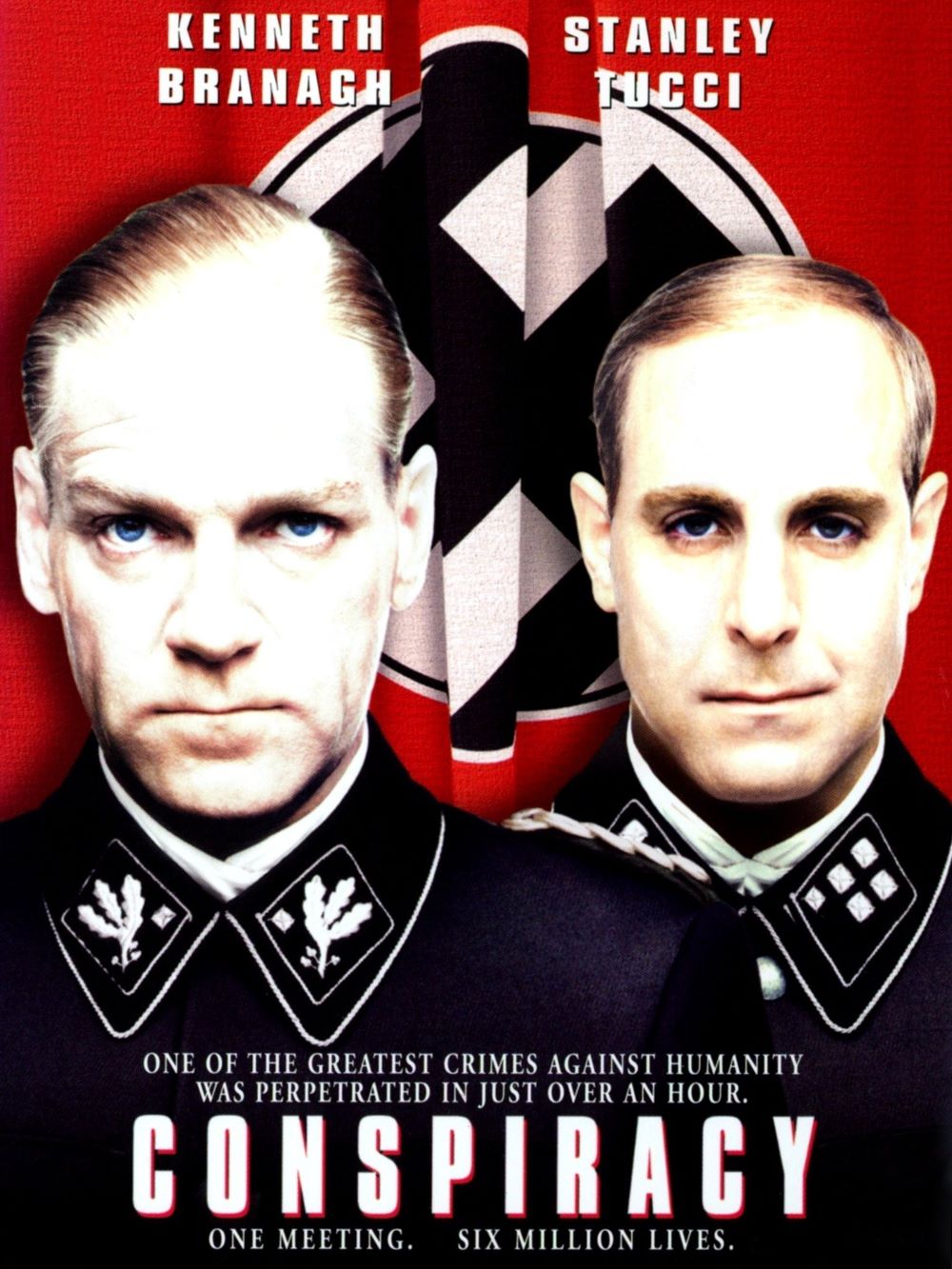
The 2001 film, Conspiracy, takes place at a villa on the outskirts of Berlin. It’s a lovely villa and, as we can see during the film’s opening moments, it’s about to play host to a meeting of very important people.
The date is January 20th and the year is 1942. Having conquered much of Europe, Nazi Germany is now at war with the Allies. Reinhard Heydrich (Kenneth Branagh), the young chief of the Reich Security Main Office and the man who many feel will eventually succeed Adolf Hitler as the leader of the Third Reich, has been directed to call a conference so that he and his deputy, Adolf Eichmann (Stanley Tucci), can “discuss” ways to solve “the Jewish question.” One-by-one, representatives of the Reich’s bureaucracy show up at the villa.
At the start of the meeting, the men discuss various ways to force the Jews out of Germany and all of the occupied territories. The men chose their words carefully, speaking in euphemisms and doing their best to sound like concerned government officials. The men know what they’re talking about but they still seem to feel the need to avoid coming right and saying it. As they talk, it becomes clear that everyone is trying to stay in Heydrich’s good graces while, at the same time, avoiding the fact that they understand the truth about what Germany is doing. It’s not until halfway through the meeting that Heydrich and Eichmann reveal that Germany’s policy has already been determined and that concentration camps with gas chambers have already been designed and built. The meeting is less about discussing the policy and more about getting each man at the meeting to sign off on it. The unspoken subtext is that each man is being tested to determine who will support (and, if need be, help to cover up) the Final Solution and who will have to be otherwise dealt with.
Based on the actual minutes of the meeting, Conspiracy is film that is perhaps even more important now than when it was first released. It’s a film that explores not only the banality of evil but also seeks to answer the question of why no one in Hitler’s government forcefully objected to the Final Solution. (Many, of course, claimed not to know what was going on. This film reveals just how little credibility that claim had.) Some of the men go along because they understand not going along would mean the end of their careers and maybe their lives. Some of the men agree because, as members of the military, they believe in supporting their country’s leadership, regardless of what that leadership represents. Some of the men agree because they want to stay in Heydrich’s good graces. These men represent a society where anti-Semitism is so normalized that it is accepted as a given and, while some of the men are not as outspoken in their prejudice as the others, it’s clear that all of them view the Jewish people as being a unique problem. Those who do raise concerns do so only out of worry of what will happen to them if the rest of the world discovers what Germany is planning. Heydrich insists that there is no need to worry because Germany will win the war. Some of the men at the Conference are clearly not convinced of Germany’s pre-destined victory but not a single one has either the morality or the courage to refuse to endorse the Final Solution. The film ends with a series of title cards, letting us know what became of the men who attended the Wannsee Conference. Heydrich was assassinated during the war. Eichmann fled to South America and hid there until he was captured by Israel in 1960. Many of the men were executed for war crimes but a surprising number of them were either acquitted or never put on trial and went to live peacefully after the war.
Well-directed by Frank Pierson, Conspiracy has a distinguished cast who brings the historical characters to terrible life. It’s one thing to read about what was said and planned at the Conference. It’s another thing to actually hear those words spoken aloud and it’s a reminder that the evil of the Holocaust was not an accident nor was it something that took its perpetrators by surprise. It was something that meticulously planned by human beings who were fully aware of what they were doing. Kenneth Branagh makes for an arrogant and intimidating Heydrich while Stanley Tucci plays Eichmann as being the type of bureaucratic robot who is incapable of seeing human beings as anything more than just dwindling numbers on a report. Colin Firth and David Threlfall make strong impressions as two of the more weary members of the Conference, as does Ian McNeice in the role of the type of crude, career-driven government functionary who has survived by pretending to be dumb.
At a time when anti-Semitism is on the upswing and Holocaust denialism is being mainstreamed, Conspiracy is an important film. When others say that the Holocaust didn’t happen or that it doesn’t matter, Conspiracy defiantly says, “Yes, it did and yes, it does.”
I don’t believe in manifesting events and I sure as heck don’t believe in the power of Twitter prayer circles.
I do believe that Lee Harvey Oswald acted alone.
That makes me a bit of a rarity in our conspiracy-crazed culture but, to me, the idea of one loser killing the most powerful man in the world makes more sense than the idea of some gigantic, complex conspiracy coming together and developing a needlessly complicated plot to kill someone who they could have just as easily blackmailed or circumvented through other methods.
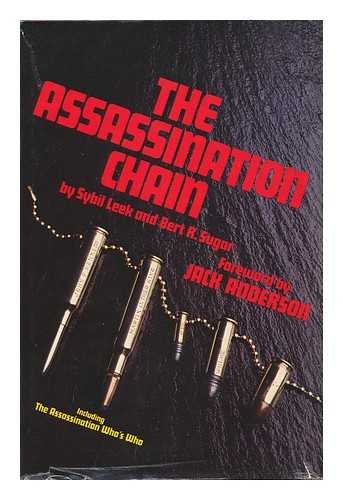
That said, just because I don’t believe in conspiracy theories doesn’t mean that I don’t find them to be oddly fascinating. Take, for instance, the 1977 conspiracy tome, The Assassination Chain.
Written by Sybil Leek and Bert R. Sugar, The Assassination Chain takes a look at the theories surrounding the assassination of John F. Kennedy. Each major theory — from Oswald acting alone to accusations against the CIA, the FBI, the Mafia, Castro, the anti-Castroites, the military-industrial complex, and various right-wing oilmen — is given its own separate chapter. With the exception of the official story, each theory is given respectful consideration. After detailing the JFK theories, The Assassination Chain features chapters about the assassinations of Martin Luther King, Jr, and Robert F. Kennedy. It even takes a look at the attempted assassination of George Wallace and suggests that both Sirhan Sirhan and Arthur Bremer were brainwashed by people who were concerned that either RFK or Wallace could keep Nixon out of the White house.
And, in conclusion, the book suggest that the guilty party was …. EVERYONE! Everyone from the CIA to the FBI to the Mafia to the Pentagon to the richest men in Texas came together in a gigantic plot to not only kill JFK but to also to kill Rev. King, RFK, and Wallace. (I think this might be the only book to suggest that MLK and George Wallace had the same enemies.) Who could stand at the controls of such a plot? Almost as an afterthought, the book accuses Howard Hughes, the famously eccentric billionaire who was later played by Leonardo DiCaprio in The Aviator.
The book’s conclusions aren’t particularly convincing but they do provide an interesting insight into the conspiracy mindset, which states that the only evidence that matters is the evidence that supports the conclusion that you’ve already reached. There’s actually far more evidence to suggest that Oswald acted alone than there is to suggest that the CIA would risk its existence by assassinating the President as opposed to just threatening to leak the details of the President’s extramarital affairs to the press. But it’s comforting to assume that the world’s events are the result of a conspiracy as opposed to just the act of one loser who was upset because his wife left him. Conspiracies provide a way to understand the whims of fate. There’s a comfort in believing that everything happens as a part of a deliberate chain as opposed to just being random events.
The thing is, though, The Assassination Chain makes for an interesting read. Regardless of whether you buy the conspiracy angle or not, it’s always interesting to explore the darker corners of the 60s and early 70s. One reason why the JFK assassination conspiracy theories are so fascinating is because they all involve shady and downright weird characters, like alcoholic ex-FBI agent Guy Bannister and his partner, a hairless pilot and amateur cancer researcher named David Ferrie. The Assassination Chain provides a tour through the fringes of the 60s and introduces to many of the characters who were made their home in those fringes. The book’s final chapter is a detailed Who’s Who of everyone who, up to that point, had been caught up in the assassinations and the theories that followed and it’s an interesting collection of eccentrics, wannabe spies, and mentally unstable blowhards.
The worn and beat-up copy of this book that I read was obviously an old library book. It reeked of cigarette smoke and, as I leafed through the book last week, I found myself imagining the previous owner, chainsmoking while trying to understand the chaotic and random nature of the world. Whomever that person was, I hope they found some sort of answer.
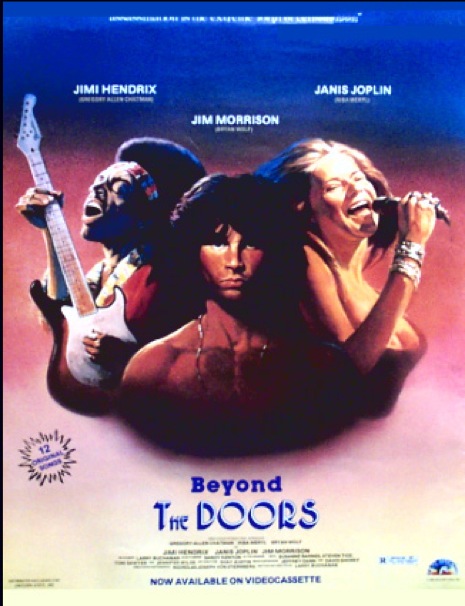
While I was researching The Trial of Lee Harvey Oswald last week, I came across another film directed by Larry Buchanan. Beyond the Doors (also known as Down On Us) sounded like one of those truly odd films that I simply had to see for myself. Fortunately, it turned out that this rare and hard-to-find movie was available (in 13 parts!) on YouTube.
First released in either 1983 or 1984 (sources vary), Beyond the Doors tells the story of a FBI agent who, as the film begins, is out hunting with two friends who proceed to gun him down. Staring down at the agent’s dead body, one of the assassins sneers, “Rock and Roll is dead. Long live Rock and Roll.” The agent’s son then goes through his father’s files and discovers that, during the late 1960s and early 70s, his father was responsible for murdering “the three pied pipers of rock and roll” — Jimi Hendrix, Janis Joplin, and Jim Morrison. The film then enters into flashback mode and we discover both why the U.S. government was determined to kill Hendrix, Joplin, and Morrison and how exactly they attempted to do it.
What can I say about Beyond the Doors? If The Trial of Lee Harvey Oswald seemed oddly respectable for a Larry Buchanan film, Beyond the Doors reminds us of why Larry Buchanan remains a cult figure for bad film lovers. Everything that Buchanan is known for is present in this film: unknown actors playing real-life characters, melodramatic dialogue, one set continually redecorated to look like a dozen different rooms, and plenty of conspiracy theories. As is typical of a Larry Buchanan film, it was shot with a lot of ambition but next to no money or actual talent. Hendrix, Morrison, and Joplin are played by lookalikes who give performances that don’t so much resemble their real-life counterparts as much as they seem to literally be Wikipedia entries brought to life. Hendrix worries that he’s sold out to the man, Joplin questions what fame’s all about, and Morrison makes pretentious observations. Buchanan couldn’t actually afford the rights to any songs from Joplin, Hendrix, or the Doors so instead, the soundtrack is full of music that’s designed to sound as if it could have been written by one of the “three pied pipers of rock and roll” even though it wasn’t. (And yes, the end result is just as silly as it sounds.) In short, Beyond the Doors is one of those films (much like Tommy Wiseau’s The Room) that is so amazingly bad and misguided that it becomes perversely fascinating.
In short, it’s a film that, like me, you simply have to see for yourself.
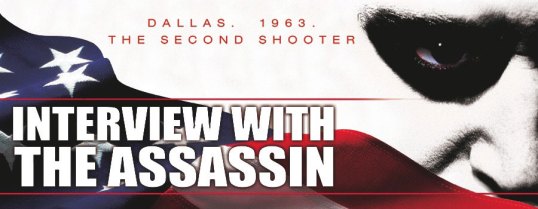
Continuing with the 44 Days of Paranoia, we today take a look at one of the best films to have been inspired by the assassination of John F. Kennedy, 2002’s Interview With The Assassin.
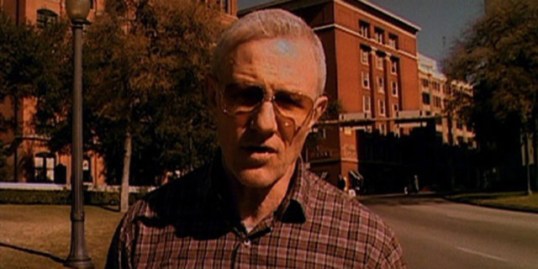
Interview With The Assassin tells the story of Ron (Dylan Haggerty), a cameraman who, at the beginning of the film, has recently lost his job. His gruff neighbor, an ex-Marine named Walter (a brilliantly menacing Raymond K. Barry), approaches Ron and tells him that he’s dying of cancer and he wants Ron to film him confessing to a crime. After Ron sets his camera up, Walter proceeds to state that he was the second gunman and that he — and not Lee Harvey Oswald — was the sniper who killed President Kennedy. When Ron asks Walter who hired him to kill Kennedy, Walter says that he was approached by a man named John Seymour but that he’s not sure who Seymour was working for.
Ron, not surprisingly, is initially skeptical of Walter’s claims. However, Walter gives Ron a spent shell casing that he claims he grabbed off the ground after he shot Kennedy. Walter explains that the only reason he’s been allowed to live is because he has that shell casing and, therefore, can prove that there was a second gunman. Ron gets the shell casing analyzed and is informed that it was probably fired in 1963.
Still skeptical but now intrigued, Ron agrees to make a documentary about Walter and his claims. Walter and Ron drive across the country to find John Seymour and confront him. Along the way, they stop in Dallas and Walter shares more of his memories of killing Kennedy.
As Ron becomes more and more convinced that Walter is telling the truth, he also finds himself becoming more and more immersed in Walter’s secretive and fatalistic worldview. However, as their paranoid road trip continues, Ron also starts to find reasons to doubt whether or not Walter is telling the truth about anything. It all leads to a genuinely surprising finale that forces us to reconsider everything that we had previously assumed about both Ron and Walter.
I usually hate found footage films but Interview With The Assassin is a wonderful exception. In his directorial debut, Neil Burger (who would later direct the brilliant Limitless) makes good use of the faux documentary format. As opposed to many other found footage films, Interview With The Assassin actually provides a believable reason for why the characters are filming everything and, even more importantly, it’s willing to both explore and question the motives of the man holding the camera. As a result, even though he spends much of the film off-screen, Ron becomes as interesting a character as Walter.
The genius of Interview With The Assassin is to be found in the film’s ambiguity. While the film creates a believable atmosphere of conspiracy and paranoia, it also forces the viewer to interpret what she’s seen and heard for herself. Is Walter crazy or is he telling the truth? Is Ron a hero trying to uncover the truth or is he a frustrated journalist who is exploiting a dying and mentally disturbed man? Convincing arguments can be made for any of those interpretations as well as a dozen more. I’ve seen the film a handful of times and I’m still conflicted on just how I feel about both Walter’s claims and the initial assumption that Ron is meant to be the film’s hero.
Interview With The Assassin is a film that invites its audience to think. As a result, it’s a film that deserves to be seen.
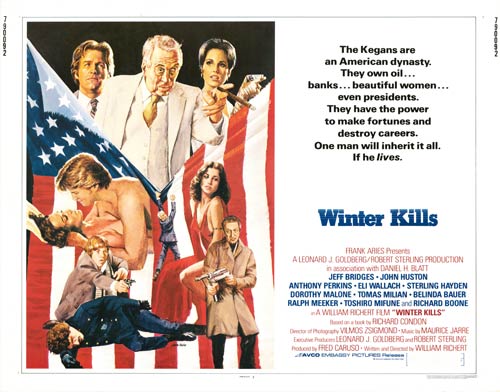
Yesterday, I took a look at Executive Action, a 1973 docudrama about the assassination of John F. Kennedy. Today, I want to take a look at another film inspired by the Kennedys, the 1979 satire Winter Kills.
As the film opens, it’s been 16 years since a popular and dynamic President named Tim Kegan was assassinated in Philadelphia. Despite constant rumors of conspiracy, the official story is that Kegan was killed by a lone gunman and that gunman was subsequently killed by another lone assassin. The President’s half-brother, Nick (played by Jeff Bridges, who looks so impossibly young and handsome in this film), has disappointed his father (John Huston) by declining to follow his brother into politics. Instead, he spends most of his time sailing on corporate oil tankers and dating fashion editor Yvette (Belinda Bauer). This all changes when a dying man named Fletcher (and played, underneath a lot of bandages, by Joe Spinell) asks for a chance to speak to Nick. Fletcher reveals that he was the 2nd gunman and that he was hired by to kill President Kegan. Before dying, Fletcher tells Nick where he can find the rifle that was used to kill the President.
Following Fletcher’s directions, Nick finds both the rifle and proof that his brother’s death was the result of a conspiracy. Determined to find out who was truly behind the conspiracy, Nick goes to see his father, the flamboyant tycoon Pa Kegan (John Huston) who, we discover, is only alive because he frequently gets blood transfusions from young women. With Pa’s encouragement, Nick is sent on an increasingly bizarre odyssey into the darkest shadows of America, a world that is populated by militaristic businessmen, sinister gangsters, and an unemotional man named John Cerutti (Anthony Perkins) who very well may be the most powerful man in the world.
The martyred President might be named Tim Kegan, his accused assassin might be named Willie Abbott, and the man who shot Abbott might be named Joe Diamond (and might be played by Eli Wallach) but make no mistake about it — Winter Kills is a thinly disguised look at both the Kennedy assassination and the Kennedy family. Based on a novel by Richard Condon (who also wrote the conspiracy classic, The Manchurian Candidate), Winter Kills takes all of the various Kennedy conspiracy theories and intentionally pushes them to their most ludicrous extremes. The end result is a film that tries (and occasionally manages) to be both absurd and sincere, a portrait of a world where paranoia is the only logical reaction.
As I discovered from listening to director William Richert’s commentary on the Anchor Bay DVD, Winter Kills had a long and complicated production history. The film was produced by two marijuana dealers, one of whom was murdered by the Mafia shortly after the film premiered while the other would later be sentenced to 40 years in prison on federal drug charges. The production actually went bankrupt more than a few times, which led to Richert, Bridges, and Bauer making and releasing another film specifically so they could raise the money to finish Winter Kills.
When Winter Kills was finally released, it got a good deal of attention because of its spectacular cast. Along with Bridges, Huston, Perkins, and Wallach, the film also features cameo appearances by Tomas Milian, Elizabeth Taylor, Ralph Meeker, Richard Boone, Sterling Hayden, Dorothy Malone, Toshiro Mifune, and a host of other actors who will be familiar to those of us who enjoy watching old movies on TCM. And yet, according to Richert, the film itself was barely released in to theaters, the implication being that Winter Kills was a film about conspiracies that fell victim to a conspiracy itself.
Given the film’s history and the subject matter, I was really hoping that Winter Kills would turn out to be a great movie. Unfortunately, it really doesn’t work. The film struggles to maintain a balance between suspense and satire and, as a result, the suspense is never convincing and the satire is ultimately so obvious that it ends up being more annoying than thought-provoking. The cast may be impressive but they’re used in such a way that film ultimately feels like it’s just a collection of showy celebrity cameos as opposed to being an actual story.
That said, Winter Kills remains an interesting misfire. Jeff Bridges is a likable and compelling lead (and he gives the film much-needed focus) and, playing a role that has a lot in common with his better known work in Chinatown, John Huston is a always watchable if not necessaily likable. Best of all is Anthony Perkins, who plays a role that, in light of what we now know about the NSA, seems oddly prophetic.
Finally, best of all, Winter Kills remains an interesting time capsule. If nothing else, it reminds us that mistrust and paranoia are not unique to this century.
Even though it happened 22 years before I was born, I sometimes feel as if it was only yesterday that President John F. Kennedy was assassinated.
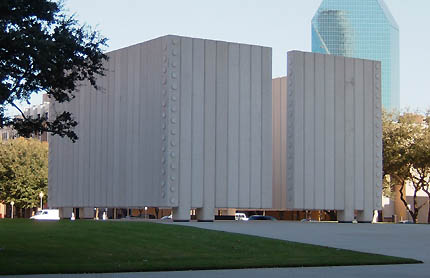
A lot of that is because I’m from Dallas. When I was born, my family lived in Oak Cliff, a few blocks away from where the accused assassin Lee Harvey Oswald once lived. I drive by the Kennedy Memorial several times a week. I’ve gone to the Sixth Floor Museum. I’ve made out on the Grassy Knoll. On a daily basis, I see tourists who have come down here from up north with their preconceived prejudices, their unwieldy copies of Stephen King’s 11/22/63, and their overactive sweat glands. (“How do you handle the heat!?” they ask when the temperature is barely above 90.) With the 50th anniversary of the assassination approaching, the Dallas Morning News has been running daily stories examining every detail of that terrible event.
The rest of the nation, of course, will never let us forget that JFK was assassinated in Dallas. Just last week, there was an idiotic and bitter opinion piece in The New York Times, written by James McAuley, in which he claimed that Dallas was a “city of hate” that should feel more guilt over the JFK assassination. As McAuley (who is studying history at Oxford and is not a resident of that city that he apparently feels qualified to judge) put it, “For 50 years, Dallas has done its best to avoid coming to terms with the one event that made it famous: the assassination of John F. Kennedy on Nov. 22, 1963.”
This, of course, is bullshit.
There are two competing schools of thought about the assassination of John F. Kennedy. One says that Lee Harvey Oswald was solely responsible. The other is that Kennedy was killed as the result of a complex conspiracy.
Let’s say, for the sake of argument, that Lee Harvey Oswald acted alone. Well, Oswald was born in New Orleans but he was raised up north in New York City. He was also a communist with a history of mental instability. Hence, if you accept that Oswald was the lone assassin than you also have to be willing to accept that Oswald would have tried to kill Kennedy regardless of what city he was living in.
Things get a bit more complicated if you believe that Kennedy was killed as the result of a conspiracy. But let’s consider the usual suspects that come up whenever people start talking about the possibility of conspiracy. The Mafia was based in the north. The CIA was based in Washington, D.C. The anti-Castroites were based in Miami. Again, all of these conspirators would have killed Kennedy regardless of what city he went to in November.
It’s easy for the rest of the country, in a fit of jealousy, anger, and delusion, to blame Dallas and Texas for the assassination of John F. Kennedy but, regardless of whether you believe in the lone assassin or a larger conspiracy, the truth is far more complex.
Over the next few days, as part of the 44 Days of Paranoia, I’ll be taking a look at some of the many films that were inspired by this assassination. Let’s start things off with one of the lesser known entries in the JFK genre, 1973’s Executive Action.
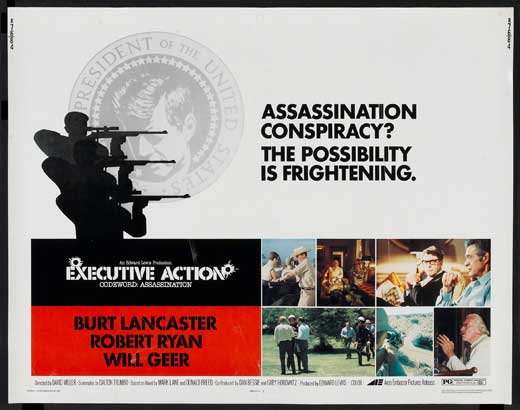
Executive Action opens with a series of grainy, black-and-white photographs of both America in the 1960s and the men who, over the course of the film, will be portrayed as having plotted and carried out the assassination of President Kennedy while a mournful piano plays in the background. It’s a low-key but eerily effective opening and it also lets the viewers know exactly what type of film they are about to see. As opposed to Oliver Stone’s far better known JFK, Executive Action is a low-key, almost deliberately undramatic film. Despite the fact that there are some familiar faces in the cast (or, at the very least, familiar faces to those of us who watch TCM), Executive Action almost feels as if it could have been a documentary.
As the film opens in 1963, we see a group of very rich men talking about the future of America. Ferguson (Will Geer) and Foster (Robert Ryan) are concerned that President Kennedy’s policies are going to destroy America. Foster is worried that Kennedy is planning on cutting back on military spending. Ferguson is upset by Kennedy’s support of the Civil Rights movement. (In one memorable scene, we see Martin Luther King delivering his Dream speech on TV before the camera pulls back to reveal Ferguson watching in disgust.) Their associate, the shadowy Farrington (Burt Lancaster), argues that the only way to stop Kennedy is to assassinate him and put the blame on a lone gunman.
With the support of Ferguson and Foster, Farrington recruits a group of gunmen (led by Ed Lauter and including Roger Corman regular Dick Miller) and works to set up the perfect patsy. A man (James MacColl) goes around Dallas, acting obnoxious and telling anyone who will listen that his name is Lee Oswald. At Ferguson’s insistence, a picture is doctored to make it appear as if Lee Harvey Oswald is posing in his backyard with a rifle. As all of this goes on, the date of November 22nd steadily approaches…
As I stated before, Executive Action is an almost obsessively low-key film. That, however, works to the film’s advantage. Ferguson, Foster, Farrington, and the other conspirators are chillingly believable because they are presented almost as being anonymous. Instead of being portrayed as being super villains, they are instead men who approach assassination as just another part of doing business. The impression one gets is that Kennedy isn’t the first leader they’ve had killed and he probably wasn’t the last. Director David Miller seamlessly mixes historical footage with film reenactments and the end result is a disturbingly plausible film.
Unfortunately, Executive Action is less well-known than some of the other films that have argued that a conspiracy was responsible for the assassination for John F. Kennedy. However, it may very well be the best.
 Through the Shattered Lens