Review: Knives Out (dir. by Rian Johnson)


“The family is truly desperate. And when people get desperate, the knives come out.” — Benoit Blanc

After shaking up galaxies far, far away with Star Wars: The Last Jedi, Rian Johnson returned to solid ground in 2019 with Knives Out, a film so self-assured and inventive it practically felt like a director catching his breath while reminding the world what made him exciting in the first place. It was his first movie after that polarizing Star Wars entry, and he used the opportunity not to go bigger, but smarter—to take something intimate, character-driven, and refreshingly old-school and make it gleam again. Knives Out landed as a kind of palate cleanser for both him and the audience: a modern mystery that leaned into genre nostalgia while reinventing it with sharp humor and social bite. The result wasn’t just a change of pace—it was a confident display of craft from a filmmaker unbothered by his critics, operating with absolute control over every frame, every line, and every perfectly timed smirk.

The setup couldn’t be more classic: a wealthy family patriarch, Harlan Thrombey, turns up dead after his 85th birthday, leaving behind a tangled household of suspects, secrets, and strained smiles. His death looks like suicide, but something isn’t right. Enter Benoit Blanc, a Southern gentleman detective hired anonymously to snoop through the wreckage of lies and grievances. The scenario drips with vintage whodunit flavor, but Johnson’s genius lies in retooling that familiarity into something electrifyingly modern. The Thrombeys aren’t just eccentric millionaires—they’re avatars of American entitlement, each convinced of their own superiority while quietly dependent on the man they pretend to revere. By building his mystery around a clan that mirrors contemporary divisions of money, politics, and self-deception, Johnson injects wit and purpose into the genre without ever losing the fun of the game.

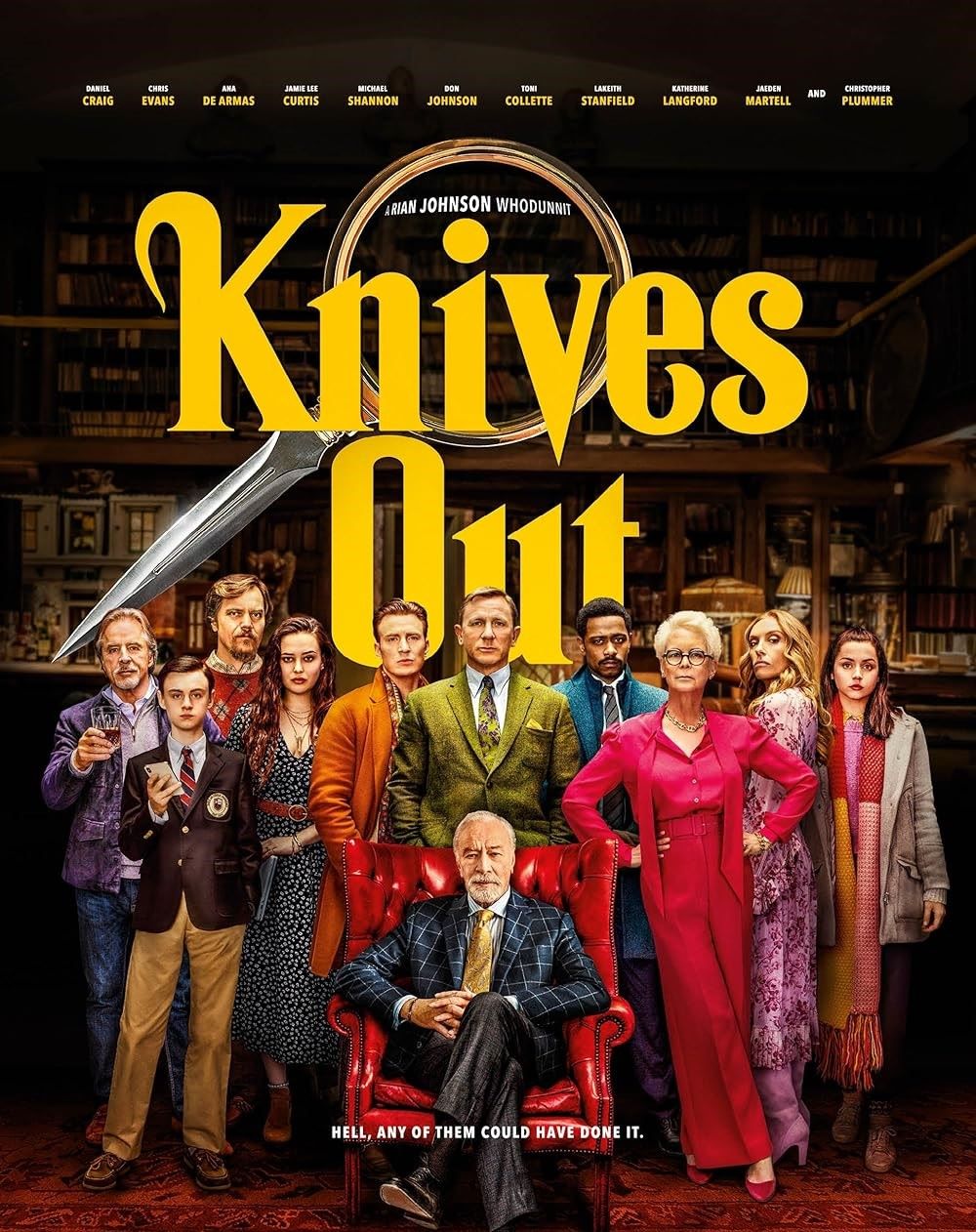
Jamie Lee Curtis plays the confident matriarch Linda, Michael Shannon the resentful son Walt, Toni Collette the spiritual grifter Joni, and Don Johnson the smirking son-in-law Richard—all of them playing heightened but recognizable shades of selfishness. Their sniping exchanges during the first act are among the film’s best sequences, packed with fast banter, political jabs, and casual hypocrisy. Johnson directs these moments like a verbal tennis match, letting personalities bounce and clash until the family’s shiny façade cracks enough for true frustrations to spill out. It’s sharp, funny, and chaotic, showing early on that no one in the Thrombey family is as self-made or self-aware as they claim to be.

Amid that colorful ensemble, the performance that most stunned audiences came from Chris Evans as Ransom Drysdale, Harlan’s playboy grandson and the family’s unapologetic black sheep. Coming off years of playing Marvel’s resolutely noble Steve Rogers, Evans dives into Ransom with visible glee, turning him into a figure of charm and mystery whose motives are never quite clear. He’s magnetic from the moment he appears—witty, cynical, a little dangerous—and Johnson clearly relishes using Evans’s clean-cut image to toy with expectations. Ransom strides into the story radiating confidence, but there’s a guarded, almost predatory intelligence behind his grin. His scenes crackle because the audience can’t quite decide where to place him: is he the rare Thrombey who sees through the family hypocrisy, or is he spinning his own kind of manipulation? That tension between self-awareness and deceit gives his every line an edge. Watching Evans in this role feels like a release for him and a thrill for viewers, a testament to both his range and Johnson’s intuitive casting.

Opposite that moral uncertainty stands Ana de Armas’s Marta Cabrera, Harlan’s kind and soft-spoken nurse who suddenly finds herself at the heart of the story. Marta grounds the entire film emotionally, her decency cutting through the Thrombeys’ arrogance like sunlight in a dusty room. She’s the migrant caretaker who everyone claims to love while casually condescending to, a detail Johnson uses to expose how often politeness masks prejudice. Marta’s inability to lie without vomiting, played initially for laughs, gradually becomes symbolic—a kind of moral honesty that makes her unique in a house ruled by deception. De Armas brings layered vulnerability to the role, balancing fear, guilt, and compassion with natural ease. Through her, Johnson turns the whodunit into something more human and emotionally resonant. She isn’t just a witness or a suspect; she’s the beating heart around which all the greed, paranoia, and privilege revolve.

Then there’s Daniel Craig’s Benoit Blanc, whose arrival shifts the film into another gear entirely. His Southern drawl—equal parts poetic and perplexing—sets the tone for what becomes one of Craig’s most playful performances. After years of portraying the stoic James Bond, he’s clearly having the time of his life as a detective who investigates with both intellect and intuition. Blanc operates less like a hard-nosed cop and more like a philosopher; he believes that solving a crime means understanding human weakness as much as evidence. His famous “donut hole” speech perfectly captures the balance Johnson strikes between earnestness and absurdity. Blanc may revel in his own melodrama, but he also brings heart to chaos, observing people’s contradictions without losing his sense of wonder. The result is a detective who’s less about revelation and more about revelation’s moral cost.

Visually, Knives Out belongs to a rare category of films that are so meticulously crafted they could be paused at any frame and still look compelling. Johnson and cinematographer Steve Yedlin transform Harlan’s mansion into a breathing character—an architectural echo chamber of secrets. The walls are lined with strange trinkets, elaborate paintings, and heavy mahogany furniture that suggest old money’s suffocating weight. There’s something both cozy and claustrophobic about the space, which mirrors the tension between family warmth and poisonous resentment. The camera glides through it with purpose, lingering on small details that gain meaning later, and the autumn-colored palette—deep reds, browns, and golds—wraps everything in an inviting melancholy. It’s as much a visual experience as it is a narrative one, and few modern mysteries feel as tactile.

Johnson’s writing keeps that sense of precision. The plot unfolds like clockwork, but the mechanics never feel mechanical. Instead, he keeps viewers off-balance by blending humor with genuine suspense. Instead of relying entirely on high-stakes twists, Johnson builds tension through empathy, giving us access to characters’ doubts and stakes rather than just their clues. The result is a mystery that keeps the audience guessing in emotional and moral dimensions, not just logical ones. Every revelation says as much about character as it does about the crime.

Underneath the quick humor and ornate mystery structure, Knives Out doubles as a satire of class and entitlement. Johnson sketches the Thrombeys as people who talk endlessly about fairness, morality, and self-reliance yet collapse into panic when their material comfort is threatened. Through them, he captures a peculiar American irony: the people most obsessed with earning their status are often those most insulated from real struggle. When the family gathers to argue over wealth and loyalty, Johnson doesn’t need to exaggerate—they expose themselves with every smug phrase and self-justified rant. It’s social commentary that’s biting but never heavy-handed because it plays out through personality instead of sermon.

Nathan Johnson’s score carries the story forward with playful precision, shifting from tension to whimsy in sync with the characters’ shifting loyalties. There’s something almost dance-like about the film’s rhythm: scenes of laughter can spiral into confession, and interrogations can dissolve into comedy without losing a beat. The editing supports that agility, cutting crisply between overlapping dialogue and close-ups that reveal just enough expression to keep us alert. Johnson’s sense of pacing feels theatrical in the best way—it’s about timing and tone rather than spectacle.

As with many of Rian Johnson’s works, contradiction fuels the story’s appeal. Knives Out is cynical about human greed but oddly hopeful about individual decency. It mocks arrogance but rewards empathy. Even when it toys with genre clichés, it does so out of affection, not scorn. Johnson clearly understands that mystery storytelling is as much about character and morality as deduction, and he uses humor and chaos as tools to explore who people become under pressure. The movie’s sophistication lies in how effortless it feels—its layers unfold smoothly, but the craft behind them is razor sharp.

The film’s ending closes with a visual that redefines power without needing words. After a story filled with deceit, pretension, and the scramble to control a legacy, it concludes on an image that says everything about perspective—who actually holds the moral high ground and how quietly dignity can win. Like the rest of the movie, it’s both playful and pointed, leaving you smiling while still turning the characters’ behavior over in your mind.

Looking back, Knives Out stands as a defining moment in Rian Johnson’s career. After the spectacle and dialogue storms of The Last Jedi, this lean, ensemble-driven mystery reaffirmed his strengths as a writer-director who thrives on structure, rhythm, and human contradictions. It’s a film that takes as much pleasure in observation as revelation, brimming with sly humor and performances that sparkle across the moral spectrum. Anchored by Ana de Armas’s poignant sincerity, Daniel Craig’s eccentric brilliance, and Chris Evans’s unpredictable charisma, it became one of the most purely enjoyable movies of its time. Witty without pretense, political without lecturing, and perfectly balanced between cynicism and heart, Knives Out remains proof that the old whodunit can still cut deep—and that Rian Johnson’s sharpest weapon is still his storytelling.

Wolf (1994, directed by Mike Nichols)


Will Randall (Jack Nicholson), the editor-in-chief of a New York Publishing house, doesn’t get much respect, not from his wife (Kate Nelligan), not from his boss (Christopher Plummer), and certainly not from Stuart Swinton (James Spader), the sleazy executive who is plotting to steal his job and destroy his marriage.  But then, one night, Will runs over a black wolf on a country road.  When he tries to helps it, the wolf bites him.  Soon after, Will starts to feel different whenever the moon is full.

I remember that, when Wolf came out in 1994, some people said that casting Jack Nicholson as a werewolf seemed like typecasting.  Nicholson apparently understood this as well so he actually downplays his usual mannerisms for the first part of the movie and gives a convincing performance as a harried executive who is worried he’s about to lose his job.  It’s only after he is bitten that Will Randall starts to come alive.  Not only does he develop the predator instinct necessary to survive in New York City but he also, without fear, pursues his boss’s daughter, Laura (Michelle Pfeiffer, at her most beautiful).  Typecast or not, Jack Nicholson is excellent in Wolf.  Equally good is James Spader as Will’s business rival, who starts to show some predator-like aspects of his own.

Director Mike Nichols was not normally a horror director and, around the midway point, his direction falters and there are times when he just seems to be going through the motions.  He gets good performances from his cast but doesn’t know how to craft a good jump scare.  The best parts of the movie are when Wolf uses lycanthropy as a metaphor for petty office politics, with Will “marking” his territory while talking to Stewart and showing a renewed killer instinct.  Wolf works better as a social satire than as a horror movie.

Fans of Frasier will be happy to see David Hyde Pierce in a small but key role.  He delivers the film’s best line.  Fans of Friends may also notice David Schwimmer in a small role.  He says nothing worth remembering.  Their presence, though, is a reminder of just how much American culture changed in 1994.  By the end of the year, both went from small roles in Wolf to co-starring in the two of the most popular sitcoms in America.

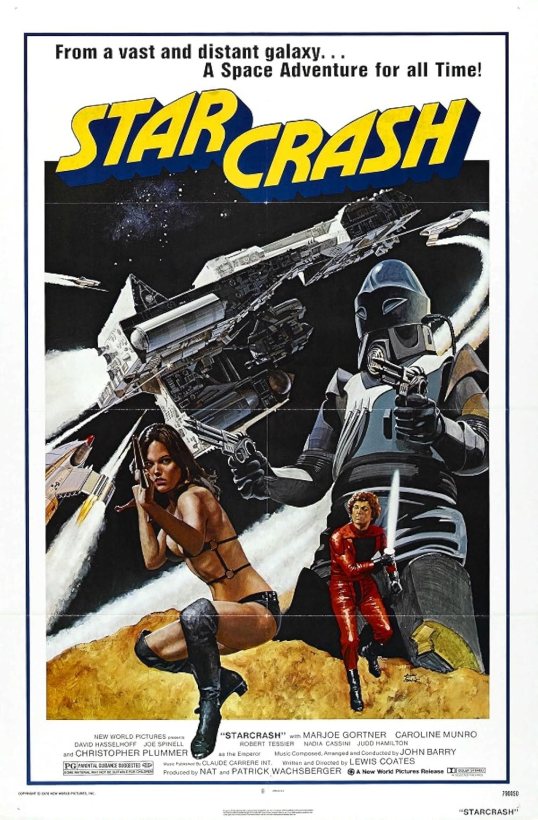
Film Review: Starcrash (dir by Luigi Cozzi)


Is there a better movie than Starcrash?

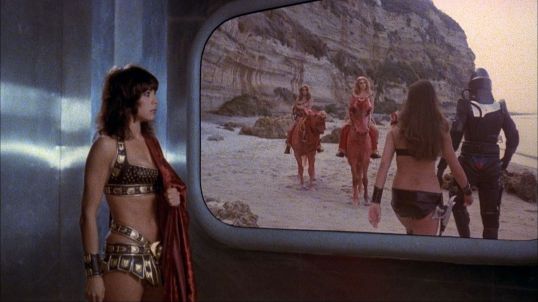
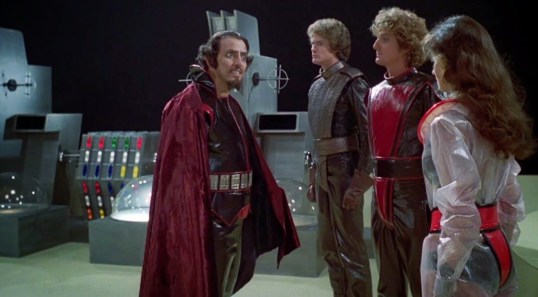
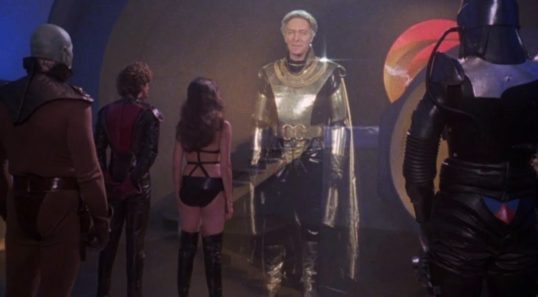
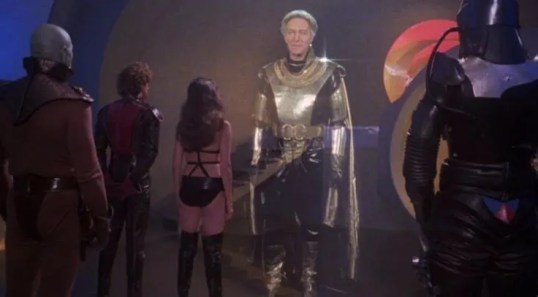
First released in 1978, Starcrash takes place in a galaxy that is probably far, far away.  The evil Count Zath Arn (Joe Spinell) is attempting to overthrow the benevolent Emperor (Christopher Plummer).  Zath Arn has built a weapon that is so large and so powerful that it can only be hidden inside of another planet.  (“Like a Death Star?” you say.  Hush, don’t go there….)  The Emperor’s son, Prince Simon (David Hasselhoff), led an expedition in search of the weapon but a surprise attack of glowing red lights led to his ship crashing on the unknown planet.  Simon is missing and Zath Arn’s power is growing.

Two legendary smugglers — Stella Starr (Caroline Munro) and the enigmatic Akton (Marjoe Gortner) — are released from prison and tasked with tracking down both the weapon and Simon.  (Stella was already in the process of escaping when she got the news of her release.)  Accompanied by the duplicitous Thor (Robert Tessier) and the loyal Elle (Judd Hamilton), a robot with a thick Southern accent, Stella and Akton set out to explore the haunted stars.

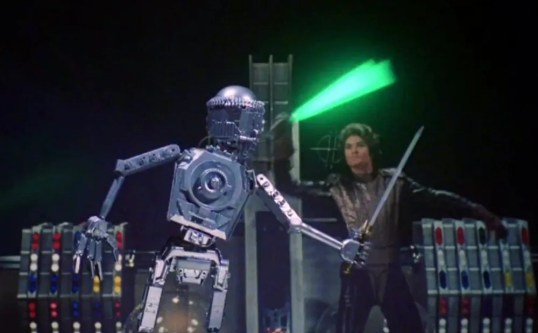
It’s a journey that leads them to …. well, actually, it only leads them to three planets.  It turns out that the weapon wasn’t that well-hidden after all.  Still, one planet is populated by Amazons and protected by a giant, tin robot.  Another planet is populated by cannibals who wear stone masks.  And then there’s an ice planet where the clouds race across the sky while Stella and Elle try to make it back to their ship without freezing to death.  And if that’s not enough to make things exciting, this film also features David Hasselhoff with a light saber!

There’s no point in denying that Starcrash would never have been made if not for the success of the first Star Wars.  Indeed, the film even begins with an opening crawl and features a shot that is almost a recreation of the first scene in Star Wars.  However, director Luigi Cozzi doesn’t limit himself to just mining Star Wars for inspiration.  The giant tin robot owes a huge debt to the creations of Ray Harryhausen.  The judge that sentences Stella and Akton to prison is the same talking head that appeared in Invaders From Mars.  A scene in which Stella explores an abandoned spaceship owes more than a little to 2001: A Space Odyssey.  Even Akton, with his telepathic powers, seems like he could have stepped out of an episode of Star Trek.

Starcrash makes no secret of its influences but it’s such an energetic and good-natured film that all of the borrowing feels like like a rip-off and more like a very affectionate homage.  It’s obvious that director Luigi Cozzi loved the films from which he borrowed and that love is present in every frame of StarcrashStarcrash is a fast-paced space adventure and it’s a lot of fun.  It’s certainly more fun than any of the recent entries in the Star Wars franchise.  Working with a low-budget, an energetic cast, and some surprisingly creative special effects, Cozzi crafts a genuinely entertaining movie.  Marjoe Gortner was never better than he was in Starcrash.  Christopher Plummer, to his credit, brings a truly noble bearing to the role of the Emperor.  Joe Spinell obviously understood that his role didn’t require subtlety and he delivers all of his lines like a villain in an old time serial.  As for David Hasselhoff …. he’s the Hoff and he brings his trademark earnestness to the role of Simon.  Starcrash is the best film that Cozzi ever directed.

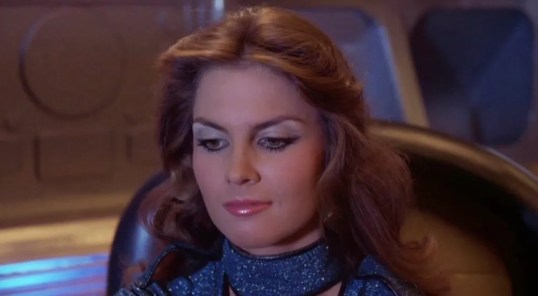
A good deal of the success of Starcrash is due to Caroline Munro, who gives such a committed and likable performance as Stella Starr that it’s hard not to mourn the fact that Cozzi was never able to make any more films about the character.  As played by Munro, Stella Starr is a smart, confident, and strong.  Stella loves doing what she does and it’s impossible not share her joy when she announces she’s taking the ship into “hyperspace.”  Even though Stella spends the majority of the film running around in a leather bikini, Munro brings a definite touch of class to the role.  No one is going to push Stella Starr around and certainly, no one is going to destroy the Galaxy on her watch.  Thank to Caroline Munro’s fearless performance, Starcrash is one of the most empowering science fictions ever made.

Starcrash ends with hints of a possible sequel but sadly, there never came to be.  (Not surprisingly, there was an unrelated film that was advertised as being a sequel but which was actually just a softcore science fiction version of Lady Chatterley’s Lover.)  It’s a shame.  Stella Starr definitely deserved to have many more adventures.

Scenes That I Love: “Halt The Flow of Time” from Starcrash


Today is apparently Star Wars Day! 

(May 4th …. may the 4th …. okay, I get it.)

So, it seems appropriate to share a scene that I love from my favorite Star Wars film, Starcrash!

Okay, technically, Starcrash is not part of the Star Wars franchise.  This 1978, Luigi Cozzi-directed film is usually considered to be one of the more blatant rip-offs of Star Wars.  But you know what?  I love Starcrash.  I’ve seen Star Wars and I’ve seen Starcrash and Starcrash is a lot more fun.  Not only does Starcrash feature Marjoe Gortner, David Hasselhoff, Joe Spinell, and Caroline Munro but it also features the one and only Christopher Plummer as the emperor of the universe.

In the scene, Hasselhoff and Munro inform Plummer that they only 45 seconds before a planet explodes.  Plummer, however, has the perfect solution and his delivery of the line “HALT …. the flow of time!” is one of the many things that makes Starcrash one of the greatest films ever made.

10 Christopher Plummer Films To Watch This Weekend


Christopher Plummer died today.  The Canadian actor was 91 years old and he left behind a truly impressive filmography.  Below are ten films that I would recommend if you want to have a Christopher Plummer film fesival this weekend.  I’ll be the first to admit that it’s a bit of an idiosyncratic list, a mixture of obscure and cult films with a few films that are well-known but which perhaps aren’t usually thought of as being Christopher Plummer films.  This was intentional on my part.  Everyone already knows that Christopher Plummer was in The Sound of Music and Knives Out.  I wanted to recommend a few films that you might not see listed elsewhere.

So, with all that in mind, here are 10 Christopher Plummer films to watch this weekend:

Starcrash (1979) — One of my favorite films of all time, this Star Wars rip-off features Christopher Plummer in the small but pivotal role of the Emperor of the Galaxy.  Plummer brings a lot dignity and humanity to the role.  If the galaxy does ever have an emperor, I hope he will be as wise as Christopher Plummer was in Starcrash.

Up (2009) — Christopher Plummer lends his amazing voice to this PIXAR film about an old man who floats away on an adventure and who runs into far more sinister adventurer named Charles Muntz.  Plummer is wonderfully menacing at Muntz, using his voice to create one of PIXAR’s most memorable villains.

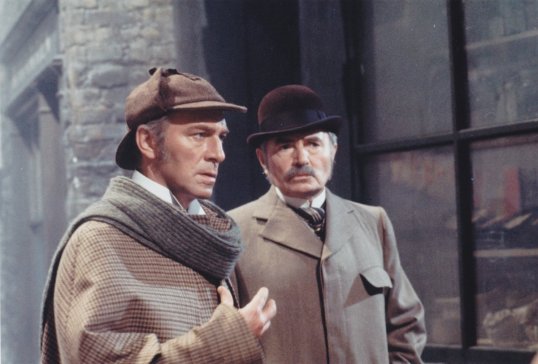
Murder By Decree (1979) — In this Canadian film, Plummer plays Sherlock Holmes while James Mason plays Dr. Watson.  Together, they investigate the crimes of Jack the Ripper and uncover a royal conspiracy.  Plummer is perhaps one of the most credible Sherlock Holmes to ever appear on screen, breathing real life into a character that otherwise could have felt like a literary invention.  Thanks to Plummer’s performance, the final scenes are poignant and rather sad and perhaps as emotional as any scene to be found in any screen adaptations of Holmes’s adventures.

12 Monkeys (1995) — Plummer is nicely cast of Brad Pitt’s father in this Terry Gilliam-directed time travel epic.

The Fall of the Roman Empire (1964) — In this historical epic, Plummer played yet another emperor, the mad Commodus.  Though The Fall of the Roman Empire has its flaws, it’s still an enjoyable work of spectacle and Plummer’s villainous turn is definitely one of the film’s highlights.  Whereas other Roman epics often portrayed the “bad” emperors as being decadent and somewhat buffoonish, Plummer plays up Commodus’s anger and his desire for revenge.  He’s the emotionally vulnerable tyrant.

Dreamscape (1984) — The enjoyable sci-fi/horror hybrid features Plummer as a sinister government agent who is conspiring to kill the President through his dreams.  Though the role might not have much depth, this is a well-made movie and Plummer makes for an effective villain.

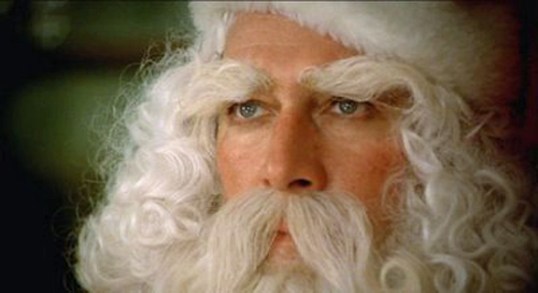
The Silent Partner (1979) — Christopher Plummer is terrifying in this Canadian film, playing a bank robber who dresses up like Santa Claus and who has no hesitation about using violence to get what he wants.  This is one of Plummer’s best villainous turns.

Barrymore (2011) — The great Christopher Plummer plays the great John Barrymore in this Canadian film.  This may not be Plummer’s best-known performances but it’s one of his best.

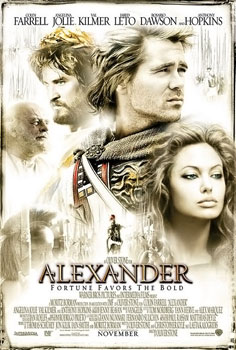
Alexander (2004) — As silly as this Oliver Stone epic sometimes is, Christopher Plummer is the ideal Aristotle.

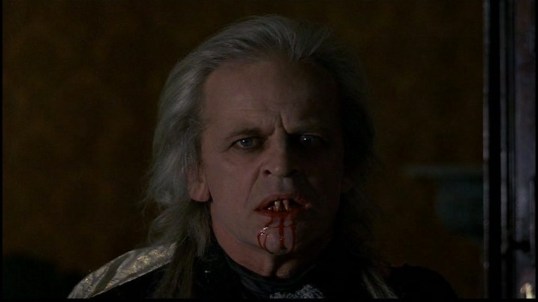
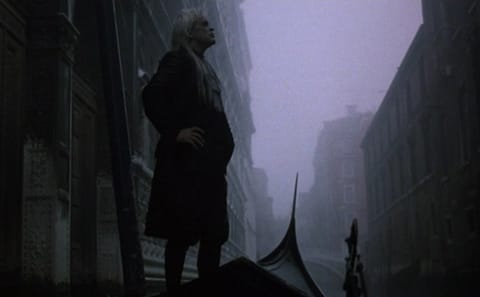
Vampire in Venice (1988) — Christopher Plummer vs. Klaus Kinski in Venice!  Kinski is Dracula.  Plummer is basically Van Helsing.  It’s a once-in-a-lifetime meeting of two unique acting talents.

Finally, a few other Christopher Plummer films that I’d also recommend checking out: Inside Daisy Clover, The Pyx, The Man Who Would Be King, Wolf, Dolores Claiborne, The New World, The Last Station, Beginners, All The Money In The World, and The Imaginarium of Doctor Parnassus.

Christopher Plummer, R.I.P.


Film Review: Alexander (dir by Oliver Stone)


Before I really get into talking about Oliver Stone’s 2004 film, Alexander, I should acknowledge that there’s about four different version of Alexander floating around.

There’s the widely ridiculed theatrical version, which was released in 2004 and which got terrible reviews in the United States, though it was apparently a bit more popular in Europe.  This version of Alexander was a notorious box office bomb and Oliver Stone’s career has never quite recovered from it.  Though Stone’s still making movies, it’s been a while since he’s really been taken as seriously as you might expect a two-time Oscar winner to be taken.  The box office and critical failure of Alexander is a big reason for that.

There’s also the Director’s Cut of Alexander, which is slightly shorter than the version that was released into theaters and which apparently emphasizes the action scenes more than the original film did.  For an Oscar-winning director to release a director’s cut that’s actually shorter than the version that he originally sent into theaters is rare and it shows that the film’s subject matter was one that Stone was still trying to figure out how to deal with.

There is also the “Final Unrated Cut,” which lasts 3 hours and 45 minutes and which Stone described as being the Cecil B. DeMille-version of the story.  At the time the Final Unrated Cut was released in 2007, Stone announced that he had put everything back into the movie and that we were finally able to see the version of the story that he wanted to tell.

However, Stone apparently still left some stuff out because, in 2009, we got the Final Cut, which goes on for 206 minutes and which, once again, apparently includes everything that Stone wanted to put in the original cut of the film.  The Final Cut has actually received some positive reviews from critic who were not impressed by the previous three versions of Alexander.

For the record, I saw the Director’s Cut.  This is the second of the Alexanders, the one that runs 167 minutes.  Some day, I’ll watch the four hour version and I’ll compare the two films.  But for now, I’m reviewing the 167-minute version of Alexander.

Anyway, Alexander is a biopic of Alexander The Great, the Macedonian ruler who took over a good deal of the known world before mysteriously dying at the age of 32.  The film jumps back and forth in time, from an elderly Ptolemy (Anthony Hopkins, going about as overboard as one can go while playing an ancient Greek historian) narrating the story of Alexander’s life to Alexander (Colin Farrell) conquering his enemies to scenes of Alexander’s mother (Angelina Jolie) and one-eyed father (Val Kilmer) shaping Alexander’s outlook on the world.  Along the way, we discover that Alexander was driven to succeed and forever lived in the shadow of his father.  We also discover that he may have been in love with his general, Hephaistion (Jared Leto), even though he married Roxane (Rosario Dawson, who gets to do an elaborate dance).  We also discover that no battle in the ancient world could begin before Alexander gave a long speech and that all of the Macedonians spoke with thick Irish accents.  Stone has said that the Irish accents were meant to signify that the Macedonians were working-class.  Other people say that, because Colin Farrell’s accent was so thick, the rest of the cast had to imitate him so he wouldn’t sound out-of-place.

And here’s the thing — yes, Alexander is a big, messy film that is often incoherent.  Yes, the cast is full of talented actors, every single one of which has been thoroughly miscast.  Yes, it’s next to impossible to keep track of who is fighting who and yes, it’s distracting as Hell that all of the Macedonians have Irish accents and that Angelina Jolie uses an Eastern European accent that’s so thick that it almost becomes a parody of itself.  All of these things are true and yet, I was never bored with the director’s cut.  The sets were huge, the costumes were beautiful, and the cast was eccentric enough to be interesting.  Val Kilmer, Angelina Jolie, and Anthony Hopkins all go overboard, chewing every piece of scenery that they can get their hands on.  Colin Farrell alternates between being determined and being wild-eyed.  Jared Leto allows his piercing stare to do most of his acting.  Even Christopher Plummer shows up, playing Aristole with a North Atlantic accent.  No one appears to be acting in the same film and strangely, it works.  The ancient world was chaotic and the combination of everyone’s different acting styles with Stone’s frantic direction actually manages to capture some of that chaos.

Oliver Stone apparently spent years trying to bring his vision of Alexander’s life to the big screen.  Watching the film, it’s a classic example of a director becoming so obsessed with a story that they ultimately forgot why they wanted to tell it in the first place.  Stone tosses everything he can at the cinematic wall, just to see what will stick.  Is Alexander a tyrant or a misunderstood humanist?  Is he a murderer or a noble warrior?  Is he in love with Hephaistion or has his borderline incestuous relationship with his mother left him incapable of trusting anyone enough to love them?  The film doesn’t seem to know who Alexander actually was but it’s so desperate to try to find an answer among all of the endless battle scenes and lengthy speeches that it becomes undeniably compelling to watch.  If nothing else, Alexander gives us the rare chance to see an Oliver Stone film in which Stone himself doesn’t seem to quite know what point it is that he’s trying to make.

Alexander is a mess but there’s something fascinating about its chaos.  It’s a beautiful wreck and, as with all wrecks, it’s impossible to look away.

International Horror Film Review: Nosferatu in Venice (dir by Augusto Caminito, Klaus Kinski, Luigi Cozzi, Mario Ciaino, and possibly others)


Nosferatu the vampyre is back!  Well, maybe.  It’s complicated,

This Italian production from 1988 was originally envisioned as being a semi-official sequel to Werner Herzog’s Nosferatu, which was itself a remake of F.W. Murnau’s silent classic.  The idea was that Klaus Kinski would reprise his role and this time, his feral version of Dracula would haunt Venice.  Kinski agreed, initially, to reprise his role.  However, after arriving on the set, Kinski lived up to his infamous reputation for being difficult.  He announced that he would, under no circumstances, don the famous make-up that he wore in Nosferatu.  And while Kinski was undoubtedly a good actor who was capable of giving performances that kept him employed despite reportedly being insane, Nosferatu without the makeup is not really Nosferatu.  He’s just another vampire.

Still, Kinski was a big enough star that he got his way about the makeup.  He also attempted to get his way during the first day of filming, when he refused to take any direction from director Mario Ciaino.  When Ciaino attempted to figure out why Kinski was being so difficult, Kinski declared that he had been promised, by producer Augusto Caminito, that he would be allowed to direct the film.  This led to Mario Ciaino quitting during the first day of production.  Producer Caminito took over as a director, though apparently Kinski did end up directing several of his own scenes.  Reportedly, other scenes were directed by Luigi Cozzi.

However, Kinski didn’t stop with getting the director replaced.  He also demanded that nearly the entire cast be replaced as well.  Kinski, in fact, was such a terror on the set that it was common for members of the crew to refuse to work with him, which perhaps explains why Kinski seems to spend so much of this film wandering around Venice by himself.

As for the film itself — well, yes, it’s exactly as big of a mess as it sounds like it would be.  Kinski plays a vampire who may or may not be Dracula.  Actually, very few of the traditional vampire rules seem to apply to him.  He wanders around in the daylight.  He looks at his reflection in a mirror.  He does, however, drink a lot of blood so I guess some things never change.  Because he refused to wear the vampire makeup or shave his head, Kinski spends the entire film looking like the aging lead singer of a 70s prog rock band.  At the same time, it must be said that Kinski actually does give a fairly good performance.  He’s a vampire who is desperate to find someone pure of heart who can end his ennui-stricken life.  Kinski’s screen presence is undeniably powerful and he looks appropriately miserable.

Christopher Plummer has the Van Helsing role and Donald Pleasence plays a priest who always seems to be somewhat nervous.  (In other words, a typical role for Donald Pleasence.)  Plummer is in Venice because, back in the 18th century, it was the last place that Kinski’s vampire was seen.  This leads to several confusing flashbacks, all of which are somewhat randomly sprinkled throughout the film.

There’s not really any story beyond Kinski walking around with a stricken-look on his face but, oddly, the film kind of works. Despite all of the directors who worked on it, the film is often visually stunning.  I think it’s the power of Venice.  No other city has quite the same atmosphere as Venice and it turns out to be the perfect location for a film about an ennui-stricken vampire.

(I know that when I visited Venice the summer after I graduated high school, I often found myself thinking about vampires.  That’s just the type of city it is.)

Anyway, the film will be best appreciated by Italian horror enthusiasts and Kinski completists.  Others will probably be bored out of their mind.  If you just want to see a good horror film set in Venice, I recommend Don’t Look Now.

Rian Johnson unsheathes the Knives Out Trailer


A filmmaker is sometimes only as good as their last film. If you mentioned director Rian Johnson’s name around 2012, it was probably met with wild applause. After all, he gave us the time travelling thriller Looper, with Bruce Willis, Emily Blunt and Joseph Gordon-Levitt.

Mentioning Johnson now breeds a bit of contempt after his outing on Star Wars: The Last Jedi. The film was hit with reviews ranging from daring to awful, and most of the Star Wars fanbase don’t think of what he’s done there.

With his newest film, Knives Out, Johnson looks like he’s moving forward. The film appears to be a classic whodunit with a fantastic cast. Christopher Plummer, Chris Evans, Ana de Armas, Jamie Lee Curtis, Toni Collette, Daniel Craig, Don Johnson, Lakeith Stanfield, Michael Shannon, Katherine Langsford, and Jaeden Martell round out the cast list, which is pretty great overall. The story seems to cover the murder of a patriarch, and a family of suspects which reminds me of the classic Infocom game, Deadline.  Hoping for the best with this one.

Enjoy.

Film Review: The Fall of the Roman Empire (dir by Anthony Mann)


Why did the Roman Empire fall?

Well, historically, there were several reasons but they can all basically be boiled down to the fact that the Empire got too big to manage and that having two separate capitols certainly didn’t help matters.  The Empire got so large and overextended that the once fabled Roman army was no match for the barbarians.

Of course, if you’ve ever watched a movie about the Roman period, you know exactly why the Empire fell.  It all had to do with decadence, gladiators, human sacrifices, and crazed emperors with unfortunate names like Caligula and Commodus.  The Roman Empire fell because the imperial government descended into soap opera, complete with love triangles, betrayals, and whispered plotting inside the Senate.

Another thing that we’ve learned from the movies is that the fall of the Roman Empire was damn entertaining.  Between the orgies and the men wearing those weird helmets with the brushes on top of them, there’s nothing more fun that watching the Roman Empire fall.

Case in point: the 1964 film, The Fall of the Roman Empire.

This three and a half hour epic begins with the last of the good Roman emperors, Marcus Aurelius (Alec Guiness), battling to keep the Germanic barbarians from invading the empire.  Marcus is a wise man and a great leader but he knows that his time is coming to an end and he needs to name a successor.  His daughter, Lucilla (Sophia Loren), is an intelligent and compassionate philosopher but, on the basis of her sex, is not eligible to succeed him.  His son, Commodus (Christopher Plummer), may be a great and charismatic warrior but he’s also immature and given to instability.  Marcus’s most trusted adviser, Timonides (James Mason), would never be accepted as a successor because of his Greek birth and background as a former slave.  (Add to that, Timonides is secretly a Christian.)

That leaves Livius (Stephen Boyd).  Livius is one of Marcus’s generals, a man who is not only renowned for his honesty and integrity but one who is also close to the royal family.  Not only is he a former lover of Lucilla’s but he’s also been a longtime friend to Commodus.  Unfortunately, before Marcus can officially name Livius as his heir, the emperor is poisoned.  Commodus is named emperor and things quickly go downhill.  Whereas Marcus ruled with wisdom and compassion, Commodus is a tyrant who crushes anyone who he views as being a potential threat.  Lucilla is married off to a distant king (Omar Sharif).  Timonides is declared an enemy after he suggests that the conquered Germans should be allowed to peacefully farm on Italian land.  Rebellion starts to ferment in every corner of the Empire and Livius finds himself trapped in the middle.  Which side will he join?

Despite all the drama, Commodus is not necessarily an unpopular emperor.  One of the more interesting things about The Fall of the Roman Empire is that Commodus’s popularity grows with his insanity.  The crueler that he is, the more the people seem to love him.  Soon, Commodus is fighting as a gladiator and having people burned at the stake.  While some Romans are horrified, many more love their emperor no matter what.  People love power, regardless of what it’s used for.  Perhaps that’s the main lesson and the main warning that the final centuries of the Roman Empire have to give us.

The Fall of the Roman Empire is surprisingly intimate historical epic.  While there’s all the grandeur that one would normally expect to see in a film about the Roman Empire, the film works best when it concentrates on the characters.  While Boyd and Loren do their best with their thinly drawn roles, the film is stolen by great character actors like Alec Guinness, James Mason, and Christopher Plummer.  Plummer, in particular, seems to be having a blast playing the flamboyantly evil yet undeniably charismatic Commodus.  Even with the Empire collapsing around then, both Plummer as an actor and Commodus as a character seems to be having a blast.  Add to that, there’s all of the usual battles and ancient decadence that you would expect to find in a film about the Roman Empire and the end result is a truly enjoyable epic.

As I watched The Fall of the Roman Empire, it was hard for me not to compare the film to Ridley Scott’s Gladiator.  That’s because they’re both basically the same damn movie.  The main difference is that The Fall of the Roman Empire is far more entertaining.  The Fall of the Roman Empire, made in the days before CGI and featuring real people in the streets of Rome as opposed to animated cells, feels real in a way that Gladiator never does.  If Gladiator felt like a big-budget video game, The Fall of the Roman Empire feels like a trip in a time machine.  If I ever do go back to 180 A.D., I fully expect to discover James Mason giving a speech to the Roman Senate while Christopher Plummer struts his way through the gladiatorial arena.

Finally, to answer the question that started this review, why did the Roman Empire fall?

It was all Christopher Plummer’s fault, but at least he had a good time.

Film Review: The Last Flight of Noah’s Ark (dir by Charles Jarrott)


I recorded the 1980 film, The Last Flight of Noah’s Ark, off of TCM because I looked at the title and the fact that it starred Elliott Gould and I figured that it would be a film about an expedition to recover the actual Noah’s Ark.  I figured that it would feature scenes of Elliott Gould and Christopher Plummer (who I just assumed would be in the movie) climbing Mount Ararat and having comical disagreements about all of the snow.  I also assumed that the movie would end with the real Noah’s Ark sliding down the mountain while Gould and Plummer tried to steer it.

Seriously, it sounded like fun!

Of course, it turned out that I was wrong.

http://www.youtube.com/watch?v=YwA4JZAcmlE

It turns out that The Last Flight of Noah’s Ark is about an out-of-work pilot named Noah Dugan (Elliott Gould) who has a gambling problem and owes a lot of money to the mob.  Normally, you’d be worried that this means Dungan has a contract out on his life but instead, it just means that a bald guy named Benchley (Dana Elcar) keeps popping up and saying that Dugan’s got a week to come up with the money.

Since this film was made before our current socialist moment, Dugan is forced to get a job.  Unfortunately, the only one that he can get involves flying a missionary (Genevieve Bujold) and a bunch of animals to a South Pacific island.  Dugan agrees but, because the plane is an old World War II bomber, he ends up having to make an emergency landing on a remote and uncharted desert isle.

Of course, it quickly turns out that Dugan, the missionary, and the animals aren’t alone!  First off, it turns out that two orphans (played by Ricky Schroder and Tammy Lauren) stowed away on the airplane.  And then, we discover that there are two Japanese soldiers stranded on the island as well!  They’ve been there since World War II!  Fortunately, one of them is named Cleveland (John Fukioka) and can speak English.

(As for Christopher Plummer, he’s nowhere to be seen because he’s not in the movie.)

Anyway, can you guess what happens?  If you think that Noah and the gang turn the plane into a big boat, you’re on the right track.  If you think that cynical Noah turns out to actually have a soft spot when it comes to children, you’re right.  If you think that Noah and the missionary embark on the most chaste romance in movie history …. oh my God, have you seen this movie before!?

Here’s the thing with The Last Flight of Noah’s Ark — the animals are cute.  I mean, the animals really are adorable.  There’s this one duck who has more screen presence than every human in this movie.  And normally, I’d say that cute animals can save just about any movie but this might be the exception to the rule.

I mean, I get it.  This was a movie for kids and that’s great.  But my God, this is a slow movie.  We start with Dugan getting threatened by the gamblers and then it’s another 25 minutes before Dugan even starts the engine on that plane.  I get that this is a family film but I imagine that even families in 1980 would have been bored to death by it.  Elliott Gould certainly seems to be bored, as he gives a performance that all but screams, “Where’s my paycheck!?”

What would have improved The Last Flight of Noah’s Ark?

Christopher Plummer, dammit.