Film Review: And The Band Played On (dir by Roger Spottiswoode)


I live in a very cynical time.

That was one of my main thoughts as I watched 1993’s And The Band Played On.

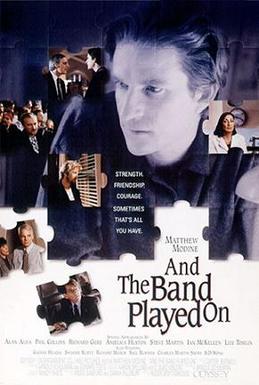
Directed by Roger Spottiswoode and featuring an all-star cast, And The Band Played On deals with the early days of the AIDS epidemic.  It’s a film that features many different characters and storylines but holding it all together is the character of Dr. Don Francis (Matthew Modine), an epidemiologist who is haunted by what he witnessed during the Ebola epidemic in Africa and who fears that the same thing is going to happen in America unless the government gets serious about the mysterious ailment that is initially called “gay cancer” before then being known as “GRID” before finally being named AIDS.  Dr. Francis is outspoken and passionate about fighting disease.  He’s the type who has no fear of yelling if he feels that people aren’t taking his words seriously enough.  In his office, he keeps a track of the number of HIV infections on a whiteboard.  “Butchers’ Bill” is written across the top of the board.

Throughout the film, quite a few people are dismissive of Dr. Francis and his warnings.  But we, the audience, know that he’s right.  We know this because we know about AIDS and but the film also expects us to trust Dr. Francis because it’s specifically stated that he worked for the World Health Organization before joining the Center For Disease Control in Atlanta, Georgia.  As far as the film is concerned, that’s enough to establish his credentials.  Of course, today, after living through the excesses of the COVID pandemic and the attempts to censor anyone who suggested that it may have begun due to a lab leak as opposed to some random guy eating a bat, many people tend to view both the WHO and the CDC with a lot more distrust than they did when this film was made.  As I said, we live in a cynical time and people are now a lot less inclined to “trust” the experts.  To a large extent, the experts have only themselves to blame for that.  I consider myself to be a fairly pragmatic person but even I now find myself rolling my eyes whenever a new health advisory is issued.

This new sense of automatic distrust is, in many ways, unfortunate.  Because, as And The Band Played On demonstrates, the experts occasionally know what they’re talking about.  Throughout the film, people refuse to listen to the warnings coming from the experts and, as a result, many lives are lost.  The government refuses to take action while the search for a possible cure is hindered by a rivalry between international researchers.  Alan Alda gives one of the best performances in the film, playing a biomedical researcher who throws a fit when he discovers that Dr. Francis has been sharing information with French scientists.

It’s a big, sprawling film.  While Dr. Francis and his fellow researchers (played by Saul Rubinek, Glenne Headly, Richard Masur, Charles Martin Smith, Lily Tomlin, and Christian Clemenson) try to determine how exactly the disease is spread, gay activists like Bobbi Campbell (Donal Logue) and Bill Kraus (Ian McKellen) struggle to get the government and the media to take AIDS seriously.  Famous faces pop up in small rolls, occasionally to the film’s detriment.  Richard Gere, Steve Martin, Anjelica Huston, and even Phil Collins all give good performances but their fame also distracts the viewer from the film’s story.  There’s a sense of noblesse oblige to the celebrity cameos that detracts from their effectiveness.  All of them are out-acted by actor Lawrence Monoson, who may not have been a huge star (his two best-known films are The Last American Virgin and Friday the 13 — The Final Chapter) but who is still heart-breakingly effective as a young man who is dying of AIDS.

Based on a 600-page, non-fiction book by Randy Shilts, And The Band Played On is a flawed film but still undeniably effective and a valuable piece of history.  Director Roger Spottiswoode does a good job of bringing and holding the many different elements of the narrative together and Carter Burwell’s haunting score is appropriately mournful.  The film ends on a somber but touching note.  At its best, it’s a moving portrait of the end of one era and the beginning of another.

Cleaning Out The DVR #29: Broadcast News (dir by James L. Brooks)


(For those following at home, Lisa is attempting to clean out her DVR by watching and reviewing 38 films by the end of this Friday.  Will she make it?  Keep following the site to find out!)

220px-Broadcast_News

I’ll give you three chances to guess what the 1987 film Broadcast News is about.

Broadcast News takes place at the Washington bureau of a major network news operation.  (You can tell this film was made in the 80s in that nobody’s working for a blog and there’s no mention of Fox, MSNBC, or CNN.)  This is where a group of hard-working men and women do their best to make the national news anchor, Bill Rorish, look good.

Bill Rorish is played by Jack Nicholson and, even though he only has about five minutes of screen time (out of a 133 minute movie), he pretty much dominates the entire film.  Some of that is because he’s Jack Nicholson and he kicks ass.  All Jack has to do to dominate a scene is show up and arch an eyebrow.  But, beyond that, everyone in the movie is obsessed with impressing Bill Rorish.  Whenever a reporter and his producer get a story on the air, they obsessively watch to see if Bill smiles afterward.  Bill Rorish is the God they all hope to please and the film (as well as Nicholson’s performance) suggests that he barely even knows that they’re alive.  It’s telling that the only time Bill shows up in person (as opposed to appearing on a TV screen), it’s because a huge number of people at the Washington bureau are being laid off.

When Bill says that it’s a shame that budget cuts are leading to so many good newspeople being laid off, someone suggests that maybe Bill could help by taking a cut in his million-dollar salary.  Needless to say, Bill Rorish is not amused.

Broadcast News centers on three of the characters who work at the Washington Bureau.  First off, there’s Jane Craig (Holly Hunter), a producer.  Jane is a true believer in the mission and the importance of journalism.  Her ethics and her belief in what constitutes proper journalism are everything to her and, at times, she can get more than a little self-righteous about it.  (If Broadcast News were made today, Jane would spend the entire movie whining about how new media is destroying the country.)  At the same time, Jane is completely neurotic, a self-described “basket case” who, at one point, ends up sobbing in a hotel room as she prepares to go to sleep by herself.

Jane’s best friend is Aaron Altman (Albert Brooks), a reporter who wants to someday be an anchor.  Aaron is smart and funny (and he better be, seeing as how he’s being played by Albert Brooks) but he’s not telegenic and he’s almost as neurotic as Jane.  Like Jane, Aaron is all about journalistic ethics but there’s a defensiveness to Aaron.  Whenever Aaron complains about vapid news anchors, it’s obvious that he’s more jealous than outraged.

And then there’s Tom Grunick (William Hurt), who represents everything that Jane and Aaron claim to be against.  He’s handsome, he’s smooth, he’s charismatic, and he’s definitely not an intellectual.  He knows little about the specifics of current events.  However, he has great instincts.  He knows how to sell a story and he knows how to present himself on camera.  He’s also a surprisingly nice and sincere guy, which makes it all the more difficult for Aaron to justify his belief that “Tom is the devil.”

From the minute that Tom arrives at the Washington bureau, there’s a strong attraction between Tom and Jane.  (Jane even sends another reporter to Alaska after she finds out that Tom slept with her.)  Tom wants to be a better reporter.  Jane wants to be happy but fears compromising her ethics.  And Aaron … well, Aaron wants Jane.

Not surprisingly, considering that the film was made 29 years ago, there were some parts of Broadcast News that felt extremely dated.  A scene where Aaron complains about a story that Tom did on date rape feels especially uncomfortable when viewed today and both Jane and Aaron occasionally came across as being a bit too self-righteous.  In today’s media world, Tom’s sins really didn’t seem like that big of a deal.

But, for the most part, I enjoyed Broadcast News.  It was an intelligent film, one the featured people having actual conversations about actual ideas and, listening to them, I realized how rare, in both movies and real life, that actually is.  It’s a witty film, full of good performances.  While I hope I never become as self-righteous as Jane, I could still relate to her in her more neurotic moments.  And who wouldn’t want a best friend like Aaron?

And, for that matter, who wouldn’t want a lover like Tom?

(That’s something I never expected to write about a character played by William Hurt.)

And, of course, there’s this scene.  Poor Aaron!

Broadcast News was nominated for best picture of 1987.  However, it lost to The Last Emperor.

http://www.youtube.com/watch?v=BPjx2pI–2U


Lisa Reviews An Oscar Nominee: Apollo 13 (dir by Ron Howard)


Apollo_thirteen_movie

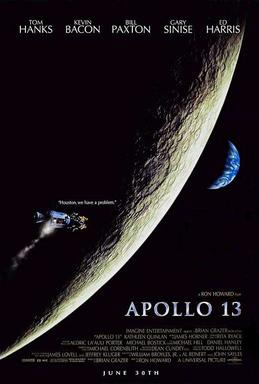
I just finished watching the TCM premiere of the 1995 Best Picture nominee, Apollo 13.  Of course, it wasn’t the first time I had seen it.  Apollo 13 is one of those films that always seems to be playing somewhere and why not?  It’s a good movie, telling a story that is all the more remarkable and inspiring for being true.  In 1970, the Apollo 13 flight to the moon was interrupted by a sudden explosion, stranding three astronauts in space.  Fighting a desperate battle against, NASA had to figure out how to bring them home.  Apollo 13 tells the story of that accident and that rescue.

There’s a scene that happens about halfway through Apollo 13.  The heavily damaged Apollo 13 spacecraft is orbiting the moon.  Originally the plan was for Apollo 13 to land on the moon but, following that explosion on the craft, those plans have been cancelled.  Inside the spacecraft, three astronauts can only stare down at the lunar surface below them.

As Commander Jim Lovell stares out the craft’s window, we suddenly see him fantasizing about what it would be like if the explosion hadn’t happened and if he actually could fulfill his dream of walking on the moon.  We watch as Lovell (and, while we know the character is Jim Lovell, we are also very much aware that he’s being played by beloved cinematic icon Tom Hanks) leaves his foot print on the lunar surface.  Lovell opens up his visor and, for a few seconds, stands there and takes in the with the vastness of space before him and making the scene all the more poignant is knowing that Tom Hanks, before he became an award-winning actor, wanted to be a astronaut just like Jim Lovell.  Then, suddenly, we snap back to the film’s reality.  Back inside the spacecraft, Lovell takes one final look at the moon and accepts that he will never get to walk upon its surface.  “I’d like to go home,” he announces.

It’s a totally earnest and unabashedly sentimental moment, one that epitomizes the film as a whole.  There is not a hint of cynicism to be found in Apollo 13.  Instead, it’s a big, old-fashioned epic, a story about a crisis and how a bunch of determined, no-nonsense professionals came together to save the day.  “Houston,” Lovell famously says at one point, “we have a problem.”  It’s a celebrated line but Apollo 13 is less about the problem and more about celebrating the men who, through their own ingenuity, solved that problem.

That Apollo 13 is a crowd-pleaser should come as no surprise.  It was directed by Ron Howard and I don’t know that Howard has ever directed a film that wasn’t designed to make audiences break into applause during the end credits.  When Howard fails, the results can be maudlin and heavy-handed.  But when he succeeds, as he does with Apollo 13, he proves that there’s nothing wrong with old-fashioned, inspirational entertainment.

Of course, since Apollo 13 is a Ron Howard film, that means that Clint Howard gets a small role.  In Apollo 13, Clint shows up as a bespectacled flight engineer.  When astronaut Jack Swiggert (Kevin Bacon) mentions having forgotten to pay his taxes before going into space, Clint says, “He shouldn’t joke about that, they’ll get him.”  It’s a great line and Clint does a great job delivering it.

Apollo 13 is usually thought of as being a Tom Hanks film but actually, it’s an ensemble piece.  Every role, from the smallest to the biggest, is perfectly cast.  Not surprisingly, Bacon, Bill Paxton, Gary Sinise, Kathleen Quinlan, and Ed Harris all turn in excellent performances.  But, even beyond the marquee names, Apollo 13 is full of memorable performances.  Watching it tonight, I especially noticed an actor named Loren Dean, who played a NASA engineer named John Aaron.  Dean didn’t get many lines but he was totally believable in his role.  You looked at him and you thought, “If I’m ever trapped in space, this is the guy who I want working to bring me home.”

Apollo 13 was nominated for best picture but it lost to Mel Gibson’s film Braveheart.  Personally, out of the nominees, I probably would have picked Sense and Sensibility but Apollo 13 more than deserved the nomination.

Embracing the Melodrama Part II #83: Bad Influence (dir by Curtis Hanson)


Bad_Influence_Film_PosterThough it may seem like a lifetime ago, it’s only been 6 weeks since I started on my latest series of reviews.  I am currently in the process of reviewing, in chronological order, 126 cinematic melodramas.  I started with the 1927 classic Sunrise and now, 82 reviews later, I have finally reached the 1990s.

(Of course, when I started this series of reviews, I somehow managed to convince myself that it would only take me 3 weeks to review 126 films.  Instead, it looks like it’s going to take two months.  So, I was only off by 5 weeks.)

Let’s start the 90s by taking a quick look at a 1990 film called Bad Influence.  I have to admit that, when I made out my list of films to review, Bad Influence was not even on my radar.  I was planning on launching my look at the 90s with a review of Ghost.  But then I saw The Avengers: Age of Ultron and I was so taken with James Spader’s performance as Ultron that  I decided to add a few James Spader films to Embracing the Melodrama.

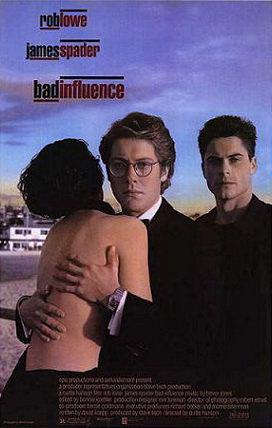
In Bad Influence, James Spader is cast somewhat against type.  He plays Michael, who has a good job and is engaged to marry the wealthy and overbearing Ruth (who, I was surprised to learn from the end credits, was played by a pre-Desperate Housewives Marcia Cross).  Michael should be happy but instead, he feels oddly dissatisfied with his life.  He’s shy and meek and spends all of his time trying to do the right thing and conform to the petty demands of society.

One day, as he’s sitting in a bar, Michael makes the mistake of trying to flirt with a woman who is obviously having a bad day.  When the woman’s boyfriend shows up, he tells Michael to leave.  When Michael mutters that it’s a free country, the man responds by grabbing Michael.  However, before the fight can go any further, handsome and charming Alex (played, somewhat inevitably, by Rob Lowe) pops up out of nowhere, smashes a bottle, and scares the man off.

Michael and Alex become fast friends, with Michael viewing the extroverted and confident Alex as being everything that he wants to be.  (Meanwhile, Alex seems to appreciate the fact that Michael has money and a nice apartment.)  Under the influence of Alex, Michael starts to stand up for himself and even manages to get a big promotion at work.  At the same time, he also ends up cheating on his fiancée (while Alex films them) , helping Alex hold up a series of convenience stores, and beating up an obnoxious co-worker.

Ultimately, Bad Influence is a lot of sordid fun.  It’s a bit like Fight Club, minus the satire and the big identity twist.  (Michael and Alex are differently separate characters.)  Director Curtis Hanson (who is perhaps best known for L.A. Confidential) brings a lot of style to the film’s tawdry fun and keeps the action moving quickly enough that you don’t have too much time to obsess over what doesn’t make sense.

Finally, James Spader and Rob Lowe are just a lot of fun to watch.  Spader turns Michael into a sympathetic protagonist and Rob Lowe seems to be having a blast going full psycho in his role.

Bad Influence is a well-made B-movie and it’s a lot of fun.  You can watch it below!

http://www.youtube.com/watch?v=o5lxJusJoAg