Film Review: Cast Away (dir by Robert Zemeckis)


“WILSON!”

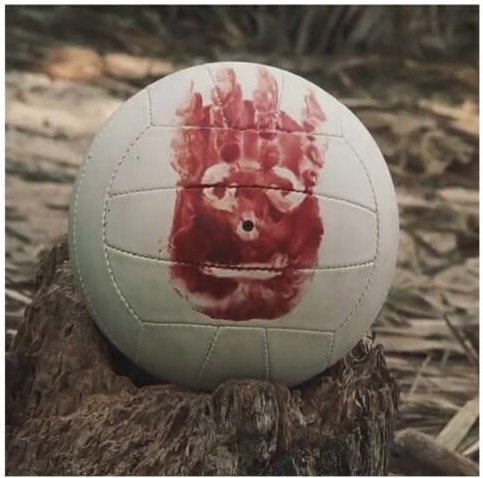
Seriously, I’m usually pretty well-behaved when I watch a movie but every time I see the 2000 film Cast Away, I find myself thinking, “Protect Wilson!  You must protect Wilson!”  And then, every time, I feel the sting of tears in my eyes as Wilson, with that red-face and that understanding attitude, goes floating away.

Wilson is a volleyball.  When a FedEx executive named Chuck Noland (played by Tom Hanks) finds himself stranded on a desert island, Wilson becomes his only companion.  A stain from Chuck’s bloody palm creates something that resembles a face on Wilson’s rubber surface and Chuck spends a lot of time talking to Wilson.  It’s how Chuck maintains his sanity, even as he loses weight, sheds most of his clothes, and grows a beard.

Chuck learns how to make fire.  He learns how to catch fish.  He is able to survive due to the supplies that he gathers from the FedEx packages that were being carried on the plane that crashed into the island.  But Chuck never stops dreaming of returning home to his girlfriend (Helen Hunt).  Eventually, Chuck finds the courage to try to make the journey back to civilization.  He brings Wilson with him but ultimately, this is something that Chuck is going to have to do on his own.  Of course, Chuck has failed to consider that he’s been gone for years.  He is presumed dead.  On the Island, time seemed like it was frozen.  For the rest of the world, life has continued.

Cast Away is a film that a lot of people, especially online film commentators, tend to criticize.  The complaint is usually that the film is essentially a commercial for FedEx, that it’s not believable that Tom Hanks could survive on that island for as long as he did, and that the film itself has a weak ending.  I’ll concede that the film does make FedEx look like the nicest corporation on Earth.  (FedEx’s CEO appears as himself, which should tell you something about how the company is presented.)  And I will admit that the film’s time-advancing jump cut, which abruptly takes Hanks from being clean-shaven and husky to being thin and bearded, does leave a lot of unanswered questions.  But I will always defend the film’s ending.  The film ends on a note of ambiguity but how else could it have ended?  Everyone thought Chuck Noland was dead.  His girlfriend had every right to get on with her life and, in fact, it would have been psychologically unhealthy for her if she hadn’t.  As for that final shot, it’s an acknowledgment that Chuck doesn’t know what lies ahead of him in the future.  All he knows is that he life isn’t over yet.  It’s a melancholy ending.  It’s a frustrating ending.  But it’s also the only way the film could have ended and therefore, it’s a perfect ending.

Cast Away is a film that I will always defend and it’s also a film that really only could have worked with Tom Hanks in the lead role.  He plays Chuck as being the ultimate everyman, an affable guy who was just trying to do his job and whose survival of the initial plane crash was largely due to luck.  Hanks is one of those actors who is instantly sympathetic and Cast Away uses his screen persona to good effect.  You want him to survive because he’s Tom Hanks.  He may be playing a character named Chuck Noland but ultimately, he’s Tom Hanks.  He survived being trapped in space.  Surely, he can survive being stranded on an island.  The majority of the film is just Hanks talking to himself.  This would have brought out the worst in so many actors but Tom Hanks makes it work.  And yes, he’ll bring tears to your eyes as he watches Wilson float away.  That’s the power of a good actor.

As for Wilson, I like to think that he washed up in Pensecola.  Recently, I played a little volleyball on a beautiful Florida beach.  Was that you, Wilson?
 

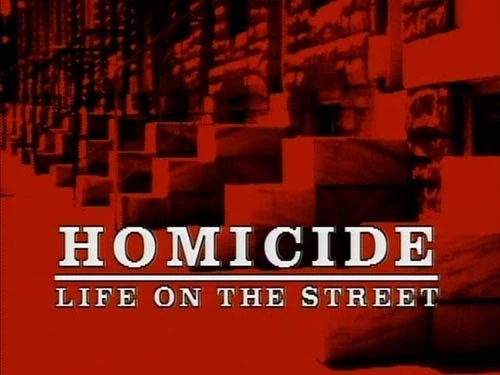
Retro Television Review: Homicide: Life On The Street 3.16 “Law & Disorder”


Welcome to Retro Television Reviews, a feature where we review some of our favorite and least favorite shows of the past!  On Sundays, I will be reviewing Homicide: Life On The Street, which aired from 1993 to 1999, on NBC!  It  can be viewed on Peacock.

This week, Munch gets away with murder.

Episode 3.16 “Law & Disorder”

(Dir by John McNaughton, originally aired on February 24th, 1995)

This week’s episode of Homicide gets off to a strange start, with a cameo from Chris Noth as Law & Order‘s Detective Mike Logan.  (Logan appeared early in the history of Law & Order, before North became known as the ill-fated Mr. Big on Sex And The City.)  Logan is transporting a prisoner to Baltimore and that prisoner is played by none other than John Waters!  Meeting Pembleton at the Amtrak station, Logan proceeds to bitch about Baltimore.  Pembleton bitches about New York.  Waters comments that Edgar Allan Poe hated New York.  When Pembleton says that Waters will be heading to prison but at least it will be a Baltimore prison, Waters says that’s why he didn’t fight extradition.  It’s a cute scene, though, as I watched it, I was struck by just how better of an actor Andre Braugher was than Chris Noth.  Noth delivered all of his line like a TV actor.  Braughter delivered his dialogue like a poet.

As for the rest of the show, we get several plotlines.  Bayliss is investigating the death of Gordon Pratt but, because Pratt shot Bolander, Felton, and Howard, none of his fellow detectives are that concerned about solving his murder.  Bayliss comes to suspect that it was a homicide detective who shot Pratt.  He asks Pembleton, Lewis, and Munch for their alibis and none of them really have a good one.  Myself, I think it’s pretty obvious that Much shot Pratt.  Munch’s hero-worship of Bolander, his anger after Pratt walked out of the station, all of it pretty much makes him the main suspect.  Lewis, who is still struggling to come to terms with Crosetti’s suicide, seems like he would be more likely to deal with his anger by drinking.  Even if he doesn’t want to admit it, Pembleton is too much of a wannabe Jesuit to do the eye for an eye thing.  Munch, though …. yeah, there’s no way Munch didn’t kill Gordon Pratt.  John Munch is a murderer.  (Okay, to be clear, the show leaves it ambiguous and never outright states that Munch was the killer but it’s still kind of obvious.)

And he gets away with it.  Bayliss tells Giardello that he’s followed-up every lead and that the Pratt case is just going to have remain open and go cold.  “Won’t help your clearance level,” Giardello shrugs.  It’s a decision that’s going to haunt Bayliss but the show suggests that Bayliss sees it as a sort of cosmic justice.  Before announcing that the case is going to go cold, Bayliss has a conversation with Pembleton and, of course, Bayliss brings up the Adena Watson case.  The Arabist got away with killing Adena Watson so Bayliss is going to let someone — Munch, let’s be honest — get away with killing Gordon Pratt.

Munch isn’t just a murder suspect in this episode.  He’s also a laughing-stock as a nude photo of him from his hippie days is the centerpiece of a photography exhibition that’s being put on by an ex-girlfriend (Valerie Perrine).  It was kind of strange, watching the episode go from Much being a suspected murderer to Munch being the comedic relief.  Still, I always enjoy it when the show remembers that Munch is basically a drug-addled survivor of the 60s.

Felton returns to the squad room, cleared for light duty.  He insists on going out to a crime scene with Giardello, leading to Felton stumbling around, making a fool of himself, and then throwing up afterwards.  Giardello informs Felton that he’s not a good detective in his current state but then again, Giardello adds, Felton has never been a good detective.  Ouch!  That’s harsh.  Of course, it’s also true.  As I’ve said before, I would not want sweaty, racist, borderline illiterate Beau Felton investigating the murder of anyone close to me.

Finally, Pembleton and Lewis investigated an apparently random shooting.  Pembleton thought the gunshot came from the projects.  Lewis insisted that the gunshot came from the white side of the neighborhood.  It turned out Lewis was right but Pembleton was unapologetic, saying he would investigate the case the exact same way if he had to do it all over again.  Watching this storyline, I found myself thinking about how black characters on television often feel interchangeable and they rarely have much of a personality beyond being a white person’s idea of what their black best friend might be like.  Homicide featured three prominent black characters — Lewis, Pembleton, and Giardello — and all three of them are portrayed as being unique individuals with their own different ways of viewing the world, the job, and each other.  Even today, when every television show is desperate to make sure everyone knows how “committed to diversity” they are, it’s rare to see a network show like Homicide, where black characters are portrayed as being individuals as opposed to just stereotypes.  This is something for which Homicide definitely deserves a bit more credit.

This was a good episode.  It appears the murder of Gordon Pratt will never be solved.  Of course, we all know Much did it.

Late Night Retro Television Review: Monsters 1.22 “Satan In The Suburbs”


Welcome to Late Night Retro Television Reviews, a feature where we review some of our favorite and least favorite shows of the past! On Wednesdays, I will be reviewing Monsters, which aired in syndication from 1988 to 1991. The entire show is streaming on Tubi.

Odd episode, this week.

Episode 1.22 “Satan In The Suburbs”

(Dir by Warner Shook, originally aired on May 13th, 1989)

Despite having graduated from Yale (and having the sweatshirt to prove it), Xantipe Finch (Deborah Strang) is struggling.  Unable to interest any publishers in any of her books and raising her son, Marty (Danny Gerard), alone, Xantipe is forced to make extra money through baking and selling cookies.  The bill collectors keep calling and threatening to turn off her electricity and to kick her and Marty out onto the streets.

Then a mysterious man (played by a young Chris Noth) materializes in her kitchen.  The man says that he’s come from Hell.  Because he won a football bet with Satan, the man has been allowed to come to Earth and to recruit Xantipe to write his autobiography.  If the book is published, the man will continue to be a happy demon.  If the book fails, he’ll be either demoted or turned into a low-level angel.  Huh?  What?  I don’t know.  It didn’t make any sense while the man was explaining it and it doesn’t make any sense now that I’m typing it up.

Reluctantly, Xantipe helps the man.  The man, for his part, deals with the bill collectors and also starts to corrupt both Xantipe and her son.  The book gets written and published but Xantipe rejects the devil’s influence, even though it means returning to a life of struggling to pay the bills.  The episode ends with Xantipe back in her kitchen, baking cookies.  The man is also there but he now has tiny angel wings on his back.

Yeah, I don’t know what any of it means either.  It makes even less sense when you watch it.

This was not a great episode.  It was never really explained why the book has to be written, why Xantipe had to be the one to help write it, or why the man turned into an angel.  The episode ended with a suggestion that Xantipe and the man were now in love but there was nothing in the 20 minutes that preceded it that would have set the audience up for that ending.  Chris Noth was adequate as the demon and Deborah Strang was likable as Xantipe but otherwise, this episode felt like filler.

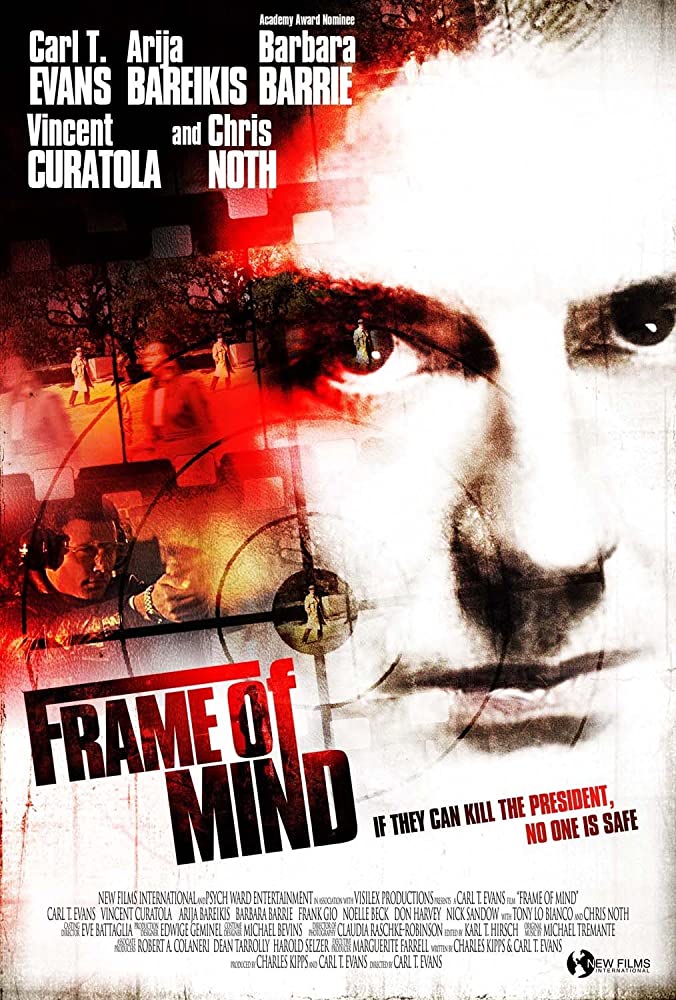
Frame of Mind (2009, directed by Carl T. Evans)


David Secca (Carl T. Evans, who also directed) is a New York cop who has just transferred to a town in New Jersey.  His wife, Jennifer (Arija Bareikis) has a new job as a teacher.  One day, while they’re out antiquing, they purchase a box that contains a roll of film.  Looking at the film reveals pictures of a dangerous looking man who has a gun and who appears to be standing on the infamous grassy knoll in Dallas, Texas.

Convinced that he’s uncovered new evidence in the assassination of John F. Kennedy, Secca carries out his own investigation of the film.  He tracks down the woman (Barbara Barrie) who actually shot the film and discovers that she is now 85 and confined to a nursing home.  He talks to a skeptical conspiracy theorist (Chris Noth).  As Secca investigates, his progress is monitored by people who, after all these years, still don’t want the truth about the Kennedy assassination to get out.  As Secca discovers, these people are still willing to kill to protect the conspiracy.

Frame of Mind is an attempt to make a conspiracy thriller that, unfortunately, is done in by its own low budget.  It’s difficult to make a conspiracy seem convincing when you don’t really have the money to hire more than a few extras.  Probably the most interesting thing about the film is that, despite the low budget, there are a few established actors in the cast.  Along with Barrie and Noth, Tony Lo Bianco, Don Harvey, Vincent Curatola, and even KISS’s Peter Criss all have small roles.  The strangest cameo of all goes to former New York Mayor David Dinkins, who plays a senator.  Being mayor of New York may be a dead end politically (just ask John Lindsay, Rudy Guiliani, Michael Bloomberg, and Bill De Blasio) but it can still serve as a launching pad for a career in the entertainment industry.

Frame of Mind might hold some interest for JFK assassination hobbyists, though it doesn’t really bring anything new to the able.  It’s mostly interesting just to see who shows up in the cast.


Playing Catch-Up: White Girl (dir by Elizabeth Wood)


white_girl_film_poster

Ever since it premiered at the Sundance Film Festival, I’ve read the White Girl was the most “shocking” film of 2016.  You can take a look at the poster above and see that, according to The Hollywood Reporter, White Girl is “SHOCKING … AND SEXY AS HELL!”

Well, I finally got a chance to watch White Girl on Netflix and the only thing shocking about it is that so many (male) critics were apparently convinced that it was the most shocking movie ever made.  I certainly wouldn’t call it shocking.  (And considering that White Girl features two graphic rapes, I’d love to know why the critic thought “sexy as Hell” would be an appropriate description.)  A better description of White Girl would be “honest.”  Then again, considering the way that the movies usually present the experience of being young, female, and in the city, perhaps the fact that White Girl is an honest film is the most shocking thing of all.

Morgan Saylor plays Leah, a college student who, along with her friend, Katie (India Meneuz), moves into a New York apartment.  The apartment is located in a largely Spanish neighborhood, one that has yet to surrender to gentrification.  While Katie and Leah’s hipster friends are immediately suspicious of everyone else in the neighborhood, the Oklahoma-born Leah is far more adventurous (or perhaps reckless).  She approaches Blue (Brian Marc) on a street corner and asks him if he has any weed.

Blue has weed and a lot more.  He’s the neighborhood drug dealer and soon, he’s also Leah’s boyfriend.  When Leah isn’t getting high and having sex with Blue, she’s working as an intern at a magazine where, early on in the film, she’s sexually assaulted by her boss, Kelly (Justin Bartha, playing a predator who, for many, will seem disturbingly familiar).  Leah invites Blue to a party given by the magazine and Blue is able to make a lot of money selling cocaine to Leah’s wealthy co-workers.

For Blue, drugs are a business and he refuses to do hard drugs himself.  To Leah, it’s an adventure, one that she believes doesn’t have any real consequences.  Or, at least, that’s the way she sees it until Blue is arrested.  With Blue, a repeat offender, facing a life sentence, Leah manages to find a lawyer (Chris Noth, who will make you skin crawl) but she needs to raise the money to pay him.  Fortunately, Leah has a stash of cocaine that Blue was supposed to sell.  Blue tells Leah that she needs to return the cocaine to his dealer but instead, Leah decides to sell the cocaine herself.  Or, at the very least, she’s going to sell whatever cocaine she doesn’t end up snorting herself…

White Girl has been called shocking because of its open and nonjudgmental portrayal of both drugs and sex but, honestly, there’s nothing shocking about it.  It may be a generational thing but, to me, Leah’s story was a familiar one.  I’ve known a lot of Leahs and, personally, there were moments in White Girl that left me cringing just because I could relate to one of Leah’s naive notions or I could remember what it was like to feel like, no matter what I did, there would never be any consequences.  Leah may not always be a likable character but it’s not because she has sex or experiments with drugs.  Instead, it’s because she spends most of the film blissfully unaware of her own privilege.  Leah thinks that she understands the realities of Blue’s world but, as she learns by the end of the film, she’s really just a tourist.  And, unlike Blue and the rest of her neighbors, Leah can always leave whenever she wants.

So, White Girl was not a shocking film to me.  Instead, it was a very honest film.  It can currently be viewed on Netflix.

Back to School Part II #39: The Glass House (dir by Daniel Sackheim)


the_glass_house_2001_film

Originally, I was planning on using the 2001 thriller The Glass House as one of my guilty pleasure reviews.  Because, seriously, this film truly is one of the guiltiest of all guilty pleasures.  I mean, there’s so much that you can criticize about the movie but it’s so much fun that I always feel rather bad for doing so.  However, after giving it some thought, I decided to use The Glass House as one of my Back to School reviews.  Seeing as how I just totally trashed a Leelee Sobieski film called Here On Earth, it only seems fair to now recommend one of her films.

In The Glass House, Leelee plays Ruby Baker, a 16 year-old whose parents are killed in a car accident.  Though their uncle (Chris Noth) wants to adopt them, the will states that Ruby and her nine year-old brother (Trevor Morgan) will instead be looked after by their parents’ best friends, Erin (Diane Lane) and Terry (Stellan Skarsgard).

Now, here’s the thing.  This is going to blow your mind.  Guess where Erin and Terry live?  They live in a big mansion in Malibu and the entire house is made out of … GLASS!  We have a title, right!?  But wait, there’s more!  Guess what Terry and Erin’s last name is?  That’s right — GLASS!  So, the house is not only literally a glass house but it’s also the Glass house as well!  And beyond that, there’s that old saying that people who live in glass houses shouldn’t throw stones and … well, that really doesn’t apply to this film.

Anyway, I’m making such a big deal about the title because it pretty much tells you everything that you need to know about The Glass House.  There is not a single subtle moment to be found in this entire film. And really, this is not a film that requires or rewards subtlety.  We know that Terry Glass is up to no good from the minute we meet him, largely because he’s played by Stellan Skarsgard and when was the last time Stellan Skarsgard played a trustworthy character?  Skarsgard pretty much gives the same performance here that he’s given in almost every thriller that he’s ever appeared in (including David Fincher’s rehash of The Girl With The Dragon Tattoo — which I’m still ticked off about, by the way) but it works wonderfully because there’s not a hint of pretension to The Glass House.  It just wants to entertain and it does just that.  There’s little that can match the entertainment value of watching Stellan Skarsgard go totally over the top.

Sure, the film has all sorts of flaws.  Ruby’s intelligence changes from scene to scene, depending on what the film’s story needs her to do.  (For that matter, the same thing can be said about every character in the film.)  But the film’s a lot of fun and Leelee Sobieski gives one of the best and most sympathetic performances of her career.  Ruby may be an inconsistent character but she’s so well-played that you like her anyway.  In a film that often threatens to go just a little bit too crazy, Leelee gives a performance of both believable grief and believable inner strength.  She keeps the film grounded just enough that you’ll continue to watch even when the narrative hits a rough patch.  As well, Bruce Dern is hilariously sleazy as a possibly duplicitous attorney.  The only thing more entertaining than watching Stellan Skarsgard go over the top is watching Bruce Dern do the same thing in the same film.

The Glass House is one of those films that seems to show up on cable constantly.  And, 9 times out of 10, I’ll at least watch at least a little bit of it.  It’s just a fun movie.

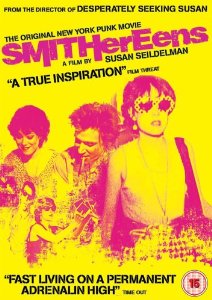
Film Review: Smithereens (1982, directed by Susan Seidelman)


SmithereensShot guerilla-style during the waning days of New York City’s original punk scene, Smithereens tells the story of Wren (Susan Berman).  Wren is a Jersey girl who, after being cut off by her family, comes to New York City.  She moves into a run-down apartment, get a job making photocopies at a xerox store, and tries to break into the New York punk scene, despite having no talent or connections.  The only thing that Wren does have is a lot of determination. When we first meet Wren, she is stealing another woman’s sunglasses and posting flyers of herself around New York City.  Written under Wren’s picture: “Do you know me?”

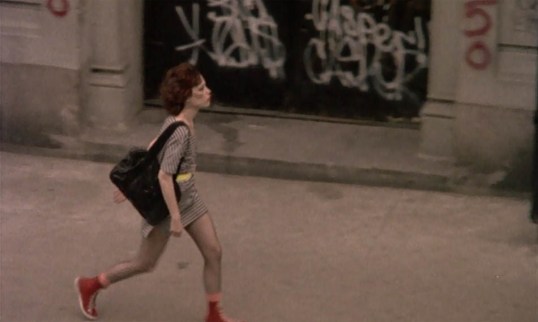
Throughout the film, Wren bounces back and forth between two men.  Paul (Brad Rinn) is a naive artist who has just arrived from Montana.  He lives in a psychedelic-painted van that he parks in an abandoned lot.  Paul first spots Wren while she is covering a subway car with her pictures and he is immediately infatuated with her.  Wren hangs out with Paul until she meets Eric (played by punk icon Richard Hell), a sleazy musician who has recorded one semi-successful album and who is trying to come up with enough money to leave New York for Los Angeles.  After Wren gets kicked out of her apartment, she moves in with Paul while continuing to sleep with Eric until she is finally forced to choose between the two men.

Susan Berman and Richard Hell

Susan Berman and Richard Hell

When Susan Berman was cast in the role of Wren, director Susan Seidelman told her to research her role by watching Nights of Cabiria and Smithereens does feel like a New York punk version of the Fellini classic.  Like Cabiria, Wren remains hopeful despite the ugliness around her.  Unlike Cabiria, Wren is not a very likable character.  She uses everyone that she meets and is then shocked when people hold it against her.  Despite that, she is so determined that it is hard not to root for her.  What is interesting is that Wren is not a malicious character.  She feels that she is destined to be famous and lacks the self-awareness to understand why other people are not as into her as she is.  If Smithereens were made today, Wren would be trying to get on American Idol or The Voice.  Sadly, Wren was just born too early to win a spot in the Jersey Shore house.

Susan Seidelman filmed on the streets of city and much of Smithereens is a documentary of life in New York City before the Giuliani/Bloomberg administrations cleaned everything up and turned Times Square into an urban Disney World.  Along with being one of the first independent American films to ever compete at the Cannes Film Festival, Smithereens was also the scriptwriting debut for future Oscar-nominated screenwriter Ron Nyswaner.  Keep an eye out for actor Chris Noth, making his film debut as a cross-dressing prostitute.

Susan Berman in Smithereens

Susan Berman in Smithereens

Film Review: Lovelace (dir by Rob Epstein and Jeffrey Friedman)


About halfway through the new biopic Lovelace, there’s a scene where former porno actress Linda Lovelace (played by Amanda Seyfried) is hooked up to a lie detector.  The polygraph examiner explains that he’s going to ask Linda a few test questions to get a reading.

“Is your name Linda Lovelace?” he asks.

Visibly nervous, Linda replies, “Can you ask something simpler?”

It’s a great scene because it establishes the central mystery of both the film and the title character.

Just who exactly was Linda Lovelace?

A girl whose main talent was apparently giving head, Lovelace became a star in the 70s when she starred in Deep Throat, the first (and perhaps only) hardcore film to become a legitimate mainstream hit.  For a brief while, Lovelace was the face of the American sex industry.  However, her attempts to have a mainstream film career failed and Lovelace retreated into obscurity.

Several years later, she wrote a book called Ordeal.  In Ordeal, Lovelace claimed that she was forced, by her abusive husband, to perform in Deep Throat.  Whereas Lovelace, during her brief stardom, originally claimed to simply be a sexual adventurer who performed on camera because it was liberating, the post-stardom Lovelace presented herself as being a brainwashed victim.  Or, as Lovelace herself put it, “When you watch Deep Throat, you’re watching me getting raped.”  While several people disputed the authenticity of Ordeal, Lovelace herself passed a polygraph examination.  Lovelace then became an anti-pornography activist before, once again, descending into obscurity and eventually dying in an automotive accident in 2002.

Lovelace deals with the issue of figuring out just who Linda Lovelace was by basically telling her story twice.

During the first 45 minutes of the film, we see how young Linda Boreman first meets Chuck Traynor (Peter Sarsgaard).  Everything about Chuck — from his mustache to his perm to his flashy clothes — practically screams sleaze but, since he’s played by Peter Sarsgaard, he also has an undeniable charm.  (With this film and An Education, Sarsgaard has proven himself to be the definitive older man who your parents warned you about.)  Chuck and Linda eventually marry and, when they need money, Linda turns to “acting” in order to pay the bills.

Under the watchful eye of producers Bobby Cannavale and Chris Noth, director Hank Azaria, and co-star Adam Brody, Linda stars in Deep Throat and becomes the face of the sexual revolution.  While there are occasional hints that things might not be perfect (bruises are often visible on Linda’s arms and legs), Linda seems to truly love the spotlight.  Even Hugh Hefner (played by James Franco, who is way too hot to only have a cameo) says she’s going to be a huge star.

And then, rather abruptly, we jump forward six years.  Linda is now writing Ordeal and we once again see how she first married Chuck Traynor, starred in Deep Throat, and came to be a star..  However, we now see the story through her eyes.  We see that Chuck wasn’t just controlling but that he was also an abusive psychopath who would hold a gun to her head in order to get a performance out of her.  We see that, during the shooting of Deep Throat, she was regularly beaten by her husband.  We see Linda attempting to reconnect with her strict and tradition parents (played by Sharon Stone and Robert Patrick).  We see the ugliness that was hidden underneath the glamour.

Considering the subject matter and the talent involved, Lovelace should have been one of the most interesting films of 2013 but, unfortunately, the two separate halves of the film just don’t come together.  While the first half of the film does a good job of capturing the absurdity of sudden fame, the second half of the film falls apart.

Oddly enough, Chuck Traynor and Linda Lovelace only come across as real human beings during the superficial first half of the film.  During the second half of the film, both Chuck and Linda come across as one-dimensional ciphers.  Linda becomes such a total victim and Chuck becomes such a melodramatic villain that neither one of them is all that compelling as a character.  Instead of being disturbing and revealing, the second half of the film just feels like another generic film about the price of fame.

Most of what I know about Linda Lovelace and Chuck Traynor comes from two sources — the 2005 documentary Inside Deep Throat and Legs McNiel’s and Jennifer Osborne’s book The Other Hollywood.  In both the book and the documentary, Lovelace comes across as being a rather pathetic figure who was exploited by both the adult film industry and the anti-pornography activists who used her as a symbol.  Both the industry and the activists abandoned Linda once her novelty was gone.  Ironically, even though both the documentary and the book are rather critical of her, it is there that she comes across as a far more interesting, sympathetic, and ultimately tragic figure than she does in this biopic.

With all that in mind, Lovelace is not necessarily a failure as a film.  The 70s are convincingly recreated and there’s a few scenes that hint at the type of film that this could have been if the filmmakers had been willing to take a few more risks.

The film is also full of excellent performances.  Seyfried is sympathetic and believable as Linda and, up until the second half of the film requires him to abandon all shades of ambiguity, Sarsgaard perfectly captures the sleazy charm that someone like Chuck Traynor would need to survive.  As Linda’s strict mother, Sharon Stone  is surprisingly strong.  Just watch the scene where Linda’s mom explains to her that she has to go back to abusive husband because that’s what marriage is all about and you’ll see an example of great acting.  Even better is Robert Patrick, who brings a poignant sadness to the role of Linda’s father.  The scene where he tells Linda that he saw her on film is heartbreaking.

Lovelace is a film of hits and misses.  Sadly, it misses the big picture but a few individual parts and performances are strong enough to justify sacrificing spending 93 minutes to watch it.