When I was a lad of 13, back in the Stone Age, I saw THE OMEGA MAN on the big screen during it’s first run. I remember thinking it was real cool, with Charlton Heston mowing down a bunch of mutant bad guys with his sub-machine gun, some funny one-liners, and a few semi-naked scenes with Rosalind Cash. What more could an adolescent kid ask for in a movie? Now that I’m (ahem!) slightly older, I recently re-watched the film, wondering just how well, if at all, it would hold up.
I’m happy to report THE OMEGA MAN, despite some flaws in logic, stands the test of time as a post-apocalyptic sci-fi action/adventure, with a touch of Gothic horror thrown in. The film is the second of three based on Richard Matheson’s novel I AM LEGEND, the first written by Matheson himself (under the pseudonym Logan Swanson) as THE LAST MAN ON EARTH, a 1964…
For the longest time, I thought that Two-Minute Warning was a movie about a gang of art thieves who attempt to pull off a heist by hiring a sniper to shoot at empty seats at the Super Bowl. As planned by a master criminal known as The Professor (Rossano Brazzi), the sniper will cause a riot and the police will be too busy trying to restore order to notice the robbery being committed at an art gallery that happens to be right next to the stadium.
I believed that because that was the version of Two-Minute Warning that would sometimes show up on television. Whenever I saw the movie, I always through it was a strange plan, one that had too many obvious flaws for any halfway competent criminal mastermind to ignore them. What if the sniper was captured before he got a chance to start shooting? What if a riot didn’t break out? The sniper spent the movie aiming at empty seats but, considering how many people were in the stadium, it was likely that he would accidentally shoot someone. Were the paintings really worth the risk of a murder charge?
Even stranger was that Two-Minute Warning was not only a heist film but it was also a 1970s disaster film. Spread out throughout the stadium were familiar character actors like Jack Klugman, John Cassevetes, David Janssen, Martin Balsam, Gena Rowlands, Walter Pidgeon, and Beau Bridges. It seemed strange that, once the shots were fired and Brazzi’s men broke into the gallery, all of those familiar faces vanished. When it comes to disaster movies, it is an ironclad rule that at least one B-list celebrity has to die. It seemed strange that Two-Minute Warning, with all those characters, would feature a sniper shooting at only empty seats. For that matter, why would there be empty seats at the Super Bowl?
That wasn’t the strangest thing about Two-Minute Warning, though. The strangest thing was that Charlton Heston was in the film, playing a police captain. In most of his scenes, he had dark hair. But, in the scenes in which he talked about the art gallery, Heston’s hair was suddenly light brown.
Recently, I watched Two-Minute Warning on DVD and I was shocked to discover that the movie on the DVD had very little in common with the movie that I had seen on TV. For instance, the television version started with the crooks discussing their plan to rob the gallery. The DVD version opened with the sniper shooting at a couple in the park. In the DVD version, there was no art heist. The sniper had no motive and no personality. He was just a random nut who opened fire on the Super Bowl. And, in the DVD version, he did not shoot at empty seats. Several of the characters who survived in the version that I saw on TV did not survive in the version that I saw on DVD.
What happened?
The theatrical version of Two-Minute Warning was exactly what I saw on the DVD. A nameless sniper opens fire and kills several people at the Super Bowl. In 1978, when NBC purchased the television broadcast rights for Two-Minute Warning, they worried that it was too violent and too disturbing. There was concern that, if the film was broadcast as it originally was, people would actually think there was a risk of some nut with a gun opening fire at a crowded event. (In 1978, that was apparently considered to be implausible.) So, 40 minutes of new footage was shot. Charlton Heston even returned to film three new scenes, which explains his changing hair color. The new version of Two-Minute Warning not only gave the sniper a motive (albeit one that did not make much sense) but it also took out all of the violent death scenes.
Having seen both versions of Two-Minute Warning, neither one is very good, though the theatrical version is at least more suspenseful than the television version. (It turns out that it was better to give the sniper no motive than to saddle him with a completely implausible one.) But, even in the theatrical version, the potential victims are too one-dimensional to really care about. Ultimately, the most interesting thing about Two-Minute Warning is that, at one time, an art heist was considered more plausible than a mass shooting.
Quarterback Cat Catlan (Charlton Heston) used to be one of the greats. For fifteen years, he has been a professional football player. He probably should have retired after he led the New Orleans Saints to their first championship but, instead, the stubborn Cat kept playing. Now, he is 40 years old and struggling to keep up with the younger players. His coach (John Randolph) says that Cat has another two or three years left in him but the team doctor (G.D. Spradlin who, ten years later, played a coach in North Dallas Forty) says that one more strong hit could not only end Cat’s career but possibly his life as well. Two of former Cat’s former teammates (Bruce Dern and Bobby Troup) offer to help Cat find a job off the field but Cat tells them the same thing that he tells his long-suffering wife (Jessica Walter). He just has to win one more championship.
Number One is unique for being one of the first movies to ever take a look at the dark side of professional football. At 40, Cat is facing an uncertain future. His years of being a star have left him unprepared to deal with life in the real world. He has no real friends and a wife who no longer needs him. This would seem like a perfect role for Heston, who always excelled at playing misanthropes. Heston is convincing when he’s arguing with his wife or refusing to sign an autograph but, surprisingly, he is thoroughly unconvincing whenever he’s on the field. For all of his grunting and all the lines delivered through gritted teeth, Heston is simply not believable as a professional athlete, even one who is past his prime. (When he played the 40 year-old Cat, Heston was 46 and looked like he was 56.) Whenever Cat throws a football, he’s played by Heston in close-ups and very obviously replaced by real-life Saints quarterback Billy Kilmer for the long shots. A football film is only as good and convincing as the football action and, on that front, Number One leaves much to be desired.
This 1969 press photo displays Heston’s throwing technique.
Two final notes: For the scene in which Cat is tackled by three Dallas Cowboys (all played by actual players), Heston requested that the players actually tackle him. Heston ended up with three broken ribs.
Finally, Number One was made the cooperation of the New Orleans Saints and features several players in the cast. When Number One was filmed, the Saints were still a relatively new expansion team. Cat is described as having already led the Saints to a championship but it would actually be another 40 years before the Saints would finally make their first trip to the Super Bowl.
Are you confused by the ratings system? Well, fortunately for you, Charlton Heston was willing to take some time out of his tennis game in order to explain it to you. This short film is from 1972 so it’s a little bit out-of-date. There’s no mention of PG-13 or NC-17, for instance. (And, of course, Charlton Heston is no longer with us…) But the point comes across regardless.
When I went to see Kingsmenat the Alamo Drafthouse, they showed this clip before the movie. The audience absolutely loved it.
I’m actually kind of upset with myself because, at one point, I was planning on spending all of February watching TCM’s 31 Days of Oscars and reviewing all of the best picture nominees that showed up on the channel. Unfortunately, I ended up getting busy with other things (like Shattered Politics, for instance) and it was only tonight that I finally got a chance to sit down and watch TCM. Oh well, maybe next year! But for now, I’m just going to watch and review as much as I can before the month ends.
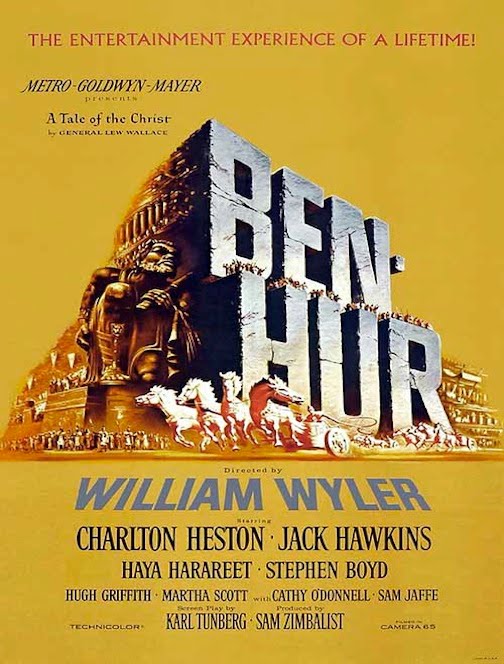
With that in mind, I just spent four hours watching the 1959 best picture winner Ben-Hur.
In many ways, Ben-Hur feels like a prototypical best picture winner. It’s a big epic film that obviously cost a lot to produce and which features a larger-than-life star surrounded by a bunch of a memorable character actors. It features two spectacular set pieces and some human drama that’s effective without being particularly challenging. It’s a film that deals with big themes but does so in a rather safe way. Perhaps not surprisingly, it’s a film that, today, is often dismissed as being old-fashioned and simplistic and yet it’s still a lot of fun to watch.
Opening with no less of an event than the birth of Jesus, Ben-Hur tells the story of Judah Ben-Hur (Charlton Heston), a wealthy Jewish aristocrat who, as a young man, was best friends with a Roman named Messala (Stephen Boyd). When Messala is named as the new commander of the local Roman garrison, he is upset to discover that Ben-Hur is more loyal to his religion than to the Roman Empire. Feeling personally rejected by his best friend (and perhaps more, as there are a lot of theories about the subtext of their relationship), Massala frames Ben-Hur for the attempted assassination of Judea’s governor.
Over the next 220 minutes, we watch as Ben-Hur goes from being a prisoner to a galley slave to the adopted son of a Roman general (Jack Hawkins) and finally one of the best chariot racers in ancient Rome. Throughout it all, he remembers a mysterious man who once attempted to give him a sip of water. Meanwhile, Ben-Hur’s family has been imprisoned and afflicted with leprosy. Appropriately, for a film that opened with the Nativity, it ends with the Crucifixion, during which Ben-Hur’s struggle to save his family also comes to a climax.
Ben-Hur is undoubtedly flawed film. (Among the film that were nominated for best picture of 1959, my favorite remains Anatomy of Murder.) The film runs about an hour too long, some of the supporting actors give performances that are a bit too over-the-top, and the entire film is so reverential that in can be difficult for modern audiences, especially in this age of nonstop irony, to take it seriously. In the lead role, Charlton Heston is always watchable and has a strong physical presence but you never quite believe that he’s the thinker that the script insists that he is. There’s nothing subtle about Heston’s performance but, then again, there’s nothing subtle about the film itself.
And yet, if the film struggles to connect on a human level, Ben-Hur still works as a spectacle. The gigantic sets and the ornate costumes are still impressive to look at. The film’s two big action sequences — a shipwreck and the chariot race — are still exciting and thrilling to watch. Ben-Hur may be dated but you can still watch it and understand why it was so popular with audiences in 1959 and, though I may not agree with a lot of the decisions, I can see why the Academy honored Ben-Hur with a record 11 Oscars. It’s the type of spectacle that, in 1959, could only have been found on the big screen. By honoring Ben-Hur, the Academy was honoring the relevance of the Hollywood establishment.
In the end, Ben-Hur may not hold up as well as some best picture winners but it’s still worth watching.
“Charlton Heston IS the Omega Man!” This movie is the second of three film adaptations of Richard Matheson’s classic novel I am Legend.
2) Last House On Dead End Street (1977)
This film is reportedly one of the most purely grindhouse films ever made. It’s also next to impossible to see. The Trash Film Guru has seen it and I’m insanely jealous. As for this trailer, it’s short but rather effective. It’s also perhaps the hundredth trailer to feature the “It’s only a movie” tagline.
3) Deranged (1974)
“A man so obsessed with death that he became…DERANGED!”
4) Equinox (1970)
I own the Criterion edition of this film. It’s actually kind of fun in its own silly way.
5) Vengeance of She (1971)
This is a Hammer film. I love how increasingly excited the narrator gets as he talks about vengeance.
6) Endgame (1983)
Finally, let’s end this entry with yet another look at a post-apocalypse future. From the iconic Italian director Joe D’Amato, it’s Endgame.
Yesterday, I posted a tracking shot from Jean-Luc Godard’s Weekend. Today, I want to offer up another great tracking shot, this one from a much better director and a much better movie: Orson Welles’ Touch of Evil. This 3 and a half-minute, unedited tracking shot begins in the United States and ends in Mexico. It also starts off one of the greatest films of all time.
Continuing my look at the original Planet of the Apes film series, we now come to the first sequel, 1970’s Beneath the Planet of the Apes. Rather blandly directed by Ted Post and featuring only a cameo performance from Charlton Heston, Beneath the Planet of the Apes is rarely given the credit it deserves. Yes, the first half of the film is rather forgettable but once you get through it, you discover one of the darkest films of the 1970s.
Beneath the Planet of the Apes begins with yet another human astronaut crash landing on the Earth of the future. This astronaut is Brent and, as played by James Franciscus, he comes across as a slightly more earnest, far less charismatic copy of Charlton Heston’s Taylor. Brent has been sent in search of Taylor. Anyway, once he lands on the planet, he is quickly arrested by the apes, meets Zira (Kim Hunter) and Cornelius (David Watson, stepping in for Roddy McDowall), and then escapes with the still-mute Nova (Linda Harrison). With Nova, Brent makes his way to the Forbidden City where he comes across the ruins of Grand Central Station and discovers that he’s actually on Earth.
Yes, that’s right. The first hour of this 95 minutes film is essentially just the first movie all over again. And yes, this film’s (many) critics are correct when they say that this first hour drags and tests the audience’s patience. Obviously, Brent may be shocked to discover he’s on Earth but it’s old news to us and many viewers are probably tempted to give up on this film before Brent even figures it out.
But don’t give up! No, because if you stick with this film you’ll discover that, once Brent figures out where he is, things get really, really fucked up.
Essentially, Brent discovers that the ruins of New York City are now underground. And in this underground city, there are people. But they’re not people like Brent or Nova. No, these are people who have been horribly scarred by radiation. They’ve also mutated to the extent that they’ve developed the powers of telepathy and mind control. Under the leadership of Mendez the Tenth (Paul Richards), they spend their time singing hymns to the Alpha/Omega nuclear bomb, or as they call it “The Holy Bomb.” They keep the Holy Bomb in St. Patrick’s Cathedral.
These mutants capture both Nova and Brent. Brent is tossed into a cell and who else is there but Taylor? And Taylor, believe it or not, has become even more sarcastic and scornful than before! Seriously, Charlton Heston frequently spoke about how much he hated this film and it’s obvious in his performance. Heston might not have been happy about being there but the audience is because, even if he is busy hating himself, Taylor brings a jolt of life to the film.
And just in time because the Apes, led by Urko (James Gregory), have invaded the forbidden city! They gun down all the mutants. Brent , Taylor, and Nova manage to escape their prison and all three of them are promptly gunned down as well. As he dies, Taylor manages to set off the Alpha/Omega bomb. We see a blinding white light followed by a somber voice over that tells us: “In one of the countless billions of galaxies in the universe, lies a medium-sized star, and one of its satellites, a green and insignificant planet, is now dead.”
And that’s it! There’s no final credits, not even a black-out. Instead, on that note, the movie just stops.
With Rise of the Planet of the Apes coming out in August, I figured why not go ahead and review the original Planet of the Apesfilms. No, I don’t mean the terrible Tim Burton film. I’m talking about the old school sci-fi series from the early 70s. For the next five days, I’ll be reviewing each installment of this landmark series of monkey-centric Let’s start at the beginning with 1968’s Planet of the Apes.
The plot of Planet of the Apes is pretty well-known. Arrogant earthman takes off from Earth, goes through some sort of time portal, and crash lands at some point in the far future. Our “hero” finds himself on a planet where all the humans are mute savages and society is dominated by equally arrogant, talking apes. (“A planet where apes evolved from man!?”) Eventually, the Earthman reveals that he can speak, he escapes captivity, and — accompanied by his mute concubine — he enters what the Apes call the forbidden zone. And, once in the forbidden zone, he discovers “his destiny” as old Dr. Zaius puts it.
It’s difficult to review a film like the original Planet of the Apes because the film itself has become a part of American culture. Even if you’ve never seen the film, you feel as if you have. Whether you’ve seen the famous ending or not, you know that it features Taylor (Charlton Heston) on his knees in front of the ruins of the Statue of Liberty, raving and cursing while the mute and confused Nova (Linda Harrison) watches. Everyone understands the significance of such famous lines as: “Take your stinking paws off of me, you damn, dirty ape!” and “Goddamn you all to Hell!” regardless of whether they’ve actually seen them delivered.
Of course, it can be argued that the fact that the film has become such a part of our culture is proof of the film’s quality. However, I would argue that the proof of the film’s quality comes from the fact that it remains a watchable and entertaining film despite having become such a part of the culture. It says a lot that a film can stay enjoyable despite being respectable.
Why does the film still work despite the film’s main selling point — the surprise ending — being neautralized by the passage of tinme? A lot of the credit, I think, has to go to the apes themselves. Even under all that makeup, Roddy McDowall as Cornelius, Kim Hunter as Zira, and especially Maurice Evans as the iconic Dr. Zaius all manage to create interesting and intriguing characters who just happen to be apes. Before long, you forget about the makeup and instead, you’re more interested in seeing how Zaius is going to handle this latest challenge to his society.
That challenge, of course, comes from Charlton Heston. Everyone is always quick to make fun of Heston as an actor and it’s true that his range was limited. Frequently, the men he played came across as the type of chauvinistic, pompous heroes that were never quite aware of the fact that everyone was secretly laughing at him. And it is true that Heston has several of those moments here in Planet of the Apes. Even his famous final scene is, to be honest, almost painfully over the top.
And you know what?
In this film, it works perfectly. I don’t know if an actor has ever been more perfectly cast than Charlton Heston was in Planet of the Apes. In the role of Taylor, Heston basically spends the entire movie acting like a complete and total pompous ass. Whether he’s recording a “fuck you” message for Earth at the beginning of the film or if he’s arrogantly dismissing Zaius before entering the Forbidden Zone, Heston comes to epitomize every single thing that we tend to dislike in our fellow human beings. As played by Heston, Taylor is the perfect clueless hero and a lot of the film’s perverse pleasure comes from watching this paragon of masculinity and superiority repeatedly humbled.
And that, ultimately, is why Planet of the Apes remains a watchable film so many decades after it was made. Good satire never goes out of style.


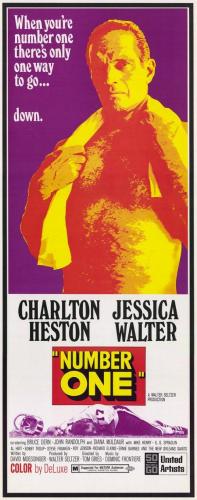 Quarterback Cat Catlan (Charlton Heston) used to be one of the greats. For fifteen years, he has been a professional football player. He probably should have retired after he led the New Orleans Saints to their first championship but, instead, the stubborn Cat kept playing. Now, he is 40 years old and struggling to keep up with the younger players. His coach (John Randolph) says that Cat has another two or three years left in him but the team doctor (G.D. Spradlin who, ten years later, played a coach in North Dallas Forty) says that one more strong hit could not only end Cat’s career but possibly his life as well. Two of former Cat’s former teammates (Bruce Dern and Bobby Troup) offer to help Cat find a job off the field but Cat tells them the same thing that he tells his long-suffering wife (Jessica Walter). He just has to win one more championship.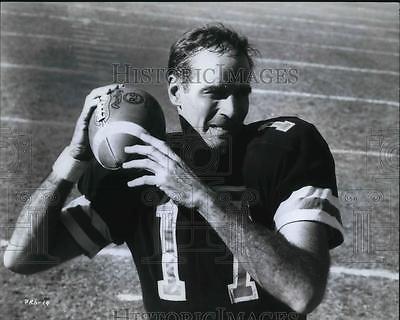
 Through the Shattered Lens