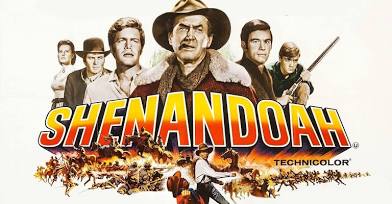
I review SHENANDOAH (1965), starring James Stewart! 


Jimmy Stewart plays Charlie Anderson, the patriarch of a large farming family in Virginia during the time of the Civil War. His family doesn’t own slaves, so he doesn’t figure it’s any of their business what all the fighting is about. He wants to keep working the land in hopes that the war will pass them by. Besides, he has six sons, a daughter, and a daughter in law that he wants to keep safe. He’s trying to keep the family together on his own as his beloved Martha had passed away sixteen years earlier giving birth to their youngest son, who we only know as Boy (Phillip Alford). Aside from the war that’s going on all around them, things seem pretty good for the Anderson’s. They all sit down for a big delicious meal every night. They attend Church every Sunday where they’re usually late and given the side-eye by Pastor Bjoerling (Denver Pyle). One of the sons, James Anderson (Patrick Wayne) and his wife Ann (Katharine Ross), have a precious newborn baby to take care of. The beautiful daughter Jennie (Rosemary Forsyth) is being courted by, and eventually marries, a lovestruck confederate officer named Sam (Doug McClure). Unfortunately the war won’t just go away, and when Boy is taken prisoner by Union soldiers, Charlie can’t stand idly by any longer. They head out to find him and bring him home. 

In the guise of an entertaining semi-western, SHENANDOAH does a great job of illustrating how futile and randomly tragic war can be. The movie starts out lighthearted and fun as the family goes about its normal life, with Jimmy Stewart’s Charlie Anderson giving his homespun advice and rolling his cigars. This is a self-sufficient family that loves, respects and enjoys each other even if they don’t agree on everything. But the war keeps inching its way into their lives. First in the form of small group of confederate soldiers who come by to get some water and try to convince the boys to join up. None of the boys will join up, but they do help bury the soldiers when they’re ambushed and killed just down the road. Next a group of men come to the ranch to try to confiscate their horses for the Union army. Of course, Charlie Anderson isn’t going to let that happen and this turns into the type of brawl that seems to come right out of John Wayne western comedy like MCLINTOCK. Everybody joins in with the participants punching and being punched repeatedly, while Boy keeps getting knocked into the horse trough. This shouldn’t be a surprise because Director Andrew V. McLaglen directed MCLINTOCK and many other John Wayne films. Finally, Boy is taken prisoner because he is wearing a confederate cap that he found floating down the steam while he was out fishing one day. Once Charlie and most of his family head out to search for Boy, the movie begins a turn into tragedy. I won’t give the specifics away, but some members of the family will die, and not a single one of their deaths will be based on the actual fighting of a war. Rather, their deaths will be based on the chaos and depravity that surrounds the war. It’s tough to see, especially when they were all so happy just a little bit earlier. For me, the movie’s changes in tone make the tragedy more powerful and really drive home its message about the futility of war. But the Anderson family, like the United States of America after the Civil War, is made up of tough, resilient folks, and the movie ends on a hopeful note that definitely brought some extra moisture to my eyes. 

Jimmy Stewart commands the screen in SHENANDOAH. You simply can’t take your eyes off of him, and his performance alone would make the movie worth watching. But with its powerful message, excellent cast, and solid direction, the movie is much more than just Stewart’s strong performance. I highly recommend it. 
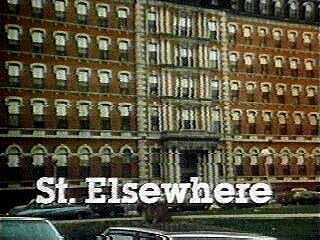
Retro Television Review: St. Elsewhere 1.8 “Tweety and Ralph”


Welcome to Retro Television Reviews, a feature where we review some of our favorite and least favorite shows of the past! On Fridays, I will be reviewing St. Elsewhere, a medical show which ran on NBC from 1982 to 1988.  The show can be found on Hulu and, for purchase, on Prime!

Oddly enough, this week’s episode is not available on Hulu.  I had to purchase it on Prime.  I’m not really sure why this episode — and apparently this episode alone — wouldn’t be on Hulu.  The world of Streaming is a strange and arbitrary place.

Episode 1.8 “Tweety and Ralph”

(Dir by Mark Tinker, originally aired on December 20th, 1982)

Dr. Craig is still trying to track down the mysterious Dr. Barnum, the man who says that he’s interested in Craig’s convertible.  Dr. Craig is constantly getting messages from Barnum.  He’s constantly hearing Barnum being paged on the PA.  Craig has become obsessed with tracking down the elusive Dr. Barnum.

Of course, Dr. Barnum does not exist.  What started as a practical joke on the part of Dr. Samuels has grown into a hospital-wide conspiracy of people playing with the emotions of the pompous and prickly Dr. Craig.  Craig is so obsessed with selling his car that he even cuts his hand while working on the engine.  Finally, Dr. Craig’s wife, Ellen (played by William Daniels’s real-life wife, Bonnie Bartlett), confronts Samuels and tells him that she knows what he’s doing.  When Samuels hears that Craig cut his hand, he feels guilty.  He knows how important a surgeon’s hands are.  Samuels finally works up the courage to tell Craig the truth.  Craig laughs.  And then he punches out Dr. Samuels.

And you know what?  Dr. Samuels totally deserved it.  Good for you, Dr. Craig!

(Everyone seems to have forgiven Dr. Samuels for causing a VD break-out during the pilot.  They’re very forgiving at St. Eligius.)

Meanwhile, the Legionnaire’s outbreak is finally contained, with the culprit being one dirty shower head.  Ward 5 is re-opened!  Yay!  Dr. Westphall celebrates his victory but still comes across as being the most depressed man on the planet.  While that goes on, Dr. Fiscus reveals that he now carries a gun so he won’t get mugged in the ER again and Dr. Cavanero considers her decision to devote her life to her career when a friend check into the hospital for hysterectomy.

That said, the majority of the episode centered around Ralph (Richard Marcus) and Jane (Laraine Newman), two psychiatric patients.  Jane is pregnant and Ralph is the father.  Ralph is a genius who graduated at the top of his class from MIT and who invented his own personal computer.  Unfortunately, he also thinks that he’s a bird and has been stealing medical supplies to build a giant nest in one of the supply closets.  Jane wants to marry Ralph but, when she and Ralph go out to dinner with Dr. Beale, Jane can only watch in horror as Ralph panics at the sight of a cat.  “Caw!  Caw!” Ralph shouts as he jumps up on  a chair.  The cat, for its part, just looks confused.

In other words, the marriage is off.  Jane tells Ralph that she’ll always love him but that she can’t be with him anymore.  The episode ends with a close-up of Ralph intensely staring at the camera.  Uh-oh, that doesn’t look good….

This was a weird but ultimately effective episode.  I really shouldn’t have been as emotionally moved as I was by Ralph and Jane’s story.  Ralph’s behavior was more than a little cartoonish.  But, I have to admit that I felt really sad as Jane said goodbye to Ralph.  Richard Marcus and Laraine Newman did such a good job playing the characters that I couldn’t help but be sad that things weren’t working out for them.

Oh well.  I guess that’s just another day at St. Eligius….

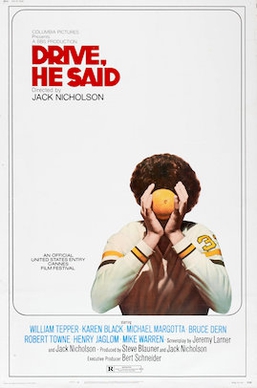
Film Review: Drive, He Said (dir by Jack Nicholson)


First released in 1971, Drive, He Said tells the story of two college roommates.

Hector (William Tepper) is a star basketball player who everyone expects to turn pro.  His intense coach (Bruce Dern) is always yelling at him to stop fooling around on the court but Hector is more interested in fooling around elsewhere as he’s having an affair with Olive (Karen Black), the wife of a self-styled “hip” philosophy professor named Richard (Robert Towne).

Gabriel (Michael Margotta) is Hector’s best friend.  They live together, even though Hector’s coach thinks that Gabriel is a bad influence.  Gabriel is a self-styled campus radical.  He has a devoted group of followers who will do just about anything that he tells them to do.  Gabriel is big into guerilla theater and symbolic protests.  Nothing he does seems to add up too much but, unlike Hector, he’s good at giving speeches.

Together, they worry about the draft!

Of course, they’re both worrying about two different types of drafts.  Hector is worried about the NBA draft and whether he should enter it.  He’s been playing basketball for as long as he can remember.  The only thing that he’s really good at is playing basketball.  And yet, Hector isn’t sure if he wants to spend the rest of his life taking orders from his coaches and devoting every minute to playing the game.  However, Hector’s worked himself into a corner.  When one NBA official asks him what he’s going to do if he’s not drafted, Hector admits that he doesn’t know.  When asked what his major is, Hector replies, “Greek.”

Gabriel, on the other hand, is worried about being drafted into the military and being sent to Vietnam.  Gabriel considers himself to be a revolutionary but it soon becomes clear that he really doesn’t have much of a plan for how to start his revolution.  Indeed, the film suggests that his activism is more about his own insecurity over his own sexuality than anything else.  Gabriel particularly seems to be obsessed with Hector’s affair with Olive.  While Hector reaches new highs on the court, Gabriel comes closer and closer to having a psychotic break.

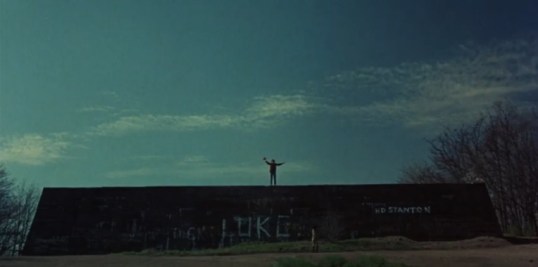
Director Jack Nicholson found a way to work in shout out to his friend, Harry Dean Stanton

Drive, He Said was one of the many “campus rebellion” films that were released in the early 70s and, much like Getting Straight, it’s definitely a product of its time.  Today, it it’s known for anything, it’s for being the directorial debut of actor Jack Nicholson.  (Nicholson has said that, before he was cast in Easy Rider, he was actually planning on abandoning acting and pursuing a career as a director.)  The film features many of the flaws the are typically present in directorial debuts.  The pacing is terrible, with some scenes ending too quickly while others seem to go on forever.  At times, the film feels a bit overstylized as Nicholson mixes jump cuts, odd camera angles, and slow motion to little effect. It’s very much a film about men, so much so that the film’s ultra-masculinity almost verges on self-parody.

And yet, there are moments of isolated brilliance to be found in Drive, He Said.  Some of the shots are genuinely impressive and the army induction scene shows that Nicholson could direct comedy, even if he does let the scene drag on for a bit too long.  Though Nicholson doesn’t appear in the film, his approach to the story features his trademark cynicism and sense of fatalism.  Though he was often associated with the counterculture, Nicholson was more a member of the Beat generation than of the hippies.  As such, Drive, He Said has more in common with Jack Kerouac than Abbie Hoffman.  Drive, He Said is definitely an anti-establishment film but, at the same time, it doesn’t make the mistake of glorifying Gabriel or his followers.  Gabriel, with his constant demand that everyone join him in his ill-defined revolution, is almost as overbearing as basketball coach and, towards the end of the film, he commits an act of violence that leaves no doubt that his “revolution” is all about his own self-gratification.  The film is less a polemic and more a portrait of people trying to find their identity during a time of political and cultural upheaval.

The film’s biggest flaw is that neither William Tepper or Michael Margotta really have the charisma necessary to carry a movie, especially one in which even the main characters often do unlikable things.  Tepper is dull while Margotta overacts and, at times, comes across as if he’s trying too hard to imitate his director.  It falls to the film’s supporting cast to provide the energy that Tepper and Margotta lack.  Fortunately, Bruce Dern and Karen Black are both perfectly cast.  Bruce Dern seems to be having a blast as the fanatical basketball coach while Karen Black brings a fierce intelligence to the role of Oliva, an intelligence that one gets the feeling wasn’t really in the original script.  Considering how misogynistic every other character in the film is, it’s impossible not to cheer when Olive announces, “I’m not going with anybody, anywhere.”

(For whatever reason, there was a definite strain of misogyny that seemed to run through the majority of the late 60s and early 70s counterculture films.  Just consider the amount of time Getting Straight devoted to Elliott Gould shouting at Candice Bergen.)

Drive, He Said is flawed but interesting.  As a director, Nicholson understood how to frame a shot but he wasn’t quite sure how to tell a cohesive story.  That said, the film itself is a definite time capsule of a very specific cultural moment.

Love on the Shattered Lens: Splendor in the Grass (dir by Elia Kazan)


What though the radiance which was once so bright

Be now for ever taken from my sight,

Though nothing can bring back the hour

Of splendour in the grass, of glory in the flower;

We will grieve not, rather find

Strength in what remains behind…

— “Ode: Intimations of Immortality from Recollections of Early Childhood” by William Wordsworth

The 1962 film, Splendor in the Grass, takes place in Kansas shortly before the start of the Great Depression.  Deanie (Natalie Wood) and Bud (Warren Beatty) are two teenagers in love but, as we learn, youthful love does not always translate into adult happiness.

Bud and Deanie are idealistic and in love but they’re from different social classes.  Bud is the son of a boisterous oilman named Ace (Pat Hingle) and Ace acts much like you would expect a millionaire named Ace to behave.  Bud’s parents are determined that he attend Yale and that he marry someone else from a wealthy family.  They don’t want him to turn out like his older sister, Ginny (Barbara Loden), who drinks, smokes, and is rumored to have recently had an abortion.  Meanwhile, Deanie is repeatedly told by her mother that she must always remain a “good girl” and not give in to the temptation to have premarital sex with either Bud or any other boy.  If she does, she’ll be forever branded a bad girl and she’ll pretty much end up with a reputation like Ginny’s.

(Interestingly enough, Ace doesn’t have any problem with Bud finding  himself a bad girl, nor does he have a problem with taking his son to a speakeasy later in the film.  As far as society in concerned, being “good” and following the rules only applies to women.)

Needless to say, things don’t work out well for either Deanie or Bud.  Bud is so frustrated that Deanie won’t have sex with him that he dumps her and then has the first of several breakdowns.  When Deanie’s attempt to win Bud back by acting more like Ginny fails, she ends up going out with a classmate named Toots Tuttle (Gary Lockwood).  Nothing good ever comes from going out on a date with someone named Toots Tuttle.  That’s certainly the case here as Deanie and Bud both struggle with the demands of a hypocritical society that expects and encourages Bud to behave in a certain way but which also condemns Deanie for having desires of her own.  And, of course, the entire time that Bud and Deanie’s drama is playing out, we’re aware that the clock is ticking and soon the stock market is going to crash and change everyone’s lives forever.

It’s kind of a depressing film, to be honest.  I’ve always found it to be rather sad.  When we first meet them, Deanie and Bud seem as if they’re perfect for each other but, throughout the entire film, the world seems to be conspiring to keep them apart.  By the end of the film, they’ve both found a kind of happiness but we’re painfully aware that it’s not the happiness that either one was expecting while they were still in school.  The film suggests that type of happiness might be impossible to attain and a part of growing up is realizing that there is no such thing as perfection.  Instead, there’s just making the best of wherever you find yourself.

There’s a scene in this film where Natalie Wood nearly drowns and it always freaks me out, both because of my own fear of drowning and the fact that it foreshadows what would eventually happen to Natalie in 1982.  (The fact that Natalie Wood and Robert Wagner’s yacht was called “Splendour” doesn’t help.)  Natalie herself was also deeply scared of drowning and just filming the scene undoubtedly took a lot of courage on Natalie’s part.  But then again, Natalie Wood’s entire performance is courageous.  Natalie Wood gives an emotional and intense performance as Deanie, holding nothing back and it’s impossible not to get emotional while watching her.  Making his film debut, Warren Beatty is a bit of a stiff as Bud, though he’s certainly handsome and you can tell why Deanie would have found him attractive.  (In high school, you always assume that the boring, handsome guys actually have more depth than they let on.)  By the end of the film, you understand that Deanie deserved better than Bud.  Then again, Deanie deserved better than just about everything life had to offer her.  But Deanie survived and endured and made the best of what she was given because, really, what else could she had done?  What other choice did she have?

For her performance in Splendor in the Grass, Natalie Wood received her second Oscar nomination for Best Actress.  She lost to Sophia Loren for Two Women and …. well, actually, Loren deserved the award.  But so did Wood.  1961 would have been a great year for a tie.

Lisa Watches An Oscar Nominee: The Sand Pebbles (dir by Robert Wise)


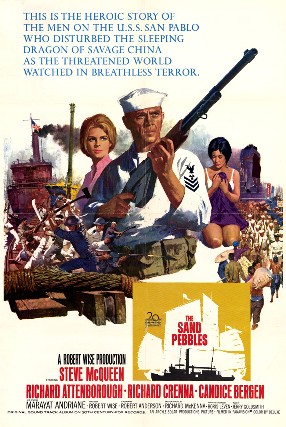
The_Sand_Pebbles_film_posterAfter watching Witness For The Prosecution, I continued TCM’s 31 Days of Oscar by watching the 1966 Best Picture nominee, The Sand Pebbles.

Considering that The Sand Pebbles is close to four hours long, it’s interesting how little there is to really say about it.  Taking place in 1926, The Sand Pebbles follows the crew of the USS San Pablo, a gunboat that patrols the Yangtze River in China.  The San Pablo is there to protect American business interests, which are in particular danger because China is caught up in a communist revolution.  For the most part, the crew of the San Pablo are portrayed as being lazy and racist.  They have little interest in understanding the culture of the people around them and they use Chinese laborer to do the work on the boat.

When Jake Holman (Steve McQueen) is transferred to the San Pablo, he upsets his fellow crewmen by insisting on working in the ship’s engine room himself, the fear being that if Holman is willing to work then the rest of them will be expected to work as well.  The ship’s commander, Lt. Collins (Richard Crenna), views Holman as being a threat to morale and starts to make plans to get Holman off of his boat.  But, first, the boat is going to have to get out of China…

The Sand Pebbles is an episodic film and some of those episodes are more interesting than others.  Typically, an episode will start out positively and then end with some sudden tragedy.  For instance, Holman trains one laborer (Mako) to be a boxer and then watches as he beats the most racist crewman on the ship.  However, just a few minutes later, the laborer is captured and savagely tortured by the communists and Holman is forced to perform a mercy killing.

In another subplot, Holman’s only friend, Frenchy (Richard Attenborough), marries a local prostitute (Emmanuelle Arsan, who would later write an autobiography that would serve as the basis for a very different type of film).  However, in order to see his wife, Frenchy has to continually swim to shore in the middle of the night.  Frenchy soon develops pneumonia and dies while his wife is dragged off and apparently executed.

And finally, Holman strikes up a romance with Shirley Eckert (Candice Bergen), an innocent missionary.  However, when her arrogant and naive boss, Jameson (Larry Gates), refuses to leave the country despite the revolution, the San Pablo is ordered to rescue them.  This, of course, leads to a final battle with the communists which leaves a good deal of the cast dead.

As I watched The Sand Pebbles, my main impression was that it was an extremely long movie.  The film’s climatic battle was exciting and Steve McQueen (not to be confused with the director of 12 Years A Slave and Shame) gave a good performance but otherwise, the film often seemed to drag.  While the movie’s theme of Americans struggling (and failing) to understand another country’s culture had a definite resonance, The Sand Pebbles did not seem to be quite sure what it truly wanted to say about it.

Let’s face it — over 500 films have been nominated for best picture.  And, while a good deal of them hold up surprisingly well and are still entertaining to watch, there’s also a handful like The Sand Pebbles, ambitious films that never quite reached their potential but were probably nominated because they seemed like the type of epic film that should be nominated.  Many of these films were nominated and a few even won.

However, in the case of The Sand Pebbles, a nomination would have to be enough.  That year, the Oscar for Best Picture was won by A Man For All Seasons.