Retro Television Reviews: Miami Vice 1.11 “Give a Little, Take a Little”


Welcome to Retro Television Reviews, a feature where we review some of our favorite and least favorite shows of the past!  On Mondays, I will be reviewing Miami Vice, which ran on NBC from 1984 to 1989.  The entire show is currently streaming on Tubi!

Tonight’s episode is a reminder that you don’t mess with Miami Vice!

Episode 1.11 “Give a Little, Take a Little”

(Dir by Bobby Roth, originally aired on December 7th, 1984)

Oh my God, this episode…. this episode put me through an emotional ringer.  After two episodes that were somewhat light and airy, Give A Little, Take A Little is a return to  the dark and surreal storytelling that was Miami Vice’s signature style.

Things start out on an energetic note, with a montage of Miami nightlife set to the tune of Tina Turner singing You Better Be Good To Me.  For once, Gina (Saundra Santiago) and Trudy (Olivia Brown) are seen before Crockett and Tubbs, this time purchasing appropriately trashy (but stylish) outfits for their undercover prostitution sting.  When Crockett and Tubbs are finally seen, they’re heading over to see their informant, Noogie (Charlie Barnett).  The very high and very talkative Noogie tells them about a warehouse that is being used by a dealer.

At the warehouse, Crockett and Tubbs find a nervous watchman, Bob Rickert (Lenny Von Dohlen).  The obviously terrified Bob explains that he’s just watching the warehouse for an old college friend of his.  When Tubbs and Crockett open up a box and yank out several bags of pills, Bob admits that he knows his friend is a drug dealer but Bob also insists that he’s never sold any drugs in his life.  Sonny takes sympathy on Bob and, after Bob gives them the name of his friend, he allows Bob to go home to his wife.

Bob’s friend is Sally Alvarado (a very young and smoldering Michael Madsen).  After the expected car chase, Crockett and Tubbs arrest him.  However, Alvarado’s lawyer — Richard Cain (Terry O’Quinn, of future Stepfather and Lost fame) — demands that Crockett reveal the name of his confidential source.  (When Crockett meets with the lawyer, he insists on calling him, “Dick.”)  The judge at Alvarado’s trial agrees that Alvarado has a right to know who has accused him of being a drug dealer and she orders that Crockett name his informant.  When Crockett refuses, Crockett goes to jail.

Meanwhile, Gina and Trudy are working at Club Ocho, which is owned by Cinco (Tony Plana).  They are both pretending to be sex workers who have just moved down to Miami from Philadelphia.  Cinco sends them out to work the streets, where they are picked up every night by their fellow Miami Vice detectives, Switek and Zito.  When Cinco’s boss, Lupo Ramirez (the great Burt Young), spots Gina at the Club, he promotes her to working directly for him.  When Ramirez comes to suspect that Gina might be an informant, he invites her to his house late at night for a meeting and, off-screen, he rapes her.

Crockett is released from jail, despite having not named his informant.  He assumes that Lt. Castillo called in a marker but Castillo instead reveals that Bob felt so guilty about Sonny being in jail that he went to Cain and confessed to being the informant.  He also agreed not to testify against Alvarez.  While Sonny was still sitting in jail, Sally Alvarez was released from prison.

That night, Noogie introduces Sonny and Tubbs to another informant, Trick Baby (Henry Sanders).  Impressed that Crockett went to jail to protect an informant, Trick Baby tells Sonny and Tubbs that Sally Alvarez is Ramirez’s second in command.  He also reveals that Ramirez is sending Cinco to kill Gina.

Back at her apartment, Gina is being comforted by Trudy when Cinco shows up.  Fortunately, Crockett and Tubbs show up at well.  A chase and gunfight leads to Cinco being seriously wounded.  Cinco promises that, if he lives, he’ll testify against Alvarez and Ramirez.

At Club Ocho, Alvarez is watching as Switek makes his debut as a stand-up comedian.  Switek’s act is terrible but it provides the cover needed for Crockett and Tubbs to arrest Alvarez.  After being told that Cinco has ratted him out, Alvarez agrees to rat out Ramirez.

The next morning, Gina and Trudy show up at Ramirez’s mansion.  Gina draws her gun and tells Ramirez that he’s under arrest.  Ramirez, who is holding the knife that he was using to make his breakfast, laughs and smugly says that Gina can’t arrest him after what “we’ve shared.”

And….

GINA SHOOTS HIM!

HELL YEAH!

Seriously, that was one of the most satisfying moments that I’ve experienced since I started watching this show.  It’s also a reminder of how different the cops on Miami Vice were from most of the other cops who showed up on crime shows in the 80s and 90s.  Just when you’re expecting Gina to sigh, lower her gun, and read Ramirez his rights because she’s a cop and a cop has to obey the law, she shoots him.  And since Ramirez was dumb enough to act like a smug jackass while holding a knife, the shooting will undoubtedly be ruled as being justified.

This was an emotional episode and not always easy to watch but it all built to a powerful conclusion.  While I did spend a lot of time playing “spot the famous guest star,” I was even happier that this episode finally gave Miami Vice‘s often neglected supporting cast to show what they could do.  John Diehl, Olivia Brown, Michael Talbott, and especially Saundra Santiago all got their chance to shine in this episode.

Next week, Giancarlo Esposito plays a drug dealer decades before Breaking Bad.
October True Crime: Judgment Day: The John List Story (dir by Bobby Roth)


In 1971, a 46 year-old account named John List committed a shocking crime.

To the outside world, John List was a normal suburbanite.  He was perhaps a little bit strict but then again, it was 1971 and all of the traditional morals that John List had grown up with were being challenged in the streets and in the movies.  Neither he nor his family were particularly sociable but again, it was assumed that they just liked the privacy that was afford to them by the mansion in which they lived.  List was married to Helen.  They lived with their three teenage children and List’s 84 year-old mother.  John List was a hard worker, he taught Sunday School, and, again, he was seen as being perfectly normal.

On November 9th, 1971, John List methodically murdered his wife, his children, and his mother.  He left his mother in her upstairs apartment while the rest of his family was laid out, in sleeping bags, in the ballroom.  (Detectives later surmised that List stopped in the middle of his murder spree to have lunch and then attended his son’s soccer game before taking him home and killing him.)  List left behind several notes, explaining that he was in a bad financial situation and that he feared that his family was heading down an immoral path that would have condemned their souls to Hell if he hadn’t killed them first.  And then, John List vanished.

For the rest of the 70s and the 80s, John List was phantom.  Some speculated that he had committed suicide while others thought that he had changed his identity and had probably remarried.  In 1987, the classic thriller The Stepfather was released in theaters.  Inspired by List’s crimes, The Stepfather starred Terry O’Quinn as Jerry Blake, a real estate agent who was obsessed with creating the perfect family.  The Stepfather imagined its killer as a friendly but rigid man who snapped whenever his illusion of perfection was threatened.  It also imagine him as someone who moved from town to town, searching for a new family that wouldn’t let him down.

As for the real John List, it turned out that those who suspected him of having changed his identity were correct.  And, just as The Stepfather suggested, he had remarried and was actually now a real stepfather.  List remained free until his story was included in a 1989 episode of America’s Most Wanted.  A forensic scientist included a bust of what John List might have looked like in 1989 and a viewer realized that the bust looked a lot like an accountant named Bob Clark.  “Bob Clark” was arrested and eventually, he confessed that he was actually John List.  Despite his attorney’s attempt to argue that he was not guilty by reason of insanity, John List was eventually convicted of five counts of murder.  He spent the rest of this life in prison, dying of natural causes in 2008.

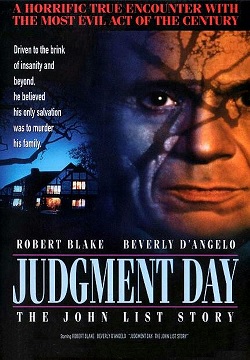
The 1993 film Judgement Day: The Story of John List tells the story of List’s crimes and his subsequent attempt to build a new life for himself.  John List is played by Robert Blake, which turns out to be a bit of a problem as Blake gives such a twitchy and obviously unstable performance that it’s hard to believe that he could have successfully gone into hiding for 18 years.  Carroll Baker and Beverly D’Angelo are not given much to do as, respectively, List’s mother and List’s first wife while David Caruso appears as the detective who is determined to catch List.  Though this film was made long before CSI: Miami, I still found myself expecting Caruso to say something quippy and put on his sunglasses.

Judgment Day doesn’t add much to the story of John List.  It certainly doesn’t offer up any new insight into what led to List becoming a murderer, beyond the fact that List himself was just kind of a jerk.  It’s pretty much a by-the-numbers production that’s only interesting today because of Blake’s subsequent legal problems.  (For the record, I’ve always felt Robert Blake was innocent.)  When it comes to John List films, stick with The Stepfather.

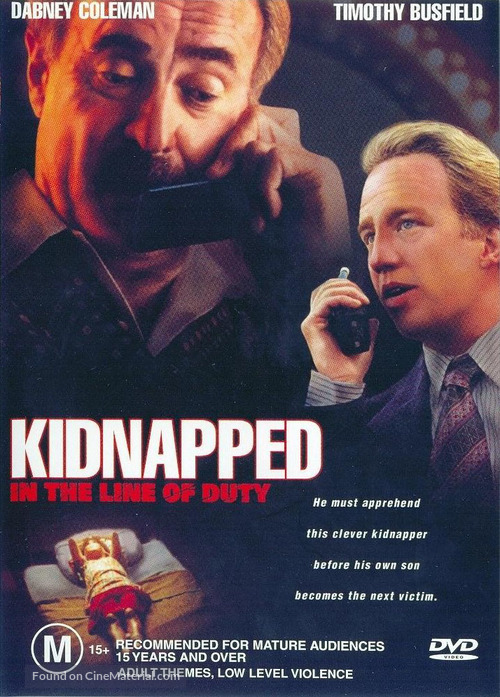
Kidnapped: In The Line of Duty (1995, directed by Bobby Roth)


Arthur Milo (Dabney Coleman) is an IRS agent who uses his government position and the powers that with it to commit heinous crimes.  (A corrupt IRS agent?  What a shock!)  Milo kidnaps the children of the wealthy, using legally-filed tax returns to select his target.  Most of his accomplices all have the perfect alibi because they’re all in prison!  As an agent of law enforcement, Milo is able to check them out of prison for hours at a time.  Milo claims that they’re helping him out with an investigation but actually, they’re kidnapping children and digging graves in return for Milo’s help with their tax problems.  Once the crime has been committed, Milo returns them to jail.  It seems like the perfect plan but Milo may have met his match in hard charging FBI agent Pete Honeycutt (Timothy Busfield).

Loosely based on a true story, Kidnapped was the tenth of NBC’s In The Line of Duty films and it was one of the few not to be directed by Dick Lowry.  It’s also the only one of the In The Line of Duty films to not feature a member of law enforcement getting gunned down nor does it end with a title card of statistics about the number of cops who are killed on the job each year.  All of this leads me to suspect that Kidnapped was not originally meant to be an In The Line of Duty movie and that it was added to the series at the last minute.  NBC was obviously hoping that the rating success of Ambush in Waco would rub off on Kidnapped.

Kidnapped is a pretty typical eccentric criminal vs eccentric investigator movie.  Pete is obsessed with taking down Milo and Milo is obsessed with showing up Pete.  It’s not a surprise when Milo starts to personally taunt Pete and it’s also not a surprise that Pete’s family is put at risk.  There are a few strange moments of humor, most of them supplied by Tracey Walter as Milo’s spacey accomplice.  The humor, though, doesn’t always seem to go along with a fact-based story about an IRS agent who abducted children and held them for ransom.

The best thing about the film is Dabney Coleman as Arthur Milo.  Coleman has always been an underrated actor.  Nobody did as good at a job at playing a curmudgeon as Dabney Coleman.  In Kidnapped, Coleman takes his usual persona up a notch by playing Milo as someone who is not just annoyed by people but who is willing to kill them too.  While Arthur Milo’s schemes are usually clever, he’s so arrogant and determined to show off how much smarter he is than everyone else that he’s usually his own worst enemy.  He’s the type of criminal who wears a white suit and a panama hat, despite the fact that his outfit will make him instantly recognizable to anyone who witnesses his crimes.  The character is a strange one but Coleman brings him to life and makes him believable.  Kidnapped is a pretty standard police procedural but worth seeing for Coleman’s villainous turn.

Sundance Film Review: Circle of Power (dir by Bobby Roth)


With the Sundance Film festival currently taking place in Utah, I am currently reviewing films that originally made a splash at the Sundance Film Festival!

(a.k.a. Circle of Power, Mystique, Naked Weekend, and probably a handful of other titles)

The Sundance Film Festival wasn’t always the Sundance Film Festival.

Up until 1984, it was known as the US Film Festival.  Because of the involvement of Robert Redford, it was something of a big deal but still nowhere as big a deal as it is today.  In fact, many of the films that were showcased and celebrated at the US Film Festival have slipped into obscurity.  While winning an award at the US Film Festival may have been nice a ego boost for an independent filmmaker, it certainly didn’t bring a film anywhere near the amount of attention that winning at Sundance does now.

Take the long and strange saga of Circle of Power, for instance.

From my own research, it appears that Circle of Power was originally filmed in 1980.  At that time, it was called Mystique.  It premiered at the Chicago International Film Festival in 1981.  A year later, under the title Circle of Power, it played at the US Film Festival.  It was awarded the Dramatic prize (which was the forerunner for Sundance’s Grand Jury Prize).

After that, it still took Circle of Power two years to achieve national distribution.  In 1984, when it was reviewed by Roger Ebert, the film had been released as Naked Weekend, a title that was as commercial as it was misleading.  (There is nudity in the film but probably not the type of nudity that Naked Weekend‘s audience was expecting.)  By the time the film was finally released on VHS, it had picked up yet another title: Brainwash.

That’s the poster for Brainwash at the top of this video.  There are two images on that poster.  One is of a woman holding a riding crop and showing off her bra.  The other is of a naked man in a cage.  Only the latter image actually appears in the movie.

The film’s distributors were obviously trying to sell Circle of Power as an exploitation film.  Actually, it’s not.  It’s … well, it’s hard to describe what exactly it is.  It starts out with a title card, informing us that what we’re about to see is based on a true story.  The rest of the film deals with a group of executives and their wives who are required to spend the weekend attending a “training course” at a beautiful hotel.  The weekend gets off to a good start, with lots of dancing and laughing.  Of course, none of the executives seem to notice that the hotel staff is watching them with a mix of scorn and pity.

(The film continually contrasts the privileged white executives with the largely black and Hispanic hotel staff.)

Before the training sessions begin, all of the executives and their wives are forced to sign a paper that states they understand that they will be psychologically and physically abused over the weekend.  Only one executive objects and he is quickly bullied into signing by his co-workers.  Apparently, they can’t do the training unless everyone agrees to sign.

The men and the women are separated.  (Interestingly, all of the executives are men.)  The men are “trained” by Bianca Ray (Yvete Mimieux, who is chilling in her final performance to date) while the women are left with Jordan Carelli (John Considine).  The training turns out to be a combination of ego stripping and physical abuse.  One overweight executive (Walter Olkewicz) is ordered to strip naked and is then locked in a cage, where food is dumped on him.  An alcoholic is forced to lay down in a coffin.  Soon, everyone is covered in bruises.  What’s remarkable is that only one executive and his wife actually seems to find any of this to be objectionable.  In fact, everyone else reacts to the abuse by hugging their abusers and crying for joy.

It’s a strange little film, one that often seems to be unsure of what it’s saying but which, at the same time, still possesses an undeniable power.  The film may be 38 years old but brainwashing is a timeless subject.  One need only spend an hour or two on twitter to see how easily people can be brainwashed.  While the film probably disappointed those seeking a naked weekend, it’s still an undeniably watchable oddity.

Previous Sundance Film Reviews:

  1. Blood Simple
  2. I Don’t Feel At Home In This World Anymore

A Movie A Day #119: Dead Solid Perfect (1988, directed by Bobby Roth)


Based on a novel by veteran sports writer Dan Jenkins, Dead Solid Perfect takes an episodic look at a year on the PGA tour.  Kenny Lee (Randy Quaid) is a good but aging golfer who wants to finally have his time in the spotlight.  His sponsor (Jack Warden) is an eccentric old racist.  His girlfriend (Corinne Bohrer, who has a lengthy scene where she walks naked down hotel hallway while carrying an ice bucket) isn’t looking for a commitment while his wife (Kathryn Harrold) is getting sick of his emotional immaturity.  Kenny Lee just wants to hit the perfect shot.

An early HBO production, Dead Solid Perfect is one of the best movies ever made about pro golfers, not that there is really much competition.  Eschewing the pretentious blathering that has marred other golf films (like The Legend of Bagger Vance), Dead Solid Perfect focuses on the day-to-day life of aging athletes who have never had to grow up.  This was Dan Jenkins’s specialty and Dead Solid Perfect feels authentic in a way that many other sports film, like Bagger Vance, do not.  Randy Quaid, long before he had his widely publicized breakdown and started making videos about the “star whackers,” is perfectly cast as Kenny.  Sadly, Dead Solid Perfect has never been released on DVD or Blu-ray but it will entertain any golf fan who owns an operational VCR.

Of course, the best movie about golf is still Caddyshack.