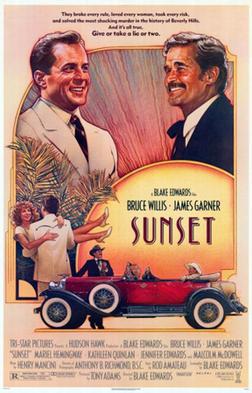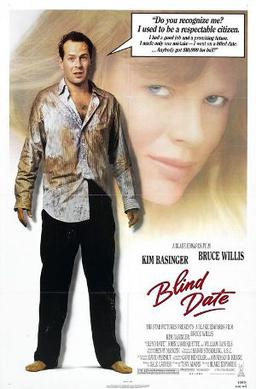
Sunset (1988, directed by Blake Edwards)


In 1920s Hollywood, famed comedian Alfie Alperin (Malcolm McDowell) has made the transition from screen stardom to working behind the scenes as a producer and studio head.  With the coming of the talkies and the death of silent cinema, Alfie plans to make his mark with an epic western starring Tom Mix (Bruce Willis) as Wyatt Earp.  The real Wyatt (James Garner) is hired to act as an on-set consultant.  Wyatt’s former girlfriend, Christina (Patricia Hodge), is now married to Alfie.

What Mix and Earp discover is that, despite his beloved public image, Alfie is actually a monster who is involved with organized crime and sex trafficking and who has the police on his payroll.  While searching for Christina’s missing son (Dermot Mulroney), Mix and Earp get caught up in a murder involving Alife’s sister (Jennifer Edwards) and a gangster named Dutch (Joe Dallesandro).  At the first Academy Awards are handed out in Beverly Hills, Tom Mix and Wyatt Earp prepare for the final showdown with their producer.

The idea behind Sunset was promising.  Wyatt Earp, a real cowboy who survived the end of the West, teams up with Tom Mix, a movie cowboy who is trying to survive the end of the silent era.  (Earp and Mix were friend in real life, as well.)  Bruce Willis comes across as being too contemporary in the role of Tom Mix but James Garner plays Wyatt Earp with a weary dignity and Malcolm McDowell does a convincing Charlie Chaplin impersonation.  Unfortunately, Blake Edwards’s direction allows the story to meander and the mystery itself is so full of red herrings that it’s impossible to follow.  Edwards didn’t seem to know if he wanted this movie to be a buddy comedy, an elegiac tribute to the end of the silent era, or a satire of Hollywood.  He tried to include elements of all three but the movie itself just doesn’t come together.  Only Garner and McDowell emerge from the film relatively unscathed.

Fortunately, for Bruce Willis, Die Hard was released just two months after Sunset.

Film Review: City Heat (dir by Richard Benjamin)


In 1984’s City Heat, Clint Eastwood plays Lt. Speer, a tough and taciturn policeman who carries a big gun, throws a mean punch, and only speaks when he absolutely has to.

Burt Reynolds plays Mike Murphy, a private investigator who has a mustache, a wealthy girlfriend (Madeleine Kahn), and a habit of turning everything into a joke.

Together, they solve crimes!

I’m not being sarcastic here.  The two of them actually do team up to solve a crime, despite having a not quite friendly relationship.  (Speer has never forgiven Murphy for quitting the force and Murphy has never forgiven Speer for being better at everything than Murphy is.)  That said, I would be hard-pressed to give you the exact details of the crime.  City Heat has a plot that can be difficult to follow, not because it’s complicated but because the film itself is so poorly paced and edited that the viewer’s mind tends to wander.  The main impression that I came away with is that Speer and Murphy like to beat people up.  In theory, there’s nothing wrong with that.  Eastwood is legendary tough guy.  Most people who watch an Eastwood film do so because they’re looking forward to him putting the bad guys in their place, whether it’s with a gun, his fists, or a devastating one-liner.  Reynolds also played a lot of tough characters, though they tended to be more verbose than Eastwood’s.

That said, the violence in City Heat really does get repetitive.  There’s only so many times you can watch Clint punching Burt while various extras get gunned down in the background before it starts to feel a little bit boring.  The fact that the film tries to sell itself as a comedy while gleefully mowing down the majority of the supporting cast doesn’t help.  Eastwood snarls like a pro and Reynolds flashes his devil-may-care smile but, meanwhile, Richard Roundtree is getting tossed out a window, Irene Cara is getting hit by a car, and both Kahn and Jane Alexander are being taken hostage.  Tonally, the film is all over the place.  Director Richard Benjamin was a last-minute replacement for Blake Edwards and he directs without any sort of clear vision of just what exactly this film is supposed to be.

On the plus side, City Heat takes place in Kansas City in 1933 and the production design and the majority of the costumes are gorgeous.  (Unfortunately, the film itself is often so underlit that you may have to strain your eyes to really appreciate it.)  And the film also features two fine character actors, Rip Torn and Tony Lo Bianco, are the main villains.  For that matter, Robert Davi shows up as a low-level gangster and he brings an actual sense of menace to his character.  There are some good things about City Heat but overall, the film is just too messy and the script is a bit too glib for its own good.

Burt Reynolds and Clint Eastwood had apparently been friends since the early days of their careers.  This was the only film that they made together.  Interestingly enough, Reynolds gets the majority of the screentime.  Eastwood may be top-billed but his role really is a supporting one.  Unfortunately, Reynolds seems to be kind of bored with the whole thing.  As for Clint, he snarls with the best of them but the film really doesn’t give him much to do.

A disappointing film, City Heat.  Watching a film like this, it’s easy to see why Eastwood ended up directing himself in the majority of his films.

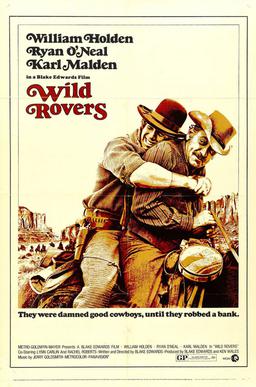
Wild Rovers (1971, directed by Blake Edwards)


In Montana, Walter Buckman (Karl Malden) runs his ranch with an iron hand, warning his neighbor, Hansen (Sam Gilman) not to even think of allowing his sheep to graze on his land.  Walter has two sons, hot-headed John (Tom Skerritt) and the laid back and good-natured Paul (Joe Don Baker).  When Walter learns that two of his ranch hands — aging Ross Bodine (William Holden) and young Frank Post (Ryan O’Neal) — have robbed a bank and are heading down to Mexico, he sends John and Paul to bring them back.  Walter is a big believer in the law and he’s not going to allow any of his people to get away with breaking it.

Ross is a veteran cowboy, who only robbed the bank after Walter withheld his pay to cover the damage of a saloon fight between Ross and Hansen’s men.  Frank is the wilder of the two.  He looks up to Ross and Ross is protective of Frank, even if he has a hard time admitting it.  Ross and Frank are heading down to Mexico so Ross can retire in peace.  Instead of going straight to Mexico, though, they make the mistake of stopping by a small town so Frank can play a little poker and visit the town’s brothel.

Wild Rovers was Blake Edwards’s attempt to make an epic, revisionist western and he includes plenty of shots of the sun setting over the mountains as well as several violent shoot-outs that are shot in Peckinpah-style slow motion.  Unfortunately, the story itself isn’t really strong enough to support Edwards’s ambitions and all of the shots of the countryside, while nice to look at, don’t really add up too much.  Wild Rovers was also a troubled production, with MGM slashing Edwards’s original three-hour film down to 106 minutes and advertising it with a poster featuring O’Neal hugging Edwards from behind, making the film look like a buddy comedy in the style of Butch Cassidy and the Sundance Kid (or an early version of Brokeback Mountain) as opposed to a violent and elegiac western.  (In 1986, a director’s cut was released, which ran for 136 minutes.)  If you only know Blake Edwards from his Pink Panther movies, the grim and tragedy-filled Wild Rovers will come as a surprise.

One thing that Wild Rovers does have going for it is a good cast.  William Holden and an energetic Ryan O’Neal are a solid team and Karl Malden, Tom Skerritt, Rachel Roberts, James Olson, and Moses Gunn all give good performances too.  This movie also provides Joe Don Baker with a sympathetic role and he’s very likable as the laid back Paul Buckman.  It’s not the type of role that Baker often got to play and it’s obvious that a lot of scenes between John and Paul were cut from the film but, in the truncated version, Joe Don Baker’s Paul Buckman becomes the moral center of the film’s story.

Wild Rovers was a disappointment at the box office, one of many that Edwards suffered in the 70s before he and Peter Sellers brought back Inspector Clouseau.

4 Shots From 4 Films: Special Audrey Hepburn Edition


4 Or More Shots From 4 Or More Films is just what it says it is, 4 shots from 4 of our favorite films. As opposed to the reviews and recaps that we usually post, 4 Shots From 4 Films lets the visuals do the talking!

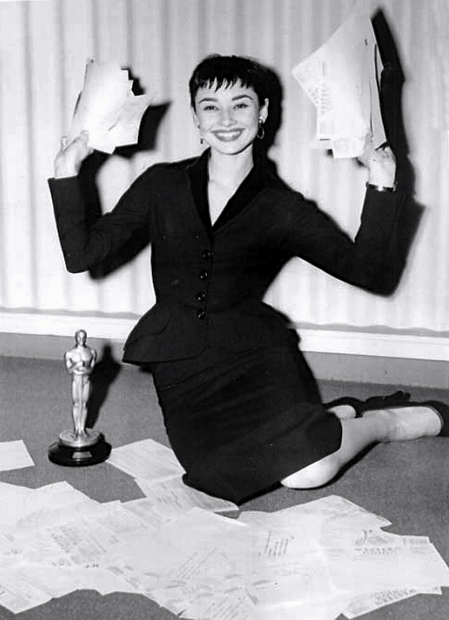
Today would have been the 93rd birthday of one of my favorite actresses, the wonderful Audrey Hepburn!

We’re all Audrey Hepburn fans here at the Shattered Lens.  How could we not be?  Long before she made her film debut, Audrey Hepburn literally risked her life as a part of the Dutch Resistance during World War II.  After she retired for regularly appearing in the movies, she devoted herself to humanitarian causes and served as a UNICEF ambassador.  She was one of the greats and, for that reason, we honor Audrey Hepburn today with….

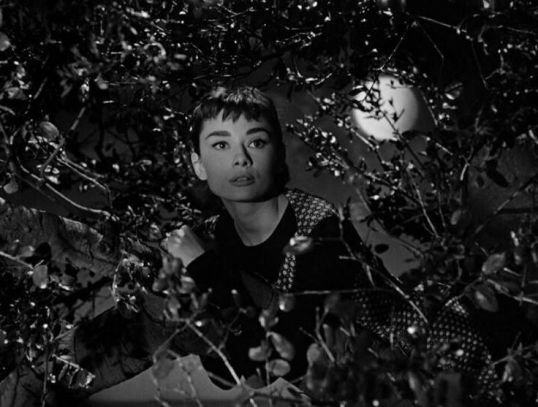
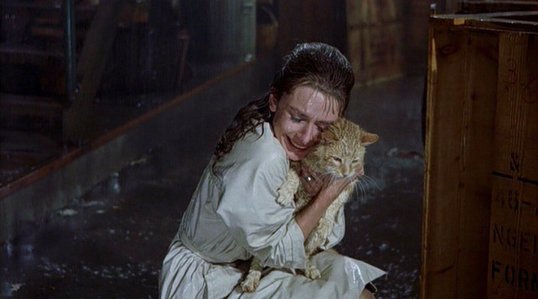
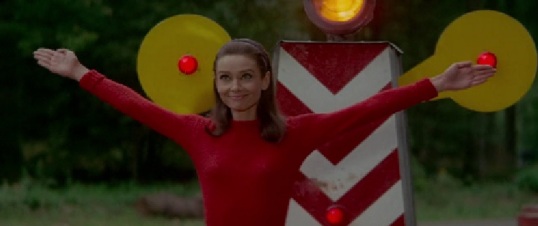
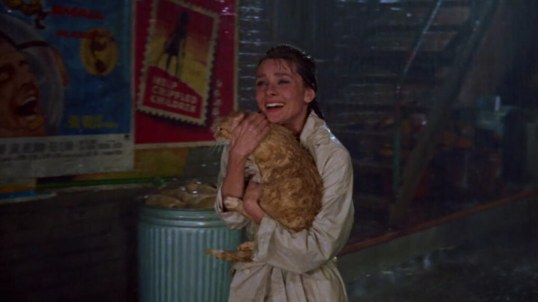
4 Shots From 4 Audrey Hepburn Films

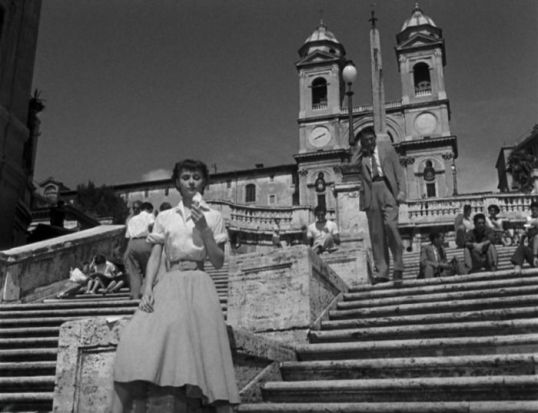
Roman Holiday (1953, dir by William Wyler, DP: Henri Alaken and Franz Planer)

Sabrina (1954, dir by Billy Wilder, DP: Charles Lang)

Breakfast at Tiffany’s (1961, dir by Blake Edwards, DP: Franz Planer)

Two For The Road (1967, dir by Stanley Donen, DP: Christopher Challis)

Scenes That I Love: Audrey Hepburn Says Goodbye to Buddy Ebsen in Breakfast at Tiffany’s


Wow.  I am really running behind!  I nearly let this day come to an end without paying tribute to the amazing Audrey Hepburn.  Hepburn was born 91 years ago, on May 4th, 1921 in Belgium.  She went on to become one of history’s best actresses, as well as a role model for us all.  It’s not every actress who could say that she was also an active member of the anti-Nazi Dutch resistance during World War II.  After she became famous and could have very easily gotten away with turning her back on the world, Hepburn continued to make a name for herself as a humanitarian, working as Goodwill Ambassador for UNICEF.

In honor of her birthday, here’s a wonderfully acted scene from 1961’s Breakfast at Tiffany’s.

4 Shots From 4 Audrey Hepburn Films: Funny Face, Breakfast at Tiffany’s, Wait Until Dark, Robin and Marian


4 Shots From 4 Films is just what it says it is, 4 shots from 4 of our favorite films. As opposed to the reviews and recaps that we usually post, 4 Shots From 4 Films lets the visuals do the talking.

Today would have been Audrey Hepburn’s 90th birthday!  In honor of the legacy of this wonderful actress and humanitarian, here are….

4 Shots From 4 Audrey Hepburn Films

Funny Face (1957, dir by Stanley Donen)

Breakfast at Tiffany’s (1961, dir by Blake Edwards)

Wait Until Dark (1967, dir by Terence Young)

Robin and Marian (1976, dir by Richard Lester)

Lisa Cleans Out Her DVR: The Carey Treatment (dir by Blake Edwards)


(Lisa is currently in the process of cleaning out her DVR!  She has got over 170 movies on the DVR to watch and she’s trying to get it done before the start of the new year!  Can she get it done?  Probably not, but she’s going to try!  1972’s The Carey Treatment was recorded off of TCM on July 23rd.)

Dr. Peter Carey (James Coburn) is the epitome of 1970s cool.  He’s got hair long enough to cover the top half of ears.  He’s got a fast car.  He’s got a rebellious attitude and a girlfriend (Jennifer O’Neill) who rarely questions his decisions.  Though you don’t see it in the movie, Dr. Carey probably smokes weed when he’s back at his fashionably decorated apartment.  How do I know this?  Well, he’s played by James Coburn.  Even if some of them are nearly 50 years old, you can still get a contact high from watching any movie featuring James Coburn.

Anyway, what the Hell is The Carey Treatment about?  Dr. Carey has just recently moved to Boston, where he’s taken a job at a stodgy old hospital.  The hospital’s chief doctor, J.D. Randall (Dan O’Herlihy, of Halloween III: Season of The Witch fame), might want Dr. Carey to tone down his free-livin’, free-lovin’ California ways but no one tells Peter Carey what to do.  In fact, the entire city of Boston might be too stodgy and conventional for Dr. Carey.  You see, Dr. Carey not only heals people.  He also beats up people who try to stand in his way.  Peter Carey is a doctor who cares but he’s also a doctor who can kick ass.

And he’s going to have to kick a lot of ass because Dr. Randall’s daughter has just turned up dead.  The police say that she died as the result of a botched abortion and they’ve arrested Carey’s best friend, Dr. David Tao (James Hong).  (The Carey Treatment, it should be noted, was filmed before Roe v. Wade legalized abortion.)  The Boston establishment is determined to use Dr. Tao as a scapegoat but Dr. Carey is convinced that his friend is innocent.  In fact, he doesn’t think that the death was the result of an abortion at all.  Carey sets out to solve the case … HIS WAY!

If it seems like I’m going a little bit overboard with my emphasis on the Dr. Peter Carey character, that’s because this entire movie feels more like a pilot for a weekly Dr. Carey television series as opposed to an actual feature film.  It’s easy to image that each week, James Coburn would drive from hospital to hospital, solving medical mysteries and debating social issues with stuffy members of the Boston establishment.  Henry Mancini would provide the theme music and Don Murray would guest star as Dr. Carey’s brother, a priest who encourages the young men in his parish to burn their draft cards.

It might have eventually become an interesting TV show but it falls pretty flat as a movie.  James Coburn is in nearly every scene, which would usually be a good thing.  But in The Carey Treatment, he gives an incredibly indifferent performance.  He seems to be bored by the whole thing and, as a result, Dr. Peter Carey is less a cool rebel and more of a narcissistic jerk.  The mystery itself is handled rather haphazardly.  On the positive side, Michael Blodgett gives a wonderfully creepy performance as a duplicitous masseur but otherwise, The Carey Treatment is nothing special.

If you want to see a great James Coburn film, track down The President’s Analyst.

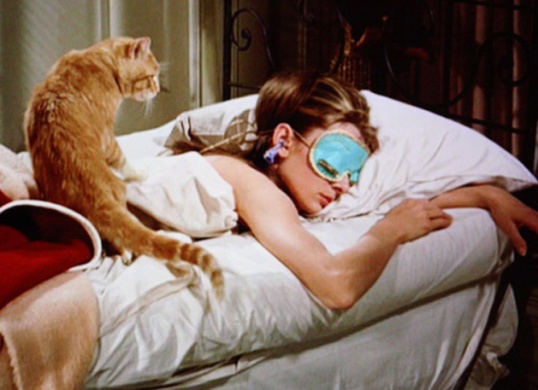
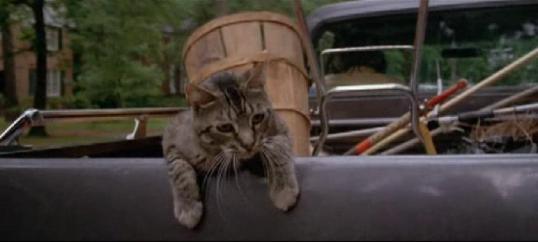
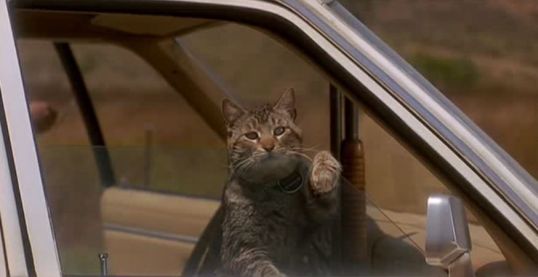
4 Shots From 4 Films: Breakfast at Tiffany’s, Inferno, Cat’s Eye, Sleepwalkers


Happy International Cat Day from the Shattered Lens!

4 Shots From 4 Films

Breakfast at Tiffany’s (1961, dir by Blake Edwards)

Inferno (1980, dir by Dario Argento)

Cat’s Eye (1985, dir by Lewis Teague)

Sleepwalkers (1992, dir by Mick Garris)

Catnip party at my place!

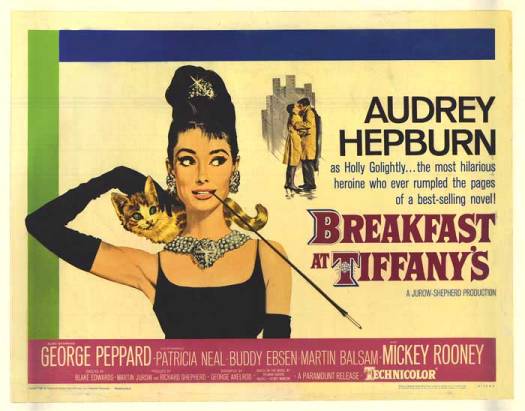
My Huckleberry Friend: BREAKFAST AT TIFFANY’S (Paramount 1961)


gary loggins's avatarcracked rear viewer

(“Breakfast at Tiffany’s” airs tonight, 6/12/17 at 8:00 EST on TCM as part of their month-long salute to Audrey Hepburn.)

“You mustn’t give your heart to a wild thing. The more you do, the stronger they get, until they’re strong enough to run into the woods or fly into a tree. And then to a higher tree and then to the sky” – Audrey Hepburn as Holly Golightly in BREAKFAST AT TIFFANY’S.

From it’s hauntingly romantic theme “Moon River” to it’s sophisticated screenplay by George Axelrod, BREAKFAST AT TIFFANY’S is a near-perfect movie. The bittersweet comedy-drama stars Audrey Hepburn in an Oscar nominated performance as Holly Golightly, a New York “party girl” who winds up falling for struggling writer George Peppard. That Hepburn didn’t get the Oscar (Sophia Loren took it home that year for TWO WOMEN) is one of the Academy’s greatest crimes. The film has a very personal connection with…

View original post 1,020 more words

The Fabulous Forties #42: The Strange Love of Martha Ivers (dir by Lewis Milestone)


StrangeLoveofMartha

The 41st film in Mill Creek’s Fabulous Forties box set was the 1946 film noir, The Strange Love of Martha Ivers.  While The Strange Love of Martha Ivers is definitely a superior example of noir and features Barbara Stanwyck in one of her best femme fatale roles, the film is best remembered for being the film debut of a Hollywood icon.

In December of this year, Kirk Douglas will turn 100 years old.  He is one of the few stars of the Golden Age of Hollywood left.  (Olivia De Havilland is another.  She’ll be turning 100 on the 1st of July.)  Though he’s had his share of health issues over the past few years, it is somehow not surprising that Kirk Douglas is going to make it to a hundred.  In fact, it probably wouldn’t be surprising if he lasted for another hundred after that.  Regardless of how old or young he may have been at any point in his career, Kirk Douglas has always epitomized virile masculinity.  Whenever you see Kirk Douglas in a film, you know that you might not like or trust his character but you definitely want him around if things start to get tough.  That remains true whether you’re watching Kirk in The Bad And The Beautiful or in Holocaust 2000.

That’s why it’s interesting to see Kirk cast very much against type in his very first film.  In The Strange Love of Martha Ivers, Kirk Douglas plays Walter O’Neil.  Walter is the district attorney of a Pennsylvania mining town called Iverstown.  He is married to Martha Ivers (Barbara Stanwyck), the niece of the widow of the man who founded Iverstown.  Walter owes almost all of his success to the influence of the Ivers family and he knows it.  He’s also in love with Martha but she doesn’t love him.  And he knows that as well.  Walter deals with his insecurity by drinking.

Walter and Martha have a secret.  Seventeen years ago, Walter witnessed Martha murder her abusive aunt.  (The aunt is played by Judith Anderson, the creepy housekeeper from Rebecca.)  Walter helped Martha to cover up the crime, lying that he saw a burglar beat the aunt to death.  As a result of their lies, an innocent man was executed for the murder.

Now, many years later, Sam Masterson (Van Heflin) has returned to Iverstown.  Sam was a friend to both Martha and Walter when they were younger.  Sam came from the poor section of town and ran away shortly after the death of Martha’s aunt.  Walter has always suspected that Martha truly loves Sam.  When Sam — now a drifter and a gambler — shows up in town, Walter fears that he knows the truth about the aunt’s death.  Walter is scared that Sam is going to blackmail him.  Even worse, he’s scared that Sam is going to steal Martha away from him.

Walter has reason to be worried.  Having met a troubled young woman named Toni (Lizabeth Scott), Sam believe he is no longer in love with Martha.  However, Martha does claim to love Sam and Sam finds himself being drawn back to her.  In fact, Martha loves Sam enough to suggest that maybe he should murder Walter…

The Strange Love of Martha Ivers is an entertaining melodrama, one that features great performances from Heflin, Stanwyck, and Scott.  However, in the end, it’s mostly interesting because Kirk Douglas is not only making his debut in a totally atypical role but he also does a fantastic job.  If The Strange Love of Martha Ivers had been made in the 50s, Kirk probably would have been cast as Sam but he’s unexpectedly perfect in the role of the angry, self-loathing, and ultimately tragic Walter.

You watch The Strange Love of Martha Ivers and, even with Kirk Douglas cast against type, you can’t help but think, “No wonder he made it to a hundred!”

martha-ivers