Today’s horror scene that I love comes not from film but from television. In this episode of The Twilight Zone (entitled “It’s A Good Life”), the citizens of a rural community have to go out of their not to upset a rather unpredictable six year-old.
What happens when you upset little Anthony Fremont?
Take a look:
Written by Rod Serling and directed by James Sheldon, this episode originally aired on November 3, 1961.
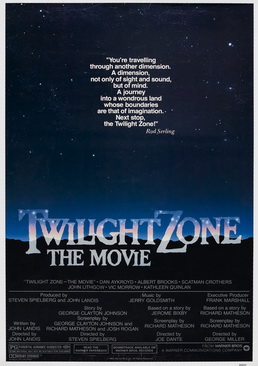
1983’s Twilight Zone: The Movie is meant to be a tribute to the classic original anthology series. It features four “episodes” and two wrap-around segments, with Burgess Meredith providing opening and closing narration. Each segment is directed by a different director, which probably seemed like a good idea at the time.
Unfortunately, Twilight Zone: The Movie is a bit of a mess. One of the episodes is brilliant. Another one is good up until the final few minutes. Another one is forgettable. And then finally, one of them is next too impossible to objectively watch because of a real-life tragedy.
With a film that varies as wildly in tone and quality as Twilight Zone: The Movie, the only way to really review it is to take a segment at a time:
Something Scary (dir by John Landis)
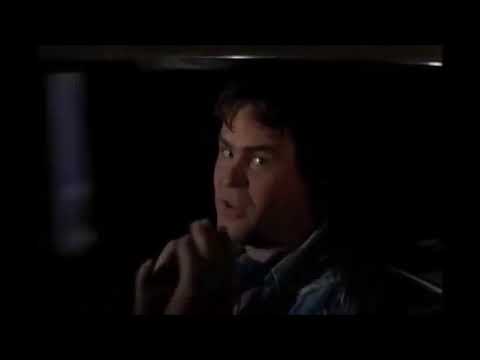
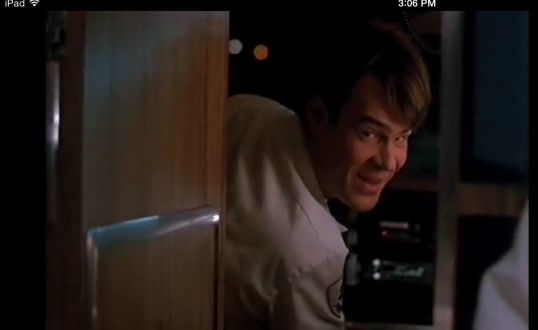
Albert Brooks and Dan Aykroyd drive through the desert and discuss the old Twilight Zone TV series. Brooks claims that the show was scary. Aykoyd asks if Brooks wants to see something really scary. This is short but fun. It’s tone doesn’t really go along with the rest of the movie but …. oh well. It made me jump.
Time Out (dir by John Landis)
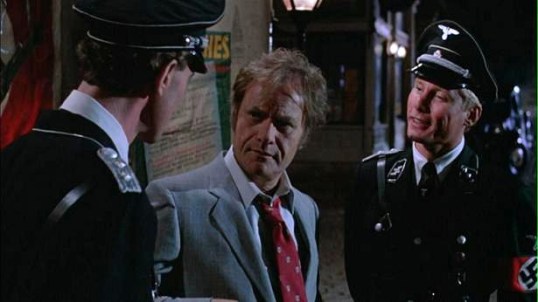
Vic Morrow plays a racist named Bill Connor who, upon leaving his local bar, finds himself transported to Nazi-occupied France, the deep South, and eventually Vietnam.
How you react to this story will probably depend on how much you know about its backstory. If you don’t know anything about the filming of this sequence, you’ll probably just think it’s a bit heavy-handed and, at times, unintentionally offensive. Twilight Zone often explored themes of prejudice but Time Out just seems to be using racism as a gimmick.
If you do know the story of what happened while this segment was being filmed, it’s difficult to watch. Actor Vic Morrow was killed during filming. His death was the result of a preventable accident that occurred during a scene that was to involve Morrow saving two Vietnamese children from a helicopter attack. The helicopter crashed, killing not only Morrow but the children as well. It was later determined that not only were safety protocols ignored but that Landis had hired the children illegally and was paying them under the table so that he could get around the regulations governing how many hours child actors could work. It’s a tragic story and one that will not leave you as a fan of John Landis’s, regardless of how much you like An American Werewolf in London and Animal House.
Nothing about the segment feels as if it was worth anyone dying for and, to be honest, I’m kind of amazed that it was even included in the finished film.
Kick The Can (dir by Steven Spielberg)
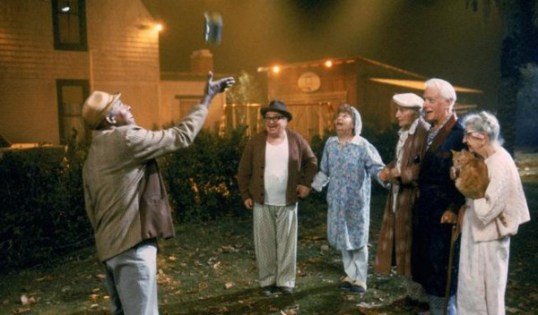
An old man named Mr. Bloom (Scatman Crothers) shows up at Sunnyvale Retirement Home and encourages the residents to play a game of kick the can. Everyone except for Mr. Conroy (Bill Quinn) eventually agrees to take part and, just as in the episode of the Twilight Zone that this segment is based on, everyone becomes young.
However, while the television show ended with the newly young residents all running off and leaving behind the one person who refused to play the game, the movie ends with everyone, with the exception of one man who apparently became a teenager istead of a kid, deciding that they would rather be old and just think young. That really doesn’t make any damn sense but okay.
This segment is unabashedly sentimental and clearly calculated to brings tears to the eyes to the viewers. The problem is that it’s so calculated that you end up resenting both Mr. Bloom and all the old people. One gets the feeling that this segment is more about how we wish old people than how they actually are. It’s very earnest and very Spielbergian but it doesn’t feel much like an episode of The Twilight Zone.
It’s A Good Life (dir by Joe Dante)
A teacher (Kathleen Quinlan) meets a young boy (Jeremy Licht) who has tremendous and frightening powers.
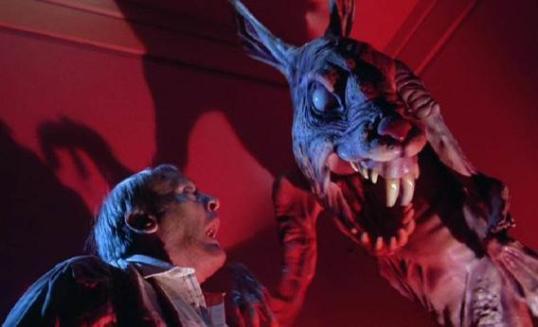
This is a remake of the classic Twilight Zone episode, It’s A Good Life, with the difference being that young Anthony is not holding an entire town hostage but instead just his family. This segment was directed by Joe Dante, who turns the segment into a cartoon, both figuratively and, at one point, literally. That’s not necessarily a complaint. It’s certainly improvement over Spielberg’s sentimental approach to the material. Dante also finds roles for genre vets like Kevin McCarthy, William Schallert, and Dick Miller and he provides some memorably over-the-top visuals.
The main problem with this segment is the ending, in which Anthony suddenly reveals that he’s not really that bad and just wants to be treated normally, which doesn’t make much sense. I mean, if you want to be treated normally, maybe don’t zap your sister in a cartoon. The teacher agrees to teach Anthony how to be a normal boy and again, what the Hell? The original It’s A Good Life worked because, like any child, Anthony had no conception of how adults felt about him. In the movie version, he’s suddenly wracked with guilt and it’s far less effective. It feels like a cop out.
Still, up until that ending, It’s A Good Life worked well as a satire of the perfect American family.
Nightmare at 20,000 Feet (dir by George Miller)
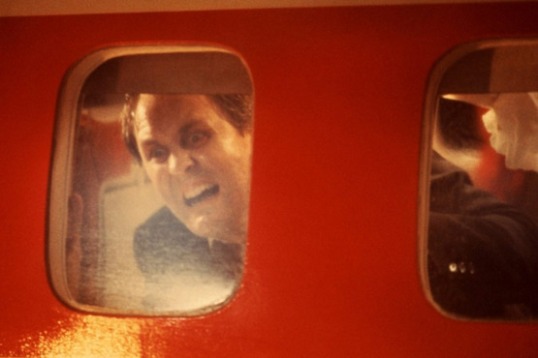
In this remake of Nightmare at 20,000 Feet, John Lithgow steps into the role that was originally played by William Shatner. He plays a man who, while attempting to conquer his fear of flying, sees a gremlin on the wing of his airplane. Unfortunately, he can’t get anyone else on the plane to believe him.
Nightmare at 20,000 Feet is the best of the four main segments. It’s also the one that sticks closest to its source material. Director George Miller (yes, of Mad Max fame) doesn’t try to improve on the material because he seems to understand that it works perfectly the way it is. John Lithgow is also perfectly cast in the lead role, perfectly capturing his increasing desperation. The one change that Miller does make is that, as opposed in the TV show, the gremlin actually seems to be taunting John Lithgow at time and it works wonderfully. Not only is Lithgow trying to save the plane, he’s also trying to defeat a bully.
Something Scarier (dir by John Landis)
Dan Aykroyd’s back as an ambulance driver, still asking his passenger if he wants to see something really scary. It’s an okay ending but it does kind of lessen the impact of Nightmare at 20,000 Feet.
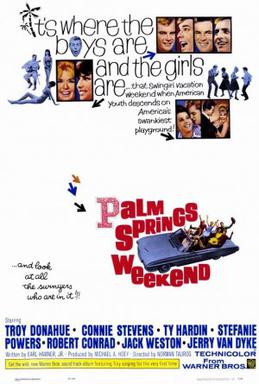
The 1963 film Palm Springs Weekend asks the question, “When is a beach film not a beach film?”
When it takes place in the freaking desert!
That’s right, Palm Springs Weekend takes place in the middle of the California desert. There’s no ocean in sight nor are there any beaches on which to frolic. Instead, there’s just a cheap motel and a swimming pool. That said, Palm Springs Weekend pretty much follows the same formula as all of the beach films that were released in the early 60s. A group of college students hop on a bus and head off for the weekend. One student is wacky. One student is rich, wild, and dangerous to know. And, of course, one student is clean-cut, responsible, boring, asexual, and studious and all about doing the right thing.
Troy Donahue, the blandest teen idol of all time, plays the clean-cut student. His name is Jim and he’s a college basketball star. Even when he’s on the bus traveling to Palm Springs, he’s still got a book to study. Jim’s the type who wears a suit and a tie to the pool. He ends up falling in love with Bunny Dixon (Stefanie Powers) and the two of them spend a lot of time talking about sex in the most chaste way possible. Bunny’s father (played by Andrew Duggan) is the chief of police and he doesn’t want any crazy college kids causing trouble in his town! Well, it’s a pretty good thing that all he has to worry about is Troy Donaue asking his daughter if she wants to take a moonlight stroll in the middle of the desert.
(Trust me. I’ve spent enough time in the desert to know that the last thing you want to do when you live near rattlesnakes is take a moonlight stroll.)
Jim’s best friend is Biff (Jerry Van Dyke). Biff is the wacky college student, which means that he plays the ukulele and he gets all the comedic moments. In this film, that amounts to getting babysitting an annoying boy and, at one point, falling into an extremely sudsy pool. Luckily, Jim’s there to deliver CPR, which leads to soap bubbles floating out of Biff’s mouth and …. you know what? I’m tired of writing about Biff.
Anyway, Biff and Jim really aren’t that important. The entire film pretty much belongs to Robert Conrad and Connie Stevens, largely because they’re the only two actors who are allowed to break out of the trap of always either being bumbling and innocent or dramatic and self-righteous. Robert Conrad plays Eric Dean, who is a spoiled rich kid who owns an expensive and fast car and who is basically a fun-loving sociopath. Meanwhile, Connie Stevens plays Gail, who is a high senior and who is pretending to be a college student. And while the film insists that we should somehow be disappointed in Gail because she’s acting wild and breaking curfew and doing more than just talking about whether or not it’s appropriate to kiss on the first date, she’s actually the most compelling character in the film because, at the very least, she’s actually setting her own rules and making her own decisions. Since Palm Springs Weekend was made in 1963, it ultimately feels the need to try to punish Gail for thinking for herself but that doesn’t change the fact that she’s still a far more interesting character than the blandly innocent Bunny. Gail’s a rebel. Gail’s the future. All hail Gail!
Anyway, Palm Springs Weekend is pretty forgettable and it’s never as much fun as any of AIP’s old Beach Party films. That said, I’d still recommend it if you’re a history nerd like me. It’s definitely a film of its time, a time capsule of an era.
Tonight’s televised horror is another episode of the 2002 revival of The Twilight Zone.
In fact, it’s a sequel to a classic episode that aired during the show’s original run!
Remember that episode about the creepy little kid in Ohio who could read thoughts and mentally make just about anything happen? He wanted it to snow so it snowed and ruined the crops. He got mad at someone who drank too much so he turned the guy into a big jack-in-the-box. His aunt sang too much so he took away her mouth. That episode was called “It’s A Good Life.”
Well, It’s Still A Good Life catches up with that boy 41 years later. He’s still ruling that little town with an iron hand but now, he’s got a daughter. And she might have powers of her own…
Bill Mumy and Cloris Leachman both appeared in the original episode and they reprise their roles here.
Seriously, the great thing about being in your 20s is that everything is set up to specifically appeal to you. Everyone wants your attention, your money, your tweets, your ideas, you love, and everything else. And, yes, I understand that most people neither like nor respect my generation but oh well and whatever. Trust me, the generation coming up behind mine is a hundred times worse.
2008 was a great time to be a politically knowledgeable millennial. Everyone running for President was desperate to get our vote and they were willing to promise us anything. And, since my age group voted overwhelmingly for Obama, all of the old elitists in the national media briefly fell in love with us. (The genius of Obama’s 2008 campaign was to tell us that we were the people that we were waiting for. Technically, it’s a bit nonsensical but never doubt what you can accomplish by appealing to the ego of the electorate.)
Of course, over the past few years, my generation has essentially been fucked over by both political parties and, since we dared to complain about it, nobody likes us anymore. But, oh well and whatever. American culture is basically built around our whims so we really don’t need anyone else’s love.
And, if all this sounds a little bitter or angry, I would point that young people and old people have been at war since time began. Generational conflict is nothing new. And if you need proof of that, I suggest watching a film from 1968 called Wild In The Streets.
Wild in the Streets tells the story of Max Frost (Christopher Jones), a rock star who lives in a gigantic mansion with his band and his groupies. When Max is asked to perform at a campaign appearance for senate candidate Johnny Fergus (Hal Holbrook), he agrees to do so because Fergus supports lowering the voting age. (When Wild In The Streets was made, you had to be 21 to vote. So, if your birthday fell on election day, you could cast your first vote and then go have your first legal drink.) However, at the rally, Max announces that he wants 14 year-olds to have the vote and then performs a song called “14 or fight!”
Max’s song is such a sensation and leads to so many protests that, in a compromise, the voting age is lowered to 15. Johnny Fergus is elected to the Senate and, before you can say “Blue dog,” promptly starts to ignore the will of the people who supported him. So, Max arranges for his girlfriend Sally (Diane Varsi) to be elected to the U.S. House. After spiking the water supply of Washington D.C. with LSD, Sally gets a bill passed and the age requirement for holding political office is lowered to 14!
Of course, in the next election, 24 year-old Max Frost is elected President of the United States. Soon, anyone over the age of 35 is being sent to re-education camps where they are force-fed LSD. Max is so ruthless that he even sends his own mother (Shelley Winters) off to re-education.
And, with all the old people gone, everything is perfect for Max. Except for that fact that 10 year-olds are now demanding the vote…
In many ways, Wild in the Streets feels like a film that could have only been made in 1968. From the psychedelic direction to the costumes to the hair to music, everything about this movie screams late 60s. But, at the same time, it’s still a genuinely amusing satire, largely because generational conflict is timeless. We all think that those older than us are clueless and that those younger are spoiled. There’s a lot of things in your life that can control. Sadly enough, getting older is not one of them.
Wild in the Streets is a fun and amusing time capsule. See it now before the younger generation comes of age and totally fucks up the world.
Don’t think bad thoughts or Anthony Freemont will turn you into a giant jack in the box!
That’s lesson to be learned from tonight’s example of televised horror. In this classic episode of The Twilight Zone, the citizens of Peaksville always have to be happy or else they’ll be punished by the cruel monster that lives among them. The big twist, of course, is that the monster is just a little boy and sometimes, it’s difficult to predict what exactly is going to upset him.
It’s A Good Life was originally broadcast on November 3rd, 1961.


 Through the Shattered Lens