The TSL Horror Grindhouse: The Toolbox Murders (dir by Dennis Donnelly)


In 1979’s The Toolbox Murders, someone is murdering the female tenants of a building in Los Angeles.  The killer, who wears a mask and a leather jacket, uses tools.  One woman is killed by a hammer to the head.  Another is skewered by a power drill.  One is stabbed with a screwdriver.  Another is shot with a nail gun.  The identity of the killer would be a total mystery if not for the fact that we’ve already seen Cameron Mitchell’s name in the cast list.

Indeed, it’s a bit pointless to cast Cameron Mitchell in any sort of whodunit-type of film.  Nine times out of ten, Mitchell being in a movie means that that Mitchell (who, in the early days of his career, originated the role of Death of a Salesman‘s Happy Loman on Broadway) is going to be revealed as the murderer.  In this case, Mitchell plays Vance Kingsley, the owner of the building.  Vance has never recovered from the death of his daughter so he’s punishing women who he considered to be sinful.

The actual toolbox murders are pretty much finished after the first twenty minutes of the film.  The rest of the movie deals with Laurie (Pamelyn Ferdin), a 15 year-old girl who is kidnapped by Vance and his nephew, Kent (Wesley Eure).  Joey (Nicholas Beauvy), who is Laurie’s brother, attempts to find and then rescue his sister and turns out to very much not up to the task.  The film itself ends on a rather sick note, one that is followed by a title card that informs us that the film is based on a true story.  Yeah, sure, it was.

The Toolbox Murders has somehow earned a reputation for being a gory and shocking grindhouse film.  It was among the films that was banned in the UK for several years.  It’s actually not that gory and the use of tools to commit the murders is not quite as clever as the film seems to think it is.  Even the nail gun murder (which is the film’s best known moment) feels rather awkward as the victim (Kelly Nichols) never really makes a run for it despite the fact that Vance has to stop to reload after every nail that he fires.

The scenes with Laurie being held hostage are far more disturbing and weird, largely due to Mitchell’s characteristically over-the-top portrayal of Vance’s psychosis.  When you watch a movie called The Toolbox Murders, you’re probably not expecting a lengthy scene where Laurie — pretending to be Vance’s dead daughter — tells a long story about what it’s like in the afterlife.  In the role of Vance’s nephew, Wesley Eure is even more disturbing than Mitchell.  As opposed to the sinister-looking Mitchell, Eure actually has the look of a nice, young community college student and that makes his actions at the end of the film all the more icky to watch.

The Toolbox Murders doesn’t quite live up to its bloody reputation but it’s still a disturbing film nonetheless.  Did you know that Heaven smells like lollipops?  After this film, you’ll never forget.
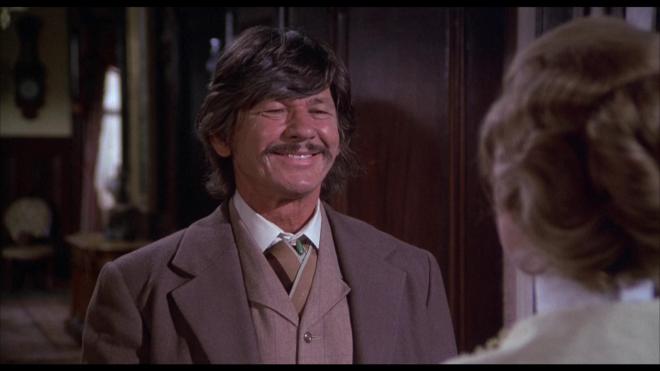
FROM NOON TILL THREE (1976) – Charles Bronson, the comedian??!


During the height of his popularity in 1976, Charles Bronson tried something quite different with this romantic comedy costarring his wife Jill Ireland. And to be honest, he’s darn funny in the role.  This movie has grown on me over the years. 

Bronson plays Graham Dorsey, a bank robber who spends an afternoon with the lonely widow Amanda Starbuck (Ireland) while his gang is robbing a bank in town.  After his gang is all killed during the robbery, Dorsey must take off and go into hiding, eventually being arrested for impersonating a quack dentist. While he’s in jail, and through a variety of circumstances, a book is written about their afternoon together and it becomes an international sensation.  As soon as Dorsey gets out of jail, he goes back to Starbuck’s home to rekindle their affair. Unfortunately for Dorsey, the book has created such a legend of him and their affair that Ms. Starbuck doesn’t even recognize the man he really is.  His method of convincing her that he’s the “real” Graham Dorsey is the funniest moment in Bronson’s entire filmography. 

Charles Bronson & Jill Ireland are clearly having a wonderful time making this movie together, which is one of the main reasons I enjoy the film.  He may not have done it often, but Bronson could play comedy and he’s excellent in this film cast completely against his normal type.  Jill Ireland is also very good as the widow Starbuck and her rendition of the song “Hello and Goodbye” was even nominated for a Golden Globe for Best Song.  We had the privilege of interviewing Jill Ireland’s niece, Lindsay Ireland, and she told us of singing this song with her aunt Jill and her cousin when she would spend summers with them in Vermont in the 70’s. It’s so fun for me to hear firsthand about those times when the Bronson’s were one of the biggest celebrity couples of the world!  The best part, Bronson valued his time with his family over anything else. They were everything to him.

**BONUS CONTENT** – I’ve included a link to the “This Week in Charles Bronson” podcast episode where Lindsay Ireland describes her time with her aunt Jill Ireland, and how they would sing “Hello & Goodbye,” the song that was in FROM NOON TILL THREE, while they were driving down the roads in Vermont. It’s a really nice insight into Jill Ireland.

Retro Television Review: St. Elsewhere 1.3 “Down’s Syndrome”


Welcome to Retro Television Reviews, a feature where we review some of our favorite and least favorite shows of the past! On Fridays, I will be reviewing St. Elsewhere, a medical show which ran on NBC from 1982 to 1988.  The show can be found on Hulu!

This week, we get to know a very bad doctor.

Episode 1.3 “Down’s Syndrome”

(Dir by Mark Tinker, originally aired on November 16th, 1982)

St. Eligius is home to several doctors, some of whom are good at their job and some of whom are really, really bad.

One of the bad ones appears to be Dr. Peter White (Terrence Knox), a resident who was in the background during the previous two episodes but who was at the center for a good deal of this episode.  Peter has a terrible bedside manner, absolutely no social skills, and his knowledge of medicine appears to be subpar at best.  When a homeless man comes in and complains of pain, Peter gives him a dose of potassium that nearly kills him.  (Only the quick thinking of Dr. Ehrlich — who himself hardly appears to be the perfect doctor — keeps the patient alive.)  Dr. White seems to be overwhelmed and it certainly doesn’t help that his wife is constantly calling the hospital and demanding to speak to him about every little thing.  That said, it’s hard to have much sympathy for Dr. White.  Yes, he’s overwhelmed but his mistakes nearly kill a man.

I have to admit that, as I watched Dr. Peter White on this week’s episode, I kept thinking about some of the doctors who treated my father after he had his car accident in May.  Whenever I spoke to them, they would brusquely answer my questions, usually in technical language that reflected that it had been a long time since they talked anyone who hadn’t gone to medical school.  At the time, I made the same excuses for them that I just made for Dr. White.  They were young, they were busy, and they were overwhelmed.  After my father died, though, I stopped making excuses for them and I instead just accepted that they weren’t very good at their job.  And perhaps Dr. White should admit the same.

It doesn’t help that Dr. White is contrasted with Dr. Auschlander, a kind and elderly liver specialist who is battling cancer but who still manages to treat all of his patients with kindness and respect.  The episode made it clear that all of the residents should hope to become a doctor like Dr. Auschlander.  While Peter snaps at his patients and nearly kills a man, Auschlander takes the time to play cards with a woman who is dying.  We should all be so lucky as to have an Auschlander in our life.

Finally, Brian Whitehill (Tony Bill) and his pregnant wife, Denise (Maureen Whitehill) are informed that their baby will be born with Down’s Syndrome.  In a scene that brings to mind Icelandic eugenics, Brian suggests that Denise get an abortion but Denise refuses, especially when she learns that she’s going to have a son.  (She already has two daughters.)  A day later, Brian comes home from work and tells Denise that he’s realized that she’s right and he’s prepared to be the father of a special needs child.  Denise replies that she had the abortion earlier in the day.  Seriously, what a depressing story!  That said, I respected what the show was doing here.  The patients are just as important as the doctors.

(And while Denise is getting an abortion, Dr. Morrison is learning that he’s going to be a father and, in contrast to Brian Whitehill, joyfully cheering in the hospital stairwell.)

As with the previous episode, there was a lot going on in the background.  Dr. Beale attempted to analyze terrorist Andrew Reinhardt (Tim Robbins), who is still basically acting like an arrogant prick.  Kathleen McAllister, the victim of Reinhardt’s attack, is still in a coma.  Dr. Westphall gave a tour of the hospital to two community leaders who both suggested that St. Eligius should shut down and move its operations to a wealthier neighborhood.  Dr. Fiscus got a blow job in an elevator from Kathy Martin.  (“Going down?” Fiscus asked the next guy who got on the elevator.)  It was a busy day at the hospital!  It was a good episode, even if it didn’t really have any of the big wow moments that the previous two episodes featured.  This episode was more about following a few days in the life of a hospital and the emphasis was on the nonstop flow of patients and doctors, some of whom were doing their best and some of whom were on the verge of giving up.  In the end, the main thing I took away from this episode was that there may not be enough Aucschlanders to make up for all the Peter Whites.