Retro Television Review: Fantasy Island 6.10 “Operation Breakout/Candy Kisses”


Welcome to Retro Television Reviews, a feature where we review some of our favorite and least favorite shows of the past!  On Tuesdays, I will be reviewing the original Fantasy Island, which ran on ABC from 1977 to 1984.  Unfortunately, the show has been removed from most streaming sites.  Fortunately, I’ve got nearly every episode on my DVR.
And now, it’s time for …. wait?  What?  *sigh*  Okay.

Episode 6.10 “Operation Breakout/Candy Kisses”

(Dir by George W. Brooks, originally aired on January 15th, 1983)

My fantasy would be to be able to review this episode.

Ever since Fantasy Island was yanked down on all the streaming sites, I’ve been watching the show off of my DVR.  A few years ago, I recorded nearly every episode off of one of the retro stations.  (Sadly, the station also appears to no longer be broadcasting the show.)  Unfortunately, nearly is not all and this is one of the episodes that I did not record.  So, obviously, I can’t review it.

I can talk a little bit about it because I did watch this episode a few years ago.  When I read the plot description on the imdb — Wheelchair-bound Kentucky racehorse breeder Rowena Haversham wants one last chance to win a race; and self-professed failure Danny Clements of Boston wants to turn his life around by breaking an American agent out of a tough foreign prison. — a bit of it came back to me.  I remembered that Rowena (Ann Turkel) was given what she thought was a magic riding crop but that, at the end of the episode, Roarke revealed that the only magic was Rowena’s belief in herself.  I think Rowena was transformed into a younger version of herself and she befriended a young rider played by Jill Whelan and ended up falling in love with Whelan’s father, who played by John Beck and not Gavin MacLeod.  And I remember that Ben Murphy played the guy who entered the prison to save the American spy but it turned out that the prison was run totally by women and the spy was having the time of his life.  I remember bits and pieces but it’s been a few years and I still wouldn’t feel comfortable even trying to tell you whether or not the episode worked.

So, consider this to be a placeholder.  If I ever find Fantasy Island streaming somewhere or if someone is kind enough to reupload the show to YouTube, I’ll come back and review this episode.

Until then, my fantasy is for an official home video release of the entire series as opposed to just the first few seasons.  Seriously, this is a fun show and one that still has a lot of fans.  Yanking it off of Tubi to make room for the Fox reboot that only lasted for two seasons really doesn’t make a bit of sense.

This needs to be fixed!
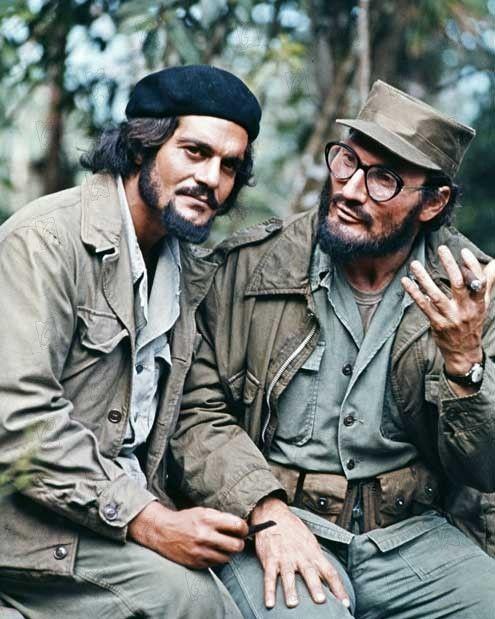
 

Icarus File No. 17: Che! (dir by Richard Fleischer)


Che Guevara!

By most accounts, Che Guevara epitomized the excesses and the hypocrisies of the extreme Left.  He spoke of the class struggle while remaining an elitist himself.  He oversaw thousands of executions and advocated for authoritarian rule.  In his writings, he frequently revealed himself to be a racist and a misogynist.  By arguing that the Russians should be allowed to bring nuclear missiles to Cuba, he brought the world to the brink of destruction.  However, he also died relatively young and he looked good on a t-shirt.  Decades after he was executed by the Bolivian Army in 1967 (or was it the CIA?), he remains an icon for college students and champagne socialists everywhere.

The film about Che! was released in 1969, two years after his death.  Starring the Egyptian actor Omar Sharif as Che Guevara, Che! opens with Guevara already a martyr and then quickly gives way to flashbacks.  Various actors pretending to be Cuban appear and speak directly to the audience, debating Che Guevara’s legacy.  Some describe him as being a violent thug who killed anyone who displeased him.  Others describe him as a visionary doctor who sacrificed his comfortable existence for the people.  It’s a rather conventional opening and one that hints that Che! is going to try to have it both ways as far as Che’s legacy is concerned.  But it’s still effective enough.  A montage of soldiers and rebels creates the proper feeling of a society on the verge of collapse.

And then Jack Palance shows up.

Palance first appears creeping his way through the Cuban jungle with a group of soldiers behind him.  Palance is chomping on a cigar and he wears the intense look of a man on a mission.  My initial reaction was that Palance was playing one of the CIA agents who sent to Cuba to try to assassinate Fidel Castro or to set up the Bay of Pigs invasion.  I kept waiting for him to look at the camera and launch into a monologue about why, for the safety of America, he had been dispatched the topple Cuba’s communist government.  Imagine my shock when Omar Sharif called Palance, “Fidel.”

Yes, that’s right.  Jack Palance plays Fidel Castro!  As miscast as the suave Omar Sharif is as Che Guevara, nothing can prepare one for seeing Jack Palance playing Fidel Castro.  Needless to say, there is nothing remotely Cuban or even Spanish about Jack Palance.  He delivers his lines in his trademark terse Jack Palance voice, without even bothering to try any sort of accent.  (And, needless to say, both he and Sharif speak English through the entire film.)  Anyone who has ever seen a picture of a young Fidel Castro knows that, while he shared a family resemblance with Justin Trudeau, he looked nothing like Jack Palance.  Eventually, Palance puts on a fake beard that makes him look even less like Castro.  When one of our narrators mentions that Castro was a great speaker, the film cuts to a scene of Palance spitting out communist slogans with a noted lack of enthusiasm.  When Castro takes control of Cuba, Palance looks slightly amused with himself.  When Che accused Castro of selling out the revolution, Palance looks bored.  It’s a remarkably bad piece of casting.  Seeing Palance as Castro feels like seeing John Wayne as Genghis Khan.  Thank goodness Hollywood never tried anything that silly, right?  Anyway….

As for the rest of the film, it hits all the expected notes.  The film was made in the very political year of 1969, a time when the New Left was ascendant and many considered Che Guevara to be a hero.  However, since this was a studio production, Che! tries to appeal to both college radicals and their parents by taking a “both sides” approach to Che Guevara.  Here’s Che teaching an illiterate farmer how to read.  Here’s Che overseeing a bunch of dissidents being executed.  Here’s Che getting angry at Castro for not being properly enthusiastic about housing Russian nuclear missiles.  Here’s Che talking about a moral revolution.  Here’s Che trying to start an unwanted war in Bolivia.  Here’s Che talking to Sid Haig — hey, Sid Haig’s in this film!

Like so many mainstream political films of the 60s and today, Che! tries to be political without actually taking any firm positions.  One is tempted to say that is the film’s downfall.  Of course, the film’s real downfall is casting Jack Palance as Fidel Castro.

There’s no way to recover from that.

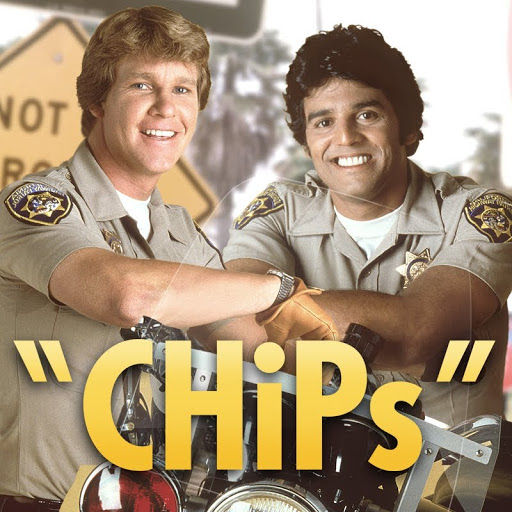
Late Night Retro Television Review: CHiPs 3.1 and 3.2 “Roller Disco”


Welcome to Late Night Retro Television Reviews, a feature where we review some of our favorite and least favorite shows of the past!  On Mondays, I will be reviewing CHiPs, which ran on NBC from 1977 to 1983.  The entire show is currently streaming on Prime!

This week, season three begins with a classic episode!

Episode 3.1 and 3.2 “Roller Disco”

(Dir by Don Weis, originally aired on September 22nd, 1979)

It’s the roller disco episode!

From the moment that I first announced that I would be watching and reviewing CHiPs for this feature, people have been telling me about the legendary roller disco episode.  Having finally reached it, I can say that it lived up to the hype.  You’re not likely to see anything more 70s than the third season premiere of CHiPs.

Now, this was a two-hour episode so there were actually quite a few subplot going on, all of which were typical CHiPs storylines.  In no particular order:

  1. A kid named Mark (Bobby Rolofson) is roller skating around the beach and idolizing three criminals.  Can Baker show him that the good guys always win?
  2. The three criminals are Lita (Helena Kallianiotes), Ty (Fred Williamson), and Romo (Jim Brown).  Lita sets up the targets.  Ty and Romo steal their purses and their wallets and then escape on roller skates.  Ty and Romo are tired of breaking the law.  Lita demands that they continue to steal.  Eventually, it falls to Baker and Ponch to arrest them.
  3. Carlin (Larry Linville) and Franco (Larry Storch) continually cause accidents on the highway.
  4. Rock star Jimmy Tyler (Leif Garrett) is so tired that he sleeps through one of those accidents.  Looking to break free from his well-meaning but overbearing manager (Bill Daily), Jimmy decides to manage his own affairs while staying at Jon Baker’s apartment.

There’s a lot going on but the main plotline is Ponch trying to find celebrities to take part in the annual highway patrol fund raiser.  Even with his big smile, Ponch struggles to charm the celebs.  He pulls over Ed McMahon at one point but fails to recognize him until McMahon drives off.  Gatraer tells Ponch that police work comes first but also tells him that he has to find celebrities.  Gatraer’s been giving Ponch a hard time ever since the first season.  Some things never change.

Fortunately, Jimmy feels guilty for overstaying his welcome at Baker’s apartment and he makes it up to Baker and Ponch by asking his celebrity friends to take part in the fund raiser.  It’s time for a roller disco with the stars!

It all leads to this classic scene:

I recognized a few of the stars, though certainly not all of them.  I recognized Victor French because I’ve been reviewing Highway to Heaven.  I’ve also seen enough old sitcoms that I immediately recognized Robert Mandan, who was apparently the best roller skater in Hollywood.  Melissa Sue Anderson, I knew from Happy Birthday To Me.  Cindy Williams, who got two shout-outs, I knew from American Graffiti.  Is it just me or did Nancy Kulp look kind of lost?  Neither Melissa Sue Anderson nor Cindy Williams seemed to want to talk to her.

The roller disco actually goes on for fifteen minutes, which I appreciated.  The show promised a roller disco and it delivered.  It was like stepping into a time machine and traveling to the 70s.  It was a great way to start season three!

Because of the holidays, this is going to be my final CHiPs review of 2024.  My reviews of this show will return on January 6th!

Retro Television Reviews: Fantasy Island 3.21 “Jungle Man/Mary Ann and Miss Sophisticate”


Welcome to Retro Television Reviews, a feature where we review some of our favorite and least favorite shows of the past!  On Tuesdays, I will be reviewing the original Fantasy Island, which ran on ABC from 1977 to 1986.  Almost entire show is currently streaming is on Youtube!

This week, Fantasy Island is invaded by jungle men and ventriloquists!

Episode 3.21 “Jungle Man/Mary Ann and Miss Sophisticate”

(Dir by Michael Vejar, originally aired on March 8th, 1980)

For years, David Farley (Dennis Cole) starred as Jungle Man on television.  When the show was canceled, David made a living by doing public appearances as Jungle Man but then the producers of the show filed a lawsuit.  As a result, David is no longer allowed to ever dress up in a loin cloth.  David comes to Fantasy Island, hoping for one last chance to be Jungle Man.

(This fantasy, by the way, had its roots in what happened to the original Lone Ranger, Clayton Moore.  Moore was told that he could no longer wear the mask in public because a new Lone Ranger movie was coming out.  The producers also took Moore to court.  Moore reacts by ditching the mask and wearing wrap-around sunglasses instead.)

Mr. Roarke explains to David that his fantasy will make Jungle Man a reality.  There will be no stunt doubles and the bad guys might not be as easy to defeat as on television.  David says he doesn’t care.  He finds himself again in the jungle, transformed into Jungle Man!  He also discovers that all of his friends are upset with him because they haven’t seen him for two years.  They think that Jungle Man just abandoned them and, of course, Jungle Man can’t explain that the show was canceled.

In Jungle Man’s absence, Queen Mara (France Nuyen) has agreed to surrender the jungle to the evil hunter, Derrick Haskell (Dick Butkus, who between Half-Nelson, Hang Time, and this show, is becoming a bit of a regular on this site).  Can Jungle Man prevent Mara from signing over her land?  And can he save Rima (Barbara Luna), the woman he loves?  And, even more importantly, can he convince Roarke to to let him live forever in the jungle?

Of course, he can.  This was a bit of silly fantasy but it still worked because of how earnest Dennis Cole was in the role of Jungle Man.  Plus, I enjoyed that life in the jungle had continued even after the Jungle Man television show was canceled.  It captured the way that a lot of us feel when our favorite TV show is cancelled and we wonder what happened to all the characters after the finale.

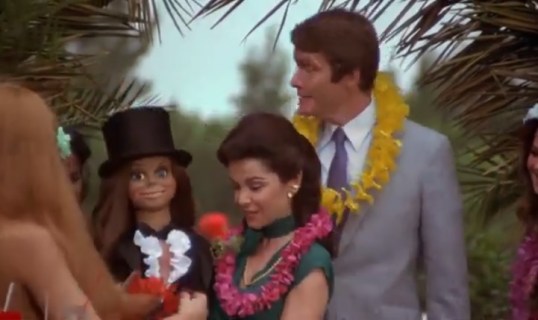
The other fantasy was …. well, it was weird and creepy and surprisingly dark.  Annette Funicello played Mary Ann Carlin (Annette Funicello), a world famous ventriloquist.  Mary Ann is worried that she can no longer tell where her personality ends and where the personality of her dummy, Valerie, begins.  Is there anything creepier than a ventriloquist with a personality conflict?

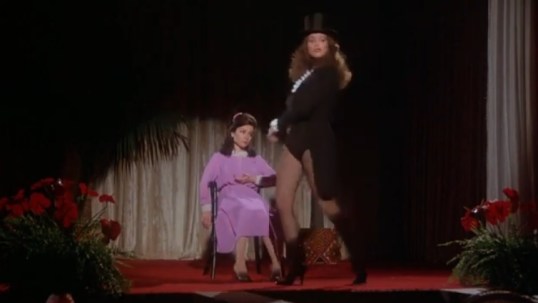
Mary Ann’s fantasy is to separate her personality from Valerie’s for a weekend so that she can decide what to do with her career.  (This sounds like something that would be better handled by a therapist than a resort owner but whatever.)  Mr. Roarke’s solution is to turn Valerie into a living human being.  Unfortunately, it turns out that Valerie has a man streak and she not only seduces Mary Ann’s boyfriend (Don Galloway) but she also gives a surreal performance in which, somehow, Mary Ann is transformed into the dummy.

Fortunately for Mary Ann. everything works out.  She finally snaps out of whatever spell she was under and she tossed Valerie, who is now suddenly a doll once again, in a fire.  Mary Ann and her boyfriend leave the Island, planning on getting married and settling down.  Apparently, Mary Ann doesn’t have a problem with the fact that her boyfriend had sex with a ventriloquist’s dummy but I still imagine that it’s something she’ll bring up whenever they have a disagreement about something.  “You think I’m spending too much money!?  Remember that time you screwed a block of wood?”

It really doesn’t make much sense at all but it’s so surreal and weird that it’s fun to watch.  This fantasy was the Island at its most nightmarish and certainly, that makes it an appropriate fantasy to close out October with!

Retro Television Reviews: Fantasy Island 3.4 “Baby/Marathon”


Welcome to Retro Television Reviews, a feature where we review some of our favorite and least favorite shows of the past!  On Tuesdays, I will be reviewing the original Fantasy Island, which ran on ABC from 1977 to 1986.  The entire show is currently streaming on Tubi!

This week’s episode is saved by the one and only Herve Villechaize.

Episode 3.4 “Baby/Marathon”

(Dir by George McCowan, originally aired on October 5th, 1979)

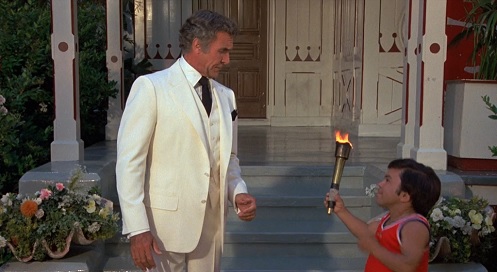
Fantasy Island is going to be hosting a marathon competition so Tattoo decides to greet Mr. Roarke while carrying a replica of the Olympic Torch.

Tattoo proceeds to light a huge flame in a cauldron.  A group of Islanders start trying to splash water on the fire, leading to Tattoo yelling at them to leave the flame alone.  Mr. Roarke, who appears to be even more disgusted than usual with Tattoo’s antics, barks at his assistant to put on his tuxedo and head down to the docks so that they can greet their guests.

Bunny Kelly (Barbi Benton), Gretchen Wasserman (Arlene Golanka), and Olaf Olafsen (Peter Isacksen) have all come to the Island so that Olaf can compete in the marathon and hopefully win enough money to keep their barbell factory open.  (Don’t blame me, I didn’t write this script.)  When Olaf is injured while trying to lift some weights, Bunny enters the marathon in his place!  (At first, Bunny tries to disguise herself as Olaf but, when that doesn’t work, Mr. Roarke declares that Bunny can compete as herself.)

Can Bunny defeat the men who have shown up to run the marathon?  Well, it won’t be easy.  Bruno Glass (Bruce M. Fischer) is so evil that he often stops in the middle of the race so that he can laugh at everyone else’s misfortune.  Helping out Bruno is his trainer, Dr. R.M. Funk (Dick Martin).  Using techniques that would be more appropriate for a cartoon, Bruno sabotages the other racers.  Somehow, Bruno is able to do this despite the fact that the entire race is being televised live to the world.  Fear not!  With the help of friendly competitor Eugene (Paul Petersen), Kitty makes it to the finish line.  When both Kitty and Eugene sprain an ankle towards the finish line, they carry each other to a tied victory!  The factory is saved and everyone falls in love!

As you have probably already guessed, the whole marathon was pretty stupid.  There really didn’t seem to be any sort of set rules as to how the marathon would be run.  Olaf and Gretchen grabbed a car and drove alongside Kitty for most of the race.  Meanwhile, Dr. Funk was somehow able to commit numerous acts of open sabotage without anyone noticing.  Because Dr. Funk and Bruno were so cartoonish, it made it difficult to take seriously the possibility that they might win.  There was no suspense whatsoever, which made for a pretty boring fantasy.

I preferred the episode’s other story, in which Tattoo was placed in charge of finding a family to adopt an orphaned baby.  At first, Tattoo wanted to adopt the baby himself but eventually, he realized that the child would be better off with Thomas (Joshua Gallegos) and Mary (BarBara Luna), two Islanders who already had a large family and who had more experience taking care of babies.  There was nothing surprising about the story but seriously, Herve Villechaize’s portrayal of Tattoo’s dilemma was surprisingly touching.  While Villechaize was notoriously difficult on the set of Fantasy Island, he also used his fame to speak out in support of abused and neglected children and he really seemed to be put his heart into this episode of Fantasy Island.  When Tattoo said that he wanted to make sure the baby had the best and most loving home possible, one got the feeling that he was speaking for Villechaize as well.

So, this was yet another mixed episode of Fantasy Island.  Ultimately, it was saved by the sincerity of Herve Villechaize.

The Gatling Gun (1971, directed by Robert Gordon)


In the post-civil war west, two Calvary troopers steal a Gatling Gun, the weapon that was invented to be such a powerful instrument of death that people would stop fighting wars just to avoid finding themselves in front of its barrel.  (It didn’t work out that way, of course.)  With the help of a pacifist reverend named Harper (John Carradine), they smuggle the gun into Apache territory.  Rev. Harper thinks that the gun is going to be destroyed and, thus, another instrument death will be eliminated. from the world  Instead, the greedy troopers are planning on selling the gun to Apache Chief Two Knife (Carlos Rivas).  Two Knife has promised a fortune’s worth of gold to anyone who can deliver to him the deadliest weapon in the west.

Before the gun can be exchanged, the reverend, his daughter, and the two deserters are intercepted by a group of Calvary troops led by Lt. Wayne Malcolm (Guy Stockwell).  One of the deserters is killed while the other, Pvt. Sneed (Robert Fuller) is captured.

However, Chief Two Knife still wants what he calls “the king gun.”  Malcolm and his troops find themselves pinned down by the Apaches.  Can Malcolm, with the help of a rancher (Phil Harris), a scout (Woody Strode), and a cook (Pat Buttram), keep both the gun and the all important firing pin from falling into the hands of Two Knife?

The Gatling Gun is a low-budget western that would probably be today forgotten except that it has fallen into the public domain and has been included in several DVD box sets.  It has the flat, generic look of a Western television show and Guy Stockwell’s stiff performance may be believable for a 19th century Calvary captain but it’s still doesn’t exactly make for compelling viewing.  The main problem is that the most exciting and interesting part of the story, the two deserters stealing the gun and tricking the Reverend into helping them, occurs off-screen and the movie instead begins with Malcolm capturing Sneed.

Western fans will mostly want to watch this one to see John Carradine and Woody Strode, two very different actors who were both favorites of John Ford’s and who appeared in several other, better westerns.  (Strode and Carradine had both previously appeared in The Man Who Shot Liberty Valance, to name just one example.)  Carradine is typically theatrical, delivering his lines like the old Shakespearean that he was.  Strode, as usual, is stoic but his imposing screen presence makes him the most memorable of the film’s heroes.  Also keep an eye out for Patrick “son of John” Wayne, playing the rancher’s son.

Though The Gatling Gun has the look of a film that was shot on a studio backlot in Hollywood, it was actually filmed, on location, in New Mexico.  The state’s then-governor, David Cargo, has a small role as Corporal Benton and is listed in the credits as “Honorable Governor David Cargo.”  A look at his imdb page reveals that David Cargo appeared in four films while he was governor.  All of them were filmed in New Mexico so I guess casting the governor was a requirement for filming in that state.  When Cargo left office in 1971, his movie career ended.