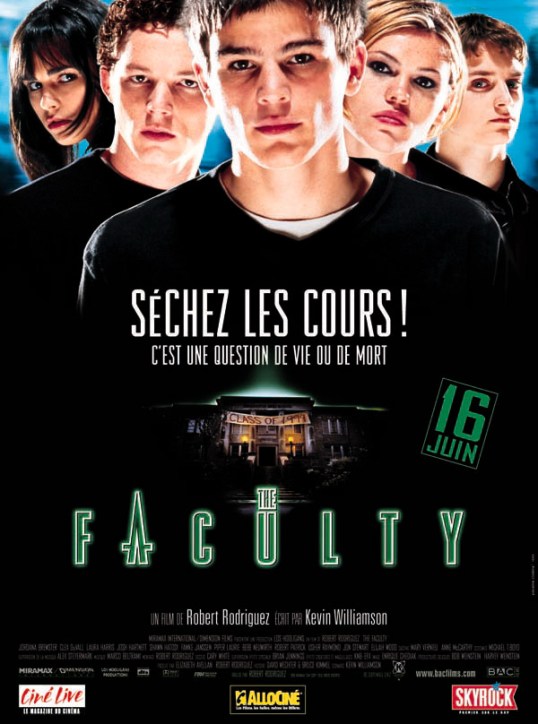
Have you ever wanted to see Jon Stewart get stabbed in the eye with a hypodermic needle?
If you answered yes, then 1998’s The Faculty might be the film for you!
The Faculty takes a look at what happens when a new alien species happens to turn up outside of a painfully normal high school in Ohio. By painfully normal, I mean that Herrington High School is just as messed up as you would expect a suburban high school to be. The teachers are all underpaid and resentful of their principal (Bebe Neuwrith). Prof. Furlong (Jon Stewart) is the overqualified science teacher who will perhaps be a little too excited about the chance to examine a new alien species. Coach Willis (Robert Patrick) is the emotionally shut off coach of the school’s losing football team. Mrs. Olson (Piper Laurie) is the drama teacher who struggles to promote creativity in a school that’s more interested in blind conformity. Miss Burke (Famke Janssen) is the teacher who cares too much. And, finally, there’s Nurse Harper (Salma Hayek), who looks a lot like Salma Hayek.
And, as typical as the teachers may be, the students are even more so. We get to know a few and they all neatly fit into the expected stereotypes. Casey (Elijah Wood) is the nerdy outcast who is regularly picked on by … well, by everyone. Deliliah (Jordana Brewster) is the status-obsessed head cheerleader who has just broken up with her boyfriend, Stan (Shawn Hatosy), because he quit the football team. Zeke (Josh Hartnett) is the school rebel, the kid who is repeating his senior year and who sells synthetic drugs out of the trunk of his car. Stokes (Clea DuVall) is an intentional outcast who pretends to be a lesbian and has a crush on Stan. And finally, there’s Marybeth (Laura Harris), a new transfer student who speaks with a Southern accent.
These students would seem to have nothing in common but they’re going to have to work together because the entire faculty of Herrington High has been taken over by aliens! Fortunately, the aliens are vulnerable to Zeke’s drugs, which is something that is learned after Jon Stewart takes a hypodermic to the eye…
When one looks over the top Texas filmmakers (director like Terrence Malick, Richard Linklater, Mike Judge, and David Gorden Green), Robert Rodriguez often comes across as being both the most likable and the least interesting. Like his frequent collaborator Quentin Tarantino, Rodriguez fills his movies with references and homages to other films but, unlike Tarantino, there rarely seems to be much going on behind all of those references. However, Rodriguez’s referential style works well in The Faculty because, along with acting as an homage to both Invasion of the Body Snatchers and John Carpenter’s The Thing, The Faculty also manages to tap into a universal truth.
Teachers are weird!
Or, at least, they seem weird when you’re a student. Now that I’m out of high school, I can look back and see that my teachers were actually pretty normal. They were people who did their jobs and, as much as I like to think that I was everyone’s all-time favorite, I’m sure that there have been other brilliant, asthmatic, redheaded, aspiring ballerinas who have sat in their class. My teachers spent a lot of time talking about things that I may not have been interested in but that wasn’t because they were obsessed with talking to me about algebra or chemistry or anything like that. They were just doing their job, just like everyone else does.
But, seriously, when you’re a student, it’s easy to believe that your teachers have been possessed by an alien life form.
Probably the best thing about The Faculty is the fact that the aliens cause the teachers to act in ways that are the exact opposite of their usual personalities. For most of the teachers, this means that they turn into homicidal lunatics. But, in the case of Coach Willis, this actually leads to him not only becoming a happy, well-adjusted human being but it also turns him into a good coach. Suddenly, Willis is getting emotional about the games, his team loves him, and he even gets a win!
But, as far as simple-minded teen sex comedies, are concerned, it’s not that bad.
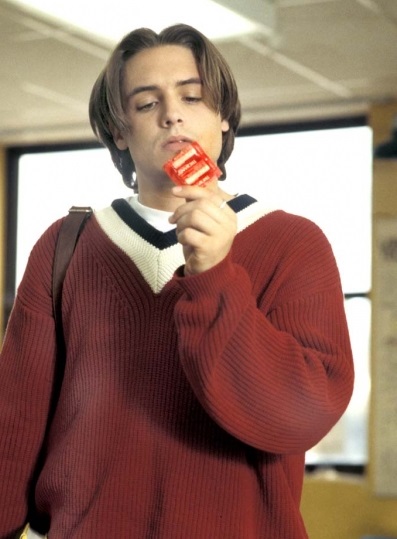
Brad Kimble (Will Friedle) is a nice but dorky high school student who, for years, has had a crush on an unattainable cheerleader, Brooke (Marley Shelton). When Brad is invited over to Brooke’s house to tutor her in biology, he arrives just after Brooke has had a fight with her jock boyfriend, Kyle (Eric Balfour sans facial hair). Soon, Brooke and Brad are making out. Brooke asks Brad if he has a condom. Of course, if Brad did have a condom, there wouldn’t be a movie. The rest of the movie deals with Brad’s attempt to not only find a condom in California and but to also get back to Brooke.
(Apparently, in the 1990s, there was some sort of sudden condom shortage in California. That’s all that I can guess after having seen Trojan War.)
Of course, that’s not as easy as it sounds. Brad’s car (actually, it’s his dad’s car) gets stolen. Brad ends up having a run in with a crazy homeless man (David Patrick Kelly) who — in a rather obvious shout out to Better Off Dead — wants two dollars. Brad gets chased by a crazy dog. Brad has to deal with a cameo appearance by a crazy Kathy Griffin. Brad runs into a crazy bus driver (played by Anthony Michael Hall). Brad ends up being pursued by a crazy police officer (Lee Majors). And since the film itself is a bit of an unacknowledged remake of Some Kind of Wonderful, Brad is also pursued by his not crazy best friend, Leah (Jennifer Love Hewitt, who I’ve always liked because we’re both Texas girls and I share her struggle). Leah is in love with Brad and Brad is in love with Leah. He’s just not smart enough to realize it.
And indeed, that’s the key to understanding the plot of Trojan War. Brad is just not that smart. This is one of those films where the great majority of Brad’s problems could have been avoided if Brad just wasn’t a moron. Fortunately, Brad is played by Will Friedle who was always the best part of Boy Meets World and who displays the unique ability to make stupidity cute. Friedle is so likable as Brad that you’re willing to forgive the film for a lot.
That doesn’t mean that Trojan War is necessarily a good movie. It’s likable but it’s never really good. For every joke that works, there’s one that doesn’t. I could have really done without the extended sequence where Brad gets lost over on the bad side of town and the movie suddenly trots out every negative Latino stereotype imaginable. But, when the movie just concentrates on Will Friedle and Jennifer Love Hewitt, it’s likable enough to waste 90 minutes on.
If nothing else, it’s certainly more entertaining than most movies that made less than 400 dollars at the box office.
By their very nature, teen films tend to get dated very quickly. Fashions, music, and cultural references — all of these serve to make a film popular when it’s first released and occasionally laughable just a few years later. Take 1995’s Clueless for instance. Watching it now, it’s impossible not to get a little snarky when Cher Horowitz (Alicia Silverstone) refers to a hot guy as being a “Baldwin.” When heard today, it’s hard not to wonder if Cher is thinking of beefy rageaholic Alec or ultra-religious realty TV mainstay Stephen. (Personally, I prefer to think that she was thinking of Adam Baldwin.)
Clueless is one of those films that I always remember watching on TV and loving when I was little but, whenever I watch it now, I always find myself feeling slightly disappointed in it. It’s never quite as good as I remember and, with each viewing, I’m just a little bit more aware that, while both were very well-cast in their respect roles, Alicia Silverstone and Stacey Dash weren’t exactly the most versatile actresses of their generation. There’s a reason why Dash is now a political commentator and Silverstone is best known for that video of her spitting food into her baby’s mouth. As well, watching the film now, it’s hard not to think about how the talented Brittany Murphy would tragically pass away 14 years after its initial release.
And yet, I can’t help it. I still enjoy Clueless. I could spend hours nitpicking it apart and pointing out what parts of it don’t quite work as well as they should but ultimately, Clueless is a fun movie that features and celebrates three strong female characters, which is more than you can say for most teen films.
Directed and written by Amy Heckerling (who earlier directed the classicFast Times At Ridgemont High), Clueless is based (quite directly) on Jane Austen’s Emma. In this version, Emma is Cher, the spoiled 16 year-old daughter of a lawyer (played, very well, by Dan Hedaya), who lives in Beverly Hills and who is happy being superficial, vain, and popular. In fact, the only person who ever criticizes Cher is her stepbrother, Josh (Paul Rudd), who is studying to be an environmental lawyer and is visiting during a break from college.
When Cher plays matchmaker and deftly manages to pair up two of her teachers (played by Wallace Shawn and Twink Caplan), she realizes that she enjoys helping people. (Though, it must be said, the only reason she helped her two teachers wass because they were both taking out the misery of being single on her…) So, Cher and her best friend Dionne (Stacey Dash) decide to help another student, new girl Tai (Brittany Murphy), become popular. After giving Tai a makeover, forbidding her to date skater Travis (Breckin Meyer, who is adorable), and trying to set Tai up with rich snob Elton (Jeremy Sisto), Cher is shocked to discover that Tai has become so popular that she is now challenging Cher’s social status. Even worse, Tai decides that she has a crush on Josh right around the same time that Cher realizes the same thing.
Plus, Cher still has to pass her driving test…
As I said before, Clueless is hardly a perfect film but it is a very likable movie. Director Amy Heckerling creates such a vivid and colorful alternate teenage universe and the script is full of so many quotable lines that you can forgive the fact that the story sometimes runs the risk of getting almost as superficial of Cher. It may never be quite as good as I remembered it being but Clueless is still an entertaining and fun movie.
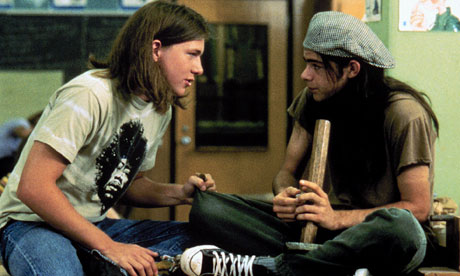
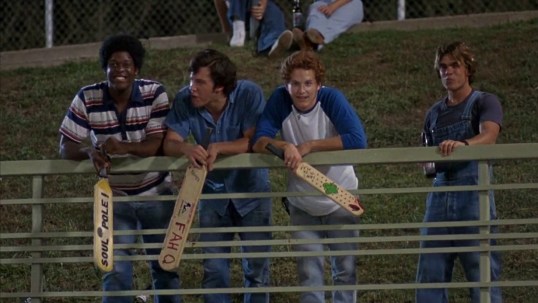
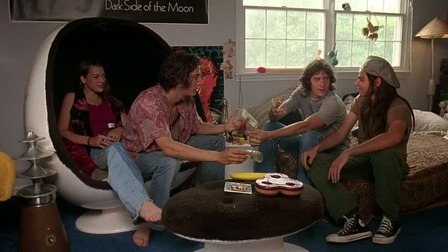
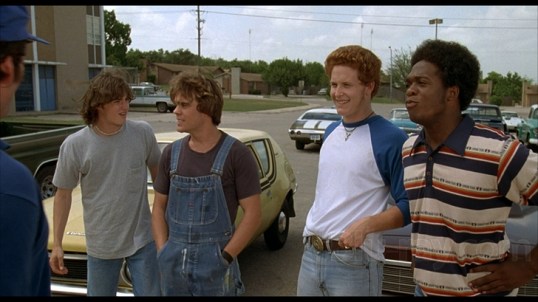
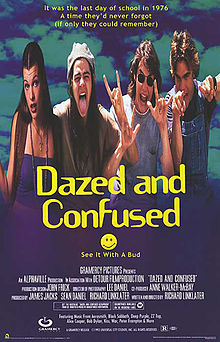
First released in 1993, Dazed and Confused is a classic Texas film. Taking place in 1976 and following a large and varied group of characters over the course of the last day of school, Dazed and Confused is like American Graffiti with a lot more weed. In many ways, it’s a plotless film, though things do happen. The students of Lee High School survive one final day of school before the start of summer. (Interestingly enough, most of the characters here are incoming seniors and freshman, as opposed to the confused graduates who usually show up in films like this. This may lower the stakes — none of the students are worrying about whether or not to go to college or anything like that — but it also gives the film a fun and laid back vibe.) The incoming freshman are all hazed by the incoming seniors. For the girls, this means being covered in ketchup and mustard and being forced to ask the seniors to marry them. For the boys, the hazing is a lot more violent and disturbing as they are chased through the streets by paddle-wielding jocks. A party is planned and then abruptly canceled when the kegs of beer are delivered before the parents leave town. Another party is held out in the woods. A high school quarterback tries to decide whether or not to sign an anti-drug pledge.
No, not much happens but then again, plot is overrated. Dazed and Confused is not about plot. It’s about capturing a specific time and place and showing how different individuals define themselves within their environment. It’s one of the best high school films ever made, perhaps the best.
Why do I so love Dazed and Confused? Let me count the ways.
First off, it’s a true Texas film. This isn’t just because it was directed by Texas’s greatest filmmaker, Richard Linklater. It was also filmed in Texas, it’s full of Texas actors, and, as a native Texan, I can tell you that it’s one of the few films that gets my homestate right. Even though the film takes place long before I was even born, there were still so many details that I recognized as being unique to Texas today. I guess the more things change, the more they remain the same.
Perhaps the most Texas scene in the entire film was when quarterback Randy Floyd (Jason London) was talking to the old couple at the minor league baseball game. Both the old man’s obsessive interest in the high school football team (“We’re countin’ on you boys next year…”) and Randy’s patiently polite answers, were, to me, the epitome of Texas. And, of course, we can’t forget the store clerk advising the pregnant woman to eat a lot of “green things” while selling her a pack of cigarettes and the guy who reacts to the destruction of his mailbox by running around with a gun. I suspect I might live a few blocks away from both of those guys.
But, beyond that, just the entire film’s laid back atmosphere epitomized everything that I love about my state.
Secondly, Dazed and Confused is an amateur historian’s dream! Richard Linklater went to high school in the 70s and he recreates the decade with a lot of obvious care and love. (It’s also somewhat obvious that both the characters of Randy and incoming freshman Mitch (Wiley Wiggins) are meant to be autobiographical.) Now, me, I’ve always been obsessive about history and I’ve always somewhat regretted that I was born long after the 70s ended. Dazed and Confused is probably about as close as someone like me will ever get to having a time machine.
I’m also something a political history junkie so how excited was I to see that, during one scene, all of the candidates for the 1976 Democratic presidential nomination were listed on a bulletin board. How many other movies have featured a reference to the Fred Harris presidential campaign? Admittedly, I know nothing about that campaign. I just think it’s neat that somebody with as common a name as Fred Harris once ran for President.
Finally, if you look really carefully, you’ll notice that Lee High School is located right next to a movie theater that, according to its marquee, is showing Family Plot, Alfred Hitchcock’s final film. Just imagine the fun that I could have had going to Lee High. I could have skipped school and gone to a movie!
Third, this film has a great soundtrack! The low rider gets a little higher … hey, I think there’s a double meaning there…
But, really, the main reason I love this film is because I love great ensemble work and Dazed and Confused has a wonderful cast. Some members of the cast went on to become famous and some did not, but all of them give great performances. In fact, the entire cast is so great that it’s difficult to know who to single out so I’m just going to name a few of my favorites.
First off, there’s the jocks. Some of them, like Jason London’s Randy “Pink” Floyd are surprisingly sensitive. Some of them, like Don Dawson (Sasha Jenson), remind me of the type of guys that I, despite my better judgment, would have totally been crushing on back in high school. And then the others are just scary, running around with their cars full of beer and obsessively paddling freshman. Benny (Cole Hauser), for instance, really does seem like he has some issues. (Perhaps it’s because he lives in Texas but still has such a strong Boston accent…)
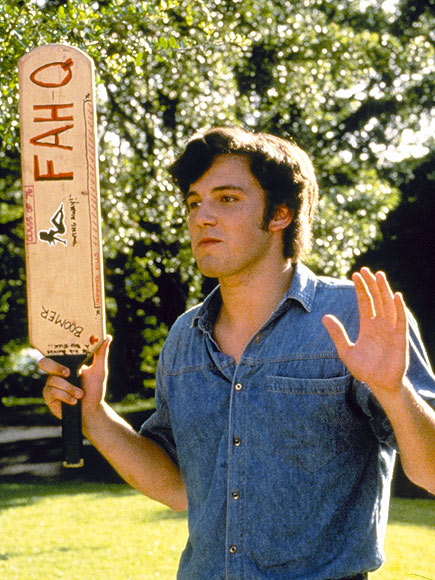
However, the scariest of the jocks is, without a doubt, Fred O’Bannion (Ben Affleck). A complete and total moron who has actually managed to fail his senior year, (“He’s a joke,” says Randy, “but he’s not a bad guy to have blocking for you…”) O’Bannion is such a total idiot that, not only is it fun to see him eventually get humiliated, but it’s even more fun to watch him and think, “That’s Ben Affleck!” And, it must be said, Affleck is totally convincing playing a complete and total dumbass. That’s not meant to be an insult, by the way. Future multiple-Oscar winner Affleck does a really good job.
And then there’s the three self-styled intellectuals, Tony (Anthony Rapp), Mike (Adam Goldberg), and red-headed Cynthia (Marissa Ribisi), who spend the whole day driving around and discussing what it all means. These are actually three of my favorite characters in the entire film, just because I’ve known (and, I must admit, loved) the type. Plus, Cynthia has red hair and we redheads have to stay united!
There’s the two incoming freshman who get to spend a night hanging out with the older kids — Mitch (Wiley Wiggins) and Sabrina (Christin Hinojosa). Mitch is adorable while Sabrina gets to ask Tony to marry her. Of course, Sabrina is covered in ketchup, mustard, and flour at the time. (“She probably looks really good once you get all the shit off her,” Mike offers.)
And, of course, you can’t forget Wooderson (Matthew McConaughey). In many ways, Wooderson is a truly creepy character. He’s the older guy who still hangs out with the high school kids. When he asks Mitch what the incoming freshman girls look like, you get the disturbing feeling that he’s not joking. (“I get older but they stay the same age,” Wooderson says about his underage girlfriends, “yes, they do.”) And yet McConaughey gives such a charismatic performance that Wooderson becomes the heart and soul of the entire film. In the end, you’re happy that Randy has a friend like Wooderson.
And there’s so many other characters that I love. There’s the hilarious stoner Slater (Rory Cochrane). There’s Mitch’s older sister, Jodi (Michelle Burke), who is the type of cool older sister that I would have liked to have been if I actually had a brother and wasn’t the youngest of four. There’s Randy’s girlfriend, Simone (Joey Lauren Adams) and Don’s occasional girlfriend, Shavonne (Deena Martin) who, at one point, refers to Don as being “Mr. Premature Ejaculation.” Even the characters that you’re supposed to hate are so well-played and so well-written that it’s a pleasure to see them. Parker Posey is hilarious as head mean girl Darla. In the role of car-obsessed Clint, Nicky Katt is dangerously hot — even if he does eventually end up kicking Mike’s ass. (“You wouldn’t say I got my ass kicked, would you?” Mike says. Sorry, sweetie, you did. But everyone watching the movie totally loved you!)
(And let’s not forget that future Oscar winner Renee Zellweger shows up for a split-second, walking past Wooderson during his “that’s why I love high school girls” monologue.)
Dazed and Confused is a great film. If you haven’t seen it, see it. And if you have seen it, see it again.
Along with my current series of 80 Back to School reviews (48 down, 32 to go!), another one of my long time goals has been to watch and review every single film to ever be nominated for the best picture. So, imagine how happy I was to discover that by watching the 1992 film Scent of a Woman, I could make progress towards completing two goals at once! Not only was Scent of A Woman nominated for best picture of the year (losing to Unforgiven) but it also features a major subplot about life and discipline at an exclusive New England prep school! Even better, it’s been showing up on Showtime fairly regularly for the past month or so.
“Wow,” I thought as my boyfriend and I sat down to watch this movie, “could life get any easier? Or better?”
And then we watched the film.
You know how occasionally you watch a film just because you’ve heard that it was nominated (or perhaps even won) an Oscar or because it has an oddly high rating over at the imdb or maybe because someone said, “Roger Ebert loved this film so, if you don’t watch and love it, that means that, by that standard of the current online film community, you really don’t love movies?” And then you watch the movie and you’re just like, “What the Hell?”
Well, that was kind of my reaction to Scent of a Woman.
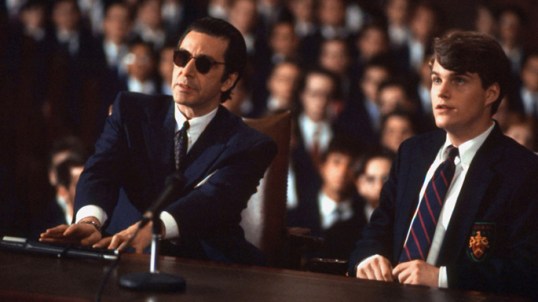
Look, the film’s not all bad. It has a few good performances. It looks great. It’s certainly better than Gigli, the film that director Martin Brest is perhaps best remembered for. It features a great scene where Al Pacino (playing a blind man) dances the tango with a woman that he’s just met. (Then again, I have a notorious weakness for dance scenes…) It’s not so much that the film is bad as much as it’s just that the movie itself is not particularly good.
Charlie Simms (Chris O’Donnell) is a scholarship student at an exclusive prep school in Massachusetts. Much like Brendan Fraser in School Ties, 1992’s other prep school melodrama, Charlie is a poor kid attending the school on a scholarship. While his rich friends prepare to go home for the Thanksgiving weekend, Charlie knows that there’s no way that he can afford to fly back to Oregon. In order to raise the money so that he can at least go back home for Christmas (how poor is this kid’s family!?), Charlie gets a temporary job for the weekend. His job? To look after Lt. Col. Frank Slade (Al Pacino), who is blind and yells a lot.
Anyway, as you can probably guess, Frank convinces Charlie to drive him to New York and they have all of the adventures that usually happen whenever a naive teenager spends the weekend with a suicidal blind man. Frank bellows a lot and tells about how, through his sense of smell, he can always tell when there’s a beautiful woman nearby. Frank also yells a lot. Did I already mention that? Because, seriously, he yells a lot.
Charlie has other problems than just Frank. It seems that a rather mild prank was pulled on the headmaster (James Rebhorn) of Charlie’s school. As a result, a bucket of paint was poured down on both the headmaster and his new car! Now, the headmaster is looking for those responsible. He just needs two witnesses. He’s already gotten one student to confess. And now, he’s blackmailing Charlie with a letter of recommendation to Harvard. All Charlie has to do is name names and his future is set…
Will Charlie name names and sacrifice his honor just to get into a college that could assure him a great life? Or will Frank convince Charlie that honor is the only thing that matters? And finally, will the film end with a big hearing in front of the entire school in which the headmaster attempts to badger Charlie, just to be interrupted by a sudden appearance from bellowing Frank Slade?
Will it!?
You can probably already guess and, since we have a no spoiler policy here at the Lens, I’ll just assume that you guessed right. (Or you could just look at the picture at the top of this review…)
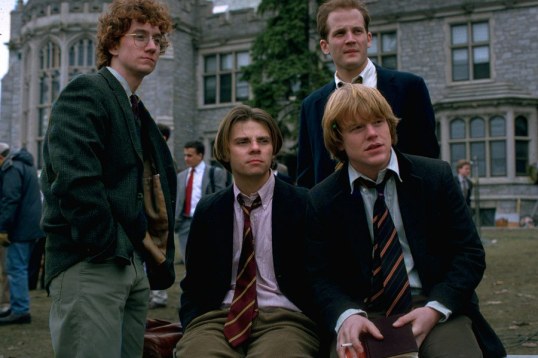
The prep school subplot pretty much just adds to the film’s already excessive running time. But it is interesting to watch because the other student — the one who names names — is played by a very young Philip Seymour Hoffman. (Or as he’s credited here, Philip S. Hoffman.) This was one of Hoffman’s first screen roles and he gives a memorable performance as an unlikable character. If you were to have seen Scent of a Woman in 1992, you would not have guessed that Philip Seymour Hoffman would eventually be an Oscar winner but you would know that he was a very talented character actor.
Otherwise, Scent of a Woman is a fairly forgettable movie. If I hadn’t known ahead of time that it was nominated for best picture, I never would have been able to guess. I’m not enough of an expert to be able to name every good 1992 film that was not nominated to make room for Scent of a Woman but I imagine that when that year’s Oscar nominations were announced, there were quite a few people left scratching their heads.
Can you figure out which one grew up to be Philip Seymour Hoffman?
And what better way to kick off the 90s than by taking a look at a film from 1992 that very few people seem to have ever heard of?
School Ties takes place in the 1950s, which of course means that everyone dresses like either James Dean in Rebel Without A Cause or Troy Donaue in A Summer Place. It also means that the soundtrack is full of the same songs that tend to turn up in every film about the 1950s. David Greene (Brendan Fraser) is a working-class teen from Pennsylvania* who wins a football scholarship to attend an exclusive prep school in Massachusetts. At first, David struggles to fit in. Not only are all of his classmates rich but they’re also extremely anti-Semitic. However, David wins them over by playing hard on the football field and hiding the fact that he’s Jewish. However, when the jealous Charlie Dillon (Matt Damon) discovers that David is a Jew, he reveals his secret and David is forced to confront his prejudiced classmates.
School Ties is one of those extremely well-intentioned films that’s never quite as good as you might hope. With the exception of David and Charlie, the characters are all pretty thinly drawn and there’s more than a few subplots that really don’t really work. For instance, Zeljko Ivanek shows up playing a sadistic French teacher who harasses one of Fraser’s friends (played by Andrew Lowery) and, as I watched Ivanek drive Lowery to the point of a nervous breakdown over proper verb conjugation, it occurred to me that I knew Ivanek was evil as soon as he showed up wearing his little bow tie and his beret. (It’s also interesting how French teachers are always evil in films like this.)
That said, the message of School Ties is still a timely one. On the surface, the message of “Don’t be an intolerant, prejudiced prick,” might seem pretty simplistic and self-explanatory. However, every day we’re confronted with evidence that there are still people out there who don’t understand this simple concept. As such, it’s a message that can stand being repeated a few times.
(Seriously, don’t be an intolerant, prejudiced prick.)
When seen today, School Ties is mostly interesting for who appears in it. For instance, Matt Damon, Ben Affleck, and Cole Hauser all show up here, 5 years before they would all co-star in Good Will Hunting.One of the anti-Semitic students is played by Anthony Rapp who, a year later, would appear with Affleck and Hauser in Dazed and Confused. Fraser’s sympathetic roommate is played by Chris O’Donnell. As for Brendan Fraser himself, it’s a bit odd to see him playing such a dramatic role but he’s convincing and believable as a football player. It’s a good-looking cast and yes, you better believe that there’s a fight scene that takes place in a shower. If you’ve ever wanted to see Brendan Fraser and Matt Damon wrestling each other while naked — well, this is the film to see.
—-
* Interestingly enough, David’s family lives in Scranton, Pennsylvania so I guess David could very well have gone to elementary school with Joe Biden and he may have family working at Dunder-Mifflin.
Well, it had to happen. We have finally reached the end of the 80s with this Back to School series of reviews. The 80s are often considered to be the “Golden Age of Teen Films,” largely due to the efforts of director-writer-producer John Hughes. In films like The Breakfast Club and Ferris Bueller’s Day Off, Hughes skillfully mixed teen comedy with teen drama and the end results were some of the best-remembered and most influential films ever made. At the same time, it’s also can’t be denied that, even as he was dealing with real issues of class differences and sexuality, Hughes also tended to idealize his teenage protagonists. They were often cast as noble savages, struggling to survive in a world that was exclusively run by cynical and judgmental adults. In The Breakfast Club, Ally Sheedy says that when you grow up, your heart dies. That, more than anything, defines the way that most of the great teen films of the 80s tended to view the world.
By the end of the 80s, John Hughes had stopped making films about high school and teenagers and so, it is perhaps appropriate that the final Back to School review of the 80s should be for a 1989 film that often time seems to be taking place on a totally different plant from the films of John Hughes. If Hughes told us that your heart dies when you grow up, Heathers would seem to suggest that most people’s hearts were never alive to begin with.
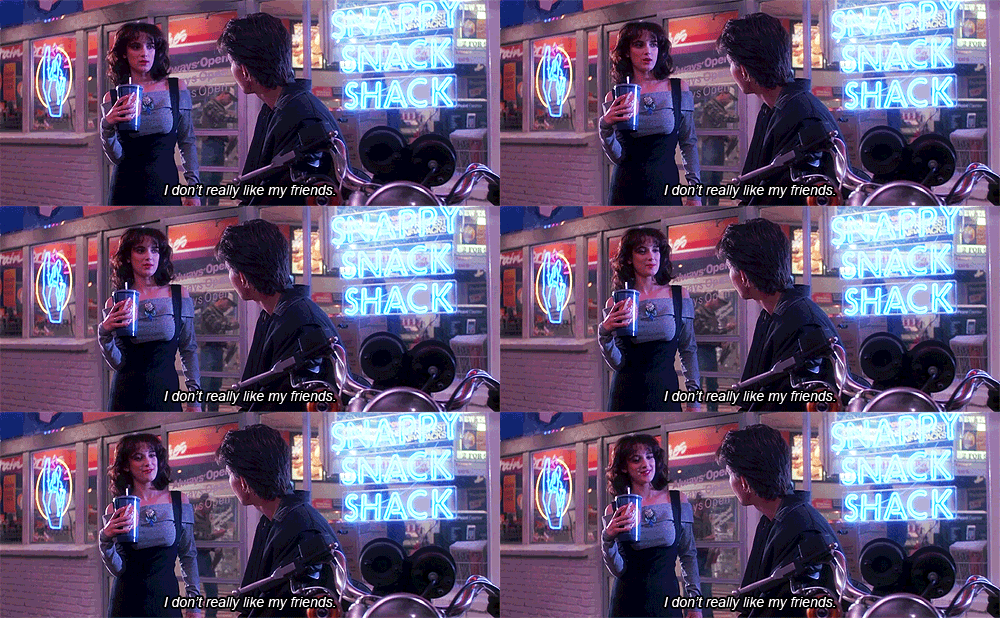
Heathers takes place at Westerburg High, a school full of student so rich that their mascot is a Rottweiler. Westerburg is run by a clique of three mean girls, all of whom are named Heather. Heather Chandler (Kim Walker) is their leader. Cheerleader Heather McNamara (Lisanne Falk) is weak-willed and insecure. And finally, Heather Duke (Shannen Doherty) is the smartest of the Heathers. She’s also bulimic. Now, there is a fourth member of the ruling clique but she’s a bit of an anomaly because she’s neither mean nor named Heather. Instead, her name is Veronica (Winona Ryder) and she is valued for her ability to forge signatures.
Since joining the Heathers, Veronica has drifted away from old friends like Betty Finn (Renee Estevez). And though Veronica quickly realizes that she doesn’t really belong with the Heathers, she doesn’t know how she can break free without also destroying her reputation of Westerburg. Then, she meets J.D. (Christian Slater), a prototypical rebel with a cause. J.D. is not only an outsider at Westerburg but he’s proud of it. Soon, he and Veronica are a couple and J.D. is pulling Veronica into his plans to destroy the social hierarchy of Westerburg High.
When a practical joke arranged by J.D. and Veronica leads to the accidental death of Heather Chandler, J.D. convinces Veronica to forge a suicide note. As a result, Heather Chandler is canonized by the same students that she previously terrorized. However, J.D. is not done killing. With each new death (and with each forged suicide note), a new social hierarchy starts to form at Westerburg until, eventually, J.D. comes up with a plan that owes a bit to the end of Massacre at Central High…
Heathers is a darker than dark comedy and one that I imagine probably could not be made today. (To be honest, I’m a little bit surprised that it could be made in 1989.) Seriously, a comedy where one of the main plot points is that students become more popular after everyone has been fooled into thinking they committed suicide? (Not to mention a scene where a grieving father shouts, “I love my dead gay son!”) People would get so offended if this film was made today but you know what? They would be totally missing the point. The film isn’t making fun of suicide as much as it’s exposing the hypocrisy of a society that only seems to care about people after they die. To me, the most important scenes aren’t the ones where people react to the fake suicides. Instead, the heart of Heathers‘s dark vision is to be found in the scene where a true outcast like Martha Dunnstock (Carrie Lynn) fails in her attempt to commit suicide and is ridiculed by the same students and teachers who were previously patting themselves on the back at Heather Chandler’s funeral.
Heathers is dark but it’s also a genuinely funny film, filled with great lines and performances. (“Fuck me gently with a chainsaw,” is my personal favorite.) It’s a film that still carries quite a satiric bite and a perfect film with which to end the 80s.
For the past two and a half weeks, we’ve been taking a chronological look at some of the best, worst, most memorable, and most forgettable teens films ever made. We started with twofilms from 1946 and now, 43 films later, we’ve reached the end of the 80s. And what better way to close out the decade that is often considered to be the golden age of teen films than by taking a look at two films from 1989 that both paid homage to the films that came before them and also served to influence the many films that would come after.
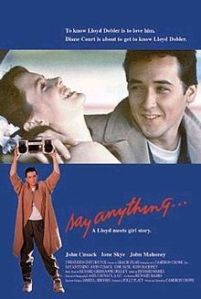
When people talk about Say Anything…, they usually seem to talk about the fact that it was the directorial debut of Cameron Crowe (who, it must be said, launched the golden age of teen films by writing Fast Time At Ridgemont High) and that it features what may be John Cusack’s best performance. Famously, Cusack apparently felt that — after performances in Class, Sixteen Candles, and Better Off Dead — he was through playing teenagers. But then he read Crowe’s script and was so impressed by it that he agreed he would play a student one last time.
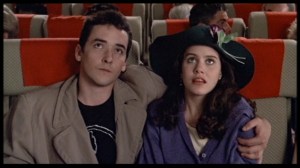
It may, however, have helped that the character Cusack plays, a likable and easy-going kickboxing enthusiast named Lloyd Dobler — is only briefly seen as a student. He graduates from high school early on in the movie. That majority of Say Anything… deals with the summer right after high school.* Lloyd has an unlikely but heartbreakingly real romance with Diane Court (Ione Skye), the valedictorian.
Cusack is so charming as Lloyd (and, needless to say, he gets all of the best lines) that I think people tend to overlook the fact that Ione Skye is equally as good. Diane is actually a far more challenging role than Lloyd. Whereas Lloyd is distinguished by his confidence and his friendly manner, Diane is neurotic, shy, and unsure of herself. She’s won a scholarship to study in England and is scheduled to leave at the end of the summer but she’s scared of flying. Even worse, her father, Jim Court (John Mahoney), is being investigated by the IRS. As the summer progresses, Diane is forced to deal with the fact that not only has her seemingly perfect father broken the law but, when he’s confronted with his crimes, he uses his daughter as his excuse. Yes, Jim seems to be saying, I stole money but I only did it to give you the best life possible.
Everyone seems to remember Say Anything… as the film that has that scene where Lloyd serenades Diane by holding that radio over his head. And yes, that’s a wonderfully romantic scene, even if it’s been parodied so many times that it’s probably no longer as effective as it was when the film was first released. But for me, Say Anything… is truly about Diane growing up and realizing that her father is not the saint that she thought he was. (Making this realization especially upsetting is the fact that, initially, Mahoney is so likable in the role.) You’re happy that Lloyd is there for her and you truly do come to love him because he is the perfect boyfriend, but ultimately, Say Anything… is Diane’s story.
(That said, though, I have to admit that some of my favorite scenes are just Lloyd talking to his friends. Lili Taylor gives a great performance and how can you not laugh at Jeremy Piven hanging out at the convenience store?)
Ultimately, of course, the film works because both Lloyd and Diane come across as real human beings. They’re not just boyfriend and girlfriend. Instead, they’re two very likable characters who have been lucky enough to find each other. In the end, you love Lloyd not because he’s funny or quirky but because he loves Diane for who she is.
Of course, it also helps that Say Anything has the perfect ending.
Ding!
—-
* On a personal note, the summer after I graduated high school was the best summer of my life because I spent most of it in Italy! Viva Iatalia!
For the past two and a half weeks, I’ve been reviewing, in chronological order, some of the best, worst, most memorable, and most forgettable teen films ever made. We started with two films from 1946 and now, we find ourselves coming to the close of the decade that is often considered to be the Golden Age of teen films, the 1980s. For our 44th entry in Back to School, we take a quick look at 1987’s Some Kind of Wonderful.
Why a quick look?
Because, quite frankly, there’s not that much to say about it.
Some Kind of Wonderful is a story about an artistic, lower-class misfit who has a crush on one of the popular kids. The only problem is that the popular kid is being cruelly manipulated by one of the richest students in school. The misft also has a best friend who is totally in love with the misfit but the misft has somehow failed to notice this. Eventually, the misfit does get to date the popular kid. Both the popular kid and the misft are given a hard time by the members of their collective clique but they still manage to go on one truly amazing date. Finally, the film ends with a big show down at a party and two people kissing outside.
Sound familiar?
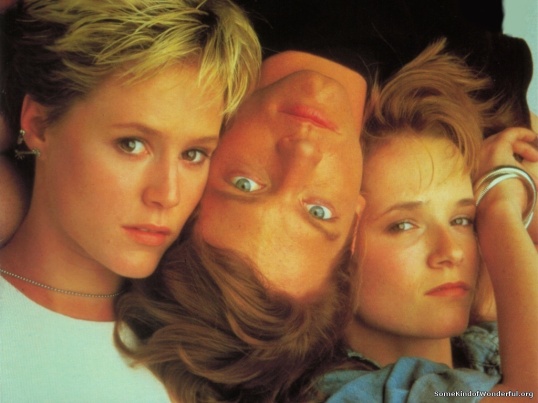
If it does, that probably means that you’ve seen Pretty In Pink. Some Kind of Wonderful is basically a remake of Pretty In Pink, the only difference being that the genders have been reversed and that the film is a lot more heavy-handed (and predictable) when it comes to examining class differences. (Not coincidentally, both films were written by John Hughes and directed by Howard Deutch and it must be said that when it comes to Some Kind of Wonderful, it’s easy to feel that both of them were simply going through the motions.) The misfit is an aspiring painted named Keith (Eric Soltz). His best friend is a drummer named Watts (Mary Stuart Masterson). The object of Keith’s affection is Amanda (Lea Thompson). Unfortunately, even though she lives in the same poor neighborhood as Keith and Watts, Amanda is dating the rich (and therefore, evil) Hardy (Craig Sheffer).
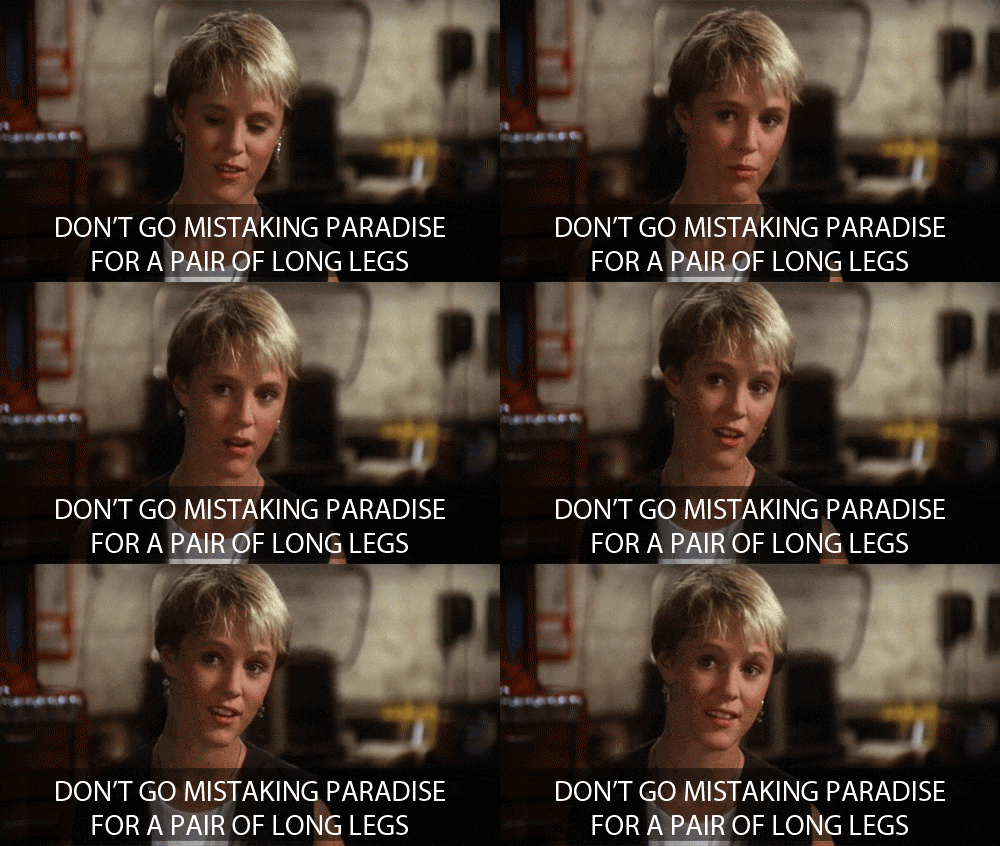
When Keith finally works up the nerve to ask out Amanda, he doesn’t realize that she’s just broken up with Hardy and is on the rebound. Watts is skeptical, telling Keith, “Don’t go mistaking paradise for a pair of long legs,” and I’m just going to admit that, as the proud owner of a pair of long legs, that line really annoyed me. I guess it’s because I’ve known people like Watts, who always act like there’s something wrong with wanting to look good.
Shut up, Watts.
With the help of Watts and Duncan (Elias Koteas), the school bully that Keith managed to befriend in detention, Keith takes Amanda out on an amazing date and shows her a wonderful portrait that he’s painted of her. At the same time, Hardy — angry because someone from a lower class is now dating his ex-girlfriend — starts to plot his own revenge…
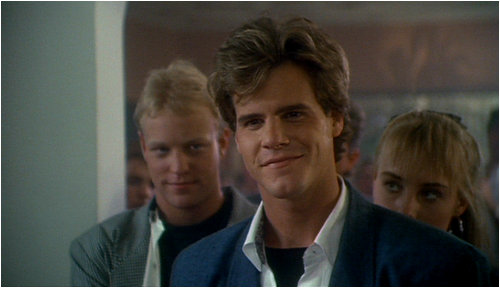
There are some positive things about Some Kind of Wonderful. There are two really good and memorable scenes that, momentarily, manage to elevate the entire film. There’s the moment when Keith shows Amanda the painting. And then there’s the erotically charged scene in which Keith and Watts practice how to kiss. Koteas, Thompson, and Masterson all gives good performances. Eric Stoltz is, at times, a bit too intense to sell some of the film’s more comedic moments but overall, he’s well-cast here. (In fact, the only performance that I really didn’t care for was Craig Sheffer’s. Sheffer one-dimensional villain only served to remind me of how good James Spader was in Pretty In Pink.)
That’s no James Spader
And yet, there’s just something missing from Some Kind of Wonderful, something that keeps this film from being … well, wonderful. I have to wonder if I had never seen Pretty In Pink, would I have thought more of Some Kind of Wonderful? Perhaps. Whereas Pretty In Pink was full of the type of small details and clever moments that make it a joy to watch and rewatch, Some Kind of Wonderful is one of those films that you can watch once and enjoy it without ever necessarily feeling the need to ever watch it again.
In his film guide, Heavy Metal Movies, Mike McPadden describes the disturbing 1987 teen crime drama River’s Edge as being “666 Candles“. It’s a perfect description because River’s Edge appears to not only be taking place in a different socio-economic setting than Sixteen Candles and The Breakfast Club but perhaps on a different planet as well.
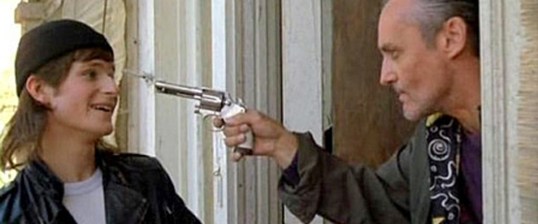
River’s Edge opens with a close-up of a dead and naked teenage girl lying on the edge of a dirty, polluted river and it gets darker from there. The dead girl was the girlfriend of the hulking John Tollet (Daniel Roebuck, playing a character who is miles away from his role in Cavegirl). As John explains to his friends, he strangled her for no particular reason. His friends, meanwhile, respond with detachment. Their unofficial leader, the hyperactive Layne (Crispin Glover), insists that since nothing can be done about the dead girl, their number one concern now has to be to keep John from getting caught. While Layne arranges for John to hide out with a one-legged drug dealer named Feck (Dennis Hopper), two of John’s friends, Matt and Clarissa (played by Keanu Reeves and Ione Skye), consider whether or not they should go to the police. Oddly enough, John really doesn’t seem to care one way or the other.
Seriously, River’s Edge is one dark film. If it were made today, River’s Edge would probably be directed by someone like Larry Clark and, in many ways, it feels like a distant cousin to Clark’s Bully. The teenagers in River’s Edge live in a world with little-to-no adult supervision. Matt’s mom is more concerned with whether or not Matt has been stealing her weed than with the fact that Matt might be covering up a murder. The local high school teacher is a former hippie who won’t shut up about how much better his generation was compared to every other generation. In fact, the only adult with any sort of moral code is Feck and he’s usually too busy dancing with a sex doll to really be of much help. It’s a world where no one has been raised to value their own lives so why should they care about a dead girl laying out on the banks of the river?
The film features good performances from Keanu Reeves, Ione Skye, and Daniel Roebuck but really, the entire movie is stolen by Crispin Glover and Dennis Hopper. In the role of Layne, Glover is a manic wonder, speaking quickly and gesturing even when he isn’t making a point. When Layne first shows up, he seems like he’s just overly loyal to his friend John but, as the film progresses, it becomes more apparent that he’s less concerned about protecting John and more interested in ordering other people to do it. For Layne, protecting John is ultimately about maintaining power over Matt, Clarissa, and the rest of their friends.
As for Dennis Hopper — well, this is one of those films that you should show to anyone who says that Hopper wasn’t a great actor. The role of a one-legged drug dealer who lives with a sex doll sound like exactly the type of role that would lead Hopper to going totally over-the-top. Instead, Hopper gave a surprisingly subtle and intelligent performance and, as a result, he provided this film with the moral center that it very much needs.









 Through the Shattered Lens