Film Review: Any Which Way You Can (dir by Buddy Van Horn)


In this 1980 sequel to Every Which Way But Loose, Philo and his orangutan Clyde are still living next door to Orville (Geoffrey Lewis) and his mother (Ruth Gordon).  Philo is still working as a truck driver but he’s becoming far better known as a bare-knuckles brawler.  In fact, when another famous fighter named Jack Wilson (William Smith), moves to the area, everyone assumes that Jack wants to challenge Philo.  It turns out that Jack’s actually a pretty nice guy.  He and Philo become jogging buddies.

Remember Lynn Halsey-Taylor (Sondra Locke), the extremely self-centered singer who broke Philo’s heart in the first film?  Well, she’s back and she’s changed her ways.  When she and Philo meet in a bar, Lynn apologizes to him for her past behavior and soon, she and Philo are a couple again.  Booo!  Seriously, Eastwood and Locke somehow have even less chemistry here than they did in the first film.  (Again, Locke and Eastwood were in a relationship at the time, which makes their total lack of chemistry even more interesting to consider.)  Everyone in the film is surprisingly forgiving of Lynn, considering that she was portrayed as being nearly sociopathic in the previous film.  Even Clyde seems to be happy to have her back.  Of course, Clyde gets to have a romance of his own, with another orangutan.  Clyde has sex with his partner while Philo and Lynne fool around in the room next door.  It’s …. kind of weird.

Anyway, the Mafia really wants Philo and Jack to fight so they decide to kidnap Lynn in order to force the fight to happen.  Instead, Jack and Philo team up to rescue Lynn and to put those gangsters in their place.  That might sound dramatic but this film is very much a redneck comedy so these are probably the least intimidating mafia soldier that I’ve ever seen.  Just as the previous film’s outlaw bikers (and they also make a return appearance in this film) were too buffoonish to be truly menacing, the same is true of the Mafia in this film.

In the end, Philo and Jack do have a fight but it’s under their own terms and, afterwards, they accompany each other to the hospital.  It’s kind of a nice moment, really.  Even after beating the hell out of each other and causing more than a few broken bones, Philo and Jack are still friends.  It’s a nice touch that Jack was played by William Smith, who was a bit of a low-budget version of Clint Eastwood.

Indeed, with Geoffrey Lewis relegated to a supporting role and Sondra Locke abducted by the mafia, the friendship between Philo and Jack becomes the heart of the film and if there is really anything that makes this film memorable, it’s the scenes that Eastwood shares with William Smith.  These two tough guys actors seem to have a natural understanding of each other and their friendship and mutual respect feels real.  They may fight but it’s only out respect for each other.  It’s a shame that Eastwood and Smith didn’t team up for more films.

Any Which Way You Can is an amiable comedy.  It’s not as much fun as Every Which Way But Loose.  Beverly D’Angelo’s Echo is missed but she was presumably busy filming Coal Miner’s Daughter at the time.  The film works best as a buddy movie.  Clint Eastwood, William Smith, Geoffrey Lewis, and an orangutan.  What a team!
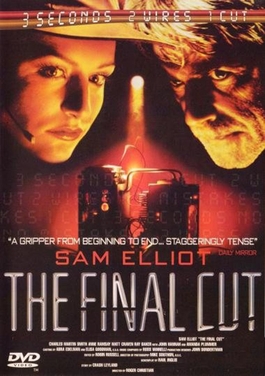
The Final Cut (1995, directed by Roger Christian)


A mad bomber is blowing up large chunks of Seattle and seems to have a vendetta against the city’s bomb squad.  John Pierce (Sam Elliott), a burn-out who used to be the best of the best when it came to defusing bombs, comes out of retirement to help with the investigation.  The only problem is that all of the evidence seems to be pointing at Pierce.  Pierce does his best to prove his innocence while more and more members of the bomb squad get blown up.

The Final Cut has its moments.  The lengthy opening scene features Amanda Plummer and John Hannah as two cocky members of the bomb squad who discover that defusing their latest explosive isn’t going to be as simple as they think it is.  The final 20 minutes takes the film into Saw territory, with an underground lair and a woman who has been turned into a human explosive.  In-between, though, the movie is often slow and Sam Elliott sleepwalks through a role that really demanded the low-budget equivalent of a Lethal Weapon-era Mel Gibson.  (Wings Hauser comes to mind.)  The actual identity of the bomber will be easy for anyone to guess though the bomber’s final fate is actually executed pretty well.

Director Roger Christian is a long-time associate of George Lucas’s and also worked on Alien as a production designer.  That’s probably why the sets, especially that underground lair, look surprisingly good for what was obviously a direct-to-video B-movie.  Five years after The Final Cut, Christian would attain an infamous immortality when he was the director unfortunate enough to be credited as directing Battlefield Earth.  Compared to Battlefield Earth, The Final Cut is damn good movie.

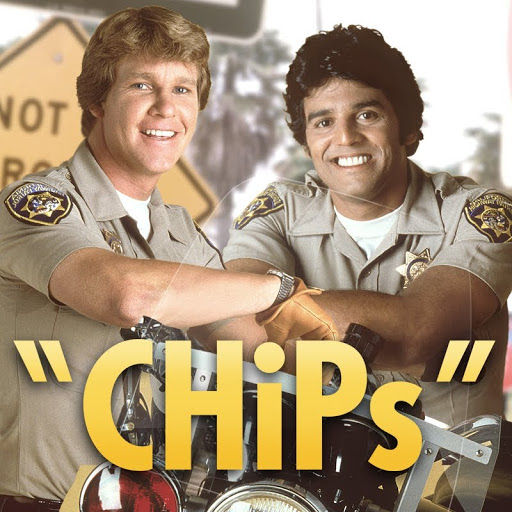
Late Night Retro Television Review: CHiPs 3.8 “Hot Wheels”


Welcome to Late Night Retro Television Reviews, a feature where we review some of our favorite and least favorite shows of the past!  On Mondays, I will be reviewing CHiPs, which ran on NBC from 1977 to 1983.  The entire show is currently streaming on Prime!

Last night’s review of CHiPs was pre-empted by a sudden storm.  Here it is now, in its entirety,

Episode 3.8 “Hot Wheels”

(Dir by John Florea, originally aired on November 3rd, 1979)

Ponch is still in the hospital, recovering from last week’s accident.  Still, because he’s Ponch, he’s the one who figures out that a bunch of disgruntled fireman are using city trucks to commit their jewelry thefts.  Hey, wait a minute.  Last week’s episode was also about jewelry thefts.  Admittedly, CHiPs was a show that tended to recycle plots but, even by CHiPs standards, this is one of those coincidences that leaves you wondering what exactly was going on in the writer’s room.

Actually, it’s easy to guess.  Erik Estrada really was injured while filming an episode.  The cast that he wears throughout this episode was real and, as easy as it can be to make fun of his overexpressive acting and his tendency to lose his shirt every other scene, you do have to respect that Estrada showed to film this episode at all.  With Estrada injured, one gets the feeling that this episode, just like last week’s, was quickly rewritten to cover the situation.

Baker gets a temporary partner in this episode.  It’s the return of his former motorcycle mate, John Clayton!  Clayton was apparently Baker’s partner before Ponch.  Clayton has a reputation for being a practical joker,  It’s all anyone can talk about.  Clayton is a legendary prankster!  They really want us to know that Clayton’s a fun guy before he shows up and we discover that he’s played by Andrew Robinson, the actor who is best-known for playing the Scorpio Killer in Dirty Harry.  Robinson wears a mustache as Clayton, probably in an attempt to keep 1979 audiences from looking at the screen and going, “Hey, I remember that guy hijacking a school bus!”

(I should mention that Andrew Robinson himself was a committed pacifist when he filmed Dirty Harry, to the extent that he actually flinched whenever he had to shoot the killer’s gun and he actually traumatized himself while filming the school bus hijack.  He actually sounds like a pretty nice guy who just happened to play one of the most loathsome screen villains of all time.)

Baker works with Clayton and it must be said that Larry Wilcox does seem to be noticeably happier when he’s acting opposite Robinson than he ever did when he was acting opposite Estrada.  The episode features Clayton performing a heroic and dangerous rescue at one point and it’s easy to see that that scene was originally conceived with Estrada in mind.  It’s also easy to imagine Estrada flashing his big grin at the end of the scene while Robinson, on the other hand, plays up the fact that anyone, even a dedicated cop, would be absolutely exhausted after all that.

Robinson does a good job as Clayton and it’s always fun to see Martin Kove play a villain on show like this.  This was a good episode.  Estrada, I assume, will be back on his bike next week.

FROM NOON TILL THREE (1976) – Charles Bronson, the comedian??!


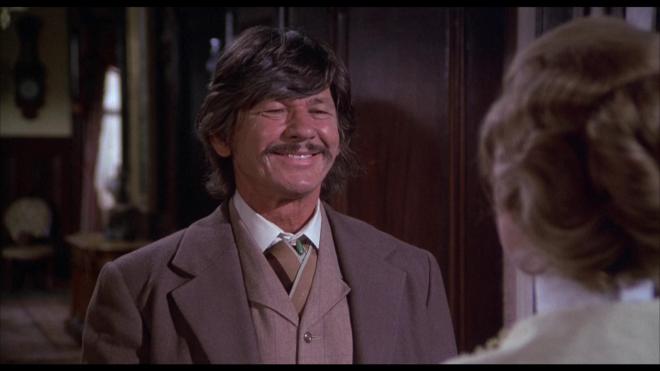
During the height of his popularity in 1976, Charles Bronson tried something quite different with this romantic comedy costarring his wife Jill Ireland. And to be honest, he’s darn funny in the role.  This movie has grown on me over the years. 

Bronson plays Graham Dorsey, a bank robber who spends an afternoon with the lonely widow Amanda Starbuck (Ireland) while his gang is robbing a bank in town.  After his gang is all killed during the robbery, Dorsey must take off and go into hiding, eventually being arrested for impersonating a quack dentist. While he’s in jail, and through a variety of circumstances, a book is written about their afternoon together and it becomes an international sensation.  As soon as Dorsey gets out of jail, he goes back to Starbuck’s home to rekindle their affair. Unfortunately for Dorsey, the book has created such a legend of him and their affair that Ms. Starbuck doesn’t even recognize the man he really is.  His method of convincing her that he’s the “real” Graham Dorsey is the funniest moment in Bronson’s entire filmography. 

Charles Bronson & Jill Ireland are clearly having a wonderful time making this movie together, which is one of the main reasons I enjoy the film.  He may not have done it often, but Bronson could play comedy and he’s excellent in this film cast completely against his normal type.  Jill Ireland is also very good as the widow Starbuck and her rendition of the song “Hello and Goodbye” was even nominated for a Golden Globe for Best Song.  We had the privilege of interviewing Jill Ireland’s niece, Lindsay Ireland, and she told us of singing this song with her aunt Jill and her cousin when she would spend summers with them in Vermont in the 70’s. It’s so fun for me to hear firsthand about those times when the Bronson’s were one of the biggest celebrity couples of the world!  The best part, Bronson valued his time with his family over anything else. They were everything to him.

**BONUS CONTENT** – I’ve included a link to the “This Week in Charles Bronson” podcast episode where Lindsay Ireland describes her time with her aunt Jill Ireland, and how they would sing “Hello & Goodbye,” the song that was in FROM NOON TILL THREE, while they were driving down the roads in Vermont. It’s a really nice insight into Jill Ireland.

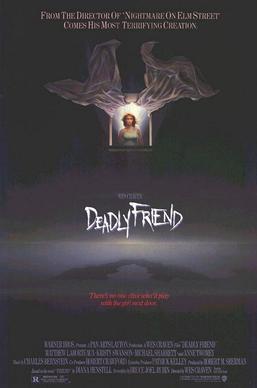
A Movie A Day #277: Deadly Friend (1986, directed by Wes Craven)


Things I learned from watching Deadly Friend:

Girls love nerds who build robots.

In 1986, nerds could build robots that displayed human feelings.

Angry old neighbors hate robots.

If a nerd can build a robot that displays human feelings, then he can also bring his girlfriend back to life by putting a computer chip from the robot in her brain.

Once brought back to life, the girlfriend will start to behave just like the robot.

Basketballs can be used to do anything.

Deadly Friend is best remembered for the scene where the newly revived Samantha (Kristy Swanson) throws a basketball with such force that it causes the head of her neighbor (Anne Ramsey) to explode.  It is also remembered for BB, the big yellow robot that was built by Paul (Matthew Laborteaux).  Deadly Friend starts out as the ultimate nerd fantasy: a beautiful girlfriend. a big robot, and a killer basketball.  By the end of the movie, the fantasy has turned into a nightmare.

Deadly Friend was Wes Craven’s follow-up to A Nightmare on Elm Street.  Craven intended for the film to be a dark love story between a teenage outcast and his zombie girlfriend, with a strong emphasis on the hypocrisy of the adults around them.  Craven said that, in his version of Deadly Friend, people like Samantha’s abusive father were meant to be scarier than Zombie Samantha With A Microchip In Her Brain.  Warner Bros. wanted a film that would appeal to teenage horror fans and demanded Elm Street-stlye nightmares and buckets of more blood.  As a result, Craven practically disowned the finished movie and Deadly Friend is a tonally inconsistent, with sentimental first love scenes competing for space with heads exploding and necks being snapped.  Despite good performances from Laborteaux and Swanson, the final film is too much of a mess to work.  However, I know that I will never look at a basketball the same way again.

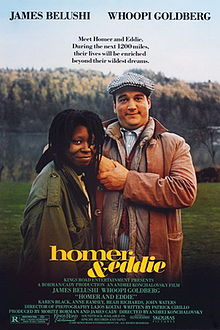
Lisa Cleans Out Her DVR: Homer and Eddie (dir by Andrei Konchalovsky)


(Lisa is currently in the process of cleaning out her DVR.  It’s taking her such a long time that she’s running out of cutesy ways to talk about how long it’s taking.  She recorded this 1989 comedy off of Starz on May 10th.)

This is another strange one.

Homer and Eddie opens with Homer (James Belushi) standing on the corner of an isolated stretch of desert road.  He is hitchhiking.  When a car finally stops to pick him up, Homer is so excited!  He gets in the back seat, gives the two men in the front seat a really wide smile, and innocently asks them how they’re doing.

One of the men (played by director John Waters) holds up a gun and demands all of Homer’s money.  After Homer hands the money over, he is kicked out of the car.  As the car drives away, Homer pulls a few dollars out of his sock and loudly yells that he fooled them and that they didn’t get all of his money.

The car abruptly stops and, going in reverse, pulls back up to Homer.  Homer gives up his money and the car speeds off.

In short, Homer probably shouldn’t be hitchhiking on his own.  Homer, you see, was hit in the head by a baseball when he was younger.  He has the mind and the innocent outlook of a child.  He is cheerful, he is religious, and he is totally unprepared to deal with real world.

Fortunately, Homer won’t be alone for too long.  Homer comes across an apparently deserted car and, without money or a place to stay, he decides to use the car as shelter.  However, it turns out that the car isn’t as abandoned as it looks!  No, the car is being used by Eddie (Whoopi Goldberg).  Eddie stole the car when she escaped from a mental institution.  Why was Eddie in the mental institution?  She’s a paranoid schizophrenic and she occasionally kills people.  Eddie and Homer are soon taking a very strange road trip, heading up north so that Homer can see his dying father.

It’s a very disjointed film, one that switches tone from scene to scene.  The two stars seem to be acting in totally different movies.  Belushi gives a very broad performance, one that often crosses the line into pure goofiness.  Eddie, meanwhile, is continually and constantly full of rage.  You never know when she’s going to snap and kill someone.  I spent a good deal of the movie waiting for her to kill Homer.  Maybe that was the point but it’s still hard to laugh at scenes of Homer and Eddie waving at a school bus full of cheerleaders when you’re also waiting for Whoopi Goldberg to beat and dismember Jim Belushi.

Homer and Eddie can  summed up by one lengthy sequence.  Eddie takes Homer to a brothel so that he can lose his virginity.  While Homer is dancing around in his underwear, Eddie is at a convenience store, shooting the clerk (played by Pruitt Taylor Vince).  The clerk, who was perfectly nice to Eddie before getting shot, looks at his wound and feebly says, “Why did you do that?” before dying.

It’s a weird little movie.  Usually, I love weird moves but this one is too much of a mess for even me.  As I watched it, I couldn’t help but think of how much more interesting the movie would be if it was the child-like Homer killing people and schizophrenic Eddie trying to keep him calm.  On a positive note, this was decades before Whoopi Goldberg gave up her edginess to co-host The View and she gives shockingly good performance.  When Eddie loses control, she’s actually frightening.  But, unfortunately, the film itself just doesn’t work.