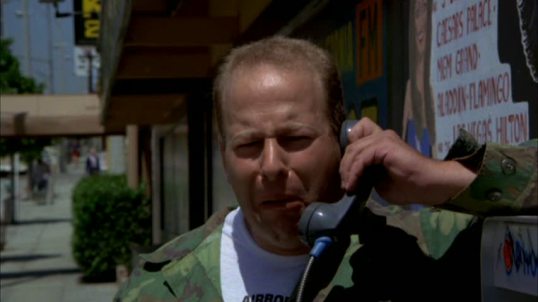
Brad’s “late night” movie review: THE NAKED CAGE (1986), starring Shari Shattuck and Angel Tompkins!


It’s a hard knock life for Michelle (Shari Shattuck). One moment she’s a hardworking teller at the local bank who loves her horse, Misty. The next moment she’s sentenced to three years in the women’s penitentiary for a crime she didn’t commit. And life is damn tough in prison. There’s the prison warden Diane (Angel Tompkins) who, when she’s not participating in lesbian dalliances with inmates, is offering Michelle protection, but only if she agrees to act as a spy for her. When Michelle says no, Diane sets her up to be brutalized by the sadistic Rita (Christina Whitaker), the bitch who’s responsible for her being in the pen in the first place! Now having to dodge the threat of rape from prison guard Smiley (Nick Benedict), as well as the constant threat of shiv-induced death at the hands of Rita, it seems Michelle may have finally received a lifeline with the arrival of a new prison guard named Rhonda (Lucinda Crosby). Rhonda seems to show some extra interest and empathy in Michelle’s plight, and she just may be in a position to help her with the wrongful conviction. That is, if Michelle can survive one more night in THE NAKED CAGE!! 

Recently, I’ve been trying to watch movies I’ve never seen before that star actors or actresses who worked with Charles Bronson. Tonight, I decided to look for a film starring Angel Tompkins, a Facebook friend, who worked with Bronson in the 1986 cop film from Cannon Films called MURPHY’S LAW. In that film she plays Jack Murphy’s ill-fated ex-wife, where she gives an uninhibited and committed performance in what would have been a throwaway role for many actresses. Not Angel… she took the role very seriously and is actually quite memorable in her couple of scenes. Paul Talbot’s book BRONSON’S LOOSE AGAIN has a chapter on the film, and he was able to interview Tompkins who told of just how much effort went into to her preparation. I recommend the book to anyone interested in Bronson or those numerous actors and actresses who worked with him in the 70’s, 80’s, and 90’s. Filmed the same year as MURPHY’S LAW, I thought it might be fun to see how committed she is in the role of the corrupt warden in Cannon’s THE NAKED CAGE. 

I’ll admit that I am not an expert on the “women in prison” genre of film. I did go through my Pam Grier phase that started with movies like COFFY (1972) and FOXY BROWN (1974), but did extend as deep as the Jack Hill “women in cages” films THE BIG DOLL HOUSE (1971) and THE BIG BIRD CAGE (1972). But those movies had Pam Grier in the cast which provided a couple of ample reasons for me to watch. THE NAKED CAGE does have some interesting things going for it. Like most of Charles Bronson’s 1980’s output, the movie was produced by Cannon Films, the international symbol of quality moviemaking from the 1980’s. And then there’s Angel Tompkins herself. She’s quite the sexy lady, having appeared in films like PRIME CUT (1972) and THE TEACHER (1974). Cannon Films and Angel Tompkins drew me in, but what about the film itself? Is it worth a watch? 

I’ll go ahead and say that for me, THE NAKED CAGE was worth the watch. This kind of movie only works for me if I like the cast. Shari Shattuck is appealing in the lead role of Michelle, a good woman, who’s wrongly convicted, but who soon finds levels of toughness she never knew she had in order to survive. I remember Shattuck starring in films like POINT OF SEDUCTION: BODY CHEMISTRY 3 (1994) with Andrew Stevens. My wife and I also watched the entire DALLAS TV series a few years ago where Shari had an extended role in season 13. She starts out here as a sweet and innocent lady, and by the end she’s wielding guns and knives like a lifelong delinquent, and I liked it! Angel Tompkins does not disappoint as the corrupt warden who seduces the inmates in order to meet her own sexual needs, as well as manipulating them into playing her larger games of control over the rest of the prison. Overall, she plays the role pretty straight, but is once again quite uninhibited when it comes to the more mature content. To me though, the most enjoyable performance comes from Christina Whitaker as the psychotic Rita. Not content with just ruining Michelle’s life, she’s determined to murder her behind the prison walls as well. From the beginning of the film where the fugitive Rita had Michelle’s estranged husband snorting cocaine off her boobs, all the way to the final frames, Whitaker chews every piece of scenery that comes into view. She’s the character I’ll remember whenever I think of THE NAKED CAGE. 

There are some things I didn’t like very much about the film. Prison guard Smiley’s sadistic rapist isn’t fun at all to watch, but his character’s fate is well deserved and somewhat satisfying when it finally occurs. Also, I didn’t care for the manipulation of the character of the drug addict Amy, played by Stacey Shaffer. She had worked very hard to beat her addiction, and in a world where many of us know people who have been lost to addiction, it’s not easy to watch her tragic fall. 

Overall, if you enjoy “women in prison” films, I think you’ll probably like this one. It’s certainly not perfect, but being a fan of Cannon Films and Angel Tompkins, I thought it was an enjoyable way to spend a Friday night while I was waiting for my wife to get home from work! 
Horror Film Review: Alligator (dir by Lewis Teague)


1980’s Alligator begins in 1968.  While on vacation in Florida, a teenage girl named Marisa Kendall purchases a baby alligator named Ramon.  When she returns home to Chicago, her jerk of a father flushes Ramon down the toilet.

12 years pass.  Marisa (Robin Riker) becomes a herpetologist.  As for Ramon, he actually survives being flushed down the toilet and thrives in the sewer.  He eats the carcasses of animals that had been a part of an experiment involving a growth serum.  The serum had the desired effect of making the animals bigger but it also increased their metabolism to the extent that they became aggressive and had to eat constantly.  Evil industrialist Slade (Dean Jagger) is convinced that, by tossing the carcasses in the sewer, he’s ensured that no one will ever find out about the experiments.  Instead, he’s turned Ramon into a giant alligator who is always hungry.  Soon, the super-intelligent alligator is ambushing and eating sewer workers.

Burned-out Detective Dave Madison (Robert Forster) teams up with Marisa to solve the mystery of why so many body parts are turning up in the sewers.  It’s not easy.  No one wants to admit that there might be a giant alligator living under the city.  Everyone wants to believe that’s just an urban legend.  But, after a tabloid reporter (Bart Braverman) manages to snap a few photographs of Ramon before being devoured, the police are forced to deal with the fact that they’ve got an alligator on their hands.  As Slade continues to try to cover up his involvement, big game hunter Colonel Brock (Henry Silva) comes to town and announces that he will be capturing the alligator.

Directed by Lewis Teague and written by John Sayles, Alligator is a dark comedy disguised as a horror film.  While numerous people get eaten and the film ends on a properly ominous note, Alligator is obviously not meant to be taken seriously.  The cast is full of good actors who send up their own images.  That’s especially true in the case of Henry Silva, who appears to be having a blast as the hyper macho Colonel Brock.  Robert Forster, meanwhile, delivers his lines with a self-aware weariness that seems a bit more appropriate for a noir hero than a film about a detective investigating a giant alligator.  One reason why the film works is because Forster, Silva, and the rest of the cast understood exactly what type of film they were appearing in and they delivered their overheated lines with just enough wit to let the viewer know that the film was in on the joke.  The big and somewhat stiff-looking alligator may not look entirely real and it may move somewhat awkwardly but ultimately, it’s the most likable character in the movie.  It just wants to relax in the sewers but, every few minutes, someone else is bugging him.

When first released, Alligator struggled at the box office but it has since gone on to become a cult favorite.  Quentin Tarantino is a self-described fan and he had said he was inspired to cast Robert Forster as Max Cherry in Jackie Brown after seeing him as Dave Madison in this film.  That’s not bad for a movie about a giant alligator!

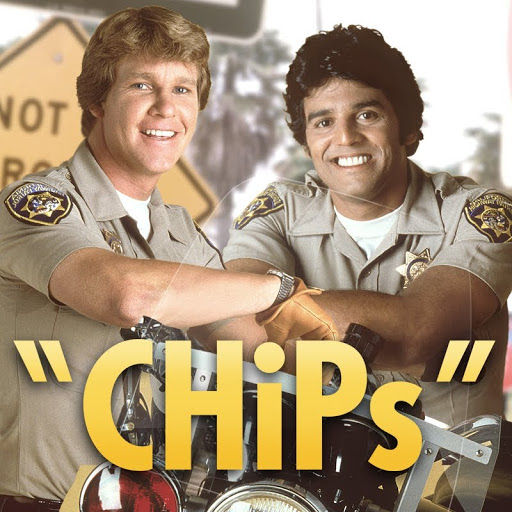
Late Night Retro Television Review: CHiPs 3.12 “Destruction Derby”


Welcome to Late Night Retro Television Reviews, a feature where we review some of our favorite and least favorite shows of the past!  On Mondays, I will be reviewing CHiPs, which ran on NBC from 1977 to 1983.  The entire show is currently streaming on Prime!

Baker and Ponch — but mostly Ponch — get a chance to shine this episode.

Episode 3.12 “Destruction Derby”

(Dir by Gordon Hessler, originally aired on November 24th, 1979)

Ponch and Baker are working undercover!

That’s …. odd.  Aren’t they just members of the Highway Patrol?  I mean, don’t get me wrong.  I know that being a member of the Highway Patrol isn’t easy and I don’t mean to imply that they’re not doing an important job.  But it just seems like undercover work would be something that you would give to a detective.  It seems like you would need some sort of special training to do that. For a show that, in the past, has pretty much taken a day-in-the-life approach to its stories, a sudden undercover episode just feels weird.

Ponch and Baker are working at the local demolition derby, trying to uncover a drug ring that…. I don’t know.  I guess people who sell drugs enjoy demolition derbys.  To be honest, I get the feeling that someone in production said, “Let’s shoot a bunch of demolition derby footage and then we’ll just make up something stupid to justify it.”  When it comes to the derby, Baker is working as a member of the pit crew and, of course, Ponch is the one driving the car.  And, of course, Ponch turns out to be a natural because there’s nothing that Ponch can’t master.  Ponch also falls for the only driver who can beat him, the mysterious Billy Wakefield (Angel Tompkins).  This episode is from the 70s so, of course, there’s a scene where she takes off her helmet, her long blonde hair falls across her back, and I guess everyone at home is supposed to go, “A woman race car driver!?  What is this madness!?”

Baker is not totally wasted in this episode.  He gets to save Ponch’s life when the bad guys attempt to booby trap Ponch’s car.  He also gets to play tennis with Getraer and Grossman.  This episode may feature Ponch and Baker going undercover but it seems like the real plot is just Baker and Ponch doing fun California things.  This episode basically is a commercial for the state.  Look! the episode says, Tennis!  Handball!  Demolition Derbies!  Erik Estrada!  We’ve got it all!

Erik Estrada can be seen wearing a wrist brace in this episode, which I assume is a lingering result of the accident that he’s spent the last few episodes recovering from.  I make a lot of jokes about Estrada but, from watching the last few accidents, it is obvious that he was pretty seriously injured in that stunt-gone-wrong.  That, while recovering, he appeared on camera at all seems worthy of respect.  A major theme of this episode seems to be that Ponch is back and Baker, after having the lead role for a few episodes, in once again back to being a supporting player.  Thank you for your service, Larry Wilcox.

Anyway, this episode featured a lot of fast cars and a lot of crashes so I liked it.

Film Review: The Don Is Dead (dir by Richard Fleischer)


“The Don is Dead!” shouts the title of this 1973 film and it’s not lying.

After the powerful and respect leader of the Regalbuto crime family dies, the Mafia’s governing body meets in Las Vegas to debate who should be allowed to take over the family’s operations.  Frank Regalbuto (a smoldering Robert Forster) wants to take over the family but it’s agreed that he’s still too young and hot-headed.  Instead, control of the family is given Don Angelo DiMorra (Anthony Quinn), an old school Mafia chieftain who everyone agrees is a man of respect.  Don DiMorra will serve as a mentor to Frank while Frank’s main enforcers, The Fargo Brothers, will be allowed to operate independently with the understanding that they will still respond if the mob needs them to do a job.  Tony Fargo (Forrest) wants to get out of the rackets all together while his older brother, Vince (Al Lettieri), remains loyal to the old ways of doing things.

Frank is not happy with the arrangement but he has other things to worry about.  He knows that there’s a traitor in his family.  While he and the Fargo brothers work to uncover the man’s identity so that they can take their revenge, Don Angelo falls in love with a Vegas showgirl named Ruby Dunne (Angel Tompkins).  However, Ruby is engaged to marry Frank and, when Frank returns from taking care of the traitor, he is tipped off as to what has been happening in his absence.  Frank goes crazy, nearly beating Ruby to death.  Don Angelo declares war on Frank and the Fargo brothers are forced to decide which side they’ll serve.

In the 1970s, almost every crime film was either a rip-off of The French Connection or The Godfather.  The Don Is Dead is unique in that it attempts to rip off both of them at the same time.  The film opens French Connection-style with a couple of hoods trying to double-cross Frank during a drug deal, leading to shoot-out.  (Keep an eye out for Sid Haig as one of Frank’s men.)   The film is full of scenes that are meant to duplicate the gritty feel of The French Connection though, needless to say, none of them are directed with the cinema verité intensity that William Friedkin brought to that classic film.  Meanwhile, Anthony Quinn plays a character who is very much reminiscent of Don Vito Corleone, even pausing at one point to tell Frank that “drugs are a dirty business.”  The Godfather‘s Abe Vigoda and Al Lettieri show up in supporting roles and Robert Forster gives a performance that owes more than a little to James Caan’s Oscar-nominated turn as Sonny Corleone.  (Interestingly enough, both Quinn and Forster were among the many actors considered for roles in The Godfather.)

Unfortunately, the film itself is slowly-paced and never really draws us into the plot.  Director Richard Fleischer, who directed a lot of films without ever developing a signature style, brings none of the intensity that William Friedkin brough to The French Connection nor can he duplicate Francis Ford Coppola’s operatic grandeur.  The Don is Dead plays out like a particularly violent made-for-TV movie.  There’s a lot of talented people in the cast but they’re defeated by thinly drawn characters.  Robert Evans often said that Coppola was hired to direct The Godfather because, as an Italian-American, he would bring an authenticity to the material that a non-Italian director would not be able to do.  The Don Is Dead would seem to indicate that Evans knew what he was talking about.

MURPHY’S LAW – Don’t F#&k with Jack Murphy!


I became obsessed with actor Charles Bronson in 1986 after receiving a VHS copy of DEATH WISH 3 as a Christmas present. Going along with that obsession was my desire to see every Charles Bronson movie that had ever been made. As much as I enjoyed re-watching DEATH WISH 3, it was always a treat when I could rent a different Bronson film at the video store. The current Bronson movie at the video store in 1987 that appealed to me as a 13 year old boy was MURPHY’S LAW, so I wanted to rent it as often as possible. There were even a couple of times when different friends asked me to spend the night, and I had one requirement for saying yes… that we rent MURPHY’S LAW! Y’all, don’t think too bad of me for this admission. Remember, I was only 13 years old, I couldn’t drive, and I didn’t have a job so if I had to use a friend’s mom to get my Bronson fix, that’s just what I had to do! Based on the timing of my initial Bronson obsession, DEATH WISH 3 and MURPHY’S LAW are 1-2 in the films that I’ve watched the most times during my life.

In MURPHY’S LAW, Charles Bronson plays Jack Murphy, a tough cop who seems to be experiencing a series of unfortunate events:

  1. A thief named Arabella McGee (Kathleen Wilhoite) tries to steal Murphy’s car and drives it through the window of a pizzaria. We know that’s his car because he loudly proclaims, “That’s MY car!!” He even wastes money on a sack of groceries by throwing it at his car while she’s driving away. He’s able to chase her down on foot, but she kicks him in the testicles and runs off leaving him doubled over in pain, grocery-less, and clutching the family jewels!
  2. A mafia kingpin named Frank Vincenzo (Richard Romanus) wants to kill him because Murphy was forced to shoot and kill the kingpin’s brother. We know the cop and the kingpin don’t like each other, because a little before the shooting they have a slight disagreement in front of the mafioso’s mother over whether the brother is a scum-sucking pimp or a talent agent. Unable to resolve the debate amicably, the mafioso inquires as to whether or not Jack has ever heard of “Murphy’s Law, if anything can possibly go wrong it will?” Murphy responds with an alternative version of Murphy’s Law, the only law that he knows, and one that I greatly prefer. You get the feeling that this argument may be revisited later in the film.     
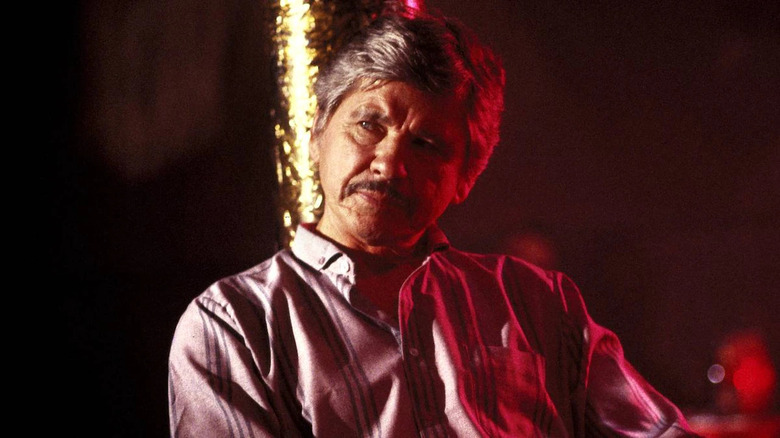
  3. Murphy’s now ex-wife Jan (Angel Tompkins) is performing extremely artistic striptease routines at a local club called Madam Tong’s. She’s also making love to the manager of the club. Rather than drinking at home alone until he passes out like most depressed men, Murphy hangs out at Madam Tong’s watching her shake her goodies for a bunch of horny lowlifes, before following them home and watching from outside until they turn off the bedroom lights. Very sad indeed.
  4. And here’s the worst part, on one of those typical nights where he’s obsessively stalking his wife, another mystery woman (Carrie Snodgress) knocks him in the head, shoots the slimy manager and Mrs. Murphy with his gun, and then frames him for their murders. Arrested for the murders and subsequently handcuffed to the thief who tried to steal his car, Murphy must stage a daring helicopter jailbreak in order to find out who framed him and clear his name before everything and everyone he holds dear is taken from him!

There are several reasons that I loved MURPHY’S LAW back in the eighties, and that I still enjoy it now. First, of course, is Charles Bronson. He was around 64 years old when he filmed MURPHY’S LAW, but he’s still in great physical condition in 1986. One of Bronson’s greatest strengths is his screen presence, and he still dominates each frame he’s in. Second, the film has an excellent supporting cast. Carrie Snodgress is having a ball playing the main villain in the film. I’ve seen her in quite a few movies, like PALE RIDER with Clint Eastwood, and 8 SECONDS with Luke Perry, but I’ve never seen her in a role like this. Snodgress was nominated for an Oscar for her role in a 1970 film called DIARY OF A MAD HOUSEWIFE. I’ve never seen that one before, but I should probably check it out! I love Kathleen Wilhoite as Arabella McGee, the thief who ends up handcuffed to Bronson. Her vocabulary, while probably not very realistic for the streets of LA at the time, was hilarious to me as a teenager. I enjoy calling the people I love “snot licking donkey farts” on occasion to this very day. It’s Kathleen Wilhoite singing the title song over the closing credits! And Robert F. Lyons is very special to me in his role as Art Penney, Jack Murphy’s partner. We got to interview him on the THIS WEEK IN CHARLES BRONSON podcast about his roles on DEATH WISH 2, 10 TO MIDNIGHT, and MURPHY’S LAW. He was so generous with his time, and just a hell of a nice guy! I’ve attached a link to the YouTube video of the interview with Mr. Lyons if you’re interested in the great stories he tells us about his time in Hollywood! Finally, MURPHY’S LAW was directed by J. Lee Thompson, my personal favorite director who worked with Bronson. Thompson directed Bronson in 9 different films, beginning with ST. IVES in 1976 and ending with KINJITE: FORBIDDEN SUBJECTS in 1989. No matter the material, you always knew that Thompson would deliver a film with a certain quality that made Bronson look good!

I’ll always be a fan of MURPHY’S LAW, partly for nostalgic reasons, but mainly because I think it’s an entertaining mid-80’s action film for Bronson at a time when he was one of the kings of the video store!

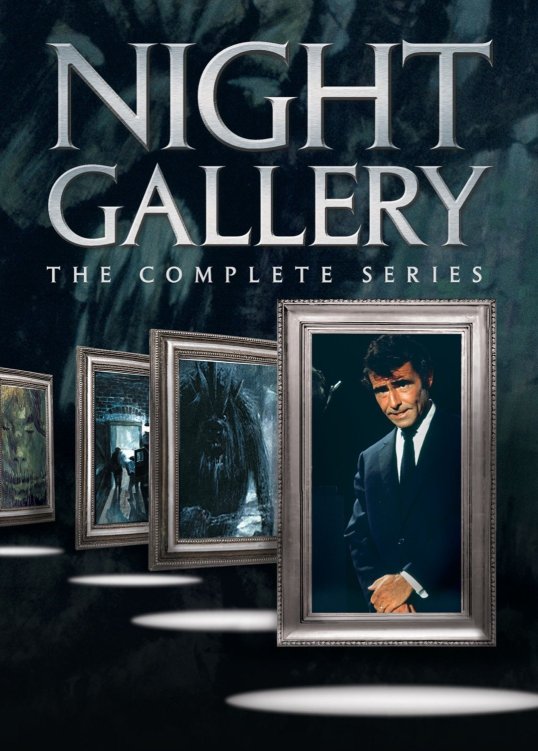
TV Review: Night Gallery 1.2 “Room With A View/The Little Black Bag/The Nature of the Enemy”


The second episode of Night Gallery originally aired on December 23rd, 1970 and it featured three stories, two of which were written by Rod Serling.  Serling, himself, introduced all three of the stories by inviting us to look at the paintings that may or may not have been inspired from them.

Room With A View (dir by Jerrold Freedman, written by Hal Dresner)

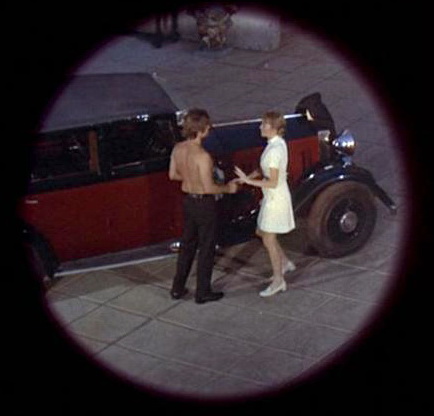
When a cranky, bed-bound man (Joseph Wiseman) discovers this his wife (Angel Tompkins) is cheating on him, he comes up with an elaborate scheme to get revenge.  It all hinges on his somewhat nervous nurse (Diane Keaton), who has no idea that she’s being manipulated.

This short segment is well-done but it doesn’t really feel like it belongs on an episode of Night Gallery.  There’s no elements of horror or science fiction to be found in this story.  Instead, it’s just about a manipulative man seeking revenge on his wife.  It’s actually easy to imagine this segment as being a flashback on a Monk-style detective show.  You just need a detective saying, “I finally figured out how you did it!”

For most viewers, probably the most interesting thing about this segment will be the presence of a young Diane Keaton, playing the nurse and laughing nervously at her patient’s rather intrusive questions.

The Little Black Bag (dir by Jeannot Szwarc, written by Rod Serling)

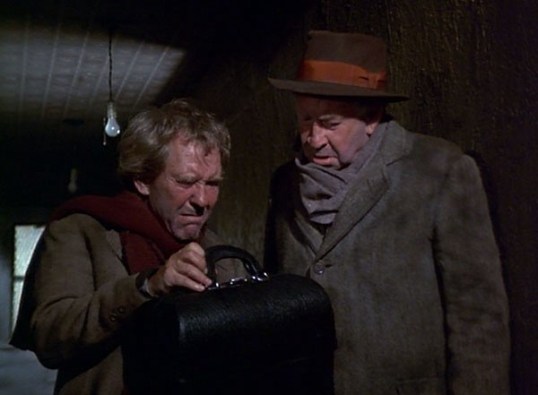
In the 30th Century, a careless accident at a time travel station sends a black medical bag into the past.  It arrives in 1971, where it’s discovered by two homeless gentlemen.  One of the men is a disgraced former doctor named William Fall (Burgess Meredith).  The other, Hepplewhite (Chill Wills), has no medical experience but he does have a greedy spirit.  Fall wants to use the bag to do good,  Hepplewhite wants to use the bag to make money.  Meanwhile, in the future, poor put-upon Gillings (George Furth) is just trying to figure out what to do about the missing bag.

The Little Black Bag is this episode’s high point, featuring good performances from Meredith, Wills, and Furth and also ending with properly macabre twist.  This is another Rod Serling story about how terrible, at heart, most people are but Jeannot Szwarc’s direction is fast-paced and he never allows things to get too heavy-handed.

The Nature of the Enemy (dir by Allen Reisner, written by Rod Serling)

NASA’s latest expedition to the Moon has run into trouble.  The astronauts have discovered that there is something living on the lunar surface.  On Earth, the director of NASA (Joseph Campanella) tries to keep everyone calm while also figuring out the nature of the enemy.

This segment has an intriguing premise but it’s let down by a so-so execution.  Like a lot of less-than-effective Night Gallery segments, this one features a story that doesn’t so much conclude as it just stops after a somewhat weak punchline.

So, the second episode of Night Gallery was not an improvement on the first and it was nowhere close to matching the pilot.  Watching this episode, it was hard not to feel that the show had a few growing pains.  Did it want to be a horror anthology or a collection of short skits?  The 2nd episode reveals a show that was still trying to find it’s voice.

Previous Night Gallery Reviews:

  1. The Pilot
  2. The Dead Man/The Housekeeper


Six Other Films From Crown International Pictures That Deserved An Oscar Nomination!


An hour ago, I told you about the only Oscar nomination that was ever received by Crown International Pictures, one of the most prolific B-movie distributors of the 70s and 80s.  That nomination was for Best Original Song for Crown’s 1972 film, The Stepmother.

Here are 6 more films from Crown International Pictures that I think deserved some Oscar consideration:

The Teacher (1974)

“She corrupted the youthful morality of the entire school!” the poster screamed but actually, The Teacher was a surprisingly sensitive coming-of-age story about a relationship between a younger man and an older woman.  Jay North and Angel Tompkins both give excellent performances and Anthony James shows why he was one of the busiest character actors of the 70s.

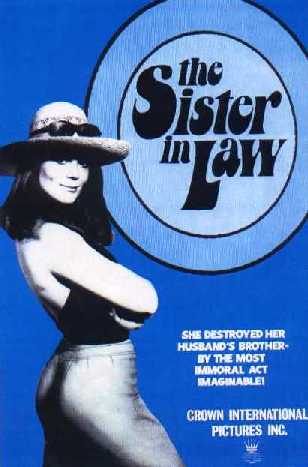
2. The Sister In Law (1974)

John Savage has been acting for several decades.  He’s appeared in a number of acclaimed films but he’s never received an Oscar nomination.  One of his best performances was in this melancholy look at love, betrayal, and ennui in the early 70s.

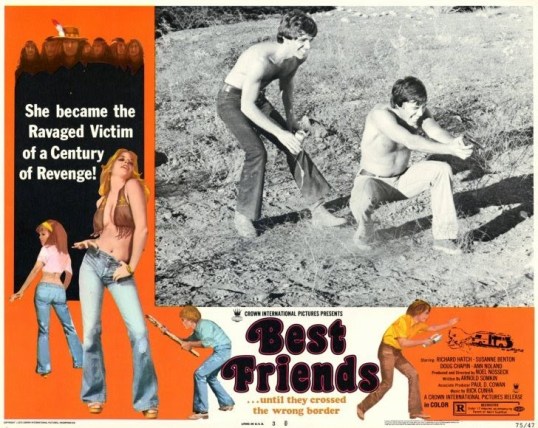
3. Best Friends (1975)

One of the strangest films ever released by Crown International, Best Friends is also one of the best.  A road trip between two old friends goes terribly wrong when one of the friends turns out to be a total psycho.  This well-acted and rather sad film definitely deserves to be better-known than it is.

4. Trip With The Teacher (1975)

Zalman King for Best Supporting Actor?  Hell yeah!

5. Malibu High (1979)

Surely Kim Bentley’s performance as a high school student-turned-professional assassin deserved some sort of consideration!

6. Don’t Answer The Phone (1980)

Don’t Answer The Phone is not a particularly good movie but it certainly is effective.  It made me want to go out and get a derringer or some other cute little gun that I could carry in my purse.  That’s largely because of the performance of Nicholas Worth.  Worth plays one of the most perverse and frightening murderers of all time and Worth throws himself into the role.  It’s one of the best psycho performances of all time and certainly worthy of a Best Supporting Actor nomination.

A Movie A Day #320: Dangerously Close (1986, directed by Albert Pyun)


Vista Verde, an exclusive suburban high school in California, has a problem.  Some of the students have a bad attitude.  Some of them are experimenting with drugs.  Graffiti is showing up all over the school.  What better way to return peace to Vista Verde than for a bunch of WASPy rich kids and other jocks to organize into a secret vigilante force?  The headmaster thinks that it’s a great idea and soon “The Sentinels” are holding mock trials and shooting the other students with paintball guns.  One bad kid even turns up dead.  Graffiti is no joke.

The leader of the Sentinels is a rich kid named Randy (John Stockwell, who also co-wrote the script).  Randy knows the importance of good PR so he befriend the editor of the school newspaper, Donny (J. Eddie Peck).  Donny may not be rich but, because of his amazing journalism skills, he has been allowed to attend Vista Verde as a magnet student.  At first, Donny is skeptical of The Sentinels but he soon finds himself seduced by not only Randy’s wealthy lifestyle but also by Randy’s beautiful girlfriend (Carey Lowell).  Meanwhile, Donny’s friend Krooger (Bradford Bancroft) not only listens to punk music but also has a mohawk so he naturally becomes the latest target of the Sentinels.

A teen film with a conscience, Dangerously Close was one of the better films to come out of the Cannon Group in the mid-80s.  The script is smarter than the average 80s teen film and Albert Pyun’s slick direction captures the appeal of being young and rich in the suburbs.  Stockwell, Peck, and Lowell all give better than average performances  and there is actually some unexpected depth to Stockwell and Peck’s friendship.  Stockwell does not play Randy as just being a typical rich villain.  Instead, he is someone who thinks he’s doing the right thing even when he’s not.

The cast is full of faces that will be familiar to anyone who has ever been a fan of 80s high school films.  Keep an eye out for Thom Matthews, Don Michael Paul, Gerard Christopher, Miguel Nunez, Jr., and DeeDee Pfeiffer, all doing their part to keep the halls of Vista Verde safe.


A Movie A Day #177: Murphy’s Law (1986, directed by J. Lee Thompson)


What is Murphy’s Law?

Let’s ask LAPD Detective Jack Murphy.

“Don’t fuck with Jack Murphy.”

Normally, having a law named after you would be pretty cool but it appears that this is just a law that Jack came up with himself.  Having to come up with your own law is kind of like having to come up with your own nickname.  Dude, it’s just lame.  Since Jack Murphy is played Charles Bronson, we can cut him some slack.

Murphy’s Law was one of the many film that, towards the end of his career, Bronson made for Cannon Films.  He played a detective in almost all of them.  Jack Murphy is Dirty Harry without the fashion sense.  He is also an alcoholic who cannot get over his ex-wife (Angel Tompkins) and her decision to become a stripper.  Not only has Murphy managed to piss off his superiors with his bad attitude but the mob is out to get him.  Everyone has forgotten Murphy’s Law.  Everyone is fucking with Jack Murphy.

Jack’s main problem, though, is Joan Freeman (Carrie Snodgress).  Years ago, Murphy sent Joan to prison for murder but, because it’s California and Jerry Brown appointed all of the judges, Joan gets out after just a few years.  Joan starts to systematically murder everyone that Murphy knows, framing Murphy for the murders.  Murphy’s arrested by his fellow cops, all of whom need a refresher on Murphy’s Law.  Though handcuffed to a young thief (Kathleen Wilhoite), Murphy escapes from jail and set off to remind everyone why you don’t fuck with Jack Murphy.

Murphy’s Law is a typical Cannon Bronson film: low-budget, ludicrously violent, borderline incoherent, so reactionary than it makes the Dirty Harry films look liberal, and, if you’re a fan of Charles Bronson, wildly entertaining.  Bronson was 65 years old when he played Jack Murphy so he cannot be blamed for letting his stunt double do most of the work in this movie.  What’s interesting is that, for once, Bronson is not the one doing most of the killing.  Instead, it is Carrie Snodgress, in the role of Joan Freeman, who gets to murder nearly the entire cast.  There is nothing subtle about Snodgress’s demonic performance, which makes it perfect for a Cannon-era Bronson film.  In fact, Carrie Snodgress gives one of the best villainous performances in the entire Bronson filmography.  There is never any doubt that Snodgress is capable of killing even the mighty Charles Bronson, which makes Murphy’s Law a little more suspenseful than most of the movies that Bronson made in the 80s.

Whatever else can be said about Murphy’s Law, it does feature one of Bronson’s best one liners.  When Joan threatens to send him to Hell, Murphy replies, without missing a beat, “Ladies first.”  Only Bronson could make a line like that sound cool.  That’s Bronson’s Law.

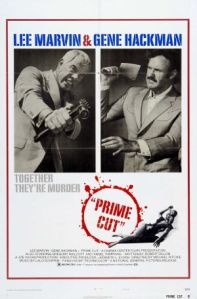
A Movie A Day #39: Prime Cut (1972, directed by Michael Ritchie)


primecutNick Devlin (Lee Marvin) is a veteran enforcer for the Chicago mob.  His latest assignment has taken him out of the city and sent him to the farmlands of Kansas.  Nick is the third enforcer to be sent to Kansas, all to collect a $500,000 debt from a local crime boss named Mary Ann (Gene Hackman).  The first one ended up floating face down in the Missouri River.  The second was chopped up into sausages at the local slaughterhouse.  Nick might have better luck because he once had an affair with Mary Ann’s wife, Clarabelle (Angel Tompkins).

When Nick tracks down Mary Ann to demand the money, he discovers that Mary Ann and his brother Weenie (Gregory Walcott, best remembered for his starring role in Plan 9 From Outer Space) are running a white slavery ring.  Kidnapping girls from a nearby orphanage, Mary Ann and Weenie keep them naked and doped up in a barn.  One of the girls, Poppy (Sissy Spacek, in her film debut), looks up at Nick and says, “Help me.”  Nick takes Poppy with him, claiming that he’s holding her for collateral until he gets the money.

The main attraction here is to see two iconic tough guys — Lee Marvin and Gene Hackman — fighting over Sissy Spacek, who is only slightly less spacey here than in her breakthrough role in Badlands.  In Prime Cut, the ruthless Chicago mobster turns out to have more of a conscience than the rural good old boys who work for Mary Ann and Weenie.  Nothing sums up Prime Cut better than the scene where Lee Marvin, wearing a black suit, and Sissy Spacek are pursued through a wheat field by a thrasher that’s being driven by a roly-poly farmer wearing overalls.  Prime Cut is both an exciting crime film and a trenchant satire of both the American heartland and the type of gangster movies that made Lee Marvin famous.