Neon Dream #9: Air – Alone in Kyoto


Sofia Coppola’s Lost in Translation left a strange impression on me. In a way I can only really compare to Casablanca, it burrowed into my memory like an actual personal experience. I don’t review movies, and I am ill equipped to explain what made it such a special film for me, but the bond that Bob Harris (Bill Murray) and Charlotte (Scarlett Johansson) forge over a few days in Tokyo is something I’ll always carry with me and look back on fondly. That’s pretty weird, but I’m not complaining.

Music was essential to Lost in Translation, embedded into scenes as a part of what Bob and Charlotte actually experience. The hotel lounge has a live jazz band. “The State We’re In” by The Chemical Brothers plays in the club they visit. Phoenix’s “Too Young” pumps over the stereo when they go to a friend’s apartment. A woman dances to Peaches’ “Fuck the Pain Away” at the strip club. The actors aren’t just seen singing karaoke; they perform it at length. Coppola was pretty clever about extending this integration to the more traditionally situated background music. Happy End’s “Kaze wo Atsumete” enhances the feeling that Bob and Charlotte are winding down from an exhausting night, but it drifts faintly into the hallway, as if playing from the karaoke room. Charlotte is wearing headphones when we first hear Air’s “Alone in Kyoto”. The Jesus and Mary Chain’s “Just Like Honey” kicks off as Bob enters his cab. The encore of “Kaze wo Atsumete” in the credits could easily be playing in Bob’s head. Almost every song in the movie functions within the environment, not just as a peripheral enhancement.

Garden State tried something like this a year later, though I don’t recall the extent of it beyond the awkward Shins sequence. The effect was a sort of garish, in-your-face endorsement of director Zach Braff’s favorite tunes. It didn’t really cut it for me, in spite of the soundtrack’s impressive cast. In Lost in Translation, Coppola was a lot more attentive to creating continuity between songs and bringing musicians on board with the film’s atmosphere. She didn’t stop at using “Sometimes” by My Bloody Valentine; she dug founder Kevin Shields out of relative obscurity to compose four original pieces. A lot of the other artists formed a pre-existing community of sorts, suited to engage the project as art rather than a quick paycheck. Soundtrack supervisor Brian Reitzell performed drums for Air on their 2001 album 10 000 Hz Legend. Both Air and Roger Joseph Manning Jr, a fellow studio musician on that album, contribute original music to Lost in Translation. Phoenix previously performed with Air, and Sofia Coppola ultimately married their singer. While their contribution was recycled (“Too Young” appears in the context of young adults who would have been familiar with obscure but up and coming artists; using Phoenix’s first single made sense), the band was still involved in Coppola’s social sphere of musicians.

“Alone in Kyoto” plays as Charlotte travels through the classic side of Japan, visiting shrines and observing ancient customs. While that could possibly put it at odds with my theme, Air’s approach keeps the feeling modern, casting tradition as a subtle, delicate element of the present rather than as a form of escapism. It also occurs in a sequence without character interaction, permitting a pure sense of exploration. Within Lost in Translation‘s soundtrack, “Alone in Kyoto” reaches closest to that Japanese dream that still permeated a lot of American subcultures in 2003. The movie itself brought many of us the closest we would ever come to actually living that dream.

Neon Dream #8: Aphex Twin – Flim


https://www.youtube.com/watch?v=RhHkUg-QCwk

I had a really neat experience once in Monterey. I had never been to California before, I didn’t have a car, and I didn’t get to see much of anything getting there, so I had no idea what existed outside of the town itself. I volunteered to help in the Big Sur marathon, and we loaded up at 4am to drive to the starting point. I knew we were going around a lot of twists and turns, but it was dark and I didn’t think much of it. When the sun came up, we were in a forest, so I figured we must have traveled inland. On the way back, I realized that we’d been dangling on the edge of a cliff dropping into the Pacific ocean the whole way. We were so high up and it was so foggy that sometimes I couldn’t see the ocean at all, and it looked like we were on some floating island in the sky.

An inner city doesn’t work like that. At night, your senses are distorted by a thousand lights shining at you from every direction. Mile-high offices dot the sky like stars. Roads expand to accommodate a vast matrix where red and white atoms shift about chaotically. Black holes surround floating portals into the dimensions of designer makeup and investment banking. Nothing really ends; it just blurs into an electric haze in the distance. The daylight shrinks it all back down into something you can swallow. The cars are just cars. The billboards abandon their depth. The towers have their peaks. Without distinct points of light, they fade from your awareness. No matter how vast the sun-lit scene may be, something about it feels just a bit smaller. It’s quaint, really–a return to a simpler world where buildings are merely a thousand feet tall and bodies line the streets in self-propelled steel boxes, listlessly nodding their heads to music beamed in from outer space.

“Flim”, by the venerable Aphex Twin, appears on the 1997 Come to Daddy EP. It has the sense about it, to me at least, of opening blinds at the top of a highrise hotel and staring across a city in its mid-day bustle.

Horror Songs of the Day: Hellraiser Theme (Christopher Young and Coil)


HellraiserPinhead

For the first horror “Song of the Day” I couldn’t decide on which theme from Clive Barker’s Hellraiser I should use.

Fans of the film should know well the original theme composed by Christopher Young for the film. It’s a more orchestral theme that gives the film a sort of grand guignol grandeur. It’s an epic piece that would get used time and time again for each successive sequel. There might be some minute changes to the theme with each new film, but the basic composition remains. It’s a theme that helps one visualize forbidden texts and grimoires laying in wait for the ones brave or foolish enough to turn the page.

Then there’s the unreleased and unused theme that Barker had originally wanted to use from the industrial band Coil. This theme for the film was more about discordant melodies that harkens back to the more disturbing musical composition used for The Exorcist. It’s a theme that brings up images of the sublime and exquisite pain that Pinhead promises to those solve the Lament Configuration.

Some fans prefer the original Christopher Young suite while others have grown to love and prefer the more disturbing piece from Coil. I, for one, think both could’ve been used in the film though if I had to pick one to use as the main theme then I would go with Christopher Young’s composition.

Christopher Young Hellraiser theme

Coil Hellraiser theme

AMV of the Day: The End of My World (Clannad/Clannad After Story)


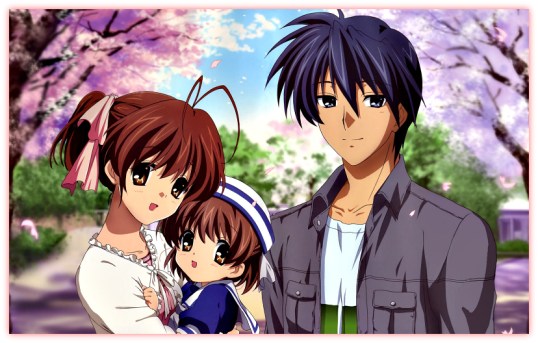
Clannad

The latest “AMV of the Day” comes from the creative mind of one xDieguitoAMV.

“The End of My World” takes select scenes from the anime series Clannad and Clannad: After Story and combines it with the ambient stylings of the band The American Dollar. It chronicles the life of the Tomoya Okazaki through his experiences in both series. It’s told through his point of view as he meets Nagisa Furukawa who would have such a huge impact on his life. The video actually reverse the order by which he sees his life since meeting Nagisa. How she’s changed his outlook on life even if it meant that the happiness he has with her gets balanced out by heartache.

Anyone who has seen this anime knows how the two seasons were polar opposites from each other when it came to their tone and characters. All I can say that I’ve heard anecdotes that even badass, hardened, cynical men who club baby seals for sport have broken down crying like little babies once they’ve seen the series’ After Story. This video will probably relapse them back to that bawling state.

Anime: Clannad, Clannad: After Story

Song: “Twelve Days Awake” by The American Dollar

Creator: xDieguitoAMV

Past AMVs of the Day

Ten Years #49: Matt Uelmen


Decade of last.fm scrobbling countdown:
49. Matt Uelmen (623 plays)
Top track (597 plays): Tristram, from Diablo (1996)
(This sample is the extended–and improved–version appearing in Diablo II.)

The Diablo series managed to evade me in its first two installments, and not for lack of effort on my part. A combination of a panophobic mother in the first instance and an outdated PC in the second restrained my computer gaming experience to Starcraft and Age of Empires. But that didn’t stop me from acquiring the soundtrack. I might have downloaded Tristram in mp3 format as early as 1997, when MIDI replicas were still a viable alternative. (The first mp3 I ever downloaded was Harvey Danger’s Flagpole Sitta. I actually remember this!) At any rate, it is my indisputable favorite song ever. Sorry …And Then There Was Silence. You’ll have to settle for indisputable second. I probably listened to Tristram thousands of times as a teenager before last.fm existed, and even in the past ten years it has drastically exceeded all other songs on my charts. (Compared to 597, my third most listened song is at a measly 255.)

I am not a huge Matt Uelmen fan overall. The numbers attest to that. But this song reaches a level of ambient perfection that has never been achieved before or since. I don’t have much to say about it, save that if you don’t like it I question your humanity. This is the only artist that has climbed his way into my top 50 based on a small selection of songs, let alone based on one single track.

Song of the Day: Blade Runner End Titles (by Vangelis)


While I find my thoughts on how to continue my review on one of my favorite films of all-time I began to listen to it’s soundtrack for inspiration. So, while listening to the Vangelis composed score for Blade Runner I came across what has to be my favorite track from the many different editions of this film’s soundtrack. This track I picked to be my latest “Song of the Day”.

The track I chose is simply the “End Titles” which plays during the film’s end credits sequence. This version of the Vangelis ambient score comes directly from the Esper Edition of the soundtrack which was a bootleg edition that made the rounds in 2002. More specifically, this version of the “End Titles” track is a demo version of what would finally end up in the film.

Vangelis was one of my favorite film composers growing up and it’s saddening that he hasn’t done as much work in the last decade or so. But then his work on Ridley Scott’s Blade Runner was his best and it’s been difficult to top since. Everything about the “End Titles” track was able to convey each and every genre influence the film would mash together to make it into the masterpiece it has become. It’s ambient and electronic synthesizer melody has hints of film noir and, of course, the very science-fiction the film’s foundation has it’s origins in. This was a soundtrack that was one-of-a-kind and as much as others have tried to copy and emulate it they’ve never succeeded.

Ambieber


I will hold my incredible taste and not my complete lack of social contacts to “blame” for having never before heard of the supposed pop sensation Justin Bieber. But I remember NSync, the Backstreet Boys, and similar disasters: These unforgivable icons who severed unscrupulously from the first rule of popstar trash ethics. (If you suck horribly as a musician, you must compensate with nice tits.) It would appear however, as recently discovered by ambient artist Shamantis, that this Bieber fellow has had you all fooled. Those vile record producers took his 35 minute Sigur Rós-esque ambient masterpiece U Smile and sped it up into some five minute trashy pop single.

Or maybe the moral of Shamantis’s experiment is that sound is all relative. The worst garbage on the market can speak in tongues. The complete version of U Smile 800% slower can be found and downloaded below. An abbreviated youtube version follows:

http://soundcloud.com/shamantis/j-biebz-u-smile-800-slower

Song of the Day: Naki Kyoku (by Boris)


Doing a major 180 degrees the latest Song of the Day come from the Land of the Rising Sun. This song was first introduced to me by site music writer necromoonyeti and from the first time the song began to it’s final note it became one of my favorite songs. My last.fm profile will attest to this as I’ve played it a couple hundred times since hearing it for the first time.

I speak of Naki Kyoku by the Japanese power trio, Boris.

It’s difficult to describe the band Boris. They’re definitely s rock band, but other than that simplistic description they’re not a band to be pegged into any particular genre of rock. Their albums have ranged from early hardcore punk and crust. They’ve dabbled in drone metal, sludge metal and ambient. The song Naki Kyoku comes from their 2003 full-lenght album, Akuma no Uta (means “The Devil’s Song”). This particular album and, especially, this song brings to mind an eclectic blending of stoner rock with its cousin, psychedelic and noise rock.

Just like the band which birthed the song, Naki Kyoku can’t be labeled under any particular subgenre of rock as it seems to sound differently for each listener. Don’t know exactly who and what Boris is as a band and especially this particular song of theirs, but I know what I like and this song is one I definitely fell in love with at first listen.