Music Video of the Day: Hitchock Blonde by Laeticia de Valer (2015, dir by J. Antonio)


According to TimeandDate.com, today is Alfred Hitchcock Day!

I’m not sure why March 12th would be considered Alfred Hitchcock Day, seeing as how Alfred Hitchcock was born in August of 1899 and passed away in April of 1980.  But no matter!  It’s always a good day for Hitchcock!

So, in honor of Alfred Hitchcock Day, today’s music video of the day is Laeticia de Valer’s Hitchcock Blonde!

Enjoy!

Spy in the House of Love: Alfred Hitchcock’s NOTORIOUS (RKO 1946) — cracked rear viewer


You won’t find a more glamorous pair of spies than Cary Grant and Ingrid Bergman in Alfred Hitchcock’s NOTORIOUS… except maybe in other films that feature Cary Grant as a spy! The Master of Suspense once again goes full speed ahead in bringing this exciting espionage caper to the screen loaded with the usual “Hitchcock Touches”, and […]

via Spy in the House of Love: Alfred Hitchcock’s NOTORIOUS (RKO 1946) — cracked rear viewer

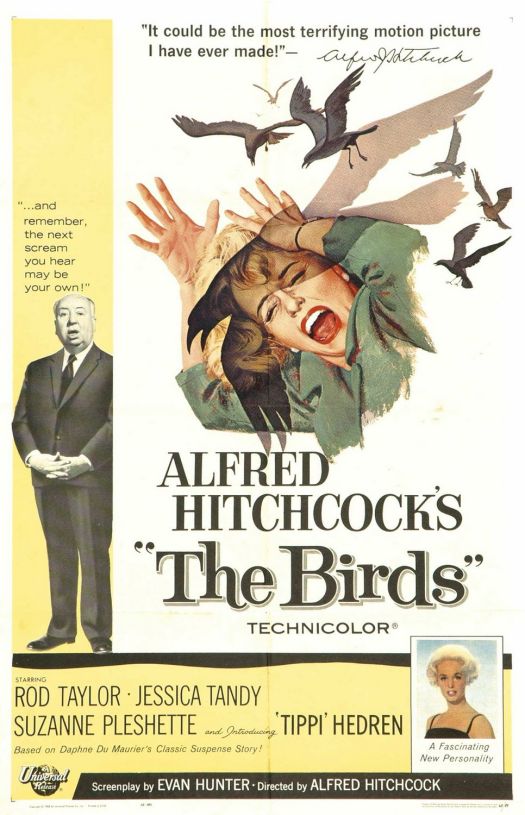
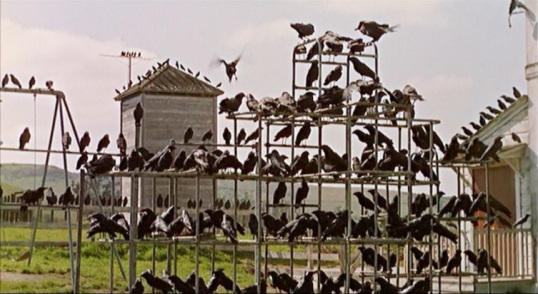
Halloween Havoc!: Alfred Hitchcock’s THE BIRDS (Universal 1963)


gary loggins's avatarcracked rear viewer

Many years ago, back in the 80’s I believe, I spent a week on Martha’s Vineyard. It was early in the morning on a gorgeous summer day, and as my friend was still crashed from the previous evening’s debauchery, I decided to walk down to the beach and catch some rays. I strolled past a particularly marshy stretch when, out of nowhere, a seagull buzzed by my head. Then another. And another. And soon there were about ten of the nasty flying rats swooping down at me, screeching and dive-bombing toward my long-haired dome (this was back when I actually had hair!). I ducked and dodged, yelling and snapping my beach towel at the airborne devils, and ran as fast as I could away from the area, scared to death one of these buzzards was going to peck my eyeballs out! It was like something straight out of Alfred Hitchcock’s 

View original post 926 more words

4 Shots From 4 Films: Special Alfred Hitchcock Edition


4 Shots From 4 Films is just what it says it is, 4 shots from 4 of our favorite films. As opposed to the reviews and recaps that we usually post, 4 Shots From 4 Films is all about letting the visuals do the talking.

This October, I am going to be using our 4 Shots From 4 Films feature to pay tribute to some of my favorite horror directors, in alphabetical order!  That’s right, we’re going from Argento to Zombie in one month!

Today’s director: the master of suspense, Alfred Hitchcock!

4 Shots From 4 Films

The Lodger (1926, dir by Alfred Hitchcock)

Psycho (1960, dir by Alfred Hitchcock)

The Birds (1963, dir by Alfred Hitchcock)

Frenzy (1972, dir by Alfred Hitchcock)

Horror Book Review: Alfred Hitchcock and The Making of Psycho by Stephen Rebello


57 years after it was first released, Alfred Hitchcock’s Psycho remains one of the most influential films ever made.

Certainly, every horror film ever released since 1960 owes a debt to Psycho.  The infamous shower scene has been duplicated so many times that I’ve lost count.  Whenever a big-name actor is unexpectedly killed during the first half of a movie, it’s because of what happened to Janet Leigh in that shower.  If not for Psycho, Drew Barrymore would have survived Scream and that shark would never have eaten Samuel L. Jackson in Deep Blue Sea.  Every giallo film that has ended with someone explaining the overly complex psychological reasons that led to the killer putting on black gloves and picking up a scalpel owes a debt to Simon Oakland’s monologue at the end of Psycho.  Psycho is so influential and popular that, decades later, A&E could broadcast a show called Bates Motel and have an instant hit.

What goes into making a classic?  That is question that is both asked and answered by Stephen Rebello’s Alfred Hitchcock and The Making of Psycho.  Starting with the real-life crimes of Ed Gein, Rebello’s book goes on to examine the writing of Robert Bloch’s famous novel and then the struggle to adapt that novel for the screen.

This book is a dream for trivia lovers.  Ever wanted to know who else was considered for the role of Marion Crane or Sam Loomis or even Norman Bates?  This is the book to look to.  Read this book and then imagine an alternate world where Psycho starred Dean Stockwell, Eva Marie Saint, and Leslie Neilsen?

(That’s right.  Leslie Neilsen was considered for the role of Sam Loomis.)

The book also confronts the controversy over who deserves credit for the shower scene, Alfred Hitchcock or Saul Bass.  And, of course, it also provides all the glorious details of how Hitchcock handled the film’s pre-release publicity.  Ignore the fact that this book was cited as being the inspiration for the rather forgettable Anthony Hopkins/Helen Mirren film, Hitchcock.  This is a fascinating read about a fascinating movie and a fascinating director.

First published in 1990 and still very much in print, Alfred Hitchcock and The Making of Psycho is a must-read for fans of film, horror, true crime, history, Alfred Hitchcock, Anthony Perkins, Janet Leigh, and Psycho.

Sweet Land of Liberty: Alfred Hitchcock’s SABOTEUR (Universal 1942)


gary loggins's avatarcracked rear viewer

The Master of Suspense puts the pedal to the metal once again in SABOTEUR, another “double chase” spy thriller that doesn’t get the attention some of Alfred Hitchcock’s other films do, but should. I’ve always enjoyed the performance of Robert Cummings as the “ordinary man caught in an extraordinary situation”; his naturally laid-back, easygoing charm makes him perfect playing Barry Kane, accused of sabotaging a wartime aircraft plant and killing his best friend in the process, who winds up on a cross-country chase alongside reluctant heroine Priscilla Lane . SABOTEUR is certainly an  important film in Hitchcock’s body of work for one important reason: it’s the director’s first film for Universal Pictures, a studio he’d have a long and profitable association with, and where he’d later create some of his finest movies.
SABOTEUR is in many respects a loose remake of Hitchcock’s THE 39 STEPS , transplanted to America and…

View original post 701 more words

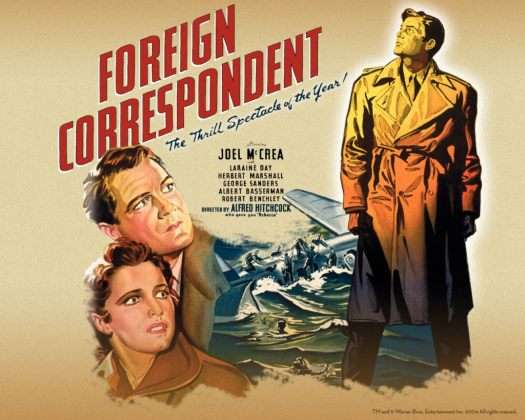
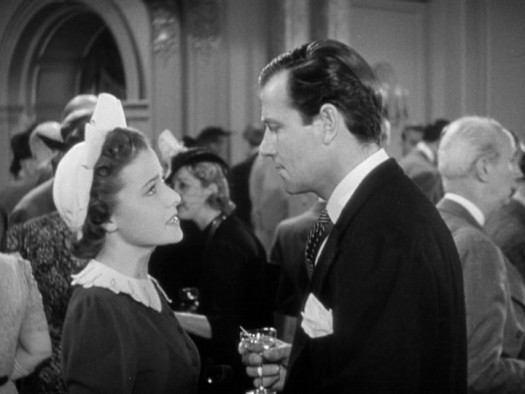
Windmills of Your Mind: Alfred Hitchcock’s FOREIGN CORRESPONDENT (United Artists 1940)


gary loggins's avatarcracked rear viewer

(When Maddy Loves Her Classic Films invited me to join in on the Alfred Hitchcock Blogathon, I jumped at the chance! I’ve just completed the Ball State/TCM 50 YEARS OF HITCHCOCK course, and have been knee-deep in his movies for a month now!)

Alfred Hitchcock’s second American film found the Master of Suspense back in the spy game with FORGEIGN CORRESPONDENT, this time with American star Joel McCrea caught up in those familiar “extraordinary circumstances” we’ve all come to love. Like REBECCA that same year, this film was nominated for Best Picture, an extraordinary circumstance indeed for a director new to these shores. Offhand I can only think of three other directors to hold that distinction – John Ford (also in ’40), Sam Wood (1942), and Francis Ford Coppola (1974). Good company, to say the least! (And please correct me if I’m wrong, any of you film fans out there).

Crime beat reporter…

View original post 644 more words

Gothic Art: Alfred Hitchcock’s REBECCA (United Artists 1940)


gary loggins's avatarcracked rear viewer

REBECCA is unquestionably a cinematic masterpiece. I remember watching it for the first time in a high school film class, enthralled as much by its technical aspects as the story itself. This was Alfred Hitchcock’s  first American film, though with a decidedly British flavor, and his only to win the Best Picture Oscar. There’s a lot of film noir shadings to this adaptation of Daphne DuMaurier’s  Gothic novel, as well as that distinctive Hitchcock Touch.

“Last night I dreamt I went to Manderley again”, begins Joan Fontaine’s narration, as the camera pans down a dark road overgrown with brush and weeds, fog rolling in all around, as we come up on the once majestic castle called Manderley, now lying in ruins. This first shot was all done with miniatures, another wonderful example of Hitchcock’s innovative use of the camera, looking and feeling totally believable (take that, CGI!). Flashbacks bring us to when Fontaine’s character, who’s…

View original post 570 more words

Fast & Furious Hitchcock: THE 39 STEPS (Gaumont-British 1935)


gary loggins's avatarcracked rear viewer

The chase is on – and on – as Robert Donat and Madeleine Carroll are pursued by cops and spies while pursuing a deadly secret in Alfred Hitchcock’s THE 39 STEPS. The “double chase”, first used by Hitch in his silent THE LODGER (1927), playfully keeps the film’s motor running in high gear, and introduces us to two of his soon-to-be famous tropes, the “McGuffin” and the ice blonde. It’s certainly an important film for Hitchcock, as it caught the eye of Hollywood producer David O. Selznick, who would bring Hitch to America’s shores five years later.

Donat, later an Oscar winner for 1939’s GOODBYE MR. CHIPS, plays Richard Hannay, trapped in circumstances beyond his control. The film begins in one of Hitchcock’s favorite places, a crowded public landmark, in this case a music hall (the marquee reminiscent of the shot of Anna Ondry walking past “A New Comedy” in BLACKMAIL ), as Hannay watches…

View original post 622 more words

Look At Me Look At You: Alfred Hitchcock’s REAR WINDOW (Paramount 1954)


gary loggins's avatarcracked rear viewer

When you go out to the neighborhood cinema, you’re indulging in a voyeuristic experience, watching the lives of people unfold before you on the screen. The theme of viewer as voyeur, peeping in on the privacy of total strangers, has never been done better than in Alfred Hitchcock’s REAR WINDOW, nor more entertainingly. Like James Stewart’s protagonist L.B. Jeffries, we the audience are the voyeurs in the shadows watching from afar, stumbling onto things not meant for our eyes, and powerless to stop them without outside assistance. Hitchcock is not only the Master of Suspense, but a master of audience manipulation, and this dazzling piece of moviemaking is not only a hell of a thrill ride but a technical marvel as well.

The world of globetrotting photojournalist Jeffries has been boiled down to the view of the courtyard outside his apartment window, just as the audience’s world is now focused on…

View original post 856 more words