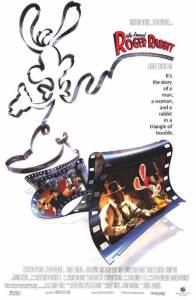
 I can’t quite remember how I found out about 1988’s Who Framed Roger Rabbit. Growing up, most of my movie news came from four major sources – Entertainment Tonight, Siskel & Ebert, the occasional movie poster you’d see at a bus stop or cinema. If you were really lucky, the production company would sometimes create a “Behind the Scenes”/”Making of” showcase a little after the movie premiered. If possible, I would read the billing block of a poster to see if I could recognize anyone familiar, Just seeing Amblin Entertainment meant you’d have Steven Spielberg, Kathleen Kennedy and Frank Marshall involved. Nothing new there. I knew Robert Zemeckis and Alan Silvestri from Romancing the Stone and Back to the Future. Movies have had mixes of animation and live action – Bedrooms & Broomsticks, Mary Poppins, etc., but the big buzz here was the film planned to somehow involve both the Disney and Warner Bros. animation studios. It was an alien concept for me, because they couldn’t be more different from each other. Historically, animation on the WB side of things were edgy and almost dared to be even raunchy if they could get away with it. Disney, on the other hand, was pristine and extremely kid friendly. Bugs Bunny and Mickey Mouse? Daffy Duck vs. Donald Duck, all on the same screen? It was the 1980’s equivalent of asking Marvel (which ironically, is owned by Disney now) and DC (which the WB has owned for decades) to write a single Justice League / Avengers crossover story.
At the time, Steven Spielberg was already well known for blockbusters like the Indiana Jones films and E.T., but did he really have enough clout to bring two major companies together like that? It blew my 13 year old mind and I became completely obsessed.
Around the time Who Framed Roger Rabbit came out, I picked up anything I could find about it. I had Alan Silvestri’s soundtrack, a poster, a stuffed Roger doll, and the video game when it came out. I even read Gary Wolf’s novel. I begged my parents to let me see it, and it was one of the rare times where my Mom took my sis and I to the movies instead of my dad (the major movie buff, who took us to see Robocop twice the year before). I think she went in part to shut me up, and to give herself a break from my nearly 2 year old brother. It remains one of the two best movie related memories I have of her.
In the world of Who Framed Roger Rabbit, humans and cartoons share the same space in Los Angeles. Cartoons live in Toontown, owned by Marvin Acme (Stubby Kaye). It’s the story of Eddie Valiant (Bob Hoskins – Hook, Mermaids), a Los Angeles Private Eye with a bit of a grudge against toons. For a quick buck, Valiant is hired by R.K. Maroon (Alan Tilvern – Firefox, Little Shop of Horrors) to snoop on Acme. Valiant’s work puts him in the path of Roger Rabbit (Charles Fleischer, Back to the Future Part II), after Eddie takes some racy pictures of Acme playing patty cake with Roger’s wife, Jessica (Kathleen Turner, Romancing the Stone). Roger angrily swears they’re still a happy couple and that Acme somehow coerced her before running off into the night. The next morning, Eddie is informed that the Marvin Acme’s been killed overnight. To make things worse, Acme’s Will is missing, leaving the fate of Toontown up in the air. All of the evidence points to Roger, but Roger asks for Eddie’s assistance in clearing his name. Can Eddie save Roger before Judge Doom (Christopher Lloyd, Back to the Future) and his pack of weasels get their hands on him?
The production for the film required jumping over a number of hurdles. Zemeckis, himself a cartoon fan, wanted to bring some of the Warner Bros. characters along with Disney characters. Even better, he also wanted to add some of Tex Avery’s classic style to the film. Similar to what he did with Ready Player One, Spielberg negotiated with some of the studios, and while he couldn’t get everyone, he did manage to get Disney, WB and a few others to commit. With this in place, they had to somehow merge animation with live-action in a way that made it look like the cartoons were interacting with their environment.
This would require one really huge magic trick, made up from an assortment of parts.
Since it was around 1986-1987, there really was no CG, yet.. James Cameron made 6 stuntmen in Alien suits look like 600 through the use of Oscar Winning Editing, and the technology that gave us the paradigm shifting dinosaurs of Jurassic Park wouldn’t occur for another 3 or 4 years. For Who Framed Roger Rabbit, the approach was a mix of robotics, puppetry, sleight of hand gadgetry, and a lot of imagination.
The art was handled by Richard Williams and his team, who would go on to win a Special Achievement Oscar for his contribution to the film. They had to draw every cell/frame by hand, on paper and then have them inked. These would then go to Industrial Light & Magic, who would add shadow, highlights and special effects To make things harder, the artists had to work around Zemeckis’ filming style and figure out how to fit the characters into each scene.
Take Jessica Rabbit’s performance of “Why Don’t You Do Right?”, sung by Amy Irving (Carrie, The Fury). At first glance, it seems a really easy shot. Girl steps on the stage, performs and leaves, right? However, there are so many things happening here on an effects level that I still don’t fully understand how they did it after all these years. ILM handled the lighting, from the sparkles in the dress, the use of the handkerchief and the great moment where Jessica blocks the spotlight in her walk from Acme to Valiant. I had to later explain to my mom that the “Wow” I whispered in the theatre during that scene had little or nothing to do with puberty. It was because I hadn’t seen anything like that before with a cartoon, and I’d hate the Academy forever if the movie didn’t win an Oscar for that.
Having cartoons on screen is one thing, but making it feel like they were interacting with people is another. Hoskins was the anchor that tied most of it all together. Having to work with nearly nothing – not even a green screen – and perform the physical actions required of the role was quite a feat compared to what some actors do with the motion capture rooms and digital walls we use today. Near lifesize models of Roger were created to help Hoskins handle some of the physical “grab and move” sequences, and actor Charles Fleischer actually spent time dressed as Roger on set (but off camera, of course) to feed his side of the conversation to Hoskins when filming a scene.
Puppeteers were brought on for moments were toon characters needed to hold objects, such as guns or knives. There is a moment of the movie where you can see one of the holes for the guns that the weasels, but it’s a pretty minute hiccup with all of the great work that was done. For the car sequences with Benny the Cab (also Fleischer), they used a special mini-car with a driver in the back. The car and driver were painted over (still, frame for frame) by the animators.
And ff course, it wouldn’t be a Zemeckis film without Alan Silvestri at the helm, musically speaking. Silvestri’s score for was a mix of detective noir and cartoony antics, which made for a perfect fit for the film. Overall, Who Framed Roger Rabbit is one of those films I cherished growing up, and it’s almost impossible for me to avoid recommending it.



 Through the Shattered Lens