In this episode of The Twilight Zone, bitter millionaire Paul (Joseph Wiseman, who also played the title character in Dr. No around the same time that this episode as shot) offers three people safety from a nuclear war on one condition. They must apologize to him for insults that are both real and imagined.
This episode originally aired on January 12th, 1962.
In this episode of The Twilight Zone, Marsha White (played by Anne Francis) discovers some strange things happening in a department store. If you’re like me and you find mannequins to be super creepy, this episode is for you!
In this episode of Buffy the Vampire Slayer, Buffy gets infected with the blood of a demon and develops the ability to hear other people’s thoughts. Along with allowing her to discover that Xander is obsessed with sex (like she needed telepathy for that) and that Giles and her mom did it twice on the hood of a police car, it also allows her to discover that one of her classmates might be planning on doing something violent.
This is one of my favorites episodes of Buffy, largely because it uses the paranormal as a way to expose a very real issue and to explore everyone’s shared humanity. Plus, I’ve always felt that, even after playing Buffy and starring in the wonderful guilty pleasure Ringer, Sarah Michelle Gellar remains a sadly underrated actress. This episode features her at her best.
I cannot begin to put into words just how much I miss the Fox Reality Channel! From 2005 until it went off the air in 2010, Fox Reality was the channel to go to if you wanted to watch some of television’s greatest guilty pleasures. It was all reality tv all the time, a mix of original programming with reruns of shows like The Amazing Race, American Idol, Hell’s Kitchen, and about a hundred different dating shows. Occasionally, they would devote an entire weekend to showing just one show and I have many fond memories of binge watching Paradise Hotel on Fox Reality.
Fox Reality also showed its share of cheap original programming as well, including today’s guilty pleasure. If you were watching the Fox Reality Channel in 2009 (as I was and I have the tweets to prove it), there’s a good chance that you saw this commercial:
Now, of course, after seeing that commercial, you probably said, “Oh my God, I have to watch this show! I mean, it says ‘sex’ right there in the title so it has to be good!”
So, you tuned into the Fox Reality Channel and, after sitting through the last 15 minutes of a rerun of The Rebel Billionaire: Richard Branson’s Quest For The Best, you watched Sex Decoy: Love Stings.
Fortunately, just in case you were unsure about what you were about to watch, the opening credits explained the whole concept behind this “reality” show:
All 8 episodes of Love Stings started out the same way, with Arizona P.I. Sandra Hope talking about how worried she is about her three daughters: Kashmir, Jasmine, and Xanadu. It upsets Sandra that all three of them dislike her nerdy boyfriend and business partner, Tom. It also upsets Sandra that all three of her daughters work as strippers whenever they are running low on funds. (But, if Sandra is so worried about all of her daughters becoming strippers, why did she give them all stereotypical stripper names? That’s what I’ve always wondered…) Then the daughters show up and make fun of Tom and complain that Sandra doesn’t treat them like adults…
It’s probably around this time that you, the viewer, came to realize that Sex Decoy: Love Stings was obviously an attempt to create a hybrid of Cheaters and Keeping Up With The Kardashians. Much like the Kardashians, Sex Decoy was obviously scripted. However, Sandra and her daughters made Kim, Khloe, Kourtney, and even Kris look like Oscar-winning thespians by comparison. Sandra, in particular, had an amazingly robotic voice. Her dialogue and her interactions with Tom and her daughters were so lacking in emotion and spontaneity that they became odd portraits of existential dread. And when Sandra robotically talked about how much money she made by exposing cheaters, it almost felt as if we were watching one of Jean-Luc Godard’s experimental attacks on capitalism.
Anyway, after each episode’s family crisis had been set up, we would then meet this week’s client and get around to exposing their mate as being a cheater. This, of course, involved a lot of secret cameras and a sex decoy who would be brought in to seduce the cheater while the client watched in a nearby trailer. (Often times, Sandra would use her own daughters as the decoy which was kind of icky. A running subplot, throughout the series, was that Kashmir felt she was never properly used as a decoy and, as a result, would threaten to go back to stripping.) The client, naturally, would often get very upset and eventually, the cheater would end up being confronted while the cameras rolled.
And again, what made this so fascinating was the total inability of Sandra or her daughters to show any hint of human emotion. The client would get upset and start yelling. The cheater would try to talk his way out of it and occasionally beg for forgiveness. Meanwhile, Sandra and the daughters would watch and say things like, “He. Is. A. Cheater.” It was almost as if they were aliens sent down to Earth to expose cheaters.
Each show would end with Sandra, Tom, and the daughters doing some sort of family activity. Sandra would often brag that Sex Decoy was a family business but, being a robot, it always came out as, “After. All. We. Are. A. Family. Business.”
It was seriously just so strange to watch and that strangeness made it the epitome of a guilty pleasure. Sadly, Fox Reality is gone but Sex Decoy lives on! You can watch every episode on Hulu. And, fortunately, there’s only 8 of them so, right when the novelty of the show starts to wear off, it’s over!
Let’s continue our look at Horror on TV with another classic episode of Buffy the Vampire Slayer! Just as yesterday’s episode focused on a supporting character (Xander), this episode focuses on Willow!
I was going to say that Doppelgangland was one of my favorite episodes of Buffy the Vampire Slayer but then I realized that everyone would probably say that. This is an episode that truly shows why countless fans continue to love the show after all these years.
I love Buffy The Vampire Slayer and it’s always bothered me that I haven’t been able to share any episodes on this site. But, fortunately, this Halloween, Hulu has come to the rescue!
The Zeppo is one of my favorite episodes. While Buffy and the Scooby Gang save the world in the background, Xander (Nicholas Brendon) finally gets an adventure of his very own! Actually, there’s a lot of things that Xander finally gets to do in this wonderful episode!
(On a personal note, it breaks my heart whenever I read about Nicholas Brendon getting arrested and I’m reminded that Xander was just a fictional character.)
“Sometimes all we can do is not enough.” — Dr. Bethany Exner
[some spoilers]
Fear the Walking Dead has been a mystery to some audiences and critics. If there was something the original series was criticized on it was that it’s writing throughout it’s current run has been uneven. There would be some great episodes and some good ones, but then some go nowhere episodes that stops any sort of momentum a particular season was having. The Walking Dead deserved some of the criticism leveled at it’s writing and how some of it’s characters appeared one-note for too long. Things began to improve once Scott M. Gimple took over a showrunner beginning with season 4. yet, some of the damage had been done by a very uneven first three season.
One thing The Walking Dead was never lacking was it’s creativity when it came to the zombies and the violence around them. Greg Nicotero and his KNB EFX crew never flinched from whatever hellish idea the writers were able to come up with. It’s probably one of the main reasons why the show has succeeded so much despite flaws in the writing and characterization. People were willing to tolerate the soap opera-style character interactions if it meant the flesh-eating and the headshots came a-plenty.
The first half of Fear the Walking Dead didn’t have much of the zombie action. It was a bold decision by the writers to stay on the path that brought the early days of the zombie apocalypse to life. This was a show that didn’t already have zombies taking over and with civilization having fallen by the wayside. It was still a world where everyone went about their daily routines. Sure the first episode gave some hints that something was amiss, but not until the final minutes did we finally see our first zombie. Even after that initial reveal at the end of the pilot the writers kept the zombies more off-screen. When they did appear it was as one or two.
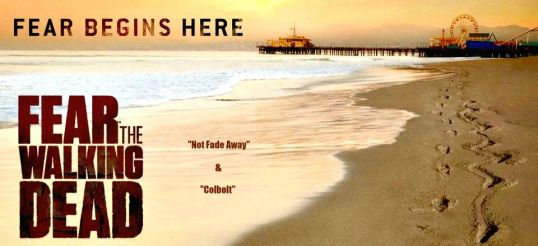
Episodes four and five, “Not Fade Away” and “Cobalt”, continued this trend of keeping the zombies at arm’s length and off-screen. We saw Travis and Madison’s neighborhood turned into a safe zone by the National Guard who had been deployed to help contain and combat the spreading infection. Some took the military’s arrival with optimism (Travis) while others saw their arrival as a sign that things were just going to get worse and that things might already be too late to save (Daniel).
These two episodes were some of the strongest in this shortened first season of Fear the Walking Dead. We got to learn more about every character, but mostly we learned just how differently each parent of the core group reacted to the growing situation. These were reactions that were as varied and complex as any we’ve seen in any of the characters in The Walking Dead.
Each parent tried to do what they thought was best for their immediate family. On one end of the moral spectrum we had Travis who tried to serve as a sort of de facto mayor of the walled-off neighborhood. Become the person that would be the one who dealt with the military liaison when it came to his family’s and, to an extent, the neighborhood’s well-being. So far, throughout the this short first season, Travis has come across as the sort of enlightened, civilized man who tries to reason and talk things out instead of acting out rashly and on instinct. This sort of personality is what we as a society want to keep the wheels of civilization moving along problem-free. But as we’ve seen this has also become a weakness as things progressively begin to get worst. Travis can’t seem to see that the rule of law and reason seem to be fighting a losing battle with the need to survive.
Yet, despite Travis’ coming off as some sort of pacifist we get a hint of logic to his seeming weak-willed madness. He sees the world crumbling around him and as a father and role model he has tried to be that moral center to his circle of family and friends. Even when what he’s seeing chips away at his belief that those in power will protect and save them, Travis tries to remain that strong, moral center.
The opposite seems to be true for the other father in our group, Daniel Salazar. This character has been quite the revelation in this series. We first meet him in episode 2. He comes across as a leery, but good man like any immigrant in the US looking to make a new life for his family. But with each new episode we learn a bit more of what makes Daniel tick. He’s a father whose past history before coming to the US hints at chaos and bloodshed. He has seen how crisis could spiral out of control in a blink of the eye and he sees that now with the arrival of the military. He doesn’t trust too many outside his wife and daughter and when he does, as the case with Madison, he does so begrudgingly. He’s adaptable to the ever-changing situation the way Travis is not. He’s willing to resort to immediate action to solve a problem or to find a solution. There’s a darkness in him that’s the current situation has awoken once more and it terrifies him, but he allows it to emerge nonetheless in order to keep his family safe.
Throughout these two episodes we see the recurring theme of authority in its many forms (parental, civilian and military) trying to do their best to keep the situation from spiraling out of control, but they despite all their efforts they fail due to that basic flaw that humanity can’t seem to shred and that’s the inability to work together at the most dire situation to solve the problem.
Both Travis and Daniel try to do the best they know how to navigate through and around the encroaching apocalypse. They succeed in some way, but in the end all their efforts still don’t amount to much as everything right from the start of the crisis has been stacked against them. All they could do now is try and save those closest to them.
The question now as we head into the season finale is whose path will ultimately be the best one to navigate in this apocalypse.
Will it be the Way of the Open Palm that we seem be getting from Travis?
A path of sticking to one’s moral center and principles. To try and keep oneself from sliding back into one’s darker impulses as we’ve seen signs of in these two episodes.
Or will it be the Way of the Closed Fist that Daniel seem to be following?
A mentality that requires quick thinking and direct action even if it means allowing one’s darker side to take hold in order to survive. It’s a path that looks to be well-suited for this apocalypse, but one that also brings with it a set of unknown dangers.
So, while the series has so far lacked in major zombie action and the gore quotient has been tame in comparison to The Walking Dead, it has one-upped it’s older sibling by allowing for it’s cast to grow as characters. Whether they all turn out for the better remains to be seen, but in the span of 5 episodes they’ve become full-fledged characters and now the finale will see who will remain steadfast and who will break.
Notes
“Not Fade Away” and “Cobalt” were directed by Kari Skogland. Meagan Oppenheimer has writing duties on the former with David Wiener being responsible for the latter.
It’s been nine days since the events of episode 3 and it looks like both the National Guardsmen and the neighborhood are fraying at the edges. It doesn’t help that the unit commander is a reservist who also happens to be an LAPD policeman on a power-trip.
Still no sign of Tobias. It looks like his own place might be located in the unsafe and unwalled “dead zones” the military have been doing sweeping patrols for the past nine days.
Sandrine Holt comes in as Dr. Bethany Exner. Not her first time in a zombie production. She was also in Resident Evil: Apocalypse as Raccoon City news reported Terri Morales.
Ruben Blades is turning out to be the MVP of the series, so far. I guess being a government torturer in his native El Salvador during it’s time of troubles is turning to be a good skillset in the coming zombie apocalypse.
In this episode of The Twilight Zone, Gladys Cooper plays an elderly woman who lives in such fear of death that she refuses to even open the door of her apartment. Then, one day, a young policeman (Robert Redford) is shot outside of her apartment and Cooper is forced to finally confront the world.
This episode was directed by Lamont Johnson and written by George Clayton Johnson. It originally aired on January 5th, 1962.
This classic episode of the Twilight Zone originally aired on February 10th, 1961. It was written by Rod Serling, directed by Jack Smight, and stars Barbara Nichols.



 Through the Shattered Lens