Welcome to Late Night Retro Television Reviews, a feature where we review some of our favorite and least favorite shows of the past! On Wednesdays, I will be reviewing 1st and Ten, which aired in syndication from 1984 to 1991. The entire series is streaming on Tubi.
This week, season one comes to an end with the Championship Game!
Episode 1.13 “Super Bull Sunday”
(Dir by Bruce Seth Green, originally aired on February 17th, 1985)
The Bulls make it to the Championship Game!
And lose!
In fact, they lose in spectacular fashion. We don’t actually see much of the game but we do see the aftermath. We learn that star running back Carl Witherspoon set a record for fumbles. Star quarterback Bob Dorsey set a record for interceptions. The offensive line set a record for letting their quarterback get sacked. Coach Denardo blames himself but Diana announces to the press that the Bull will be back next year so …. “LOOK OUT!”
Admittedly, the big game only took up about 5 and a half minutes of screentime. Most of this episode centered around a dumb plot to trick Diana into selling the Bulls to the Japanese so that her ex-husband (remember him?) could swoop in and buy back his team. It was a pretty dumb plan that fell apart easily but, at the very least, it appears that it finally led to Diana firing her duplicitous general manager, Roger Barrow (Clayton Landey), something she should have done at the start of the season.
But let’s give the show some credit. It would have been really easy to just have the Bulls pull off another last-minute victory. Instead, season one ended with the agony of defeat and the actors actually did a really good job of playing up their depression. It can’t be easy make it to the Championship Game and fail.
So, that’s it for season one. It wasn’t really that good of a season but maybe I would feel differently if I was a football fan or if I was a dude. This is very much a guy-centered show. Next week, we’ll start season 2!
In Children of the Full Moon, a married couple on holiday has some car trouble. They find a large house that is looked over by Ms. Ardoy (Diana Dors) and inhabited by a multitude of children, who may or may not be werewolves. This episode starts out somewhat light but the tone eventually shifts and things end on a memorably dark note. Diane Dors gives a wonderful performance as the mysterious Ms. Ardoy. Be careful about where you take your vacation.
This episode originally aired on November 1st, 1980.
I’ve never been a rabid consumer of horror films, but I do love Alfred Hitchcock. And when you consider that Charles Bronson was featured three times in his TV series, ALFRED HITCHCOCK PRESENTS, you know I’m all in. Bronson first appeared in the season 1 episode, “And So Died Riabouchinska” which starred the Invisible Man himself, Claude Rains! I thought it would be fun to revisit this early episode from the classic TV series.
When a juggler named Ockman is found dead in the basement of a vaudeville theater, Detective Krovitch (Charles Bronson), a no-nonsense police investigator, is on the case. The prime suspect quickly emerges to be John Fabian (Claude Rains), a ventriloquist whose act revolves around his beautiful female dummy, Riabouchinska, who we find out is modeled after a long, lost love. As Krovitch interrogates Fabian and all of those around him, including his embittered wife Alyce (Wynne Miller), and her lover, the shady manager Douglas, it becomes clear that the ventriloquist has a dark and dangerous past. We discover a Fabian who is lost in a world of obsession, self delusion and even perversion, a world that the now deceased Ockman was threatening to expose. Without giving too much away, this episode blends psychological horror with police procedural and spits out an episode that still resonates loudly on the freaky-meter!
Adapted by Mel Dinelli from Ray Bradbury’s short story, “And So Died Riabouchinska” is an exceptional entry in Season 1 of the ALFRED HITCHCOCK PRESENTS TV series. Claude Rains is incredible as Fabian. It’s a thespian tour-de-force, with Rains creating a role that’s creepy, pathetic, and oddly relatable all at the same time. I haven’t seen many of Rains’ most notable works, but based on his performance here, I do know that he’s amazing. Charles Bronson, whose strong screen presence was as obvious as the nose on his face, even this early in his career, goes toe to toe with Rains (and Riabouchinska) and helps ground the episode in something resembling the real world. It’s not a showy role for the legendary tough guy, but he conveys the toughness and authority that would go on to define his career. Performances aside, the episode is truly set apart with an emotional storyline that plumbs the depths of the human psyche in a way that seems daring for 1956 television. There are parts of this episode that will definitely make you squirm in your seat!
Overall, in my opinion, “And So Died Riabouchinska” is an essential episode of the ALFRED HITCHCOCK PRESENTS series. It’s a lot of fun seeing Hitchcock introduce the show at the beginning and wrap it up at the end, but the best part is the fact that the story that takes place in-between is creepy, clever, and compulsively re-watchable.
For the tenth season of Doctor Who, the BBC knew that they needed to start things off with a bang. The first serial of season ten, The Three Doctors, brought together the first three actors who had played the Doctor.
A crisis was needed to explain why the Time Lords would decide to break their owns laws by bringing the Second Doctor and then the First Doctor out of their respective time zones. Writers Dave Martin and Bob Baker came up with a story about the Doctor’s homeworld having its energy drained through a black hole. If Gallifrey is destroyed then all of time and space will unravel. (Everyone who has seen an episode of the original Doctor Who knows the drill.) The villain is Omega (Stephen Thorne, who also played Azal in The Daemons), the first Time Lord, who has never forgiven his fellow Time Lords for abandoning him in an anti-matter universe that looks like a quarry. The story is silly in the way that Doctor Who often could be but I think anyone watching will understand that the story is not that important. Omega, the black hole, the energy blob that is sent to Earth to capture the Third Doctor, all of it was really just an excuse to bring back Patrick Troughton and William Hartnell.
Hartnell does not get to do much. He was in increasingly poor health when he returned as the First Doctor and was also suffering from memory problems. Sadly, this prevented him from sharing the same physical space as Troughton and Jon Pertwee. Instead, it’s explained that the First Doctor is caught in a time eddy and can only communicate via the TARDIS’s viewscreen. Even if he isn’t physically present, the First Doctor reveals himself to be the smartest of the three Doctors. When he isn’t scolding the Second and Third Doctors, he’s figuring out how to enter Omega’s universe. It’s not always easy to watch Hartnell looking frail and clearly reading some of his lines from cue cards but, even when ill, he still had the natural authority that he brought to the first two and a half seasons of Doctor Who.
Patrick Troughton and Jon Pertwee are a delight to watch. Their bickering is one of the highlights of the serial and both Troughton and Pertwee appear to have really enjoyed their scenes together. The show also gets mileage from including the Brigadier (Nicholas Courtney) and Sgt. Benton (John Levene) along with the three Doctors. I’ve always enjoyed how both of them come to accept the strangest of things with barely a shrug. This is the episode where Benton enters the TARDIS and, when the Third Doctor asks if Benton’s going to point out that it’s bigger on the inside than the outside, replies, “It’s pretty obvious, isn’t it?”
TheThreeDoctors is hardly a perfect DoctorWho adventure. (If any adventure needed the presence of the The Master, it was this one.) It is, however, a tribute to the men who played the first three Doctors and the role they all played in making the show an institution. The Three Doctors was also the final acting role of William Hartnell, who passed away two years after the serial was broadcast.
Welcome to Retro Television Reviews, a feature where we review some of our favorite and least favorite shows of the past! On Wednesdays, I will be reviewing the original Love Boat, which aired on ABC from 1977 to 1986! The series can be streamed on Paramount Plus!
Welcome aboard, it’s love!
Episode 6.21 “The Captain’s Crush/Out Of My Hair/Off-Course Romance”
(Dir by Ted Lange, originally aired on February 19th, 1983)
Kathy Costello (Stella Stevens) is looking forward to taking a cruise with her husband, Joe (Monte Markham). However, at the last minute, Joe decides that he would rather go to a golf tournament than take a vacation with his wife. The angry Kathy boards the boat and immediately runs into her ex-boyfriend, Ted Cole (Ron Ely). Kathy enjoys spending time with Ted but then suddenly, Joe shows up on the cruise. He’s not happy to discover his wife is spending time with her ex. The main problem with this story is that there’s no one to root for. Kathy is cheating but her husband is being a jerk. It’s rare that I ever watch an episode of The Love Boat and say, “This should end with divorce,” but this episode inspired me.
Meanwhile, Lydia (Delta Burke) boards the boat with her wealthy fiancé (Jeffrey Tambor). Lydia’s ex-boyfriend (Richard Gilliland) also boards the boat, hoping to break up their engagement. This storyline felt oddly similar to the other storyline and it suffered from the same problem. There was no one to root for. None of these people deserved to get married.
Finally, movie star Janine Adams (Joan Collins) boarded the boat and ate dinner with the Captain. The next day, the tabloid news wires are full of speculation that the Captain is going to become Jane’s tenth husband and the Captain starts to think that maybe he’d like to be Jane’s tenth husband. Go for it, I say! Seriously, Janine and the Captain are as close to a likable couple as this episode has so they might as well get married. Of course, they don’t get married. I guess that’s a good thing. It’s hard to imagine The Love Boat without Captain Stubing at the helm.
This episode was directed by Ted Lange and, as usual, he gets good performances from the cast. Unfortunately, this cruise is let down by two weakly-written stories.
Welcome to Late Night Retro Television Reviews, a feature where we review some of our favorite and least favorite shows of the past! On Tuesdays, I will be reviewing Pacific Blue, a cop show that aired from 1996 to 2000 on the USA Network! It’s currently streaming everywhere, though I’m watching it on Tubi.
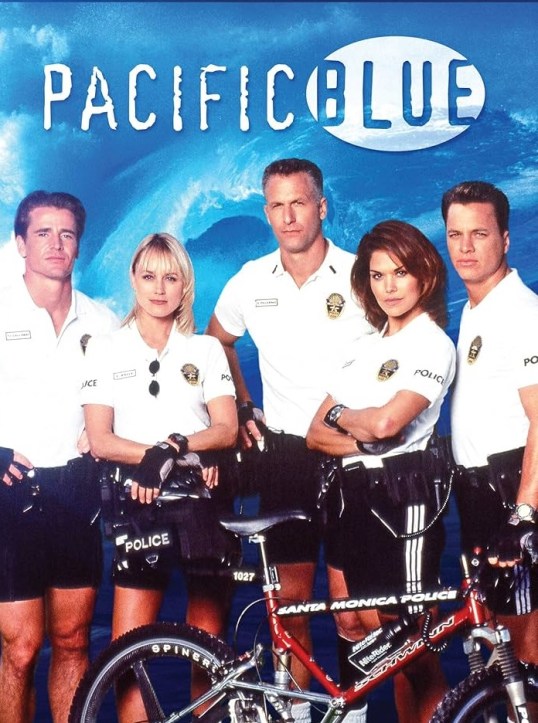
Everyone’s book for another season of bicycles and law-breaking.
Episode 3.1 “Inside Straight”
(Dir by Michael Levine, originally aired on August 3rd, 19997)
One night, while on a date with Chris, TC spots a man holding a gun. TC draws his own gun and yells at the man to drop his weapon. The man turns around. He fires so TC shoots and the man goes down. It turns out that the man was an undercover narcotics detective with a spotless record.
TC is suspended and the bike patrol basically stops doing their job and instead proceed to harass the dead man’s wife and his partner until they discover that the wife and the partner were having an affair and, conveniently, the cop was actually shot by someone who happened to be standing behind TC. It seems like simple forensic evidence (like the amount of bullets on the scene) should have proven that without the bike patrol even getting involved but I guess the cops in Malibu or wherever this show takes place are extremely incompetent.
Meanwhile, the poker game of mobster Joseph Tataglia (Joseph Campanella) gets held up, The thief is a degenerate gambler who tries to frame TC’s older brother, Teddy (Andy Buckley — how, it’s David Wallace from The Office!). The real thief is easily exposed and captured. I’m not really sure what the point of this story was. Tataglia last appeared during the first season but this episode acts as if he’s been a continual presence in the show for the past two seasons. I imagine viewers were confused as to who he was or why he had so much pull with Palermo.
There’s a scene where TC is subjected to an intense interrogation from Internal Affairs and I have to admit that it made me laugh because TC and Palermo were wearing their dorky bicycle cop uniforms while being yelled at by someone in a suit.
Another scene features Victor and Cory telling Chris and TC that there’s a huge crowd waiting to see the movie that they want to see. Victor says TC might have to flash his badge to get tickets. Police arrogance is annoying in general but it’s even worse coming from people who ride bicycles.
It appears that nothing had changed with the start of a new season.
Today’s episode of televised horror is The Silent Scream, the seventh episode of Hammer House of Horror. It was originally broadcast in the UK on October 25th, 1980.
A quick content warning for everyone: This episode features some scenes of animals in distress so I personally would advise viewer discretion. That said, I simply had to share this episode because it features Peter Cushing’s final performance for Hammer Studios. He plays a seemingly kindly old man who has a very dark secret. A youngish Brian Cox plays the ex-con who gets a job working for Cushing. This is a very unnerving episode with an ending that truly sticks with you.
Having been captured by UNIT at the end of The Daemons, the Master (Roger Delgado) is now a imprisoned on a small island in the English channel. He claims that he is reformed and he now spends most of his days watching the BBC. (Has he not been punished enough?)
When the Doctor (Jon Pertwee) and Jo Grant (Katy Manning) visit the Master to try to learn the location of his TARDIS, they come up empty. They do, however, learn that several ships have gone missing and, understandably, they suspect that the Master is involved.
They’re correct. The Master has duped his warden, Trenchard (Clive Morton), into helping him steal electrical equipment so that he can contact The Sea Devils, a race of bipedal reptiles the live under the sea. The Sea Devils, much like their cousins, the Silurians, were the original inhabitants of Earth. They’ve now woken from hibernation to discover that mankind — who they last knew to be a collection of barely evolved monkeys — have taken over the planet. And they’re not happy about it.
The Silurians and the Sea Devils appeared in three serials during the original run of Doctor Who and all of them followed the same basic plot. The Silurians or the Sea Devils woke up from their hibernation. The Doctor tried to broker a peace with humanity. Humanity reacted by blowing them up. The Sea Devils were usually more reluctant to make peace than the Silurians. In The Sea Devils, the Doctor himself is forced to sabotage their base to keep them from attacking humanity but that’s nothing compared to the atomic bomb that the British government wanted to drop on them. Whenever a Silurian or a Sea Devil shows up, it means that the Doctor is going to disappointed in humanity once again.
The Sea Devils is a serial of which I have fond memories because Malcolm Hulke’s novelization was the first Doctor Who book that I ever read. (Malcolm Hulke also wrote the serial itself.) I read the book before I even saw the show. The novelization was my introduction to the Doctor, UNIT, and especially the Master. Hulke was one of the best writers of the DoctorWho novelizations, taking the time to add depth to the characters. This was especially true of Trenchard, who is portrayed far more sympathetically in the novel than he was on the show.
TheSeaDevils also features one of Roger Delgado’s finest turns as the Master. This was the Master’s first appearance during the ninth season of DoctorWho and Delgado shows that, even when imprisoned, the Master never stops manipulating and scheming. This episode shows why Delgado’s Master was such a classic villain and truly a worthy opponent of the Doctor. Delgado does such a good job in the scenes where The Master pretends to be reformed that it’s easy to understand how he managed to trick Trenchard. At the end of the serial, The Master makes another escape, again by fooling the humans around him. Delgado made The Master into a magnetic and compelling villain.
Roger Delgado appeared twice more as the Master before his untimely death in an auto accident. Jon Pertwee later said that Delgado’s death was one of the reasons that he decided to step away from the role of the Doctor. The Master would eventually return and he would be played by several different actors. For me, the true Master will always be Roger Delgado.
Welcome to Retro Television Reviews, a feature where we review some of our favorite and least favorite shows of the past! On Tuesdays, I will be reviewing the original Fantasy Island, which ran on ABC from 1977 to 1984. The show is once again on Tubi!
Smiles, everyone, smiles!
Episode 7.13 “Ladies Choice/Skin Deep”
(Dir by Don Weis, originally aired on January 28th, 1984)
The highlight of this week’s episode is Mr. Roarke beating someone up.
The person on the other end of the beating is John McDowell (Lloyd Bochner), who owns a winery on the Island and who, for reasons that aren’t particularly clear, hates Mr. Roarke. When McDowell discovers that Fancy Summerfield (Kim Lankford), who grew up at the winery when it was owned by her father, is in love with Mr. Roarke, McDowell decides to manipulate her to hurt Roarke. Fancy, who is upset that Mr. Roarke doesn’t return her romantic feelings, allows herself to fall for McDowell but then realizes that McDowell is a jerk.
A party at McDowell’s mansion leads to a fist fight between Roarke and McDowell. McDowell starts it but Roarke ends it. He beats up McDowell with such ease that McDowell surrenders. Fancy realizes that McDowell is not the man for her and she also realizes that Roarke does care about her, even if he’s not in love with her. (This episode implies that Roarke does not allow himself to fall in love with mortal women. It’s understandable when you consider what happened when he got married.)
And let’s give credit where credit is due. Ricardo Montalban looked good beating up Lloyd Bochner. Admittedly, it was obvious that the majority of the fight was filmed using stunt doubles but, in those rare occasions where we saw Roarke’s face as he threw a punch, Montalban looked like he knew what he doing.
(Lawrence, needless to say, did not come to Mr. Roarke’s aid during the fight. In fact, Lawrence was barely in this episode.)
As for the other fantasy, it was pretty stupid. Joe (Michael Lembeck) comes to the Island with his loudmouth buddy, Vinnie (Fred Travalena). They are attending a sports expo. Vinnie is all about hitting on the models but Joe falls for Paula Santino (Donna Pescow), who is pretty but definitely not glamorous. The main problem with this fantasy was that both Joe and Paula were neurotic quip machines so listening to them have a conversation made me want to rupture my ear drums. Vinnie, for his part, said some pretty bad things about Paula. Roarke was too busy beating up John McDowell to do anything about it.
This episode was …. actually, not quite as bad as some of the other season seven episodes that I’ve recently watched. The second fantasy got old pretty quickly but the first fantasy featured Roarke beating someone up and there’s something to be said for that. The main problem with this episode is that none of the Island guests were particularly likable but I still appreciated that Roarke was willing to go to all of that trouble for them.
Then again, without Tattoo around, Roarke really doesn’t have any choice but to take on all the trouble himself. What else is he going to do? Depend on Lawrence?
The anime adaptation of Shiki, based on Fuyumi Ono’s acclaimed horror novel and directed by Tetsurō Amino, stands as a rare specimen in the horror genre. Rather than relying on quick shocks, excessive gore, or typical jump scares, Shiki unsettles its audience through atmosphere, moral erosion, and the slow, relentless unraveling of human conscience. Premiering in 2010, the series unfolds at a measured, almost meditative pace, transforming what could have been a simple vampire tale into a profound meditation on survival, faith, fear, and the delicate boundary between life and death when everything is pushed to the brink.
The story is set in Sotoba, a small, isolated village nestled precariously near a larger modern metropolis. The residents of Sotoba live tightly woven lives, their routines and social bonds preserved with careful attention over generations. This fragile peace shatters when a mysterious wave of deaths begins sweeping through the population. At first, these fatalities are dismissed as consequences of the harsh local climate—heatstroke, seasonal illnesses, and the inevitable toll of old age. Yet, as the body count rises, the truth reveals itself to be much darker: the deceased are rising as vampires, known locally as “shiki” or “corpse demons,” creatures that survive by feeding on the living.
What distinguishes Shiki from many other vampire narratives is its refusal to paint the conflict in stark black-and-white terms of good versus evil. The shiki are portrayed not as mindless monsters but as tormented souls, burdened by memories, emotions, and guilt over what they have become and the horrors they must commit to survive. Conversely, the human villagers—once caring and close-knit neighbors—succumb to suspicion, fear, and eventually cold-hearted survival instincts. The real horror emerges as morality frays and the line between human and monster becomes irrevocably blurred.
Unlike classic horror tales set in small towns—such as Stephen King’s ’Salem’s Lot, where a seemingly idyllic village hides sinister supernatural forces—Shiki offers a nuanced inward gaze. For instance, the novel They Thirst situates vampirism within a sprawling urban landscape, where anonymity accelerates chaos and alienation. In contrast, Shiki uses the microcosm of Sotoba to emphasize intimate, communal decay. The focus is not just on the physical threat, but on the erosion of social bonds and moral fabric, revealing how fragile human civility truly is under stress.
While ’Salem’s Lot depicts vampires as a pure evil contaminating a tight-knit community—highlighting themes of moral corruption and contamination—Shiki explores moral ambiguity with far greater depth. The vampires, including the enigmatic Sunako Kirishiki, retain their memories, emotions, and even remorse. Both vampires and humans carry guilt and anguish, complicating simplistic notions of villainy. The villagers—their friends, family, and neighbors—begin to see the suffering of the vampires while realizing their own brutal deeds. The narrative challenges viewers to question whether survival excuses the loss of morality or if it is possible to retain one’s spirit even amid brutal chaos.
At the heart of the series are characters who embody competing moral philosophies. Natsuno Yuki, a cynical teenager newly transplanted to Sotoba from the city, provides both an insider and outsider’s perspective. His disillusioned view highlights how fear, suspicion, and grief can unravel even the most intimate relationships. Natsuno serves as a rational voice within a community unraveling into paranoia and despair, offering a reflection of the audience’s own struggle to comprehend the incomprehensible.
Dr. Toshio Ozaki exemplifies the desperate human desire for order amid chaos. Initially, he seeks to explain away the deaths with rational, scientific explanations grounded in medicine. However, when superstition and supernatural realities intrude, Ozaki is compelled to confront truths beyond his understanding. His leadership in trying to save Sotoba begins with scientific resolve but soon descends into moral compromise. As hysteria spreads, the villagers’ collective violence explodes into ruthless slaughter, justified as necessary to preserve survival. Ozaki’s internal conflict—balancing ethical convictions against brutal necessity—reflects the series’ central question: at what point does the will to survive erode the soul?
Set against this turmoil is Sunako Kirishiki, the quiet yet profoundly troubled leader among the shiki. Though she has lived for centuries and suffers deeply from a sense of divine rejection—believing God has forsaken her—Sunako retains a core spirituality that anchors her sense of morality. Even as she is forced to kill in order to survive, she wrestles with guilt and her faltering faith. Her belief that divine rejection is not synonymous with divine abandonment acts as a form of moral defiance, preserving her fragile humanity amid brutal circumstances.
This spiritual resilience is deepened through her relationship with Seishin Muroi, a local junior monk and published author. Muroi, gentle and introspective, offers a unique perspective on the tragedy unfolding in Sotoba. His dual roles as a religious figure and a thoughtful writer allow him to interpret the crisis with spiritual depth and philosophical insight. His literary works—admired by the Kirishiki family, especially Sunako—explore mortality, suffering, and the search for meaning beyond pain. As a monk, Muroi embodies faith and compassion; as an author, he grapples with existential ambiguities, granting him a rare wisdom in navigating the village’s descent.
Muroi’s role makes him both observer and actor in Sotoba’s unraveling. His spiritual duties compel him to provide comfort and guidance, while his writings deepen his understanding of human and supernatural suffering. This duality shapes his interactions with Sunako and others, serving as a pathway for faith and empathy to endure amid horror and despair.
Sunako’s friendship with Muroi becomes central to her moral endurance. In contrast to Tatsumi, the Kirishiki family’s pragmatic and ruthless jinrō guardian who views survival through a cold, utilitarian lens, Muroi offers a moral counterpoint grounded in mercy and hope. Through his compassionate presence and reflective insights, Sunako finds a way to renew her faith. Although she feels forsaken, Muroi’s influence rekindles the fragile spark of belief in her that prevents her humanity from being swallowed by despair.
The thematic contrast between Muroi and Tatsumi becomes a fulcrum for Shiki: survival devoid of soul versus survival with spirit. Muroi’s continuing faith—soft, tentative, but persistent—demonstrates that even in the bleakest conditions, moral conviction need not fade entirely. His dual lens as monk and author enriches the narrative, bridging theology and philosophy while threading through the story’s core existential dilemmas.
Amino’s direction amplifies these themes through patient pacing and subtle storytelling. The mounting tension grows slowly through quiet, contemplative moments and lingering visuals—the hum of cicadas, shifting light through leaves, the barely audible footsteps in the dark. Ryu Fujisaki’s stylized character designs convey unease with elongated features and a surreal sheen, while Yasuharu Takanashi’s sparse, mournful score melds choral lamentations with haunting silences. Together, these elements create an immersive atmosphere steeped in dread and melancholy.
By the series’ climax, the distinction between human and shiki dissolves into near indistinguishability. Both sides bear the scars of survival—physical, psychological, and spiritual. The violence ceases, but the damage lingers, leaving survivors hollow, burdened by guilt and loss. Yet amidst the ruins of a shattered community, Sunako’s renewed faith, forged under Muroi’s guidance, flickers faintly—an emblem of hope that refuses to be extinguished.
The final scene distills this weighty truth without grandiosity or closure. There are no victors, no absolutes—only profound loneliness in survival. The living bear wounds deeper than any inflicted by fang or bullet. But in this quiet aftermath, Sunako’s fragile faith, buoyed by Muroi’s steadfast compassion, pulses as the last vestige of what it means to remain human: choosing faith and empathy even when everything else seems lost.
Shiki closes not with resolution but with a haunting reminder: survival is incomplete without humanity, and faith—however delicate—is the courage to hold onto that humanity when all else has fallen away.