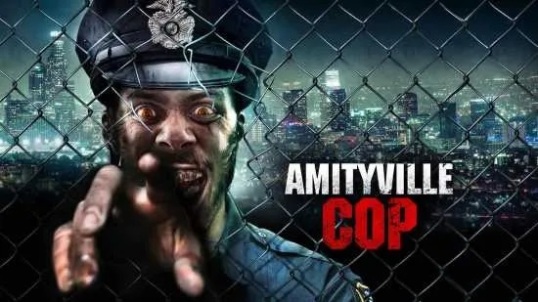
2021’s Amityville Cop does not take place in Amityville.
Actually, as far as I can remember, we never learn the name of the city where this movie is supposed to be taking place. But it definitely is a city and it’s not on Long Island so we can safely assume that it’s not Amityville. It’s not even New York City, which would have at least made the film somewhat Amityville-adjacent.
Amityville Cop also does not feature the infamous house. Nor does it feature a recreation of the DeFeo murders or any conversations about the Lutz hauntings or any of the other nonsense that we typically expect from an Amityville film.
In fact, there’s really no reason for this film to be called Amityville Cop, beyond the fact that Amityville is a recognized brand.
Instead, this is yet another remake of Maniac Cop. This time, the cop in question was a rookie who was either sacrificed by a Satanic cult or who voluntarily chose to be possessed by a demon. It’s a bit hard to follow exactly what happened, to be honest. The head of the cult is played by Laurene Landon, who also appeared in two of Maniac Cop films. Her role is brief but she’s around long enough to ensure that Officer Wilson (Lovie Johnson) will come back to life as a demon who wanders around in the city in his policeman’s uniform and who kills people for the least little infraction. (“No loitering,” he says, before killing one unfortunate homeless man.)
Meanwhile, the non-possessed cops are pretty much useless. Benson (Jason Toler) and his partner, Val (Nicole D’Angelo) are both infamous for roughing up suspects. Tom (Leonard Zhang) is socially awkward and never hangs out with the other cops while off-duty because he’s always too busy taking care of his mother. Cooper (Chris Spenelli) is boring. Lewis (Craijece Danielle) is inexperienced. Detective Clawson (Lisa London) always seems like she’s more interested in going after her fellow cops than the actual criminals. And Chief Benson (Jeffrey Moon) is more concerned with throwing a New Years Party at the station house than actually solving any crimes.
Yes, the entire police force appears to be gathered at the station, partying and dancing as the New Year approaches. It kind of makes you wonder just who exactly is on patrol in the city. Then again, it is New Years Eve. It’s not as if that’s a time of the year that’s associated with people getting drunk and disorderly. Anyway, the important thing that Officer Wilson eventually shows up for the party and soon, the killings start and Tom starts to consider which side he wants to be on.
Where to start with all this? It’s not a very good movie. You probably already guessed that. The awkward dialogue is stiffly delivered, the kills are largely uninspired, and the characters themselves are not particularly interesting. Benson, our nominal hero, literally bullies Tom to the extent that Tom is willing to sacrifice his soul to get revenge but the film never calls him out on it. No one ever says, “Gee, Benson, maybe you went too far when you made fun of his mom.” On the plus side, Officer Wilson is occasionally intimidating. There was one scene where he suddenly comes running down a hallway and, for a few seconds, the film came to life. But it’s hard not to feel that, in our cultural moment, Amityville Cop missed the chance to be something truly subversive. At a time when many people are asking whether we need the police at all, this film asks whether we actually need any more Amityville films.
Filmed in 1988 but apparently not released until 1990, Killing American Style is a low-budget variation on The Desperate Hours.
The film opens with a ruthless criminal named Tony Stone (Robert Z’Dar, of Maniac Cop fame) leading a daring robbery of an ice cream truck depot. All of the ice cream trucks have come back for the day and, when Tony and the boys show up, the money is still being counted. Tony quickly takes control of the situation, intimidating everyone with both his weaponry and his amazing jawline.
Unfortunately, for Tony, the robbery is not as successful as he thought. Yes, he gets away with a lot of money but the police quickly track him down to his home, where he’s in the process of having sex with his stepmother. Tony is arrested and, in record time, sentenced to a maximum security prison. (Seriously, the arrest, conviction, and sentencing all seem to happen on the same day.) Tony is put on a prison bus but then the bus itself stops to help out a stranded motorist. The motorist turns out to be Tony’s brother, Jesse (Bret Johnston). In the resulting shootout, all of the guards are killed but Jesse is wounded. Tony and his associate, Lynch (John Lynch …. hey, I wonder if that’s just coincidence?), take Jesse to a nearby ranch house.
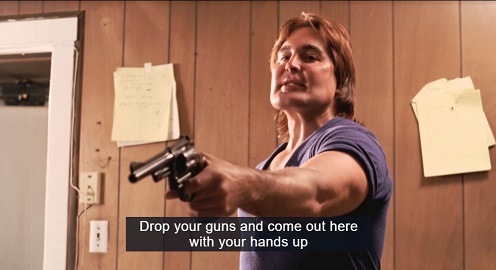
The house belongs to John Morgan (Harold Diamond), who is a long-haired kickboxing champion. When Tony arrives, John is out of the house and beating up the dad of a kid who bulled Morgan’s son, Brandon. John is not happy to come home and discover Tony holding his entire family hostage. For that matter, Morgan’s son isn’t amused by it either.
Because they are being pursued by a grim and determined police detective (played by Jim Brown …. yes, the same Jim Brown who starred in countless blaxploitation films in the 70s), Tony and his men do not want to run the risk of leaving the house to retrieve the loot from the robbery themselves. So, they send Morgan out to pick up the suitcase from Tony’s stepmother. I guess they assume that Morgan will be able to move around inconspicuously despite the fact that Morgan is a 6’1 kick boxer with long hair. I mean, there’s no way that Morgan is going to be able to move around without being noticed by the cops.
Of course, before Morgan can get the money, he also has to get a doctor for Jesse. Dr. Fuji (Joselito Rescober) agrees to help, despite the fact that he never seems to be quite sure what’s actually going on with all the angry men who keep pointing guns at each other. When Dr. Fuji mentions that he wants to kill Tony “Japanese style,” Morgan promises that he’s going to kill Tony “American style.” It’s never really made clear what the difference is between the two styles, though the American version does seem to involve a bit more kickboxing.
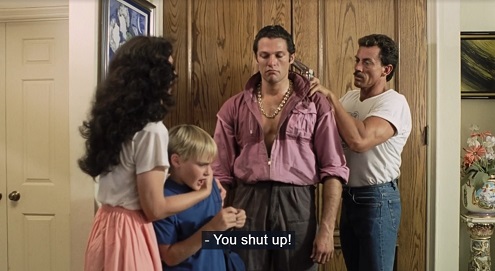
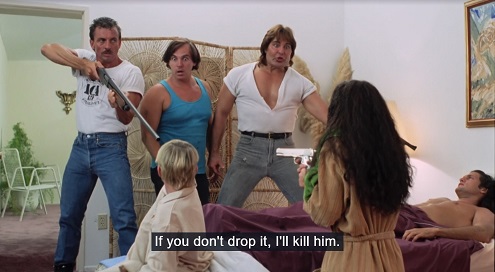
Anyway, this is an incredibly cheap and dumb movie but Robert Z’Dar seems like he’s having fun as Tony and …. well, to be honest, Robert Z’Dar is really the only reason to recommend this film. He gives an enjoyably over-the-top performance, one that certainly contrasts with the more subdued performance of Harold Diamond. (For his part, Diamond often seems to be struggling to stay awake.) Hostage movies usually bore me to tears and this one had a lot of slow spots but it also had shots like the one below:
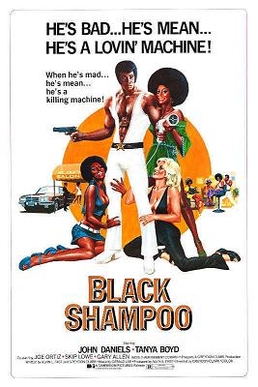
The 1976 film, Black Shampoo, tells the story of Mr, Jonathan (played by an expressionless actor named John Daniels). Mr. Jonathan is the hottest hairstylist on the Sunset Strip. Rich women flock to his salon so that Mr. Jonathan can do their hair and, as the first scene in the film makes clear, do a lot more as well. Black Shampoo begins with a wash and rinse that soon leads to Mr. Jonathan’s client saying, “It is bigger and better!” while the singers on the film’s funk-heavy soundtrack tell us that, “He’s a real man.”
Mr. Jonathan is so popular that the women who come into his salon are visibly upset if they’re told that their hair will be done by Mr. Jonathan’s two associates, Artie and Richard. “Artie doesn’t have the right equipment!” one woman exclaims while another complains, “My hair’s a mess …. I haven’t had my hair done in over a month.” Fortunately, helping to keep the place running is Mr. Jonathan’s new administrative assistant, Brenda St. John (Tanya Boyd). In fact, Mr. Jonathan could even see himself settling down with Brenda.
Unfortunately, Brenda is the ex-girlfriend of a white gangster named Mr. Wilson (Joe Ortiz). And Mr. Wilson is determined to get Brenda back, even if it means sending two of his thugs down to Mr. Jonathan’s and messing the place up. It’s easy for them to vandalize the salon and to harass Artie and Richard because Mr. Jonathan hardly ever seems to be there. He’s always either visiting a client at home or taking part in a falling in love montage with Brenda. When Brenda is kidnapped, Mr. Jonathan falls into a deep depression. Eventually, though, Mr. Jonathan realizes that he has to rescue Brenda and retrieve the black book that proves that Mr. Wilson is a crime lord. Fortunately, Mr. Jonathan is as handy with a chainsaw as he is with a hair blower.
Ugh. This film …. I mean, to be honest, the movie seems like it’s going to be fun when it starts. Yes, the acting is terrible and the dialogue is risible but it’s such a 70s film that I assumed it would be kind of fun. And there are some enjoyably silly moments, like the whole falling in love montage. But, as the film progresses, the violence and the film’s overall tone just gets uglier and uglier. That, in itself, is not a problem. In fact, you could argue that violence should be ugly because it’s violence. But, in the case of Black Shampoo, too much of that ugly violence is played for titillation. When Mr. Wilson threatens to sodomize a character with a curling iron, the film seems to take a certain delight in Mr. Wilson’s sadism. The film is certainly not on the side of the poor guy who is being threatened. Instead, it feels like the film is saying, “Do you think will show this happen or do you think will cut to another scene? Keep watching to find out!” It’s gross.
It would help if Mr. Jonathan were himself an engaging character but John Daniels’s performance in painfully dull. He has a definite physical presence, though he definitely looks a lot better on the film’s poster than he does in the actual movie. But, when he has to deliver dialogue or show emotion, he’s so awkward that it’s like staring at a brick wall and waiting for it to do something. As a character, Mr. Jonathan should be someone who moves with a certain confidence and swagger. John Daniels usually seems like he’s more busy trying not to look straight at the camera.
On the plus side, everyone’s hair looks beautiful.
In the late 1970s, the Rev. Jim Jones was a very powerful man.
The leader of the California-based People’s Temple, Rev. Jones had made a name for himself as a civil right activist. As a minister, he made it a point to reach out to the poor and to communities of color. (It was said, largely by Jones, that he had been forced to leave his home state of Indiana by the Ku Klux Klan.) Local politicians eagerly sought not only Jones’s endorsement but also the donations that he could easily raise from the members of the People’s Temple. Though there were rumors that he was more of a cult leader than a traditional preacher, Jones was appointed chairman of the San Francisco Housing Authority. Everyone from Governor Jerry Brown to San Francisco Mayor George Moscone appeared with Jim Jones at campaign events. Among the national figures who regularly corresponded with Jim Jones were First Lady Rosalyn Carter and Vice President Walter Mondale.
Of course, what actually went on behind the closed doors of the People’s Temple was a bit of secret. Jones was a self-proclaimed communist who claimed to have had visions of an upcoming nuclear war between the U.S. and Russia. In his sermons, he often claimed that it would be necessary for both him and the rest of the People’s Temple to eventually leave the United States. Jones spoke of enemies that were trying to destroy him, like the reporters who investigated Jones’s claim of being a faith healer and who followed up on reports that Jones was sexually exploiting both the women and the men who followed him. Jones secretly started to make plans to leave the United States in 1973 but it would be another four years before he and a thousand of his followers arrived in Guyana. The People’s Temple Agricultural Project sat in the jungle, isolated from oversight. It was informally known as Jonestown.
Over the next year, Jonestown did not exactly thrive. Rev. Jones demanded that his people work hard and he also demanded that they spend several hours a day studying socialism and listening to him preach. Jones ran his commune like a dictator, refusing to allow anyone to leave (for their own safety, of course). Anyone who questioned him was accused of being an agent of the CIA. In the U.S, the families of Jonestown’s citizens became concerned and started to petition the government to do something about what was happening in Guyana. A few people who did manage to escape from Jonestown told stories of forced labor, suicide drills, rape, and torture. The People’s Temple claimed that those people were all lying and, because Jones still had his government connections, he was largely left alone.
Finally, in 1978, Congressman Leo Ryan, a Democrat who had a history of opposing the political establishment, flew down to Guyana so that he could see Jonestown for himself and also bring back anyone who wanted to leave. Despite the efforts of Jones to disguise the truth about life in Jonestown, several people did ask to leave the colony with Rep. Ryan. Jones sent his most loyal men to meet and open fire on Rep. Ryan’s entourage at a nearby airstrip. Rep. Ryan and four others were shot and killed, making Ryan the first Congressman to be assassinated since 1868. Nine others, including future Rep. Jackie Speier, were wounded in the attack.
Back at Jonestown, Jim Jones announced that his prophecy was coming true and that the imperialists would soon descend on Jonestown. Though 85 of Jones’s followers managed to escape into the jungle, the other 909 residents of Jonestown subsequently died. Though some showed signs of having been murdered by Jones’s followers, the majority committed suicide by drinking poisoned Flavor-Aid. Jim Jones shot himself in the head.
The world was horrified and the term “drinking the Kool-Aid” entered the discourse. And, of course, many filmmakers were inspired by the horrific events that happened in Jonestown. Ivan Rassimov, for instance, played a Jim Jones-style cult leader in Umberto Lenzi’s Eaten Alive. Meanwhile, Powers Boothe would win an Emmy for playing Jim Jones in a 1980 television miniseries called Guyana Tragedy.
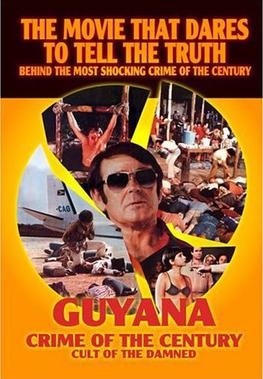
Guyana Tragedy is often described as being the definitive film about Jim Jones. However, a full year before Guyana Tragedy aired, the Mexican director, Rene Cardona Jr., was in theaters with his own version of the Jim Jones story. To anyone who is familiar with Cardona’s style of filmmaking, it’s perhaps not surprising that 1979’s Guyana: Crime of the Century did not win any awards.
Cardona’s film opens with a rather odd title card, explaining that, though the film is based on Jonestown, the names of certain characters “have been changed to protect the innocent.” But if you’re going to start the film by announcing that it’s about the biggest news story of the past year, what’s the point of changing anyone’s name? And for that matter, why is Jim Jones renamed James Johnson and his colony rechristened Johnsontown? Jones was hardly one of the innocents, not to mention that he was dead and in no position to sue when the film came was released. Why is Leo Ryan renamed Lee O’Brien, especially when the film portrays Ryan as being the type of hard-working and honest congressman that anyone would be happy to vote for?
The film opens with Rev. James “Johnson” (played by Stuart Whitman) giving a lengthy sermon about how it’s time for the congregation to move to Guyana, which he describes as being a Socialist paradise. Oddly, in the film, the People’s Temple is portrayed being largely white and upper middle class whereas, in reality, the opposite was true. Indeed, Jones specialized in exploiting communities that were largely marginalized by American society. One reason why Jones’s claim of government persecution was accepted by the members of his church is because the People’s Temple was made up of people who had very legitimate reasons for distrusting the American government.
A few scenes later, Johnson is ruling over “Johnsonville.” Since this is a Cardona film, the viewers are shown several scenes of people being tortured for displeasing Johnson. A child is covered in snakes. Another is shocked with electricity. A teenage boy and girl are forced to kneel naked in front of Johnson as he announce that their punishment for trying to run away is that they will be forced to have sex with someone of Johnson’s choosing. Once the torture and the nudity is out of the way, the film gets around to Congressman O’Brien (Gene Barry) traveling to the Johnsontown. Since the audience already knows what’s going to happen, the film becomes a rather icky game of waiting for O’Brien to announce that he’s ready to go back to the landing strip.
Because the film has been released under several different titles and with several different running times, Guyana: Crime of theCentury has gotten a reputation for being one of those films that was supposedly cut up by the censors. I’ve seen the original, uncut 108-minute version of Guyana and I can tell you that there’s nothing particularly shocking about it. Instead, it’s a painfully slow film that doesn’t really offer much insight into how Jim Jones led over 900 people to their deaths. While Gene Barry make for a convincing congressman, Stuart Whitman gives a stiff performance as the Reverend Johnson. There’s very little of the charisma that one would expect from a successful cult leader. One gets the feeling that Whitman largely made the film for the paycheck.
Of course, Whitman was hardly alone in that regard The film features a host of otherwise respectable actors, including Yvonne DeCarlo, Joseph Cotten, John Ireland, Robert DoQui, and Bradford Dillman. As well, Cardona regular Hugo Stiglitz appears as a photographer. (Stiglitz is perhaps best known for starring in Nightmare Cityand for lending his name to a character in Tarantino’s Inglourious Basterds.) Of the large cast, I appreciated the performances of Cotten and Ireland, who play Johnson’s amoral but well-connected attorneys. (The characters are based on the Temple’s real-life attornes, Charles Garry and Mark Lane. Lane also wrote the first JFK conspiracy book, Rush to Judgment.) I also liked Yvonne DeCarlo’s performance as the most devoted of Johnson’s followers. Even Bradford Dillman’s natural blandness was used to good effect as his character comes to represent the banality of evil when it comes time for him to start administering the Flavor-Aid. But those good performances still can not overcome the film’s slow pace and the fact that the film didn’t bring any new insight to the tragedy.
The film sticks fairly close to what is believed to have actually happened at Jonestown but, in the end, it barely even works as an example of shameless grindhouse filmmaking. It’s not even offensive enough to be enjoyable on a subversive level. Instead, it was just a quick attempt to make some money off of the crime of the century.
So, you think you can just ignore the law, huh? Well, the Super Cops have got something to say about that! This film was based on the “true” adventures of two widely decorated NYPD cops. The cops were so good at their job that they were even nicknamed Batman and Robin. Of course, long after this movie came out, it was discovered that they were both corrupt and were suspected of having committed more crimes than they stopped. Amazingly, this film was directed by the same man who did Shaft. The Super Cops are kind of annoying, to be honest.
2. Super Fuzz (1980)
Far more likable than The Super Cops was Super Fuzz. Terence Hill plays a Florida cop who gets super powers! Ernest Borgnine is his hapless partner. The film was directed by Sergio Corbucci, of Django fame.
3. Miami Supercops (1985)
In 1985, Terence Hill returned as a Florida cop in Miami Supercops. This time, his old partner Bud Spencer accompanied him.
4. Miami Cops (1989)
Apparently, Miami needed a lot of cops because Richard Roundtree decided to join the force in 1989. Unfortunately, I could only find a copy of this trailer in German but I think you’ll still get the idea.
5. The Soldier (1982)
In order to celebrate loyalty, here’s the trailer for 1982’s The Soldier! They’re our government’s most guarded secret …. or, at least, they were. Then someone made a movie about them.
And finally, what better way to celebrate both Loyalty and Law Day than with a film that pays tribute to the Molokai Cops? From Andy Sidaris, it’s….
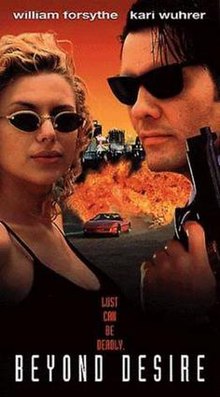
1995’s Beyond Desire tells the story of Ray Patterson (William Forsythe). He’s spent the last 14 years in jail, convicted of a murder that he says he didn’t commit. He likes to sing. He’s obsessed with Elvis. He claims that he doesn’t know how to drive because he’s been in prison for the last 14 years but he appears to be in his mid-40s so you have to kind of wonder if maybe Ray just wants other people to drive him around. After all, Elvis never drove himself.
Perhaps because everyone is sick of listening to him as he sings Amazing Grace in his cell, Ray is released from prison. Since he was serving his time in Nevada, this means that Ray now has to walk down a desert road and hope that someone gives him a ride. Fortunately, for Ray, a woman named Rita (Kari Wuhrer) pulls up in fancy red car and asks him where he’s going. Rita explains that she’s always had a fantasy about picking up someone who has just been released from prison. Ray accepts her offer of a ride and soon, they’re at a desert motel, engaging in saxophone-scored, Vaseline-on-the-lens softcore sex. Ray may have forgotten how to drive but apparently, he didn’t forget everything during those 14 years he spent in prison. If nothing else, this film reveals more of William Forsythe than most viewers probably ever thought they’d see.
Soon, Ray and Rita are head to Vegas. Of course, it turns out that Rita wasn’t quite honest about why she picked up Ray. Rita is a high-priced escort and she works for a local crime boss named Frank (Leo Rossi). Frank wants Ray to reveal the location of some stolen money. Ray, meanwhile, feels that Frank is the key to clearing his name and catching the real murderer. At first, it seems like everyone is just manipulating everyone else but Rita and Frank do eventually end up falling in love. Can their love survive bullets and hints of betrayal?
Like many 90s crime films, Beyond Desire is one of those films that was obviously made to capitalize on the success of Quentin Tarantino. The characters of Ray and Rita are such obvious copies of True Romance‘s Clarence and Alabama that the film comes close to turning into a self-parody. Ray is a big Elvis fan and occasionally quotes lyrics at inopportune times. The soundtrack itself is full of Elvis songs, though the budget apparently wasn’t big enough to actually get the rights to any of Elvis’s recordings. Instead, we get cover versions, the majority of which feel rather wan. The film emphasizes the garish glitz of the Vegas Strip but none of the quirky beauty of it. Las Vegas, an adult playground sitting in the desert, is pure Americana. That was something that was captured by Francis Ford Coppola in The Godfather, Martin Scorsese in Casino and David Lynch in Twin Peaks: The Return. The film uses Vegas as a convenient backdrop but it has nothing to say about the location itself.
Like the majority of road movies, the film tends to meander a bit. Ultimately, the road leads to nowhere. That, in itself, is not necessarily a problem. The same could be said of Tony Scott’s True Romance or any number of films directed by Wim Wenders. Unfortunately, this film wasn’t directed by Tony Scott or Wim Wenders. Instead, it was directed by the guy who did Halloween 5 and the end result is a film that, even when taken as a purely stylistic exercise, still feels rather empty. It’s a shame because William Forsythe shows off a lot of quirky, bad boy charm in the role of Ray and Kari Wuhrer make Rita into a far more complex and conflicted character than one might expect. But, unfortunately, the film itself just doesn’t live up to their performances.
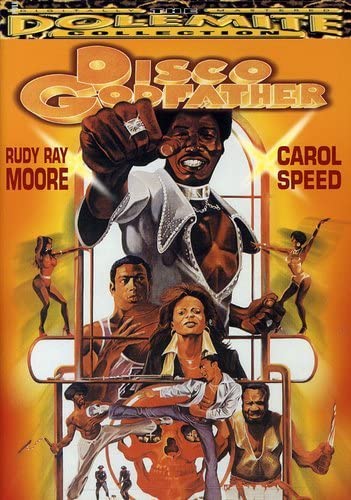
“Put your weight on it!” Tyrone Williams (Rudy Ray Moore) shouts at the start of 1979’s Disco Godfather. It’s a phrase that he regularly employs as he encourages everyone at the local disco to hit the dance floor and show off their moves. All Tyrone has to do to get people to dance is to shout out his catch phrase. He’s such a beloved figure in the community that most people just call him, “Godfather.”
The Godfather is the uncle of Bucky Williams (Julius Carry), a promising young basketball star who seems to have his entire future ahead of him. However, what the Godfather doesn’t know is that Bucky has fallen in with the wrong crowd and they’ve been pushing him to smoke …. ANGEL DUST! Bucky’s girlfriend tries to warn him that he’s been smoking too much of “the whack” but Bucky doesn’t heed her warning. Suddenly, Bucky is in the middle of the dance floor, freaking out as he imagines being attacked by zombie basketball players and a sword-wielding witch. He also sees the Disco Godfather, telling him to calm down, but suddenly the Godfather is transformed into a skeleton!
After Bucky is subdued and taken down to the local PCP recovery center (which is full of users who are all screaming, rolling around on the floor, and generally acting whacked out), the Godfather decides that he can no longer stand by while his community is victimized by the PCP dealers. With the help of Noel (Carol Speed), the Godfather starts a group called Angels Against Dust and starts a campaign to “attack the whack!” While the Godfather tracks down the dealers, Noel holds a rally where, at one point, she announces that everyone is going to have to come together and “whack the attack.”
The fact that this obviously flubbed line was included in the final film tells you much about what makes Disco Godfather such an interesting viewing experience. The film was shot very quickly and with very little money and, as such, second takes were a luxury that the film couldn’t afford. However, there’s also an undeniable charm to the film’s low-budget style. It’s amateurish but it’s amateurish in the most likable way possible. Even in the case of the “whack the attack” line, it’s hard not to appreciate that Carol Speed didn’t let that one flub stop her from giving the rest of her speech. By that same token, it’s also hard not appreciate that, later in the film, a never-before-seen character suddenly helps the Godfather fight off a bunch of pushers. This character was played by Moore’s karate instructor and his appearance is totally random and yet totally appropriate. In the world of DiscoGodfather, the chaotic plotting is the point. The more random the film becomes, the more it suggests a universe ruled by chance and coincidence. The total lack of logic starts to make sense. Werner Herzog would probably love this film if he ever saw it.
Rudy Ray Moore, of course, was a famously raunchy comic who was best-known for playing Dolemite in three films. However, Disco Godfather finds him in a bit more of a dramatic mood, as he tours the local PCP ward and tells everyone he meets that they have to “attack the whack,” Compared to the Dolemite films, there’s considerably less sex and profanity to be found in DiscoGodfather. There are several fight scenes and Rudy Ray Moore gets to show off his karate moves but the violence is never as over the top as it was in Dolemite. The problem, however, is that Rudy Ray Moore was a natural-born comic and, as a result, every line that he utters, regardless of how serious the topic, sounds like its building up to a punchline. Moore gets to do some dramatic acting at the end of the film, when the Godfather is himself force fed the whack and he starts to hallucinate various disturbing images. “That’s not right, mama!” the Godfather says at one point and indeed, the trip sequence is the strongest part of the film, a genuinely surreal trip into the subconscious of a man who just wanted to encourage people to dance.
Disco Godfather is one of those films that you just have to see. When Disco Godfather isn’t learning about PCP, he’s telling everyone to “put your weight on it” and, as a result, this film not only features a lot of anti-drug hysteria but it also features a lot of dancing. This is very much a film of its time. In one the film’s few deliberately funny moments, the album cover for the SaturdayNightFever soundtrack is seen covered in cocaine. Of course, the Disco Godfather doesn’t need cocaine to have a good time and he certainly doesn’t need the whack. He just needs the music and people willing to put their weight on it.
Disco Godfather was not a box office success when it was originally released, with Moore later saying that he made a mistake by toning down his persona for the film. Moore was probably correct but, seen today, Disco Godfather is an enchantingly berserk time capsule. Watch it and then be sure to watch Eddie Murphy play Rudy Ray Moore in the Netflix biopic, Dolemite Is My Name.
Oosh and Doosh, the stars of Polk County Pot Plane
First released in 1977, Polk County Pot Plane tells the story of Oosh (Don Watson) and Doosh (Bobby Watson), two brothers who have the long hair, country accents, and full beards of two guys who made most of their life decisions at a Lynard Skynard concert and who haven’t looked back since.
Oosh and Doosh spend most of their time hanging out in the mountains of Northern Georgia. They pass the time drinking beer, smoking weed, and driving too fast. Oosh and Doosh do have a job, of course. The Dixie Mafia pays them to help unload all of the marijuana that is transported on a plane that regularly lands in the mountains. The plane is nicknamed Big Bird and it even gets its own credit at the start of the film.
The opening credits also inform us that the pilot of Big Bird was played by an actor named Big Jim.
At the start of the film, Oosh and Doosh are unloading the plane but, unbeknownst to them, the cops have followed them out to the landing area. When the cops finally make their presence known, Big Jim and the plane are able to escape but Oosh, Doosh, and two other hippies are arrested (and their RV practically destroyed) after a long chase.
With Oosh and Doosh in the county jail, the word goes out to all the drug kingpins, which is to say that there is a lengthy montage of people picking up the phone and explaining the situation over and over again. Eventually, a helicopter lands on top of the jail and Oosh and Doosh are able to make their escape. The helicopter flies over Georgia with Oosh and Doosh literally clinging onto the bottom of it.
This scene was filmed without stunt people. That really is Don and Bobby Watson hanging onto that helicopter and the scene is also makes it clear that the helicopter really was flying high above a small town with the two actors dangling underneath. If either Don and Bobby Watson had lost their grip, they would have basically plunged to their death. On the one hand, you might wonder how the Watsons were convinced to risk their lives for a film called Polk County Pot Plane. On the other hand, the scene is a hundred times more effective than one might expect precisely because the risk was real.
In fact, not a single professional stunt person was used in Polk Count Pot Plane. All of the stunts were done by the members of the cast, the majority of whom appear to have been amateurs. The sheriff who locks up Oosh and Doosh apparently was an actual sheriff. Big Jim actually was a pilot. While there isn’t much information available about the Watson brothers, their country stoner vibe feels authentic from the start. For almost the entire cast, this was their first and only film. What they lacked in experience, they made up for in authenticity.
There’s not much of a plot to Polk County Pot Plane, though it was reportedly based on a true story. Oosh and Doosh get out of jail and find themselves being ordered to transport more drugs. They also rip-off their bosses and, in the end, there’s an attempt to steal the plane itself. For the most part, the film exists so that the police can chase Oosh and Doosh and several cars can be destroyed in the process. The minute that we see a group of people trying to transport a house from one location to another, we know that someone’s going to end driving through it and destroying the whole thing. That’s the type of movie that Polk CountyPot Plane is. It’s low-budget, it doesn’t always make a lot of sense, and it’s definitely amateurish.
And yet, it’s also entertaining and rather likeable. The amateur vibe helps. Because the Watson brothers appears to have essentially been playing themselves, the film at times has a documentary vibe. For all of the silly comedy and the mumbled lines (with the Watsons especially sounding like King of the Hill‘s Boomhauer at times), it’s hard not to feel that this film probably gets close to the truth of what it was like to smuggle marijuana in the Deep South during the 1970s. The combination of car crashes and the film’ s stoner vibe becomes rather fascinating.
Polk County Pot Plane was also released under the title In Hot Pursuit. It can be found in several Mill Creek box sets and on YouTube!
Albert Pyun made his directorial debut with this film, which starred Richard Lynch. The Sword and the Sorcerer was Pyun’s most financially successful film.
2. Dangerously Close (1986)
In 1986, Albert Pyun directed the teen vigilante classic, Dangerously Close.
3. Cyborg (1989)
Due to the presence of Jean-Claude Van Damme in the leading role, Cyborg remains one of Pyun’s best-known films.
4. Captain America (1990)
20 years before Kevin Feige and the MCU, Albert Pyun brought Captain America to the big screen!
5. Omega Doom (1996)
In 1996, Albert Pyun was responsible for this post-apocalyptic western, starring Rutger Hauer.
6. Tales of an Ancient Empire (2011)
Finally, in 2011, Pyun directed his long-awaited sequel to The Sword and the Sorcerer, Tales of An Ancient Empire.
Sitting off the coast of Delaware, Plum Island seems like the perfect place to live. The people are friendly. The town is small and quaint but definitely inviting. There are plenty of horses, for those who like to ride. The island’s one mailman is a welcome sight, dropping off mail everyday and giving everyone a friendly wave.
The only problem with Plum Island is that, as pretty as it may be, it is also the home to two feuding Irish families. Patrick O’Flynn (Kenneth Welsh) and Seamus Muldoon (Richard Fitzpatrick) have been enemies for as long as anyone can remember. Their feud has gone on for so long that its doubtful anyone even know what started it all. The two families have an uneasy peace up until the breakout of the zombie apocalypse. The O’Flynns want to kill every zombie that shows up on the island. The Muldoons, on the other hand, want to keep the zombies as pets and workers until a cure for their condition can be found. Eventually, Patrick O’Flynn turns out to be so reckless in his mission to destroy the undead that he’s exiled from the island. Even his own daughter, Janet (Kathleen Munroe), supports sending Patrick off to the mainland.
However, no sooner has Patrick been exiled then he hooks up with a bunch of AWOL National Guardsmen, who are weary of spending the rest of their days chasing the undead. Patrick leads them back to Plum Island, hoping to use them to destroy the the Muldoons forever.
Released in 2010, Survival of the Dead is both the final entry in George Romero’s Dead films (which started way back in 1968 with the classic Night of the Living Dead) and it was also Romero’s last completed film as a director. (Romero died in 2017, while in pre-production on a film called Road of the Dead.) Unfortunately, Survival of the Dead was not warmly greeted by critics or audiences, many of whom felt that Romero was simply rehashing concepts that he had already fully explored in the previous Dead films.
To a certain extent, those critics have a point. There are a lot of flaws with Romero’s final film, from the obviously low budget to the inconsistent performances. (Welsh, Fitzpatrick, and Munroe are all well-cast and give good performances but the National Guardsmen are all forgettable at best.) At the same time, there’s enough weird moments in Survival of the Dead to make it watchable. Plum Island is a memorably surreal location. The undead of Plum Island continue to exhibit the same behavior in death that they did in life. The mailman still tries to deliver mail. Another zombie continues to ride her horse across the island. It’s only when they sense the living amongst them that they turn deadly. As with all of Romero’s Dead films, the living dead may be dangerous and relentless but the truly scary characters in the film are the living humans who, even in the middle of the end of the world, cannot set aside their differences long enough to work together. The film’s final shot, which suggests that it takes more than death to end a blood feud, is so striking that it makes up for a lot of the weaker moments that came before it.
In the end, the most interesting thing about Survival of the Dead is that it’s more of a western than a traditional horror movie, featuring two warring families fighting on horseback and battling to control the land. Romero often said that he felt trapped by his reputation as a horror filmmaker and that he was actually interested in all genres of film. With Survival of the Dead, Romero finally got to make a Western. The end result is uneven but still has enough interesting moments to make it worth watching.





 Through the Shattered Lens