VGM Entry 02: Early arcade music


VGM Entry 02: Early arcade music
(Thanks to Tish at FFShrine for the banner)

Few early games had music mainly because they were better off without it. The music of Rally-X was certainly an enhancement to the gameplay, but if it really showcases the best technology of the day then it’s easy to understand why most programmers didn’t bother. New technology came fast though, and Rally-X was hopelessly outdated in a matter of months. Carnival (Sega, 1980) is often credited as the first game to employ any of the new and improved sound chips for continuous music, but this claim amounts to little. All of the arcade developers took advantage of the advancements as quickly as they were able.

That’s why you get games like New Rally-X (Namco, February 1981), released less than a year after the original. Video game music immediately emerged in fully developed form the moment it became an option; it didn’t really take any market research to recognize that this would enhance the product.

From 1981 on, arcade music sounded pretty decent. Certainly a lot of games suffered from bad compositions, but many did try, and the work here becomes a simple matter of listening to everything and picking out the best. Arcade games had a unique advantage in this regard. Being self-contained systems, every new game had the opportunity to employ the newest technology on the market. This was seldom the case with computer games, and never the case on home consoles. A pretty massive disparity in sound quality would continue to distinguish arcade music from all of the competition up through the end of the 1980s, when the arcade began to die out as a viable source of revenue for game producers.

The indisputable king of arcade music was Taito. They backed up their claim to being the first, with Space Invaders in 1978, by maintaining a higher standard of quality than most of the competition. Jungle King (1982) is one of my favorite early examples. Here the music isn’t just a nice added feature; it’s the game’s entire selling point. The player feels compelled to keep moving, driven by a sense of urgency and adventure that would be completely absent otherwise. The sound effects make an effort to acknowledge the music’s dominance, seldom clashing and, with the hero’s footsteps on the rock-dodging stage, even roughly synching up to add another layer of depth to the music.

Jungle King has kind of a funny history. The form you are seeing here never made it far out the door before the estate of Edgar Rice Burroughs won a lawsuit for copyright infringement on Tarzan. Having already tossed out a beta version called Jungle Boy, Taito recouped their losses by replacing the Tarzan character with a creepy explorer in a pith helmet and safari outfit and retitled the game Jungle Hunt. Never really satisfied with this conversion, they went back to the drawing board again after the release, replacing the explorer with a pirate. Pirate Pete became the forth and final installment of the game, featuring new graphics and a new soundtrack but the same old mechanics.

Konami may have been Taito’s driving force, persistently one-upping them. Gyruss (Konami, 1983) is a real audio masterpiece. Rally-X and Space Invaders both had tonal sound effects, and in the latter ‘sound effects’ and ‘music’ were one and the same entity. Gyruss might be seen as a sort of climax to this trend of music-sound effects-gameplay synthesis.

J. S. Bach’s Toccata and Fugue in D minor, BWV 565, might seem like an odd choice at first glance, but it had recently been converted into a rock and roll hit by the U.K. band Sky, so it certainly had some pop culture appeal. The significance here though is how well the game is paced to the music, or vice versa. Enemies appear almost on cue, and every sound effect is perfectly attuned to the background music. Really, to call it ‘background music’ at all does it a disservice. Gyruss has a very distinct song, but though the music and sound effects can be easily separated, in practice they are essentially indistinguishable.

What’s most impressive to me is that I really doubt the synthesis is programmed. It would become common enough in the future to sync up music to game events fluidly (consider the added music layer in Super Mario World when you mount Yoshi) and vice versa (the Guitar Hero series and many other games like it are based around the concept), but that’s all written into the code. In Gyruss the cues are apparent, not encoded reality. It tricks our senses, like a fine painting, and indeed it should be regarded as an interactive audiovisual work of art.
AMV of the Day: Azumanga Daioh 1985


I believe this is the third Azumanga AMV to be posted here, but what can I say?  The series lends itself nicely to being made into AMVs.  This is an older AMV, and I really don’t know if it was ever entered into an AMV contest at a convention or if it was just done for fun.  Either way, this was created by Suberunker Studeosh and it mixes scenes from Azumanga Daioh with the Bowling for Soup song 1985.

This video in particular has a bit of a checkered past if you will.  Perhaps this is a recent development, but for the longest time these videos were either taken down or had their music blocked because Bowling for Soup, or most likely their producers, objected to the use of their song in the video.  Mainly this was an issue with it being posted on YouTube, but as you can now see, they don’t seem to have a problem with the music being played these days.  Either cooler heads prevailed and they realized that no harm was being done, or they figured the song was old enough to where its monetary value was sufficiently decreased so it didn’t matter anymore.  At any rate, it’s good that people can now see and hear this video as the creator intended.

At any rate, this video features the somewhat jaded and a little immature teacher of the series, Yukari Tanizaki, and the majority of the scenes were taken from Azumanga Daioh, but there were a few quick snippets from other anime shows too.  It’s a really well put together video, and fans of the series are sure to enjoy it, as well as people who just appreciate a good AMV.

Anime: Azumanga Daioh, Naruto, Fruits Basket, Pokemon, Full Metal Alchemist, Neon Genesis Evangelion

Song: “1985” by Bowling For Soup

Creator: Suberunker Studeoh


Past AMVs of the Day

VGM Entry 01: Proto-game music


VGM Entry 01: Proto-game music
(Thanks to Tish at FFShrine for the banner)

I woke up one morning in June with a fairly innocent idea in mind. I thought I’d write up a short series on my favorite video game soundtracks. It would be a simple enough venture. I’d give a background post on the pre-Nintendo era, then do a little recap of Super Mario Bros., The Legend of Zelda, all that jazz, and then before I know it be firmly rooted in my SNES/Playstation-era comfort zone, free to recap the two dozen or so games I like best without much interference.

It was a really terrible plan. The shear quantity of material I found myself obligated to cover to even reach my timeframe of interest was daunting, and even then, what could I really say about it? Video game music isn’t some even playing field with linear stylistic evolutions, where everything possesses an equal opportunity for aesthetic value and accessible histories lend themselves to easy commentary. First of all, video game music is a business in which artists can’t simply extend their deadlines until they’re fully satisfied with the end product, and second of all, technology is so intrinsic and varied that comparison becomes hopelessly arbitrary.

But good music is good unconditionally. Technological limitations can do nothing to compromise that; uncertainty obscures only the factors which lead to its creation. With that in mind, I will proceed with my little project here. I intend to listen to quite a lot of video game music attentively and share with you that which appeals to me most. I will provide what little history I can along the way, riddled with inaccuracies and technical fumblings, but in the ends it’s just an excuse to indulge my senses.

So, the first place to start is with that predictably loaded question “what was the first video game with music?” Since there exists no agreement on the definition of music, this question cannot be answered, but we can look at the potential candidates.

Gun Fight (Taito, 1975) had music in a very indisputable sense. I only hesitate to call it the first of its kind because the common consensus fails to confirm it as such; I find it frequently referenced as “one of” the earliest examples, but the sources are never sufficiently decisive. This vague conditional might indicate that no one has really thoroughly investigated the matter, or it might be a consequence of contextual displacement ported to Wikipedia and thence diffused. The latter holds quite a bit of weight; Gun Fight is the earliest game I have personally stumbled upon containing indisputable music, granted some questionable claims to the throne precede it.

But let’s carry on with the indisputables first.

Rally-X (Namco, 1980) was the first game with continuous music which we can indisputably regard as such. You’ll note that the music, whatever you may think of it, is clearly distinguished from the sound effects. The hum of the motor in the background is a distinct entity. Rally-X certainly did not inspire background music in video games–it is not historically significant in that sense–but it was the first game to employ it in such a way that no acceptable definition of music could deny its existence as such.

What’s more significant for my interests is the sound effects. The engine audio is interactive, such that the pitch changes depending on the direction in which the player steers the vehicle. This often clashes with the music, but it possesses the capacity to become a part of the music; one could imagine the player making rhythmic turns in pre-determined directions to harmonize the sound effects with the established musical track, or even producing such an outcome by chance for short periods of time. If we factor into our definition of music a performer’s intent then we are treading very thin ice, and if we do not then we may argue that the familiar blips of Pong (Atari, 1972) possess a musical capacity.

Tomohiro Nishikado’s Space Invaders (Taito, 1978) is often distinguished from Rally-X. Wikipedia for instance employs the cop-out of describing the former as the first game with a continuous soundtrack and the latter as the first with continuous background music. This makes sense in so far as the music of Rally-X is distinct from its sound effects and the ‘music’ of Space Invaders is not, but it ignores the complication which the latter brings to light. I mean, it’s really the choice of notes that jeopardizes the classification of Space Invader‘s sound effects as music; it just doesn’t illicit much of an emotional response in the listener–or at least in me. If Tomohiro Nishikado had shamelessly replicated John Williams’ Jaws in this manner I might never have questioned its musical legitimacy even with half as many notes (and even had I never heard the original). When we begin to define music based strictly on aesthetic value, we again tread on thin ice, but perhaps we venture closer to the truth of the matter.

I’m not trying to beat around the bush here; I’m just humoring myself. I can state in plain terms that Gun Fight is the earliest game I know of that included music, Space Invaders took the first step towards incorporating music continuously into gameplay by giving its sound effects distinctly musical properties, and Rally-X made the final step into video game music as we commonly think of it. These ‘firsts’ aren’t that important anyway, as they were dictated by technological developments rather than artistic innovations.

I just find the whole early development of game sound fascinating in its implications for how music ought to be understood. Computer Space (Nutting Associates, 1971), created by Nolan Bushnell and Ted Dabney and released a year before Pong, was the first coin-op video game designed for mass distribution, and its sounds possess substantially greater aesthetic value than the earliest attempts at video game music. No no, I’m not going to make some silly argument that it constitutes music, but just how important is ‘music’ anyway? Sound is the stimulus. It would take some time for ‘composer’ and ‘sound programmer’ to become two distinct jobs within the video game industry, and the difference between them is not so obvious as one might initially think.

Song of the Day: The Battle Is To The Strong from Fate/Zero (by Yuki Kajiura)


Slowly, but surely I’ll be posting more and more of my experiences over at this past Anime Expo 2012 and the latest “Song of the Day” was a song that began one of the highlights of the Expo.

The song is “The Battle Is To The Strong” by Japanese composer Yuki Kajiura for the anime series Fate/Zero. It’s one thing to listen to this song when it plays during the series and even when listening to it as part of the official soundtrack, but to hear it live in an auditorium was a different experience altogether. The song is a mixture of choral symphony with modern rock. Kajiura’s vocal quartet that she chose for her solo work with FictionJunction provided the vocals in the song with longtime band member Koichi Korenaga handling the electric guitar work throughout the piece. His guitar solo which begins around the 1:46 mark got a huge response from the audience.

What made this song stand out is Yuki Kajiura’s work as it’s composer. Unlike ome of her contemporary who have done soundtrack and score work for anime and video game she’s quite eclectic in her stylistic choices. This song is a perfect example of how she’s able to combine both classical styles and hard rock influences and make them work well together. She’s quite similar to one of the masters of the Japanese music scene in Nobuo Uematsu who also defies being pegged as just a composer who sticks to one or two styles.

The only thing that would’ve made this song sound even better and the experience infinitely more memorable was if the concert had been held at the larger and more acoustically sound concert venue in the Nokia Theater, but the X-Games had taken over the area (another reason why the X-Games was the bane of most of the Anime Expo attendees).


Song of the Day: Gotham’s Reckoning from The Dark Knight Rises (by Hans Zimmer)


This weekend sees the conclusion of Christopher Nolan’s deconstruction of the superhero myth, especially that of the Batman/Bruce Wayne duo. I’ve never been a big fan of Hans Zimmer’s work as a film composer though he does have some very good work in his body of work down the years. When I found out that his co-composer from the first two Nolan Batman films, James Newton Howard, wasn’t going to be involved in the third film, The Dark Knight Rises, I was very worried at how the score for that film would turn out.

Fortunately, there was one new piece of music from this Zimmer-composed soundtrack that I found to be great and my latest”Song of the Day”.

“Gotham’s Reckoning” is the leitmotif for the main antagonist of The Dark Knight Rise come in the form of the physically imposing but still devious and cunning Bane. Zimmer uses the now-recognizable ritualistic chanting that has been used over and over in the trailers and tv spots for the film. It’s only in “Gotham’s Reckoning” that we hear the chanting, but the tempo and tone created by the chants become the basis for Bane’s theme and could be heard throughout the film whenever the character enters the scene to do something important.

It doesn’t have the discordant sound that Joker’s theme had in the second film. Bane’s theme has a much more linear and organized quality to it while still retaining the primal qualities that describes Bane as a villain who wasn’t just more than a match for Batman physically actually surpasses him) but also a match for the Dark Knight in intelligence albeit with a huge streak of malice and ruthlessness. For those who have seen the film they might have noticed how Bane’s theme soon becomes a variant on the main theme for the whole trilogy. Will not spoil it for those who haven’t seen, but it’s very hard not to miss.


Song of the Day: Black (by Kari Kimmel)


Time for a quick “Song of the Day”. This time the song chosen is courtesy of Kari Kimmel and her country-inspired song “Black”.

The song could be recently heard as part of the San Diego Comic-Con exclusive Season 3 trailer for AMC’s The Walking Dead. It begins playing a little past the halfway mark in the trailer as David Morrissey’s character of the governor introduces both Michonne and Andrea to the safe haven that is Woodbury. As fans of the comic book will attest to this town of Woodbury becomes a major player in the original comic book source and should remain as important in the upcoming season.

I’ve never heard of Kari Kimmel until I heard this song played as part of the trailer, but that’s the great thing about music. One never knows when one will discover something great to listen to and the country-blues sound of Kimmel’s song is right up my alley when it comes to what I enjoy listening to.

Black

when everything has turned to black
you don’t know where to go
you need something to justify your soul

silences are broken
confidence is gone
when everything you’re holdin onto falls

(yeah)

every body’s selling truths
on every corner now
they wait until fear has knocked you down

all the rules are changin now
you’re livin in sin
everything around you’s cavin in

and all you hold onto’s slipping
like water through your hands…

BREAK

CHORUS
And you sing- lalala, lalala, lalala

far off in the distance
somewhere you can’t see
allegences have formed your destiny

opposition all around
feedin off your soul
trying hard to swallow up your hope

and demons all around you waiting
for you to sell your soul

CHORUS
they’re singin- lalala, lalala, lalala

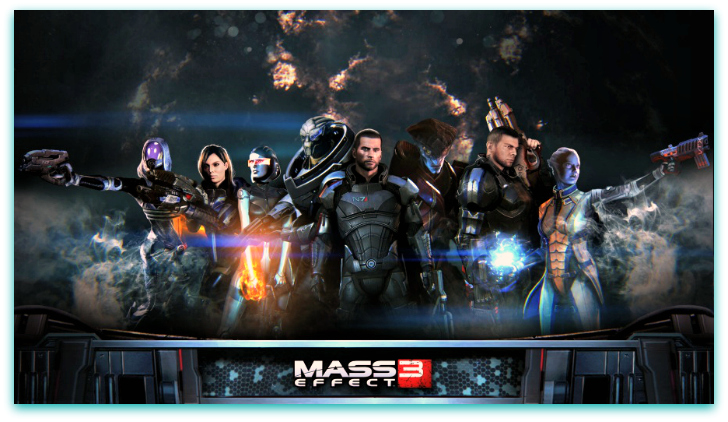
Song of the Day: An End, Once and For All from Mass Effect 3 (by Clint Mansell & Sam Hulick)


Earlier this year we saw the release of the final entry in BioWare’s epic space opera video game series with Mass Effect 3. The initial response to this game was a near-unanimous critical praise and acclaim. Yet, as people finished the game a very vocal group of gamers and fans of the series were more than just a tad disappointed with how their favorite series came to an end. The venom and hate that poured from an ending that didn’t seem to cater to how these gamers thought the series would end became so loud that BioWare did something unexpected. The company, especially it’s founders and head honchos, decided to amend the ending to the game with a downloadable content that just came out in the last week or so. It was content that expanded on the ending to the game. It wasn’t enough to placate and satisfy those who felt betrayed by BioWare, but for some who did complain the ending was a good enough expansion to the game’s original ending that, while not all was forgiven, BioWare helped themselves in repairing the rift which grew between company and fan-base.

Let’s just say that I wasn’t one of those who complained about the ending. I thought it was sublime and the ending I chose fit in well with how I saw the game ultimately should’ve ended with how I had chosen my character to act, talk and behave throughout the three games in the series.

It’s from the recent Mass Effect 3 Extended Cut DLC that I pick the latest “Song of the Day”. It’s the song the piece of orchestral score which plays through all the three original endings but extended beyond the original version of the score that ended abruptly. “An End, Once and For All” extends in this new version for a much more dramatic and satisfying end to a series that I consider one of the best gaming experiences I’ve ever had in over three decades.

I give much thanks to the game’s two orchestral composer in Clint Mansell whose contribution could be heard in the beginning of this chosen score. Sam Hulick adds his own voice to the score as the music moves toward an epic crescendo which finishes the song.

SPOILER

SPOILER

SPOILER

If you want to witness why I thought the Synthesis Choice was the ending that made sense then watch the video below.

AMV of the Day: Safety Dance (Nichijou)


In what will be one of several posts about my experience during this year’s Anime Expo 201, I have chosen to begin this series by choosing the latest “AMV of the Day”. While I wasn’t present when this video was shown to attendees (the schedule for the AMV contest panel conflicted with several other panels pantsukidasai56 and I were already committed to attending) I still sought it afterwards.

“Safety Dance” by Shin (listed under the Youtube account of tehninjarox) was well-received by those who attended the AMV Contest panel. While it didn’t win Best Comedy category it was picked as the winner of the Random/Fun category which is like the place where the hard to categorize and label videos end up. It’s a hodgepodge group of videos which tend to range from the weird, funky right up to just plain psychedelic.

The video is another feather in the cap of Shin who is considered one of the top AMV producers. Using the song “Safety Dance” by Men Without Hats (plus some dialogue from Futurama) and the quirky anime series Nichijou, Shin has created a really hilarious and unique AMV which really shows his editing skill in keeping the song in-sync with the anime characters in the video. The anime itself works well with the song with all the scenes of dancing (funny dancing but dancing nonetheless).

I think if I was present during the AMV Contest when this video played at Anime Expo 2012 I probably would’ve voted for this to win. I’m just glad that many others thought the same and made sure it won.

Anime: Nichijou

Song: “Safety Dance” by Men Without Hats feat. dialogue from Futurama

Creator: Shin (tehninjarox)

Past AMVs of the Day

Song of the Day: Smoke Without Fire


How much do I love the 2009 film An Education?

I love it so much that I once unfollowed someone on twitter when he said that he hated it.  And even though I eventually refollowed the guy, it was on the condition that he rewatch An Education and fall in love with the film.  Unfortunately, shortly after he promised to do just that, he announced that he felt that Rooney Mara was a better Girl with the Dragon Tattoo than Noomi Rapace and I had to unfollow him and his xenophobic film criticism.  So, I’m not sure if he’s rewatched An Education but I doubt it.

As you may have guessed, I love An Education.  It’s one of my favorite films of the past few years.  The rest of you can have your Rooney Mara and your Avatar.  I’m more than happy to watch and rewatch An Education, thank you very much.

Today’s song of the day plays over the end credits of An Education and, with its retro feel and smoky lyrics, it provides a perfect ending to a great film.  Performed by Duffy and written by Duffy and Bernard Butler, Smoke Without Fire is the song of the day for June 29th, 2012.

Dance Scenes That I Love: Simon Zealotes/Poor Jerusalem from Jesus Christ Superstar


Today, Arleigh and Pantsukudasai have left town to attend the Anime Expo and I find myself momentarily alone here at the TSL Bunker, curled up on the couch in my beloved Pirates t-shirt and Hello Kitty panties, and cursing my asthma.  As I lay here, it occurs to me that it’s been a while since I’ve shared a “scene that I love” here on the site.  So, why not rectify that situation now?

Norman Jewison’s 1972 film version of Jesus Christ Superstar is a film that I’ve been meaning to review for a while but for now, I just want to share my favorite scene from that film, the performance of Simon Zealotes/Poor Jerusalem.

There’s several reasons I love that scene but mostly it just comes down to the fact that it captures the explosive energy that comes from watching a live performance.  Larry Marshall (who plays Simon Zealotes) has one of the most fascinating faces that I’ve ever seen in film and when he sings, he sings as if the fate of the entire world depends on it.  That said, I’ve never been sold on Ted Neely’s performance as Jesus but Carl Anderson burns with charisma in the role of Judas.
 
Mostly, however, I just love the choreography and watching the dancers.  I guess that’s not that surprising considering just how important dance was (and still is, even if I’m now just dancing for fun) in my life but, to be honest, I’m probably one of the most hyper critical people out there when it comes to dance in film, regarding both the the way that it’s often choreographed and usually filmed.  But this scene is probably about as close to perfect in both regards as I’ve ever seen.  It goes beyond the fact that the dancers obviously have a lot of energy and enthusiasm and that they all look good while dancing.  The great thing about the choreography in this scene is that it all feels so spontaneous.  There’s less emphasis on technical perfection and more emphasis on capturing emotion and thought through movement.  What I love is that the number is choreographed to make it appear as if not all of the dancers in this scene are on the exact same beat.  Some of them appear to come in a second or two late, which is something that would have made a lot of my former teachers and choreographers scream and curse because, far too often, people become so obsessed with technical perfection that they forget that passion is just as important as perfect technique.  (I’m biased, of course, because I’ve always been more passionate than perfect.)  The dancers in this scene have a lot of passion and it’s thrilling to watch.